

Introduction
Pigs were introduced in Brazil since the sixtieth century during the colonization period. The animals probably originated from the Iberian Peninsula (Cavalcanti, Reference Cavalcanti2000). The variety of environment conditions found in farms in different regions of Brazil resulted in a wide variety of breeds that for centuries sustained livestock production in the country (Mariante et al., Reference Mariante, Albuquerque, Egito, McManus, Lopes and Paiva2009).
Naturalized swine produce a higher fat to meat ratio than commercial breeds, so there was little interest in using them for improvement programmes. However, in rural areas these were the preferred animals, not only due to the large production of lard but also because of the taste of their meat. They are adapted to different ecosystems in different regions of Brazil and have a high capacity for survival in unfavourable conditions. The naturalized pig breeds of Brazil are characterized by their toughness, resistance to diseases, low management requirements and feeding as well as a high adaptability. These traits make them an important genetic resource to be used in breeding programmes and research, thus justifying efforts for their conservation (Castro, Albuquerque and Germano, Reference Castro, Albuquerque and Germano2002). Eight naturalized Brazilian swine breeds have already been described in the literature: Canastra, Canastrão, Nilo, Piau, Caruncho, Pirapetinga, Moura and Tatu.
Currently, there is no standardization in the phenotypic characterization of pig breeds as well as their denomination leading to a possible loss of genetic diversity. On the other hand, these breeds can also be considered as a potential source of new allelic combinations of extreme importance for the future of the Brazilian pig industry (Sollero, Paiva and Faria, Reference Sollero, Paiva and Faria2009). However, the lack of data recording and specifying traits of zootechnical interest coupled with the large distances between farms and the small size of the breeding population makes it difficult to effectively work with naturalized swine herds (Garcia and Barbosa, Reference Garcia and Barbosa2005). Crossbreeding and selection can rapidly modify characteristics of a breed, giving rise to different genetic groups and complicating breed identification. Although molecular techniques have aided in the identification and characterization of individuals and breeds, phenotypic characterization is also necessary. A few studies have been carried out on the diversity of naturalized swine breeds in South American countries and subjective data are frequently missing for the most naturalized breeds of farm animals (McManus et al., Reference McManus, Paiva, Silva, Murata, Louvandini, Cubillos, Castro, Martinez, Dellacasa and Perez2010).
The Moura breed is a primary source of edible fat or lard. In addition, its relatively efficient conversion of food into weight gain makes it a useful cross with modern breeds. These features make this breed a good alternative for subsistence farming in the various regions of Brazil (Castro et al., Reference Castro, Alvares, Zocoller-Seno, Neves and Passipiéri2001). The Moura is usually blue roan in colouration, occasionally red roan (Mason, Reference Mason1996). The breed emerged in southern Brazil (Machado, Reference Machado1967), although the precise period remains unknown. This breed was widely used in the farms of the region before the introduction of the breeds such as Duroc, Landrace, Large White and others (Fávero et al., Reference Fávero, Figueiredo, Fedalto and Woloszyn2007).
The first initiatives aiming the formation of breeding herds for selection programmes of Moura pigs occurred in the state of Paraná, initially led by the Universidade Federal do Paraná in 1985, and later by the Company Café do Paraná. The first genealogical records of the breed were issued by the Brazilian Association of Swine Breeders (ABCS) in 1990, the year that marked the opening of Brazilian Pig Book (PBB) of the Moura breed. Two other breeders, also in Paraná, started the records of animals since the year 1992. The records issued by ABCS stopped in 1995. But returned in 2002, when Embrapa Swine and Poultry created a pure herd using animals from the Universidade Federal do Paraná, and this persists until today. One thousand, five hundred and twenty eight (1528) births were registered as pure animals in the ABCS from 2003 to 2011 (ABCS, 2011). Currently, there are records on animals in the municipalities of Teutônia, Roca Sales, Cruzeiro do Sul, Venâncio Aires and Carlos Barbosa. In the state of Santa Catarina, there are reports of the occurrence of the breed in the region of Lages. In Paraná state, the records of occurrence are in the municipalities of Bituruna and Roncador. In addition to these states, boars were sent to the Southern, UNESP (Ilha Solteira-SP), and Noreasthern, Universidade Federal do Piauí (Teresina-PI), regions to compose pure herd.
The aim of this study was to monitor the conservation programme of the herd of Moura pigs maintained by Embrapa Swine and Poultry, located in the state of Santa Catarina (Brazil) through pedigree and population viability analysis.
Materials and methods
Experimental design
Animals
Pig data from the conservation herd of Moura pig breed maintained by Embrapa Swine and Poultry, located in Concordia, Santa Catarina, Brazil were analysed.
The herd comprised a pure breeding herd of about 20 females and ten males of different families. These families are crossed with each other to expand the genetic base for sire and dam replacement. When there is no need to replace animals, females are crossed with boars of MS115 strain, a third-generation light pig developed by Embrapa, and the piglets sold for finishing.
The data from all purebred pigs for pedigree and population viability analyses were obtained directly from the curators of the Moura herd.
Analysis of pedigree
The genetic population parameters were analysed using the ENDOG program, version 4.8 (Gutiérrez and Goyache, Reference Gutiérrez and Goyache2005). The information included pedigrees of animals born between 1999 and 2011, totalling 411 animals: 255 females and 156 males.
Two analyses were performed, one with all the animals of the pedigree and another considering only the animals that are currently part of the herd. For this purpose, animals born after 2006 were used, totalling 364 records.
Analysis of population viability
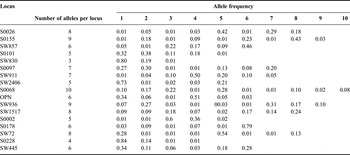
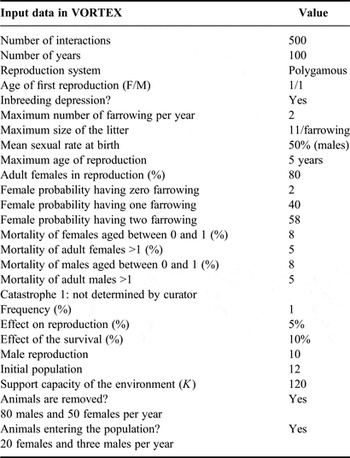
The known distribution of allele frequencies was obtained by microsatellite marker analysed in Animal Genetics Laboratory – LGA, Embrapa Cenargen, coming from the genotypic analysis of 35 animals (Table 1). Simulations of interactions between demographic, environmental and genetic factors were made in the program VORTEX Population Viability Analysis Software, version 9.99 (Miller and Lacy, Reference Miller and Lacy2005). Table 2 shows the demographic parameters used to simulate the Moura pig herd, obtained mainly from the answers of the curators of the conservation herds linked to the National Programme for Conservation of Animal Genetic Resources. The base scenario was used in the VORTEX model. VORTEX models population dynamics as discrete sequential events that occur according to the distribution of the random variables informed. A population was simulated as undergoing a series of events that describe the annual cycle of a sexually reproducing organism: mate selection, reproduction, mortality, age increase each year, migration, among others. At the end of the simulations, the programme provides: (1) the probability of extinction of the population; (2) the mean time to extinction if the population is extinguished in at least 50 percent of the simulations; and (3) the average size and genetic variation within the remaining population. Loss of genetic diversity is estimated by simulating the transmission of alleles from parents to offspring in a hypothetical neutral locus. The programme monitors how original alleles remain in the population, the average heterozygosity and the genetic diversity relative to the initial level.
Allele frequencies in the conservation herd of Moura pig from Embrapa Swine and Poultry.

Demographic parameters input in VORTEX used to simulate the population of Moura pigs.

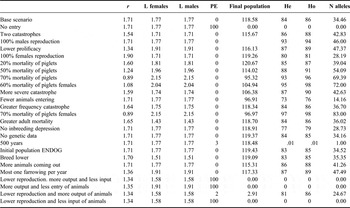
To determine which factors mostly affect the population, 26 new scenarios were created by changing just one of the parameters of the base scenario (Table 3).
Population viability analysis of the Moura herd, considering the base and additional scenarios.

r, rate of population growth; L, interval between generations; PE, probability of extinction; He, expected heterozygosity; Ho, observed heterozygosity; N alleles, The average number of alleles at the end of the simulation period.
Results
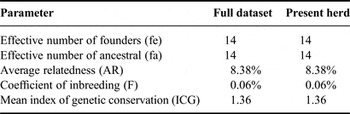
The reference population was formed by parents of known animals. The pedigree information with the identification of parents was 85 percent. The values found for the effective number of founders (fe), effective number of ancestors (fa), average relatedness (AR), coefficient of inbreeding (F) and mean index of genetic conservation (ICG) for the reference population with pedigree are listed in Table 4. The coefficient of inbreeding was 0.06 percent, which is considered low for the herd.
Population parameters from ENDOG pedigree analysis in Moura pigs.

The reference population (animals with both parents known) was smaller than that used for analysing the founders. From a total of 411 animals in the pedigree, 353 were included in the reference population. The base population, with at least one known parent, had 58 animals. When considering only the current herd, the base population fell to 52 animals. The number of ancestors that contributed to the reference population was 31. Analysing only the current herd, the reference population was 364 animals and 35 ancestors.
There are a few generations available for evaluating the Moura herd. This is common in conservation programmes, since the interest in the conservation of these animals is recent, and insufficient to obtain detailed information on their genealogy. The average number of complete generations observed was 1.32, the average maximum number of generations observed was 2.64 and the average equivalent complete generations observed was 1.78.
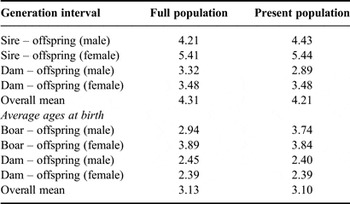
The interval between generations of the conservation herd from the Moura pigs and average ages at birth are shown in Table 5. In the pedigree analysis, there were 27 records of animals born in 1999. The next birth was registered only in 2004, indicating gaps in the registry of pedigree.
Interval between generations of the conservation herd from the Moura pigs (in years) and average ages at birth.

The generation interval in Moura pigs was obtained in the simulation with VORTEX. The interval between generations refers to the average value at the end of the 100 years simulation and was close to the reality of the species. The generation interval in male was 1.77, in female 1.77 and the average size of the final population was 118.58.
The fixation index (F-statistics) describes the level of heterozygosity in the population. The F statistics shows how inbreeding influences within the subpopulation (F IS), among subpopulations (F ST) and in the whole population (F IT). The values found for the Moura herd were: F IS = −0.043073, F ST = 0, and F IT = −0.043073. The zero value indicates no population subdivision.
The Ne averaged by year of birth of the animals was 30 and decreased in the period analysed. The herd size did not increase, probably due to lack of market for the products, the absence of replacements and to the structural difficulties in maintaining a larger herd. This population size may cause problems in the viability of this herd.
Factors threatening the herd and possible management strategies for conservation were tested in the new scenarios in the PVA to determine the major threats. The average final herd size was very close to the environmental carrying capacity (K), indicating the growth capacity of the herd, considering the rearing conditions. The probability of extinction was 0 based on 500 iterations performed in the VORTEX, indicating no extinction of the herd. The herd increased rapidly to environmental carrying capacity (K) with an average deterministic growth rate (Det.r) of 1.71.
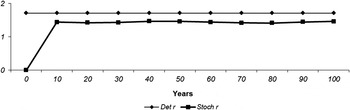
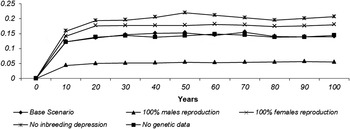
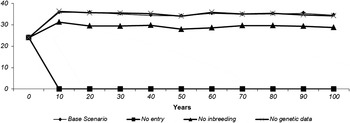
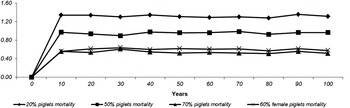
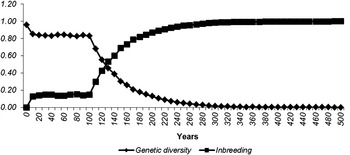
Figure 1 shows the population growth comparison between deterministic (Det.r) and stochastic (Stoch.r) simulation. The Det.r assumes no inbreeding depression, no mating restrictions and no entry or exit to the animal population. Therefore, it simulates how the herd would react without any fluctuation due to chance or environment. The Stoch.r considers the occurrence of environmental events at random. Figures 2 and 3 show the comparison of the evolution of inbreeding and the final average number of alleles, at different scenarios, respectively. Figure 4 shows the comparison of the growth rate, Stoch r. between different scenarios of mortality in piglets and Figure 5 shows the comparison of the evolution of genetic diversity and inbreeding in scenario 500 years.
Comparison between growth rates Det r. and Stoch r.

Comparison of the evolution of inbreeding in different scenarios.

Comparison of the evolution of the final average number of alleles at different scenarios.

Comparison of the growth rate, Stoch r. between different scenarios of mortality in piglets.

Comparison of the evolution of genetic diversity and inbreeding in scenario 500 years.

Discussion
The parameters that support population viability are the high prolificacy of the breed and the entry of new animals. The number of animals added to the herd was considered high. Evaluating the number of births in each year added to the entry of animals and subtracting the animals from the population, intentionally or by mortality, it was noticed an important increase of animals every year in this herd. Scenarios were created by changing only the factors: prolificacy and fecundity; entry of animals and animals leaving the population. In scenarios with “fewer offspring”, “more animals produced” and “more than one farrowing per year”, the values of the maximum number of offspring, number of animals leaving the herd and number of farrowings per year changed. The scenario that most impacted the herd was of the maximum number of farrowings per year. The other parameters were not affected in relation to the base scenario. Other scenarios were that there was a decrease in the entry of animals caused the extinction of the herd in all simulations. It was noted, therefore, that maintaining the entry of animals in the herd is important for its persistence. This result corroborated with Fimland (Reference Fimland2007), who also noted that the most effective way to maintain genetic variability is the immigration of individuals carrying alleles from different populations. Hamann and Distl (Reference Hamann and Distl2008) found the 19 immigrants per generation were sufficient to maintain the inbreeding within the acceptable level.
The coefficient of inbreeding observed was 0.06 percent (Table 4). Estimating the inbreeding coefficient is complex because it usually requires knowledge of the pedigree of individuals. In addition, the calculation of the coefficient from the pedigree information requires the specification of the degree of relationship between the founders (Hedrick and Kalinowski, Reference Hedrick and Kalinowski2000). According to Toro Rodriganez and Rodriguez (Reference Toro, Rodriganez and Rodriguez2000), for the calculation of the inbreeding coefficient, it is preferable to use pedigree information instead of using the molecular marker information. Molecular marker can be useful to verify, correct or even complete pedigree data. The pedigree analysis always begins with a founder population, in other words, individual ancestry unknown and presumably unrelated, from which the population is descended from pedigree (Lacy, Reference Lacy1989). When the founder population information is not available (as here), it is assumed that the founders are not related and are not endogamous (Hedrick and Kalinowski, Reference Hedrick and Kalinowski2000). Sollero Paiva and Faria (2009) observed that the Moura and Monteiro had the lowest genetic diversity among native Brazilian pig breeds in terms of the effective number of alleles and observed heterozygosity. Pedigree analysis is always recommended to allow planning to maximize the effective size of the reproduction in relation to the total population size, and consequently, decrease the variability in the effects of genetic drift (Lacy, Reference Lacy1989).
A few generations were available for the evaluation of the Moura herd, and time was insufficient to obtain detailed information of their genealogy. The intervals between generations (Table 5) were considered high for the species compared with studies of Toro Rodriganez and Rodriguez (2000), who found that a generation interval of 2.44 years for Iberian pigs. This is probably because the animals from the Moura herd were not used for commercial purposes and the substitution in the herd only took place when they became ill or died. The herd size has not increased during the time period studied, probably due to the absence of available replacements for the parents and structural difficulties in maintaining a larger herd.
There was a small difference between Det.r and Stoch.r, which could indicate low environmental influences on population (Figure 1). However, the answers given by the herd curators were considered very optimistic, which could explain the positive results when the base scenario was analysed alone. Stoch.r will be smaller than Det.r if the population suffers wide fluctuations in environment, catastrophes or genetic instabilities, as well as due to the demographics of small populations (Miller and Lacy, Reference Miller and Lacy2005), as seen here.
To demonstrate the changing pattern of inbreeding coefficient of the herd, the scenario without animal entry was observed. The maximum value was attained in the first 10 years of the simulation (data not shown). The best performance of this parameter (Figure 2) was when 100 percent of males were available for reproduction. No significant difference was seen between the base scenario and that without the true population genetic data. The inbreeding coefficient is calculated in each year of the VORTEX simulation and, if no true allele frequency is provided, the programme determines a unique allele for each animal in the initial population. The data from the pedigree analysis with ENDOG, even though not very deep, are more accurate. VORTEX considers inbreeding depression solely as increased mortality of animals up to 1 year of age without considering decline in fertility and prolificacy. This may explain the low difference found between the base scenario and that without inbreeding depression, as the mortality rate of piglets reported was low (8 percent). Figure 3 shows that there was no significant difference in the mean number of alleles between the base scenario without inbreeding depression, and that with the analysis of true genetic information from population. The exception was for the scenario of “no entry” of animals, whose population rapidly went into extinction and, therefore, the final average number of alleles was 0.
When analysed the impact of increased probability of reproduction in males and females, was observed that increasing the number of males in reproduction had more impact on the final average number of alleles than the increase in the number of females (data not shown). This can be explained by two factors. The information provided by the herd curator who reported that 80 percent of females and 10 percent males were available for reproduction. The second is the method of calculating these parameters by VORTEX. It was considered that every female of reproductive age has 80 percent chance of reproducing each year. As for the males, this was only 10 percent. Therefore, any increase in male number will have a greater impact than female.
Analysing the mortality rates of the base scenario it was noted that a higher mortality rate of piglets affected the rate of population growth, the interval between the generations and the final number of animals. These parameters do not alter the probability of extinction, heterozygosity or number of alleles. The mortality of piglets had a more severe effect on the population than adult mortality, and especially mortality of female piglets (Figure 4). However, mortality of animals up to 1 year informed by the curator was low, indicating that the conservation herd has good management of the offspring.
It was observed that increasing the number of catastrophes reduced the rate of growth and the final number of animals in the population, but did not affect the number of alleles and heterozygosity. Changing other scenarios such as the frequency and severity of the catastrophe, had greater effects on the population. The higher frequency of catastrophes had greater impact, with more effect on genetic diversity. The highest frequency of one catastrophe affected the population more than the lower frequency and severity of two catastrophes (data not shown). Thus, it was inferred that minimizing the consequences of frequent catastrophes in the herd conservation is more important than specific effects of more severe catastrophes.
When the viability of the population was tested for a period of 500 years, it was noted that the probability of extinction was small (3 percent), but the population was seriously compromised at the end of this period, when looking at the final number of alleles and heterozygosity. The other parameters were not affected. Figure 5 shows the evolution of genetic diversity and inbreeding coefficient in this period, and it is seen that in the first 100 years these parameters remain relatively stable. From the year 100, these indices are seriously affected. This result demonstrates the ability of the pigs to adapt to the negative effects of small population size for a period, but after a certain point, this control is no longer possible and the population is seriously compromised. According to Rangel (Reference Rangel2012), a species does not go extinct immediately after the reduction of habitat or climate change beyond the tolerance limit of the animals. Extinction can occur several generations after the initial impact on the population. This initial period, until effective extinction, creates a window of opportunity for conservation, in which it is still possible to ensure the viability of the population (Wearn Reuman and Ewers Reference Wearn, Reuman and Ewers2012). Simulations performed for a shorter period of time may not be sufficient to predict what conservation strategy is needed to ensure persistence of the population. A population may seem feasible when the simulation considers only 100 years, but the risk of extinction may increase considerably if a longer period is considered, as observed in Figure 5. Simulations should therefore be over a long period of time (over 100 years) or performed for two different periods and check if the results found in the short-term simulation remain in the long term (Nilson, Reference Nilson2003).
Conclusion
The characterized Moura herd has low population size. Only a few breeders or producers are interested in this breed, a usual situation in production of Animal Genetic Resources in Brazil. In the present study, this small effective population size may cause problems for the population in the near future, despite the inbreeding coefficient being considered low. The herd curators should continue to import animals from other breeders as this is essential for the viability of this conservation herd, as well as care should be taken to maintain the reproductive rate of the animals. In conservation programmes with small herds of domestic breeds, it is important to evaluate the risk of extinction and which management activities should be prioritized to reduce this risk. However, no specific risk factor is identified in this study.
Acknowledgments
The authors acknowledge CNPq for scholarships and financial aid and INCT-Pecuária – Informação Genético Sanitária da Pecuária Brasileira (CNPq/MCT/FAPEMIG), as well as the farmers and researchers who contributed with data and access to the animals.