



1 Introduction
UltrafiltersFootnote
1
play a fundamental role in infinite combinatorics, set-theoretic topology and model theory. From constructing compactifications of topological spaces and analyzing convergence, to proving Ramsey theorems, finding non-trivial elementary embeddings of the universe, or building nonstandard models of a theory, applications of ultrafilters are ubiquitous across these areas of mathematics. Several important classes of ultrafilters on countable sets have been introduced and studied over the years. A particularly notable example are the P-points, which were introduced by Walter Rudin in [Reference Rudin44], to prove that under the Continuum Hypothesis (CH), the space
 $\omega ^{\ast }= \beta \omega \setminus \omega $
is not homogeneous (the same conclusion was later established without assuming CHby Frolík in [Reference Frolík25] and further refined by Kunen in [Reference Kunen34] who explicitly constructed ultrafilters with distinct topological types). Since then, special classes of ultrafilters on countable sets became a central topic of study and research.
Although, it is a straightforward theorem of ZFC that there are (non-principal) ultrafilters on the natural numbers, the existence of ultrafilters with interesting topological or combinatorial properties is far more subtle. Moreover, their existence is often independent. The first major result of this kind was obtained by Kunen in [Reference Kunen35] where he proved that Ramsey ultrafilters consistently do not exist. Some time later, Miller proved in [Reference Miller40] (see also [Reference Miller41]) that Q-points may not exist and Shelah constructed a model without P-points (see [Reference Shelah46, Reference Wimmers54]). More recently, it was proved by Cancino and Zapletal (see [Reference Cancino-Manríquez and Zapletal12]) that it is consistent that every (non-principal) ultrafilter on
 $\omega $
is Tukey top. For more results regarding the existence or non existence of special ultrafilters, the reader may consult [Reference Brendle7, Reference Cancino-Manríquez10, Reference Chodounský and Guzmán13, Reference Dow and Shelah21, Reference Fernández-Bretón and Hrušák24, Reference Shelah47, Reference van Mill53] or [Reference Guzmán and Hrušák28] among many others. As these results illustrate, the existence of special classes of ultrafilters is a major concern for set theorists and topologists.
Random forcing was introduced by Solovay in [Reference Solovay48] and models obtained by adding more than
 $\omega _{1}$
many random reals to a model of CHare often called random models (or random real models). Since random forcing is one of the most well-known and studied forcing notions, one might expect that the structure of ultrafilters in the random models is very well understood. However, this is far from the case. The previously mentioned Theorem of Kunen in [Reference Kunen35] actually shows that there are no Ramsey ultrafilters in the random models. On the other hand, there are Q-points in those models since the dominating number is equal to
 $\omega _{1}$
(see [Reference Blass, Foreman and Kanamori4]). Now, the important question is: What about P-points? This is where the story gets complicated. In an unpublished note, Kunen proved that if you add
 $\omega _{1}$
Cohen reals to a model of CHand then any number of random reals, you will get a P-point. In particular, P-points exists in some random models. The general case (without the preliminary Cohen reals) was later addressed by CohenFootnote
2
[Reference Cohen16]. He defined a combinatorial object called pathway, (which is very similar to Roitman´s Model Hypothesis (MH), see [Reference Barriga-Acosta, Brian and Dow2, Reference Roitman43]) proved that the existence of a pathway entails that there is a P-point and that pathways exist after adding any number of random reals to a model of CH.Unfortunately, it was later discovered that the proof of the existence of pathways is flawedFootnote
3
(see [Reference Chodounský and Guzmán13, Reference Fernández-Bretón and Hrušák22]). No further progress was made on this problem until the publication of [Reference Dow20], where the first author proved that there is a P-point if
 $\omega _{2}$
-many random reals are added to a model of CH +
 $\square _{\omega _{1}}$
(see [Reference Roitman43] for further results). In the present work, we improve this result by showing that there are P-points (and more) if less than
 $\aleph _{\omega }$
random reals are added to a model of the CH (the principle
 $\square _{\omega _{1}}$
is no longer needed). The proof follows closely the argument from [Reference Dow20], but through a careful analysis of the interaction of countable subsets within countable elementary submodels, we are able to avoid the use of
 $\square _{\omega _{1}}$
and extend the result beyond
 $\omega _{2}.$
We introduce a new type of combinatorial object, which we call a multiple
 $\mathfrak {d}$
-pathway. This notion has some resemblance to Cohen’s pathways, the hypothesis MH and to the generalized pathways introduced by Fernández–Bretón in [Reference Fernández-Bretón23]. We will prove that the existence of a multiple
 $\mathfrak {d}$
-pathway entails the existence of P-points (even strong P-points) and Gruff ultrafilters. Finally, it will be proved that multiple
 $\mathfrak {d}$
-pathways exist if less than
 $\aleph _{\omega }$
random or Cohen reals are added to a model of CH.
The structure of the article is as follows: after reviewing some notation and preliminaries, in Section 4, multiple
 $\mathfrak {d}$
-pathways will be introduced and we will prove some of their most fundamental properties. In Section 5, a P-point is constructed from a multiple
 $\mathfrak {d}$
-pathway. This construction will be further refined in Section 6, to get a strong P-point. Although in theory, the reader can skip Section 5 and jump to Section 6, we do not recommend it, since the construction in Section 5 is the best example to understand how to perform transfinite recursions using a multiple
 $\mathfrak {d}$
-pathway. Section 7 contains our last application of multiple
 $\mathfrak {d}$
-pathways, the construction of a Gruff ultrafilter. In Section 8, we develop some combinatorial results regarding countable elementary submodels that will be needed later. In Section 9, we prove that there are multiple
 $\mathfrak {d}$
-pathways in the models obtained by adding less than
 $\aleph _{\omega }$
many random or Cohen reals. Although, we are mainly interested in the random reals, the proof for Cohen reals is exactly the same.
2 Notation
For a set X, we denote by
 $\mathcal {P}\left ( X\right ) $
its power set. We say that
 $\mathcal {F\subseteq } \mathcal {P}\left ( X\right ) $
is a filter on X if
 $X\in \mathcal {F}$
and
 $\emptyset \notin \mathcal {F},$
for every
 $A,B\subseteq X,$
if
 $A\in \mathcal {F}$
and
 $A\subseteq B$
then
 $B\in \mathcal {F}$
and if
 $A,B\in \mathcal {F}$
then
 $A\cap B\in \mathcal {F}.$
A family
 $\mathcal {I}\subseteq \mathcal {P}\left ( X\right ) $
is an ideal on X if
 $\emptyset \in \mathcal {I}$
and
 $X\notin \mathcal {I},$
for every
 $A,B\subseteq X,$
if
 $A\in \mathcal {I}$
and
 $B\subseteq A$
then
 $B\in \mathcal {I}$
and if
 $A,B\in \mathcal {I}$
then
 $A\cup B\in \mathcal {I}.$
If
 $\mathcal {B}$
is a family of subsets of
 $X,$
denote
 $\mathcal {B}^{\ast }=\left \{ X\setminus B\mid B\in \mathcal {B}\right \} .$
It is easy to see that if
 $\mathcal {F}$
is a filter then
 $\mathcal {F}^{\ast }$
is an ideal (called the dual ideal of
 $\mathcal {F}$
) and if
 $\mathcal {I}$
an ideal then
 $\mathcal {I}^{\ast }$
is a filter (called the dual filter of
 $\mathcal {I}$
). If
 $\mathcal {I}$
is an ideal on X, define
 $\mathcal {I}^{+}=\mathcal {P}\left ( X\right ) \smallsetminus \mathcal {I}$
, which is called the family of
 $\mathcal {I}$
-positive sets. The Fréchet filter is the filter of cofinite subsets
 $.$
An ultrafilter is a maximal filter that extends the Fréchet filter (so in this work, all ultrafilters are non-principal). If
 $\mathcal {U}$
is an ultrafilter, we say that
 $\mathcal {B\subseteq U}$
is a base of
 $\mathcal {U}$
if every element of
 $\mathcal {U}$
contains one of
 $\mathcal {B}.$
We say that a family
 $\mathcal {P\subseteq P}\left ( X\right ) $
is centered if the intersection of any finite collection of its elements is infinite.
By
 $\mathfrak {c,}$
we denote the cardinality of the set of real numbers. For any two sets A and
 $B,$
we say
 $A\subseteq ^{\ast }B$
(A is an almost subset of B or A is almost contained in B) if
 $A\setminus B$
is finite. For
 $\mathcal {P\subseteq } \left [ \omega \right ] ^{\omega }$
and
 $A\in \mathcal {P}\left ( \omega \right ) ,$
we say that
 $A$
is a pseudointersection of
 $\mathcal {P}$
if it is almost contained in all elements of
 $\mathcal {P}.$
For
 $f,g\in \omega ^{\omega }$
, define
 $f\leq g$
if and only if
 $f\left ( n\right ) \leq g\left ( n\right ) $
for every
 $n\in \omega $
and
 $f\leq ^{\ast }g$
if and only if
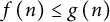 $f\left ( n\right ) \leq g\left ( n\right ) $
holds for all
 $n\in \omega $
except finitely many. A family
 $\mathcal {B} \subseteq \omega ^{\omega }$
is unbounded if
 $\mathcal {B}$
is not bounded with respect to
 $\leq ^{\ast }.$
A family
 $\mathcal {D}\subseteq \omega ^{\omega }$
is a dominating family if for every
 $f\in \omega ^{\omega },$
there is
 $g\in \mathcal {D}$
such that
 $f\leq ^{\ast }g.$
The bounding number
 $\mathfrak {b}$
is the size of the smallest unbounded family and the dominating number
 $\mathfrak {d}$
is the smallest size of a dominating family. We say
 $\mathcal {S}=\left \{ f_{\alpha }\mid \alpha \in \mathfrak {b} \right \} \subseteq \omega ^{\omega }$
is a scale if
 $\mathcal {S}$
is dominating and
 $f_{\alpha }\leq ^{\ast }f_{\beta }$
whenever
 $\alpha <\beta .$
It is easy to see that
 $\mathfrak {b=d}$
is equivalent to the existence of a scale. A function
 $f\in \omega ^{\omega }$
is unbounded over a model M if
 $f\nleq ^{\ast }g$
for every
 $g\in M$
and is dominating over M if it dominates every element of
 $M\cap \omega ^{\omega }.$
 $\mathcal {P}\left ( \omega \right ) $
will have its natural topology, which is homeomorphic to
 $2^{\omega }$
. In this way, the topology of
 $\mathcal {P}\left ( \omega \right ) $
has for a subbase the sets of the form
 $\left \langle n\right \rangle _{0}=\left \{ A\subseteq \omega \mid n\notin A\right \} $
and
 $\left \langle n\right \rangle _{1}=\left \{ A\subseteq \omega \mid n\in A\right \} $
, for
 $n\in \omega .$
A Polish space is a separable and completely metrizable space. The Baire space (
 $\omega ^{\omega }$
) and the Cantor space (
 $2^{\omega }$
) are examples of Polish spaces. We will need the concepts of
 $F_{\sigma }, G_{\delta },$
Borel, analytic, coanalytic and projective subsets of a Polish space, which can be found in [Reference Kechris33] or [Reference Srivastava49]. We say that
 $T\subseteq 2^{<\omega }$
is a tree if it is closed under taking initial segments and
 $f\in 2^{\omega }$
is a branch of T if
 $f\upharpoonright n\in T$
for every
 $n\in \omega .$
The set of all branches of T is denoted by
 $\left [ T\right ] $
. In this context, a tree is well-pruned if every node can be extended to a branch. It is well known that the compact subsets of
 $2^{\omega }$
correspond to branches of well-pruned subtrees of
 $2^{<\omega }$
(see [Reference Kechris33]). For
 $n\in \omega $
, the n-level of the tree T is denoted by
 $T_{n}.$
Let X be a topological space. We say that
 $C\subseteq X$
is crowded if it does not have an isolated point. A perfect subset of X is a closed, non-empty crowded subset of
 $X.$
On the other hand,
 $S\subseteq X$
is scattered if it does not contain a non-empty crowded subset.
We will work extensively with elementary submodels. The reader is invited to consult [Reference Dow18] for their most important properties and to learn how to apply them in topology and set theory. For
 $\kappa $
a cardinal, by H
 $\left ( \kappa \right ) $
, we denote the collection of all subsets whose transitive closure has size less than
 $\kappa .$
For M a countable elementary submodel of H
 $\left ( \kappa \right ) $
(and
 $\kappa>\omega _{1}$
), the height of M is
 $\delta _{M}=M\cap \omega _{1}.$
It is easy to see that it is always a countable ordinal. We will fix
 $\trianglelefteq $
a well order of H
 $\left ( \kappa \right ) $
and by Sub
 $\left ( \kappa \right ) $
we denote the set of all countable
 $M\subseteq $
H
 $\left ( \kappa \right ) $
such that
 $\left ( M,\in ,\trianglelefteq \right ) $
is an elementary submodel of
 $($
H
 $\left ( \kappa \right ) ,\in ,\trianglelefteq ).$
The well ordering will play a key role in some of our arguments.
For A a set of the ordinal numbers, we will denote by OT
 $\left ( A\right ) $
its order type. If f is a function, by dom
 $\left ( f\right ) $
, we denote its domain and im
 $\left ( f\right ) $
, is its image.
3 Forcing preliminaries
We review some preliminaries on forcing that will be needed in Section 9. Naturally, we assume the reader is already familiar with the method of forcing as presented in [Reference Kunen36].
Let
 $\mathbb {P}$
and
 $\mathbb {Q}$
be partial orders. By
 $V^{\mathbb {P}}$
, we denote the class of all
 $\mathbb {P}$
-names as defined in [Reference Kunen36]. An isomorphism
 $F:\mathbb {P\longrightarrow Q}$
can be extended recursively to a bijection between
 $V^{\mathbb {P}}$
and
 $V^{\mathbb {Q}}$
(which we will also denote as F) by letting
 $F\left ( \dot {a}\right ) =\{(F(\dot {b}),F\left ( p\right ) )\mid (\dot {b},p)\in \dot {a}\}.$
The proof of the following result can essentially be found in [Reference Jech31] or [Reference Jech32] and is easy to prove by induction on the rank of names.
Proposition 1 Let
 $\mathbb {P}$
and
 $\mathbb {Q}$
be partial orders and
 $F:\mathbb {P\longrightarrow Q}$
an isomorphism. For every
 $p\in \mathbb {P}, \varphi $
a formula,
 $\dot {a}_{0},\dots ,\dot {a}_{n}\in V^{\mathbb {P}}$
and sets
 $b_{0},\dots ,b_{m},$
the following are equivalent:
-
1.
 $p\Vdash $
“
$\varphi (\dot {a}_{0},\dots ,\dot {a}_{n} ,b_{0},\dots ,b_{m})$
”.
-
2.
$F\left ( p\right ) \Vdash $
“
$\varphi (F\left ( \dot {a}_{0}\right ) ,\dots ,F\left ( \dot {a}_{n}\right ) ,b_{0},\dots ,b_{m} )$
”.




We now review the standard method for adding many random or Cohen reals using finite support. Proofs of the results mentioned below can be found in [Reference Kunen37]. For a set
 $I,$
we will always equip
 $2^{I}$
with its usual Tychonoff topology (where
 $2=\left \{ 0,1\right \} $
is a discrete space).
Definition 2 Let
 $I,J$
be two infinite sets and
 $\triangle :I\longrightarrow J$
an injective function.
-
1. Define
$\triangle ^{\prime }:2^{J}\longrightarrow 2^{I}$
given by
$\triangle ^{\prime }\left ( f\right ) =f\circ \triangle $
for
$f\in 2^{J}.$
-
2. Define
$\triangle _{\ast }:\mathcal {P}\left ( 2^{I}\right ) \longrightarrow \mathcal {P}\left ( 2^{J}\right ) $
, where
$\triangle _{\ast }\left ( B\right ) =\left \{ f\in 2^{J}\mid f\circ \triangle \in B\right \} $
(in other words,
$\triangle _{\ast }\left ( B\right ) =\left ( \triangle ^{\prime }\right ) ^{-1}\left ( B\right ) $
).






It is easy to see that if
 $\triangle :I\longrightarrow J$
is a bijection, then
 $\triangle ^{\prime }$
is a homeomorphism. The following proposition follows from standard computations and diagram chasing arguments.
Proposition 3 Let
 $I,J,K$
be three infinite sets and
 $\triangle :I\longrightarrow J$
,
 $\sigma :J\longrightarrow K$
bijective functions.
-
1.
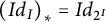
$\left ( Id_{I}\right ) _{\ast }=Id_{2^{I}}$
(where
$Id_{X}$
denotes the identity mapping of a set X). -
2.
$\left ( \sigma \circ \triangle \right ) _{\ast }=\sigma _{\ast } \circ \triangle _{\ast }.$
-
3.
$\left ( \triangle ^{-1}\right ) _{\ast }=\left ( \triangle _{\ast }\right ) ^{-1}.$
-
4.
$\triangle _{\ast }$
is a bijection.




We say
 $B\subseteq 2^{I}$
is Baire if it belongs to the smallest
 $\sigma $
-algebra that contains all clopen sets. Denote by Baire
 $\left ( 2^{I}\right ) $
, the collection of all the Baire subsets of
 $2^{I}.$
If I is countable, then the notion of Borel and Baire coincide, but they are not the same if I is uncountable. If
 $\triangle :I\longrightarrow J$
is bijective, then
 $\triangle _{\ast }\upharpoonright $
Baire
 $\left ( 2^{I}\right ) $
is a bijection between Baire
 $\left ( 2^{I}\right ) $
and Baire
 $\left ( 2^{J}\right ) .$
Definition 4 Let I be an infinite set.
-
1.
$\mathcal {M}_{I}$
denotes the
$\sigma $
-ideal of meager sets in
$2^{I}.$
-
2.
$\mathcal {N}_{I}$
denotes the
$\sigma $
-ideal of null sets in
$2^{I}$
(where
$2^{I}$
has the standard product measure). -
3. Cohen forcing on I (denoted by
$\mathbb {C}\left ( I\right ) $
) is the set of all Baire subsets of
$2^{I}$
that are not in
$\mathcal {M}_{I}.$
We order
$\mathbb {C}\left ( I\right ) $
by inclusion:
$A\leq B$
if and only if
$A\subseteq B$
. -
4. Random forcing on I (denoted by
$\mathbb {B}\left ( I\right ) $
) is the set of all Baire subsets of
$2^{I}$
that are not in
$\mathcal {N}_{I}.$
We order
$\mathbb {B}\left ( I\right ) $
by inclusion:
$A\leq B$
if and only if
$A\subseteq B$
.


Note that as we defined them, neither
 $\mathbb {C}\left ( I\right ) $
or
 $\mathbb {B}\left ( I\right ) $
are separative. Alternatively, we could take their quotients. This choice does not affect the content of the article. If
 $\triangle :I\longrightarrow J$
is bijective, then
 $\triangle _{\ast } :\mathbb {C}\left ( I\right ) \longrightarrow \mathbb {C}\left ( J\right ) $
and
 $\triangle _{\ast }:\mathbb {B}\left ( I\right ) \longrightarrow \mathbb {B}\left ( J\right ) $
are isomorphism of partial orders. If
 $K\subseteq I,$
then
 $\mathbb {B}\left ( K\right ) $
(
 $\mathbb {C}\left ( K\right ) $
) is isomorphic to a regular suborder of
 $\mathbb {B}\left ( I\right ) $
(
 $\mathbb {C}\left ( I\right ) $
), and for convenience we will regard them as actual suborders. Furthermore, if
 $\dot {a}$
is a
 $\mathbb {B}\left ( I\right ) $
-name for a subset of
 $\omega ,$
we can find a countable
 $K\subseteq I$
such that
 $\dot {a}$
is a
 $\mathbb {B}\left ( K\right ) $
-name (and the same for Cohen forcing). We will be using all these facts implicitly.
4 Multiple
$\mathfrak {d}$
-pathways

Multiple
 $\mathfrak {d}$
-pathways will be introduced in this section and we will prove some of their most fundamental properties. Before proceeding, we introduce some definitions.
Definition 5 Let X be a set and
 $n\in \omega .$
A relation
 $R\subseteq X^{n}\times \omega ^{\omega }$
is
 $\leq ^{\ast }$
-adequate if for every
 $x_{1} ,\dots ,x_{n}\in X,$
there is
 $f\in \omega ^{\omega }$
such that for every increasing
 $g\in \omega ^{\omega },$
if
 $g\nleq ^{\ast }f,$
then the relation
 $R\left ( x_{1},\dots ,x_{n},g\right ) $
holds.
A function f as above will be called an R-control for
 $\left ( x_{1},\dots ,x_{n}\right ) .$
It is not hard to find
 $\leq ^{\ast }$
-adequate relations and several examples will be provided in the text.
Definition 6 Let
 $M_{0},\dots ,M_{n}$
be countable elementary submodels of some H
 $\left ( \kappa \right ) .$
We will say that the sequence
 $\left \langle M_{0},\dots ,M_{n}\right \rangle $
is
 $\delta $
-increasing if
 $\delta _{M_{i}}\leq \delta _{M_{i+1}}$
for each
 ${i<n.}$
It is worth pointing out that in our work, the sequence
 $\left \langle M_{0},\dots ,M_{n}\right \rangle $
is typically not an
 $\in $
-chain (which is often the case when working with models as side conditions, see [Reference Todorčević50, Reference Todorcevic, Chong, Feng, Yang, Slaman and Woodin51]) and it will often be the case that
 $\delta _{M_{i}}=\delta _{M_{i+1}}$
for some
 $i<n.$
When discussing a specific
 $\delta $
-increasing sequence
 $\ \left \langle M_{0},\dots ,M_{n}\right \rangle ,$
it will be understood that
 $n\in \omega $
and we will write
 $\delta _{i}$
instead of
 $\delta _{M_{i}}$
in case there is no risk of confusion.
We can finally introduce the main definition of this section.
Definition 7 Let
 $\kappa>\mathfrak {c}$
be a regular cardinal,
 $\mathcal {B} =\left \{ f_{\alpha }\mid \alpha <\omega _{1}\right \} \subseteq \omega ^{\omega }$
a family of increasing functions and
 $\mathcal {S\subseteq }$
Sub
 $\left ( \kappa \right ) $
a stationary subset of
 $[$
H
 $\left ( \kappa \right ) ]^{\omega }$
such that every model in
 $\mathcal {S}$
has
 $\mathcal {B}$
as an element. We say that
 $\left ( \mathcal {B},\mathcal {S}\right ) $
is a multiple
 $\mathfrak {d}$
-pathway if for every
 $\delta $
-increasing sequence
 $\left \langle M_{0},\dots ,M_{n}\right \rangle $
of models from
 $\mathcal {S},$
for every projective and
 $\leq ^{\ast }$
-adequate relation
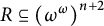 $R\subseteq \left ( \omega ^{\omega }\right ) ^{n+2}$
with
 $R\in M_{n}$
and
 $x_{i}\in M_{i}$
for
 $i\leq n,$
we have that
 $R\left ( x_{0},\dots ,x_{n} ,f_{\delta _{n}}\right ) $
holds.
Several comments regarding the definition are in order:
-
1. The term “multiple” indicates that there are typically several models that share the same height, which is not the case in the MH of Roitman.
-
2. For our applications, the stationarity of
$\mathcal {S}$
is only used to ensure that every real (and hence every countable ordinal) appears in some model of
$\mathcal {S}.$
-
3. The relation R is required to be projective. The key feature of this requirement is that it can be coded by a real, so several strengthenings or weakenings are possible. For the applications of P-points and strong P-points, Borel relations are enough, but it appears that more is needed for Gruff ultrafilters.
-
4. Following the approach of Fernández–Bretón in [Reference Fernández-Bretón23], it is possible to define a notion of a multiple pathway for more cardinal invariants of the continuum. We do not pursue this approach here, since we do not have applications for other cardinal invariants. However, the study of multiple pathways parametrized by cardinal invariants of the continuum might prove fruitful in the future.


To avoid constant repetition, when working with a multiple
 $\mathfrak {d} $
-pathway
 $\left ( \mathcal {B},\mathcal {S}\right ) ,$
we will always use
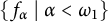 $\left \{ f_{\alpha }\mid \alpha <\omega _{1}\right \} $
to refer to the sequence
 $\mathcal {B}$
. We have the following simple result regarding multiple pathways.
Proposition 8 Let
 $\left ( \mathcal {B},\mathcal {S}\right ) $
be a multiple
 $\mathfrak {d} $
-pathway. For every
 $M\in \mathcal {S},$
the function
 $f_{\delta _{M}}$
is unbounded over
 $M.$
In particular, the existence of a multiple
 $\mathfrak {d} $
-pathway implies that
 $\mathfrak {b}=\omega _{1}.$
Proof Let
 $M\in \mathcal {S}$
. Define the relation
 $R\subseteq \left ( \omega ^{\omega }\right ) ^{2}$
, where
 $R\left ( g,f\right ) $
if
 $f \nleq ^{\ast }g.$
Clearly,
 $R\in M$
, is a
 $G_{\delta }$
relation and is
 $\leq ^{\ast }$
-adequate. Since obviously
 $\left \langle M\right \rangle $
is
 $\delta $
-increasing, it follows that every real in M is R related to
 $f_{\delta _{M}}.$
Finally, since the models in a multiple
 $\mathfrak {d}$
-pathway cover
 $\omega ^{\omega },$
we conclude that
 $\mathcal {B}$
is unbounded, hence
 $\mathfrak {b}=\omega _{1}.$
The definition of multiple
 $\mathfrak {d}$
-pathway only mentions relations on the Baire space, however, we can extend it to any Polish space, as the next lemma shows.
Lemma 9 Let
 $\left ( \mathcal {B},\mathcal {S}\right ) $
be a multiple
 $\mathfrak {d}$
-pathway and
 $\left \langle M_{0},\dots ,M_{n}\right \rangle $
a
 $\delta $
-increasing sequence of models of
 $\mathcal {S}.$
For every Polish space
 $X\in M_{0}\cap \dots ^{n+2},$
where
 $P\left ( g_{0},\dots ,g_{n},f\right )cap M_{n}, R\subseteq X^{n+1}\times \omega ^{\omega }$
projective and
 $\leq ^{\ast }$
-adequate relation in
 $M_{n}$
and
 $x_{i}\in X\cap M_{i}$
for
 $i\leq n,$
the relation
 $R\left ( x_{0},\dots ,x_{n},f_{\delta _{n}}\right ) $
holds.
Proof We, first, find a continuous surjection
 $H:\omega ^{\omega }\longrightarrow X$
with
 $H\in M_{0}\cap \dots \cap M_{n}$
(since X is a Polish space, there is a continuous surjection from
 $\omega ^{\omega }$
to X, we now use the well order of H
 $\left ( \kappa \right ) $
to find one, denoted H, that is in all our models). Define the relation
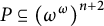 $P\subseteq \left ( \omega ^{\omega }\right ) ^{n+2}$
, where
 $P\left ( g_{0},\dots ,g_{n},f\right ) $
holds just in case
 $R\left ( H\left ( g_{0}\right ) ,\dots ,H\left ( g_{n}\right ) ,f\right ) $
is true. Note that
 $P\in M_{n}$
and is
 $\leq ^{\ast }$
-adequate. Moreover, it is easy to see that P is a continuous preimage of
 $R,$
so P is projective as well. H is surjective and it is in every
 $M_{i},$
so we can find
 $g_{i}\in M_{i}\cap \omega ^{\omega }$
such that
 $H\left ( g_{i}\right ) =x_{i}.$
Since
 $\left ( \mathcal {B},\mathcal {S}\right ) $
is a multiple
 $\mathfrak {d} $
-pathway, we know that
 $P\left ( g_{0},\dots ,g_{n},f_{\delta _{n}}\right ) $
is true, which means that
 $R\left ( x_{0},\dots ,x_{n},f_{\delta _{n}}\right ) $
is true as well.
This covers the basics of multiple
 $\mathfrak {d}$
-pathways and we are ready to move on to applications.
5 A P-point from a multiple
$\mathfrak {d}$
-pathway

An ultrafilter
 $\mathcal {U}$
on
 $\omega $
is a P
-point if every countable subfamily of
 $\mathcal {U}$
has a pseudointersection in
 $\mathcal {U}.$
Without a doubt, the class of P-points is among the most important and studied families of ultrafilters on countable sets. Note that ultrafilters that are not P-points are very easy to construct (for example, every ultrafilter extending the dual filter of the density zero ideal). In this way, the challenge is in constructing P-points. Shelah was the first to show that it is consistent that there are no P-points (see [Reference Shelah46, Reference Wimmers54]). On the other hand, several set theoretic axioms imply the existence of a P-point, for example, the equality
 $\mathfrak {d=c},$
the inequality
 $\mathfrak {u<d}$
(see [Reference Blass, Foreman and Kanamori4]) or the parametrized diamond
 $\Diamond \left ( \mathfrak {r}\right ) $
from [Reference Moore, Hrušák and Džamonja42]. None of these principles hold in the random real models, which makes the construction of P-points in such models very interesting. We will now build a P-point from a multiple
 $\mathfrak {d}$
-pathway. Our approach is inspired by Theorem 5.7 of [Reference Dow20].
Definition 10 Let
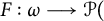
 $F:\omega \longrightarrow \mathcal {P}\left ( \omega \right ) $
and
 $g\in \omega ^{\omega }.$
Define
 $F^{g}= {\textstyle \bigcup \limits _{n\in \omega }} F\left ( n\right ) \cap g\left ( n\right ) .$
It is clear that if F is
 $\subseteq $
-decreasing, then
 $F^{g}$
is a (possibly finite) pseudointersection of im
 $\left ( F\right ) .$
Note that if
 $f\leq g,$
then
 $F^{f}\subseteq F^{g}.$
It is trivial to see that if F is the constant function with value
 $A\subseteq \omega $
and
 $g\in \omega ^{\omega }$
is increasing, then
 $F^{g}=A.$
The following results are easy and we leave them to the reader.
Lemma 11 Let
 $F:\omega \longrightarrow \left [ \omega \right ] ^{\omega }$
be
 $\subseteq $
-decreasing. There is
 $f\in \omega ^{\omega }$
such that for every increasing
 $g\in \omega ^{\omega },$
if
 $g\nleq ^{\ast }f,$
then
 $F^{g}$
is infinite.
Lemma 12
-
1. Let
$n\in \omega .$
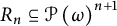
The set
$R_{n}\subseteq \mathcal {P}\left ( \omega \right ) ^{n+1}$
consisting of all
$\left ( A_{0},\dots ,A_{n}\right ) $
such that
$A_{0}\cap \dots \cap A_{n}$
is infinite, is
$G_{\delta }.$
-
2. The set
$R\subseteq \mathcal {P}\left ( \omega \right ) ^{\omega }$
consisting of all functions F such that im
$\left ( F\right ) $
is centered, is
$G_{\delta }.$





We will need the following.
Lemma 13 Let
 $\left ( \mathcal {B},\mathcal {S}\right ) $
be a multiple
 $\mathfrak {d} $
-pathway and
 $\left \langle M_{0},\dots ,M_{n}\right \rangle $
a
 $\delta $
-increasing sequence of models of
 $\mathcal {S}$
and
 $m\leq n$
be the least such that
 $\delta _{m}=\delta _{n}.$
For every
 $i\leq n,$
assume
 $F_{i} :\omega \longrightarrow \left [ \omega \right ] ^{\omega }\in M_{i}$
is
 $\subseteq $
-decreasing
 $.$
If
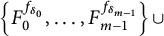 $\left \{ F_{0}^{f_{\delta _{0}}},\dots ,F_{m-1}^{f_{\delta _{m-1}}}\right \} \cup $
im
 $\left ( F_{m}\right ) \cup \dots \cup $
im
 $\left ( F_{n}\right ) $
is centered, then
 $ {\textstyle \bigcap \limits _{i\leq n}} F_{i}^{f_{\delta _{i}}}$
is infinite.
Proof Define the relation
 $R\subseteq \left ( \mathcal {P}\left ( \omega \right ) ^{\omega }\right ) ^{n+1}\times \omega ^{\omega }$
, where
 $R(G_{0},\dots ,G_{n},f)$
holds in case one of the following conditions is true:
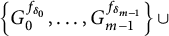
-
1.
$\left \{ G_{0}^{f_{\delta _{0}}},\dots ,G_{m-1}^{f_{\delta _{m-1}}}\right \} \cup $
im
$\left ( G_{m}\right ) \cup \dots \cup $
im
$\left ( G_{n}\right ) $
is not centered. -
2.
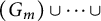
$G_{0}^{f_{\delta _{0}}}\cap \dots \cap G_{m-1}^{f_{\delta _{m-1}}}\cap G_{m}^{f}\cap \dots \cap G_{n}^{f}$
is infinite.


Since
 $f_{\delta _{0}},\dots ,f_{\delta _{m-1}}\in M_{n},$
we get that
 $R\in M_{n}.$
By Lemma 12 (or rather by its proof), the first clause is an
 $F_{\sigma }$
condition and the second one is
 $G_{\delta },$
so R is both
 $F_{\sigma \delta }$
and
 $G_{\delta \sigma },$
although we only care that it is Borel. Moreover, it is
 $\leq ^{\ast }$
-adequate by Lemma 11 and Proposition 8. The conclusion follows since
 $\left ( \mathcal {B},\mathcal {S}\right ) $
is a multiple
 $\mathfrak {d}$
-pathway.
We can now prove the following.
Theorem 14 If there is a multiple
 $\mathfrak {d}$
-pathway, then there is a P-point.
Proof Fix
 $\left ( \mathcal {B},\mathcal {S}\right ) $
a multiple
 $\mathfrak {d} $
-pathway. Define
 $D=\left \{ \delta _{M}\mid M\in \mathcal {S}\right \} $
and for every
 $\delta \in D,$
let
 $W_{\delta }=\cup \left \{ \mathcal {P}\left ( \omega \right ) \cap M\mid M\in \mathcal {S}\wedge \delta _{M}\leq \delta \right \} .$
By recursion over
 $\delta \in D,$
we will define families
 $\mathcal {U} _{\delta }, \mathcal {A}_{\delta }$
and
 $\mathcal {P}_{\delta }$
with the following properties:
-
1.
$\mathcal {U}_{\delta }, \mathcal {P}_{\delta ,}$
and
$\mathcal {A}_{\delta }$
are subsets of
$\left [ \omega \right ] ^{\omega }.$
-
2.
$\mathcal {U}_{\gamma }\subseteq \mathcal {U}_{\delta }$
and
$\mathcal {A} _{\gamma }\subseteq \mathcal {A}_{\delta }$
for
$\gamma \in D\cap \delta .$
-
3.
$\mathcal {A}_{\delta }\subseteq W_{\delta }.$
-
4.
$\mathcal {P}_{\delta }$
is the collection of all
$F^{f_{\delta }}$
for which there is
$M\in \mathcal {S}$
with
$\delta _{M}=\delta , F:\omega \longrightarrow \mathcal {A}_{<\delta }$
is
$\subseteq $
-decreasing and belongs to M (where
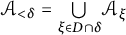
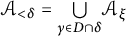
$\mathcal {A}_{<\delta }= {\textstyle \bigcup \limits _{\xi \in D\cap \delta }} \mathcal {A}_{\xi }$
). -
5.
$\mathcal {U}_{\delta }= {\textstyle \bigcup } \{\mathcal {P}_{\gamma }\mid \gamma \in D\cap \left ( \delta +1\right ) \}.$
-
6.
$\mathcal {U}_{\delta }\cup \mathcal {A}_{\delta }$
is centered. -
7.
$\mathcal {A}_{\delta }$
is
$\subseteq $
-maximal with respect to points 3 and 6.







Assume, we are at step
 $\delta \in D$
and
 $\mathcal {U}_{\gamma }, \mathcal {A} _{\gamma ,}$
and
 $\mathcal {P}_{\gamma }$
have been defined for all
 $\gamma \in D\cap \delta .$
In case,
 $\delta $
is the minimum of
 $D,$
we have
 $\mathcal {U} _{\delta }=\mathcal {P}_{\delta }=\emptyset .$
Choose
 $\mathcal {A}_{\delta }\subseteq W_{\delta }$
any maximal centered set extending the Fréchet filter. Now consider the case, where
 $\delta $
is not the least member of
 $D.$
Note that
 $\mathcal {U}_{\delta }$
and
 $\mathcal {P}_{\delta }$
are defined from
 $\mathcal {A}_{<\delta },$
so we only need to find
 $\mathcal {A}_{\delta }.$
Define
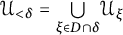 $\mathcal {U}_{<\delta }= {\textstyle \bigcup \limits _{\xi \in D\cap \delta }} \mathcal {U}_{\xi }$
and note that
 $\mathcal {U}_{<\delta }\cup \mathcal {A} _{<\delta }$
is centered, since (by the recursion hypothesis) it is an increasing union of centered sets. We now prove the following.
Claim 15
 $\mathcal {U}_{\delta }\cup \mathcal {A}_{<\delta }$
is centered.
Let
 $B_{0},\dots ,B_{n}\in \mathcal {U}_{\delta }\cup \mathcal {A}_{<\delta }$
, for every
 $i\leq n,$
we find
 $M_{i}\in \mathcal {S}$
and
 $F_{i}\in M_{i}$
in the following way:
-
1. In case
$B_{i}\in \mathcal {A}_{<\delta },$
choose
$M_{i}$
for which
$\delta _{i}=\delta _{M_{i}}<\delta $
and
$B_{i}\in M_{i}.$
Let
$F_{i} :\omega \longrightarrow \left [ \omega \right ] ^{\omega }$
be the constant function with value
$B_{i}.$
-
2. If
$B_{i}\in \mathcal {U}_{\delta },$
choose
$M_{i}$
with
$\delta _{i}=\delta _{M_{i}}\leq \delta $
and
$F_{i}:\omega \longrightarrow \mathcal {A} _{<\delta _{i}}\in M_{i}$
that is
$\subseteq $
-decreasing and
$B_{i} =F_{i}^{f_{\delta _{i}}}.$











It might be possible that for some
 $i\leq n$
both clauses apply (in other words,
 $B_{i}\in \mathcal {U}_{\delta }\cap \mathcal {A}_{<\delta }$
). If that is the case, we can choose to follow either one of them. For each
 $i\leq n,$
we have the following:
-
1.
$B_{i}=F_{i}^{f_{\delta _{i}}}.$
-
2.
$F_{i}\in M_{i}$
, is
$\subseteq $
-decreasing and im
$\left ( F_{i}\right ) \subseteq \mathcal {A}_{<\delta }.$


By taking a reenumeration and possibly picking more elements of
 $\mathcal {U} _{\delta }\cup \mathcal {A}_{<\delta },$
we may assume that
 $\left \langle M_{0},\dots ,M_{n}\right \rangle $
is
 $\delta $
-increasing and
 $\delta _{n}=\delta .$
Let
 $m\leq n$
be the least such that
 $\delta _{m}=\delta .$
We claim that
 $H=\left \{ F_{0}^{f_{\delta _{0}}},\dots ,F_{m-1}^{f_{\delta _{m-1}}}\right \} \cup $
im
 $\left ( F_{m}\right ) \cup \dots \cup $
im
 $\left ( F_{n}\right ) $
is contained in
 $\mathcal {U}_{<\delta }\cup \mathcal {A} _{<\delta }.$
Pick
 $i\leq n.$
We have the following cases:
-
1. If
$B_{i}\in \mathcal {A}_{<\delta },$
then
$F_{i}^{\delta _{i}}=B_{i}$
so there is nothing to do. -
2. If
$B_{i}\in \mathcal {U}_{\delta }$
and
$i<m,$
then
$F_{i}:\omega \longrightarrow \mathcal {A}_{<\delta _{i}}$
which implies that
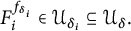
$F_{i} ^{f_{\delta _{i}}}\in \mathcal {U}_{\delta _{i}}\subseteq \mathcal {U}_{\delta }.$
-
3. If
$B_{i}\in \mathcal {U}_{\delta }$
and
$m\leq i,$
there is nothing to do since we already noted that im
$\left ( F_{i}\right ) \subseteq \mathcal {A}_{<\delta }.$





We already pointed out that
 $\mathcal {U}_{<\delta }\cup \mathcal {A}_{<\delta }$
is centered, so H is centered as well. We are now in position to invoke Lemma 13 and conclude that
 $ {\textstyle \bigcap \limits _{i\leq n}} F_{i}^{f_{\delta _{i}}}$
is infinite. Since
 $B_{i}=F_{i}^{f_{\delta _{i}}},$
this finishes the proof of the claim. We can now apply Zorn’s Lemma and find
 $\mathcal {A}_{\delta }\subseteq W_{\delta }$
extending
 $\mathcal {A}_{<\delta },$
such that its union with
 $\mathcal {U}_{\delta }$
is centered and it is maximal with these properties.
After completing the recursion, define
 $\mathcal {U=} {\textstyle \bigcup \limits _{\delta \in D}} \mathcal {U}_{\delta }$
and
 $\mathcal {A=} {\textstyle \bigcup \limits _{\delta \in D}} \mathcal {A}_{\delta }.$
We will now prove the following.
Claim 16
-
1.
$\mathcal {U\cup A}$
is centered. -
2.
$\mathcal {U}=\mathcal {A}.$
-
3.
$\mathcal {U}$
is an ultrafilter. -
4.
$\mathcal {U}$
is a P-point.


To see the first point, simply note that
 $\mathcal {U\cup A}$
is the increasing union of the sets
 $\mathcal {U}_{\delta }\cup \mathcal {A}_{\delta }$
and since we already knew those are centered, it follows that
 $\mathcal {U\cup A}$
is centered as well. We will now prove
 $\mathcal {U\subseteq A}.$
Let
 $B\in \mathcal {U},$
find
 $\delta \in D$
such that
 $B\in W_{\delta }$
(recall that
 $\mathcal {S}$
is stationary). Since
 $B\in \mathcal {U},$
clearly
 $\mathcal {U} _{\delta }\cup \left \{ B\right \} \cup \mathcal {A}_{\delta }$
is centered
 $.$
By the maximality of
 $\mathcal {A}_{\delta }$
that
 $B\in \mathcal {A}_{\delta }.$
We will now show that
 $\mathcal {A\subseteq U}.$
Let
 $A\in \mathcal {A}$
and
 $\delta \in D$
such that
 $A\in \mathcal {A}_{\delta }.$
Since
 $\mathcal {S}$
is stationary, we can find
 $\gamma \in D$
and
 $M\in \mathcal {S}$
such that
 $\delta _{M}=\gamma $
and
 $\delta ,A\in M$
(so
 $\delta <\gamma $
). Let F be the constant sequence with value
 $A.$
We get that
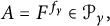 $A=F^{f_{\gamma }}\in \mathcal {P}_{\gamma },$
so
 $B\in \mathcal {U}.$
It is time to prove that
 $\mathcal {U}$
is an ultrafilter. Let
 $A,B,C,E\subseteq \omega $
such that
 $A,B\in \mathcal {U}$
and
 $A\subseteq C.$
Find
 $\delta \in D$
and
 $M\in \mathcal {S}$
such that
 $\delta _{M}=\delta $
and
 $A,B,C,E\in M.$
In this way,
 $A\cap B,C,E$
and
 $\omega \setminus E$
are in
 $W_{\delta }.$
Since
 $\mathcal {U=A}$
is centered, it follows that
 $\mathcal {U}_{\delta }\cup \left \{ A\cap B,C\right \} \cup \mathcal {A}_{\delta }$
is centered. By the maximality of
 $\mathcal {A}_{\delta },$
we get that
 $A\cap B,C\in \mathcal {A}_{\delta }.$
Moreover, either
 $\mathcal {U}_{\delta } \cup \mathcal {A}_{\delta }\cup \left \{ E\right \} $
is centered or
 $\mathcal {U}_{\delta }\cup \mathcal {A}_{\delta }\cup \left \{ \omega \setminus E\right \} $
is centered, so the maximality of
 $\mathcal {A}_{\delta }$
entails that
 $E\in \mathcal {A}_{\delta }$
or
 $\omega \setminus E\in \mathcal {A}_{\delta }.$
Finally, recall that in the first step of the recursion we made sure that
 $\mathcal {U}$
contains the Fréchet filter.
It remains to prove that
 $\mathcal {U}$
is a P-point. Pick
 $F:\omega \longrightarrow \mathcal {U}$
that is
 $\subseteq $
-decreasing
 $.$
For every
 $n\in \omega ,$
choose
 $\delta _{n}\in D$
such that
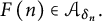 $F\left ( n\right ) \in \mathcal {A}_{\delta _{n}}.$
We now find
 $\delta \in D$
and
 $M\in \mathcal {S}$
such that
 $\delta _{M}=\delta $
and
 $F,\left \{ \delta _{n}\mid n\in \omega \right \} \in M.$
In this way,
 $F\in M$
and it is a decreasing sequence of elements of
 $\mathcal {A}_{<\delta },$
so
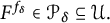 $F^{f_{\delta }}\in \mathcal {P} _{\delta }\subseteq \mathcal {U}.$
6 A strong P-point from a multiple
$\mathfrak {d}$
-pathway

A P-point is an ultrafilter for which we can diagonalize against countably many of its elements, while a strong P-point is an ultrafilter for which we can diagonalize against countably many of its compact subsets. Since every singleton is compact, it follows that strong P-points are P-points. It is not difficult to show that Ramsey ultrafilters are never strong P-points. The mere existence of a P-point is not enough to imply either the existence of a strong P-point, nor of a P-point that is not strongFootnote
4
. In the Miller model every P-point is strong, while in Shelah’s model of only one Ramsey ultrafilter (see [Reference Shelah46]), every P-point is Ramsey, and, therefore, not strong. Naturally, both types of P-points exist under CH(cov
 $\left ( \mathcal {M}\right ) =\mathfrak {c}$
is enough). In [Reference Blass, Hrušák and Verner5], Blass, Hrušák, and Verner proved that strong P-points are precisely the ultrafilters whose Mathias forcing does not add dominating reals. This makes them very useful for constructing models, where the bounding number is small, while other invariants like the splitting number or variants of the almost disjointness number are large (see [Reference Brendle6, Reference Brendle and Fischer8, Reference Brendle and Raghavan9, Reference Dow, Coplakova and Hart19, Reference Guzmán, Hrušák, Martínez-Celis and Fuchino26, Reference Guzmán, Hrušák and Martínez-Celis27, Reference Shelah45, Reference Shelah46] or [Reference Guzmán and Kalajdzievski29]). Strong P-points were introduced by Laflamme in [Reference Laflamme38] with the purpose of studying the collection of all
 $F_{\sigma }$
filters as a forcing notion. We will obtain a strong P-point from a multiple
 $\mathfrak {d}$
-pathway.
Definition 17 An ultrafilter
 $\mathcal {U}$
on
 $\omega $
is a strong P-point if for every sequence
 $\left \langle \mathcal {C}_{n}\right \rangle _{n\in \omega }$
of compact subsets of
 $\mathcal {U},$
there is a partition
 $P=\left \{ P_{n}\mid n\in \omega \right \} $
of
 $\omega $
into intervals such that the set
 $\{A\subseteq \omega \mid \forall n\in \omega \exists X_{n}\in \mathcal {C} _{n}\left ( A\cap P_{n}=X_{n}\cap P_{n}\right ) \}$
is contained in
 $\mathcal {U}.$
For convenience, we will denote fin
 $=\left [ \omega \right ] ^{<\omega }\setminus \left \{ \emptyset \right \} .$
Given an ultrafilter
 $\mathcal {F}$
on
 $\omega ,$
we define the filter
 $\mathcal {F}^{<\omega }$
on finthat is generated by
 $\{\left [ A\right ] ^{<\omega } \setminus \left \{ \emptyset \right \} \mid A\in \mathcal {F}\}.$
It is not hard to see for
 $X\subseteq $
fin,we have that
 $X\in \left ( \mathcal {F} ^{<\omega }\right ) ^{+}$
if and only if for every
 $A\in \mathcal {F},$
there is
 $s\in X$
such that
 $s\subseteq A.$
The following theorem combines results from Blass, Chodounský, Hrušák, Minami, Repovš,Verner, and Zdomskyy (see [Reference Blass, Hrušák and Verner5, Reference Chodounský, Repovs and Zdomskyy14, Reference Hrušák and Minami30]). We will only need the equivalence between 1) and 3).
Theorem 18 Let
 $\mathcal {U}$
be an ultrafilter on
 $\omega .$
The following are equivalent:
-
1.
$\mathcal {U}$
is a strong P-point. -
2. The Mathias forcing of
$\mathcal {U}$
does not add dominating reals. -
3.
$\mathcal {U}^{<\omega }$
is a P
$^{+}$
filter, this means that every countable
$\subseteq $
-decreasing sequence contained in
$\left ( \mathcal {U}^{<\omega }\right ) ^{+}$
has a pseudointersection in
$\left ( \mathcal {U}^{<\omega }\right ) ^{+}.$
-
4.
$\mathcal {U}$
is a Menger subset of
$\mathcal {P}\left ( \omega \right ) .$


We now need to prove some results regarding compact sets that will be used later.
Definition 19 Let
 $X\subseteq $
fin.Define:
-
1.
$\mathcal {C}\left ( X\right ) =\left \{ A\subseteq \omega \mid \forall s\in X\left ( A\cap s\neq \emptyset \right ) \right \} $
. -
2.
$T_{X}\subseteq 2^{<\omega }$
is the set consisting of all
$s\in 2^{<\omega }$
such that for every
$u\in X,$
if
$u\subseteq $
dom
$\left ( s\right ) ,$
then
$u\cap s^{-1}\left ( \left \{ 1\right \} \right ) \neq \emptyset .$




It is easy to see that
 $\mathcal {C}\left ( X\right ) $
is a compact subset of
 $\mathcal {P}\left ( \omega \right ) , T_{X}$
is a well-pruned tree and
 $\mathcal {C}\left ( X\right ) =\left [ T_{X}\right ] $
(we are identifying a set with its characteristic function). The relevance of these notions is the following lemma, which can be found in [Reference Guzmán and Kalajdzievski29] or [Reference Guzmán, Hrušák, Martínez-Celis and Fuchino26].
Lemma 20 Let
 $\mathcal {U}$
be an ultrafilter on
 $\omega $
and
 $X\subseteq $
fin.
 $X\in \left ( \mathcal {U}^{<\omega }\right ) ^{+}$
if and only if
 ${\mathcal {C}\left ( X\right ) \subseteq \mathcal {U}.}$
We now prove the following.
Lemma 21 Let
 $X,Y\subseteq $
fin.The following are equivalent:
-
1.
$\mathcal {C}\left ( X\right ) \cup \mathcal {C}\left ( Y\right ) $
is centered. -
2. For every
$n,m,l\in \omega ,$
and every
$s_{1},\dots ,s_{n}\in \left ( T_{X}\right ) _{m}$
,
$z_{1},\dots ,z_{n}\in \left ( T_{Y}\right ) _{m}$
there is
$k>m,l$
such that for every
$\overline {s}_{1},\dots ,\overline {s}_{n}\in \left ( T_{X}\right ) _{k}$
,
$\overline {z}_{1},\dots ,\overline {z}_{n}\in \left ( T_{Y}\right ) _{k}$
for which
$s_{i}\subseteq \overline {s}_{i}$
and
$z_{i}\subseteq \overline {z}_{i}$
for every
$i\leq n,$
there is
$u\in \lbrack l,k)$
such that
$\overline {s}_{i}\left ( u\right ) =\overline {z}_{i}\left ( u\right ) =1$
for every
$i\leq n.$











Proof It is easy to see that 2) implies 1). Now, assume that
 $\mathcal {C}\left ( X\right ) \cup \mathcal {C}\left ( Y\right ) $
is centered. For each
 $i\leq n,$
define
 $S_{i}=\{A\in \mathcal {C}\left ( X\right ) \mid A\cap m=s_{i} ^{-1}\left ( \left \{ 1\right \} \right ) \}$
and
 $Z_{i}=\{B\in \mathcal {C} \left ( X\right ) \mid B\cap m=z_{i}^{-1}\left ( \left \{ 1\right \} \right ) \}.$
These are compact subsets of
 $\mathcal {P}\left ( \omega \right ) .$
We now consider the compact space
 $W=S_{1}\times \dots \times S_{n}\times Z_{1} \times \dots \times Z_{n}.$
For
 $u\geq l,$
define
 $V_{u}=\{\left ( A_{1} ,\dots ,A_{n},B_{1},\dots ,B_{n}\right ) \in W\mid u\in A_{1}\cap \dots \cap A_{n}\cap B_{1}\cap \dots \cap B_{n}\}.$
Each
 $V_{u}$
is open. Moreover, since
 $\mathcal {C}\left ( X\right ) \cup \mathcal {C}\left ( Y\right ) $
is centered, it follows that
 $\left \{ V_{u}\mid u\geq l\right \} $
is an open cover of
 $W.$
Since W is compact, we can find
 $r\in \omega $
such that
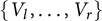 $\left \{ V_{l},\dots ,V_{r}\right \} $
is an open cover of
 $W.$
We claim that
 $k=r+1$
is as desired. Indeed, let
 $\overline {s}_{1},\dots ,\overline {s}_{n}\in \left ( T_{X}\right ) _{k}$
and
 $\overline {z}_{1},\dots ,\overline {z}_{n}\in \left ( T_{Y}\right ) _{k}$
for which
 $s_{i}\subseteq \overline {s}_{i}$
and
 $z_{i}\subseteq \overline {z}_{i}$
for every
 $i\leq n.$
Pick
 $\left ( A_{1},\dots ,A_{n},B_{1},\dots ,B_{n}\right ) \in W$
such that
 $A_{i}\cap k=\overline {s}_{i}^{-1}\left ( \left \{ 1\right \} \right ) $
and
 $B\cap m=\overline {z}_{i}^{-1}\left ( \left \{ 1\right \} \right ) $
for every
 $i\leq n$
(this is possible since the trees are well-pruned). In this way, there is
 $u\in \lbrack l,k)$
such that
 $\left ( A_{1},\dots ,A_{n},B_{1},\dots ,B_{n}\right ) \in V_{u},$
which implies the desired conclusion.
With the lemma (or rather its natural generalization to any finite number of subsets of fin), we get.
Corollary 22 Let
 $n\in \omega $
and define
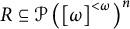 $R\subseteq \mathcal {P}\left ( \left [ \omega \right ] ^{<\omega }\right ) ^{n}$
as the set of all
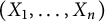 $\left ( X_{1},\dots ,X_{n}\right ) $
such that
 $ {\textstyle \bigcup \limits _{i\leq n}} \mathcal {C}\left ( X_{i}\right ) $
is centered. R is a
 $G_{\delta }$
relation.
We now introduce the following notion.
Definition 23 For a function
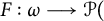 $F:\omega \longrightarrow \mathcal {P(}$
fin
 $\mathsf {)}$
and
 $g\in \omega ^{\omega },$
we define the set
 $F^{g}= {\textstyle \bigcup \limits _{n\in \omega }} F\left ( n\right ) \cap \mathcal {P}\left ( g\left ( n\right ) \right ) .$
If F is
 $\subseteq $
-decreasing, then
 $F^{g}$
is a pseudointersection of im
 $\left ( F\right ) .$
Note that if
 $f\leq g,$
then
 $F^{f}\subseteq F^{g}.$
It is trivial to see that if F is the constant function with value
 $A\subseteq $
fin and f is increasing, then
 $F^{f}=A.$
Lastly, if
 $B\subseteq \omega ,$
then
 $\mathcal {C(}\left [ B\right ] ^{1})$
consists of all supersets of
 $B.$
The following lemma has appeared in [Reference Guzmán and Kalajdzievski29, Lemma 57] and in [Reference Guzmán, Hrušák, Martínez-Celis and Fuchino26, Lemma 3].
Lemma 24 Let
 $\mathcal {F}$
be a filter,
 $\mathcal {D\subseteq F}$
compact and
 $X_{1},\dots ,X_{n}\subseteq \mathcal {P(}$
fin
 $\mathsf {)}$
with
 $\mathcal {C}\left ( X_{1}\right ) ,\dots ,\mathcal {C}\left ( X_{n}\right ) \subseteq \mathcal {F}.$
For every
 $i\leq n,$
there is
 $Y_{i}\in \left [ X_{i}\right ] ^{<\omega }$
such that for every
 $F\in \mathcal {D}$
and
 $A_{i} ^{1},\dots .,A_{i}^{n}\in \mathcal {C}\left ( Y_{i}\right ) ,$
we have that
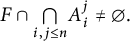 $F\cap {\textstyle \bigcap \limits _{i,j\leq n}} A_{i}^{j}\neq \emptyset .$
It will be convenient to introduce the following notion.
Definition 25 Let
 $\mathcal {A}$
be a family of compact subsets of
 $\mathcal {P}\left ( \omega \right ) .$
We say that
 $\mathcal {A}$
is compatible if
 $ {\textstyle \bigcup } \mathcal {A}$
is centered.
We can now prove the following.
Lemma 26 Let
 $\mathcal {D\subseteq P}\left ( \omega \right ) $
be a compact set,
 $n\in \omega $
and
 $F_{i}:\omega \longrightarrow \mathcal {P(}$
fin
 $\mathsf {)}$
for each
 $i\leq n$
such that
 $\left \{ \mathcal {D} \right \} \cup \left \{ \mathcal {C}\left ( F_{i}\left ( k\right ) \right ) \mid i\leq n\wedge k\in \omega \right \} $
is compatible. There is
 $h\in \omega ^{\omega }$
such that for every increasing
 $g\in \omega ^{\omega },$
if
 $g\nleq ^{\ast }h,$
then
 $\mathcal {D\cup C}\left ( F_{0}^{g}\right ) \cup \dots \cup \mathcal {C}\left ( F_{n}^{g}\right ) $
is compatible.
Proof We may assume that
 $F_{i}\left ( k\right ) \subseteq \left [ \omega \setminus k\right ] ^{<\omega }$
for every
 $k\in \omega $
and
 $i\leq n.$
With the aid of Lemma 24, we can find an increasing
 $h\in \omega ^{\omega }$
such that for every
 $m\in \omega $
the following holds: For every
 $E_{0},\dots ,E_{m}\in \mathcal {D}$
and
 $A_{i}^{1},\dots ,A_{i}^{m}\in F_{m}\left ( i\right ) \cap \mathcal {P}\left ( h\left ( m\right ) \right ) $
for every
 $i\leq n,$
we have that
 $E_{0}\cap \dots \cap E_{m}\cap {\textstyle \bigcap \limits _{i\leq n,\text { }j\leq m}} A_{i}^{j}$
is non-empty. It is easy to see that h has the desired property.
We only need one more preliminary result.
Lemma 27 Let
 $\left ( \mathcal {B},\mathcal {S}\right ) $
be a multiple
 $\mathfrak {d} $
-pathway,
 $\left \langle M_{0},\dots ,M_{n}\right \rangle $
a
 $\delta $
-increasing sequence of models in
 $\mathcal {S}$
and
 $m\leq n$
the least such that
 $\delta _{m}=\delta _{n}.$
For every
 $i\leq n,$
let
 $F_{i}:\omega \longrightarrow \mathcal {P(}$
fin
 $\mathsf {)}\in M_{i}$
that is
 $\subseteq $
-decreasing.
If
 $\{\mathcal {C(}F_{0}^{f_{\delta _{0}}}),\dots ,\mathcal {C(}F_{m-1} ^{f_{\delta _{m-1}}})\}\cup \left \{ \mathcal {C}\left ( F_{i}\left ( k\right ) \right ) \mid m\leq i\leq n\wedge k\in \omega \right \} $
is compatible, then
 $ {\textstyle \bigcup \limits _{i\leq n}} \mathcal {C}(F_{i}^{f_{\delta _{i}}})$
is centered.
Proof Define the relation
 $R\subseteq (\mathcal {P(}$
fin
 $)^{\omega } )^{n+1}\times \omega ^{\omega }$
, where
 $R\left ( G_{0},\dots ,G_{n},f\right ) $
holds just in case one of the following conditions is met:
-
1.
$\{\mathcal {C(}G_{0}^{f_{\delta _{0}}}),\dots ,\mathcal {C(}G_{m-1} ^{f_{\delta _{m-1}}})\}\cup \left \{ \mathcal {C(}G_{i}\left ( k\right ) )\mid m\leq i\leq n\wedge k\in \omega \right \} $
is not compatible. -
2.
$\mathcal {C(}G_{0}^{f_{\delta _{0}}})\cup \dots \cup \mathcal {C(} G_{m-1}^{f_{\delta _{m-1}}})\cup \mathcal {C(}G_{m}^{f})\cup \dots \cup \mathcal {C(}G_{n}^{f})$
is centered.


Since
 $f_{\delta _{0}},\dots ,f_{\delta _{m-1}}\in M_{n},$
we conclude that
 $R\in M_{n}.$
By Corollary 22, the first clause is an
 $F_{\sigma }$
condition and the second one is
 $G_{\delta },$
so R is both
 $F_{\sigma \delta }$
and
 $G_{\delta \sigma },$
hence it is Borel. Moreover, it is
 $\leq ^{\ast }$
-adequate by Lemma 26. The conclusion of the lemma follows since
 $\left ( \mathcal {B},\mathcal {S}\right ) $
is a multiple
 $\mathfrak {d}$
-pathway.
We now prove the main result of the section.
Theorem 28 If there is a multiple
 $\mathfrak {d}$
-pathway, then there is a strong P-point.
Proof Let
 $\left ( \mathcal {B},\mathcal {S}\right ) $
be a multiple
 $\mathfrak {d} $
-pathway. Define
 $D=\left \{ \delta _{M}\mid M\in \mathcal {S}\right \} $
and for every
 $\delta \in D,$
define
 $W_{\delta }$
as the set of all
 $\mathcal {C} \left ( X\right ) $
such that
 $X\subseteq $
finand there is
 $M\in \mathcal {S}$
such that
 $\delta _{M}\leq \delta $
and
 $X\in M.$
By recursion over
 $\delta \in D,$
we will define
 $\mathcal {U}_{\delta }, \mathcal {A} _{\delta }$
and
 $\mathcal {P}_{\delta }$
such that:
-
1.
$\mathcal {U}_{\delta }\subseteq \left [ \omega \right ] ^{\omega }$
while
$\mathcal {P}_{\delta }$
and
$\mathcal {A}_{\delta }$
are families of compact subsets of
$\mathcal {P}\left ( \omega \right ) .$
-
2.
$\mathcal {U}_{\gamma }\subseteq \mathcal {U}_{\delta }$
and
$\mathcal {A} _{\gamma }\subseteq \mathcal {A}_{\delta }$
for every
$\gamma \in D\cap \delta .$
-
3.
$\mathcal {A}_{\delta }\subseteq W_{\delta }.$
-
4.
$\mathcal {P}_{\delta }$
is the collection of all
$\mathcal {C(} F^{f_{\delta }})$
such that
$F:\omega \longrightarrow \mathcal {P(}$
fin
$)$
is
$\subseteq $
-decreasing and there is
$M\in \mathcal {S}$
with the property that
$\delta _{M}=\delta , F\in M,$
and
$\mathcal {C(}F\left ( n\right ) )\in \mathcal {A}_{<\delta }$
for every
$n\in \omega $
(where
$\mathcal {A}_{<\delta }= {\textstyle \bigcup \limits _{\gamma \in D\cap \delta }} \mathcal {A}_{\xi }$
). -
5.
$\mathcal {U}_{\delta }= {\textstyle \bigcup } \left \{ \mathcal {P}_{\gamma }\mid \gamma \in D\cap \left ( \delta +1\right ) \right \} .$
-
6.
$\mathcal {U}_{\delta }\cup {\textstyle \bigcup } \mathcal {A}_{\delta }$
is centered. -
7.
$\mathcal {A}_{\delta }$
is maximal with respect to points 3 and 6.










Assume, we are at step
 $\delta \in D$
and
 $\mathcal {U}_{\gamma }, \mathcal {A} _{\gamma }$
, and
 $\mathcal {P}_{\gamma }$
have been defined for all
 $\gamma \in D\cap \delta .$
In case
 $\delta $
is the minimum of
 $D,$
we have
 $\mathcal {U} _{\delta }=\mathcal {P}_{\delta }=\emptyset .$
Choose
 $\mathcal {A}_{\delta }\subseteq W_{\delta }$
any maximal compatible set of compact sets such that
 $ {\textstyle \bigcup } \mathcal {A}_{\delta }$
extends the Fréchet filter. Now, consider the case, where
 $\delta $
is not the least member of
 $D.$
Note that
 $\mathcal {U}_{\delta }$
and
 $\mathcal {P}_{\delta }$
are defined from
 $\mathcal {A}_{<\delta },$
so we only need to find
 $\mathcal {A}_{\delta }.$
Define
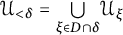 $\mathcal {U}_{<\delta }= {\textstyle \bigcup \limits _{\xi \in D\cap \delta }} \mathcal {U}_{\xi }$
and note that
 $\mathcal {U}_{<\delta }\cup {\textstyle \bigcup } \mathcal {A}_{<\delta }$
is centered, since (by the recursion hypothesis) it is an increasing union of centered sets. We now prove the following.
Claim 29
 $\mathcal {U}_{\delta }\cup {\textstyle \bigcup } \mathcal {A}_{<\delta }$
is centered.
Let
 $B_{0},\dots ,B_{n}\in \mathcal {U}_{\delta }\cup {\textstyle \bigcup } \mathcal {A}_{<\delta }$
, for every
 $i\leq n,$
we find
 $M_{i}\in \mathcal {S}$
and
 $F_{i}\in M_{i}$
in the following way:
-
1. If
$B_{i}\in {\textstyle \bigcup } \mathcal {A}_{<\delta },$
let
$M_{i}$
such that
$\delta _{i}=\delta _{M_{i} }<\delta $
and there is
$X_{i}$
$\in M_{i}$
such that
$B_{i} \in \mathcal {C}\left ( X_{i}\right ) $
and
$\mathcal {C}\left ( X_{i}\right ) \in \mathcal {A}_{\delta _{i}}.$
Let
$F_{i}:\omega \longrightarrow \mathcal {P(} $
fin) be the constant sequence with value
$X_{i}.$
-
2. If
$B_{i}\in \mathcal {U}_{\delta },$
let
$M_{i}$
such that
$\delta _{i}=\delta _{M_{i}}\leq \delta $
and
$F_{i}:\omega \longrightarrow \mathcal {P(}$
fin)
$\in M_{i}$
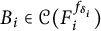
such that
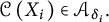
$B_{i}\in \mathcal {C(} F_{i}^{f_{\delta _{i}}})$
and each
$\mathcal {C}\left ( F_{i}\left ( k\right ) \right ) $
is in
$\mathcal {A}_{<\delta _{i}}.$













It might be possible that for some
 $i\leq n,$
both clauses apply. If that is the case, we can choose to follow either one of them. For each
 $i\leq n,$
we have the following:
-
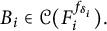
1.
$B_{i}\in \mathcal {C(}F_{i}^{f_{\delta _{i}}}).$
-
2.
$F_{i}:\omega \longrightarrow \mathcal {P(}$
fin)
$\in M_{i}$
and is
$\subseteq $
-decreasing
$.$
-
3.
$\mathcal {C}\left ( F_{i}\left ( k\right ) \right ) \in \mathcal {A} _{<\delta }$
for all
$k\in \omega .$





By taking a reenumeration and possibly picking more elements of
 $\mathcal {U} _{\delta }\cup {\textstyle \bigcup } \mathcal {A}_{<\delta },$
we may assume that
 $\left \langle M_{0},\dots ,M_{n} \right \rangle $
is
 $\delta $
-increasing and
 $\delta _{n}=\delta .$
Let
 $m\leq n$
be the least such that
 $\delta _{m}=\delta .$
We claim that
 $H=\mathcal {C(} F_{0}^{f_{\delta _{0}}})\cup \dots \cup \mathcal {C(}F_{m-1}^{f_{\delta _{m-1}}})\cup {\textstyle \bigcup } \left \{ \mathcal {C}\left ( F_{i}\left ( k\right ) \right ) \mid m\leq i\leq n\wedge k\in \omega \right \} $
is contained in
 $\mathcal {U}_{<\delta }\cup {\textstyle \bigcup } \mathcal {A}_{<\delta }.$
Pick
 $i\leq n.$
We have the following cases:
-
1. If
$B_{i}\in {\textstyle \bigcup } \mathcal {A}_{<\delta },$
we have that
$\mathcal {C}\left ( X_{i}\right ) \in \mathcal {A}_{<\delta }$
and
$F_{i}^{\delta _{i}}=X_{i}$
. -
2. If
$B_{i}\in \mathcal {U}_{\delta }$
and
$i<m,$
then
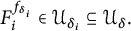
$F_{i}:\omega \longrightarrow \mathcal {A}_{<\delta _{i}}$
which implies that
$F_{i} ^{f_{\delta _{i}}}\in \mathcal {U}_{\delta _{i}}\subseteq \mathcal {U}_{\delta }.$
-
3. If
$B_{i}\in \mathcal {U}_{\delta }$
and
$m\leq i,$
there is nothing to do since we already noted that
$\mathcal {C}\left ( F_{i}\left ( k\right ) \right ) \in \mathcal {A}_{<\delta }$
for all
$k\in \omega .$









Recall that
 $\mathcal {U}_{<\delta }\cup {\textstyle \bigcup } \mathcal {A}_{<\delta }$
is centered, so H is centered as well. We are now in position to invoke Lemma 27 and conclude that
 $ {\textstyle \bigcup \limits _{i\leq n}} \mathcal {C(}F_{i}^{f_{\delta _{i}}})$
is centered. Since
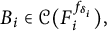 $B_{i}\in \mathcal {C(}F_{i}^{f_{\delta _{i}}}),$
this finishes the proof of the claim. We use Zorn’s Lemma and find
 $\mathcal {A}_{\delta }\subseteq W_{\delta }$
extending
 $\mathcal {A}_{<\delta }$
such that
 $\mathcal {U}_{\delta }\cup {\textstyle \bigcup } \mathcal {A}_{\delta }$
is centered and it is maximal with these properties.
After completing the recursion, define
 $\mathcal {U=} {\textstyle \bigcup \limits _{\delta \in D}} \mathcal {U}_{\delta }$
and
 $\mathcal {A=} {\textstyle \bigcup \limits _{\delta \in D}} \mathcal {A}_{\delta }.$
We will now prove the following.
Claim 30
-
1.
$\mathcal {U\cup } {\textstyle \bigcup } \mathcal {A}$
is centered. -
2.
$\mathcal {U}= {\textstyle \bigcup } \mathcal {A}.$
-
3.
$\mathcal {U}$
is an ultrafilter. -
4. If
$X\in \left ( \mathcal {U}^{<\omega }\right ) ^{+},$
then
$\mathcal {C} \left ( X\right ) \in \mathcal {A}.$
-
5.
$\mathcal {U}$
is a strong P-point.


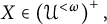


Since
 $\mathcal {U\cup } {\textstyle \bigcup } \mathcal {A}$
is equal to the union of
 $\mathcal {U}_{\delta }\mathcal {\cup } {\textstyle \bigcup } \mathcal {A}_{\delta }$
and these are increasing and centered, it follows that
 $\mathcal {U\cup } {\textstyle \bigcup } \mathcal {A}$
is centered. We prove that
 $\mathcal {U\subseteq } {\textstyle \bigcup } \mathcal {A}.$
Let
 $B\in \mathcal {U}, \delta \in D,$
and
 $M\in \mathcal {S}$
such that
 $\delta _{M}=\delta $
and
 $B\in M.$
Let
 $X=\left [ B\right ] ^{1}$
and recall that
 $\mathcal {C}\left ( X\right ) =\left \{ A\subseteq \omega \mid B\subseteq A\right \} $
and
 $\mathcal {C}\left ( X\right ) \in W_{\delta }$
. Clearly,
 $\mathcal {U}_{\delta }\cup \mathcal {A}_{\delta }\cup \mathcal {C}\left ( X\right ) $
is centered, so by the maximality of
 $\mathcal {A}_{\delta },$
we get that
 $\mathcal {C}\left ( X\right ) \in \mathcal {A}_{\delta },$
hence
 $B\in {\textstyle \bigcup } \mathcal {A}.$
Now, take
 $A\in {\textstyle \bigcup } \mathcal {A}.$
Find
 $\delta \in D$
and
 $Y\in W_{\delta }$
such that
 $A\in \mathcal {C}\left ( Y\right ) .$
Let F be the constant sequence with value
 $Y.$
We now find
 $\gamma \in D$
and
 $M\in \mathcal {S}$
such that
 $\delta _{M}=\gamma $
and
 $\delta ,F\in M.$
We have that
 $\mathcal {C}\left ( Y\right ) =\mathcal {C}\left ( F^{f_{\gamma }}\right ) \subseteq \mathcal {U} _{\gamma }.$
We now prove that
 $\mathcal {U}$
is an ultrafilter. Let
 $A,B,C,E\subseteq \omega $
such that
 $A,B\in \mathcal {U}$
and
 $A\subseteq C.$
Find
 $\delta \in D$
and
 $M\in \mathcal {S}$
such that
 $\delta _{M}=\delta $
and
 $A,B,C,E\in M.$
Let
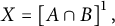 $X=\left [ A\cap B\right ] ^{1},$
which is in
 $W_{\delta }.$
Since
 $\mathcal {U= {\textstyle \bigcup } A}$
is centered, it follows that
 $\mathcal {U}_{\delta }\cup \mathcal {C}\left ( X\right ) \cup {\textstyle \bigcup } \mathcal {A}_{\delta }$
is centered. By the maximality of
 $\mathcal {A}_{\delta },$
we get that
 $\mathcal {C}\left ( X\right ) \in \mathcal {A}_{\delta }.$
Since
 $A\cap B, C\in \mathcal {C}\left ( X\right ) ,$
it follows that
 $A\cap B,C\in \mathcal {U}.$
Moreover, we know that either
 $\mathcal {U}_{\delta }\cup {\textstyle \bigcup } \mathcal {A}_{\delta }\cup \mathcal {C}(\left [ E\right ] ^{1})$
is centered or
 $\mathcal {U}_{\delta }\cup {\textstyle \bigcup } \mathcal {A}_{\delta }\cup \mathcal {C(}\left [ \omega \setminus E\right ] ^{1})$
is centered, so by the maximality of
 $\mathcal {A}_{\delta },$
we obtain that
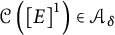 $\mathcal {C}\left ( \left [ E\right ] ^{1}\right ) \in \mathcal {A}_{\delta }$
or
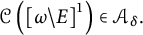 $\mathcal {C}\left ( \left [ \omega \setminus E\right ] ^{1}\right ) \in \mathcal {A}_{\delta }.$
Finally, recall that in the first step of the recursion we made sure that
 $\mathcal {U}$
contains the Fréchet filter.
Let
 $X\in \left ( \mathcal {U}^{<\omega }\right ) ^{+}$
. Since
 $\mathcal {U}$
is an ultrafilter, we know that
 $\mathcal {C}\left ( X\right ) \subseteq \mathcal {U}$
by Lemma 20. Find
 $\delta \in D$
and
 $M\in \mathcal {S}$
such that
 $\delta _{M}=\delta $
and
 $X\in M.$
Clearly,
 $\mathcal {U}_{\delta }\cup \mathcal {C}\left ( X\right ) \cup {\textstyle \bigcup } \mathcal {A}_{\delta }$
is centered, so by the maximality of
 $\mathcal {A} _{\delta }$
, we conclude that
 $\mathcal {C}\left ( X\right ) \in \mathcal {A} _{\delta }.$
It only remains to prove that
 $\mathcal {U}$
is a strong P-point. We use Theorem 18. Let
 $F:\omega \longrightarrow \left ( \mathcal {U}^{<\omega }\right ) ^{+}$
be
 $\subseteq $
-decreasing
 $.$
By the previous point of the claim, for every
 $n\in \omega ,$
we can find
 $\delta _{n}\in D$
such that
 $\mathcal {C}\left ( F\left ( n\right ) \right ) \in \mathcal {A}_{\delta _{n}}.$
We now choose
 $\delta \in D$
and
 $M\in \mathcal {S}$
with
 $\delta _{M}=\delta $
such that
 $F\in M$
and
 $\delta _{n}<\delta $
for every
 $n\in \omega .$
In this way,
 $\mathcal {C(}F^{f_{\delta } })\in \mathcal {P}_{\delta }$
and then it is contained in
 $\mathcal {U}.$
We conclude that
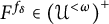 $F^{f_{\delta }}\in \left ( \mathcal {U}^{<\omega }\right ) ^{+}$
by applying Lemma 20 once again.
7 A Gruff ultrafilter from a multiple
$\mathfrak {d}$
-pathway

We now turn our attention to ultrafilters on the rational numbersFootnote
5
, which we denote by
 $\mathbb {Q}$
. A particularly nice combinatorial feature of the rational numbers (which is not true for the real numbers), is that it has no Bernstein subsets. In other words, if we split the rational numbers into two pieces, then at least one of them contains a perfect subsetFootnote
6
. This property motivates the following definition.
Definition 31 Let
 $\mathcal {U}$
be an ultrafilter on
 $\mathbb {Q}.$
We say that
 $\mathcal {U}$
is a Gruff ultrafilter if it has a base of perfect sets.
Gruff ultrafilters were introduced by van Douwen in [Reference van Douwen52] while studying
 $\beta \mathbb {Q}$
(the Čech–Stone compactification of
 $\mathbb {Q})$
who asked if there are such ultrafilters. He was able to to prove they exist in case that cov
 $\left ( \mathcal {M}\right ) =\mathfrak {c}$
and later Copláková and Hart in [Reference Coplakova and Hart17] obtained the same conclusion under
 $\mathfrak {b=c}.$
Both of these results were improved by Fernández–Bretón and Hrušák in [Reference Fernández-Bretón and Hrušák24] where a Gruff ultrafilter is obtained from
 $\mathfrak {d=c}.$
Fernández–Bretón and Hrušák were also interested in the existence of Gruff ultrafilters in the random model and constructed one using a pathway (see also [Reference Fernández-Bretón23]). Unfortunately, as discussed before, it is not known if pathways exist in the random model. We will now build a Gruff ultrafilter from a multiple
 $\mathfrak {d}$
-pathway. Our approach takes inspiration from [Reference Dow20, Reference Fernández-Bretón23, Reference Fernández-Bretón and Hrušák24]. Apart from the papers already mentioned, the reader may consult [Reference Balderas and Guzmán1, Reference Ciesielski and Pawlikowski15, Reference Millán39] to learn more about Gruff ultrafilters and [Reference Cancino-Manríquez, Hrušák and Meza-Alcántara11] for more on combinatorics of scattered subsets of the rationals.
Denote by scatt,the ideal of scattered subsets of
 $\mathbb {Q}$
and by bscatt,the ideal generated by both the scattered sets and the bounded (from above) subsets of
 $\mathbb {Q}.$
When constructing a Gruff ultrafilter, it is sometimes more convenient to build one which has a base of perfect unbounded subsets (see [Reference Fernández-Bretón and Hrušák24]). Given
 $A\subseteq \mathbb {Q},$
the crowded kernel of A (denoted by
 $K\left ( A\right ) $
) is the union of all the crowded subsets of
 $A.$
The following are simple remarks regarding this notion.
Lemma 32 Let
 $A\subseteq \mathbb {Q}.$
-
1. If
$A\in $
scatt
$^{+}$
, then
$K\left ( A\right ) $
is crowded. -
2.
$K\left ( A\right ) $
is the largest crowded subset contained in
$A.$
-
3. If
$A\in $
bscatt
$^{+}$
, then
$K\left ( A\right ) $
is crowded and unbounded. -
4. The symmetric difference between A and
$K\left ( A\right ) $
is in scatt. -
5. If
$\mathcal {F}$
is a filter on
$\mathbb {Q}$
such that scatt
$^{\ast }\subseteq \mathcal {F}$
and
$A\in \mathcal {F},$
then
$K\left ( A\right ) \in \mathcal {F}.$


We will now recall a very useful notion from [Reference Fernández-Bretón and Hrušák24]. From now on, fix an enumeration
 $\mathbb {Q}=\left \{ q_{n}\mid n\in \omega \right \} $
. For
 $q\in \mathbb {Q}$
and
 $r>0,$
we denote by
 $B\left ( q,r\right ) $
, the open ball of q with radius
 $r.$
Given a function
 $f\in \omega ^{\omega }$
and
 $n\in \omega ,$
denote
 $J_{f}\left ( n\right ) =B(q_{n},\frac {\sqrt {2}}{k}),$
where k is the least natural number such that
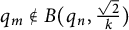 $q_{m}\notin B(q_{n} ,\frac {\sqrt {2}}{k})$
for every
 $m\leq f\left ( n\right ) $
such that
 $m\neq n$
(the purpose of
 $\sqrt {2}$
is only to ensure that
 $J_{f}\left ( n\right ) $
is a clopen subset of
 $\mathbb {Q},$
evidently we can use any other positive irrational number). Intuitively, we are making
 $J_{f}\left ( n\right ) $
as large as possible with the restriction that it can not include any
 $q_{m}$
for which
 $m\leq f\left ( n\right ) $
and
 $m\neq n.$
Definition 33 Let
 $X\subseteq \mathbb {Q}$
and
 $f\in \omega ^{\omega }.$
Define
 $X\left ( f\right ) =\mathbb {Q\setminus } {\textstyle \bigcup \limits _{n\notin X}} J_{f}\left ( n\right ) .$
The following two results can be found in [Reference Fernández-Bretón and Hrušák24].
Lemma 34 Let
 $X,Y\subseteq \mathbb {Q,}$
and
 $f,g\in \omega ^{\omega }.$
-
1.
$X\left ( f\right ) $
is a closed subset of
$X.$
-
2. If
$X\subseteq Y,$
then
$X\left ( f\right ) \subseteq Y\left ( f\right ) .$
-
3.
$X\left ( f\right ) \cap Y\left ( f\right ) =\left ( X\cap Y\right ) \left ( f\right ) .$
-
4. If
$f\leq g,$
then
$X\left ( f\right ) \subseteq X\left ( g\right ) .$






Proposition 35 Let
 $X\subseteq \mathbb {Q}$
be crowded and unbounded. There is
 $h\in \omega ^{\omega }$
such that for every increasing
 $g\in \omega ^{\omega },$
if
 $g\nleq ^{\ast }h,$
then
 $X\left ( g\right ) $
is perfect and unbounded.
Using Proposition 35, for every
 $X\subseteq \mathbb {Q,}$
that is crowded and unbounded, we fix a function
 $h_{X}\in \omega ^{\omega }$
such that for every increasing
 $g\in \omega ^{\omega },$
if
 $g\nleq ^{\ast }h_{X},$
then
 $X\left ( g\right ) $
is perfect and unbounded.
For a rational number
 $q\in \mathbb {Q},$
define
 $\left \langle q\right \rangle _{0}=\left \{ A\subseteq \mathbb {Q}\mid q\notin A\right \} $
and
 $\left \langle q\right \rangle _{1}=\left \{ A\subseteq \mathbb {Q}\mid q\in A\right \} .$
We endow
 $\mathcal {P}\left ( \mathbb {Q}\right ) $
with the topology that has as a sub-base the family
 $\left \{ \left \langle q\right \rangle _{i}\mid q\in \mathbb {Q}\wedge i<2\right \} .$
Evidently,
 $\mathcal {P}\left ( \mathbb {Q}\right ) $
with this topology is homeomorphic to
 $\mathcal {P}\left ( \omega \right ) .$
The following lemma refers to this topology.
Lemma 36
-
1. The collection of all crowded unbounded subsets of
$\mathbb {Q}$
is
$G_{\delta }.$
-
2. The ideal bscattis coanalytic.


We now prove the following.
Lemma 37 Let
 $\left ( \mathcal {B},\mathcal {S}\right ) $
be a multiple
 $\mathfrak {d} $
-pathway and
 $\left \langle M_{0},\dots ,M_{n}\right \rangle $
a
 $\delta $
-increasing sequence of models from
 $\mathcal {S}.$
Let
 $m\leq n$
be the first one such that
 $\delta _{m}=\delta _{n}.$
For every
 $i\leq n,$
pick
 $X_{i}\in M_{i}\cap $
bscatt
 $^{+}.$
If
 $X_{0}\left ( f_{\delta _{0}}\right ) \cap \dots \cap X_{m-1}\left ( f_{\delta _{m-1}}\right ) \cap X_{m}\cap \dots \cap X_{n}\in $
bscatt
 $^{+},$
then
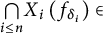 $ {\textstyle \bigcap \limits _{i\leq n}} X_{i}\left ( f_{\delta _{i}}\right ) \in $
bscatt
 $^{+}.$
Proof Define the relation
 $R\subseteq \mathcal {P}\left ( \mathbb {Q}\right ) ^{n+1}\times \omega ^{\omega }$
, where
 $R\left ( Y_{0},\dots ,Y_{n},f\right ) $
holds in case one of the following conditions is met:
-
1.
$Y_{0}\left ( f_{\delta _{0}}\right ) \cap \dots \cap Y_{m-1}\left ( f_{\delta _{m-1}}\right ) \cap Y_{m}\cap \dots \cap Y_{n}\in $
bscatt. -
2.
$Y_{0}\left ( f_{\delta _{0}}\right ) \cap \dots \cap Y_{m-1}\left ( f_{\delta _{m-1}}\right ) \cap Y_{m}\left ( f\right ) \cap \dots \cap Y_{n}\left ( f\right ) \in $
bscatt
$^{+}$
.



Since
 $f_{\delta _{0}},\dots ,f_{\delta _{m-1}}\in M_{n},$
we conclude that
 $R\in M_{n}.$
By Lemma 36, the first clause is coanalytic and the second one is analytic
 $,$
so R is projective. We now prove that it is
 $\leq ^{\ast }$
-adequate. Let
 $Y_{0},\dots ,Y_{n}\subseteq \mathbb {Q},$
if
 $Z=Y_{0}\left ( f_{\delta _{0}}\right ) \cap \dots \cap Y_{m-1}\left ( f_{\delta _{m-1}}\right ) \cap Y_{m}\cap \dots \cap Y_{n}\in $
bscatt, there is nothing to do, so assume otherwise. We claim that
 $h_{K\left ( Z\right ) }$
is an R-control for
 $\left ( Y_{0},\dots ,Y_{n}\right ) .$
To see this, pick
 $g\in \omega ^{\omega }$
increasing such that
 $g\nleq ^{\ast }h_{K\left ( Z\right ) }.$
We now have the following:
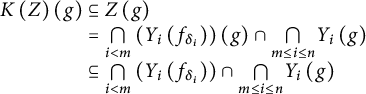 $\begin {array}{r@{\ }l} K\left ( Z\right ) \left ( g\right ) & \subseteq Z\left ( g\right ) \\ & = {\textstyle \bigcap \limits _{i<m}} \left ( Y_{i}\left ( f_{\delta _{i}}\right ) \right ) \left ( g\right ) \cap {\textstyle \bigcap \limits _{m\leq i\leq n}} Y_{i}\left ( g\right ) \\ & \subseteq {\textstyle \bigcap \limits _{i<m}} \left ( Y_{i}\left ( f_{\delta _{i}}\right ) \right ) \cap {\textstyle \bigcap \limits _{m\leq i\leq n}} Y_{i}\left ( g\right ) \end {array} $
By Proposition 35, we know that
 $K\left ( Z\right ) \left ( g\right ) $
is perfect and unbounded, so
 $ {\textstyle \bigcap \limits _{i<m}} \left ( Y_{i}\left ( f_{\delta _{i}}\right ) \right ) \cap {\textstyle \bigcap \limits _{m\leq i\leq n}} Y_{i}\left ( g\right ) $
is not in bscatt.The conclusion of the lemma follows since
 $\left ( \mathcal {B},\mathcal {S}\right ) $
is a multiple
 $\mathfrak {d}$
-pathway.
We now proceed to prove the main result of the section.
Theorem 38 If there is a multiple
 $\mathfrak {d}$
-pathway, then there is a Gruff ultrafilter.
Proof Let
 $\left ( \mathcal {B},\mathcal {S}\right ) $
be a multiple
 $\mathfrak {d} $
-pathway. Define
 $D=\left \{ \delta _{M}\mid M\in \mathcal {S}\right \} $
and for
 $\delta \in D,$
denote
 $W_{\delta }= {\textstyle \bigcup \limits _{\delta _{M}\leq \delta }} M\cap \mathcal {P}\left ( \mathbb {Q}\right ) .$
By recursion over
 $\delta \in D,$
we shall find
 $\mathcal {U}_{\delta },\mathcal {A}_{\delta }$
, and
 $\mathcal {P} _{\delta }$
with the following properties:
-
1.
$\mathcal {U}_{\delta }$
and
$\mathcal {P}_{\delta }$
are families of perfect and unbounded sets. -
2.
$\mathcal {A}_{\delta }\subseteq W_{\delta }\cap $
bscatt
$^{+}.$
-
3. If
$\gamma \in D\cap \delta ,$
then
$\mathcal {A}_{\gamma }\subseteq \mathcal {A}_{\delta }$
and
$\mathcal {U}_{\gamma }\subseteq \mathcal {U}_{\delta }.$
-
4.
$\mathcal {P}_{\delta }$
is the family of all
$X\left ( f_{\delta }\right ) $
for which there is
$M\in \mathcal {S}$
for which
$\delta _{M}=\delta $
and
$X\in M\cap \mathcal {A}_{<\delta }$
is crowded (where
$\mathcal {A}_{<\delta }= {\textstyle \bigcup \limits _{\gamma \in D\cap \delta }} \mathcal {A}_{\gamma }$
). -
5.
$\mathcal {U}_{\delta }= {\textstyle \bigcup } \left \{ \mathcal {P}_{\xi }\mid \xi \in D\cap \left ( \delta +1\right ) \right \} .$
-
6.
$\mathcal {U}_{\delta }\cup \mathcal {A}_{\delta }$
generates a filter contained in bscatt
$^{+}.$
-
7.
$\mathcal {A}_{\delta }$
is maximal with respect to points 2 and 6.



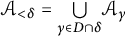



Before starting the construction, note that
 $\mathcal {A}_{\delta }$
will have the following property: If
 $B\in \mathcal {A}_{\delta },$
then
 $K\left ( B\right ) \in \mathcal {A}_{\delta }.$
To see this, let
 $M\in \mathcal {S}$
such that
 $B\in M$
and
 $\delta _{M}\leq \delta .$
Since
 $B\in M,$
we get that
 $K\left ( B\right ) \in M,$
hence
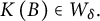 $K\left ( B\right ) \in W_{\delta }.$
Call
 $\mathcal {F}$
the filter generated by
 $\mathcal {U}_{\delta }\cup \mathcal {A} _{\delta }\cup $
bscatt
 $^{\ast }$
. Since
 $B\in \mathcal {F},$
then
 $K\left ( B\right ) \in \mathcal {F}$
(see Lemma 32) which implies that
 $\mathcal {U}_{\delta }\cup \mathcal {A}_{\delta }\cup \left \{ K\left ( B\right ) \right \} $
generates a filter contained in bscatt
 $^{+}.$
By the maximality of
 $\mathcal {A}_{\delta },$
we conclude that
 $K\left ( B\right ) \in \mathcal {A}_{\delta }.$
Assume, we are at step
 $\delta \in D$
and
 $\mathcal {U}_{\gamma }, \mathcal {A} _{\gamma }$
, and
 $\mathcal {P}_{\gamma }$
have been defined for all
 $\gamma \in D\cap \delta .$
In case
 $\delta $
is the minimum of
 $D,$
we have
 $\mathcal {U} _{\delta }=\mathcal {P}_{\delta }=\emptyset .$
Choose
 $\mathcal {A}_{\delta }\subseteq W_{\delta }\cap $
scatt
 $^{+}$
any maximal centered set extending the filter of cobounded subsets of
 $\mathbb {Q}.$
Now, consider the case, where
 $\delta $
is not the least member of
 $D.$
Note that
 $\mathcal {U} _{\delta }$
and
 $\mathcal {P}_{\delta }$
are defined from
 $\mathcal {A}_{<\delta },$
so we only need to find
 $\mathcal {A}_{\delta },$
but first we need to prove that both
 $\mathcal {U}_{\delta }$
and
 $\mathcal {P}_{\delta }$
consist of perfect and unbounded sets. It is enough to prove it for
 $\mathcal {P}_{\delta }.$
Let
 $M\in \mathcal {S}$
with
 $\delta _{M}=\delta $
and
 $X\in M\cap \mathcal {A} _{<\delta }$
is crowded. Moreover, X is also unbounded since
 $\mathcal {A} _{<\delta }$
extends the filter of cobounded sets. We need to prove that
 $X\left ( f_{\delta }\right ) $
is perfect and unbounded. Since
 $X\in M,$
it follows that
 $h_{K}$
is also in
 $M.$
Since
 $f_{\delta }$
is unbounded over
 $M,$
we get that
 $X\left ( f_{\delta }\right ) $
is perfect and unbounded by Proposition 35.
Define
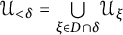 $\mathcal {U}_{<\delta }= {\textstyle \bigcup \limits _{\xi \in D\cap \delta }} \mathcal {U}_{\xi }$
and note that
 $\mathcal {U}_{<\delta }\cup \mathcal {A} _{<\delta }$
generates a filter contained in bscatt
 $^{+}$
by the recursion hypothesis. We now prove the following.
Claim 39
 $\mathcal {U}_{\delta }\cup \mathcal {A}_{<\delta }$
generates a filter contained in bscatt
 $^{+}.$
Let
 $B_{0},\dots ,B_{n}\in \mathcal {U}_{\delta }\cup \mathcal {A}_{<\delta }$
, for each
 $i\leq n,$
we find
 $M_{i}\in \mathcal {S}$
and
 $X_{i}\in M_{i}$
in the following way:
-
1. In case
$B_{i}\in \mathcal {A}_{<\delta },$
choose
$M_{i}$
for which
$\delta _{i}=\delta _{M_{i}}<\delta $
and
$B_{i}\in M_{i}.$
Let
$X_{i}=K\left ( B_{i}\right ) .$
-
2. If
$B_{i}\in \mathcal {U}_{\delta },$
choose
$M_{i}$
with
$\delta _{i}=\delta _{M_{i}}\leq \delta $
and
$X_{i}\in M_{i}\cap \mathcal {A}_{<\delta _{i}}$
crowded such that
$B_{i}=X_{i}\left ( f_{\delta _{i}}\right ) .$










It might be possible that for some
 $i\leq n$
both clauses apply. If that is the case, we use either of them. For each
 $i\leq n,$
we have the following:
-
1.
$X_{i}\in M_{i}\cap \mathcal {A}_{<\delta }$
and is both perfect and unbounded. -
2.
$X_{i}\left ( f_{\delta _{i}}\right ) \subseteq B_{i}.$


By taking a reenumeration and possibly picking more elements of
 $\mathcal {U} _{\delta }\cup \mathcal {A}_{<\delta },$
we may assume that
 $\left \langle M_{0},\dots ,M_{n}\right \rangle $
is
 $\delta $
-increasing and
 $\delta _{n}=\delta .$
Let
 $m\leq n$
be the least such that
 $\delta _{m}=\delta .$
We claim that
 $X_{0}\left ( f_{\delta _{0}}\right ) ,\dots ,X_{m-1}\left ( f_{\delta _{m-1} }\right ) ,X_{m},\dots ,X_{n}\in \mathcal {U}_{<\delta }\cup \mathcal {A}_{<\delta }.$
Pick
 $i\leq n.$
We have the following cases:
-
1. If
$B_{i}\in \mathcal {A}_{<\delta },$
then
$X_{i}=K\left ( B_{i}\right ) \in \mathcal {A}_{\delta _{i}},$
so
$X_{i}\left ( f_{\delta _{i}}\right ) \in \mathcal {U}_{\delta _{i}}$
. -
2. If
$B_{i}\in \mathcal {U}_{\delta }$
and
$i<m,$
then
$X_{i}\in \mathcal {A}_{\delta _{i}},$
so
$X_{i}\left ( f_{\delta _{i}}\right ) \in \mathcal {U}_{\delta _{i}}$
. -
3. If
$B_{i}\in \mathcal {U}_{\delta }$
and
$m\leq i,$
we already knew that
$X_{i}\in \mathcal {A}_{<\delta }.$








Recall that
 $\mathcal {U}_{<\delta }\cup \mathcal {A}_{<\delta }$
generates a filter contained in bscatt
 $^{+}$
, so
 $X_{0}\left ( f_{\delta _{0} }\right ) \cap \dots \cap X_{m-1}\left ( f_{\delta _{m-1}}\right ) \cap X_{m} \cap \dots \cap X_{n}\in $
bscatt
 $^{+}$
. We are now in position to call Lemma 37 and conclude that
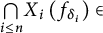 $ {\textstyle \bigcap \limits _{i\leq n}} X_{i}\left ( f_{\delta _{i}}\right ) \in $
bscatt
 $^{+}$
. Since
 $X_{i}\left ( f_{\delta _{i}}\right ) \subseteq B_{i},$
this finishes the proof of the claim. We now invoke Zorn’s Lemma and find
 $\mathcal {A}_{\delta }\subseteq W_{\delta }$
extending
 $\mathcal {A}_{<\delta }$
as desired.
After completing the recursion, define
 $\mathcal {A=} {\textstyle \bigcup \limits _{\delta \in D}} \mathcal {A}_{\delta }$
and
 $\ \mathcal {U}$
as the set of all
 $B\subseteq \mathbb {Q}$
for which there is
 $U\in {\textstyle \bigcup \limits _{\delta \in D}} \mathcal {U}_{\delta }$
for which
 $B\subseteq U.$
We will now prove the following.
Claim 40
-
1.
$\mathcal {U\cup A}$
generates a filter contained in bscatt
$^{+}.$
-
2.
$\mathcal {U=A}.$
-
3.
$\mathcal {U}$
is an ultrafilter. -
4.
$\mathcal {U}$
is a Gruff ultrafilter.


The first point is easy, we now prove that
 $\mathcal {U=A}.$
We will first see that
 $\mathcal {U\subseteq A}.$
Let
 $U\in \mathcal {U},$
find
 $\delta \in D$
and
 $M\in \mathcal {S}$
such that there is
 $B\in \mathcal {U}_{\delta }$
for which
 $B\subseteq U$
and
 $B,U\in M.$
It is clear that
 $\mathcal {U}_{\delta } \cup \mathcal {A}_{\delta }\cup \left \{ U\right \} $
generates a filter contained in bscatt
 $^{+}.$
Since
 $U\in W_{\delta },$
it follows by the maximality of
 $\mathcal {A}_{\delta }$
that
 $U\in \mathcal {A}_{\delta }.$
We now prove that
 $\mathcal {A\subseteq U}.$
Let
 $A\in \mathcal {A}_{\delta }$
for some
 $\delta \in D.$
We now choose
 $\gamma \in D$
and
 $M\in \mathcal {S}$
such that
 $\delta _{M}=\gamma $
and
 $A,\delta \in M.$
Since
 $A\in \mathcal {A}_{<\gamma },$
it follows that
 $K=K\left ( A\right ) $
is also in
 $\mathcal {A}_{<\gamma }.$
In this way,
 $K\left ( f_{\gamma }\right ) \in \mathcal {U}_{\gamma }$
and then
 $A\in \mathcal {U}.$
The proof that
 $\mathcal {U}$
is an ultrafilter is similar to arguments used in the proof of Theorems 14 and 28. Finally, it is Gruff since
 $ {\textstyle \bigcup \limits _{\delta \in D}} \mathcal {U}_{\delta }$
is a base of
 $\mathcal {U}$
consisting of perfect sets.
8 Combinatorics of elementary submodels
Our current goal now is to prove that multiple
 $\mathfrak {d}$
-pathways may consistently exist. We will derive several combinatorial results concerning countable elementary submodels which are the new insight for the main theorems of the article. The results in this section do not directly refer to pathways and may be of independent interest.
Fix a regular cardinal
 $\kappa>\mathfrak {c}$
and
 $\trianglelefteq $
a well order of H
 $\left ( \kappa \right ) .$
The following result is well-known, we prove it for completeness.
Lemma 41 (CH)
Assume that
 $M,N\in $
Sub
 $\left ( \kappa \right ) $
and
 $\delta _{M}\leq \delta _{N}.$
H
 $\left ( \omega _{1}\right ) \cap M\subseteq $
H
 $\left ( \omega _{1}\right ) \cap N.$
Proof Let
 $g:\omega _{1}\longrightarrow $
H
 $\left ( \omega _{1}\right ) $
be the
 $\trianglelefteq $
-minimal bijection, so it is in both M and
 $N.$
Since H
 $\left ( \omega _{1}\right ) \cap M=g\left [ \delta _{M}\right ] $
and H
 $\left ( \omega _{1}\right ) \cap N=g\left [ \delta _{N}\right ] ,$
the result follows.
We now extend the previous lemma.
Lemma 42 (CH)
Let
 $M,N\in $
Sub
 $\left ( \kappa \right ) $
with
 $\delta _{M}\leq \delta _{N}.$
If
 $A\in M\cap N$
and is a countable subset of the ordinals, then
 $\mathcal {P}\left ( A\right ) \cap M\subseteq N.$
Proof Let
 $B\in \mathcal {P}\left ( A\right ) \cap M$
and
 $\gamma =$
OT
 $\left ( A\right ) <\omega _{1}.$
Denote by
 $e:A\longrightarrow \gamma $
the (unique) order isomorphism. Since
 $A\in M\cap N,$
it follows that
 $e\in M\cap N.$
Clearly
 $e\left [ B\right ] \in $
H
 $\left ( \omega _{1}\right ) \cap M$
, so
 $e\left [ B\right ] \in N$
by Lemma 41. Since
 $e^{-1}$
is also in
 $N,$
it follows that
 $B\in N.$
If A is a set of ordinals, we denote by
 $\overline {A}$
its closure in the usual order topology. It is easy to see that the closure of a countable set is also countable. In particular, if
 $M\in $
Sub
 $\left ( \kappa \right ) $
and
 $A\in M$
is a countable set of ordinals, then
 $\overline {A}\subseteq M.$
For us, a partition P is simply a collection of pairwise disjoint sets (
 $\emptyset \in P$
is allowed) and a partition for a set A is a partition whose union is
 $A.$
Lemma 43 (CH)
Let
 $M,N\in $
Sub
 $\left ( \kappa \right ) $
with
 $\delta _{M}\leq \delta _{N}, n\in \omega ,$
and
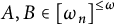 $A,B\in \left [ \omega _{n}\right ] ^{\leq \omega }$
such that
 $A\in M$
and
 $B\in N.$
-
1. There is a partition
$P=\left \{ A_{0},A_{1}\right \} \in M$
of A such that
$A_{0}\in N$
and
$A_{1}\cap B=\emptyset .$
-
2.
$A\cap B\in N .$



Proof Note that the second point is a trivial consequence of the first. We prove the first point by induction over
 $n.$
For
 $n\leq 1,$
we have that
 $A\in N$
by Lemma 41, so we simply let
 $A_{0}=A\cap B$
and
 $A_{1}=A\setminus B.$
Assume the lemma is true for
 $n,$
we prove that it is true for
 $n+1$
as well. Denote
 $\beta = {\textstyle \bigcup } \overline {A\cap B}+1$
and note that
 $\beta \in M\cap N.$
Fix
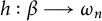 $h:\beta \longrightarrow \omega _{n}$
be the
 $\trianglelefteq $
-least injective function, clearly
 $h\in M\cap N.$
Define
 $C=h\left [ A\cap \beta \right ] $
and
 $D=h\left [ B\cap \beta \right ] ,$
we have that
 $C\in M$
and
 $D\in N.$
We can now apply the inductive hypothesis and find a partition
 $\left \{ C_{0} ,C_{1}\right \} \in M$
of C such that
 $C_{0}\in N$
and
 $C_{1}\cap D=\emptyset .$
Letting
 $A_{0}=h^{-1}\left ( C_{0}\right ) $
and
 $A_{1} =A\setminus h^{-1}\left ( C_{0}\right ) ,$
we have that
 $\left \{ A_{0} ,A_{1}\right \} \in M$
and
 $A_{0}\in N.$
We only need to prove that
 $A_{1}\cap B=\emptyset .$
Assume that there is
 $\alpha \in A_{1}\cap B,$
it follows that
 $\alpha <\beta $
and
 $h\left ( \alpha \right ) \in C\setminus C_{0}=C_{1}.$
In this way,
 $h\left ( \alpha \right ) \in C_{1}\cap D,$
but this is a contradiction since
 $C_{1}\cap D=\emptyset .$
The following definition plays a similar role to the finite partitions used in [Reference Dow20].
Definition 44 Let
 $\left \langle M_{0},\dots ,M_{n}\right \rangle $
be a
 $\delta $
-increasing sequence of models from Sub
 $\left ( \kappa \right ) $
. We say that
 $\mathcal {P}=\left \langle P_{i}\mid i\leq n\right \rangle $
is a coherent sequence of partitions for
 $\left \langle M_{0},\dots ,M_{n}\right \rangle $
if for every
 $i\leq n,$
the following conditions hold:
-
1.
$P_{i}\in M_{i}$
and is a finite partition consisting of countable subsets of the ordinals. -
2. If
$i<j,$
then
$P_{i}\cap M_{j}\subseteq P_{j}.$
-
3.
$ {\textstyle \bigcup \limits _{j\leq n}} P_{j}$
is a partition.




The next lemma illustrates how to construct non-trivial coherent sequences of partitions.
Lemma 45 (CH)
Let
 $\left \langle M_{0},\dots ,M_{n}\right \rangle $
be a
 $\delta $
-increasing sequence of models from Sub
 $\left ( \kappa \right ) $
,
 $l\in \omega ,$
and
 $A_{i}\in M_{i}\cap \left [ \omega _{l}\right ] ^{\leq \omega }$
for every
 $i\leq n.$
There is
 $\mathcal {P}=\left \langle P_{i}\mid i\leq n\right \rangle $
a coherent sequence of partitions for
 $\left \langle M_{0},\dots ,M_{n}\right \rangle $
such that
 $A_{i}\subseteq \cup P_{i}$
for every
 $i\leq n.$
Proof We proceed by induction over
 $n.$
For
 $n=0,$
we simple take
 $P_{0}=\left \{ A_{0}\right \} $
and we are done. Assume the lemma is true for
 $n,$
we will see it is true for
 $n+1$
as well. Find
 $\left \langle P_{i}\mid i\leq n\right \rangle $
a coherent sequence of partitions for
 $\left \langle M_{0},\dots ,M_{n}\right \rangle $
such that
 $A_{i}\subseteq \cup P_{i}$
for every
 $i\leq n.$
Claim 46 There is
 $\left \langle R_{i}\mid i\leq n\right \rangle $
a coherent sequence of partitions for
 $\left \langle M_{0},\dots ,M_{n}\right \rangle $
with the following properties:
-
1.
$\cup P_{j}\subseteq \cup R_{j}$
for every
$j\leq n.$
-
2. For every
$B\in {\textstyle \bigcup \limits _{i\leq n}} R_{i},$
we have that
$B\cap A_{n+1}\in M_{n+1}.$



Denote
 $P= {\textstyle \bigcup \limits _{i\leq n}} P_{i}.$
Pick
 $C\in P$
and
 $i\leq n$
the minimal one for which
 $C\in P_{i}.$
We can apply Lemma 43 and find a partition
 $\left \{ C_{0},C_{1}\right \} \in M_{i}$
of C such that
 $C_{0}\in M_{n}$
and
 $A_{n+1}\cap C_{1}=\emptyset .$
Define
 $R=\left \{ C_{u}\mid C\in P\wedge u\in 2\right \} $
and for every
 $i\leq n,$
denote
 $R_{i}=R\cap M_{i}.$
We claim that
 $\left \langle R_{i}\mid i\leq n\right \rangle $
is as desired. Clearly, R is a partition, if
 $B\in R$
then
 $B\cap A_{n+1}\in M_{n+1}$
and if
 $i<j,$
then
 $R_{i}\cap M_{j}=R\cap M_{i}\cap M_{j}=R_{j}\cap M_{i}\subseteq R_{j}.$
It remains to prove that
 $\cup P_{j}\subseteq \cup R_{j}$
for every
 $j\leq n.$
Let
 $C\in P_{j}$
and find
 $i\leq j$
the first one for which
 $C\in P_{i}.$
Note that
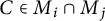 $C\in M_{i}\cap M_{j}$
and
 $\delta _{i}\leq \delta _{j},$
so by Lemma 42, we know that
 $\mathcal {P}\left ( C\right ) \cap M_{i}\subseteq M_{j},$
which entails that
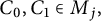 $C_{0},C_{1}\in M_{j},$
hence
 $C_{0},C_{1}\in R_{j}.$
This finishes the proof of the claim.
Fix
 $\left \langle R_{i}\mid i\leq n\right \rangle $
as above. Define
 $R_{n+1}=(M_{n}\cap {\textstyle \bigcup \limits _{i\leq n}} R_{i})\cup \{A_{n+1}\setminus {\textstyle \bigcup \limits _{i\leq n}} R_{i}\}.$
It is easy to see that
 $\left \langle R_{i}\mid i\leq n+1\right \rangle $
is as desired.
We now prove the final result of this section, which will enable us to transfer certain names across elementary submodels.
Proposition 47 (CH)
Let
 $\left \langle M_{0},\dots ,M_{n}\right \rangle $
be a
 $\delta $
-increasing sequence of models from Sub
 $\left ( \kappa \right ) $
,
 $l\in \omega ,$
and
 $\mathcal {P}=\left \langle P_{i}\mid i\leq n\right \rangle $
a coherent sequence of partitions for
 $\left \langle M_{0},\dots ,M_{n}\right \rangle $
, where
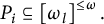 $P_{i}\subseteq \left [ \omega _{l}\right ] ^{\leq \omega }.$
There is a bijection
 $\triangle :\omega _{l}\longrightarrow \omega _{l}$
with the following properties:
-
1. If
$A\in {\textstyle \bigcup \limits _{i\leq n}} P_{i},$
then
$\triangle \left [ A\right ] \in M_{n}$
and
$\triangle \upharpoonright A$
is order preserving. -
2. If
$A\in P_{n},$
then
$\triangle \upharpoonright A$
is the identity mapping.


Proof Take an enumeration
 $\left \{ A_{0},\dots ,A_{m}\right \} $
of all elements of
 $ {\textstyle \bigcup \limits _{i<n}} P_{i}$
that are not in
 $P_{n}$
and denote
 $Y= {\textstyle \bigcup } {\textstyle \bigcup \limits _{i\leq n}} P_{i}.$
Choose
 $\beta <\delta _{n}$
such that OT
 $\left ( Y\right ) <\beta $
and
 $Y\cap \omega _{1}\subseteq \beta .$
For each
 $k\leq m,$
denote
 $\gamma _{k}=$
OT
 $\left ( A_{k}\right ) $
and
 $e_{k}:A_{k} \longrightarrow \gamma _{k}$
the (unique) order isomorphism. Define
 $\triangle _{k}:A_{k}\longrightarrow \omega _{1}$
, where
 $\triangle _{k}\left ( \alpha \right ) =\beta \left ( k+1\right ) +e_{k}\left ( \alpha \right ) $
and note that im
 $\left ( \triangle _{k}\right ) =[\beta \left ( k+1\right ) ,\beta \left ( k+1\right ) +\gamma _{k}),$
which belongs to
 $M_{n}$
since
 $\beta ,\gamma _{k}\in M_{n}.$
Moreover, note that if
 $k\neq r,$
then im
 $\left ( \triangle _{k}\right ) \cap $
im
 $\left ( \triangle _{r}\right ) =\emptyset $
and if
 $A\in P_{n},$
then
 $A\cap \omega _{1}\subseteq \beta $
, while im
 $\left ( \triangle _{k}\right ) \cap \beta =\emptyset $
for every
 $k\leq m,$
so im
 $\left ( \triangle _{k}\right ) $
and A are disjoint. In this way, we can extend
 $ {\textstyle \bigcup \limits _{k\leq m}} \triangle _{k}$
to a permutation of
 $\omega _{l}$
that fixes every element of
 $P_{n}.$
9 Forcing multiple
$\mathfrak {d}$
-pathways

We now apply the results from the previous section to establish the existence of multiple
 $\mathfrak {d}$
-pathways in certain random and Cohen models. Having that goal in mind, we need to introduce a couple of definitions.
Definition 48 Let
 $\mathbb {P}$
be a partial order and
 $\dot {a},\dot {b}$
two
 $\mathbb {P} $
-names. We say that
 $\dot {a}$
and
 $\dot {b}$
are equivalent if
 $\mathbb {P}\Vdash $
“
 $\dot {a}=\dot {b}$
”.
We now introduce the main definition of this section.
Definition 49 Let
 $\mathbb {P}$
be a partial order. We say that
 $\mathbb {P}$
has the transformation property if for every large enough regular
 $\kappa $
,
 $\left \langle M_{0},\dots ,M_{n}\right \rangle $
a
 $\delta $
-increasing sequence of models in Sub
 $\left ( \kappa \right ) $
, where
 $\mathbb {P}\in M_{i}$
for every
 $i\leq n$
,
 $\dot {a}_{0}\in M_{0},\dots ,\dot {a}_{n}\in M_{n}$
that are
 $\mathbb {P}$
-names for subsets of
 $\omega ,$
there is an automorphism
 $H:\mathbb {P\longrightarrow P}$
such that:
-
1.
$H\left ( \dot {a}_{n}\right ) =\dot {a}_{n}.$
-
2. For every
$i<n$
, we have that
$H(\dot {a}_{i})$
is equivalent to a
$\mathbb {P}$
-name that is in
$M_{n}.$



It is worth pointing out that the automorphism H is not required to be in
 $M_{n}.$
Note that we obtain an equivalent definition if we take each
 $\dot {a}_{i}$
to be a
 $\mathbb {P}$
-name for an element of
 $\omega ^{\omega }$
, or even a
 $\mathbb {P}$
-name for a pair of functions from
 $\omega ^{\omega }$
(instead of a
 $\mathbb {P}$
-name for a subset of
 $\omega $
).
We recommend the reader to consult Section 3 as we will be using the notation and results from there.
Theorem 50 (CH)
Let
 $\mathbb {P}$
be a ccc forcing that does not add dominating reals and has the transformation property.
 $\mathbb {P}$
forces that there is a multiple
 $\mathfrak {d}$
-pathway.
Proof Choose
 $\mathcal {B}=\left \{ f_{\alpha }\mid \alpha \in \omega _{1}\right \} \subseteq \omega ^{\omega }$
a scale of increasing functions,
 $\kappa $
a large enough regular cardinal such that
 $\mathbb {P\in }$
H
 $\left ( \kappa \right ) .$
Define
 $\mathcal {S}_{0}=\{M\mid M\in $
Sub
 $\left ( \kappa \right ) \wedge \mathcal {B},\mathbb {P}\in M\},$
which is stationary. We claim that if
 $G\subseteq \mathbb {P}$
is a generic filter, then in
 $V\left [ G\right ] $
we will have that
 $\left ( \mathcal {B},\mathcal {S}\right ) $
is a multiple
 $\mathfrak {d}$
-pathway, where
 $\mathcal {S}=\{M\left [ G\right ] \mid M\in \mathcal {S}\}.$
Since
 $\mathbb {P}$
is ccc,
 $\mathcal {S}$
is forced to be stationary,
 $M\left [ G\right ] \cap V=M$
and
 $\delta _{M\left [ G\right ] }=\delta _{M}$
for every
 $M\in \mathcal {S}_{0}$
(see [Reference Shelah46, Reference Todorcevic, Chong, Feng, Yang, Slaman and Woodin51]).
Let
 $p\in \mathbb {P}, \left \langle M_{0},\dots ,M_{n}\right \rangle $
a
 $\delta $
-increasing sequence of models in
 $\mathcal {S}_{0}$
,
 $\dot {x}_{0}\in M_{0},\dots ,\dot {x}_{n}\in M_{n}$
that are
 $\mathbb {P}$
-names for elements of
 $\omega ^{\omega }$
and
 $\dot {R}\in M_{n}$
a name for a projective and
 $\leq ^{\ast }$
-adequate relation. We will now apply the transformation property of
 $\mathbb {P}.$
For
 $i<n,$
let
 $\dot {a}_{i}=\dot {x}_{i}$
, let
 $\dot {u}$
be a
 $\mathbb {P}$
-name for an element of
 $\omega ^{\omega }$
that is forced to code
 $\dot {R}$
(this is possible since
 $\dot {R}$
is forced to be a projective relation) and let
 $\dot {a}_{n}$
be a
 $\mathbb {P}$
-name for the pair
 $(\dot {u},\dot {x}_{n}).$
By the transformation property, we can find an automorphism
 $H:\mathbb {P\longrightarrow P}$
such that
 $H\left ( \dot {x}_{i}\right ) $
is equivalent to a name in
 $M_{n}$
for every
 $i\leq n, H\left ( \dot {x} _{n}\right ) =\dot {x}_{n}$
and
 $H(\dot {R})=\dot {R}.$
Since
 $\dot {R}$
is forced to be
 $\leq ^{\ast }$
-adequate, there is
 $\dot {g}\in M_{n}$
a
 $\mathbb {P}$
-name that is forced to be an
 $\dot {R}$
-control for
 $\left ( H\left ( \dot {x} _{0}\right ) ,\dots ,H\left ( \dot {x}_{n}\right ) \right ) .$
Since
 $\mathbb {P}$
does not add dominating reals and is ccc, we know that
 $H\left ( p\right ) \Vdash $
“
 $f_{\delta _{n}}\nleq ^{\ast }\dot {g}$
”. Therefore, we know that
 $H\left ( p\right ) \Vdash $
“
 $H(\dot {R})\left ( H\left ( \dot {x}_{0}\right ) ,\dots ,H\left ( \dot {x}_{n}\right ) ,f_{\delta _{n}}\right ) $
” and since H is an isomorphism, with the aid of Proposition 1, we conclude that
 $p\Vdash $
“
 $\dot {R}\left ( \dot {x}_{0},\dots ,\dot {x} _{n},f_{\delta _{n}}\right ) $
”.
Both Cohen and random forcings are ccc and do not add dominating reals (random forcing does not even add unbounded reals, see [Reference Bartoszyński and Judah3]). Our next goal is to show that they have the transformation property. For the remainder of the section, l will denote a natural number,
 $\mathbb {P}\left ( I\right ) $
will be either Cohen or random forcing (where
 $I\subseteq \omega _{l}$
) and
 $\kappa $
a large enough regular cardinal.
Proposition 51 (CH)
Let
 $M,N\in $
Sub
 $\left ( \kappa \right ) $
with
 $\delta _{M}\leq \delta _{N}, I\in M\cap \left [ \omega _{l}\right ] ^{\omega }$
, and
 $\dot {a}\in M$
a
 $\mathbb {P}\left ( I\right ) $
-name for a subset of
 $\omega .$
If
 $\triangle :\omega _{l}\longrightarrow \omega _{l}$
a permutation for which there is
 $P\in M$
a finite partition of I such that for every
 $A\in P$
we have that
 $\triangle \upharpoonright A$
is order preserving and
 $\triangle \left [ A\right ] \in N,$
then
 $\triangle _{\ast }\left ( \dot {a}\right ) $
is equivalent to a name in
 $N.$
Proof Take an enumeration
 $P=\left \{ P_{i}\mid i\leq n\right \} $
and choose
 $\beta <\delta _{M}$
a limit ordinal larger than OT
 $\left ( I\right ) .$
For each
 $i\leq n,$
denote
 $\gamma _{i}=$
OT
 $\left ( P_{i}\right ) $
and
 $e_{i}:P_{i}\longrightarrow \gamma _{i}$
the only isomorphism. Since
 $\triangle $
is order preserving in each
 $P_{i},$
we know that
 $\gamma _{i}$
is isomorphic to
 $\triangle \left [ P_{i}\right ] $
as well. Let
 $\widehat {e}_{i}:\triangle \left [ P_{i}\right ] \longrightarrow \gamma _{i}$
be the only isomorphism. Note that
 $e_{i}\in M$
and
 $\widehat {e}_{i}\in N.$
We now define the function:

Clearly,
 $h=g\circ \triangle $
and im
 $\left ( h\right ) =$
im
 $\left ( g\right ) .$
We have the isomorphisms
 $h_{\ast }: \mathbb {P}\left ( I\right ) \longrightarrow \mathbb {P}\left ( h\left [ I\right ] \right ) $
and
 $g_{\ast }:\mathbb {P}\left ( \triangle \left [ I\right ] \right ) \longrightarrow \mathbb {P}\left ( h\left [ I\right ] \right ) $
. Note that
 $h,h_{\ast }\in M$
and
 $g,g_{\ast }\in N.$
Denote
 $\dot {b}=h_{\ast }\left ( \dot {a}\right ) ,$
which is a
 $\mathbb {P}\left ( h\left [ I\right ] \right ) $
-name. Since
 $h\left [ I\right ] $
is a countable subset of
 $\omega _{1},$
since
 $\mathbb {P}\left ( h\left [ I\right ] \right ) $
is ccc, we can code
 $\dot {b}$
as an element of
 $M\cap $
H
 $\left ( \omega _{1}\right ) $
and by Lemma 41, we conclude that
 $\dot {b}\in N.$
In this way, we know that
 $\dot {c}=g_{\ast }^{-1}(\dot {b})$
is a
 $\mathbb {P}\left ( \triangle \left [ I\right ] \right ) $
-name that is in
 $N.$
In this way, in order to prove that
 $\triangle _{\ast }\left ( \dot {a}\right ) $
is in
 $N,$
it is enough to show that it is equal to
 $\dot {c}.$
Let
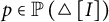 $p\in \mathbb {P}\left ( \triangle \left [ I\right ] \right ) $
and
 $n\in \omega .$
Using Propositions 1 and 3, we obtain the following:

We conclude that
 $\triangle _{\ast }\left ( \dot {a}\right ) $
and
 $\dot {c}$
are equivalent. Since
 $c\in N$
, the proof is finished.
We can finally prove the following.
Proposition 52 (CH)
 $\mathbb {P}\left ( \omega _{l}\right ) $
has the transformation property.Footnote
7
Proof Let
 $\kappa $
be a regular large enough cardinal,
 $\left \langle M_{0} ,\dots ,M_{n}\right \rangle $
a
 $\delta $
-increasing sequence of models from Sub
 $\left ( \kappa \right ) $
and
 $\dot {a}_{0}\in M_{0},\dots ,\dot {a}_{n}\in M_{n}$
be
 $\mathbb {P}\left ( \omega _{l}\right ) $
names for subsets of
 $\omega .$
For every
 $i\leq n,$
find
 $A_{i}\in M_{i}\cap \left [ \omega _{l}\right ] ^{\omega }$
such that
 $\dot {a}_{i}$
is a
 $\mathbb {P}\left ( A_{i}\right ) $
-name. We now use Lemma 45 to summon
 $\mathcal {P}=\left \langle P_{i}\mid i\leq n\right \rangle $
a coherent sequence of partitions for
 $\left \langle M_{0},\dots ,M_{n}\right \rangle $
such that
 $A_{i}\subseteq \cup P_{i}$
for every
 $i\leq n.$
Denote
 $I_{i}=\cup P_{i}$
for every
 $i\leq n.$
Clearly,
 $I_{i}\in M_{i}$
and
 $\dot {a}_{i}$
is a
 $\mathbb {P}\left ( I_{i}\right ) \,$
-name. We now invoke Proposition 47 to find a permutation
 $\triangle :\omega _{l} \longrightarrow \omega _{1}$
such that is the identity in every element of
 $P_{n}$
and for every
 $B\in {\textstyle \bigcup } P_{i}$
it is the case that
 $\triangle \left [ B\right ] \in M_{n}$
and
 $\triangle \upharpoonright B$
is order preserving. Finally, by Proposition 51, we know that
 $\triangle _{\ast }\left ( \dot {a} _{i}\right ) $
is equivalent to a name in
 $M_{n}$
for every
 $i\leq n.$
Moreover, since
 $\triangle \upharpoonright I_{n}$
is the identity, we get that
 $\triangle _{\ast }\left ( \dot {a}_{n}\right ) =\dot {a}_{n}.$
We can now conclude.
Corollary 53 (CH)
Let
 $l<\omega .$
Both
 $\mathbb {C}\left ( \omega _{l}\right ) $
and
 $\mathbb {B}\left ( \omega _{l}\right ) $
force that there is a multiple
 $\mathfrak {d}$
-pathway.
In particular,
Theorem 54 (CH)
Let
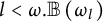 $l<\omega. \mathbb {B}\left ( \omega _{l}\right ) $
force that there is a strong P-point and a Gruff ultrafilter.
Of course, this is also true for Cohen forcing, but it is not new since the existence of a Gruff ultrafilter and a strong P-point follow from
 $\mathfrak {d=c}$
(see [Reference Fernández-Bretón and Hrušák24, Reference Guzmán, Hrušák and Martínez-Celis27]).
10 Open questions
We now list some questions we do not know how to solve. The most important one is the following.
Problem 55 Are there P-points (Gruff ultrafilters, strong P-points) in every model obtained by adding any number of random reals to a model of CH?
It would be enough to provide a positive answer to the following.
Problem 56 Does CHimply that
 $\mathbb {C}\left ( \kappa \right ) $
and
 $\mathbb {B}\left ( \kappa \right ) $
have the transformation property for any cardinal
 $\kappa $
?
In [Reference Dow20] the first author proved that there will be an ultrafilter that does not contain a nowhere dense P-subfilter (equivalently,
 $\omega ^{\ast }$
can not be covered by nowhere dense P-sets) after adding
 $\omega _{2}$
Cohen reals to a model of CH
 $+ \square _{\omega _{1}}$
. Building on the ideas developed in this article and in [Reference Dow20], we were able to construct such an ultrafilter after adding fewer than
 $\aleph _{\omega }$
Cohen reals over a model of CH,this result will appear in another paper.
Acknowledgements
We would like to thank Michael Hrušák and Juris Steprāns for several helpful discussions related to the topic of this article. We would also like to thank the referee for their comments, which greatly improved the article.






