Philosophers have often been at a loss to explain the secret of the strange power which patriotic tunes seem to exercise over the people . . . but the mystery is at an end if we are willing to attribute to music the power which I have claimed for it, of pitching high the plane of the emotions, and driving them home with the most efficacious and incomparable energy.
— Hugh Reginald Haweis, Music and Morals Footnote 1When the cleric and musical theorist Hugh Reginald Haweis, writing in the 1870s, sought to epitomize his belief in the emotional power of music, he turned to the sphere of national politics. Eighty years earlier, British loyalists reacting to the French Revolution turned just as naturally to music: in a much-quoted letter to the activist John Reeves, “A friend to Church and State” maintained that “any thing written in voice & especially to an Old English tune . . . made a more fixed Impression on the Minds of the Younger and Lower Class of People, than any written in Prose.”Footnote 2 Across the eight intervening decades, these opinions were repeatedly put into practice, as political actors sought to use music “as a powerful secondary agent to deepen and intensify the emotion already awakened by the words of [their creed].”Footnote 3 Music's potency was understood to inhere in its ability to arouse and amplify the passions—and though the underlying medical theories shifted over the century, the idea remained: music had a power to mobilize, energize, even effect action by engaging body, spirit and mind. I discuss three cases when the emotional power of music, particularly song, had direct political consequences. The first instance, concerning the proposed use of counterrevolutionary music in the Royal Navy, was unintended. The second, concerning the political activist Samuel Bamford, was highly purposeful. The third, concerning performances of the blackface song “Buffalo Gals,” was a complex negotiation between ostensibly innocent intent and insidious consequence. Taken together, they bear out Haweis's belief in the political potency of music—whether by design or otherwise.
Reaction
In 1799, newly secure in the living of Bolam, Northumberland, a parish granted him by the lord chancellor,Footnote 4 Reverend Alexander Duncan published by subscription his Miscellaneous essays, naval, moral, political, and divine, sold at London and Yarmouth at the optimistic price of three shillings.Footnote 5 He dedicated the work to “the right honourable Lord Duncan, Viscount Camperdown, Baron Lundie of Lundie, Admiral of the White Division, and Commander in Chief, in the North Seas, &c.” This exalted personage was, unsurprisingly, Alexander Duncan's uncle, on whose flagships, the Venerable and the Kent, he served as chaplain between 1796 and 1800, seeing action at Camperdown in October 1797, the first major victory to follow the mass mutinies at Spithead and the Nore.Footnote 6 It was in this context of personal nepotism and public unease that Duncan's Essays appeared—a bold if ill-advised decision that may well have led to his retiring from the sea, never to write again, within months of publication.
Duncan presumed too much upon his position: naval chaplains were held in low regard, and two reviewers took exception to his presuming to write on naval matters at all.Footnote 7 Set against this, he advocated an uncompromising, reactionary, martial loyalism that toed the government line on the war with France: one otherwise hostile reviewer praised his “ardent spirit of patriotism,” while the Anti-Jacobin Review allowed, “The spirit of piety and loyalty that pervades these Essays, and the evident good intentions of the author, must soften the rigour of critical disquisition.”Footnote 8 Nonetheless, Duncan's patriotism was found wanting in his controversial second essay. The anonymous reviewer observed, “To keep alive the courage of our seamen, Dr. D. proposes that ‘martial songs should be learned and sung occasionally.’ He remarks that ‘in going into action against an enemy, martial music has the finest effect possible.’—‘You can work more instantaneously upon the passions in this way than in any other almost you can name’ . . . we trust that the courage of our seamen will never be at so low an ebb as to need the assistance of an old song.”Footnote 9
Duncan's suggestion, which he defended as “calculated to preserve, and keep alive, a high spirit of magnanimity, heroism, and bravery, on board,” had its parallels. Several contemporary clerics, such as James Plumptre of Hinxton, Cambridgeshire, turned to songs to improve popular conduct on both local and national levels, while the sea songs of Charles Dibdin the Elder were widely credited not only with motivating sailors but with actively discouraging mutinies.Footnote 10 Yet Duncan was not simply proposing “the assistance of an old song.” He suggested that: “A band of music should be allowed each ship of the line, full and complete; even the smallest vessel in the service ought not to be without music of some kind or other.”Footnote 11 His reasoning was based upon the direct power of music, whether vocal or instrumental. Yet in so doing, Duncan unwittingly cited a highly problematic example: “We shall quote an instance . . . from the French. Few are ignorant of the wonderful effects produced upon their mad republican desperadoes, by their vocal and instrumental music, when going into battle. We have heard some of their tunes introduced into our service on shore.—The music is certainly enlivening and animating in a high degree, and might be useful in promoting our purpose . . . what might we not expect in a better cause, from similar martial songs and tunes, both vocal and instrumental . . . ?”Footnote 12
Duncan seems to have been oblivious to the dangers of his own reasoning. The last thing the strictly regulated Royal Navy would welcome, still reeling from the mutinies of 1797, was music along the lines of the “Marseillaise” and “Ça ira,” calculated to work “upon the passions,” to be “enlivening and animating.” The two nations’ military approaches were ideologically opposed: the French army consisted of relatively untrained conscripts formed into massed columns, metaphorically whipped into a fervor of fraternal feeling in order to sustain morale and compensate for a lack of professionalism; the British forces were increasingly professionalized, their soldiers drawn up in thin red lines to maximize firepower at the expense of solidarity, their sailors drugged into a quiescent stupor by a daily ration of rum, with both soldiers and sailors literally whipped into a state of rigid discipline. The ideal British serviceman executed his duties not with zeal but mechanistically, and consequently the only music permitted on duty at sea was that of fife and drum, used purely for signaling purposes. While the army provided wider opportunities for musicians in the form of regimental bands, once on the field of battle these musicians would down their instruments and become auxiliary paramedics.Footnote 13 And throughout the nineteenth century, the great age of the sea shanty, the Royal Navy forbade its sailors to sing while at work.Footnote 14 The French were mobilized citizens, the British enlisted subjects, by which rationale Duncan's naïve enthusiasm for inspirational music was not merely misplaced but alarming: the very suggestion, treating sailors as autonomous men of feeling, smacked of democracy.
Duncan's was not quite a lone voice. A decade earlier, a naval surgeon (a creature of similar negligible status to a naval chaplain), Charles Fletcher, published a tract on the health of seamen, supported by his patron the Duke of Cumberland and dedicated to the Duke of Clarence (later William IV), himself a sailor.Footnote 15 In a chapter on “Chearfulness,” Fletcher praised those few captains who, at their own expense, provided “small bands for their [sailors’] entertainment,” declaring that it would “be well in government to make some addition to the Marine music.”Footnote 16 Yet Fletcher, though writing before the French Revolution, was more circumspect than Duncan: “It need hardly be mentioned, that the word chearful is not meant here, to imply riot or any kind of dissoluteness; which must be subversive of all order: but that hilarity of spirit, which is not only a preservative of health, but which may be made subservient to laudable action.”Footnote 17 Fletcher stressed this pragmatist position further: “I have remarked something like a superior degree of health and happiness in those people among whom this chearfulness has been most cultivated. And I have also observed those ships to which they belonged make good battle. Let it not therefore be said, that . . . a relaxation of discipline might ensue.”Footnote 18 The thrust of his argument concerned music as recreation rather than in combat.Footnote 19 Even in the 1780s, Fletcher understood the danger that music was seen as posing to discipline, a necessary corollary to its putative advantages.Footnote 20
Fletcher's views are in accordance with the prevailing medical consensus on the power of music, described by fellow Scottish physician John Gregory as “perhaps greater than that of any of the fine arts. It is capable of raising every passion and emotion of the soul.”Footnote 21 Fletcher, Gregory, and their contemporaries Richard Browne and Richard Brocklesby all wrote and lectured on the potential of music as a stimulant that worked upon the passions by altering the flow of bodily spirits, communicated to the body via vibrations passed from the external ear to the auditory nerve.Footnote 22 This was understood as an embodied process, which led to obvious anxieties when applied to the mass of the people: the prospect of the irrational stimulation of the multitude in an age of revolution would naturally be distrusted by the British military authorities as likely to result in precisely that “riot” and subversion of order that Fletcher decried. In the 1790s, Duncan's proposal of animating the British sailor in battle with instrumental music was tantamount to giving him a liberty cap and asking him to sing the “Marseillaise,” so invidious was music held to be as a stimulant. Put another way, the addition of music to the body under arms transformed it into the body politic by dint of playing upon its passions. In what follows, we shall see that the authorities were right to reject Duncan's suggestions: music that animated organized bodies of men could have powerfully subversive consequences.
Reform
It took twenty years for these anxieties to be realized. In 1819, Samuel Bamford, a Lancashire weaver, stood trial as an organizer of Manchester's St. Peter's Field demonstration, which was already acquiring the infamous nickname “Peterloo.” The government's reputation depended upon proving that the protest had been militant, therefore justifying its suppression. Music was central to their case. Bamford's own account did not deny the event's martial overtones, in preparation for which ten thousand protestors practiced drills to the directions of a bugle used “to sound his orders.”Footnote 23 Marchers assembled into square and column—military formations—and moved to fife and drum.Footnote 24 In his defense, Bamford sought to “prove the object of the music, and the use made of it, in playing national and loyal airs.”Footnote 25 Elsewhere, he stressed the innocuousness of their “band of music,” claiming, “A hundred or two of our handsomest girls . . . danced to the music, or sung snatches of popular songs.” He added, “At Newtown we were welcomed with open arms by the poor Irish weavers . . . Some of them danced . . . We thanked them by the band striking up, ‘Saint Patrick's day in the morning;’ they were electrified; and we passed on, leaving those warm-hearted suburbans capering and whooping like mad.”Footnote 26
If this testimony formed part of Bamford's defense, it cannot have endeared him to the judge. This was the spectacle feared during the 1790s: the people “electrified,” their passions worked upon through martial musical mobilization. Nor was Bamford's point about “loyal and national airs” disingenuous, for, as early as 1815, he had made a habit of writing parodies of these airs, putting new lyrics to tunes such as “God Save the King” to subvert their message.Footnote 27
A facility for seditious parody ran deep in Bamford's family: his grandfather had refashioned the ballad “Sally in Our Alley” into a treasonable Jacobite song.Footnote 28 Bamford also remembered his father as an excellent flautist and singer with “a deep taste for melody [who] introduced several of his pieces amongst the religious body with which he was connected.”Footnote 29 Faith did not preclude superstition, however: Bamford senior “seldom forgot to hum a psalm or hymn tune” when crossing a “haunted field”—an early lesson to his son in the functional capacity of music.Footnote 30 Brought up not only on hymns but on “numerous songs [and] ballads” from the local book shop, the infant Bamford began his career of musical demagoguery by teaching fellow children “a rude rhyme,” which they sung together in “the yard.”Footnote 31 By the age of fourteen, when Bamford joined the Volunteers and first heard the famous local song “Jone o’ Grinfilt”—besides learning the value of fife and bugle—his musical education was complete.Footnote 32
Music informed Bamford's activism beyond Peterloo. His chief memoir contains eleven instances of the political application of named music from 1816 to 1821.Footnote 33 This account, itself a functional text making an intervention in reformist politics, deploys music on two levels: within the historical narrative and as rhetoric aimed at its readers.Footnote 34 As such, I discuss it in the present tense, as a literary account of the past, not as that past itself. But I focus upon the first level: upon three degrees of political utility to which Bamford or his comrades apparently bent musical performance.
Most obviously, the Bamford of the memoir uses music to perform defiance. The first time he is arrested and carried off in a coach, he sings a verse of his own “The Farewell”—a pastoral composition that performs, to both his close-pressed captors and his later readers, Bamford's self-possession in the face of adversity.Footnote 35 On a second coach journey, Bamford is bound in leg-irons alongside three comrades, enduring a bumpy, sleepless night ride. In response, they sing “Glory to thee, my God, this night,” which “brought the singing parties of our own homes to our recollection.” Not only would this have kept them occupied and their guard awake but the very singing of a hymn—then restricted to Dissenters and forbidden in the Anglican service—was a subtle, because pious, demonstration of resistance.Footnote 36 One of their number, O'Connor, then sings “that mournful lament, ‘Where is my cabin-door fast by the wild wood?’ . . . To which, we all responded as chorus.”Footnote 37 The verse is the fourth of Thomas Campbell's “Exile of Erin.”Footnote 38 Here, the work is done by omission: Bamford does not quote the first, second, or fifth verses, which end “Erin go bragh” (“Ireland Forever”)—a pro-Independence slogan that frequently attracted the wrath of the law.Footnote 39 Bamford's party would have known the rest of the song; we may suppose that his readers did too, and a point is made in the text without opening the moderate, middle-aged Bamford-as-author to censure. Looking back, the question becomes whether their guards knew the song: if so, this was a way to invoke “Erin go bragh” without culpability; if not, then it was an in-joke at their captors’ expense.
Conversely, Bamford also notes the use of music in fraternization with the “enemy.” All three instances take place in drinking establishments. First, the disreputable patrons of a rural alehouse near Bury suspect Bamford and his companion, Healey, of being excisemen, and the two are at risk of “certain manglement or murder.” To diffuse the tension, “Healey made himself agreeable by singing, in his best manner, ‘The deil cam fiddlin’ thro’ the toon, / An’ danc'd awa wi’ th'exciseman.’”Footnote 40 The song was well chosen: besides expressing antipathy to all excisemen, it was set to a convivial fiddle tune, and written by Robert Burns. Healey was thus aligning himself with both the North and the rural laborer, removing any taint of officialdom.Footnote 41
Two later tunes achieve the same effect: we are not so different, you and I. A fellow captive, “the doctor,” takes advantage of a stop at an inn to ingratiate himself with their guards. “An hour or two were passed in jocular entertainment—the doctor spouted and sung for them as was his wont—and a verse of a fine old song, on a genial subject, made his captors almost as jovial as himself.”Footnote 42 This was the ancient drinking song “I cannot eat but little meat,” set to a melody of extreme simplicity affording the soldiers ample scope for participation.Footnote 43 Bamford must have learned from this example, for during a later arrest, while being held at Sam Ogden's hostelry, Harpurhey, with an escort, “more ale was brought, and being willing to improve our acquaintance, I sung, in my way, that fine old piece known as ‘General Wolf's [sic] Song.’ . . . The jugs were again replenished; the soldiers . . . asked me to drink with them,—I did so, and gave them a toast.”Footnote 44 This song, better known as “How Stands the Glass Around?” or “Why, Soldiers, Why?,” was a drinking song given in compliment to Bamford's martial company, and moreover a glee performed by two voices. It is reasonable to suppose that some of his escort may have sung the counterpoint, putting Bamford literally in harmony with his guards. These performances, besides affording their singers a more pleasant journey, have a deeper purpose: in using a shared musical culture to reinforce bonds between working-class reformer and working-class representatives of the state, Bamford and “the doctor” are proselytizing for their cause, reminding the soldiers that a uniform is no barrier to sympathy, and that—to invoke Burns à la Healey—a man's a man for a’ that.
It is no coincidence that these musical fraternizations take place in public houses. Yet communal singing could strengthen bonds even in captivity. As Bamford relates in his prison narrative: “We now began to be much better satisfied with ourselves and each other . . . striving to amuse each other, we had no lack of songs [and] hymns.”Footnote 45 Hymns figure prominently in Bamford's account, fit both to his self-fashioning as a God-fearing reformer and for communal rendition in straitened circumstances. As one of six in Coldbathfields prison, Bamford recalls: “We stirred up the fire, drew our seats to the hearth, and . . . concluded by singing ‘The Union Hymn,’ which I led for that purpose.”Footnote 46 In an earlier version, Bamford adds, “Thus we made the very walls of our prison to vibrate with the shout of liberty; and ever after, so long as we continued together, we sung the above as our evening hymn.”Footnote 47
Bamford is most forthcoming concerning his “Lancashire Hymn:” “I often said to my companions; ‘observe our neighbours, the Church-folks . . . what charms they add to their religious assemblages by the introduction of vocal music. Why has such an important lesson remained unobserved by us? Why should not we add music, and heart-inspiring song to our meetings?’ and then I wrote my ‘Lancashire Hymn,’ to one of the finest trumpet strains I ever heard.”Footnote 48
Expanding on the setting in his Homely Rhymes, he notes, “The Lancashire Hymn. For Public Meetings” is set to “Falmouth—1st vol. Harrison's Collection.”Footnote 49 This is the clearest instance of Bamford's insisting upon the music of his verses, extended to this bibliographic detail by the tune's obscurity. You can sing this hymn, Bamford says; do so.
Its setting is Bamford's most complex, extending to twenty bars with extensive counterpoint.Footnote 50 He alters both meter and rhyme, yet the result remains musically coherent. Evidently, he was familiar with the opening essay of Harrison's collection, an introduction to “The Art of Singing” that contains specific advice concerning hymn tunes:
Tunes in the Sharp Key or series are naturally expressive of cheerfulness and joy, and should therefore be adapted to psalms of Praise and thanksgiving; and that tunes in the Flat Key are naturally expressive of humility, sorrow and the tender affections, and should be sung to . . . subjects Mournful and Pathetic. This rule is too commonly violated, & with the most unhappy effect; for hereby the sentiments, and the tune, are at variance with each other . . . [W]hen the tune and the sentiments properly accord, they mutually assist, & animate each other; the music acquires superior energy and expression, and adds vigour and delight to the sacred exercises of devotion.Footnote 51
We return here to the doctrines of natural philosophy outlined in relation to Duncan and Fletcher and later propounded by Haweis as an explanation of musical affect. Harrison, a headmaster and a clergyman, was presumably up to date with such matters.Footnote 52 Following Harrison's advice, Bamford selected a tune in A major (a “sharp key”) for this most rousing of his communal productions.
Harrison's favorite maxim, “Let then the melody of song be accompanied by the melody of the heart,” was prescriptive: one should only sing sacred music in a state of sincere piety.Footnote 53 Yet in following this direction, Bamford claims that he and his fellow inmates also felt the reverse: music began to influence the passions, not only of themselves but of their listeners: “We also made it a rule to sing ‘The Lancashire Hymn,’ every evening before locking-up time. We closed the door of our day-room during this piece of devotion—for we always sung in the true spirit of devotion—and surprised, at first, our almost insensible turnkeys, by the awakening of tones of sublime and heart-stirring music.”Footnote 54 Here was that triple function of music encapsulated in a single act: to unite, to defy, and to reach out. Bamford was clearly a master of directing music to harmonious political consequences. But, as the third case study will show, the heightened experiences afforded by music could just as easily result in violence and division.
Race
One night in November 1847, Inspector Campbell of the Dublin police was on patrol. Passing the Ha'penny Bridge, “his attention was drawn to the bridge by rather unusual sounds, and on approaching ‘loud resounded mirth and dancing’ . . . on closer examination he discovered the tune to be ‘Buffalo Gals won't you come out to night?’”Footnote 55 The inspector broke up the meeting and charged three “persons” with selling whiskey. Yet this was only the first in a series of encounters between “Buffalo Gals” and the law in which the song quite literally enjoyed the last laugh.
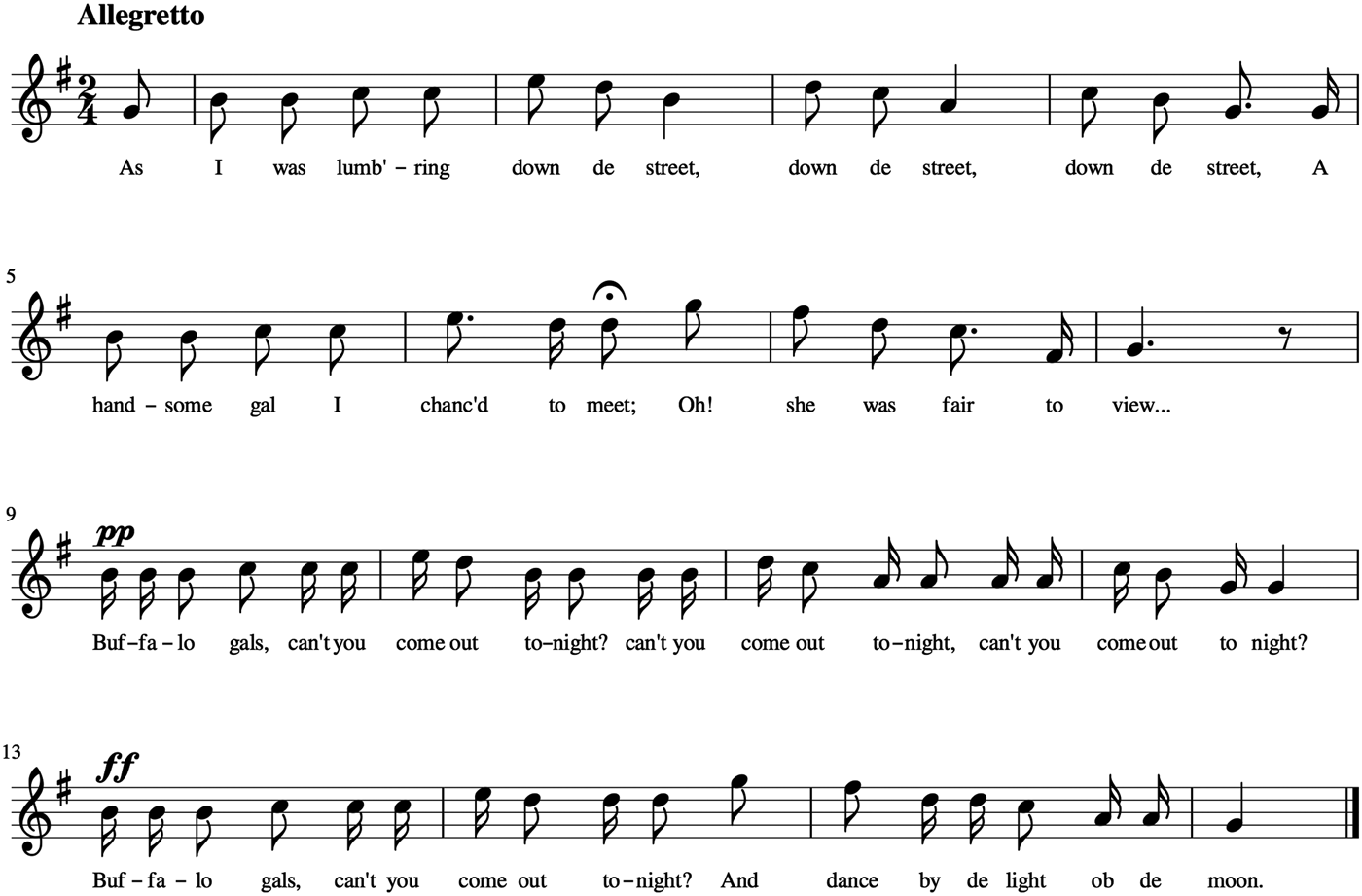
“Buffalo Gals” (figure 1) remains well known across a variety of contexts, but in the nineteenth century its indelible identity was as a blackface minstrel song. Named after the New York town where the original Christy's Minstrels formed around 1842, and first published by John “Cool White” Hodges in 1844, it formed part of the core repertoire introduced to England by the “Ethiopian Serenaders” in 1846.Footnote 56
“Buffalo Gals,” first verse and chorus. Vocal reduction created by the author from the first English edition: The favorite Negro Melody “De Boatmen's dance” (“Old Dan Tucker,” “Buffalo gals,” “Dandy Broadway swell,” “Color'd fancy ball,” “Lucy Neal”) sung [ . . . ] by the Ethiopian serenaders. Authorized edition (London, 1846). Music Collections H.1435, British Library.

While much has been written on the Victorian craze for blackface, relatively little work has focused upon the music,Footnote 57 attention instead centering on the visual. Thus, though academics have recognized the importance attributed by contemporaries to dance,Footnote 58 or minstrels’ facility for self-promotion,Footnote 59 there remains no explanation for its popularity that does not collapse into anxieties around racism and historical relativism.Footnote 60 I would therefore like to attend to the properties of a single song, not as a means of whitewashing the politics at play but both to add specificity to those politics and to tease out an intersection between race and gender that furthered the manifestation of not one but two forms of violent prejudice.
Early reviews of the Ethiopian Serenaders were overwhelmingly positive. Even the correspondent for the abolitionist Daily News “confessed” to being won over by “a fund of melody and a real and stable excellence, as well of voice instrumentation and harmony.”Footnote 61 Both the Morning Post and Lloyd's focused on the instruments, the Post describing “banjoes, tambourine, accordion, and bones, the latter instrument being used after the manner of castanets, with a forty-horse power . . . Never were bones denuded of their covering so eloquent.”Footnote 62 Lloyd's agreed that “the performer on the bone castanets . . . played with surprising execution.”Footnote 63 Critical excitement was prompted by skilled performances upon novelty instruments; or as a “comic” song of the following year put it, “Nothing now goes down / But blackeys, bones, and banjoes”—musical interest being inextricable from, but not identical to, the performance of race.Footnote 64
Audiences clearly responded to the rhythmic properties of these performances. I do not think I am falling back on a lazy association between Afro-American music, rhythm, and the body—for one thing, this is not Black music—but rather I am charting that stereotype's consolidation.Footnote 65 While the contemporary focus upon rhythm, dance, and body may have been prompted by racialized assumptions, it was also fair comment on a musical tradition rooted in the appropriation of a long-standing fusion between Anglo-Saxon dance music, played upon fiddles, and Afro-American percussive techniques involving everything from hand claps, foot stamps, and thigh slaps to triangles, sticks, and bones.Footnote 66 Both the bones and the tambourine (which was larger than today and with fewer cymbals, and therefore more of a hand drum) were percussive instruments employed to facilitate dancing; scholarship on the plantation music subsequently exploited by minstrelsy indicates that, functionally, this was indeed dance music.Footnote 67 Early blackface playbills even found it necessary to request that “gentlemen” auditors refrain from stamping their feet in time.Footnote 68
On its introduction to England, “Buffalo Gals” swiftly passed beyond its first venue, St. James's Theatre. Writing around five years later, the journalist Henry Mayhew presents us with a six-piece blackface band who claimed that, of their repertoire, “the ‘Buffalo Gals’ was best liked” in markets and squares across London.Footnote 69 As late as 1879, an article describing the continued appeal of “Buffalo Gals” summarized this “kind of music” as “the rattle of the bones, the tum tum of the banjo.”Footnote 70 Yet “Buffalo Gals” was not dependent on instrumentation. An 1846 edition of the music declared, “The sprightly strains of Negro minstrelsy never fail to excite enthusiasm in the dance . . . The serenade ‘Buffalo Gals,’ is the subject of the finale, and forms an excellent galop . . . easy, yet effective, the time well marked.”Footnote 71 Though rooted in a racist imaginary, the account draws attention to equally significant features of simplicity and danceability. Five years later, in Preston, the song was performed by “glee-singers” at a benevolent dinner, where “a portion of the tables, &c., were removed” prior to the performance to better allow for dancing.Footnote 72 In neither context was the song accompanied by the costumes or instrumentation of blackface, yet it remained, functionally, dance music.
This porosity agrees with an 1859 article in Household Words: “The soot I shall not enlarge upon; but the melodies themselves, and the genuine songs, are very taking and spirited.”Footnote 73 Conforming with Eileen Southern's characterization of plantation songs, the melody of “Buffalo Gals” is simple, with one note per syllable and a range of just one octave, the most basic of time signatures, and an extreme degree of repetition.Footnote 74 This tune, as catchy as a nursery rhyme and called “childish” by contemporaries, is split equally between verse and chorus, the latter boasting a novel use of syncopation that distinguished it among the early blackface repertoire.Footnote 75 The tune is a palpable kinetic hit, yet it is the interaction of music with lyrics that makes it of real interest—lyrics that allowed, in the aggrieved words of the Times, “a parcel of Ethiopian serenaders [to] assume that you are a Buffalo girl, and persist in the inquiry if you can't ‘come out to-night?’”Footnote 76
Like many blackface songs, “Buffalo Gals” objectifies a woman, the verse narrating an encounter and the chorus exhorting all such “gals” to come out tonight, and “dance by the light ob de moon.” Childlike words are inflected by this “negro” dialect, a trope that infantilized the imagined Black narrator while implying a sexual dimension, due to contemporary associations between Blackness and lust. Eric Lott has written of the misogyny enacted through minstrelsy, the violent objectification of each subaltern group—people of color and women—“lending the other [prejudice] emotional and political force.”Footnote 77 As Mike Pickering notes, “Blackface discourse did not operate in isolation from other discourses, such as those of gender, religion and class”—and in this case, it was racial prejudice that heightened the sexism of “Buffalo Gals.”Footnote 78 If one viewed women of color as availably promiscuous, then singing the song and thereby inhabiting its perspective allowed one to make that judgment about any woman.
In 1851, a mob, “five to one” of them men,Footnote 79 gathered in Finsbury to disrupt a meeting of “Bloomer” feminists.Footnote 80 The speakers, intimidated by the “disorderly” throng, were late in taking the stage. “Some very coarse remarks were made at the expense of the dress reformers. As the principal performers were after time, it was suggested that a grand chorus of ‘Buffalo gals, can't you come out to-night,’ would be an appropriate invitation.” This was music as weapon, a modern form of charivari put to essentially chauvinistic, intimidating ends.Footnote 81 Yet in relating this detail, the previously censorious journalist seems amused by the idea of a rowdy group of hostile men singing a provocative blackface song in a space intended for political discussion.
Indeed, amusement seems to have been a recurrent motivation for reporters. Three years earlier in Southampton, a convicted felon was taken up for trespassing at night. He protested that he was hiding in order “to evade the notice of the master of the hand-maidens whom he was serenading with ‘Buffalo Gals.’”Footnote 82 The following year in Nottingham, two lace-makers were charged with disorderly conduct. “About 2 o'clock on Sunday morning, policemen Cliff and Roberts heard a great noise in Woolpack-lane, and on proceeding to the place they found the prisoners kicking at a house door, and asking some women, whom they called ‘buffalo gals,’ if they were coming out that night.”Footnote 83 In both cases, the song appears to have justified both the criminal behavior and its subsequent reporting.
A further case, from York in 1858, is worth quoting at length:
Jefferson Wright (22), shoemaker, was charged with having stolen a quantity of wearing apparel . . . [Wright] was drinking at the house of a publican named Westoby, at Atwick. During the night, the prosecutrix [Harriet Barff], who is Mr. Westoby's servant, was awoke by hearing the prisoner in her bedroom, whereupon she sprang out of bed and ran to her mistress. The prisoner followed, and put his hand on Mrs. Westoby's mouth, whereupon she screamed, and he ran away . . . The defence was that the present case, instead of being a felony, was a piece of folly. The fact was he was courting the girl . . . He therefore, after singing “Buffalo gals come out to night,” got into the girl's room, and ran away with her crinoline and odd stocking by way of a lark. The case, which excited infinite amusement in a crowded court, ended in the prisoner's acquittal, a verdict which was hailed with loud applause.Footnote 84
In short, a drunken man broke into a house in circumstances that could have escalated to attempted rape, before assaulting another woman and stealing some clothing—yet, framed as a jest by the crucial detail of the song, the whole thing was excused as a bit of fun. Court, community, and readership were all turned against Harriet Barff and Mrs. Westoby—who were legally in the right—by the performance of the song.Footnote 85 “Buffalo Gals” had the last laugh.
I trust that these readings do not evoke the killjoy spirit of Dublin's Inspector Campbell. The incidents fit Pickering's judgment: “The blackface mode allowed white men and women of all social classes an indulgence in fun.”Footnote 86 Yet “fun” often seems a cipher for something more troubling, in which blackface permitted white men to indulge in acts of misogyny that would otherwise contravene social codes.Footnote 87 I also think it significant that, although no visual signifiers were used, “Buffalo Gals” still meant blackface. Firstly, at this early date, any rendition must have carried racialized connotations. But more importantly, the song's musical properties, its syncopated chorus and associations with dance and the body, all defined blackface. It is not as if preexisting British repertoires lacked songs about moonlit courtship: as the Household Words article observes, “The Buffalo Gals who are incited to come out to-night, are no whit worse than [the songwriter Thomas] Moore's lady who desired to take advantage of the young May Moon which is beaming love.”Footnote 88 Yet there was something distinctive about “Buffalo Gals” that lent itself to and enabled these disruptive, sexualized performances. Music was not merely an outlet for less than tender passions but both a conceptual framework and a kinetic catalyst, encouraging one set of prejudices in the articulation of another, with highly unsavory consequences.
Coda
We will never know what Alexander Duncan would have made of “Buffalo Gals.” Haweis, however, took a surprisingly positive view of the early blackface songs: “The sensation which they produced was legitimate, and their success was well deserved. The first melodies were no doubt curious and original.”Footnote 89 Looking back from the 1870s, he admired “the distinctive charm and original pathos” of this repertoire, approving its “wild tenderness and passionate sweetness, like music in the night.” For Haweis, any music produced (as he thought) in conditions of captivity and suffering, expressive of true sentiment, was true music: “The negro is more really musical than the Englishman. If he has a nation emerging into civilisation, his music is national.”Footnote 90
Though Haweis here exhibits a condescending, essentializing perspective, he also reveals a concern typical of his generation: the perceived lack of an English national school of music. “The influence of music is every day becoming more widespread; but is it an influence which soothes, relieves, recreates, and elevates the people? . . . before the musical art accomplishes this its high mission amongst us, it must become a real, not an artificial, expression of the emotions as they work in English hearts and English homes.”Footnote 91 Yet if this forum has demonstrated anything, it is that Haweis's worries were misplaced. For music to exert a strong influence over the emotions and thereby the actions of the people, no such precondition needed to be met. It is in performance that music engages with the emotions, and therefore any musical performance was potentially politically affective. Taken together, these three cases enjoin us, as historians, to think about music, less as individual works requiring close reading, and more as a form of performance that occurred in historical times and places that informed its potential: atop a revolutionary powder-keg; coordinated by an expert political agitator and songwriter; in a repressive society subject to the dual prejudices of racism and misogyny. Music had political consequence by virtue of its ubiquity, not its exceptionalism, and it worked upon the emotions: not by being good music, but simply by being music at all.