THE MALIA PENDANT
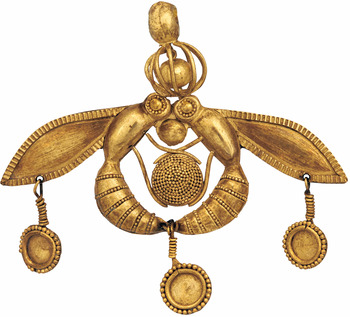
One of the great treasures of Minoan Crete is a golden pendant ‘much written about and variously interpreted’ Footnote 1 and often called in English the ‘bee pendant’ (fig 1). It was recovered in the early twentieth century during excavations at Chrysolakkos (Xρυσόλακκoς), Footnote 2 the necropolis complex associated with the palace at Malia (Mάλια) on the island’s north coast about 35km east of the modern city of Heraklion (Hράκλϵιo). Because the cemetery is linked with the Old Palace Period of Minoan civilisation, this pendant is usually dated to 1800–1650 bc, and it is generally taken for granted that it was created by an indigenous goldsmith working in Crete, ‘the supreme achievement of Early Minoan goldworking’. Footnote 3 By any measure, this golden jewel is a remarkable and beautiful object. Moreover, the pendant is unique: ‘there is no single specimen of Bronze Age gold work from any part of the Aegean, Egypt or the Near East to which the Malia pendant might be compared with regard to the complexity of its design and execution of sophisticated gold-working techniques.’ Footnote 4 It has long intrigued us, for different reasons.
Gold pendant from Chrysolakkos, now in the Archaeological Museum of Heraklion (see Vasilakis Reference Vasilakis1999, 128). Photograph: Courtesy of the Hellenic Ministry of Culture and Sports/Archaeological Receipts Fund and Archaeological Museum of Heraklion, Crete.

The pendant (fig 1) was first described, soon after excavation, by the French archaeologist and historian Pierre Demargne (1903–2000). It is 50mm wide, 46mm high and weighs 5.5g. Footnote 5 The jewel takes the form of two insects, which are, to all intents and purposes, identical (mirror images) joined head-to-head with the tips of their abdomens almost touching in a symmetrical or heraldic arrangement. The insects’ wings spread backwards. Their abdomens are represented as segmented, six abdominal segments being demarcated by ‘encircling’ bands of tiny gold beads. On the other hand, there is no attempt to suggest thoracic segments, and only one wing and two (of the six) legs are evident for each insect. From the lower edges of the wings and a point close to the tip of the abdomen of the left-hand insect dangle three discs, each one separately suspended on a twisted gold wire; these are almost invariably ignored when the jewel is discussed, exceptions being the original description by Demargne and the quite recent discussion by Bloedow and Björk. Footnote 6 With their legs, the insects are ‘grasping’ a centrally placed circular disc granulated with concentric circles of gold beads, Footnote 7 and there is a second, smaller, smooth globule placed above this and between the insects’ heads as if they were ‘eating’ it. In place of their pairs of antennae, there is a single cage-like structure containing another smooth pellet of gold suspended at the top. Above this is the loop of gold by which the entire pendant was hung when it was worn, probably around the owner’s neck. The reverse of the jewel is not decorated, being flat and smooth, without granulation or any attempt at three-dimensional effects.
Demargne was cautious in his identification of the insects because of the stylisation and adaptation employed by the goldsmith. Footnote 8 He particularly cited the reduction in the number of legs, the unnatural round eye and the solitary wing of each individual insect. Noting that the insects could belong to several families of Hymenoptera, he suggested they were either bees or wasps without using any formal scientific (Latin) names. Footnote 9 The uncertainty, he explained, precluded interpretation of the prominent granulated disc in the centre of the jewel, although it was perhaps a highly stylised representation of the honeycomb made by bees Footnote 10 or the multi-celled nest made by wasps. On the other hand, despite describing them, he made no attempt to postulate a natural model for the three discs hanging, albeit most unnaturally, from the insects.
Like others quoted here, we are not convinced by labels or discussions which suggest that the insects are, in common English parlance, ‘bees’, which almost invariably implies the European honey bee (Apis mellifera L., 1758). The shapes and proportions of the body parts of the insects forming the pendant are not appropriate for that species of bee. The distinguished entomologist Owain Westmacott Richards (1901–84), who was a world authority of the aculeate Hymenoptera, Footnote 11 was emphatic in stating that sources describing ‘the insects as bees … [are] certainly incorrect’. Footnote 12 However, the insects were indubitably modelled on Hymenoptera, as suggested first by Demargne; Footnote 13 the model can be more narrowly assigned to suborder Apocrita (narrow-wasted Hymenoptera), infraorder Aculeata. When vernacular English nomenclature is employed, that infraorder encompasses countless insect species variously called bees, wasps, hornets and ants, labels that are imprecise.
The designation of the insects as bees appears to have originated with the archaeologist Sir Arthur Evans (1851–1941), although it is important to emphasise that he was both unequivocal and equivocal. Writing in the fourth volume of The Palace of Minos, Footnote 14 he stated that the pendant ‘though combining features, more Minoico [in the Minoan manner], of other Hymenoptera was probably intended to represent bees’; however, in his preface he called them hornets, Footnote 15 without any qualification, but labelled a photograph of the jewel as ‘with bees or hornets’. Footnote 16 Hornet was the label adopted by John Devitt Stringfellow Pendlebury (1904–41) Footnote 17 and many others, although it is unlikely they gave the insects’ identity much consideration and simply followed Evans. The German archaeologist Otfried Deubner (1908–2001) suggested that the model for the insects was a wasp such as Sceliphron destillatorium Illiger, 1807 (mud-dauber wasp) carrying a ball of soil. Footnote 18 Richards averred that to ‘an entomologist, it is clear that the insects represented are not bees and almost certainly not hornets, but very likely a social wasp of the genus Polistes’. Footnote 19
As just noted, Deubner suggested that the granulated disc held by the insects could represent a ball of mud or soil, an unlikely object for a goldsmith to copy, and what this disc signifies has exercised others, too. Footnote 20 When designated as bees, the insects are variously described as holding a (circular) honeycomb Footnote 21 or ‘a drop of honey’ Footnote 22 or that they are sharing ‘a drop of honey’ or ‘storing away’ a drop of honey. Footnote 23 When labelled as wasps it has been suggested that they are sampling a berry Footnote 24 or ‘sucking a drop of honey’. Footnote 25 Richards proposed that the disc could represent a ball of wood-pulp. Footnote 26 This granulated disc is unlikely to represent a honeycomb, especially if it is in proportion to the insects, Footnote 27 and if the insects are not bees they would not necessarily be sharing or holding ‘honey’ (or nectar).
Granted Demarge’s scholarly caution, is it possible to identify with confidence any plants or animals that clearly inspired the goldsmith to create this masterwork, and does the combination of these botanical and zoological subjects lead to a better understanding of the jewel?
A plant model
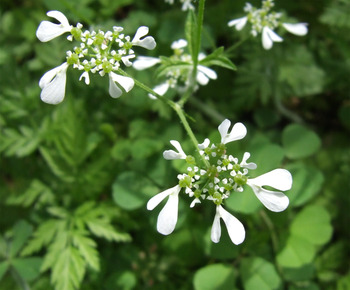
The three dangling discs have a distinctive general structure that mimics the fruits of a herb native to Crete and other places in the eastern Mediterranean. We suggest that the plant model was Tordylium apulum L. (καυκαλύθρα, afkalithra, Apulian hartwort), a winter annual that is abundant and widespread in Crete, especially in disturbed or cultivated ground particularly in the lowlands. Footnote 28 It is a member of the large family Apiaceae (Umbelliferae), which includes such plants as Daucus carota L. (carrot) and, among others, the aromatic culinary herbs Foeniculum vulgare L. (fennel), Anethum graveolens L. (dill) and Petroselinum crispum L. (parsley), also natives of the Mediterranean. This hartwort has minute white florets arranged in umbels – flattened compound, umbrella-like ‘heads’ (inflorescences) (fig 2). Like some related plants, it is edible and often one of the herbs (horta, χόρτα) included in the traditional Cretan ‘wild green’ pies called kalitsounia (καλιτσoύνια). Given the relative stability of the indigenous flora of Crete it is likely that T. apulum and other umbellifers are not introduced species and so would have inhabited the island long before the Bronze Age. Footnote 29
Tordylium apulum in bloom, photographed in Crete. Photograph: E C Nelson.

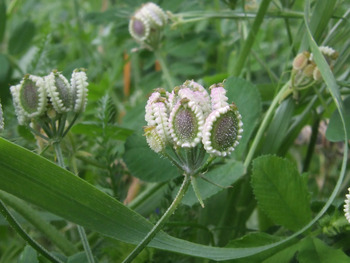
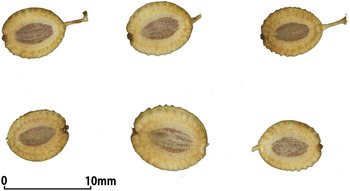
T. apulum produces clusters of relatively large fruits (fig 3), which are unmistakable, disc-like, oval to almost circular in outline, 5–10mm long and with a ‘thick pale beaded margin’. Footnote 30 These fruits are often tinged red when immature and ripen to the colour of straw, pale gold. The ‘beaded margin’ is the unmistakable character that links this hartwort with the three dangling discs of the Malia pendant. The goldsmith used minute beads of gold to create the effect: twenty-nine on the central and the right-hand discs and thirty on the left-hand disc. The resemblance is not exact, but a high degree of naturalism was achieved, as with the pair of insects. In a random sample (n = 66) of fruits of Apulian hartwort collected in Crete (by ECN), individual fruits had 20–28 marginal swellings (mean = 24.9; mode = 23) (fig 4).
Tordylium apulum in fruit, photographed in Crete. Photograph: E C Nelson.

Fruits of Tordylium apulum. Photograph: E C Nelson.

Apulian hartwort must have been familiar to the Minoan people, probably as a common edible plant, just as in present-day Crete. Of course, we do not know any Minoan name for T. apulum, nor the significance, if any, of these fruits to the goldsmith, but such knowledge is not necessary to appreciate this exquisite ornament.
An insect model
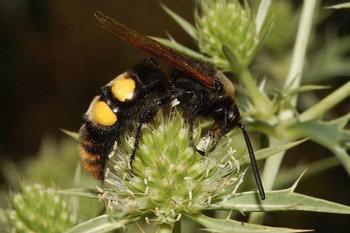
During a prolonged working visit to Crete in the spring of 2005, beside a track bordered by native trees and shrubs near the village of Almirida, Hania Prefecture, one of the authors (ECN) chanced upon a shrub of Styrax officinalis L. (storax, στoυράκι) in full bloom. Numerous insects were visiting the flowers, including honey bees most probably from some of the many beehives kept in the locality, several ponderous black carpenter bees (Xylocopa spp) and a large hornet- or wasp-like insect that was eventually identified as Megascolia maculata (Drury, 1773) (velvet wasp or mammoth wasp Footnote 31 ) (fig 5). In its proportions and morphology, the velvet wasp strikingly resembles the pendant’s insects. It is a relatively large insect, up to 6cm long, with a dark abdomen marked by brilliant golden yellow bands; the female is larger than the male. Coincidentally, this was ‘most probably’ Footnote 32 the insect seen in Crete by the American zoologist, Professor Demorest Davenport (1911–2004), who subsequently asserted in a short note published in Antiquity that there ‘can be no doubt whatever as to who [sic] the model was … [for] the Cretan “hornet” pendant’. Footnote 33
Male Megascolia maculata maculata foraging on an inflorescence of Eryngium campestre L. (field eryngo; Apiaceae), a species widespread in Crete, photographed at Arsac, France, August 2007. Photograph: Professor Nicolas J Vereecken.

Adult M. maculata feed on nectar. Footnote 34 When the velvet wasp foraged on the storax flower, it embraced the central bundle of stamens and then curled its abdomen around them. The wings were swept backwards and were held at an angle of approximately 45 degrees to the median horizontal axis of the insect’s thorax. This posture was very reminiscent of the pair of insects composing the Malia pendant, and comparison of the pendant with images of foraging Megascolia confirms the similarity.
Hood has argued that the jeweller ‘was probably vague about differences between bees and wasps, and may even have mistaken some kind of wasps for bees’. Footnote 35 Similar mistaken taxonomy applies today among many folk in Greece and elsewhere. Footnote 36 The craftsman perhaps saw Megascolia foraging on flowers and, considering it a ‘bee’, used it as a model for the pendant. In other words, perhaps he meant to represent ‘bees’, but unwittingly sculpted Megascolia. While Hood claimed that there ‘is nothing to suggest that the jeweller studied nature or had specimens to copy in front of him’, Footnote 37 there is equally nothing to suggest that the craftsman did not have both an insect and a plant model in front of him.
DISCUSSION
The Malia pendant provokes debate and defies easy explanation. Yet, the majority of those who have discussed it have taken no notice of the three suspended golden discs; the exceptions, as noted, include Demargne and Bloedow and Björk. Footnote 38 These discs are integral to the ornament, and surely have as much significance as the two insects. Otherwise, why were they attached to it? One possible purpose is to give a person viewing the jewel an immediate sense of scale: accepting that the discs are modelled on the fruit of T. apulum, they are close to life-size, suggesting that the insects are represented at that scale too. Of course, because the discs are suspended on wires, they will have moved, as the wearer breathed and moved, glinting and glittering in sunlight and lamplight.
Minoan artists in Crete and adjacent Aegean islands were fascinated by the natural world and frequently depicted or modelled animals and plants, yet they were not producing scientifically exact representations nor were they compiling illustrated catalogues of flora and fauna. They were creating aesthetically pleasing works of art for decorative and possibly religious purposes, although the Malia pendant lacks any clear religious symbolism. Numerous examples can be cited, ranging from depictions on Minoan sarcophagi of the common octopus (Octopus vulgaris Cuvier, 1797) and the spectacular dragon arum (Dracunculus vulgaris L.) to frescoes showing dolphins, crocuses, white-blossomed Madonna lilies (Lilium candidum L.) and sea daffodils (Pancratium maritimum L.). Footnote 39
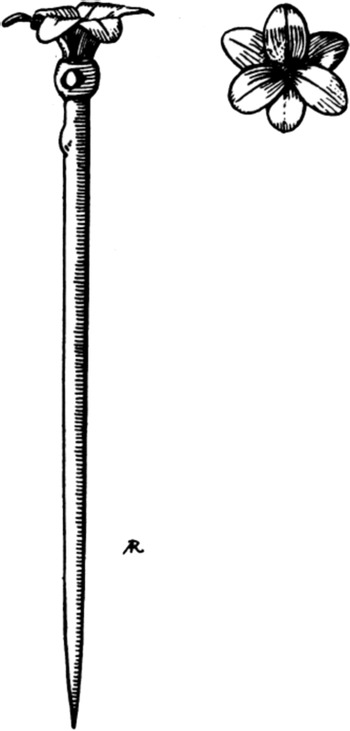
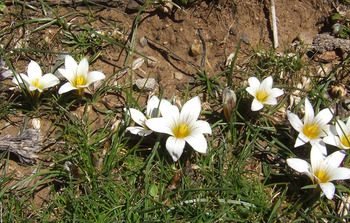
Less well known are flowers, leaves, fruits and even frogs worked in gold. In particular, it should be noted that another of the gold objects unearthed at Chrysolakkos at the same time as the pendant, and illustrated by Demargne, Footnote 40 was a toggle pin comprising a solid gold straight shaft surmounted by a six-petalled flower made of gold (fig 6). Evans noted this as an ‘exquisite gold pin with an amaryllis-like flower’. Footnote 41 The flower that caps the pin closely resembles in both size and shape a blossom of the Cretan native sand crocus (Romulea bulbocodium (L.) Sebast. & Mauri), Footnote 42 which often forms vast drifts in suitable habitats from sea level to the upland plains and mountain slopes (fig 7). The six petal-like segments of the living flower, arranged in two whorls, were carefully reproduced in gold in their correct relative shapes and positions, giving the distinct impression that the goldsmith knew the plant well and modelled the head of the pin from an actual specimen. Although Warren has noted, with regard to plants, that Minoan artists sought to ‘convey a spirit of naturalism while eschewing exact, botanical representation’, Footnote 43 this pin, ‘so deftly wrought’ Footnote 44 and, like the pendant, ‘unique to Crete’, Footnote 45 suggests that at times exact representation was not disdained but was meticulously attempted.
Gold toggle pin from Chrysolakkos, now in the Archaeological Museum of Heraklion (height 88mm; illustration from Demargne Reference Demargne1930, 420, fig 4).

Romulea bulbocodium in bloom, photographed in Crete. Photograph: E C Nelson.

The same practices must have pertained in depicting animals. Due to stylisation, precise identification of some subjects is ‘at once made problematical’. Footnote 46 In the case of the Malia pendant, economy – for example, the reduction in the numbers of wings and legs – enhanced stylisation. Kitchell applauded the goldsmith who created the pendant for providing ‘all the information needed to correctly interpret the work, while still creating a pleasing whole, [and] avoiding the precision of a text book illustration in the process’. He went on to assert, questionably in our opinion, that ‘we can now be sure … that the insects … are bees’. Footnote 47 Despite being critical of Kitchell’s arguments because these were ‘based chiefly on circumstantial evidence’, Bloedow and Björk came to the same conclusion: ‘one can scarcely any longer entertain serious doubts about the identification of the insects. They are bees.’ Footnote 48
We disagree, and propose that the insect model for the Malia pendant was not a worker of the common European honey bee with its stocky body, but a species of one of the larger Hymenoptera native to Crete. It is misleading to give the insects a more particular vernacular name in any language, and we do not have any idea what the Minoan name was for these animals. The goldsmith may have been inspired to position the beautifully granulated disc between the insects after observing foraging Hymenoptera such as M. maculata working to gather nectar. Thus, as suggested, but then dismissed, by Hood, Footnote 49 this granulated disc may be the goldsmith’s attempt to represent the compound inflorescence (‘flower head’), perhaps in bud, of a plant on which the insects had been observed, but, if so, its stylisation precludes better identification. Models could include species of Eryngium (eryngo, sea holly; Apiaceae), Scabiosa (scabious; Caprifoliaceae, formerly Dipsacaceae) or a member of the daisy family (Compositae or Asteraceae) such as Phagnalon graecum or Anthemis rigida (rayless chamomile), or a species of Allium (onions and garlics; Alliaceae). Other possible models are the central discs, without the ray florets, of such plants as Glebionis coronaria (crown daisy) or Anthemis chia. In this regard, reports in scientific literature indicate that whereas the larvae of scoliid wasps are parasitoid, the day-flying adult females visit flowers to forage for nectar because they need to feed before their eggs can mature. Footnote 50
Minoan artists and craftworkers are renowned for their proclivity to take inspiration from the environment in which they lived. The Malia pendant is a brilliant composition entirely consistent with Crete’s native flora and fauna. Its creator was a person of great skill and imagination, who must have observed in intimate detail the plants and animals that shared his Cretan habitat. It is unlikely, perhaps, that the pin crowned with the flower of Romulea was made by the same goldsmith, yet it also was inspired by nature and required very close attention both to working with gold and to observing the morphology of the model plant. Lastly, while the Malia pendant is often viewed as being associated with the craft of beekeeping, Footnote 51 our interpretation suggests otherwise – the jewel represents, indeed celebrates, the natural world of Crete.