Introduction
Lithium-ion batteries have abundant applications in consumer electronic and electric vehicles because of their high specific capacity and energy density.[Reference Scrosati, Abraham, van Schalkwijk and Hassoun1] The electrolyte is essential for lithium-ion batteries since it functions as the medium for the lithium cation's movement between electrodes during charging and discharging processes. Lithium hexafluorophosphate, LiPF6, is used as the salt in many commercially available lithium-ion batteries due to its well-balanced properties. However, LiPF6 has safety problems due to its chemical dissociation equilibrium producing LiF (less charge transport) and PF5 (a reactive safety risk) which further lead to its chemical and thermal instability.[Reference Aurbach, Schecter, Nazri and Pistoia2] The traditional carbonate solvents, with high vapor pressures, used in lithium-ion batteries are flammable and potentially toxic.[Reference Rossi and West3] In particular, linear carbonates have a low flash point; for example, diethyl carbonate's (DECs) flash point is 25 °C.[4]
We seek to replace the linear carbonates in electrolyte formulations with organosilyl nitrile (OSN) solvents. Organosilyl compounds generally have lower vapor pressures, higher flash points, and tolerate higher operating voltages than carbonates.[Reference Peña Hueso, Osmalov, Dong, Usrey, Pollina and West5] The nitrile functional group is able to solvate the lithium cation, while the organosilyl moieties prevent thermal decomposition.[Reference Guillot, Peña Hueso, Usrey and Hamers6,Reference Chen, Usrey, Peña Hueso, West and Hamers7] Nitrile-based electrolytes have been reported recently by several groups. Ma and Mandal[Reference Ma and Mandal8] have reported on lithium bis(trifluorosulfonyl)imide (LiTFSI)-based electrolytes in solvents of etheric nitriles, while Xie et al.[Reference Xie, Mai, Wang, Luo, Yan and Zhang9] have used the LiPF6 salt in etheric nitrile electrolytes. The dinitrile adiponitrile has been used as the solvent in LiTFSI electrolytes by Farhat et al.,[Reference Farhat, Ghamouss, Maiback, Edstrom and Lemordant10] while Rohan et al.[Reference Rohan, Kuo, Lin, Hsu, Li and Lee11] have mixed dinitrile and mononitrile molecules as the solvent in LiTFSI electrolytes. Pohl et al.[Reference Pohl, Grunebaum, Drews, Passerini, Winter and Wiemhofer12] have used a silyl ether nitrile, 3-((trimethylsilyl) oxy) propionitrile, and the salt LiTFSI as the electrolyte in full lithium-ion cell cycling studies and found especially good higher temperature (above 60 °C) performance. Pohl and Wiemhofer[Reference Pohl and Wiemhofer13] used a different silyl nitrile 1,3-bis(3-cyanopropyl)tetramethyldisiloxane in an ethylene carbonate (EC) binary solvent blend (1:1) as an electrolyte with the salt LiClO4 and found an increase in oxidative stability to 5.4 V versus Li/Li+. More recently, Horowitz et al.[Reference Horowitz, Ben-Barak, Schneier, Goor-Dar, Kasnatscheew, Meister, Grunebaum, Wiemhofer, Winter, Golodnitsky and Peled14] have characterized the solid electrolyte interphase (SEI) layer using the same 1,3-bis(3-cyanopropyl)tetramethyldisiloxane solvent and LiTFSI as the salt finding that fluoroethylene carbonate is a necessary additive (10%) for good SEI formation and stable cell cycling. Wang et al.[Reference Wang, Yong, Yang, Ouyand and Zhang15] have synthesized silyl glycerol carbonates and used these with the mixed salts LiPF6/LiODFB (lithium oxalyldifluoroborate) as the electrolyte in graphite/LiCoO2 full cells achieving better cycling performance than a conventional electrolyte cell. Philip et al.[Reference Phillip, Bhandary, Groche, Schonhoff and Rieger16] have synthesized ten different molecules containing both a silyl and carbonate functional group, prepared electrolytes with the salt LiTFSI, and explored their electrolyte properties including ionic conductivity and ion transport.
Fluorination of organosilyl compounds (abbreviated generally as FOS) reduces solvent reaction and improves thermal stability.[Reference Peña Hueso, Dong, Pollina, Usrey, Hamers, West and Osmalov17,Reference Xu18] Pure FOS solvents typically have a lower dielectric permittivity and higher viscosity compared with linear carbonates. Therefore, they are most suitable as an electrolyte additive in commercial lithium-ion battery electrolytes to improve the thermal and chemical stability of the electrolyte without significant ion transport performance decrease.[Reference Lyons, Peña Hueso, Johnson and West19] In a recent computational study, Ueda et al.[Reference Ueda, Yamada, Konno, Hoshino, Kojima and Tanaka20] have found that organosilicon additives improve the SEI layer on a graphite anode by reducing the thickness of the SEI layer and decomposing less electrolyte in the formation of the SEI layer. In this project, we explore the ion transport performance of the OSN electrolytes through variable temperature pulsed field gradient (PFG) NMR studies on a family of FOS electrolytes with: varying salt content (LiPF6 or LiTFSI from 0.3 to 1.6 M), fluorine content of the FOS (none to three), and blends of an FOS solvent with conventional carbonates EC and DEC in a ratio of 1:3. We assess the salt dissociation of the electrolytes and address issues of ion/solvent interactions in these lithium-ion electrolytes.
Experimental
Electrolytes
Organosilyl solvents and electrolytes were prepared as reported earlier[Reference Peña Hueso, Osmalov, Dong, Usrey, Pollina and West5] by Silatronix, Inc., Madison, WI, USA. In an argon dry box, the liquid electrolytes were transferred into 5-mm diameter, 9-in. length NMR tubes to a depth of not more than 5 mm. Samples containing LiPF6 salt were first transferred into Teflon NMR sleeves before the sleeves were then placed into the NMR tube. Using a tip-off manifold, the tubes were flame sealed under vacuum on a Schlenk line. These tubes were then used for the duration of all NMR experiments. As the salt is the most likely to decompose, occasional fluorine NMR measurements throughout the use of the NMR tubes showed no  ${\rm PF}_6^-$ decomposition.
A Brüker Avance 400 MHz NMR spectrometer was used for all acquired spectra. A 5 mm PABBO BB-1H/D Z-GRD NMR probe was used for some T 1 experiments and all composition NMR experiments. A 4 mm MIC 1H Z-GRD DIFF-30 NMR probe was used for diffusion experiments and most T 1 determination experiments. All data were acquired and analyzed using Bruker Topspin 3.0 software. The DIFF-30 probe is a single-frequency probe so each nucleus was measured at frequencies of 400.01 MHz for 1H, 376.3 MHz for 19F, and 155.5 MHz for 7Li. Temperature calibration was completed using an ethylene glycol/DMSO-d6 standard and gradient strength calibration (maximum = 874 Gcm−1) was completed via the Bruker-provided gadolinium chloride-doped water sample.
Relaxation, or T 1, times were measured using an inversion recovery pulse sequence. Diffusion coefficients were measured in a PFG-STE experiment[Reference Annat, MacFarlane and Forsyth21] with 16 different values of the magnetic gradient strength, g. Using the Bruker relaxation analysis software, the diffusion coefficient, D, was calculated from the Stejskal–Tanner equation.
 $$I\lpar g \rpar = I_0\cdot e ^{-\gamma ^2\cdot g^2\cdot D\cdot \delta ^2\cdot {\left({\Delta -{\delta \over 3}}} \right)}$$
Gradient pulse time variables δ and Δ were kept between 1 and 3 ms and between 6 and 20 ms, respectively, over a temperature range from 298 to 330 K. As we have seen thermal convection effects above 315 K, from 315 to 330 K, the Δ (diffusion time) was less than 8 ms. Molar conductivity, Λ, was calculated with the Nernst–Einstein equation:
 $${\rm \Lambda} _{{\rm NMR}}{\rm}={\rm } \displaystyle{{{\it N}{\rm e}^{\rm 2}} \over {{\it kT}}}(D_{\rm cation} + D_{\rm anion})$$
where N is Avogadro's number (6.02 × 10²³), e is the charge on the electron (1.60 × 10¹⁹), k is Boltzman's constant (1.38 × 10⁻²³), and T is the temperature in Kelvin for D cation and D anion. Salt dissociation, α, also known as ionicity (and the inverse of the Haven ratio) was calculated using the relationship between the impedance molar conductivity, Λimpedance, and the NMR measurements of the molar conductivity, ΛNMR[Reference MacFarlane, Forsyth, Izgorodina, Abbott, Annat and Fraser22]:
 $${\rm \alpha} = \displaystyle{{{\rm \Lambda} _{\rm impedance}} \over {{\rm \Lambda} _{{\rm NMR}}}}$$
The impedance molar conductivity, Λimpedance, is reported in a separate research letter.[Reference Lyons, Derrah, Sharpe, Yoon, Beecher, Usrey, Peña Hueso, Johnson and West23] In order to assess the fraction of transport by the lithium, the 7Li (D +) and 19F (D −) diffusion measurements were used to calculate the lithium transport number, t p, as follows:
 $$t_p = \displaystyle{{D_ +} \over {D_ + + D_{\rm -}}}$$
Results and discussion
The solvents used in this report are based on OSN molecules whose chemical structures are generically depicted as

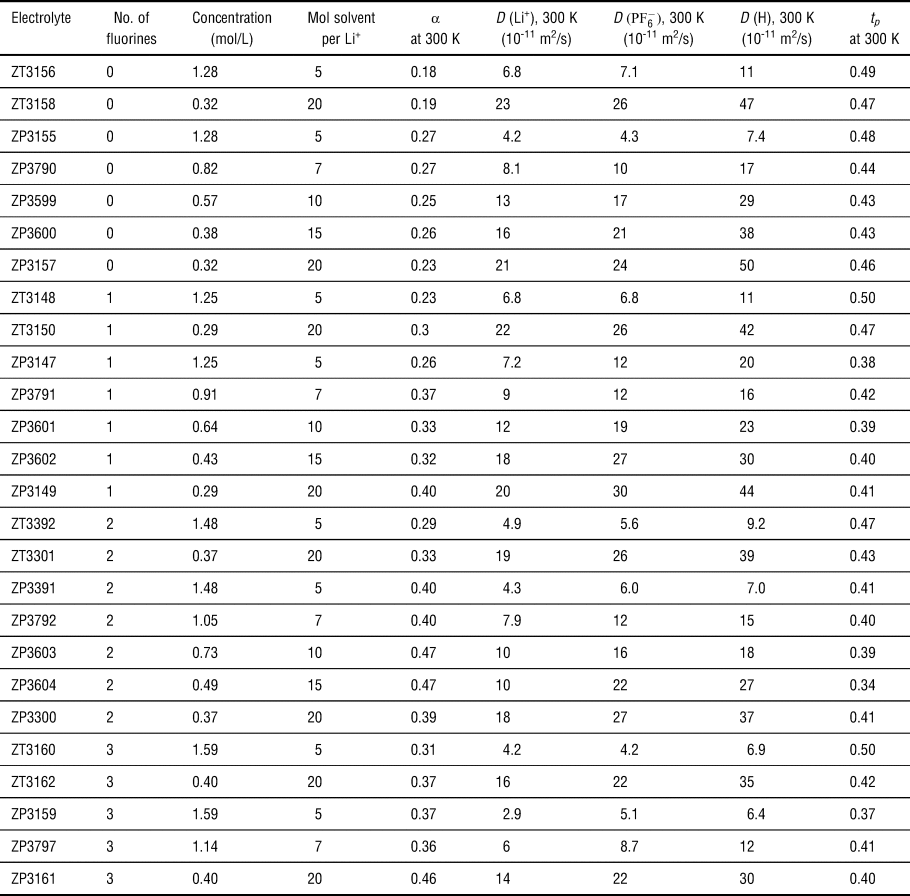
We explored electrolytes of varying solvent fluorination (X, Y, Z from no fluorine up to trifluoro), lithium salt concentration (0.3–1.6 M), and lithium salt anion. Eighteen of these electrolytes use the salt LiPF6, while eight electrolytes mix the salt LiTFSI with an OSN solvent. The LiPF6 electrolytes are labeled as ZP3### samples (P for ${\rm PF}_6^-$), while the LiTFSI electrolytes are labeled ZT3### samples (T for TFSI−). In Table I, we detail the diffusion coefficients, salt dissociation (α) values, and lithium transport number values for 26 electrolytes at 300 K. In all these electrolytes, we see that the solvent diffuses considerably faster than either ion. In the LiPF6 electrolytes, D F is faster than D Li, although only by a small amount in the solvents with no fluorination. In contrast, in two LiTFSI electrolytes, D F and D Li are equal to each other at 300 K (electrolytes ZT3148 and ZT3160). Hayamizu has observed similar solvent, anion, and cation trends in LiPF6 electrolytes of EC and DEC solvents.[Reference Hayamizu24] The calculated lithium transport numbers demonstrate more effectively the similarities in ion diffusion. These values are 0.50 for the two LiTFSI electrolytes with equal cation and anion diffusion coefficients. All of the lithium transport numbers for these OSN electrolytes are higher than Hayamizu found for EC and propylene carbonate LiPF6 electrolytes. In DEC/LiPF6 electrolytes, Hayamizu also found more equivalent ion diffusion leading to calculated lithium transport numbers of 0.49 at 303 K. We find higher lithium transport numbers in these LiTFSI electrolytes than Wang et al.[Reference Wang, Yong, Yang, Ouyand and Zhang15] reported in their organosilicon glycerol carbonate electrolytes as well as compared to the LiTFSI silyl carbonate electrolytes reported by Philip et al.[Reference Phillip, Bhandary, Groche, Schonhoff and Rieger16] In varying the solvent fluorination, the lithium transport numbers are highest in the solvent with no fluorination and decrease when the solvent is fluorinated. In a computational study of these electrolytes, Zhu et al. have found that the lithium cation–nitrile nitrogen of the solvent has the most favorable energy interaction.[Reference Zhu, Lyons and Hernandez25] However, they have also calculated a favorable (though smaller) energy interaction for the lithium cation and the fluorine on the silyl moiety. A second interaction of the lithium cation with the solvent molecule may explain the trend in the lithium transport numbers with solvent fluorination. As the solvent is the fastest diffusing species in the electrolyte, an additional interaction of the slowest diffusing lithium cation with solvent would increase the average diffusion of the lithium species in the electrolyte. Below we discuss ion pairing and that too is an important factor in the interpretation of the lithium transport numbers.
Diffusion coefficients (7Li, 19F, and 1H), salt dissociation, α, and lithium transport number, t p, values for OSN electrolytes at 300 K.

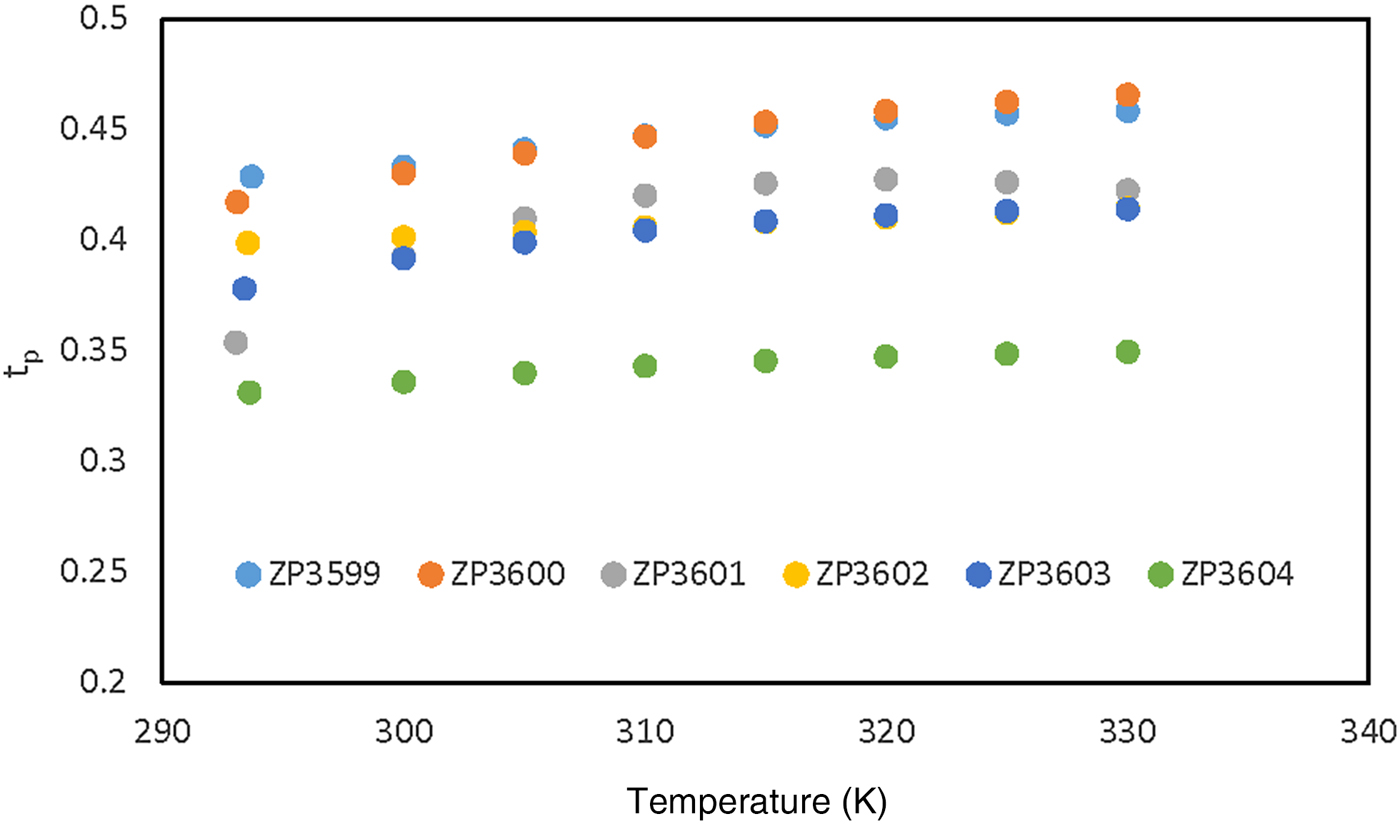
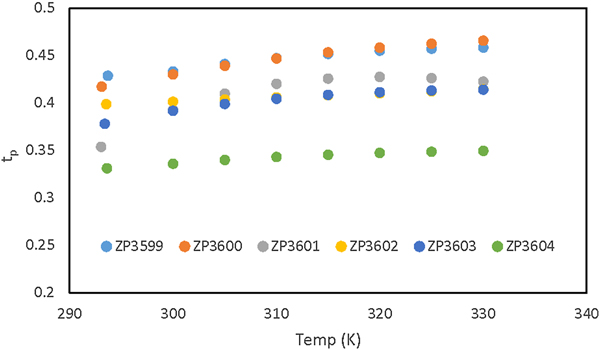
Arrhenius plots of the ion and solvent diffusion for the 0.4 and 0.7 M LiPF6 electrolytes are in Supplementary Fig. S1, while Arrhenius fit parameters are summarized in Supplementary Table S1. While 19F and 1H solvent Arrhenius plots are linear, a Vogel−Tamman−Fulcher (VTF) fit better describes the 7Li data and this is most obvious in electrolyte ZP3601 where the lithium temperature dependence is highly curved. Activation energies for the anion and solvent are the same within experimental errors, while the cation pseudo-activation energies are considerably lower as the addition of the T o parameter from the VTF equation substantially reduces the slope term in that regression fit of the data. We attribute the different temperature dependencies to strong solvation of the lithium cation by the solvent, while the anion and solvent have much less interaction. Lithium transport numbers increase slightly with temperature, as shown in Fig. 1, showing an improvement in lithium-ion diffusion compared to anion diffusion as the temperature increases. For the most concentrated LiPF6 electrolytes (Supplementary Fig. S2), we saw the largest increase in t p with temperature. In the monofluorinated solvent, ZP3147, t p increases from 0.38 at 300 K to 0.43 at 330 K, while in the trifluorinated solvent, ZP3159, t p increases from 0.37 to 0.42.
Lithium transport number, t p, calculated from Eq. (2), for six OSN/LiPF6 (0.4–0.7 M) electrolytes across the temperature range 300–330 K.

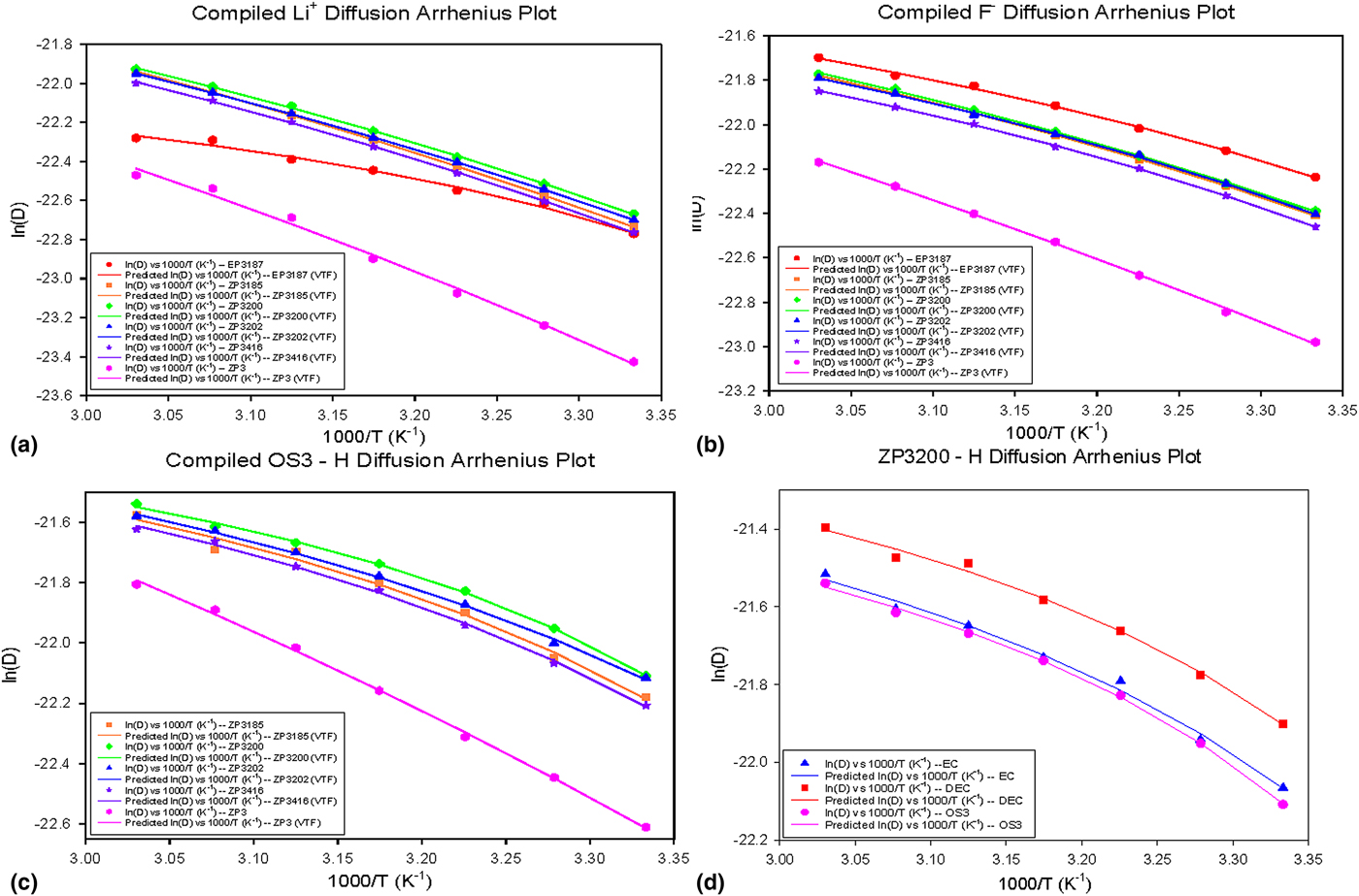
Seeking to replace the flammable carbonates in commercial electrolyte formulations, we then explored the diffusion of the salt and solvent in solvent blends of the monofluorinated OSN solvent in typical EC/DEC solvent blends (Supplementary Table S2). Figure 2 shows the lithium, fluorine, and proton Arrhenius plots of four blends of the monofluorinated OSN solvent with a 1:3 volume proportion of EC/DEC and a 1.2 M LiPF6 concentration in comparison to the pure monofluorinated organosilyl electrolyte (ZP3) and the EC/DEC electrolyte with no organosilyl component (EP3187). The volume proportion of fluorinated organosilyl solvent (listed as either ZP3 or OS3) varied from 2% to 18%. Diffusion of the 7Li, 19F, and 1H (silyl solvent) are all slowest for the pure organosilyl electrolyte, ZP3. Interestingly, lithium diffusion is faster in the four blend electrolytes than the pure carbonate electrolyte, EP3187 [Fig. 2(a)]. The solvent blend with 6% ZP3 has the fastest lithium and solvent diffusion. Figure 2(d) shows the diffusion of the three solvent constituents, EC, DEC, and the organosilyl solvent. DEC, the least viscous of the three solvents, diffuses fastest at all temperatures as expected. Though the organosilyl solvent is less viscous than EC, both the organosilyl and EC molecules diffuse at the same rate over this temperature range. The curved Arrhenius plot suggests these molecules solvate the lithium cation and we propose that both of those solvent molecules participate together in the solvation of the lithium cation at this blend proportion. Supplementary Table S2 reports on the activation energies for diffusion in all six of these electrolytes as well as the salt dissociation values and lithium transport numbers. In our parallel research letter on the ionic conductivities of these electrolytes, we report on the high ionic conductivities of these blend electrolytes.[Reference Lyons, Derrah, Sharpe, Yoon, Beecher, Usrey, Peña Hueso, Johnson and West23] Faster diffusion of the lithium cation in the blend electrolytes leads to values of salt dissociation in these electrolytes which are as high or higher (0.45) than the all carbonate electrolyte (0.41) and contribute to the observed high ionic conductivities. This faster lithium diffusion also leads the lithium transport numbers to be higher in the blends (t p = 0.43) than either the pure organosilyl electrolyte (t p = 0.39) and the all carbonate electrolyte (t p = 0.37) similar to results we had reported earlier in carbonate/silyl bend electrolytes.[Reference Lyons, Peña Hueso, Johnson and West19]
Arrhenius plots of (a) 7Li, (b) 19F, and (c) 1H diffusion coefficients measured from 300 to 330 K for FOS nitrile/carbonate blend electrolytes. All electrolytes contained 1.2 M LiPF6 and a 1:3 EC:DEC ratio with increasing amounts of the FOS solvent ZP3 (OS3) from 2% up to 18%. (d) In the ZP3200 electrolyte with 6% FOS solvent, 24% EC and 70% DEC, the DEC protons diffuse faster than the EC and organosilyl protons over the 300−330 K temperature range.

Neutral ion pair/aggregate formation is considerable in these electrolytes (salt dissociation <1), so we sought to apply the approaches of Stolwijk et al.[Reference Stolwijk, Kosters, Wiencierz and Schonhoff26] and Krachkovskiy et al.[Reference Krachkovskiy, Bezak, Fraser, Halalay and Goward27] to our data and assess the effect of neutral ion pair formation in our electrolytes. Because we know both the charged ion transport from our impedance conductivity measurements and the total ion transport (charged and neutral species) from our NMR experiments, we can calculate charge diffusivity, D κ, effective cation,  $D_ + ^{{\rm eff}}$, effective anion,
 $D_-^{{\rm eff}}$, and diffusion coefficients. We can then calculate the lithium cation transference numbers, t f, defined by Krachkovskiy et al.[Reference Stolwijk, Kosters, Wiencierz and Schonhoff26] as
 $$t_f = \displaystyle{{D_ + ^{{\rm eff}}} \over {D_ + ^{{\rm eff}} + D_{\rm -}^{{\rm eff}}}}$$
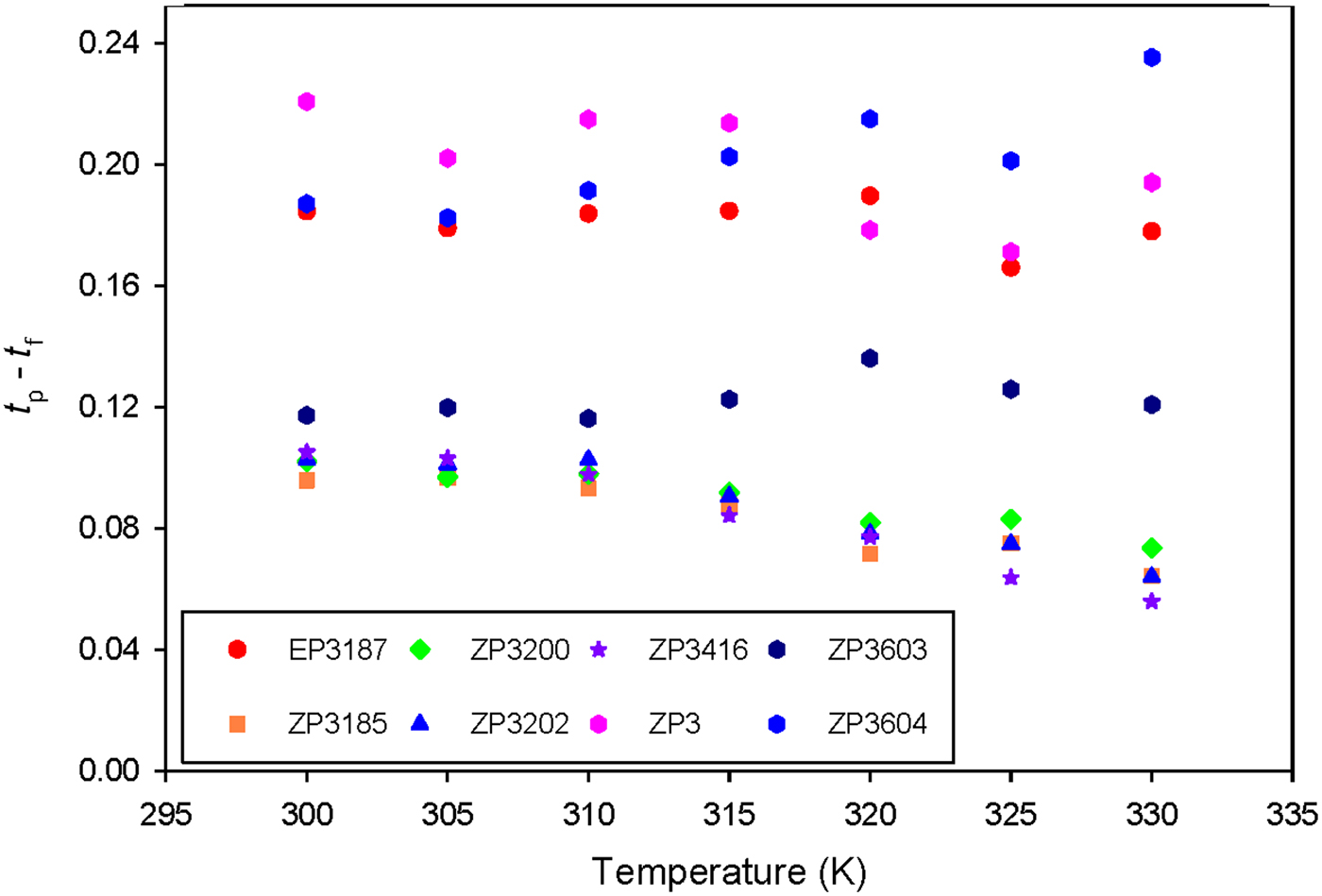
Supplementary Table S2 lists both the lithium transport, t p, and transference numbers, t f, for the OSN/carbonate blends. Figure 3 plots the difference in these values, (t p– t f), for eight electrolytes as a function of temperature: the all carbonate and blend electrolytes at 1.2 M LiPF6, and then the pure difluoroorganosilyl electrolyte at two concentrations (ZP3603 0.73 M LiPF6; ZP3604 0.49 M LiPF6). Lower values of (t p–t f) correspond to less neutral ion pair formation as  $D_ + ^{{\rm eff}}$ is more similar in value to D + and likewise for the anion. We see less ion pairing in the blend electrolytes and the more concentrated salt electrolyte ZP3603. Ion pairing decreasing with increasing salt concentration is counterintuitive. However, if the neutral ion pairs are the predominant form of the salt in the solvent at 0.49 M (which they are here since α = 0.47), then added salt in the higher concentration electrolyte may be forming charged ion aggregates. Therefore, more charged species are present in solution at 0.73 M salt leading to the decrease we see in (t p– t f). Increased temperature decreases ion pairing in the blends while slightly increasing ion pairing in the difluoro electrolytes. When
 $D_ + ^{{\rm eff}}$ is equal to D +, t p, and t f will also be equal and no neutral ion pairs are present in the solution. Supplementary Table S3 lists the values for D κ, D 0,
 $D_ + ^{{\rm eff}}$, and
 $D_-^{{\rm eff}}$ while Supplementary Fig. S3 plots the ratios of
 $D_ + ^{{\rm eff}} /D_ +$ and $D_-^{{\rm eff}} /D_-$ for six of the pure OSN electrolytes with varying fluorination of the solvent. For the lithium cation, $D_ + ^{{\rm eff}} /D_ +$ is much less than the values for the anion,
 $D_-^{{\rm eff}} /D_-$, showing that ion pair formation is more significant for the cation than anion. Based on this, we speculate that the charged aggregates in solution have a higher lithium content than anion suggesting an aggregate composition such as [Li(PF6)Li]+. Anionic triple ion aggregates have been suggested before in ionic liquid electrolytes.[Reference Hou, Zhang and Madsen28,Reference Duluard, Grondin, Bruneel, Pianet, Grelard, Campet, Delville and Lessegues29] The difluoro electrolytes have the highest values of both
 $D_ + ^{{\rm eff}} /D_ +$ and
 $D_-^{{\rm eff}} /D_-$, again indicating less ion pairing of the salt occurring in this solvent as we saw above for the lower values of (t p – t f). As the temperature increases, we see
 $D_-^{{\rm eff}} /D_-$ decrease for all the electrolytes, while
 $D_-^{{\rm eff}} /D_-$ decreases with temperature in the two difluoro electrolyte, but the other electrolytes with less fluorine in the solvent are relatively constant with temperature. The lower amount of ion pairing in the difluorinated solvents may also be due to the favorable Si−F solvent interaction with the lithium cation found in the computational studies of these electrolytes.[Reference Zhu, Lyons and Hernandez25]
Difference between the lithium transport number, t p, and lithium transference number, t f, from 295 to 330 K for OSN/carbonate blend electrolytes and two difluoroorganosilyl nitrile electrolytes. Electrolytes EP3187, ZP3185, ZP3200, ZP3202, ZP3416, and ZP3 contained 1.2 M LiPF6 and a 1:3 EC:DEC ratio with increasing amounts of the FOS solvent ZP3 from 2% (ZP3185) up to 17.7% (ZP3416). The two difluoroorganosilyl nitrile electrolytes contained 0.73 M (ZP3603) or 0.49 M LiPF6 (ZP3604).

Conclusion
Lithium-ion transport is enhanced in OSN electrolytes in comparison to cyclic carbonate solvents for lithium-ion batteries. From PFG-STE NMR measurements, we have measured lithium cation transport numbers for electrolytes with varying fluorination of the OSN solvent. Solvents with no fluorine have the highest transport values and LiTFSI electrolytes have higher transport numbers than LiPF6 electrolytes. Lithium transport numbers increase with temperature for the LiPF6 salt electrolytes. In EC/DEC/fluoroorganosilyl (FOS) solvent blends, lithium diffusion is faster in the blends in comparison to either the EC/DEC solvent blend or the pure FOS solvent. In the 6% FOS blend, we suggest both the EC and FOS molecules solvate the lithium cation. From an analysis of the neutral ion pairs present compared to charged solvated ions or ion aggregates represented by the charge diffusivity, D κ, we calculate lithium transference numbers from the effective cation diffusion,  $D_ + ^{{\rm eff}}$, and effective anion diffusion,
 $D_-^{{\rm eff}}$. There is less ion pair formation in the EC/DEC/FOS solvent blend electrolytes compared to the all carbonate or pure FOS solvents. As well there is less ion pairing in the more concentrated difluoroorganosilyl nitrile electrolyte. The decrease in ion pairing with salt concentration in the difluoroorganosilyl nitrile electrolytes and the significantly lower
 $D_ + ^{{\rm eff}} /D_ +$ compared to
 $D_-^{{\rm eff}} /D_-$ can be explained by lithium-rich ion aggregates present in these electrolytes.
Supplementary material
The supplementary material for this article can be found at https://doi.org/10.1557/mrc.2019.112.
Acknowledgments
L.J.L. thanks Grinnell College students, Steven Sharpe and Kyle Dixon-Anderson, who provided solvent diffusion data on two LiTFSI electrolytes. We thank Martin Minelli and Andrew Mobley for the use of their Schlenk lines. Grinnell College provided funding support and NMR diffusion equipment was funded by NSF-MRI (Grant no. 042138).