


The rise in affective disorders in young people (Twenge et al., Reference Twenge, Cooper, Joiner, Duffy and Binau2019), increased presentations to mental health services (Olfson et al., Reference Olfson, Druss and Marcus2015), increases in suicidal ideation and behaviours (Ivey-Stephenson et al., Reference Ivey-Stephenson, Demissie, Crosby, Stone, Gaylor, Wilkins, Lowry and Brown2020), and various other indicators have led some to refer to a ‘crisis’ in adolescent mental health (Gunnell et al., Reference Gunnell, Kidger and Elvidge2018; McGorry & Mei, Reference McGorry and Mei2018b). Community concern for youth mental health is, arguably, higher now than at any other time in history, and subsequently, there is a greater appetite for wellbeing and mental health interventions in schools than ever before. One school-based intervention with strong potential is universal mental health screening, which involves administering validated instruments to an entire school or year group in order to identify students who may have mental health issues. Screening in schools is a long-standing practice, dating back one hundred years (e.g., Wickman, Reference Wickman1928), and more recently the case for screening has been articulated by various mental health professionals (Albers et al., Reference Albers, Glover and Kratochwill2007; Humphrey & Wigelsworth, Reference Humphrey and Wigelsworth2016; Stiffler & Dever, Reference Stiffler and Dever2015). Despite this promise, implementation of school-based screening remains surprisingly low. Previous studies in the United States found that only around 2–12% of schools ran screening programs (Bruhn et al., Reference Bruhn, Woods-Groves and Huddle2014; Romer & McIntosh, Reference Romer, McIntosh, Evans, Foa, Gur, Hendin, O’Brien, Seligman and Walsh2005). Our own research in Australia indicated that only 16% of school psychologists reported screening for mental health in the previous 12 months (Burns & Rapee, Reference Burns and Rapee2021).
So, if mental health screening shows so much promise, why don’t more schools implement it? The reasons for the low implementation rates are not well understood. To begin to understand this issue, we surveyed a sample of Australian school psychologists regarding their views on barriers to universal screening in schools (Burns & Rapee, Reference Burns and Rapee2021). The main barriers identified fell within three broad categories: (1) Concern about how to respond to students referred to a school-based counselling service via a screening program (e.g., ‘I couldn’t cope with a flood of more referrals from screening’; ‘I would be concerned about how to follow-up students who are identified as at-risk by a mental health screening program’); (2) Concern about resources to implement a screening program (e.g., ‘I don’t have enough time to implement a mental health screening program’, ‘It would cost too much/I don’t have money for mental health screening’); and (3) Lack of knowledge about how to implement a screening program (e.g., ‘I don’t know how/I’ve never been taught how to run a screening program’).
While establishing a screening program is not without challenges, these barriers are not necessarily insurmountable. Our purpose in writing this paper is to further advance the knowledge of school-based practitioners by providing a brief ‘how to’ process for the implementation of universal mental health screening programs. Specifically, we articulate a four-step process that school psychologists and counsellors can use to plan a screening program and that considers the barriers to screening that can be anticipated.
Stage 1: Engaging the Support of School Management
Sometimes a school principal or executive may initiate a universal screening program. In fact, there is good reason to believe that school management are more interested in mental health and wellbeing programs now than ever before. One recent survey found that student behaviour and mental health was rated by principals as the greatest need and/or challenge for students in their school (Iachini et al., Reference Iachini, Pitner, Morgan and Rhodes2016). However, there will be times when instigating a screening program will fall on the school-based mental health practitioner, who will then need to formulate the most compelling case for screening and take it to the school management. Accordingly, school psychologists and counsellors will need to be prepared with a set of arguments that are useful in convincing school administrators of the value of screening. Arguments for the proactive management of students with mental disorders generally — and universal screening in particular — are numerous and can be considered within two broad categories. The first is arguments concerning the overall benefits to the mental health of young people and consequent benefits to society generally. Such arguments include:
-
that a significant proportion of young people with mental disorders are not identified, nor receiving professional intervention (Lawrence et al., Reference Lawrence, Johnson, Hafekost, Boterhoven De Haan, Sawyer, Ainley and Zubrick2015);
-
that effective, evidence-based interventions for common mental disorders in young people, including school-based interventions, are readily available (Werner-Seidler et al., Reference Werner-Seidler, Perry, Calear, Newby and Christensen2017);
-
that there is a sound economic case showing that investing money in early intervention/prevention programs is cost effective (National Mental Health Commission, 2020);
-
that the earlier a young person receives intervention for mental disorders the more likely they are to have better health outcomes (McGorry & Mei, Reference McGorry and Mei2018a).
The second and related set of arguments for proactive mental health care and screening more specifically apply to the educational and general functioning of the young person within the school context. These arguments may be more immediate and persuasive for school principals and school executives and include:
-
that students with mental disorders are at far greater risk of lower educational outcomes than those without (Breslau et al., Reference Breslau, Lane, Sampson and Kessler2008; Goodsell et al., Reference Goodsell, Lawrence, Ainley, Sawyer, Zubrick and Maratos2017);
-
that students with mental disorders are at higher risk of school dropout (Leach & Butterworth, Reference Leach and Butterworth2012);
-
that teachers are not proficient at identifying students with mental disorders generally, and internalising disorders in particular (Husky et al., Reference Husky, Kaplan, McGuire, Flynn, Chrostowski and Olfson2011; Moor et al., Reference Moor, Maguire, McQueen, Wells, Elton, Wrate and Blair2007; Scott et al., Reference Scott, Wilcox, Schonfeld, Davies, Hick, Turner and Shaffer2009);
-
that students with mental disorders require targeted instruction strategies that cannot be delivered if such students are not identified (Niesyn, Reference Niesyn2009);
-
that managing challenging students is an important contributor to teacher burnout (Ghanizadeh & Jahedizadeh, Reference Ghanizadeh and Jahedizadeh2014), which can be better managed if such students are identified.
A psychologist/counsellor in a particular school, however, may bring more nuanced and personal reasons for introducing a universal screening program in their particular school. This may relate to concerns about the number of students presenting to the counselling service for a specific problem (e.g., anxiety or depression), concern about suicide rates within the local community, incidence of distress within the student body following a traumatic event, or concern about the number of students found to be abusing substances. One important point that should be emphasised when presenting the case for a screening program is that the goal of screening is not to diagnose students, but simply to identify students who might have a problem so that they can receive appropriate assessment from a professional. Moreover, the school psychologist/counsellor will need to have considered all the points raised in Stages 2–4 in this article in anticipation of the questions from management. Ultimately, the desired outcome is to make a case to maximise support from school management, in turn, increasing the likelihood that they will provide sufficient resources.
Stage 2: Establishing the Support of the Broader School Community
The support of school management alone is not sufficient to ensure a successful screening program. Other key stakeholders include the parent body, staff members and the students themselves. Our recommendation is to be honest and open about the screening process with parents and students. This includes sharing the purpose of screening, the process of screening, and the outcomes of screening. Parents and students alike will need to ask questions and be given satisfactory answers. A range of common concerns and questions from parents and students can be anticipated, and the school ‘team’ (mental health staff and school management) should be prepared to provide an honest answer to all these questions (see Table 1). Information about a screening program can be distributed via a school’s newsletter, website or email correspondence to parents. School staff can take some reassurance from the knowledge that universal screening has some degree of support both from parents (Fox et al., Reference Fox, Eisenberg, McMorris, Pettingell and Borowsky2013; Soneson et al., Reference Soneson, Childs-Fegredo, Anderson, Stochl, Fazel, Ford, Humphrey, Jones and Howarth2018) and from students themselves (Robinson et al., Reference Robinson, Pan Yuen, Martin, Hughes, Baksheev, Dodd, Bapat, Schwass, McGorry and Yung2011). To the degree that teachers or other school staff are involved in the administration of a screening program, or that their general classroom practices are disrupted by a screening program, they should also be included in processes to enlist their support. This could include explaining the purpose and value of the program for them, or at least being suitably empathic with their frustrations about having their routine changed.
Anticipating common concerns about screening from parents

Despite the fact that most parents these days fully support the identification of any mental health concerns in their children, schools will need to anticipate the occasional complaint or parent distress. It is important not to panic and jeopardise an entire student body’s benefits based on a small, vocal minority. Naturally, any parent concerns need to be addressed calmly and empathically, and these parents can be reminded that they are completely at liberty to withdraw their child from the process if they wish. One common concern that might be raised is that asking young people about mental health symptoms (especially ones such as self-harm or suicide) will ‘put ideas in their head’. Due to this concern, a number of studies have addressed this issue and have consistently failed to show that asking people about mental health issues such as suicidal thoughts leads to any increase in subsequent distress or risk (DeCou & Schumann, Reference DeCou and Schumann2018; Gould et al., Reference Gould, Marrocco, Kleinman, Thomas, Mostkoff, Cote and Davies2005). In fact, allowing young people to openly talk about their concerns is more likely to reduce distress.
Stage 3: Implementation of the Program
With a clear rationale for the screening program, coupled with the support of school management and the broader school community, the stage is set for planning the logistics of the screening program. Best approaches to implementing screening involve a collaborative approach between teachers, school psychologists/counsellors and any community-service involved (Dowdy et al., Reference Dowdy, Furlong, Raines, Bovery, Kauffman, Kamphaus, Dever, Price and Murdock2015). Each school or district will then approach screening in a different manner, depending on the characteristics and needs of their student body. We provide here a series of questions to help practitioners plan the necessary approach.
-
1. Which cohort should we screen? Schools may choose to screen a class, a grade, or the entire school. This decision will be informed by the mental health risks identified within the student body. To some degree, it will also be informed by the resources available to the school or school district, with schools prioritising cohorts considered to have the greatest risks.
-
2. Which respondents should we screen? Schools have the option of seeking information directly from students, from staff who know the student (such as a Home Room or Pastoral Care teacher), and/or from parents of students. Unfortunately, agreement about mental health symptoms across different raters is typically low (Miller et al., Reference Miller, Martinez, Shumka and Baker2014; Orchard et al., Reference Orchard, Pass, Cocks, Chessell and Reynolds2019). Schools need to make decisions based on which informant(s) are likely to give the most relevant information, coupled with who they can best access — traditionally, students and/or staff are easier to access than parents. In some instances, screening through parents has been shown to be more effective in identifying disorders than relying on the report of young people themselves (Kuhn et al., Reference Kuhn, Aebi, Jakobsen, Banaschewski, Poustka, Grimmer, Goodman and Steinhausen2017). Age is an important factor when considering who to screen. Students in Grade 4 and below are unlikely to have to have adequate skills with reading and emotional insight to provide accurate self-report data. Traditionally, particularly in the United States, screening of these students has taken the form of using teachers and/or parents as respondents using tools such as the Student Risk Screening Scale (Drummond, Reference Drummond1994) or the Systematic Screening for Behavior Disorders (Walker & Severson, Reference Walker and Severson2014).
-
3. How often should we screen? In part this depends on the stability of the construct being screened for and the resources available to screen. There is some reason to believe that students’ emotional and behavioural risk patterns remain reasonably stable across high school years (Dowdy et al., Reference Dowdy, Nylund-Gibson, Felix, Morovati, Carnazzo and Dever2014), meaning it may be redundant to screen students every year. That said, a young person’s social and emotional circumstances will change over time. Screening more frequently will better capture such changes but require more school resources. We encourage a frequency that is sustainable over time in preference to a system that is so frequent and resource intense that it is unsustainable. Ideally, screening each student every 12–24 months provides a school with excellent data from which to prioritise their limited counselling resources.
-
4. What should we screen for? What is screened for will depend on the concerns the school might have for the cohort being screened. As a rule, universal screening will be most effective when it casts a ‘broad net’ to capture a wide range of problem types. We also advocate for a focus on internalising symptoms rather than externalising symptoms, as externalising disorders are, by definition, more obvious to caring adults in a young person’s life. A number of parameters can help schools determine what types of concerns they should screen for, which we shall divide into three categories – prevalence, age of onset and honesty of expected responses.
-
Prevalence We advocate for a screening approach that is most likely to identify students at risk for the more common types of emotional disorders; specifically, anxiety, attention difficulties and mood disorders. By comparison, disorders such as psychosis and bipolar disorder are relatively uncommon in school-aged populations, and screening is less likely to identify such students.
-
Age of onset The age of onset of different disorders is now well documented (de Girolamo et al., Reference de Girolamo, Dagani, Purcell, Cocchi and McGorry2012; Kessler et al., Reference Kessler, Amminger, Aguilar-Gaxiola, Alonso, Lee and Ustun2007). For example, younger students are more likely to experience attention difficulties and some anxiety disorders (e.g., separation anxiety), whereas older students are more likely to present with depression and other anxiety disorders (e.g., social anxiety). Accordingly, practitioners are advised to screen for disorders of concern for the age cohort being screened.
-
Honesty of response Students are less likely to honestly report concerns that are stigmatising, illegal or socially inappropriate. Accordingly, screening for signs of substance abuse or conduct disorder are unlikely to yield valid answers.
-
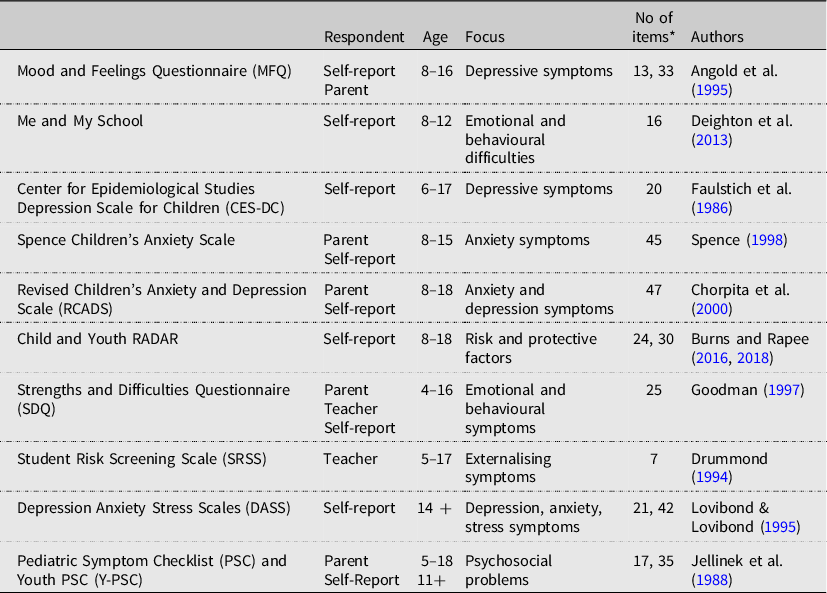
5. What screening instruments should we use? Selection of the screening instrument(s) is frequently one of the more difficult challenges schools face. Many school mental health professionals can feel overwhelmed about what instrument(s) they need, ignorant about what options are available, and unsure about how to source the selected instrument. A school’s choice of instrument will be guided by their answers to the other questions raised in this section. An additional question is whether a school can use screeners that are available free of charge or whether it has a budget to purchase commercially available screeners. Some test developers and/or distributers offer online screening commercially, such as the Behavioral and Emotional Screening System (Kamphaus & Reynolds, Reference Kamphaus and Reynolds2015). Using online commercial screeners have the obvious benefit of saving considerable time in scoring and interpreting responses, but also requires a school or school district to make available a large amount of money to cover the cost. Glover and Albers (Reference Glover and Albers2007) offer three key considerations when evaluating possible instruments — it must be appropriate for the intended use (suitability), it must have strong psychometric properties (technical adequacy) and it must be practical to administer (usability). We would add that the selected screener must be not only practical to administer, but also practical to score, particularly if it is being administered to a large number of students. In relation to a screener’s psychometric properties, the best screeners will have clearly published data not only on their reliability and validity, but also on the cut-off scores that best differentiate those students who are at risk from their asymptomatic peers. While no screener is perfect, the chosen instrument(s) must be sensitive enough to detect genuine cases, and specific enough to avoid non-cases of the difficulty screened for. Remembering that screening is never about seeking to make a diagnosis, schools can afford to favour sensitivity over specificity when screening. While it is beyond the scope of this article to review all universal screeners suitable for school use, Table 2 provides a brief summary of some commonly used screening instruments. Many of the screeners we have included are now quite old, with some dating back to the 1990s. This is not necessarily a criticism as in many cases they have continued to be thoroughly evaluated and developed. We direct readers to more extensive reviews of screeners by Stiffler and Dever (Reference Stiffler and Dever2015) and Dever et al. (Reference Dever, Raines and Barclay2012).
Table 2.Examples of available screening instruments

Note: *Some instruments offer short and long versions.
-
6. Do we need parental consent to screen students? This is a contentious and important matter to consider. Schools can adopt either an ‘opt in/active’ consent, whereby students can only participate with written consent from parents, or an ‘opt out/passive’ consent, whereby the screening program is promoted within the school community and parents can notify the school if they do not want their child included. Unfortunately, using an active rather than passive parental consent procedure has been shown to reduce the total number of students participating in screening as well as differentially affecting students in subgroups with increased risk for mental disorders (Chartier et al., Reference Chartier, Stoep, McCauley, Herting, Tracy and Lymp2008). Put simply, active parental consent makes it less likely that screening will pick up on the students who are most at risk. In a high school, parental consent is unlikely to be required from so-called ‘mature minors’ — those whom the school considers to be sufficiently mature and intelligent to understand the nature and implications of the specific decision they are being asked to make. When screening younger children and/or when screening for more controversial difficulties (e.g., suicidal ideation) schools will need to be more consultative with how they approach consent. Even when passive parental consent is used, schools are advised to be transparent with the parent body about the purposes and processes of screening and to ensure a process of informed consent is sought from the students being screened, including being explicit about who will see the results, what the results will be used for and what will happen if identified as at-risk. Regardless of which approach to consent is adopted, a discussion across the whole school community around mental health screening provides an excellent opportunity for school psychologists and counsellors to provide education to parents and, in turn, promote the positive and proactive focus of the school to provide a ‘whole of child’ educational experience.
-
7. The where, when, how and who of administering screeners. Each school will find different mechanisms to administer screening tools. Commonly, screeners are administered to students by class or wellbeing teachers during class time or ‘wellbeing’ classes. In this situation, it is vital that the school psychologist/counsellor provides teachers with explicit instruction on how to administer the screening and how to respond to anticipated student questions. An alternative is to have external providers (community clinics, university clinics, private providers) attend the school campus to run the screening program. As with the completion of any psychological tool, students should be given reasonable privacy to complete a screener without others viewing their responses. Administration options are usually via pen/paper or an online survey tool. Increasingly, schools adopt the online option (Burns & Rapee, Reference Burns and Rapee2021), although this requires some IT skills to set up the online survey and then to access results once completed. School psychologists/counsellors are advised to liaise with IT staff in their schools to consider the best options for their context. An important consideration is how to occupy students within the cohort who choose not to participate in the screening program while their peers complete the screening. In our experience, this time provides an excellent opportunity to direct these students to a suitable mental health website to explore strategies for promoting positive wellbeing. Moreover, schools must consider what time in the school calendar to carry out screening. Very early in the school year students may not yet be experiencing the common stresses of school life, while too late in the year does not allow the school adequate time to make follow-up arrangements. Times of high stress, such as exam periods, should also be avoided as all students could be expected to show ‘normal’ elevations in distress. Scoring and interpreting screening results will usually be the responsibility of the school psychologist/counsellor. Instrument developers should provide clear instructions on how to score their instruments, including providing relevant cut-off scores to indicate risk, from which a list of students to follow-up can be compiled.

Stage 4: Follow-Up for Students Identified as At Risk
A school screening program is only effective to the degree that students identified as at-risk can be linked to suitable mental health follow-up. The task of the school psychologist/counsellor at this point is to ensure that the identified students are appropriately followed up. A clear, predetermined follow-up plan for these students allows practitioners to feel in control of the process without feeling overwhelmed by the additional work. Broadly speaking, such follow-up falls into two options.
Pathway 1: Linking With Community-Based Services
The first pathway is referral to community-based mental health services for further assessment and intervention. To this end, school-based practitioners must be familiar with available community services, including details of referral possesses, wait times, costs, and so on. Moreover, they must be confident in the ability of these services to respond to those referred in a timely and professional manner. For most school students, this pathway to care will involve the school psychologist/counsellor guiding the student’s parents/guardians in how to navigate the process. The importance of collaboration between schools and community-based services is increasingly being recognised (Hertz & Barrios, Reference Hertz and Barrios2021) and models of pathways and linkages between schools and community services have been described in detail elsewhere (Kutcher & Wei, Reference Kutcher and Wei2013; Wei et al., Reference Wei, Kutcher and Szumilas2011). In many areas, including rural and remote areas (Aisbett et al., Reference Aisbett, Boyd, Francis, Newnham and Newnham2007), there are limited mental health services available. In such situations, school-based mental health practitioners may consider referring students/families to alternative means of care including telehealth services (Gloff et al., Reference Gloff, LeNoue, Novins and Myers2015) or online programs for specific disorders. Examples include the Chilled Online program for anxiety (Stjerneklar et al., Reference Stjerneklar, Hougaard, McLellan and Thastum2019) or the SPARX program for depression (Merry et al., Reference Merry, Stasiak, Shepherd, Frampton, Fleming and Lucassen2012).
Pathway 2: In-School Assessment and Intervention
The second pathway to care is additional assessment and intervention within the school itself. One within-school option is further individual assessment and intervention by the school psychologist/counsellor. This option is most feasible for those schools that are resourced adequately enough to manage the additional referrals generated by screening. Alternatively, screening may be a pathway to group intervention programs run on school campus, either by school staff or external providers. A growing literature has identified a range of evidence-based programs, both face to face and online, that can be delivered at school (Calear & Christensen, Reference Calear and Christensen2010; Corrieri et al., Reference Corrieri, Heider, Conrad, Blume, König and Riedel-Heller2014; Sanchez et al., Reference Sanchez, Cornacchio, Poznanski, Golik, Chou and Comer2018). Popular examples of such programs include Cool Kids (Haugland et al., Reference Haugland, Haaland, Baste, Bjaastad, Hoffart, Rapee, Raknes, Himle, Husabø and Wergeland2020; McLoone et al., Reference McLoone, Hudson and Rapee2006), and the Resourceful Adolescent Program (Shochet & Hoge, Reference Shochet, Hoge and Essau2009).
In-school and community-based pathways to care are not mutually exclusive, and some students may receive both. The most important point to make, however, is that schools should have a clear and feasible follow-up plan to ensure that screening leads to action that will improve the plight of students identified as at risk. Moreover, the best outcomes for students are most likely to happen when schools work in tandem with local community-based services.
Conclusion
Universal mental health screening in schools continues to offer great promise to ensure young people at risk of developing (or already experiencing) mental disorders are identified in a timely manner and referred to appropriate intervention. In light of the current, unprecedented interest on wellbeing and mental health in schools, there has never been a better time to roll out screening programs. The challenge for school systems broadly — and school psychologists and counsellors specifically — is to translate that promise into effective action. We began this article by identifying three main barriers to screening given by school psychologists: concerns about resources to implement a screening program, a lack of knowledge about the mechanics of how to implement a screening program, and concerns about how to respond to an increase work demand created by screening. We believe that by working to convince management and staff of the benefits of universal screening for the whole school, a screening program can be ‘owned’ by all staff and thereby reduce the burden of screening on the individual psychologist/counsellor. Concerning a lack of knowledge about screening, we have provided a series of questions to help guide the ‘how to’ process, with an understanding that there can be many alternate and successful strategies for implementing screening. Most school psychologists and counsellors already have an excellent skill-set for the tasks of group screening. The question of managing the workload of following up identified students most likely remains the barrier of greatest concern for many school psychologists and counsellors. We believe that well established and articulated pathways to care are the best way to mitigate the risk of a ‘flood’ of new referrals. The follow-up process becomes a shared responsibility between the school psychologist/counsellor, the student’s parents and the community mental health services. Group-based or online treatments also play an important part in reducing the need for one-to-one follow-up by the psychologist/counsellor. Ultimately, it is likely that targeted intervention and referral for students in the early stages of a mental disorder is less time consuming than managing an unexpected presentation of a student with severe and advanced symptoms at a later date.
In this article we have offered some practical responses to these concerns and hope that they may equip and motivate some school psychologists and counsellors to undertake screening within their schools. Nonetheless, many practical matters remain inadequately addressed, and more can be done to better equip schools to run their own programs. Three challenges in particular stand out to us. The first relates to improving the availability of suitable screening instruments. For use in schools, screeners must be brief, acceptable to stakeholders (in terms of content and process, such as ease of completion and scoring), developmentally appropriate, and most importantly, accurate in detecting youth with existing or developing mental disorders. We have noted earlier that many screeners currently in use are quite old, and it is important that the language and standardisation data remains current. The second matter relates to the management of youth identified during screening. Schools need evidence-informed pathways to care to ensure at-risk students receive suitable interventions — either within the school or in the community. More can be done to articulate effective processes that maximise the likelihood of young people receiving evidence-based treatments. Third, better data is required to make a case for the economic benefits to schools that come from the early identification of students with mental disorders. Accordingly, more work is required on modelling the costs and outcomes of screening in schools. To address these three concerns, we have recently commenced a study involving around 80 schools and in excess of 10,000 students across the state of New South Wales, Australia, with the aid of a grant from the BUPA Health Foundation. As a result of this study, we hope to soon be able to offer school administrators, psychologists and counsellors additional resources, including a free, brief screening tool and additional guidelines and materials to further enhance the delivery of universal screening in schools.