INTRODUCTION
Amblyomma variegatum is considered as the most harmful tick species in West Africa. Its life-cycle has a very pronounced seasonality under tropical climates with a single rainy season (Petney et al. Reference Petney, Horak and Rechav1987). Adults infest their hosts mainly during the beginning of the rainy season; larvae attach late in the same season and disappear at the onset of the dry season; nymphs engorge during the dry season with an infestation peak occurring 4–8 weeks after its onset. Immature stages of Rhipicephalus appendiculatus (Norval et al. Reference Norval, Sutherst, Kurki, Gibson and Kerr1988) and A. hebraeum (Norval et al. Reference Norval, Sutherst, Jorgensen, Gibson and Kerr1989) do not cause quantifiable weight loss; this is also the case for A. variegatum of which only the adults cause important direct losses to cattle (Stachurski et al. Reference Stachurski, Musonge, Achu-Kwi and Saliki1993), and results in the farmers having to control, specifically, this stage by manual tick removal or through application of chemical acaricides.
Considering that engorged nymphs do not move over long distances to find a moulting place once they have detached, the distribution of unfed adults is mainly determined by nymph drop-off rhythm and by tick survival in the environment (Minshull and Norval, Reference Minshull and Norval1982). Determining the tick drop off pattern and/or identifying factors influencing their detachment may thus lead to the proposal of measures which could be part of an integrated tick control strategy. Minshull (Reference Minshull1982) considered that “advantages could be taken of the well-defined drop-off patterns exhibited by all three stages of R. appendiculatus” and proposed to delay the movement of cattle from the paddock to the pastures since most engorged females detach early in the morning. Bianchi and Barré (Reference Bianchi and Barré2003) noted that host movement can induce Boophilus microplus drop off and that a 20–40 min walk speeds up the morning detachment of engorged females. They suggested putting these findings to good use “by cleaning up the dairy cattle before they return to pasture”.
The drop-off rhythm of A. variegatum nymphs has been studied in Guadeloupe by Barré (Reference Barré1989) who found that most detached in the morning. On the other hand, Rechav (Reference Rechav1978) observed that nymphs of A. hebraeum dropped off mainly in the late afternoon, and Mohammed et al. (Reference Mohammed, Khitma and Hassan2005) found that A. lepidum nymphs detach at 18.00 h or 22.00 h according to the season. Since these divergent findings have different implications regarding possible control measures, studies were carried out in Burkina Faso to identify the detachment rhythm of A. variegatum nymphs. In the light of the results, a further experiment was implemented to assess whether it was possible to reduce the density of A. variegatum adults in the pasture through proper herd management.
MATERIALS AND METHODS
Experimental site and animals
Two different experiments were carried out to determine A. variegatum nymph detachment rhythm. The first involved 4 naturally infested cattle temporarily removed from their herds and kept during 6 days in CIRDES facilities (Bobo-Dioulasso), in a 12 m2 paddock adjacent to a cowshed and surrounded by moats filled with soapy water to prevent tick escape. The second experiment took place in herds belonging to Fulani cattle breeders settled for several decades in villages located 15 km (herd A) and 13 km (herd C) east of Bobo-Dioulasso. The monitored herds comprised 65 (herd A) and 52 (herd C) zebus, Baoulé and cross-bred animals. Only zebus and cross-bred cattle were involved in the study; cattle monitored in CIRDES paddock were cross-bred coming from these herds.
The experiment carried out to check whether it was possible to lower pasture infestation through herd management was implemented in a 10-ha farm located 8 km west of Bobo-Dioulasso. The monitored herd comprised 38 Gudali zebus which grazed on community pasture in addition to the farm private land. The whole herd was involved in the first part of the study during which engorged nymphs were naturally scattered on the pastures by the infested cattle. Four, and then 6 zebus of the herd, randomly chosen among the bull-calves and heifers and weighing more than 150 kg, were used for the second part of the study during which the adult ticks present in the pasture were captured by these ‘trap-cattle’.
The tropical climate in the region is characterized by a mean annual rainfall of 1050 mm. The rainy season occurs from mid-May to early October (Diallo et al. Reference Diallo, de La Rocque and César1998). The natural vegetation is a woody and bushy savannah.
Experiments in CIRDES paddock
Cattle chosen because of their high nymph infestation were examined as soon as they arrived in the paddock. Clusters of attached ticks were delimited by lines drawn on the skin with a marker pen which allowed the establishment of a precise diagram of tick distribution. Animals were then examined daily on several occasions. Each alteration (tick starting the final engorgement phase, which is identifiable by a change in colour, from brown to grey (Barré, Reference Barré1989); detachment of an engorged nymph; disappearance of a nymph before engorgement) was immediately recorded on the diagram. During the first trial, the nymphs were checked 5 times daily, at 06.30 h (just after dawn), 09.30 h, 12.00 h, 14.30 h and 17.30 h (just before dusk). During the second trial, the schedule was modified to take into account the results of the first trial and field observations according to which herds arrive back from pasture only at sunset or up to 20–30 min later. Ticks were therefore checked at 06.30 h, 09.30 h, 12.00 h, 15.00 h, 17.00 h and 18.30 h. This last tick count was carried out by lamplight.
Field assessment of drop-off rhythm
A year later, in November–December 1999, a similar study was carried out with naturally infested cattle grazing on community pasture. During 4 weeks, 4 animals chosen in herd A (weeks 1 and 3) or in herd C (weeks 2 and 4) were examined during 4 successive days according to the protocol described above. The distribution of delimited nymph clusters was reported on a diagram and attachment, engorgement and drop off of the ticks were regularly checked and recorded. Some animals were monitored during 2 trials, others only once. Every morning, a 10-m long rope was tied around the horns of the chosen animals, allowing their catching and examination in the pasture. The first tick count took place just before the herd left the night paddock, between 09.30 h and 10.45 h according to day and herd (10.05 h on average), and the last count just after the herd came back from pasture, between 18.00 h and 19.00 h (18.20 h on average), generally by lamplight. In the meantime, the monitored cattle were examined on 4 occasions, at 11.00 h, 14.00 h, 15.30 h and 17.00 h.
Alteration of the density of A. variegatum adults in the environment
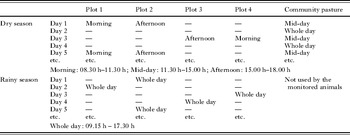
In Bobo-Dioulasso region, almost all livestock graze community pasture: it was therefore difficult to identify a farm where fences could be installed. The land of the chosen farm (herd T) was not very wide, part of it was covered by crop fields and the vegetation was very heterogeneous with regard to the available biomass (Fig. 1). Four plots were delimited with wire fences to define 2 groups of 2 plots of irregular shape but with similar size and vegetation in each group. Plots P1 and P2, partly installed on woody lush savannah, were regarded as more suitable for tick survival than plots P3 and P4 placed on poor fallows and stony/bushy savannah. Plots P1 and P4 were randomly selected to be grazed, during the dry season, from 08.30 h to 11.30 h, whereas P2 and P3 were grazed between 15.00 h and 18.00 h. The herd grazed alternately these plots and community pasture where cattle could drink from a river. Community pasture was used every other day throughout the whole day and from 11.30 h to 15.00 h when the plots were grazed, according to the schedule described in Table 1. This first part of the study took place from 1 December 2003 to 12 January 2004 and was stopped because cattle infestation had become too low and because there was no more grass in the plots. These plots remained unused until the next rainy season.
Map of the farm T where the study scheduled to assess the influence of herd management on Amblyomma variegatum adult pasture density was implemented. ‘Morning’ and ‘afternoon’ refer to the period during which the fenced plots were grazed by the herd during the dry season.

Experimental schedule of the study carried out on farm T during a dry season (whole herd involved) and the following rainy season (4 and then 6 zebus involved)
(Each pasture was grazed by the cattle during the indicated time-periods.)

Between 26 May 2004 and 2 July 2004, the plots were grazed in turn by the monitored cattle, each plot being used on 9 occasions, from 09.15 h to 17.30 h. The grazing order of the plots was randomly determined (Table 1). The 4-day period during which the cattle successively grazed the 4 plots is designated as a ‘passage’. During the first 7 passages, the group consisted of the same 4 zebus; 2 zebus were added for the 2 last passages in order to capture as many ticks as possible before the grass was completely grazed.
During the dry season, herd infestation was assessed once a week by tick counts carried out on 5 randomly chosen animals. During the rainy season, the monitored animals were examined twice a day, before and after each grazing session; all ticks were systematically removed.
Data analysis
Comparison of tick numbers or percentage between animals, plots or days was done by Chi2 test. P-values below 0·05 were considered as significant.
RESULTS
Experiments in the paddock
The engorgement and detachment of 203 nymphs was monitored. Seventy percent of these nymphs had been located during the first cattle examination, the others being spotted for the first time up to 5 days later, although no tick could attach in the paddock. Despite very careful examination of the animals involved in the second trial, this proportion was not significantly reduced (26% vs 36%; Chi2=2·3, P>0·10).
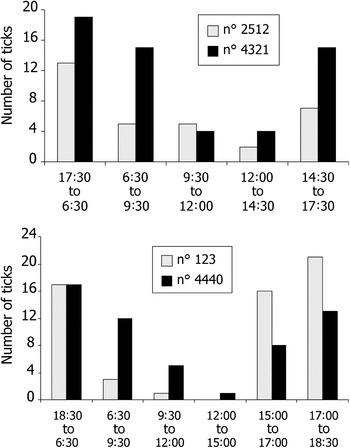
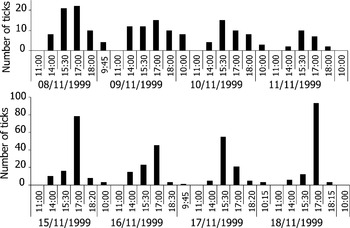
The detached nymphs (3 of which disappeared without being previously seen engorged) dropped off mainly in the afternoon or in the night, particularly during the second trial for which an additional control was performed after sunset (Fig. 2). There was no difference in the drop-off pattern between the 2 cattle monitored during the first trial (Chi2=2·3, P>0·50), unlike during the second one: 64% of the nymphs engorged on animal no. 123 detached in the afternoon (38% for no. 4440) whereas 7% detached in the morning (30% for no. 4440; Chi2=13·4, P<0·01). Considering the hourly drop-off rate, there were 2 drop-off peaks: a main peak in the afternoon or soon after sunset and a lower peak in the morning, after the first tick count. On the other hand, few nymphs detached during the mid-day hot hours.
Amblyomma variegatum nymph drop-off pattern during the 2 trials implemented in CIRDES paddock with 4 naturally infested cattle (top: first trial; bottom: second trial).

Experiments in the field
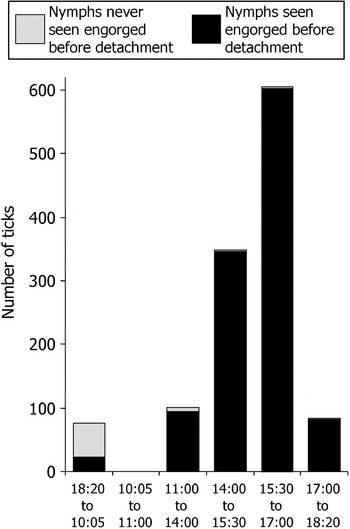
During the 16-day study, 1213 nymphs disappeared from the monitored cattle: 64 (5%) were not seen engorged or semi-engorged before detachment and most of them (53 of 64) disappeared during the night. The nymph detachment pattern, all data being merged in a single 24-h period, was very heterogeneous. Fifty per cent of the ticks detached between 15.30 h and 17.00 h and 29% between 14.00 h and 15.30 h (Fig. 3). Only 6% of the nymphs dropped off in the night pen, although the cattle spent two thirds of the study period there.
Amblyomma variegatum nymph detachment pattern for the 1213 ticks monitored during the field trial.

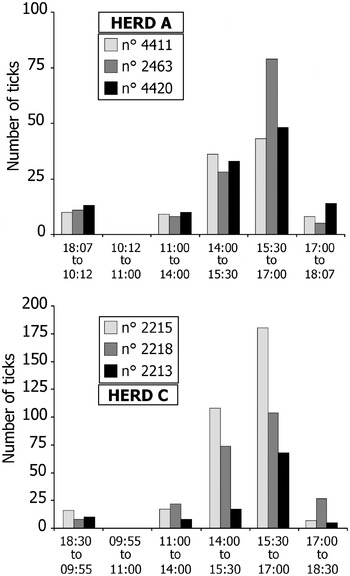
The detachment rhythm was rather similar for all the monitored cattle: the percentage of nymphs dropping off between 14.00 h and 17.00 h varied from 69% to 88% according to the host. There were, however, significant differences between animals in both herds (herd A: Chi2=16·5, P<0·05; herd C: Chi2=43·6, P<0·001) (Fig. 4). The detachment rhythm varied also sometimes according to the day. It was homogeneous during the first week (no significant difference between the 4 days; Chi2=20, P>0·05), more variable during weeks 3 and 4 (Chi2 >30, P<0·01), and dramatically heterogeneous during week 2 (Chi2=109, P<10−17). Unlike the usual pattern, more ticks detached between 14.00 h and 15.30 h on several occasions (Fig. 5).
Amblyomma variegatum nymph drop-off pattern according to the host for the 6 animals monitored on 2 occasions. The tick numbers are the total over the 8-day period.

Amblyomma variegatum nymph drop-off pattern according to the time-period for week 1 (top, herd A) and week 2 (bottom, herd C) of the field trial.

There was a high difference between the drop-off patterns observed in the field and in the paddock, fewer ticks detaching during the night and morning in the field. Six percent of the nymphs disappeared between 18.20 h and 10.05 h in the field, whereas 43% did so between 18.30 h and 09.30 h during the second paddock trial, and 58% during the first trial for a period starting 1 h earlier (Chi2=300, P<10−50).
Monitoring of herd T during the dry season
The herd started to graze the plots shortly before the nymph infestation peak. Each of the 4 plots was used on 11 occasions. The mean infestation of the zebus varied from 65 nymphs per animal (11 December) to 15 nymphs per animal (12 January), with a peak at 82 ticks on 9 December 2003.
Capture of A. variegatum adults during the rainy season
When the second phase of the study started, the herd was already infested since the A. variegatum adults had been active for a few weeks. On the first morning, the 4 monitored zebus harboured 89 A. variegatum (69 males, 19 females and 1 nymph) together with other ticks (Hyalomma, Rhipicephalus and Boophilus). All these ticks were manually removed, as were those found attached to the monitored cattle on the next 35 mornings: 79 A. variegatum males (74 of which attached to the predilection sites: udder or groin, chest and axilla, perineal area), 9 females (7 of which attached to the inter-digital areas) and 45 nymphs, as well as other ticks including 262 Hyalomma (79 of which attached to the inter-digital areas).
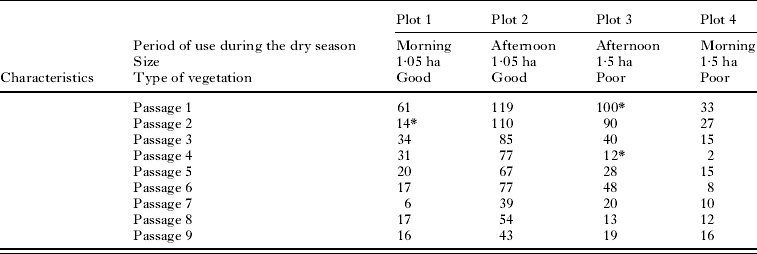
During the 36 days of the study (9 passages in each plot), the animals picked up 1395 adult A. variegatum: 216 in plot P1, 671 in plot P2, 370 in plot P3 and 138 in plot P4. The total number of ticks captured by the zebus decreased from 313 for the first passage to 75 for the 7th passage; then it increased slightly during the final passages, when 2 animals were added (Table 2). Diurnal rains occurred on 3 occasions during the study (Table 2). Two of the rainy days were contemporaneous with a reduced number of captured ticks in comparison with the previous and next passages in the same plot.
Number of Amblyomma variegatum adults captured during the rainy season by the monitored cattle on farm T during the 9 passages (4 zebus for passage 1–7; 6 zebus for passage 8 and 9); characteristics of the 4 plots installed.
(The asterics indicate the days during which rainfall occurred in the morning.)
More males (854) than females (541) were captured, but sex ratio changed during the course of the experiment: 71% of the picked-up ticks were males during the first 3 passages, but only 40% during the last 3 passages. Eighty-nine percent of the 1395 ticks captured in the plots attached to the inter-digital areas.
The number of picked-up adults depended strongly on the vegetation in the plots. Although P3 and P4 were 50% larger than their counterpart installed on lush savannah and used in the same half-day during the previous dry season, the zebus captured less ticks there than in P1 (57% more than in P4) or in P2 (81% more than in P3). When the plots with same size and vegetation were compared, it appeared that the number of A. variegatum adults captured in the plots grazed in the afternoon during the previous dry season was higher than that captured in the plots grazed in the morning. In these latter, the cattle picked up nearly 3-fold fewer A. variegatum adults (3·1-fold fewer for P1 compared to P2, Chi2=233, P<10−50; 2·7-fold fewer for P4 compared to P3, Chi2=105, P<10−24).
The monitored cattle also captured A. variegatum nymphs, Rhipicephalus spp. adults and 820 Hyalomma spp. adults in the plots. Most of the Hyalomma (75%) attached to the inter-digital areas.
DISCUSSION
During the study carried out in the field, 64 of the 1213 monitored nymphs disappeared without being previously observed as semi-engorged, mostly during the night. It was therefore not possible to know whether they died, were removed by the hosts, moved from one cattle to another, or engorged before detaching. Not more than 5% of the attached A. variegatum nymphs were thus removed or killed by grooming or by cattle immune reaction. Grooming, which is considered as an important tick control method for antelopes and gazelles, but also for cattle infested with B. microplus (Hart, Reference Hart1994), thus does not seem to be efficient against A. variegatum nymphs.
During paddock and field studies, clear heterogeneous drop-off rhythms were observed although patterns were not similar. In the paddock, the nymphs detached mostly in the afternoon (14% per h between 16.00 h and 19.00 h) but also in the morning (5% per h from 07.00 h to 10.00 h). In the field, the detachment pattern was even more heterogeneous with about 80% of the ticks detaching between 14.00 h and 17.00 h (26% per h) and less than 0·5% of the ticks detaching hourly between 19.00 h and 11.00 h. For both experiments, few nymphs detached during the hottest hours. Rechav (Reference Rechav1978) mentioned similar results with A. hebraeum nymphs infesting rabbits: 70% of the ticks dropped off during the last 4 h of the day. Conversely, Barré (Reference Barré1989) observed in Guadeloupe that the detachment peak of A. variegatum nymphs occurred in the morning, between 08.00 h and 10.00 h.
How can one explain this difference? Rechav (Reference Rechav1978) showed that modification of the photoperiod altered tick-drop off rhythm: the nymphs detached later when hosts and ticks were permanently maintained in darkness. Bianchi and Barré (Reference Bianchi and Barré2003) stated that “movement of steers is one of the major factors that stimulate detachment of the ticks”. Barré's results were obtained with ticks placed in cloth bags stuck on the skin of caged goats: the ticks did not experience normal daylight and hosts could not move readily. Differences between A. variegatum from Guadeloupe and from Burkina Faso might also result from local adaptation to climatic and/or environmental conditions. Ticks of various origins should be studied in the same conditions to test this hypothesis.
As for CIRDES paddock, one third of the surface was under a platform and the west side was adjacent to a building both of which provided shade in the afternoon. Cattle did not have a large area to move, while farmer herds can walk up to 10–12 km per day at that period. These conditions, even if they did not create complete darkness or total host immobility, may have modified the light and host movements perceived by the nymphs and therefore their detachment pattern. Wrong conclusions might then be drawn from studies carried out in ‘near natural’ conditions.
Although the detachment pattern was quite consistent during the study, the rhythm varied according to day and host. Bianchi and Barré (Reference Bianchi and Barré2003) noticed not only that host movements stimulate B. microplus detachment but also that sunlight may influence tick detachment. This was also postulated by Rechav (Reference Rechav1978) who stated that “light is the dominant synchronizer affecting the endogenous rhythms”. Could sunlight variations during the field study explain the daily differences of detachment pattern? As these variations were not recorded, it is impossible to determine. On the other hand, cattle in the same herd have different behaviours. Some are always at the front of the herd, others are walking slowly behind, and some are covering greater distances than more indolent animals, etc. These differences might also have influenced the A. variegatum nymph drop-off rhythm and could explain the host-related variations of detachment pattern observed in the field and in the paddock.
It has been postulated that drop-off regulation results from the synchronization with host behaviour, allowing moulting to occur in a suitable environment where host finding by the next stage could be easier (Rechav, Reference Rechav1978; Belozerov, Reference Belozerov, Obenchain and Galun1982). Mohammed et al. (Reference Mohammed, Khitma and Hassan2005) stated thus that evening detachment of A. lepidum nymphs attached within cotton bags fixed around sheep scrotum (the distribution of this tick occupies more arid areas than that of A. variegatum (Petney et al. Reference Petney, Horak and Rechav1987)), occurring at 18.00 h or 22.00 h according to the season, increases the “chance to encounter the next host”. A. variegatum nymphs drop-off rhythm seems also adapted to main host behaviour. When detaching during the last third of the photo-phase, engorged nymphs can limit desiccation and have 15–18 h of favourable climatic conditions to find a microhabitat appropriate for survival. Dropping off the hosts earlier would expose the ticks to the hottest hours which could lead to high mortality. Wilkinson (Reference Wilkinson1970) thus assumed that B. microplus was absent in some Australian regions because of the excessively high temperatures at ground level. Conversely, if engorged nymph detachment would occur later, when the cattle are back in the kraal, ticks would be in a very unfavourable environment: for example, no bushes or clumps of grass of which the root network could protect them from the desiccation, high risk of crushing by the cattle, high risk of predation by chickens which are efficient predators (Morel, Reference Morel1974; Hassan et al. Reference Hassan, Dipeolu, Amoo and Odhiambo1991; Dreyer et al. Reference Dreyer, Fourie and Kok1997). Finally, unfed adults would hardly find hosts in the kraal that are generally moved onto harvested fields during the dry season so that manure can fertilize the soil; but cattle are no longer brought into these fields during the following rainy season.
Considering the important differences between the detachment patterns observed in the paddock and those in the field, only the latter results were regarded as representative. Despite some daily or host variations, near 80% of the engorged A. variegatum nymphs detached between 14.00 h and 17.00 h. An experiment was therefore carried out to determine whether one could exploit this detachment pattern to modify tick density in the fields.
During this latter study, the collected data gave indications as regards tick biology. It appeared that heavy rains hampered movements of A. variegatum adults, which had already been observed during other studies (Stachurski, Reference Stachurski2000 b); this is probably due to the host-seeking behaviour of the ticks which do not wait at the top of the vegetation but actively walk on the ground to reach the potential host. The invasion process of A. variegatum adults was confirmed: the majority of the ticks captured in the pasture attached to the inter-digital areas and moved towards the predilection sites at night when the animals are lying down in the night pen. At this time, movements from one cattle to another may occur (Stachurski, Reference Stachurski2000 a). This may explain why, despite the evening manual removal of the captured ticks, monitored animals were infested in the morning by some A. variegatum adults, coming from other cattle of the herd, and why these ticks were mainly attached to the predilection sites. The very low number of female ticks found attached to the cattle in the morning and the fact that, unlike males, they were mainly attached to the inter-digital areas, are also consequences of the biological characteristics of A. variegatum. Females do not usually attach to the predilection sites until males have started to produce aggregation-attachment pheromone, 3–5 days after attachment (Norval and Rechav, Reference Norval and Rechav1979). The low proportion of females among the ticks captured at the beginning of the study is also partly due to this characteristic. In addition, females need higher humidity at soil level to display host-seeking activity (Stachurski, Reference Stachurski2006).
Collected data suggested that invasion of cattle by the Hyalomma ticks present in the area (mainly H. marginatum rufipes and H. truncatum) may also take place in the same manner. Seventy-five percent of the ticks found in the evening were attached to the inter-digital areas; monitored cattle were infested in the morning despite evening tick removal; and only 30% of the nightly attached Hyalomma were found on the feet.
Regarding A. variegatum adults, more ticks were picked up in the plots with denser vegetation than in those installed on stony savannah and fallows, even though these latter were larger. This confirmed that the presence of favourable microhabitats for nymph moulting and survival in the pastures greatly influences adult distribution (Minshull and Norval, Reference Minshull and Norval1982).
Herd management during the dry season can influence the number of A. variegatum adults present in the pasture 6 months later: cattle picked up nearly 3-fold more A. variegatum in the plots grazed in the afternoon during the nymph infestation period in comparison with those grazed in the morning. How could livestock owners implement a tick control method using this observation? Where could they bring their animals during the nymph drop-off periods, i.e. in the afternoon, to prevent pasture infestation? One solution could be to bring back the herd to the night pen earlier in the day, so that most ticks would detach in this unsuitable environment. This could be applied if herdsmen could leave the night pen much earlier in the morning (before dawn) or if cattle could be left free to graze nightly, which is impossible in areas where pastures are interspersed with non-harvested fields. However, from November onwards, cattle are allowed to graze crop residues in harvested fields where they can spend more than 3–4 h daily (Stachurski, Reference Stachurski2000b). Such fields are unsuitable for nymph survival (no shade, no bush and no perennial grasses) and are not grazed in the next rainy season: the great majority of engorged nymphs disseminated there would die. The strategy during the dry season could therefore be to bring cattle into these fields after 14.00 h or 15.00 h and to let the animals graze community pasture during the first half of the day while, at present, herds are indiscriminately brought in the morning or in the afternoon into the fields. Cattle infestation during the rainy season and consequently acaricide treatments could therefore be reduced by the implementation of this kind of integrated tick control strategy. Such a herd management would not require an important change in current practices since herdsmen are already accustomed to move cattle between savannah and harvested fields (Stachurski, Reference Stachurski2000 b). However, as most farmers use community pasture, herd movement management would only be effective in reducing tick densities if all the herds sharing the same pastures could follow the same procedure. The implementation of this type of strategy should therefore be preceded by a local awareness campaign.
ACKNOWLEDGEMENTS
Thanks to S. Zoungrana, M. Konkobo, I. Dicko, and I. Barry for technical assistance during data collection, and to the farmers who accepted the constraints due to the experimental schedules. The studies were conducted under the supervision of Dr S. M. Touré and Professor A. S. Gouro, successive general directors of CIRDES. The various versions of the manuscript were improved by Dr Lesley Bell-Sakyi and Dr Pablo Tortosa.
FINANCIAL SUPPORT
These studies were funded by CIRAD.