


Introduction
A person’s alignment with conservative (Republican) and liberal (Democrat) political ideologies is often indicative of their traditional (conservative) or progressive (liberal) beliefs concerning family values and government policies (Goren Reference Goren2020). However, the views and diversity of American families are changing as more people than ever are partnering in interracial relationships, having multiracial children, and forming biracial families (Roy and Rollins Reference Roy and Rollins2019). Coinciding with these racial/ethnicity and family demographic shifts is a greater desire to understand the political views of the approximately 20% of newlywed, cohabiting, and unmarried interracially partnered voting-aged adults to better gauge their impact on, and how they are impacted by, governmental policies and political representation (Livingston and Brown Reference Livingston and Brown2017). Studies show people with more conservative ideologies have a greater preference for a same-race heterosexual relationship than those with more liberal views (Anderson et al. Reference Anderson, Goel, Huber, Malhotra and Watts2014; Eastwick et al. Reference Eastwick, Richeson, Finkel and Son2009), which suggests the political beliefs of romantically involved adults might be expected to differ by the individual’s relationship type (same-race versus interracial). Yet, little is known about whether the political beliefs of those in established interracial relationships lean towards conservative or liberal ideologies or how their political views compare to people in same-race relationships.
Analyzing the association between relationship type and political beliefs of heterosexual partners is particularly complex because political attitudes differ along both racial/ethnic and sex lines (Pew Research Center 2024). In terms of race and ethnicity, the average White adult tends to lean Republican, whereas most Asian, Black, and Hispanic persons lean Democrat (Oliphant and Cerda Reference Oliphant and Cerda2025). These racial/ethnic disparities in political views at least partially reflect group differences in their attitudes and experiences related to racial animus, racial inequality, and racially targeted policies like affirmative action (Coll et al. Reference Coll, Torres and Tolbert2024; Gomez and Wilson Reference Gomez and Wilson2006; Sears and Henry Reference Sears and Henry2003). Concerning sex, most men lean Republican and women lean Democrat (Oliphant and Cerda Reference Oliphant and Cerda2025), suggesting there are sex differences in support for traditional values and progressive approaches to family and government policies. Political views further vary at the intersection of race/ethnicity and sex (Pew Research Center 2024), but married men and women both have more Republican-leaning views (Rothwell and Newport Reference Rothwell and Newport2024). Thus, a thorough examination of the connection between relationship type and political beliefs requires exploring whether this association is moderated by the individual’s race/ethnicity, sex, and marital status.
Still, despite the significant influence politicians have over the lives of the growing number of interracially partnered people, we are not aware of a study that explores the political beliefs of voting-age adults in established interracial relationships. Such an examination is warranted to provide policy makers and the broader society with some insight into how political affiliations and policies in the United States may evolve in the future. Therefore, the goal of the present paper is to extend the discourse on racial and ethnic politics by exploring whether interracially partnered adults have more conservative or liberal political beliefs than those in same-race relationships as well as the extent the focal association between relationship type and political beliefs is moderated (varies) by an individual’s race/ethnicity, sex, and marital status.
Interracial Romance and Political Beliefs
Interracial romantic partnerships were relatively uncommon in the United States before the Supreme Court deemed anti-miscegenation laws unconstitutional with its ruling in the 1967 case of Loving vs. Virginia (1967). In the years since, there have been significant increases in the percentage of Americans who approve of Black-White interracial marriage (McCarthy Reference McCarthy2021), the prevalence of interracial marriages (Livingston and Brown Reference Livingston and Brown2017), and the number of multiracial children born to interracially partnered couples (Jones et al. Reference Jones, Marks, Ramirez and Rios-Vargas2021). These changes in policy and American families correspond with a demographic shift in the United States becoming more racially and ethnically diverse (Jones et al. Reference Jones, Marks, Ramirez and Rios-Vargas2021). In knowing this, there is growing interest in the impact interracial relationships have on American society and it’s political policies. The connection between anti-miscegenation laws and the prevalence of interracial relationships highlights the impact political policies have on shaping American families and the partner selection process. Nonetheless, because the political beliefs of interracially partnered individuals have received little empirical attention, even less is known about whether differences in people’s romantic relationship type (same-race vs. interracial) differentially affect the political beliefs of voting-age adults. In the United States, the political beliefs of liberals (Democrat) and conservatives (Republican) generally reflect their ideological views on family values and government policies (Goren Reference Goren2020). That is, people with conservative beliefs tend to support policies that promote traditional family values like racial homogamy (same-race marriage) and a domestic division of labor with a male breadwinner and female homemaker (Eastwick et al. Reference Eastwick, Richeson, Finkel and Son2009; Smith Reference Smith2008), and those with liberal beliefs often support policies that promote social equality and changes to the traditional family structure (Smith Reference Smith2008).
Although previous studies have focused on the correlation between political beliefs and attitudes towards interracial relationships (Anderson et al. Reference Anderson, Goel, Huber, Malhotra and Watts2014; Pew Research Center 2017), the literature suggests we might expect political beliefs to differ by relationship type for several reasons. For one, the assortative mating theory presumes people usually select a romantic partner who has similar characteristics to themselves, like race/ethnicity and political views (Qian and Lichter Reference Qian and Lichter2018; Siow Reference Siow2015). Still, nearly 20% of voting-aged newlyweds and cohabitors cross racial lines for romance, with White-Nonwhite partnerships being the most prevalent (Livingston and Brown Reference Livingston and Brown2017; Passel et al. Reference Passel, Wang and Taylor2010). However, about 20% of adults also cross political lines for marriage even though most White adults identify as Republican, whereas Asian, Black, and Hispanic people commonly identify as Democrats (Pew Research Center 2025).
Second, having a same-race partner is more important to people with conservative-leaning ideologies than liberals (Anderson et al. Reference Anderson, Goel, Huber, Malhotra and Watts2014; Eastwick et al. Reference Eastwick, Richeson, Finkel and Son2009), and such in-group racial preferences suggest conservatives may be less likely to cross racial lines for romance than liberals. Some conservative-leaning racial/ethnic minorities do prefer to interracially partner with White conservatives, however, which the system-justification theory posits is a way of conforming to the social expectations of the dominant group (Eastwick et al. Reference Eastwick, Richeson, Finkel and Son2009; Jost and van der Toorn Reference Jost and Van Der Toorn2012). Collectively, the research points to people in same-race relationships, particularly White couples, leaning politically conservative. Since most interracial couples are White-Nonwhite dyads (Passel et al. Reference Passel, Wang and Taylor2010), there is a high likelihood that either (a) interracially partnered White adults have liberal-leaning views or (b) racial/ethnic minorities with White partners have conservative-leaning views. Thus, the existing research leads us to hypothesize that most people in interracial relationships are more likely to have liberal-leaning political beliefs than individuals in same-race relationships.
Political Challenges to Interracial Relationships
Chief Justice Warren’s opinion in the Loving vs. Virginia case, that laws preventing interracial relationships were grounded in “racial discrimination” and were “designed to maintain White Supremacy,” established anti-miscegenation laws as both illegal and inherently racist (Loving v Virginia 1967). According to the racialized political theory, Justice Warren’s viewpoint is especially salient to people in interracial relationships because they have more opportunities for meaningful intergroup contact and socialization experiences that may alter their racial and political beliefs (Phan et al. Reference Phan, McNeely and Vargas2023). Using this principle, Phan et al. (Reference Phan, McNeely and Vargas2023) found that interracially partnered individuals perceive more racial discrimination than people in same-race relationships and that persons who perceive racial/ethnic minorities (Asian, Black, and Hispanic) are discriminated against tend to identify as Democrat and vote for Democratic candidates. In contrast, perceiving White people are discriminated against was associated with 50% lesser odds of voting for a Democratic candidate. Therefore, the racialized political theory can be used to presume that the discrimination perceived by either partner in an interracial relationship may impact their political beliefs as well as the candidates for whom they vote in such a way that the association between relationship type and political beliefs may vary by the individual’s race/ethnicity.
For people in same-race and interracial relationships, differential experiences with discrimination, racial inequality, and racially targeted policies may contribute to dissimilar political beliefs. For example, discriminatory attitudes like symbolic racism—the covert racial animus (hostility) White Americans have towards Nonwhite groups—significantly predict White Americans’ opposition to policies targeted to help Black people, like preferential hiring and removing restrictive voting qualifications (Coll et al. Reference Coll, Torres and Tolbert2024; Gomez and Wilson Reference Gomez and Wilson2006; Rabinowitz et al. Reference Rabinowitz, Sears, Sidanius and Krosnick2009). Moreover, symbolic racism has been found to be inversely related to liberal ideology, whereby people with the least racial hostility tend to have the most liberal-leaning political views (Gomez and Wilson Reference Gomez and Wilson2006). There is also the prominent idea that voters with low levels of implicit racial bias, the unconscious attitudes and stereotypes that may unknowingly lead to discrimination, lean Democrat, and those with greater implicit racial bias lean Republican (Maryfield Reference Maryfield2018). This position is evidenced by research showing nearly three-fourths (73%) of Democrats believe racial inequality is a critical threat to American society compared to 23% of Republicans (Smeltz Reference Smeltz2020). Accordingly, individuals who support policies that promote racial equality probably have less racial hostility towards Nonwhite groups along with liberal-leaning beliefs. Given that all interracial couples have at least one Nonwhite partner, this suggests that people in established interracial relationships have low levels of racial animus and implicit racial bias and, in turn, have more liberal-leaning political beliefs than those in same-race relationships generally and White couples specifically.
The possibility that people in interracial relationships have more liberal-leaning political beliefs could be reflected by the political views of their multiracial children. Research indicates there is a strong intergenerational transfer of political beliefs, as over 80% of teenagers identify with the same political party as their Republican and Democrat parents (Cooperman Reference Cooperman2023). A study by Davenport (Reference Davenport2016) further demonstrates the impact of parental political socialization extends to the multiracial children of interracial couples by showing that Black-White people who self-identify as multiracial have liberal-leaning political views that are similar to monoracial Black persons on racial issues like discrimination and affirmative action. Because children often adopt the political beliefs of their parents, Davenport’s (Reference Davenport2016) work suggests the racial composition of interracial couples may play a significant role in shaping the political beliefs of their multiracial children. Consequently, the liberal-leaning political beliefs of some multiracial individuals may be indicative of the political beliefs of their interracially partnered parents.
In addition to a person’s race/ethnicity, the different views of men and women are another critical factor to account for when examining the link between relationship type and political beliefs. An in-depth report by Pew Research Center (2024) finds that most registered voters who are men (52%) lean Republican and women (51%) lean Democrat, a pattern of political allegiance that has remained fairly constant for the past thirty years. For interracially partnered heterosexual couples, however, it is essential to also consider political beliefs at the intersection of race/ethnicity and sex. Here, political beliefs vary more significantly in that most White men and women have Republican-leaning views, but most Asian, Black, and Hispanic men and women lean Democrat (Pew Research Center 2024). Such disparities suggest the association between relationship type and political beliefs is likely to differ by sex and may further vary at its intersection with race/ethnicity.
For romantically involved men and women, marital status has been shown to be another significant predictor of their political beliefs. Specifically, Republicans have a higher marriage rate than Democrats, and married people are more likely to have Republican-leaning beliefs (Pew Research Center 2024; Rothwell and Newport Reference Rothwell and Newport2024). When further considering sex, most married men and women are both more likely to be Republican-leaning voters, whereas those who are cohabiting, divorced, and never-married are likely to lean Democrat (Pew Research Center 2024). Although Democrats are less likely to be married (Rothwell and Newport Reference Rothwell and Newport2024), we do not know whether marital status differentially impacts the political views of those in same-race and interracial relationships. Thus, differences in the political beliefs of adults in same-race and interracial relationships might significantly vary by the person’s marital status, which may also be moderated by a person’s race/ethnicity and sex.
Summary and Research Hypotheses
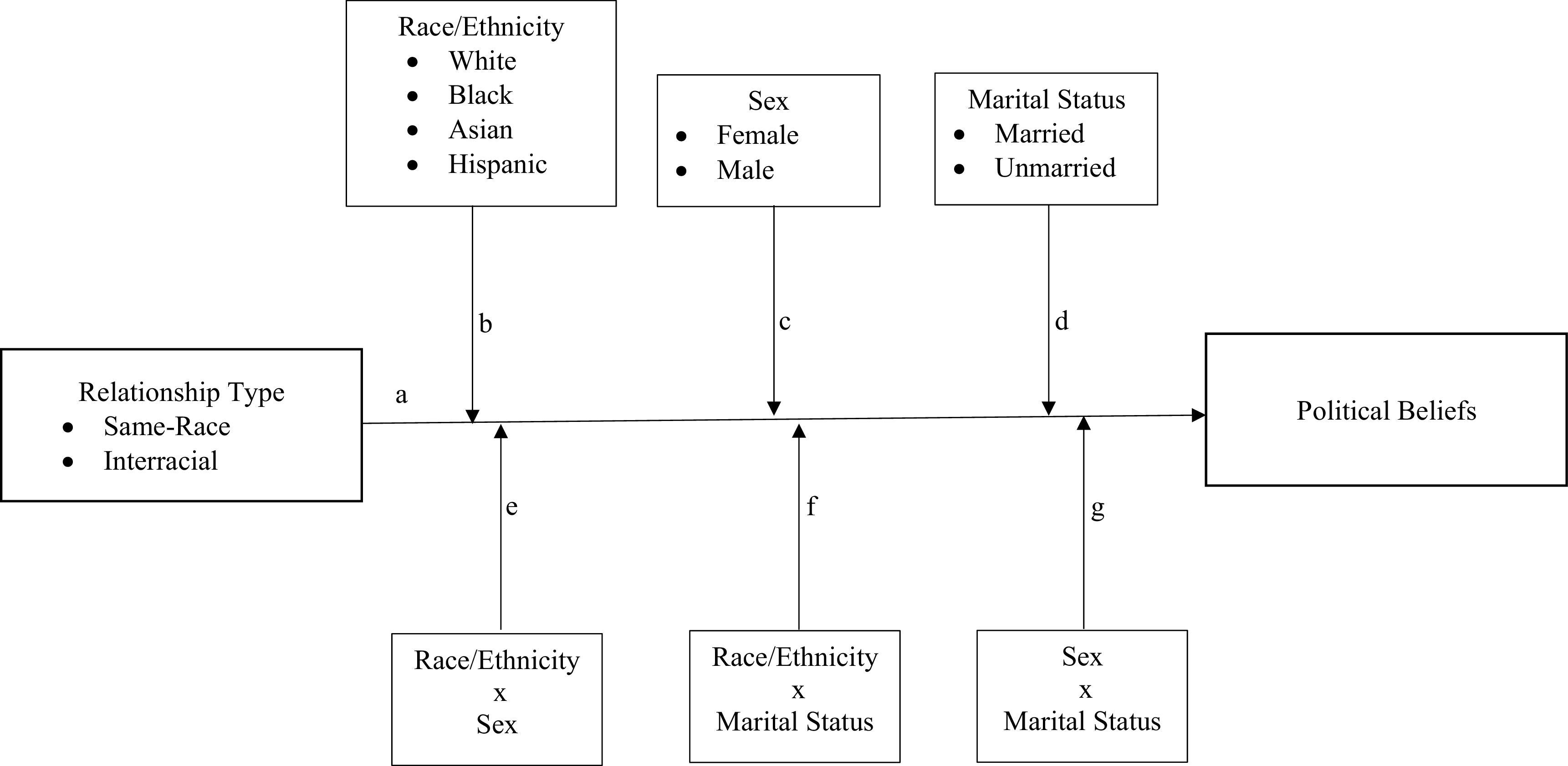
The idea that people from different racial groups are presumed to be biologically and socially different makes race/ethnicity a significant socio-political issue for those in interracial relationships. Despite these presumptions and the influence politicians may have on the lives of interracial couples and their multiracial families, little is known about the political beliefs of interracially partnered people. To address this gap in the race, ethnicity, and politics literature, the present study uses a nationally representative sample of romantically involved adults to compare the political beliefs of those in same-race and interracial relationships (relationship type). Because the literature suggests the effects of this focal association may be conditioned by other salient factors, the multivariate statistical models also examine if the political beliefs of people in same-race and interracial relationships are moderated by the individual’s race/ethnicity, sex, and marital status (Baron and Kenney Reference Baron and Kenny1986; Sojo and Guarino Reference Sojo and Guarino2011). Therefore, as our conceptual model depicts in Figure 1, we hypothesize that a person’s relationship type is associated with their political beliefs (pathway a), and this focal association will be moderated by the individual’s race/ethnicity (pathway b), sex (pathway c), and marital status (pathway d). We also test whether the political beliefs of same-race and interracially partnered people are further moderated by the multiplicative effects of the individual’s race/ethnicity and sex (pathway e), race/ethnicity and marital status (pathway f), as well as their sex and marital status (pathway g).
Conceptual depiction of moderation model.

Figure 1. Long description
A conceptual diagram depicting the moderation model of political beliefs influenced by relationship type, race/ethnicity, sex, and marital status. The diagram includes several labeled components: Race/Ethnicity, Sex, Marital Status, Relationship Type, and Political Beliefs. Race/Ethnicity includes categories such as White, Black, Asian, and Hispanic. Sex includes Female and Male. Marital Status includes Married and Unmarried. Relationship Type includes Same-Race and Interracial. Arrows indicate the relationships between these components. Relationship Type influences Political Beliefs directly and indirectly through interactions with Race/Ethnicity, Sex, and Marital Status. Specific paths are labeled with letters a through g, indicating the flow and interaction between these variables. The diagram illustrates how these factors interrelate to influence political beliefs.
Data and Methods
The present study uses a sample of 12,603 people from Wave 4 (collected in 2008) of the National Longitudinal Study of Adolescent to Adult Health (Add Health) to predict the political beliefs of romantically involved adults in same-race and interracial relationships. The Add Health data is a nationally representative sample of 80 high schools and 52 middle schools from the United States, each selected with an unequal probability of selection. Incorporating systematic sampling methods and implicit stratification into the Add Health study design ensured this sample is representative of U.S. schools with respect to region of the country, urbanicity, school size, school type, and ethnicity (Harris et al. Reference Harris, Halpern, Whitsel, Hussey, Killeya-Jones, Tabor and Dean2019).
Dependent Variable
Political beliefs were measured by the respondent’s answer to the question, “In terms of politics, do you consider yourself very conservative, conservative, middle-of-the-road, liberal, or very liberal?” Responses were dummy coded very conservative (−2), conservative (−1), middle-of-the-road/moderate (0), liberal (1), and very liberal (2) so that scores below zero indicate respondents have conservative-leaning political beliefs and scores above zero indicate liberal-leaning political beliefs.
Independent Variables
The respondent’s relationship type was determined by the romantically involved respondents’ answer to the question: “What is the race of your romantic partner?” Respondents who reported that their current or most recent romantic partner had the same racial background as themselves were categorized as being in a same-race relationship (e.g., Black-Black), and those whose partner had a different racial/ethnic background than their own were categorized as being in an interracial relationship (e.g., White-Hispanic).
Moderating Variables
Race/ethnicity was measured using the respondent’s self-reported racial/ethnic background and categorized into one of four mutually exclusive categories: Non-Hispanic White, Non-Hispanic Black, Hispanic (of any race), and Asian. Sex is a dichotomous measure that is dummy coded to indicate whether the respondent self-identified their biological sex as female (1) or male (0). Marital status is a dichotomous measure to indicate whether the respondent is married (1) or in a cohabiting, pregnant, or dating relationship (0).
Control Variables
Age is a continuous measure of the respondent’s reported age. Educational attainment is a categorical variable that has been dummy coded to indicate the respondent’s highest level of educational attainment as less than high school (0), high school graduate (1), vocational (2), some college (3), bachelor’s degree (4), and post-bachelor’s degree (5).
Analytical Strategy
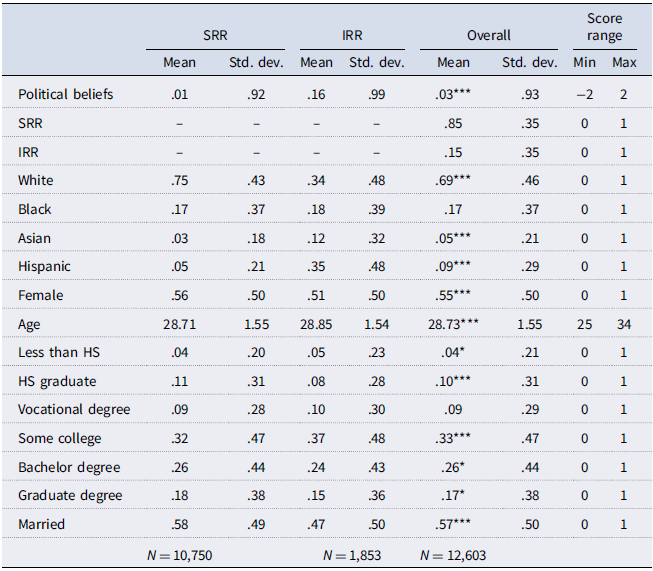
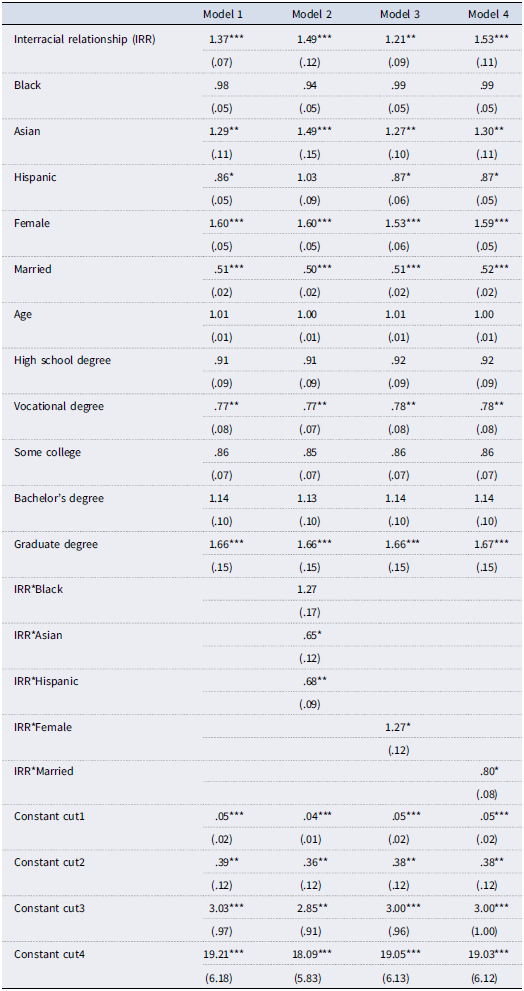
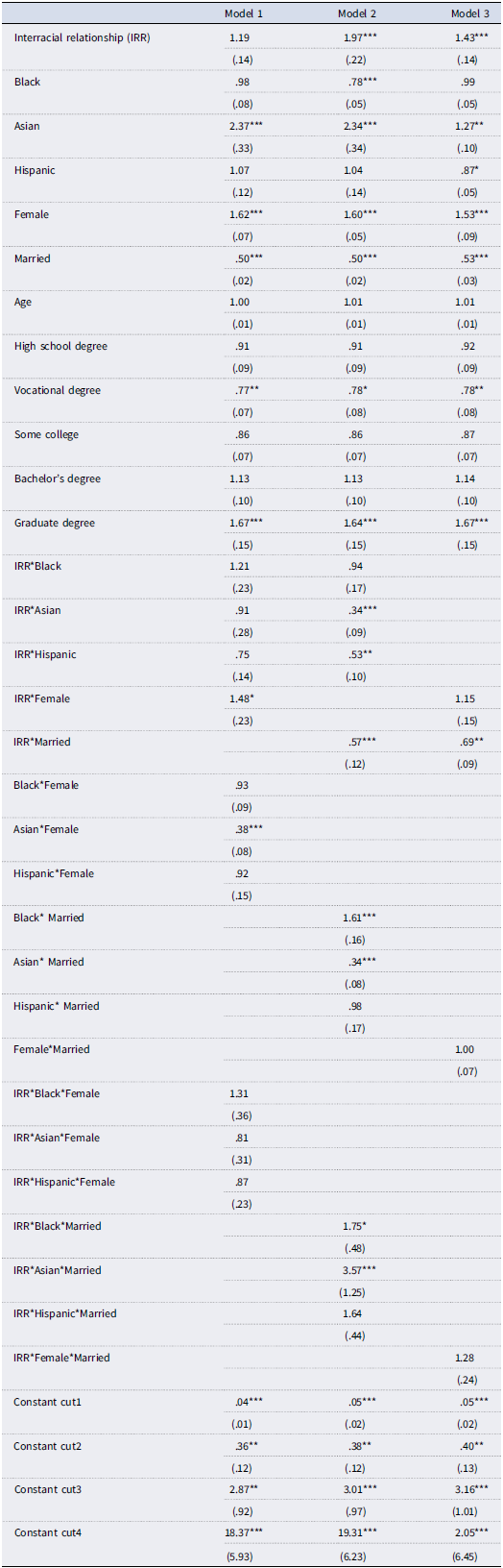
The analytical strategy for this study is designed to first provide the descriptive statistics for the sample of respondents in same-race and interracial relationships that are presented in Table 1. We conducted our multivariate analyses using ordinal logistic regression because the dependent variable is rank-ordered with five categories and coded so that moderate scores are zero, scores below zero indicate respondents have conservative-leaning political beliefs, and scores above zero indicate liberal-leaning political beliefs. Because previous studies show political views differ by race/ethnicity, sex, SES, and marital status (Oliphant and Cerda Reference Oliphant and Cerda2025; Pew Research Center 2024; Rothwell and Newport Reference Rothwell and Newport2024), we use same-race relationships, White, male, less than high school education, and unmarried as the reference groups to explore the association between interracial relationships (IRR) and political beliefs in our multivariate analyses. Table 2 presents the odds ratios (OR) and standard errors from the ordinal logistic regression analyses examining the association between relationship type and political beliefs as well as our two-way interactions testing whether the focal association is moderated by the respondent’s race/ethnicity (IRR*Race/Ethnicity), sex (IRR*Sex), and marital status (IRR*Marital Status). Table 3 presents the odds ratios and standard errors from the ordinal logistic regression analyses of our three-way interactions testing whether the focal association is moderated by the multiplicative effects of the respondent’s race/ethnicity and sex (IRR*Race/Ethnicity*Sex), race/ethnicity and marital status (IRR*Race/Ethnicity*Marital Status), and sex and marital status (IRR*Sex*Marital Status). Coefficient estimates in the analyses are adjusted for the complex sampling design of the Add Health study by using the “svy” command in Stata SE, version 14 (StataCorp 2015).
Descriptive statistics, overall and by relationship type

Table 1. Long description
A table with descriptive statistics for various demographic and social factors. The table has 12 rows and 10 columns. Column headers are SRR Mean, SRR Std. dev., IRR Mean, IRR Std. dev., Overall Mean, Overall Std. dev., Score range Min, and Score range Max. Row labels include Political beliefs, SRR, IRR, White, Black, Asian, Hispanic, Female, Age, Less than HS, HS graduate, Vocational degree, Some college, Bachelor degree, Graduate degree, and Married. Each row provides mean and standard deviation values for SRR, IRR, and Overall categories, along with the score range for each factor. Notable trends include higher overall means for White, Female, and Married categories, and lower standard deviations for SRR and IRR in Political beliefs.
Note: ***denotes significant at p < .001, **denotes significant at p < .01, *denotes significant at p < .05 using ANOVAs for continuous variables, and chi-squared tests for dichotomous variables. Tests indicate differences across the three racial groups. Some columns do not total 100% due to rounding error. SRR = same-race relationship and IRR = interracial relationship.
Odds ratios for the ordinal logistic regression analyses predicting political beliefs by Romantic relationship type with two-way interactions (N = 12,603)

Table 2. Long description
A table with four models comparing odds ratios for political beliefs by romantic relationship type with two-way interactions. The table has 21 rows and 4 columns. Column headers are Model 1, Model 2, Model 3, and Model 4. Row labels include Interracial relationship (IRR), Black, Asian, Hispanic, Female, Married, Age, High school degree, Vocational degree, Some college, Bachelor’s degree, Graduate degree, IRR*Black, IRR*Asian, IRR*Hispanic, IRR*Female, IRR*Married, Constant cut1, Constant cut2, Constant cut3, and Constant cut4. Each cell contains odds ratios and standard errors. Notable interactions include IRR*Asian, IRR*Hispanic, IRR*Female, and IRR*Married.
Note: ***denotes significant at p < .001, **denotes significant at p < .01, *denotes significant at p < .05. Reference groups for the categorical variables are same-race relationship, White, male, less than high school, and unmarried. SRR = same-race relationship and IRR = interracial relationship.
Odds ratios for the ordinal logistic regression analyses predicting political beliefs by Romantic relationship type with three-way interactions (N = 12,603)

Table 3. Long description
The table presents odds ratios and standard errors from ordinal logistic regression analyses. It includes three models with various predictors and interactions. The table has 40 rows and 10 columns. Column headers are Model 1, Model 2, and Model 3, each with corresponding standard error values. Row labels include Interracial relationship (IRR), Black, Asian, Hispanic, Female, Married, Age, High school degree, Vocational degree, Some college, Bachelor’s degree, Graduate degree, IRR*Black, IRR*Asian, IRR*Hispanic, IRR*Female, IRR*Married, Black*Female, Asian*Female, Hispanic*Female, Black*Married, Asian*Married, Hispanic*Married, Female*Married, IRR*Black*Female, IRR*Asian*Female, IRR*Hispanic*Female, IRR*Black*Married, IRR*Asian*Married, IRR*Hispanic*Married, IRR*Female*Married, Constant cut1, Constant cut2, Constant cut3, Constant cut4. Each row lists the odds ratios and standard errors for the respective variables and interactions across the three models. The table provides detailed statistical results for the association between relationship type and political beliefs, adjusted for various demographic factors.
Note: ***denotes significant at p < .001, **denotes significant at p < .01, *denotes significant at p < .05. Reference groups for the categorical variables are same-race relationship, White, male, less than high school, and unmarried.
Results
Bivariate Correlations
The descriptive means for the characteristics of people in same-race relationships and interracial relationships are presented in Table 1. We find 15% of the sample is interracially partnered, which is in line with nationally representative data (Livingston and Brown Reference Livingston and Brown2017). On average, political beliefs significantly differ by relationship type such that people in interracial relationships (.16) are more liberal than those in same-race relationships (.01). Involvement in each relationship type varies by race/ethnicity, as most people in same-race relationships are White (74%), followed by Black (17%), Hispanic (5%), and Asian adults (3%). In contrast, 35% of interracially partnered people are Hispanic, 34% White, 18% Black, and 12% Asian. Although near equal percentages of people in same-race and interracial relationships are college educated (76%), individuals in same-race relationships are more likely than those in interracial relationships to be female (56% vs. 51%) and married (58% vs. 47%).
Multivariate Analyses
The OR from the ordinal logistic regression analyses predicting political beliefs by relationship type are presented in Table 2. The findings in Model 1 show that, controlling for demographic characteristics, people in interracial relationships (OR = 1.37, p < .001) have 37% greater odds of having liberal political beliefs than those in same-race relationships. Models 2–4 test for the effects of the two-way interactions to determine whether the focal relationship between relationship type and political beliefs is moderated by the respondent’s race/ethnicity, sex, and marital status. Model 2 finds that interracially partnered Asian (OR = .65, p < .05) and Hispanic adults (OR = .68, p < .01), respectively, have 35% and 32% greater odds of having conservative political beliefs than White adults in same-race relationships. Model 3 shows interracially partnered women (OR = 1.27, p < .05) have 27% greater odds of having liberal-leaning beliefs than men in same-race relationships, and Model 4 shows interracially married adults (OR = 0.80, p < .05) have 20% greater odds of having conservative-leaning political beliefs than unmarried persons in same-race relationships.
Table 3 extends the analyses examined in Table 2 by testing the multiplicative effects of three-way interactions for the respondent’s race/ethnicity, sex, and marital status on their political beliefs. Model 1 tests the impact of the IRR*Race/Ethnicity*Sex interaction and finds none are statistically significant (n.s.). Model 2 examines the effect of the IRR*Race/Ethnicity* Marital Status interaction and shows interracially married Black (OR = 1.75, p < .05) and Asian (OR = 3.57, p < .05) adults respectively have 75% and 357% greater odds of having liberal-leaning political beliefs than unmarried White adults. The IRR*Sex*Marital Status interaction is tested in Model 3, and again, the results are not statistically significant.
Discussion
Presumed differences along racial/ethnic lines makes race/ethnicity a meaningful socio-political issue for people in interracial relationships. As the number of interracial couples and their multiracial families grows, so too does their influence in shaping political beliefs, policies, and representation. With approximately one in five voting-aged adults being interracially partnered, understanding their political beliefs, which are often a proxy for one’s family values, has become a salient social issue for researchers and policy makers (Goren Reference Goren2020; Livingston and Brown Reference Livingston and Brown2017). Yet, we know very little about the political views of interracially partnered individuals. As such, the present study is the first to compare the political beliefs of people in established same-race and interracial relationships (relationship type).
We tested several hypotheses using a nationally representative sample from the Add Health study, and our analyses reveal that people in interracial relationships are nearly 40% more likely to have liberal political beliefs than those in same-race relationships. This finding supports our primary hypothesis and extends existing work showing people with conservative views prefer same-race partnerships (Eastwick et al. Reference Eastwick, Richeson, Finkel and Son2009; Yancey Reference Yancey2007). To say that interracially partnered adults are liberal-leaning only tells part of the story, however, as we discover those views are significantly moderated by the individual’s race/ethnicity, sex, and marital status. In fact, we find that interracially partnered Asian and Hispanic adults, respectively, have 35% and 32% greater odds of having conservative-leaning views. This is an interesting finding that suggests, although most interracially partnered adults have liberal-leaning beliefs, some racial/ethnic minorities with conservative views also prefer interracial relationships (Eastwick et al. Reference Eastwick, Richeson, Finkel and Son2009; Yancey Reference Yancey2007).
One explanation for this finding can be postulated from the system-justification theory, which states that minority groups may support systems that reinforce inequality because they might socially and psychologically see the status quo as reasonable (Eastwick et al. Reference Eastwick, Richeson, Finkel and Son2009). For example, Hispanic persons have been found to refute the existence of racism and support voting for Republican presidential candidates like Mitt Romney and Donald Trump (Alamillo Reference Alamillo2019). Thus, interracially partnered Asian and Hispanic persons may lean conservative to be more structurally assimilated into the groups and social institutions of the White majority to attain the privileges associated with being White or having a White romantic partner (Miller and Kail Reference Miller and Kail2016).
We also discover that interracially partnered women have significantly more liberal beliefs than men in same-race relationships. This is another noteworthy discovery, as our data from 2008 provides evidence for differences in political beliefs between people in interracial and same-race relationships, along with additional gaps by sex and marital status before Donald Trump was elected President. Distinguishing political beliefs before and after Trump’s first election is meaningful because researchers use the Trump effect to argue that women have increasingly become more liberal and men more conservative since Donald Trump was first elected as U.S. President in 2016 (Block et al. Reference Block, Aday, Hall and Schmader2022; Lawless and Fox Reference Lawless and Fox2017). The Trump effect may also be related to him taking credit for the most recent abortion ban since he nominated three of the six Supreme Court Justices who decided to overturn the federal abortion protections of Roe v. Wade in their Dobbs v. Jackson Women’s Health Organization ruling (Supremecourt.gov 2022). Much like the anti-miscegenation laws that limited women’s ability to freely choose their romantic partners, the Dobbs ruling significantly limits women’s ability to make autonomous decisions about their reproductive healthcare. Therefore, regardless of who is President, interracially partnered women may lean more liberal because they desire to have autonomy in their choices of romantic partners and their own reproductive health.
In addition, our study reveals interracially married adults are 20% more likely to have conservative political beliefs than unmarried persons in same-race relationships. This is a surprising finding that suggests some interracially married persons may be more supportive of policies and politicians that promote traditional family values. Our discovery also supports research showing married people generally have more Republican-leaning political beliefs than unmarried persons (Pew Research Center 2024) and implies that, regardless of relationship type or political affiliation, married persons probably share many core values.
The results of the three-way interactions further inform us on the important effect marital status has on the political beliefs of interracial partnered individuals. For one, we make the novel discovery that interracially married Black and Asian persons, respectively, have 75% and over 350% greater odds of being liberal. This finding strongly aligns with the tenets of assortative mating theory (Qian and Lichter Reference Qian and Lichter2018; Siow Reference Siow2015) and suggests that since both Black and Asian people generally have liberal views, they probably interracially partner with people who share their political beliefs. Furthermore, it demonstrates the significance of accounting for the multiplicative effects of both race/ethnicity and marital status since the results for marital status alone suggest intermarried individuals generally have conservative beliefs. Thus, our findings not only show marital status plays a meaningful role in shaping the political beliefs of intermarried adults, but this discovery might help explain the liberal-leaning beliefs of multiracial adults since married parents significantly influence the political socialization of their children (Cooperman Reference Cooperman2023; Davenport Reference Davenport2016).
Our study makes several influential findings, but one limitation is that we do not know respondents’ political beliefs before the start of their relationship, which prevents us from determining whether someone’s partner influenced their political beliefs. For example, we do not know if White adults with liberal political beliefs are more likely to select a Black partner or if their political beliefs were changed by their socio-political experiences of having a Black partner. Another limitation of this study is that we used Add Health data from 2008. While this data is still useful, future research should analyze more recent data to test the impact of the Trump effect and the partisan politics of Democrats and Republicans on the lives of interracial couples and their multiracial families.
Bringing awareness to the political beliefs of people in interracial relationships is exceedingly important because to some with conservative political beliefs, interracial relationships threaten traditional barriers between racial groups (Eastwick et al. Reference Eastwick, Richeson, Finkel and Son2009). This viewpoint gains credibility when considering only Congressional Republicans opposed The Respect for Marriages Act in 2022, which President Biden signed into law to protect interracial marriages (H.R.8404 2022). Our discovery that people in interracial relationships have more liberal political views could therefore imply that opposing interracial relationships might be a Republican strategy to reduce support for Democratic candidates and liberal policies. From this perspective, although White adults generally lean conservative, some people with conservative beliefs may oppose interracial relationships because an increase in White-Nonwhite interracial relationships could lead to more White voters leaning liberal rather than conservative, which might be perceived as a threat to Republican political power and influence.
In contrast, we find a significant number of interracially partnered racial/ethnic minorities lean conservative. It is therefore possible that as more conservative racial/ethnic minorities interracially partner with White adults who share their political beliefs, the Republican party may gain more political power and influence. To better understand the impact interracial couples are having on the political landscape and party affiliation, future research should examine people’s political beliefs by the specific couple’s racial composition (e.g., Asian male – White female or Black female – Hispanic male).
Interracial relationships are a catalyst for major changes in racial/ethnic relations and diversity in the United States, especially as children from these romantic relationships contribute to the biracial baby boom (Cruz and Berson Reference Cruz and Berson2001). Studies show the multiracial offspring born to interracial couples with Black-White backgrounds have more progressive political views that might benefit Democratic candidates (Davenport et al. Reference Davenport, Franco and Iyengar2021), but less is known about the political beliefs of those with other multiracial identities. Therefore, future research needs to explore how specific couple’s racial compositions also influence the political beliefs of their multiracial children. Additionally, from the perspective that the romantic partnerships of multiracial people are considered to be interracial (Song Reference Song2015), the findings from our study support the need for existing (Lemi Reference Lemi2026) and future research to examine how being in an interracial relationship with a mixed-race background impacts the political beliefs and policies of multiracial politicians like Cory Booker, Kamala Harris, and Barack Obama as well as their impact on the political beliefs of other interracially partnered people. Lastly, the findings of this study demonstrate there is much to be acknowledged about the political beliefs of adults in interracial relationships. Thus, as this demographic continues to grow more prevalent as the United States becomes more racially/ethnically diverse, the political beliefs of biracial families are likely to have an increasingly greater influence on the policies, processes, and representatives that shape racial and ethnic politics.
Funding statement
This research uses data from Add Health, funded by grant P01 HD31921 (Harris) from the Eunice Kennedy Shriver National Institute of Child Health and Human Development (NICHD), with cooperative funding from 23 other federal agencies and foundations. Add Health is currently directed by Robert A. Hummer and funded by the National Institute on Aging cooperative agreements U01 AG071448 (Hummer) and U01AG071450 (Aiello and Hummer) at the University of North Carolina at Chapel Hill. Add Health was designed by J. Richard Udry, Peter S. Bearman, and Kathleen Mullan Harris at the University of North Carolina at Chapel Hill.
Competing interests
The authors declare they have no known competing interests.

 Open access

