Introduction
The Cerrado biome of Brazil is known as the Brazilian savannah and has a prevalence of low fertility soils (Barbosa and Kumar, Reference Barbosa and Kumar2016; Costa-Coutinho et al., Reference Costa-Coutinho, Jardim, Castro and Viana-Junior2019). The most found class of soil in Brazil are the latosols, which occur in the regions of different climatic conditions, relief and material of origin (Tognon et al., Reference Tognon, Demattê and Demattê1998). These are deep soils, in an advanced stage of weathering, with relatively homogeneous colour of the yellow and/or reddish hues (Gaspari et al., Reference Gaspari, Pontelli and Biffi2020), also being characterized by its low fertility, strong acidity, low bases saturation, for being dystrophic or for having aluminium, and for being poor in organic matter, with consequent low availability of nitrogen to the plants (Bloom, Reference Bloom2015).
Tropical savannahs are natural worldwide dynamic systems of open fields and forests (Lehmann et al., Reference Lehmann, Anderson, Sankaran, Higgins, Archibald and Hoffmann2014). Due to these characteristics, these locations are widely used for animal production and cultivation of forage plants (Muir et al., Reference Muir, Pitman, Foster and Dubeux2015). The cactus pear has potential for cultivation in the Brazilian savannah despite its little use in this region (Edvan et al., Reference Edvan, Mota, Silva, Nascimento, Sousa, Silva, Araujo and Araujo2020). This plant, in addition to being adapted, has a high nutritional value for animals, being an efficient alternative to maintain the availability of feed in seasonal periods (Nova et al., Reference Nova, Barros, Paixão, Tonholo and Uchoa2017; Santos and Farias, Reference Santos and Farias2017). Among the different species of cactus pear, Nopalea cochenillifera is more accepted by animals, due to its high level of soluble carbohydrates, in addition to presenting high forage mass production and rapid growth (Santos et al., Reference Santos, Santos, Farias, Dias and Lira2001). In the dry season, it is common for the cactus pear to become the only source of feed for the animals, guaranteeing their feeding security (Almeida et al., Reference Almeida, Soares, Santos Neto and Pinto2019), in addition to reducing the need for water supply, since the animals reduce or suppress water intake (Neto et al., Reference Neto, Soares, Batista, Andrade, Andrade, Lucena and Guim2016), due to the high water content in the plant, which is approximately 90% (Lopes et al., Reference Lopes, Costa, Cordeiro Júnior and Brito2013).
To improve crop performance, adequate mineral fertilization is essential, as the cactus pear extracts large amounts of nutrients from the soil, mainly nitrogen, thus, the fertilization replaces the soil nutrients removed by the plant during its development (Schefer et al., Reference Schefer, Cipriani, Cericato, Sordi and Lajús2016). The type of soil might have great influence on nutrients loss processes, as soils with medium and low clay content have less nitrogen retention capacity, mainly in the form of NH41+, when compared to clay soils (Sangoi et al., Reference Sangoi, Ernani, Lech and Rapazzo2003). Due to these factors, it is important to use alternative sources of nitrogen fertilization that make it possible to reduce losses, and that increase the N use efficiency in the soil (Soratto et al., Reference Soratto, Silva, Cardoso and Mendonça2011).
The most used nitrogen sources in the cultivation of cactus pear in Brazil are urea, ammonium nitrate and ammonium sulphate (Santos et al., Reference Santos, Silva Júnior, Cavalcante, Marques and Albano2016). However, those are more susceptible to losses to the environment through ammonia volatilization and nitrate leaching (Noellsch et al., Reference Noellsch, Motavalli, Nelson and Kitchen2009), mainly in soils with medium and low clay content. Among nitrogen fertilizer sources, urea is widely used due to its lower cost, but its use efficiency by the plant is reduced because it is rapidly hydrolysed, increasing the loss of nitrogen through volatilization in the form of ammonia (Skonieski et al., Reference Skonieski, Viégas, Martin, Nornberg, Meinerz, Tonin, Bernhard and Frata2017). The cactus pear has shown positive responses to nitrogen fertilizations above 100 kg of N per hectare (Nascimento et al., Reference Nascimento, Edvan, Gomes, Ratke and Carvalho2020). Using urea, the efficiency of nitrogen fertilization is inversely proportional to the increase in the nitrogen level, that is, high levels provide low efficiency (Bernardi et al., Reference Bernardi, Silva and Baretta2018).
Coated urea consists of granules that are protected by a layer composed of additives and mineral polymers, which gradually favours the supply of nitrogen in the soil solution and, consequently, improves its use efficiency by plants throughout cultivation (Grant et al., Reference Grant, Wu, Selles, Harker, Clayton, Bittman and Lupwayi2012). The positive effect of slow-release nitrogen fertilization has been reported in different crops, varying with the characteristics of soil, management and climate conditions that alter the NH3 volatilization, in the period of application of the fertilizer (Eman et al., Reference Eman, Saleh and Mostafa2009; Osman and El-Rahman, Reference Osman and El-Rahman2009; Rodrigues et al., Reference Rodrigues, Santos, Ruivo and Arrobas2010).
Thus, it was hypothesized that the use of urea coated by polymers with levels higher than 100 kg of N per hectare in the cultivation of N. cochenillifera in a yellow latosol with medium clay content and under rainfed conditions in the Brazilian savannah, would provide better growth, production and nutritional quality for animal feeding, when compared to the use of conventional urea. Therefore, this study was developed with the objective of evaluating the forage potential of N. cochenillifera variety Doce grown in yellow latosol with medium clay content under rainfed conditions in the Brazilian savannah, fertilized with urea in comparison with coated urea in different levels, through the assessment of characteristics of growth, production, chemical and mineral composition, as well as the nutritional value of the plant.
Materials and methods
Experiment location
The experiment was carried out from December 2015 to December 2017, in the town of Bom Jesus, Piauí, Brazil, located at latitude 09°04′28″ South and longitude 44°21′ 31″ West, at an altitude of 277 m (Fig. 1). The climate is type Aw (tropical climate with dry winter season) according to the Köppen classification model. The vegetation of the region is the Cerrado, which is equivalent to the Brazilian savannah (Costa-Coutinho et al., Reference Costa-Coutinho, Jardim, Castro and Viana-Junior2019).
Meteorological data, monthly average air temperature and relative humidity and monthly total rainfall during the cultivation period of N. cochenillifera variety Doce. Source: http://www.inmet.gov.br. Station: 83919, Bom Jesus, Piauí, Brazil.

The data referring to rainfall, air relative humidity and maximum and minimum temperatures during the experimental period from 2015 to 2017 are shown in Fig. 1. The soil of the experimental area was classified as Typic Haplustox (Soil Survey Staff) and Typical Yellow Dystrophic Latosol according to the Brazilian Soil Survey (Ratke et al., Reference Ratke, Campos, Inda, Barbosa, Silva, Nobrega and Silva2020). Most of the soils of the region come from the Parnaíba sedimentary basin (Souza et al., Reference Souza, Coutinho, Silva, Amorim and Alves2017). Physical and chemical analyses of the soil were carried out following the methodology of Teixeira et al. (Reference Teixeira, Donagemma, Fontana and Teixeira2017). The soil characteristics are shown in Table 1.
Soil characteristics of the experimental area

Experimental design
A randomized block design in a 2 × 4 × 2 factorial scheme with four replications was adopted. The factors corresponded to two nitrogen sources (urea and urea protected by polymers, N+), four nitrogen levels (0, 60, 120 and 240 kg/ha/year) and two harvests (year I and year II).
Planting and fertilization
The cactus pear (N. cochenillifera) variety Doce was planted with a spacing of 1.5 m × 0.1 m between plants, with 50% of the cladode length buried in the soil, with a density of 66 670 plants/ha in December 2015. Each experimental unit (plot) contained 16 plants, from which four useful plants were evaluated per plot at the end of each year of assessment (year I – December 2015 to November 2016 and year II – December 2016 to November 2017). Manual weeding was performed, and when necessary, insecticide was applied for pest control (O,O-dimethyl O-4-nitrophenyl phosphorothioate). The evaluation period consisted of 2 years, with two evaluation cycles (year I – December 2015 to November 2016 and year II – December 2016 to November 2017), under rainfed conditions.
The soil was fertilized in December 2015 (sowing fertilization) and in December 2016 (maintenance fertilization), following the recommendations of Edvan and Carneiro (Reference Edvan and Carneiro2019). Forty-eight kilograms of phosphorus per ha as single superphosphate (18% P2O5) and 107 kg of potassium per ha as KCl (60% K2O) were applied. In the fertilizations, the nitrogen was applied using conventional urea (CH4N2O, containing 45% N) and N+ (CH4N2O, FH Nitro Mais®, composed of urea coated by 0.15% Cu and 0.4% B, 100% soluble to avoid nitrogen losses due to volatilization) in the levels of 0, 60, 120 and 240 kg/ha, distributed in the plots according to the treatments. Due to the greater possibility of nutrient loss, as it is a soil of high sand content, presenting 1 : 1 clay, iron and aluminium oxides, the fertilization was distributed as described above, to avoid nitrogen and potassium leaching in the rainiest period, as there is a predominance of irregular rains in the region.
Evaluation of production, carrying capacity, efficiency and water accumulation
Two harvests were carried out to evaluate the cactus pear. In each harvest, the plants had 1 year of growth, with the first harvest happening in December 2016 and the second one in December 2017. The morphometric characteristics of the plant were evaluated before each harvest, and soon after the characteristics of production, chemical composition and nutritional value of the plants were assessed. The cladodes were cut at the bottom of the primary cladode, preserving the mother plant (matrix) (Edvan and Carneiro, Reference Edvan and Carneiro2019).
At the end of each evaluation year (year I and year II), the plants were evaluated for the morphometric characteristics of the cladode and plant, and the production characteristics, following the methodology described by Edvan and Carneiro (Reference Edvan and Carneiro2019). The non-destructive morphometric evaluations carried out before each harvest were: plant height, number of cladodes, length and width of cladodes. The height was measured with a measuring tape. The number of cladodes was obtained through their counting. To measure the height and width of the plant, a measuring tape marked in centimetres was used, with the measurement being carried out vertically, from the bottom of the plant to the highest point (height) and horizontally, from one point to the other with the greatest wingspan (width). The area of each cladode (CA) was determined as described by Cortázar and Nobel (Reference Cortázar and Nobel1991), using the following expression: CA = Length × Width × 0.632.
The forage green mass yield (GMY) of the cactus pear variety Doce was determined at the harvest, in t/ha. Then, a sample with about 500 g of green matter was taken for laboratory analysis and determination of the dry mass. The samples were dried in a forced ventilation oven at 65°C until the material reached constant dry weight, in order to quantify the dry matter (DM) content through the method no. 934.01, expressed as g/kg, according to the AOAC methodology (AOAC, 2012). With the DM content of the plant, it was possible to calculate the forage dry mass yield (DMY) in t/ha.
A simulation was carried out to find the number of animals that could be fed with the production of cactus pear resulting from the different levels and sources of nitrogen fertilization studied, in 1 ha. For this, a balanced diet by Silva et al. (Reference Silva, Oliveira, Santos, Ramos, Cartaxo, Givisiez and Zanine2021), tested in non-castrated sheep with the average age of 150 days, stipulating an average weight gain of 200 g animal/day, with a single roughage source, the cactus pear (38.2% of the total diet), associated with concentrate (61.4% of the total diet) composed of: wheat bran (71.5%), ground corn (18.4%), soybean meal (6.8%), mineral supplement (1.9%), ammonium chloride (1.1%), urea (0.13%) and ammonium sulphate (0.01%). To estimate the number of animals (NA) fed the total production of the cactus pear in kg DM/ha/year (CPP), the average weight of 22 kg body weight (BW) of non-castrated male lambs, the intake (I – kg DM/ha/AU) of 2.5% of the BW, the ingestion of cactus pear of 382.6 g DM/day, and the period of 62 days of confinement of the tested diet, were considered through the formula:

where NA is the number of animals fed the cactus pear; CPP is the total production of cactus pear in kg DM/ha during the year; CPI is the cactus pear intake in kg DM/ha/AU given by the relation between BW at the percentage of intake based on the BW and the cactus pear intake in kg DM/AU and CT is the consumption time in days.
The following formulas were used to calculate water efficiency and water accumulation: Water use efficiency = [DM t/ha / Accumulated Rainfall in mm per month] × 1000; Water accumulation = [(t/ha − DM t/ha) / Accumulated Rainfall] × 1000. The values of N accumulation were obtained through the N content in the plant and the production of forage dry mass (DMY). The nitrogen use efficiency (NUE), was determined through the ratio between the yield of DM/kg/ha and the level of N applied, using the formula: NUE = (DM in t/ha × 1000) / Level of N/ha, with the NUE given in kg of DM level/N.
Chemical composition analysis
Chemical analyses were performed to determine the DM content at 105°C, the crude protein (CP) using the method no. 988.05 according to the AOAC procedures (AOAC, 2012), the neutral detergent insoluble nitrogen and acid detergent insoluble nitrogen based on the total N according to the AOAC methodologies (AOAC, 2012), and the ashes through the method no. 942.05. The neutral detergent fibre (NDF) and acid detergent fibre (ADF) fractions were obtained through the methodology described by Mertens (Reference Mertens2002), adapted for autoclave equipment (105°C/60 min) (Barbosa et al., Reference Barbosa, Detmann, Rocha and Franco2015), using non-woven bags (TNT) with 4 × 5 cm2 of size and 100 μm porosity (Valente et al., Reference Valente, Detmann, Valadares Filho, Cunha, Queiroz and Sampaio2011). After determining NDF and ADF, the correction for ashes and protein was carried out. Neutral detergent fibre (NDFap) and acid detergent fibre (ADFap) corrected for ashes and protein and the lignin, were obtained through the method of Van Soest et al. (Reference Van Soest, Robertson and Lewis1991). Total carbohydrates (TC) were determined according to the equation: TC = 100 − (%CP + %EE + %MM). The fractionation of carbohydrates that are classified in fractions A + B1, B2 and C was determined by the methodology of Sniffen et al. (Reference Sniffen, O'connor, Van Soest, Fox and Russell1992), using the following equations: A + B1 = 100 − (C + B2); B2 = NDFap − C; C = % LIG × 2.4.
In situ degradability
The in vitro DM digestibility and organic matter digestibility were determined through the method adapted from Tilley and Terry (Reference Tilley and Terry1963), with a 48-h incubation. First, 0.5 g of the sample were weighed in a filter bag, then the bags were heat sealed and placed in the digestion flasks (1000 ml capacity) of the Daisy incubator. After that, approximately 1600 ml of the buffer solution and 400 ml of ruminal fluid (collected from a donor animal) were added. The tubes were inoculated with constant bubbled CO2 for 120 s, then transferred to the incubator where they were maintained for 48 h at 39°C. At the end of the incubation, the bags were removed from the flasks, and washed with cold water, and after washing, the material was subjected to the fibre analyser and followed the procedure for determining the NDF. To obtain the digestibility of organic matter, the bags were burned in a muffle oven at 600°C for 4 h.
Determination of macro- and microminerals
To determine macro- and microminerals, nitric-perchloric digestion was performed. After digestion the phosphorus (P) content was determined by UV/VIS spectrophotometry at 660 nm, by reading the blue colour intensity of the phosphomolybdic complex produced by the reduction of molybdate with ascorbic acid in a spectrophotometer model IL-592 EVEN®. The contents of potassium (K), calcium (Ca), magnesium (Mg), iron (Fe), manganese (Mn), zinc (Zn), sodium (Na) and copper (Cu) were determined by atomic absorption spectrophotometry, model AA240FS VARIAN®, according to the methodologies described by Silva (Reference Silva2009) and carried out in the Soil Analysis Centre of CPCE/UFPI.
Statistical design
The adopted statistical model was: Yijkn = μ + Li + Sj + Tk + LSTijk + ɛijk, where Yijkn is the observation n, referring to the nitrogen levels i, evaluated for source j and at time k; μ is the general constant; Li is the effect of the nitrogen levels i, i = 0, 60, 120, 240; Sj is the nitrogen source evaluated, j is the coated and conventional urea, Tk is the cactus pear evaluation time k, k = year I, year II; LSTij is the interaction between nitrogen levels i, nitrogen sources j and cactus pear evaluation time k and ɛijk is the random error associated to each Yijkn observation.
The data were subjected to analysis of variance and interaction of factors at the level of significance of P < 0.05. For the analyses of the nitrogen sources (urea and urea coated by polymers, N+) and evaluation periods (year I – December 2015 to November 2016 and year II – December 2016 to November 2017), the Tukey's test was used, and to analyse the nitrogen levels (0, 60, 120 and 240 kg/ha/year) the regression analysis was used. All analyses were performed with a significance level of P < 0.05. The data were analysed using SISVAR software version 5.0 (Ferreira, Reference Ferreira2011).
Results
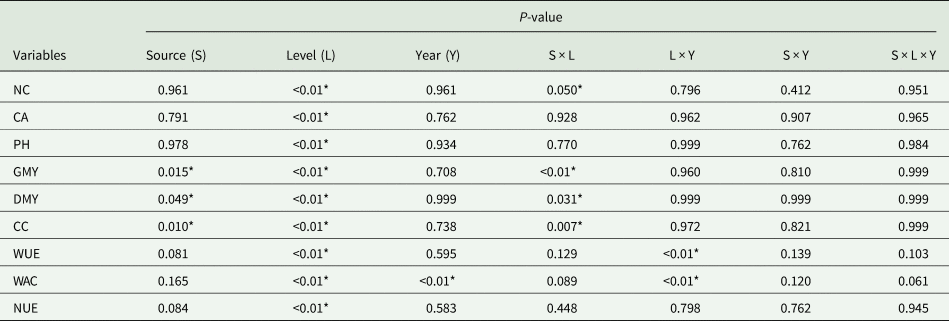
There was significant effect of the interaction (P < 0.05) between sources × levels of nitrogen on the number of cladodes (NC), forage GMY, forage DMY and carrying capacity (CC) (Table 2). Also, significant effect of the interaction between nitrogen levels × years of harvest was observed on NUE and water accumulation. However, there was no significant effect of the interaction between sources × years neither between source × level × year (P < 0.05) on any of the agronomic variables evaluated.
Analysis of variance of the agronomic parameters of cactus pear under different nitrogen sources and levels, in two years of harvest

Source (S), nitrogen fertilizer source; level (L), nitrogen level; year (Y), year of harvest; NC, number of cladodes; CC, cladode area; PE, perimeter; PH, plant height; GMY, green mass yield; DMY, dry mass yield; WUE, water use efficiency; WAC, water accumulation; CC, carrying capacity; NUE, nitrogen use efficiency.
*Significant value (P < 0.05).
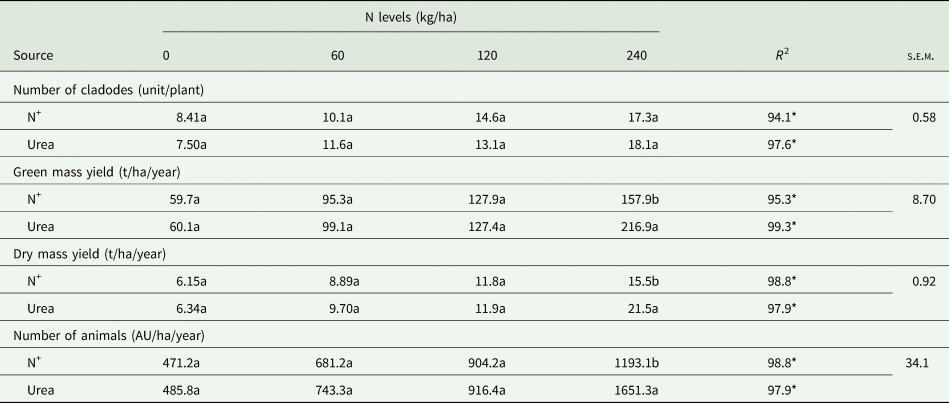
The agronomic variables, cladode area (CA), plant height (PH) and NUE, had an isolated effect (P < 0.01) on the nitrogen levels (Table 3). The number of cladodes was not affected by the nitrogen source; however, regarding the N levels, there was an increasing linear increment. The level of 240 kg/ha provided higher emission of cladodes per plant, respectively, for N+ and urea (Table 3).
Breakdown of the effect of interaction between sources × nitrogen levels on the agronomic parameters of cactus pear

s.e.m., standard error of the mean.
Means followed by different lowercase letters in the column differ at P < 0.05 by Tukey's mean test.
*Linear effect at P < 0.05 in the row.
The nitrogen source did not influence the results of production of green mass, dry mass and carrying capacity up to the level of 120 kg N/ha/year. The use of conventional urea provided superior results with the level of 240 kg/ha, in comparison with the source N+. GMY, DMY and CC followed the same trend, with an increasing linear effect of both sources as the nitrogen level increased in the soil. With the level of 240 kg N/ha/year the conventional urea provided higher production of the three variables, with 38% more than coated urea (N+). Among the years of evaluation, the water accumulation (Table 3) was higher in year I (December 2015 to November 2016), showing an increasing linear effect with the increase in N levels, obtaining increments of 46, 77 and 123% with the levels of 60, 120 and 240 kg/ha, respectively. In year II, there was also increasing linear effect, but with lower values.
The water use efficiency (WUE) was higher in year II (December 2016 to November 2017) up to the level of 60 kg/ha, whereas with the levels of 120 and 240 kg/ha the year I presented the highest WUE. It was observed that the increase in the nitrogen levels improved the WUE in year I, mainly in plants that received the level of 240 kg/ha, obtaining a value above 61% for the WUE when compared to year II. In year II, the WUE presented decreasing linear effect as the nitrogen levels increased, with a 3% decrease from level 0 to the level of 240 kg N/ha.
Increasing linear effect was observed with the increase of the nitrogen levels, on CA and PH, with increments of 19 and 41%, for the levels 0 and 240 kg N/ha, respectively (Table 4). Although for NUE there was a linear decreasing effect as the N level increased, with a reduction of 0.39 kg DM of cactus pear for each kg of N/ha applied.
Breakdown of the effect of interaction between years of harvest × nitrogen levels on the agronomic parameters of cactus pear

Means followed by different lowercase letters in the column differ at P < 0.05 by Tukey's mean test.
*Linear effect at P < 0.05 in the row.
The highest NUE was found with the level of 60 kg N/ha, however, when the level of N increased to 120 kg N/ha there was a reduction in NUE of 20% and when comparing the NUE with the level of 60 kg N/ha to the level of 240 kg N/ha there was a reduction of 100% in the N use efficiency.
In the analysis of the nutritional value of the cactus pear, an effect of the interaction was found between nitrogen sources × year of harvest on non-fibre carbohydrates (NFC), fraction A + B1, fraction B2 and calcium content (P < 0.05) (Table 5). Furthermore, there was an effect of the interaction between nitrogen levels × year of harvest on the nutritional parameters ether extract (EE), NDF and neutral detergent fibre corrected for ashes and protein (NDFap) (P < 0.05).
Analysis of the isolated effect of nitrogen levels on the agronomic parameters of cactus pear that did not had effect of the interaction

s.e.m., standard error of the mean; CA, cladode area (cm); PH, plant height (cm); NUE, nitrogen use efficiency (kg of DM/kg of N applied).
*Linear effect at P < 0.05 in the row.
There was an effect of the interaction between nitrogen source × nitrogen level × harvest year only on the variable of nutritional value of the cactus pear IVOMD (P < 0.05). It was found an isolated effect of the nitrogen levels on CP, TC, NFC, fraction A + B1, fraction B2 and phosphorus content. The mineral matter (MM) and the contents of potassium, magnesium and zinc had a significant isolated effect on the harvest year (Table 6).
Analysis of variance of the nutritional parameters of cactus pear under different sources and levels of nitrogen, in two years of harvest

DM, dry matter; EE, ether extract; CP, crude protein; MM, mineral matter; NDF, neutral detergent fibre; NDFap, neutral detergent fibre corrected for ash and protein; ADF, acid detergent fibre; LIG, lignin; NDIN, neutral detergent insoluble nitrogen; TC, total carbohydrates; NFC, non-fibre carbohydrates; A + B1, fraction A + B1; B2, fraction B2; C, fraction C; IVDMD, in vitro dry matter digestibility; IVOMD, in vitro organic matter digestibility.
*Significant value (P < 0.05).
Cactus pear plants fertilized with urea showed 11% in year I and 16% in year II more NFC than the plants fertilized with the N+ source. NFC, fraction A + B1, fraction B2 and calcium were affected by the nitrogen source and the year of harvest (Table 7). NFC values were higher, presenting 3.5 g/kg DM when the plants were fertilized with urea in year I and 5.4 g/kg DM in year II, and the same response was observed for fraction A + B1. The treatments with urea presented 12% in year I and 13% in year II more of the fraction A + B1 than the treatments fertilized with N+.
Breakdown of the effect of interaction between nitrogen source × years of harvest on the nutritional parameters of cactus pear

s.e.m., standard error of the mean.
Means followed by different uppercase letters in the column differ for year of harvest and followed by lowercase in the rows differ for nitrogen source at P < 0.05 by Tukey's mean test.
The fraction B2 of cactus pear presented a higher concentration in year I (December 2015 to November 2016) when the plants were fertilized with N+, while urea only provided higher values of this fraction in year II (December 2016 to November 2017). Inverse response was observed for calcium concentration, which had less accumulation in the cactus pear in year II, when the plants were fertilized with urea.
The EE content presented increasing linear effect according to the nitrogen levels in the two years of harvest. In year II, the highest nitrogen level, 240 kg/ha, provided the highest contents of EE, NDF and NDFap (Table 8). There was a quadratic trend for the contents of NDF and NDFap with the increase in nitrogen fertilization with a maximum value in the level of 120 kg/ha.
Breakdown of the effect of interaction between nitrogen levels × years of harvest on the nutritional parameters of cactus pear

s.e.m., standard error of the mean.
Means followed by different lowercase letters in the column differ at P < 0.05 by Tukey's mean test.
*Linear effect at P < 0.05 in the row.
An increasing effect was observed for CP whose content was increased by 40.6 g/kg DM with the level of 240 kg N/ha in comparison with the level 0. Although for TC, NFC and fraction A + B1 there was a reduction in the contents of 85.6; 82.2 and 74.1 g/kg DM, respectively, in the level of 240 kg N/ha when compared to level 0 (Table 9).
Analysis of the isolated effect of nitrogen levels on the nutritional parameters of cactus pear that did not had effect of the interaction

s.e.m., standard error of the mean; CP, crude protein; TC, total carbohydrates; NFC, non-fibre carbohydrates.
*Linear effect at P < 0.05 in the row.
For the isolated effect of the years of harvest, the highest contents were observed in year I, with values 34% higher for MM, 11.8% for fraction C, 39% for potassium, 23% for magnesium and 25% for zinc, in comparison with year II of harvest of cactus pear (Table 10).
Analysis of the isolated effect of years of harvest on the nutritional parameters of the cactus pear that did not had effect of the interaction

s.e.m., standard error of the mean.
Means followed by different uppercase letters in the row differ at P < 0.05 by Tukey's mean test.
Discussion
The hypothesis that the use of coated urea in levels higher than 100 kg of N per hectare in the cultivation of N. cochenillifera variety Doce under rainfed conditions in the Brazilian savannah, would provide better growth, production and nutritional quality for animal feeding, when compared to the conventional urea was refuted, as the urea without coating showed superior results in these conditions.
The higher efficiency of urea coated by polymers in Yellow Latosol, with medium clay content was not confirmed, despite scientific reports that conventional urea is very volatile in these soils and therefore has low efficiency. According to Alves et al. (Reference Alves, Carneiro, Edvan, Candido, Furtado, Pereira, Neto, Mota and Nascimento2018) urea coated by polymers shows better results in irrigated crops, but in this experiment the cultivation of cactus pear was under rainfed, thus impairing the slow release of nitrogen in the soil. Different studies have shown that urea coated by polymers does not provide increased productivity in certain crops, and the use of urea without coating is recommended (Civardi et al., Reference Civardi, Silveira Neto, Ragagnin, Godoy and Brod2011; Frazão et al., Reference Frazão, Silva, Silva, Oliveira and Corrêa2014), which was confirmed in the cultivation of cactus pear.
The increase in the number of cladodes of the cactus pear influenced by the nitrogen levels, regardless of the source, was probably due to the stimulation of nitrogen at the cellular level. Taiz and Zeiger (Reference Taiz and Zeiger2017) pointed out that nitrogen can stimulate cell division in the plant promoting the emission of new cladodes. In a study developed by Cunha et al. (Reference Cunha, Gomes, Martuscello, Amorim, Silva and Ferreira2012) the morphometry and accumulation of biomass in cactus pear under the levels of nitrogen (0, 100, 200 and 300 kg/ha) was evaluated, and they observed that the number of cladodes increased from 27.7 (0 kg of N) to 36 cladodes (300 kg of N), representing an increase of 23%. Araújo and Machado (Reference Araújo, Machado and Fernandes2006) reported that the growth and production of any plant species are influenced by the levels of the available N and P and the interaction between these nutrients in the soil.
In the current study, the increase in the number of cladodes was 51.4% when the cactus pear was fertilized with N+ and 58.7% when fertilized with conventional urea, with the level of 240 kg N/ha, in comparison with the plants that did not receive nitrogen fertilization. It was observed that even with no difference in the number of cladodes between the nitrogen sources tested, the conventional urea provided greater development of the cactus pear, with higher production of green and dry mass, and consequently higher carrying capacity, when 240 kg of N/ha was used. The study carried out by Lima et al. (Reference Lima, Silva, Matos, Bonou and Dantas Neto2020) showed that urea at a nitrogen level of 600 kg/ha provided the largest cactus pear cladode areas.
Regarding the agronomic characteristics of the cactus pear, it was observed that the urea coated by polymers did not present advantages over the conventional urea in yellow latosol with medium clay content in crop cultivated under rainfed. No studies testing coated urea in the cultivation of cactaceae were found. However, Veçozzi et al. (Reference Veçozzi, Sousa, Scivittaro, Weinert and Tarril2018) evaluated the solubilization and NUE of nitrogen fertilizers of controlled release in irrigated rice and it was found that the NUE of the urea coated by polymers was similar to the conventional urea, not increasing the release time of the nutrient in this cultivation system.
Urea coated by polymers (N+) promotes greater use of nitrogen due to the slow availability and delay in hydrolysis by the urease inhibitor, thus, sources of N of slow release allow to reduce N losses, which usually occur with the use of conventional urea (Civardi et al., Reference Civardi, Silveira Neto, Ragagnin, Godoy and Brod2011). However, this effect was not observed on the productive characteristics of the cactus pear, probably due to the scarcity of water in the dry period in both years of harvest (June to August 2017 and May to August 2018), so that the lack of water in the soil made it difficult to make nitrogen available over time (Fig. 1). In a study carried out with irrigated crop in a dry region of Brazil, Alves et al. (Reference Alves, Carneiro, Edvan, Candido, Furtado, Pereira, Neto, Mota and Nascimento2018) reported that the use of coated urea reduced the relative losses of N by volatilization.
The higher production of green and dry mass with the increase in the N levels, for both sources of N, is related to the increase in the number and area of cladodes, as well as plant height. According to Donato et al. (Reference Donato, Pires, Donato, Bonomo, Silva and Aquino2014), the increase in the cladode area is fundamental in determining the active photosynthetic area of the plant, because the larger the area of the cladode, the greater the interception of sunlight providing greater accumulation of forage dry mass. This response was also observed by Leite et al. (Reference Leite, Sales, Monção, Guimarães, Rigueira and Gomes2018) who evaluated the effect of different levels of nitrogen (0, 150, 300, 450 and 600 kg of N/ha) on structural, productive and nutritional characteristics of cactus pear (N. cochenillifera, variety Doce). The authors observed that the secondary and tertiary cladodes increased on average 72.5% when the cactus pear was fertilized with 600 kg of N/ha in comparison with the level zero of nitrogen.
In year I, there was less accumulated rainfall, with a deficit of 367.4 mm when compared to year II (Fig. 1). Nevertheless, in year I the nitrogen fertilization provided greater water accumulation, and this fact can be explained by the better spatial distribution of rainfall, associated with lower night temperatures, which contributes to a greater accumulation of water in the plant. Thus, Fernandes et al. (Reference Fernandes, Lima, Lopes, Silva, Santos and Silva2020) explain that the greatest accumulation of rainfall in the Brazilian Cerrado, mainly in the town of Bom Jesus, Piauí, occurs from January to March, with consequent water deficit in the soil during most of the year (dry season, May to September) and that over the years there is an increase in potential evapotranspiration, due to the increase in the average air temperature.
When experiencing water stress, plants tend to close their stomata to reduce water loss through transpiration, which consequently causes a reduction in CO2 assimilation and a reduction in net photosynthesis, decreasing their development (Taiz and Zeiger, Reference Taiz and Zeiger2017). Cavalcante et al. (Reference Cavalcante, Santos, Silva, Fagundes and Silva2014) reported that N. cochenillifera variety Doce is the one that produces the largest number of cladodes per plant, but with the increase in plant density, their emission and size decreased, which is related to greater competition of plants for space, water and nutrients, resulting in lighter cladodes and consequently with less water accumulation.
It should be noted that the good yield of this crop is related to areas with air relative humidity above 40% and day/night temperature from 25 to 15°C. Since air relative humidity is a crucial factor in the survival of the cactus pear, together with the high night temperatures observed in some regions of the semi-arid region, they may justify the low productivity or even the death of the cactus pear (Edvan et al., Reference Edvan, Mota, Silva, Nascimento, Sousa, Silva, Araujo and Araujo2020).
Nitrogen is one of the main regulators of photosynthesis, increasing the water accumulation and the WUE (Cunha et al., Reference Cunha, Gomes, Martuscello, Amorim, Silva and Ferreira2012). Another fact that may have contributed to this result is the adaptability of the cactus pear. Lopes et al. (Reference Lopes, Cândido, Gomes, Pompeu RCF and Silva2018) pointed out that the cactus pear performs well in dry regions of the world because it has biochemical, anatomical, morphological, and physiological characteristics adapted to the climatic rigours of these regions. It is a crop with high productive potential in these regions, in addition to high tolerance to arid and semi-arid conditions, as it has photosynthesis of the CAM type and high efficiency in the use of water (Silva et al., Reference Silva, Fagundes, Viegas, Muniz, Rangel, Moreira and Backes2014).
The cultivars ‘Orelha de Elefante Mexicana’ (O. stricta), ‘Miúda’ (N. cochenillifera) and ‘Copena’ (O. ficus-indica) are the most efficient in the use of water, being, therefore, the most indicated for cultivation in environments with water restriction (Ramos et al., Reference Ramos, Macêdo, Santos, Edvan, Sousa, Perazzo, Silva and Cartaxo2021). According to Moreira et al. (Reference Moreira, Pérez-Marin, Araújo, Lambais and Sales2020), under water stress, plants close their stomata, reducing water loss through transpiration, however, this mechanism causes low regulation of photo-assimilate rates.
Even with the greater development of the cactus pear, obtaining an increase in the cladode area and plant height with higher levels of nitrogen, there was a 50% reduction in the NUE with the level of 240 kg/ha, when compared to the lowest level, 60 kg/ha. There is a lack of response from NUE in forage species under dry environmental conditions, as the low availability of water imposes less efficiency in the use of nutrients, especially nitrogen, as it is a nutrient that is easily lost in the soil (Moreira et al., Reference Moreira, Pérez-Marin, Araújo, Lambais and Sales2020).
Regarding the changes in the nutritional value of the cactus pear, it was observed that the NFC values in the second year of the cactus pear fertilized with urea were higher (399.1 g/kg DM) than those found by Leite et al. (Reference Leite, Sales, Monção, Guimarães, Rigueira and Gomes2018) for the cactus pear which was 355.6 g/kg DM. The superiority of NFC observed in the second year caused a higher content of fraction A + B1 of carbohydrates, considering that this fraction is basically composed of soluble carbohydrates and easy to use by ruminal microorganisms. In the first year, there was a higher concentration of fibre carbohydrates, which are the structural ones, necessary for the development and support of the plant, and in the second year, there was a higher concentration of NFC (carbohydrates reserves).
The NDF content observed was higher than the one found by Edvan et al. (Reference Edvan, Mota, Silva, Nascimento, Sousa, Silva, Araujo and Araujo2020) when they evaluated the cactus pear in a Brazilian savannah region of yellow latosol with medium clay content. The authors observed an NDF value of 196.3 g/kg DM and an NFC value of 571.4 g/kg DM. The variations in the contents of these carbohydrate fractions are closely related to the development of the plant, because in the current study, the plants obtained greater height and cladode area than those observed by Edvan et al. (Reference Edvan, Mota, Silva, Nascimento, Sousa, Silva, Araujo and Araujo2020).
With the increase in the growth and development of the cladodes, the plant needs a greater amount of supporting carbohydrates, such as cellulose and hemicellulose, with that, these variations in the NDF content occur, which is mainly composed of these two structural carbohydrates. In addition, according to Alves et al. (Reference Alves, Andrade, Bruno and Santos2016), genetic factors, environmental growth conditions, soil, cultivation, harvest period, stress and plant age contribute to differences in chemical composition in the genus Nopalea.
The higher amount of minerals in the cactus pear in year I is related to the lower availability of rain in that period, which was 955.95, and 1323.4 mm in year II (Fig. 1). The cactus pear showed considerable levels of MM, with a higher concentration of calcium, potassium and magnesium. Also, the variations in this composition are observed according to the species, age, time of the year, crop management, crop location and physiological stage of the cladode (Dubeux Júnior et al., Reference Dubeux Júnior, Araújo Filho, Santos, Lira, Santos and Pessoa2010). In a study developed by Alves et al. (Reference Alves, Andrade, Bruno and Santos2016) when they evaluated the variability, correlation and importance of chemical and nutritional characteristics of the cactus pear (Opuntia and Nopalea), it was observed that there is a positive correlation between zinc and CP, since zinc is part of many proteins; in many enzymes, this metal ion is needed at the active site (carbonic anhydrase, superoxide dismutase, alcohol dehydrogenase and glutamate dehydrogenase).
The current study indicates that the coated urea, in yellow latosol with medium clay content, under these climatic conditions had low efficiency in the cultivation of cactus pear when compared to the conventional urea. It is important to highlight that the use of coated urea must be economically viable, and it is necessary that the increase in efficiency causes productivity gains that compensate the investment in a higher cost product, allowing the substitution of conventional sources (Veçozzi et al., Reference Veçozzi, Sousa, Scivittaro, Weinert and Tarril2018). The responses of the agronomic parameters of cactus pear variety Doce were proportional to the increase in the level of N, with the best level being 240 kg N/ha.
Conclusions
The use of conventional urea promotes better results of agronomic and nutritional characteristics of the cactus pear variety Doce grown in Yellow Latosol with medium clay content in the Brazilian savannah region under rainfed conditions, when compared to the use of urea coated by polymers.
Acknowledgements
The authors acknowledge the Coordination for the Improvement of Higher Education Personnel (CAPES) for the scholarship and to the Centre for Studies in Forage Crops (NUEFO) of CPCE/UFPI for the support provided.
Financial support
This study was supported by the Coordination for the Improvement of Higher Education Personnel (CAPES).
Conflict of interest
The authors reported no potential conflict of interest.