Numerous examples around the world suggest that the poor economic prospects of young generations threaten their long-term support for the political regime they live under (see, for example, The Economist Reference Teorell and Hadenius2017; The Economist 2020; The Economist 2021). When the youth in crisis-ridden autocratic Togo or Belarus take to the streets to demand free elections, or when unemployed Italian and Chilean millennials lose confidence in the blessings of political freedom, the future of democracy is obviously at stake. However, it has not been systematically investigated whether and how early-life economic hardships affect democratic support in the long term, leaving unanswered the fundamental question: do early-life economic struggles affect democratic support later in life?
The notion that economic performance has immediate impacts on regime legitimacy is well established. Short-term growth dynamics affect popular sentiment towards the government (see Kelly and Enns Reference Kelly and Enns2010; Lewis-Beck and Stegmaier 2000; Pop-Eleches and Pop-Eleches Reference Petersen2012; Stevenson Reference Steckenrider, Cutler and Siegel2001; Tilley, Neundorf and Hobolt 2018; Wlezien and Soroka Reference Welzel, Inglehart and Klingemann2021) and, more importantly, regarding the advantages of democracy relative to autocracy (Anderson and Guillory Reference Anderson and Guillory1997; Armingeon and Guthmann Reference Armingeon and Guthmann2014; Clarke, Dutt and Kornberg Reference Clarke, Dutt and Kornberg1993; Dukalskis and Gerschewski Reference Dukalskis and Gerschewski2017; Haggard and Kaufman Reference Haggard and Kaufman1995; Hofferbert and Klingemann Reference Hofferbert and Klingemann1999; Quaranta and Martini Reference Poterba, Venti and Wise2016; Weatherford Reference Visser and Krosnick1984; Weatherford Reference Weatherford1987). At the same time, we know that current democratic support is shaped by early-life experiences: early-life regime encounters increase support for that specific regime later in life through mechanisms of nostalgia and socialization (Bernhard and Karakoc Reference Bernhard and Karakoc2007; Mishler and Rose Reference Mietzner2007; Neundorf Reference Mortimer and Simmons2010; Neundorf and Pop-Eleches Reference Neundorf and Pop-Eleches2020; Neundorf, Gerschewski and Olar Reference Neundorf2020; Pop-Eleches and Tucker Reference Pop-Eleches and Pop-Eleches2014). Zooming in on the economics, a third strand of literature holds that early-life economic circumstances form people's general political values (Giuliano and Spilimbergo Reference Giuliano and Spilimbergo2014; Inglehart Reference Inglehart1971; Inglehart and Welzel Reference Inglehart and Welzel2010; Sears and Valentino Reference Sears and Funk1997; Welzel, Inglehart and Klingemann Reference Weatherford2003).
However, these literatures have existed apart, without reconciling the apparent effects of early-life economic experiences with the specific dynamics of democratic support. In other words, whether early-life economic hardships affect later-life democratic support has not been examined. Given the volatile economy experienced by many countries around the world, this lacuna is highly unfortunate. Democratic stability requires unwavering support from ordinary citizens (Claassen Reference Claassen2020). Not knowing to what extent such support is formed by early-life economic experiences and endures leaves us without guidance to predict – and perhaps affect – the extent to which ordinary citizens will demand and support democracy.
This article addresses these shortcomings theoretically and empirically. We argue that economic experiences during early adulthood (that is, ages eighteen to twenty-eight) are wired into our everyday cognitive schemes of how to evaluate abstract institutions, such as political regimes. We emphasize the importance of early adulthood, as this is when people start forming political opinions and establish themselves economically. Thus, we propose that those experiencing economic growth under democracy in early adulthood connect democracy with greater economic security and prosperity, and that this perception is subsequently converted into support for democracy throughout most of their lives. Conversely, these people would be less supportive of democracy had they experienced economic recession in early adulthood. In autocracies, we expect similar logics, leading to the opposite effects of economic experiences on democratic support. Citizens who experience economic growth under autocracy in early adulthood connect autocracy with greater economic security and prosperity, and accordingly convert this perception into less support for democracy throughout most of their lives. Conversely, they become more supportive of democracy if they experienced economic recession during their early adulthood under an autocratic regime. Put simply, the use of early-adulthood economic cues to evaluate political regimes is a general mechanism but has contrasting consequences for democratic support depending on whether the regime in place was democratic or autocratic.
To examine our propositions, we use a compilation of surveys covering ninety-seven countries worldwide during the period 1994‒2015, totalling more than 320,000 observations. Using country, year, age and cohort fixed effects, we compare citizens' support for democracy and economic growth during early adulthood under either democratic or autocratic rule. We also account for a range of alternative explanations at the country and individual levels, as well as economic growth and regime developments later in people's lives, and we compare effects across different estimations and age periods. Across these tests, we find strong, consistent support for our propositions. Economic experiences in early adulthood are important cues for democratic support that generally endure until around age sixty. Early-adulthood economic experiences thus play a major part in how people evaluate political regimes, regardless of other individual characteristics and later economic and regime experiences.
These results have broad implications for the study of democratic support. First, they demonstrate that the impacts of economic performance during early adulthood are not as transient as hitherto assumed. In general, most literature on the consequences of economic performance finds them to be transitory and vanishing after a short period (for a comprehensive review, see Margalit Reference Margalit2019). In contrast to such conventional wisdom, and in line with more recent research on early-life economic impacts (see, for example, Giuliano and Spilimbergo Reference Giuliano and Spilimbergo2014; Neundorf and Soroka Reference Neundorf and Soroka2018), we show that economic performance during early adulthood has lasting impacts on democratic support during most of citizens' working lives, regardless of how the economy performs afterwards.
Secondly, the similar workings of performance legitimacy across democracies and autocracies modify an important aspect of classic modernization theory, expecting that economic security and prosperity increase pro-democratic attitudes across institutional settings (see, for example, Inglehart and Welzel Reference Inglehart and Welzel2010; Welzel, Inglehart and Klingemann Reference Weatherford2003). In contrast, results from this study demonstrate that the impacts of individual economic growth experiences are highly conditional on the regime type in place. Just as with democracies, autocracies may see windfalls in public support decades on from high economic growth.
Thirdly, the findings more broadly imply that those who adhere to democracy cannot necessarily be taken for principled supporters who were raised as more inclusive and tolerant, and that growing up under an autocracy does not necessarily induce autocratic nostalgia. Instead, vital parts of democratic support are given by deep psychological considerations stemming from the early-life connection between regime and economic experiences. The early-adulthood interplay between economic performance and regime context leaves long-lasting marks on people's feelings of security and prosperity. While democratic support is likely also determined by people's principles of rights and justice, we show that at least part of it stems from deeply wired perceptions of which regime is best at delivering economic goods.
State of the Art
We follow Norris (Reference Niemi and Jennings2011) in defining democratic support as citizens' commitment to democratic principles and values. Specifically, the purpose is to explain variation in public support for the democratic process, rules and norms. This taps into a ‘high-level’ sentiment that is more abstract than: (1) satisfaction with how the democracy is actually functioning; (2) trust in politicians, parties and specific institutions; and (3) approval of specific incumbent leaders and governments. At the same time, it is more specific than abstract national identities and values, such as support for an independent Catalonia or a communist society (for a discussion on this, see, for example, Canache, Mondak and Seligson Reference Canache, Mondak and Seligson2001; Linde and Ekman Reference Lewis-Beck and Stegmaier2003). We focus on support rather than satisfaction because regime satisfaction fluctuates more than principled regime support and is more closely tied to current performance records than deeply wired experiences (see, for example, van Ham and Thomassen Reference Trump2017).
One prominent factor behind such democratic support is performance legitimacy. While its sources are many (see, for example, Anderson and Guillory Reference Anderson and Guillory1997; Norris Reference Niemi and Jennings2011, ch. 10), economic growth is one of the most thoroughly studied (see, for example, Armingeon and Guthmann Reference Armingeon and Guthmann2014; Clarke, Dutt and Kornberg Reference Clarke, Dutt and Kornberg1993; Dukalskis and Gerschewski Reference Dukalskis and Gerschewski2017; Hofferbert and Klingemann Reference Hofferbert and Klingemann1999; Neundorf Reference Mortimer and Simmons2010). Growth has downstream effects on other performance parameters, such as public goods provision, and a clear potential to affect regime preferences in democracies as well as autocracies. When the economy performs well, citizens are generally content with their current political regime; when recession occurs, however, broad segments of society grow discontent with their regime due to various hardships, such as rising unemployment, declining incomes and cuts to state-sponsored programmes (Quaranta and Martini Reference Poterba, Venti and Wise2016). As Haggard and Kaufman (Reference Haggard and Kaufman1995, 7) have shown, people respond intuitively and immediately to their economic situation, and change their evaluation of the present political regime accordingly.
Despite this convincing record of evidence, there has been no systematic attempt at using cross-country data to investigate whether and how economic performance legitimacy builds and endures at the individual level (for a review, see, for example, Margalit Reference Margalit2019). A burgeoning literature studies the historical determinants of regime preferences (Simpser, Slater and Wittenberg Reference Sigel and Siegel2018). For instance, cohort analyses show that people who grow up in an autocratic (communist) regime and later experience democratic transition are generally less inclined to express support for the new democratic system (see Bernhard and Karakoc Reference Bernhard and Karakoc2007; Mishler and Rose Reference Mietzner2007; Neundorf and Pop-Eleches Reference Neundorf and Pop-Eleches2020; Pop-Eleches and Tucker Reference Pop-Eleches and Pop-Eleches2014). Bernhard and Kubik (Reference Bernhard and Kubik2014) substantiate how this legacy works through mechanisms of nostalgia and reminiscing about the former communist regime.
Some studies come closer to the economic determinants of democratic support. Neundorf (Reference Mortimer and Simmons2010), for instance, finds that good economic performance under the present democratic regime reduces generational differences in democratic support among Eastern Europeans. Claassen and Magalhaes (Reference Claassen and Magalhaes2021), by contrast, find that economic growth fluctuations only affect satisfaction with democracy, not diffuse support for democracy. In a recent study of a global sample of countries, Neundorf, Gerschewski and Olar (Reference Neundorf2020) suggest the relevance of early-life economic experiences, finding that cohorts brought up under so-called ‘inclusionary regimes’ (that is, autocracies with a wider redistribution of socio-economic and political goods) are less supportive of democracy later in life. Likewise, Inglehart's (Reference Inglehart1971) classic study provides valuable insights by pointing to the enduring effects of early-life economic experiences on fundamental values among citizens in Western European advanced industrial societies. In later studies, Inglehart alongside Welzel (see Inglehart and Welzel Reference Inglehart and Welzel2010; Welzel, Inglehart and Klingemann Reference Weatherford2003) demonstrate how the educational and occupational opportunities associated with economic development drive the formation of postmaterialist as well as emancipatory (versus authoritarian) values on the national level.
While these individual-level and historical analyses pin down important dynamics of democratic support, the original formation and reproduction of economic performance legitimacy throughout a person's life remains heavily under-studied. Recent contributions (for example, Neundorf Reference Mortimer and Simmons2010; Neundorf and Pop-Eleches Reference Neundorf and Pop-Eleches2020; Neundorf, Gerschewski and Olar Reference Neundorf2020) focus exclusively on early-life experiences under autocracy, which could give the impression that the early-life foundations of economic performance legitimacy mostly or exclusively matter in autocracies. Moreover, several studies question the linear relationship between early-life economic success and higher democratic support proposed by Inglehart and Welzel. Teorell and Hadenius (Reference Taber and Lodge2006) point out that emancipatory values are not coherent at the individual level within countries and not clearly related to the components of modernization (see also Trump Reference Tremblay and Roger1991). In fact, in another specific test of Inglehart's original theory, Sangster and Reynolds (Reference Rhodes-Purdy1996) demonstrate that early-life experiences affect materialist but not postmaterialist value orientations, indicating how, from the outset, the effects of the surrounding economy are evident but regime-neutral. Further historical, macro-level analyses show that positive economic performance stabilizes democracies as well as autocracies (see Dukalskis and Gerschewski Reference Dukalskis and Gerschewski2017; Haggard and Kaufman Reference Haggard and Kaufman1995; Weatherford Reference Visser and Krosnick1984; Weatherford Reference Weatherford1987). This is supported by several case studies documenting how people in different authoritarian countries, such as China (Zhao 2009) and Mexico before 2000 (Magaloni Reference Lucardi2006), have credited and punished autocratic regimes for economic growth fluctuations much like in democracies. Good economic performance may just as well strengthen autocratic support.
In sum, we need more systematic research on whether and how early-life economic experiences affect later-life democratic support. The next sections present our argument that addresses this question. We argue that economic experiences during early adulthood (that is, age eighteen to twenty-eight) leave lasting cues of performance legitimacy. We first pin down why economic factors in this period of life are particularly important for regime support and then why this effect tends to endure, though at a decreasing rate. Afterwards, we outline how the effect works across different regimes, stressing the importance of whether the regime in place during early adulthood was democratic or autocratic.
Argument
The Importance of Early-Adulthood Economic Experiences
The economy is profoundly important for our sense of personal security and prosperity. When a country experiences growth, ceteris paribus, the economic situation for its inhabitants improves. Although the benefits of growth are likely unevenly distributed, studies on the growth elasticity of poverty suggest that even the poor benefit to some extent from country-level growth (Adams Reference Adams2004). This means that jobs are easier to get, businesses are easier to run and general wealth tends to increase, which, in turn, improves the ability to buy popular goods, such as food and shelter, or, in more developed economies, the freedom to make individual life choices. As the performance legitimacy literature holds, such growth experiences should transfer into individual feelings of economic security and prosperity, which then reflects positively on the evaluation of the regime in place (see Norris Reference Niemi and Jennings2011, 189). Erroneously or not, people use actual performance records as a short cut to assess the relative advantages of political regimes (see, for example, Dukalskis and Gerschewski Reference Dukalskis and Gerschewski2017; Haggard and Kaufman Reference Haggard and Kaufman1995; Neundorf Reference Mortimer and Simmons2010; Norris Reference Niemi and Jennings2011).
Beyond the day-to-day effects of economic performance, there are reasons to believe that individual-level economic experiences during early adulthood (age eighteen to twenty-eight) structure later-life regime support. To see this, consider first how early-adulthood economic experiences shape later-life economic success. In many countries, people become legally competent at age eighteen and, in turn, economically independent as they begin to take full-time jobs and earn their own money. Indeed, research has shown that the ramifications of economic shocks are particularly strong for younger workers because job displacement has long-term effects on earnings, the likelihood of facing poverty and the fear of future job loss (Davis and Von Wachter Reference Davis and Von Wachter2011). Further, with some cross-country variations, people are most affected by the economy in their twenties, which is when they find stable housing and start a job, a career or a successful business. People usually settle economically around their late twenties (Visser and Krosnick Reference Van Ham, Thomassen and van Ham1998). Some spend much of their twenties in tertiary education, where important socialization takes place (Stubager Reference Stoker, Bass, Shapiro and Jacobs2008). Yet, the vast majority of people, particularly before 1994, when our surveys begin, did not reach this education level (see World Bank Reference Wlezien and Soroka2020).
Down the road, economic prosperity in early adulthood provides for the vital needs of one's family, such as financing of mortgages, childcare and child education. Likewise, jobs and incomes are likely to set paths for later employment opportunities, income increases and, in turn, family welfare (Poterba, Venti and Wise Reference Pop-Eleches and Tucker2018; Tremblay and Roger Reference Tilley, Neundorf and Hobolt1993). Thus, individual-level experiences of economic recession during early adulthood should limit later-life economic security and prosperity, while individual-level growth experiences should improve it.
Early-adulthood economic experiences should form not only later-life economic success, but also later-life regime support. Perhaps the most consistent finding in political socialization research supports the so-called ‘impressionable years’ hypothesis, stating that over the life span, political attitudes fluctuate most in the twenties and stabilize in the thirties (Sears and Funk Reference Sangster and Reynolds1999). Research shows that the first encounters with citizenship rights, general political participation and economic independence characterizing this age profoundly affect political attitudes (Emmenegger, Marx and Schraff Reference Emmenegger, Marx and Schraff2017; Sears and Brown Reference Sears and Valentino2013, 71–4; Stoker and Bass Reference Stevenson2011, 456–9). More specifically, Giuliano and Spilimbergo (Reference Giuliano and Spilimbergo2014) find that large macroeconomic shocks experienced between age eighteen and twenty-five shape preferences for redistribution (for similar findings, see Margalit Reference Magaloni2013; Neundorf and Soroka Reference Neundorf and Soroka2018), while Neundorf, Gerschewski and Olar (Reference Neundorf2020) empirically connect early-adulthood experiences of redistribution with current regime support.
These results likely reflect the fact that the voting age is eighteen in many democracies, marking the first time people have to make up their mind politically (Bartels and Jackman Reference Bartels and Jackman2014). Young adults in autocracies may therefore compare this situation with their own. At the same time, it is only around age twenty-five that people become capable of forming strong opinions about specific political regimes. While abstract reasoning develops earlier in adolescence, the formation of specific regime preferences arguably takes more time because political regimes are institutional complexities, frequently multidimensional, with extensive economic and redistributive consequences (see Norris Reference Niemi and Jennings2011, 24‒5; Rhodes-Purdy Reference Quaranta and Martini2017, 3‒5). Making up one's mind about the proper political regime therefore involves weighing multiple, often conflicting, societal principles and individual rights.
In this complex weighing, economic experiences offer a powerful cue. Those who emerge from early adulthood with less economic success (that is, with lower income and wealth generated, and more unstable or less promising jobs) may, of course, have been subject to sectoral specificities or an unlucky series of events and decisions, or their limited success may have been self-inflicted, resulting from a lack of effort or competence. In most cases, however, people can distinguish such accidental or personal reasons for economic success from ‘societal’ or ‘political’ ones, some of which may pertain to the regime (see LaFrance and Cicchetti Reference Krosnick and Alwin1979; Petersen et al. Reference Norris2010). Thus, not only does regime support take shape during early adulthood, but the connection between individual economic experiences and regime preferences should also be particularly pronounced during this period of life by providing lasting cues about the capacity of a political regime to satisfy individual needs.
Experiences before early adulthood may also matter for economic performance legitimacy, though not to the same extent. During childhood, schooling and parents' attitudes and situations matter most, and only the basic personality forms here (Sangster and Reynolds Reference Rhodes-Purdy1996). Important shifts in personal ability and consciousness take place from adolescence and into early adulthood. While parents' opinions are still influential (Niemi and Jennings Reference Neundorf, Gerschewski and Olar1991), adolescence is when people develop the cognitive capacities for abstract reasoning, interpreting impressions of their surroundings and thinking in terms of societal needs and principles. This shapes, for instance, party identification and ideological leanings (Krosnick and Alwin Reference Krishnarajan, Doucette and Andersen1989). However, research demonstrates that political attitudes acquired in adolescence are amenable to change and only settle during early adulthood, or ‘the impressionable years’ (Markus Reference Margalit1979; Niemi and Jennings Reference Neundorf, Gerschewski and Olar1991). Coupled with the fact that economic and regime evaluations only decisively kick in when people enter adulthood, we expect that early-adulthood economic experiences matter most.
In sum, early-adulthood economic experiences should affect later-life regime support. Thus, support for democracy should reflect not only current economic experiences, but also fundamental beliefs about the economics–regime nexus. While the literature basically agrees on age eighteen as the lower threshold of early adulthood, the upper threshold is more ambiguous, both theoretically and empirically. We base our upper threshold on findings that most people settle economically at the end of their twenties. Age twenty-eight fits these findings and provides a ten-year period neat for interpretation.
The Enduring Effects on Democratic Support
How does the effect of early-adulthood economic experiences on regime support evolve over the life span? Research traditionally debates two models of political socialization: political attitudes acquired during early adulthood may last across life cycles (see, for example, Jennings Reference Jennings, Barnes, van Deth and Kent Jennings1989; Neundorf and Soroka Reference Neundorf and Soroka2018; Sears and Funk Reference Sangster and Reynolds1999; Sears and Valentino Reference Sears and Funk1997), or they may change with events that occur later in people's lives (see, for example, Sigel Reference Sears, Brown, Huddy, Sears and Levy1989). Based on findings that political attitudes are least stable in early and late adulthood (see, for example, Alwin, Cohen and Newcomb Reference Alwin, Cohen and Newcomb1991; Visser and Krosnick Reference Van Ham, Thomassen and van Ham1998), we propose to combine the two. We thus hold that the effect of early-adulthood economic experiences endures but gradually decays with age.
Memories endure and guide public opinion, as people process new information to make it fit fundamental beliefs (Taber and Lodge Reference Stubager2006). This should work for economic performance legitimation as well. Economic experiences provide a welcome short cut by which people focus on performance records, rather than intrinsic regime traits (Haggard and Kaufman Reference Haggard and Kaufman1995). Following this logic, economic experiences should affect regime support immediately. However, the forces of early-adulthood socialization also leave lasting cues for evaluation. Research indicates that economic experiences set in motion processes of learning with lasting impacts beyond immediate circumstances (Margalit Reference Margalit2019, 280). Once experience has been gathered and initial assessments have been made, fundamental beliefs about the economics–regime nexus should be stable beyond the immediate future because information on new economic and regime conditions is either discarded or interpreted in ways that confirm earlier assessments (Mortimer and Simmons Reference Mishler and Rose1978). In other words, early-adulthood economic experiences should continue to affect regime support even though conditions change.
However, early-adulthood cues are likely not equally effective throughout life. Although political attitudes pertaining to the regime are relatively more stable during midlife, few socialization effects stay unaffected; rather, they weaken with new information from economic growth fluctuations, regime changes or other political events (Sigel Reference Sears, Brown, Huddy, Sears and Levy1989). Research shows that political attitudes unravel towards late adulthood due to changes in living conditions, identification and social networks related to work, family and residence (Steckenrider and Cutler Reference Simpser, Slater and Wittenberg1989). As retirement from the job market comes closer, people start identifying less with work roles and become less politically active (Steckenrider and Cutler Reference Simpser, Slater and Wittenberg1989; Visser and Krosnick Reference Van Ham, Thomassen and van Ham1998). In addition to this socialization effect, more rational calculations may be at work. The tendency to use job incomes to save money for consumption during retirement should make the state of the economy a less salient concern towards retirement as more money is saved (see Deaton Reference Deaton2005). In turn, there is likely to be a constant battle between early-adulthood and later experiences in the formation of regime support. Yet, in net terms, early-adulthood memories should endure but decrease with age.
The Heterogeneous Effects of Autocracies and Democracies
We argue that economic performance legitimacy works according to the same logic across democracies and autocracies, meaning that individuals experiencing success in their first interactions with the economy should be more likely to form a positive view of the political regime in place during these interactions. In other words, early-adulthood economic experiences should have heterogeneous effects on later-life democratic support depending on the regime in place during early adulthood: high growth in democracies increases democratic support, while high growth in autocracies decreases it – and vice versa during economic recessions.
Different regimes rely on different types of legitimacy to stabilize their rule, and they often combine several legitimation strategies in order to survive (Gerschewski Reference Gerschewski2013; Norris Reference Niemi and Jennings2011). Our argument is not that economic performance legitimacy is the most important driver of regime support in any regime at any point in time. Rather, among many other legitimacy types, we focus on the specific impact of economic performance legitimacy and have reasons to believe that it is significant in both democracies and autocracies. Both democracies and autocracies are constantly challenged to legitimize themselves in terms of economic performance. In a globalized economy where few political leaders can escape addressing popular needs, handling the economy and delivering growth and prosperity for the people are essential concerns.
The significance of economic performance to securing voter support in democracies is well known. One reason is that democracies are often inaugurated on the promise of increased wealth and prosperity (Haggard and Kaufman Reference Haggard and Kaufman1995). Even though regime legitimacy in democracies most obviously relies on principled support for the very procedures of democracy, voters care about the public and private goods they may achieve from economic growth, and evaluate the attractiveness of the regime accordingly (Armingeon and Guthmann Reference Armingeon and Guthmann2014; Clarke, Dutt and Kornberg Reference Clarke, Dutt and Kornberg1993; Neundorf Reference Mortimer and Simmons2010; Norris Reference Niemi and Jennings2011, ch. 10). In fact, the economic voting literature has shown that voters perceive elections as particularly effective means of holding politicians accountable for their economic policies (Anderson Reference Anderson2000; Lewis-Beck and Stegmaier 2000).
Economic experiences matter greatly in autocracies as well as in democracies. For obvious reasons, electoral accountability is less effective in autocracies. Autocrats rely on extensive repression and co-optation to survive (see Bueno de Mesquita et al. Reference Bueno de Mesquita2005). In particular, dictators use repression to handle popular protests during economic recessions, thus augmenting the negative impact of low growth on regime support. Moreover, more than democracies, autocracies use other sources of legitimacy, varying from the charisma of a dictator, to traditions and rituals connected with a monarchical family, to a common history or religious beliefs. However, this does not imply that citizens of autocracies do not expect their leaders to also care about their economic fortune. In fact, after the end of the Cold War, most autocracies deliberately provided economic growth to build public approval in otherwise manipulated elections and thus stay clear of democratization pressures (Dukalskis and Gerschewski Reference Dukalskis and Gerschewski2017; Lucardi Reference Linde and Ekman2019). Other autocracies, like China and Singapore, continue to legitimize themselves through economic performance but without elections (Zhao 2009).
As in democracies, there are solid micro-foundations for expecting economic performance legitimacy in autocracies. Autocratic stability hinges on the provision of patronage to selected groups of voters or public goods like infrastructure, healthcare, education and higher employment to broader segments of the population. As they are reluctant to redistribute their own resources or those of their core supporters to others beyond the narrow winning coalition, autocrats would prefer to keep the masses at bay by expanding rather than slicing the economy (Cassani Reference Cassani2017; Dukalskis and Gerschewski Reference Dukalskis and Gerschewski2017). This is probably why autocrats often defend their rule in public by highlighting the autocratic virtues of centralized and effective decision making to deliver economic growth (see Knutsen Reference Knutsen2020).
Autocrats care about economic growth and popular sentiment with good reason. Citizens in autocracies are just as concerned about the regime's ability to deliver economic growth, seeing the connection between growth and their own economic security and prosperity. In fact, in the absence of free and fair elections as the yardstick for legitimacy, residents in autocracies often use economic performance records to assess the current system of government relative to a more democratic one (Neundorf Reference Mortimer and Simmons2010; Neundorf, Gerschewski and Olar Reference Neundorf2020). Global survey research (see, for example, Norris Reference Niemi and Jennings2011) and case studies of economic and public legitimation in autocracies (see, for example, Magaloni Reference Lucardi2006; Mietzner Reference Markus2018; Zhao 2009) support this interpretation. This means that experiencing early adulthood under a well-performing autocracy induces citizens to develop positive impressions of non-democratic ways of governing a country.
In sum, people in a democracy who experience economic growth in early adulthood should be more supportive of democracy and less supportive if they experience economic recession during early adulthood. Likewise, people in an autocracy who experience economic growth in early adulthood should be less supportive of democracy and more supportive of democracy if they experience economic recession during early adulthood.
Based on these propositions, we formulate two hypotheses:
Hypothesis 1: Individuals experiencing higher economic growth – compared to those experiencing lower growth – during early adulthood in a democracy are enduringly more supportive of democracy later in life.
Hypothesis 2: Individuals experiencing higher economic growth – compared to those experiencing lower growth – during early adulthood in an autocracy are enduringly less supportive of democracy later in life.
As discussed earlier, we further expect the relationship between early-adulthood economic experiences and democratic support to endure but gradually wane as people get older, and to ultimately disappear during the final period of a lifespan.
The heterogeneous effects across regimes need some further clarification. The categorical focus on democracies vis-à-vis autocracies may leave out important dynamics within these regime types, as differences within the groups of democracies and autocracies may matter as well. For instance, a few studies show that exposure to more extreme regime traits, such as more orthodox communism, leaves larger socialization effects (see, for example, Pop-Eleches and Tucker Reference Pop-Eleches and Pop-Eleches2014). More generally, it may be that people are better able to attach responsibility for performance to more extreme and therefore more recognizable regimes. This would mean that the impact of early-adulthood economic experiences is stronger in, say, totalitarian regimes than in more open electoral autocracies.
On the other hand, one could argue that – although such within-regime variations are important – the most pivotal dividing line is between regime forms where leaders are selected in free and fair elections and regimes where they are not. Research demonstrates that people have particularly clear perceptions of democracy as a system offering mechanisms of vertical accountability, as opposed to autocracy (Knutsen and Wegmann Reference Knutsen and Wegmann2016), and that they generally understand when they have a free choice of government and when not (see, for example, Kerr Reference Kerr2013). These points imply that we should expect the main dividing line between the contrasting impacts of early-adulthood economic experiences on democratic support to concern regimes with and without free and fair elections – or, put simply, between democracies and autocracies. Without ruling out important variation within the broad categories of democracy and autocracy, we follow the arguments that focus primarily on democracies vis-à-vis autocracies, though we undertake several further empirical examinations of this assumption later.
Research Design and Data
To test our hypotheses, we leverage within-country differences in economic and regime conditions during early adulthood (that is, age eighteen to twenty-eight). Specifically, we compare generations within the same country who experienced varying levels of economic growth under either democratic or autocratic rule during these ten years in their lives. We restrict our sample to individuals age twenty-eight and upFootnote 1 to reduce the likelihood that we are picking up the effect of current economic and regime conditions. This allows us to study the effects of past exposure to varying contexts on current attitudes. Specifically, the main estimation strategy is a series of ordinary least squares (OLS) models that take the following form:
 $$D_{i, j, t} = \beta E_{i, j, t} + \delta R_{i, j, t} + \varphi ( E_{i, j, t}R_{i, j, t}) + \gamma X_{\,j, t} + \varepsilon Z_{i, j, t} + \alpha _j + \lambda _{t\;} + \vartheta _{i\;} + \pi _{i\;} + \smallint _{i, j, t}, $$
for i = 1, …, n respondents, j = 1, …, n countries and t = 1, …, T years.
The dependent variable, D i,j,t, is citizens' level of democratic support. To measure democratic support, we follow the procedure outlined by Neundorf, Gerschewski and Olar (Reference Neundorf2020), combining data from a series of surveys to ensure the widest possible coverage across cohorts and countries: the World Values Survey (2014), European Values Study (2015), Central and Eastern European Barometer (1997), Latinobarometer (Reference LaFrance and Cicchetti2015), Americas Barometer (2014), Asian Barometer (2014) and Afrobarometer (2015). We exploit a question that appears in all employed surveys that asks respondents whether they agree with the following statement: ‘Democracy is the best form of government.’ We expect individuals who support democracy to be more likely to agree and those less supportive of democracy to disagree. The resulting variable is a seven-point scale with a continuous measure ranging from 0 to 100, with 0 implying complete disagreement with the statement and 100 implying complete agreement. (For additional details on the harmonization procedure, see the ‘Harmonizing Survey Data’ section in the Online Appendix.)
The validity of this measure rests on the premise that citizens around the world have some common understanding of democracy when they state their approval of this regime form. This is empirically supported in recent studies (see, for example, Knutsen and Wegmann Reference Knutsen and Wegmann2016), though some important differences still exist (see, for example, Kirsch and Welzel Reference Kirsch and Welzel2019). While we cannot completely overcome this issue, we mitigate any bias by including country fixed effects, α j. This ensures that the estimations do not compare responses across countries, but focus solely on variation within countries over time. As public conceptions of democracy vary considerably less within than across countries, this greatly increases the comparability of the measure, which we show empirically further in the following.
To measure economic experiences during early adulthood, E i,j,t, we calculate the ten-year moving average of gross domestic product (GDP) per capita growth in the country during early adulthood for each individual with data from the Maddison Project (Bolt and van Zanden Reference Bolt and van Zanden2020).Footnote 2 To measure regime type during early adulthood, R i,j,t, we calculate the ten-year average of democratic years in early adulthood for each individual with data from Boix, Miller and Rosato (Reference Boix, Miller and Rosato2018) (the BMR dataset). We use the BMR dataset for two reasons. First, its dichotomous measure enables us to distinguish between autocracies and democracies in a discrete manner for a given year. Secondly, it employs an electoral definition of democracy that aligns well with our definition of democracy discussed earlier. Specifically, its electoral democracy categorization takes the form of a binary indicator, where 1 is given for years when free and fair elections with at least 50 per cent male suffrage are in place and 0 when this is not the case. Approximately 47 per cent of our respondents only experienced democracy during early adulthood, and approximately 27 per cent only experienced autocratic rule.
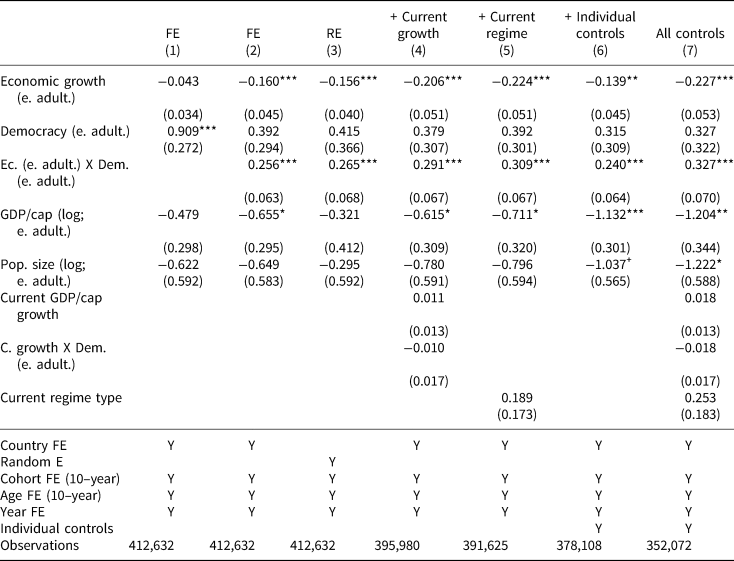
To account for potential observable confounders, we include a set of country-level controls in X i,t, specifically, for logged population size and logged GDP per capita using the Maddison Project data (Bolt and van Zanden Reference Bolt and van Zanden2020). To capture the conditions in early adulthood, these variables are measured as the moving average in the period when the respondent was eighteen to twenty-eight years old. In additional models, we control for individual-level predictors of democratic support in Z i,j,t. These are unlikely to directly affect a country's regime type or growth rate. However, they are likely to reflect underlying factors that determine the effect of a country's regime or growth on respondents' lives and regime evaluation. Specifically, we employ the following variables: level of education (primary or less, secondary, and post-secondary), gender and current employment status (from Neundorf, Gerschewski and Olar Reference Neundorf2020). As these factors are likely to introduce post-treatment bias, they are not included in our main models. In additional models, we include post-treatment variables, current economic growth and current regime to assess alternative mechanisms that could potentially drive the results (see Models 4 and 5 in Table 1).
Estimated effect of growth during early adulthood in autocracies and democracies

Note : Standard errors clustered by country cohort in parentheses + p < 0.1; * p < 0.05; ** p < 0.01; *** p < 0.001. e. adult. = early adulthood, Ec. = economic growth, Dem. = ten-year average of democratic years in early adulthood, Pop. size = population size, C. growth = current GDP/cap growth.
In our main models, we also account for age, cohort and year fixed effects. It is possible to distinguish between different time effects on democratic support (Neundorf, Gerschewski and Olar Reference Neundorf2020, 1898). First, an individual can have low or high support for democracy simply because they are old (so-called ‘ageing effects’). Secondly, an individual's support for democracy can be affected by a current event, such as a financial crisis, which affects everyone in a survey wave, regardless of their age (so-called ‘period effects’ or ‘year effects’). Thirdly, an individual can have certain attitudes towards democracy because they were socialized at a certain point in history (so-called ‘cohort effects’). Given our interest in individuals' particular economic experiences in early adulthood and the average effect of such experiences later in life, we include the following fixed effects in our regressions. To separate our main effects from age effects, we control for age dummies,  $\vartheta _{i\;}$, in ten-year intervals, which allows ageing to have a non-linear impact. In addition, as individuals may be exposed to different international political climates during their formative years (for example, the Cold War versus the liberal hegemony of the 1990s), we include ten-year interval cohort fixed effects, given by π i. Finally, we handle period effects by including year fixed effects, λ t , which measure the year in which an individual was surveyed about their attitudes towards democracy.
Besides time effects, the hypothesized relationship may be confounded by country characteristics, which render it more likely that citizens of a specific country experience growth or democracy during early adulthood. We thus limit our analysis to within-country variation in exposure to regime and growth by implementing country fixed effects, α j. This is also pivotal in terms of addressing endogeneity issues: countries that are frequently exposed to economic crises and autocracy (for example, Venezuela and Egypt) are likely to be different from economically stable, democratic countries (for example, Germany and Denmark) on a range of unobservable, potentially confounding historical legacies, such as political culture and labour market traditions. By including country fixed effects, the models control for these and other time-invariant factors. This estimation strategy is therefore preferable to more traditional multilevel modelling strategies, which might account for the hierarchical data structure in the error terms but would not allow for such fine-grained control for potential unobservable confounders. Following the general recommendation by Abadie et al. (Reference Abadie2017, 17), we cluster our standard errors on the level of the treatment assignment, which, in our case, is country cohorts, because this clustering gives a conservative estimate of the uncertainty of the coefficients.Footnote 3
Results
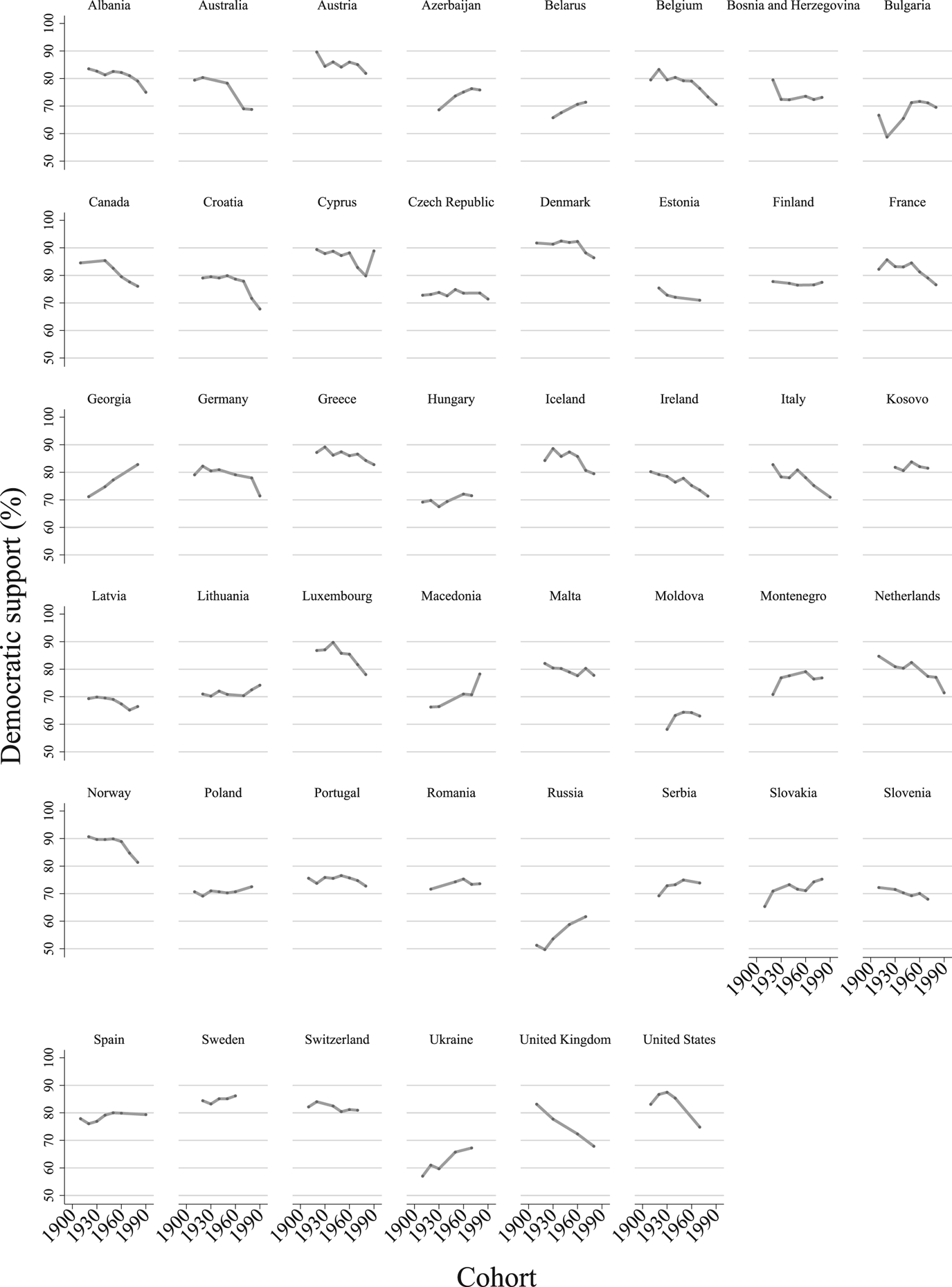
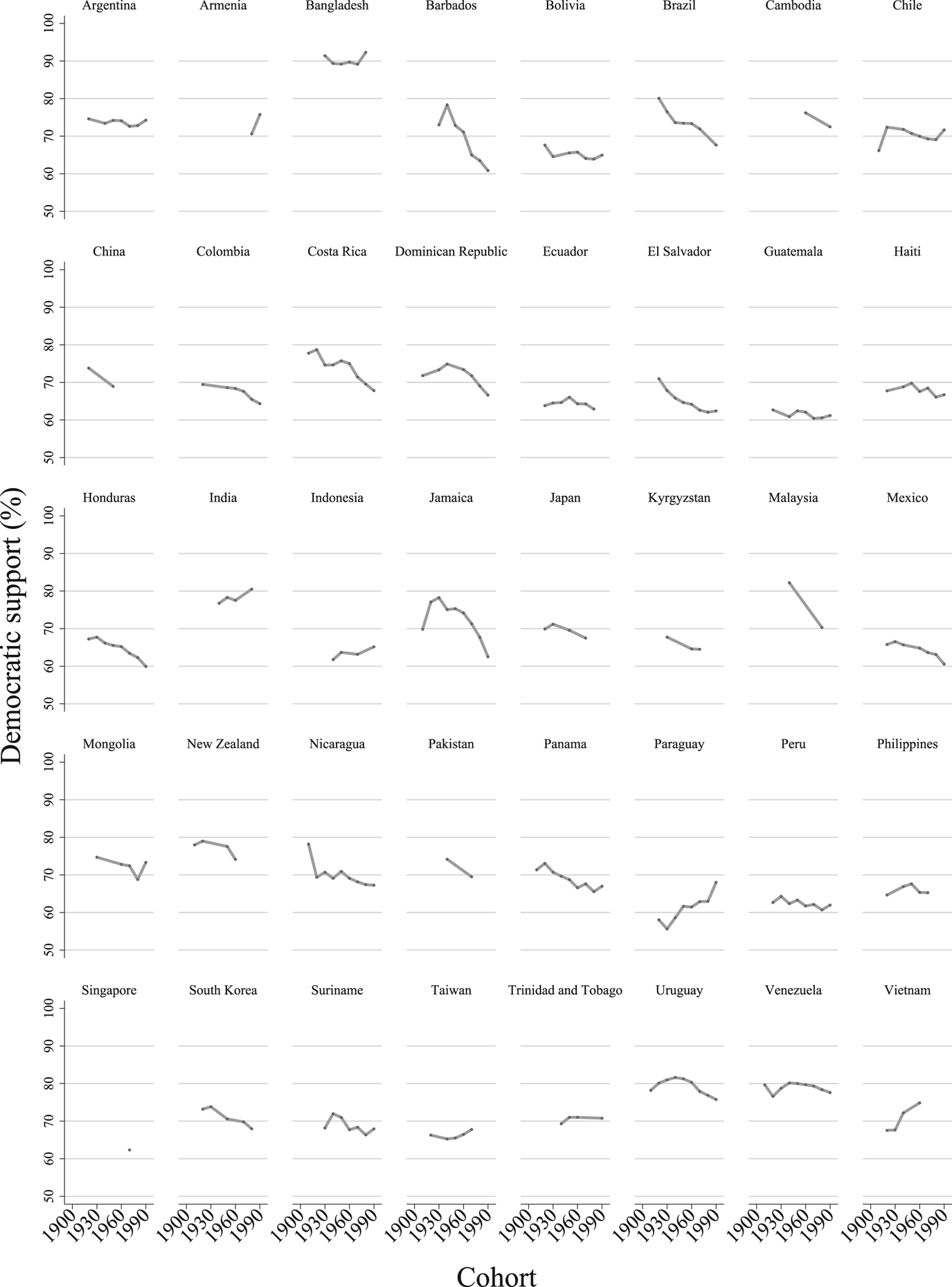
Figures 1 and 2 depict fluctuations in democratic support in the regions for which we have most extensive coverage: Europe (including Australia, Canada and the United States), Latin America and Asia. They show marked fluctuations between cohorts within and between countries. Compare, for instance, the waning support for democracy as cohorts get younger in Brazil with the stable levels of support across cohorts in Argentina (see Figure 2). Importantly, we see no uniform trends, as younger generations, for example, are generally no more sceptical of democracy than older generations. Instead, we see signs that cohort-specific experiences across countries determine democratic support: in some countries, older generations support democracy more; in some, the mid-range cohorts show the highest support; and in some, the youngest generations find democracy most valuable.
Democratic support in Europe across cohorts.

Democratic support in Latin America and Asia across cohorts.

Table 1 presents the main results of the examinations of our two hypotheses. Model 1 constitutes the main model specification without any interaction terms. The insignificant coefficient of early-adulthood economic growth indicates that, overall, the economy in itself has no clear effect on democratic support: people are not more or less supportive of democracy as a result of early-adulthood economic experiences.
To examine the potentially varying effect of early-adulthood economic growth across regime types, Model 2 includes the product term of early-adulthood economic growth and early-adulthood regime type. Here, the coefficient of early-adulthood economic growth suggests the direct effect of early-adulthood economic experiences in autocracies and is significantly negative. This indicates that having experienced a well-performing economy during early adulthood in an autocracy significantly reduces support for democracy later in life – and vice versa. Moreover, the product term is positive, statistically significant and larger in absolute magnitude than the aforementioned direct effect. This suggests that the effect of early-adulthood economic growth on democratic support flips and becomes positive if experienced in a democracy. Model 3 presents similar findings using random effects to ensure that our results are not simply an artefact of our rather restrictive main model specification.Footnote 4
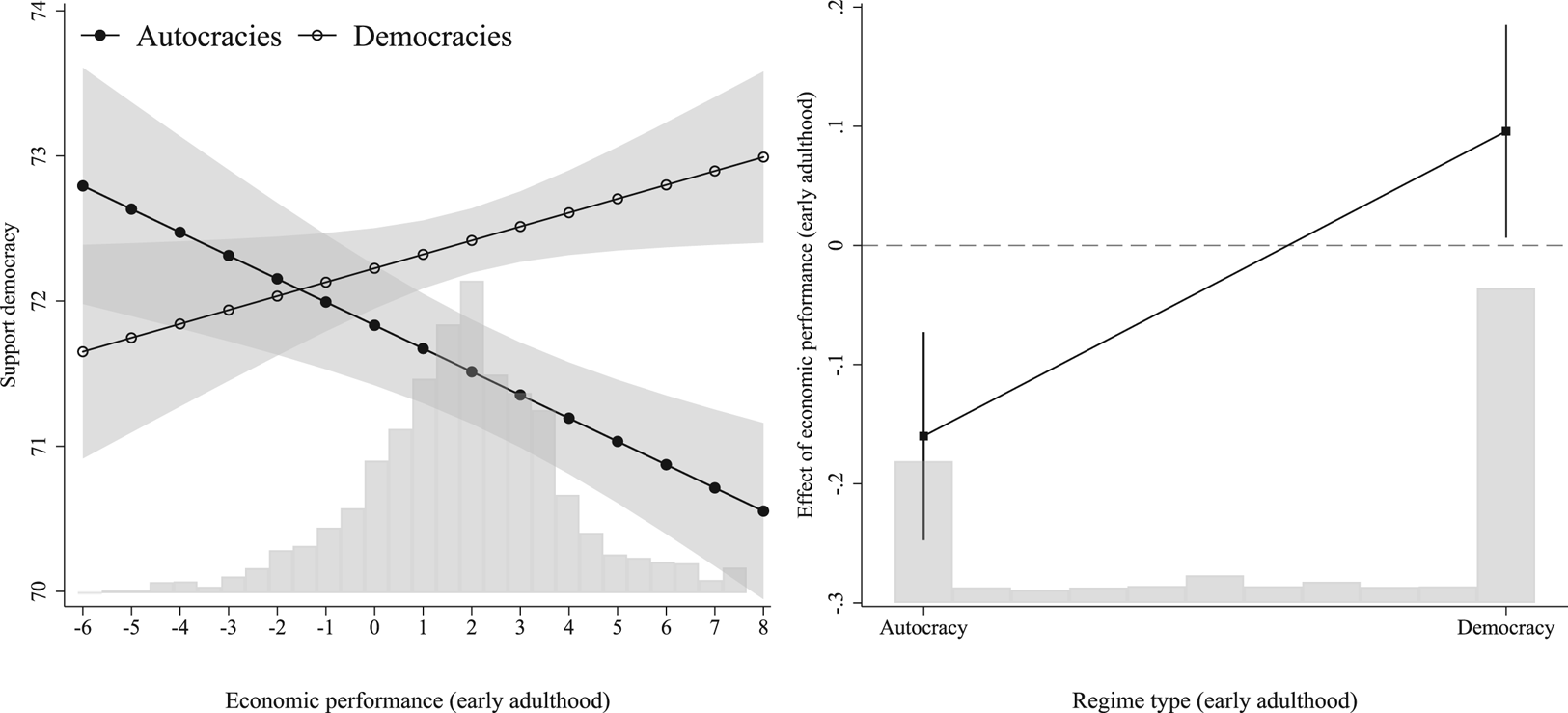
These effects are more clearly illustrated in the left panel of Figure 3, which depicts the predicted probabilities of democratic support across different early-adulthood economies in autocracies and democracies, respectively (based on Model 2 from Table 1). It shows a clear, negative effect of early-adulthood growth under autocracy. Conversely, there is a less pronounced, but still clear, positive effect of growth under democracy. The right panel offers a more direct comparison by illustrating that the marginal effects in autocracies are significantly negative and positive in democracies. A one-standard-deviation increase in early-adulthood growth under autocracy (2.43) is estimated to decrease support for democracy by 0.43, whereas it is estimated to increase support by 0.26 under democracy. This confirms that the effect of early-adulthood economic experiences is, in fact, disparate across regime types.
Main results illustrated.
Note: Based on Model 2 from Table 1. Includes 95 per cent confidence intervals.

Although the effects are not particularly strong, they are notable when considering that they describe within-country variation and concern historical factors. If we compare our results to the effects of current economic growth (the lagged average growth over the last two years), we find that in democracies, a one-standard-deviation increase in current growth is estimated to increase support for democracy by 0.65.Footnote 5 Thus, the effect of economic growth during early adulthood in democracies is more than one-third of the impact of current growth (0.26/0.65 = 0.4). For individuals living under autocracy in early adulthood, the respective comparable impact corresponds to about two-thirds (0.43/0.65 = 0.66). These relative effect sizes are notable as the respondents in our sample were surveyed, on average, twenty-three years after the end of early adulthood.Footnote 6
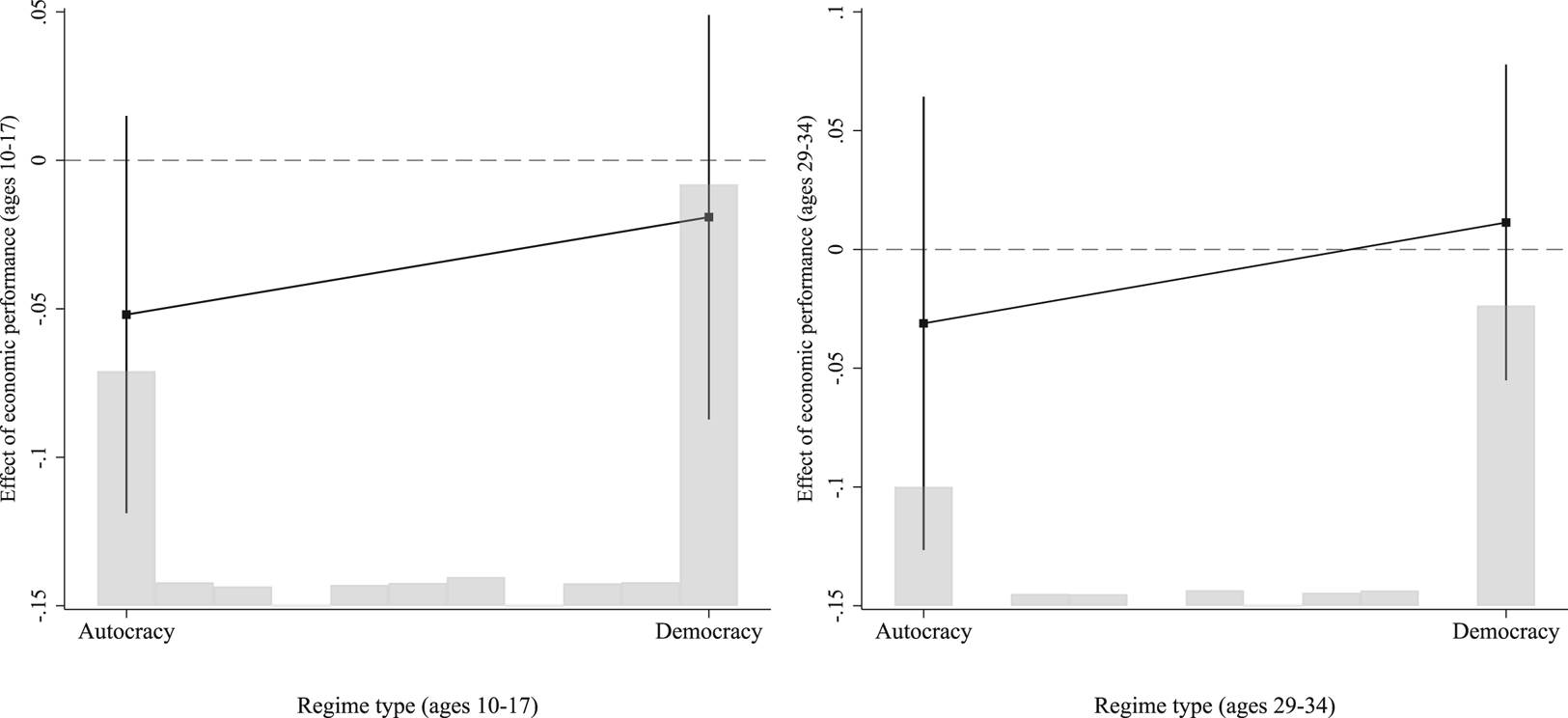
We also examine empirically the effects of other periods of early life than age eighteen to twenty-eight. Figure 4 presents the effect of economic growth across regime type during, respectively, adolescence (ages ten to seventeen) and an alternative periodization of early adulthood (ages twenty-nine to thirty-four). As expected, we find no lasting impact of growth prior to age eighteen and after age twenty-eight. In Figure A3 in the Online Appendix, we allow even greater flexibility and repeat the analysis using four-year windows from age eight. This analysis supports that the age windows encompassing early adulthood (ages eighteen to twenty-two and ages twenty-two to twenty-seven) are the only ones for which we find a differential impact of growth across democracies and autocracies.
Examining potential effects during other periods in life.
Note: Based on Table A4 in the Online Appendix. Control variables are measured in the same age window as democracy and growth. Includes 95 per cent confidence intervals.

Ruling Out Alternative Explanations
We consider a number of additional alternative explanations for our results, along with an array of robustness checks. First, to assess whether early-adulthood economic growth correlates with current economic growth and affects current support for democracy through this connection, Model 4 in Table 1 controls for current economic growth as well as its interaction with early-adulthood regime type. Although this model specification includes post-treatment controls, we see that the coefficients are quite stable – further strengthening the validity of the findings. We also exploit a survey question asking whether the respondent is employed or not (including retired). We split the sample in these two groups and run analyses for each (see Models 9–10 in Table A10). Reassuringly, the coefficient on early-adulthood economic experiences is significant for both samples.Footnote 7
Secondly, our findings could be driven by the effect of early-adulthood regime type on current regime type – and thereby current democratic support. Yet again, as seen in Model 5 in Table 1, the results seem highly stable when accounting for this possibility. The pattern remains when, in Model 6, we introduce controls for individual characteristics, such as education and current economic situation. Thus, the effect of early-adulthood experiences seems important unto itself beyond its impacts on current-day regime and economic developments.
In the Online Appendix, we consider other alternative explanations and find that they cannot account for our results: that early-adulthood variation in autocratic regime type (for example, military versus personalist) may explain both growth and later support for democracy (see Figure A4); that low growth predicts regime change (into or away from democracy) and thus subsequent democratic support (see Figure A5); that the extent of repression may influence both growth and regime transition (see Figure A6); that the regime's use of performance legitimacy claims might impact both its stability and the connection individuals make between economic growth and the regime (see Table A5); and that the results are not an artefact of a strong country-level correlation between democracy and development (see Table A11). We also present several alternative robustness checks in the Online Appendix and show that the results persist with alternative measures of growth and economic experiences (see Figures A1 and A2) and with a continuous measure of democracy (see Figure A8). We run models excluding all individuals experiencing both democracy and autocracy during early adulthood and models comparing effects across different subsamples of mixed regime experiences, but we find no substantive differences (see Figure A9). We control for current conditions using a ten-year window to match our early-adulthood variables and find that this does not alter our results (see Table A6). We explore whether there might be further variation in the effects of growth within the categories of democracy and autocracy using continuous measures of democracy. We find that the categorical democracy–autocracy difference remains the most salient (see Table A7). Finally, we examine and find that missing values in our key variables do not affect results (see Tables A8–A9).
How Long Does the Effect Last?
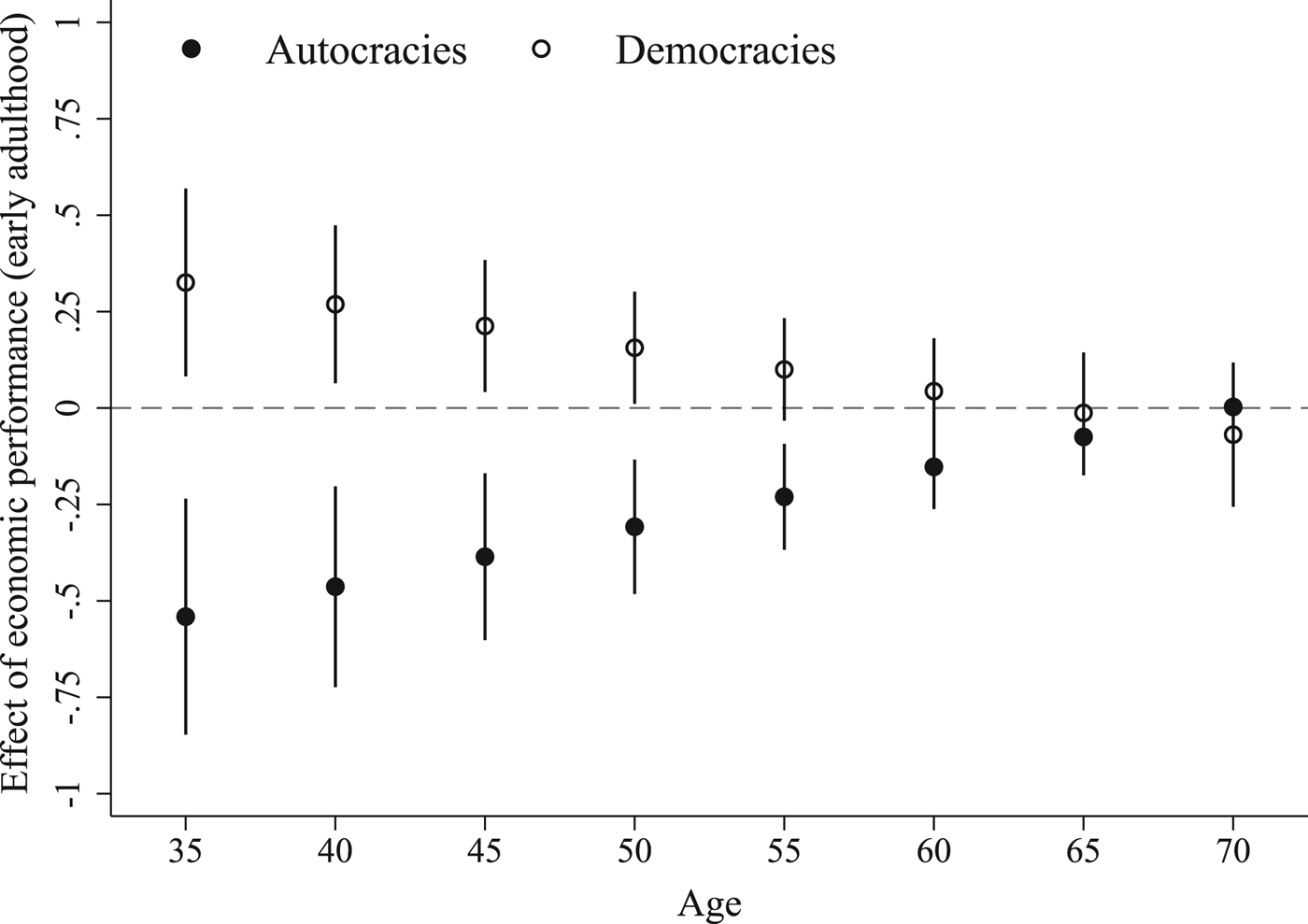
To get a sense of the endurance of the effects, the left panel in Figure 5 shows the estimated coefficient for growth during early adulthood from age thirty-five to age seventy. The estimates are based on Model 1 from Table 1, where we split the sample into individuals who experienced either autocracy or democracy at ages eighteen to twenty-eight and interact our growth measure with a measure for current age. As shown, the differential effect of growth weakens as individuals grow older and disappears around age sixty. There is no significant difference in endurance across regimes (see Figure A7 in the Online Appendix). Thus, as expected, the effect decreases over time but is still highly enduring.
The endurance of early-adulthood economic experiences.
Note: Based on Model 1 from Table 1, with the sample split into individuals who experienced either autocracy or democracy during early adulthood. Includes 95 per cent confidence intervals.

Conclusion
We set out to examine the individual-level foundations of economic performance legitimacy and the impact on democratic support throughout life. Despite strong assertions regarding the potential for economic hardships among contemporary youths around the world to disrupt patterns of democratic support in the future and renewed scholarly interest in the long-term determinants of democratic support, this research agenda has received little attention. Our article provides theoretical and empirical answers to this pending issue.
We argue that experiences with the economy during early adulthood (that is, ages eighteen to twenty-eight), when people start forming their political opinions and establish themselves economically, are wired into people's everyday cognitive schemes as cues for evaluating political regimes. This effect should be lifelong but decreasing. Examining our hypotheses in a compilation of surveys covering ninety-seven countries worldwide in the period 1994‒2015, while accounting for potential confounders in an array of specifications, we find strong and robust support for our propositions. These findings challenge the notion that economic performance has transient, unequivocal effects across regime types on democratic support. Instead, the effect of economic performance seems more enduring and heterogeneous than previously acknowledged. As people connect the regime type in place and their economic situation during early adulthood, the effect of economic performance on democratic support is historically bound and may be negative as well as positive. While our results may also be driven by people evaluating the economic situation of their fellow citizens, rather than their own, they suggest that the economic experiences of young generations are likely to form strong and sticky beliefs about the economic benefits of democracy for decades ahead. Future research should therefore study the mechanisms that connect people's early-adulthood economic experiences with present-day democratic support.
Supplementary Material
Online appendices are available at: https://doi.org/10.1017/S0007123422000278
Data Availability Statement
Replication data for this article can be found in Harvard Dataverse at: https://doi.org/10.7910/DVN/GFCNG9.
Acknowledgements
We thank the three anonymous reviewers and editors for constructive feedback. Special thanks go to Jørgen Møller and Svend-Erik Skaaning for extensive commenting.
Financial Support
None.
Competing Interests
None.