Introduction
Personality disorders are relatively prevalent in older adults, with one meta-analysis estimating that the prevalence of these disorders is approximately 10% in all adults over the age of 50 years (Abrams and Horowitz, Reference Abrams and Horowitz1996). Some studies, however, suggest that upwards of 30% (Abrams and Horowitz, Reference Abrams and Horowitz1996) or 60% (Molinari and Marmion, Reference Molinari and Marmion1995) of older adults in clinical samples meet criteria for a personality disorder. Furthermore, research suggests that the rate of diagnosis of personality disorders is similar between younger and older adults (Molinari et al., Reference Molinari, Ames and Essa1994). Collectively, these studies indicate that personality disorders are important mental health diagnoses among older adults because of their prevalence; this is especially true due to the complex and chronic nature of difficulties associated with personality disorders (van Alphen et al., Reference van Alphen, Derksen, Sadavoy and Rosowsky2012). However, there is a significant lack of research regarding personality disorders in older adults (van Alphen et al., Reference van Alphen, Derksen, Sadavoy and Rosowsky2012), particularly concerning associated psychological difficulties and sequelae.
More specifically, older adults exhibit a high suicide rate (Centers for Disease Control and Prevention, 2014), and suicide risk may be a sequela of difficulties related to personality disorders. It is, therefore, critical to examine the relation between personality disorders and suicide risk in this age group. It is especially important to examine suicide risk in community-dwelling older adults who are not pursuing mental health treatment, as older adults are less likely to receive such specialty treatment and to endorse psychological concerns (Klap et al., Reference Klap, Unroe and Unutzer2003; De Leo et al., Reference De Leo, Cerin, Spathonis and Burgis2005), and often see a primary care provider within a month of death by suicide (Luoma et al., Reference Luoma, Martin and Pearson2002).
Previous research has linked personality disorders to suicide risk in older adults. A case-control study found that personality disorders were more common among older adults who died by suicide than among older adults who died of other causes (Harwood et al., Reference Harwood, Hawton, Hope and Jacoby2001). Research also suggests that a diagnosis of any personality disorder among older adults admitted to a psychiatric inpatient unit is associated with a higher likelihood of previous suicide attempts, when compared to older adults admitted without a diagnosis of personality disorder (Kunik et al., Reference Kunik1993). Among community-dwelling older adults, personality disorder traits have been linked to more severe suicide ideation (Segal et al., Reference Segal, Marty, Meyer and Coolidge2012).
Previous research has also found that depressive symptoms and hopelessness are common among older adults with personality disorders (Molinari et al., Reference Molinari, Ames and Essa1994), suggesting that these symptoms may be important to the relation between personality disorders and suicide risk. In fact, depression and hopelessness have been identified as robust risk factors for suicide ideation in older adults (e.g. Sirey et al., Reference Sirey2008). Yet, depression and hopelessness may not be the most important variables driving suicide risk among older adults with personality disorders, and research indicates that depression is not always necessary for the development of suicide ideation in older adults (Sirey et al., Reference Sirey2008). For example, Cukrowicz et al. (Reference Cukrowicz, Cheavens, Van Orden, Ragain and Cook2011) found that in a sample of older adults, depression and hopelessness were not significantly associated with suicide ideation. Therefore, it is important to examine other potential variables that may drive suicide risk among older adults with personality disorder traits.
Personality disorder traits may influence older adults’ relationships with others, as these traits can create interpersonal tension or difficulties (van Alphen et al., Reference van Alphen, Derksen, Sadavoy and Rosowsky2012). A recent theory of suicide risk, the interpersonal theory of suicide (Joiner, Reference Joiner2005; Van Orden et al., Reference Van Orden, Witte, Cukrowicz, Braithwaite, Selby and Joiner2010), highlights the importance of interpersonal relationships in suicide risk. This theory posits that there are two critical and proximal risk factors for suicide ideation: thwarted belongingness (defined as a lack of reciprocal care in valued relationships and feeling like one does not belong in social groups; Van Orden et al., Reference Van Orden, Witte, Cukrowicz, Braithwaite, Selby and Joiner2010) and perceived burdensomeness (defined as the belief that one is so incompetent that he or she is a liability to others and that others would be better off if he or she were gone; Van Orden et al., Reference Van Orden, Witte, Cukrowicz, Braithwaite, Selby and Joiner2010). More specifically, thwarted belongingness comprises two primary dimensions: loneliness (i.e. not being married, having few friends and other social supports, living alone, and having a non-intact family), and an absence of reciprocal caring relationships (i.e. family and other interpersonal conflict, social withdrawal, and loss through divorce; Van Orden et al., Reference Van Orden, Witte, Cukrowicz, Braithwaite, Selby and Joiner2010). Perceived burdensomeness is also characterized by two dimensions: self-hate (i.e. low self-esteem, self-blame, and agitation) and feelings of liability (i.e. feeling expendable and experiencing distress related to a variety of negative life events, such as unemployment and incarceration; Van Orden et al., Reference Van Orden, Witte, Cukrowicz, Braithwaite, Selby and Joiner2010). Importantly, the interaction between perceived burdensomeness and thwarted belongingness is hypothesized to be the factor through which other more distal risk factors (e.g. personality disorder traits) influence suicide ideation (Van Orden et al., Reference Van Orden, Witte, Cukrowicz, Braithwaite, Selby and Joiner2010).
Previous research has provided empirical evidence for components of this theory in older adults. In a cross-sectional study, Cukrowicz and colleagues (Reference Cukrowicz, Ekblad, Cheavens, Rosenthal and Lynch2011) found that self-reported perceived burdensomeness and loneliness (a construct closely related to thwarted belongingness) were associated with greater suicide ideation among community-dwelling older adults. The interaction of perceived burdensomeness and thwarted belongingness has also been linked to the presence of suicide ideation in a large sample of older adults (Cukrowicz et al., Reference Cukrowicz, Jahn, Graham, Poindexter and Williams2013). Additionally, Jahn et al. (Reference Jahn, Cukrowicz, Linton and Prabhu2011) reported that perceived burdensomeness intervened in the relation between depressive symptoms and suicide ideation among community-dwelling older adults, providing evidence for the proximal nature of this risk factor. However, research has not supported portions of the interpersonal theory of suicide. For example, Van Orden et al. (Reference Van Orden, Witte, Cukrowicz, Braithwaite, Selby and Joiner2010) indicated that hopelessness was a required mediator of the relation between the interaction of perceived burdensomeness/thwarted belongingness and suicide ideation; however, this has not been supported in older adult samples (e.g. Cukrowicz et al., Reference Cukrowicz, Jahn, Graham, Poindexter and Williams2013). Consequently, the interpersonal theory of suicide has been revised to reflect that hopelessness is not a proximal risk factor for suicide ideation (Joiner et al., Reference Joiner, Ribeiro and Silva2012).
When examined in the context of personality disorders, the interpersonal theory of suicide suggests that personality disorder traits would contribute to perceived burdensomeness and thwarted belongingness, particularly because relating to others is one of the critical difficulties in personality disorders (American Psychiatric Association, 2000). For example, personality disorder traits may be characterized by detachment from others, social withdrawal, unstable interpersonal relationships, and a pervasive dependence on others (American Psychiatric Association, 2000). Therefore, these traits may negatively interfere with sustained positive interpersonal relationships and may increase thwarted belongingness, as well as increase perceived burdensomeness due to low self-esteem and dependence.
Because previous research has established depressive symptoms and hopelessness as important risk factors for suicide ideation among older adults with personality disorders, it is important to examine these variables as parallel mediators of this relation as well. However, because previous research also suggests that established robust risk factors such as depressive symptoms may not be the most important variables in relation to suicide ideation in older adults (e.g. Sirey et al., Reference Sirey2008), it is critical to examine these variables in relation to newer, theory-based variables (e.g. perceived burdensomeness, thwarted belongingness). Additionally, including all four risk factors (i.e. depressive symptoms, hopelessness, perceived burdensomeness, and thwarted belongingness) as parallel mediators allows us to test the interpersonal theory of suicide, potentially falsifying some of its tenets, should we find that the established risk factors (i.e. depressive symptoms and hopelessness) act as mediators and the theory-based risk factors (i.e. perceived burdensomeness and thwarted belongingness) do not.
Therefore, the purpose of this study was to examine a multiple mediator model with depressive symptoms, hopelessness, perceived burdensomeness, and thwarted belongingness acting as parallel mediators of relations between personality disorder traits and suicide ideation in older adults. Given theoretical postulations (Joiner Reference Joiner2005; Van Orden et al., Reference Van Orden, Witte, Cukrowicz, Braithwaite, Selby and Joiner2010) and previous empirical evidence (e.g. Jahn et al., Reference Jahn, Cukrowicz, Linton and Prabhu2011), we hypothesized that perceived burdensomeness and thwarted belongingness would act as significant parallel mediators of the relation between personality disorder traits and suicide ideation, because of their critical and proximal nature, but depressive symptoms and hopelessness would not act as significant parallel mediators as they have been shown to be less proximal than perceived burdensomeness and thwarted belongingness (e.g. Jahn et al., Reference Jahn, Cukrowicz, Linton and Prabhu2011; Cukrowicz et al., Reference Cukrowicz, Jahn, Graham, Poindexter and Williams2013). Additionally, we explored the profile of personality disorder traits seen in generally healthy older adults.
Methods
Participants
A total of 167 participants (aged 65 years and older) were recruited from a primary care clinic as part of a larger study examining factors related to depression and suicide ideation. These participants were generally community-dwelling older adults, indicating that they were generally healthy. A detailed description of these samples has been provided previously (e.g. Cukrowicz et al., Reference Cukrowicz, Jahn, Graham, Poindexter and Williams2013), and is described briefly here. Participants were excluded from the study if they endorsed current or past psychotic or manic symptoms, reported current substance abuse, or evidenced cognitive impairment on a cognitive screener. Fifteen screened participants were excluded from the study due to cognitive impairment. One additional participant was excluded due to past psychotic symptoms. Therefore, 151 participants were included in this study.
Procedures
The study was approved by a large public southwestern university's Institutional Review Board. All procedures were completed in compliance with the approved protocol. Upon being recruited from a primary care clinic after being approached by a research assistant at a regularly scheduled appointment, participants who agreed to participate completed a single research session at their home or in the research clinic. All participants provided informed consent prior to participation. Participants were administered semi-structured clinical interviews for suicide risk and major depressive episode, and completed self-report measures regarding a number of clinical and psychosocial variables. To ensure participant safety, all research personnel were trained in suicide risk assessment; in addition, all participant responses were examined during the research session for evidence of suicide risk. In cases where suicide risk was identified, research personnel provided intervention as needed, commensurate with the level of risk. Each participant, upon finishing the study, received resources pertaining to local mental health services.
Measures
Geriatric suicide ideation scale
(GSIS; Heisel and Flett, Reference Heisel and Flett2006). The GSIS is a self-report questionnaire assessing suicide ideation and related constructs in older adults. The GSIS consists of 31 items, which can be summed for a total score or divided into four subscales: suicide ideation, death ideation, loss of personal and social worth, and perceived meaning in life (Heisel and Flett, Reference Heisel and Flett2006). For the current study, the total score was utilized. Using a five-point scale ranging from 1 (strongly disagree) to 5 (strongly agree), participants were asked to rate each statement (e.g. “I have seriously considered suicide more than once earlier in my life”). Scores range from 31 to 155, with higher scores representing greater suicide ideation. In samples of older adults, the GSIS has good internal reliability and validity (Heisel and Flett, Reference Heisel and Flett2006). Internal consistency in this sample for the GSIS total score was excellent (Cronbach's α = 0.89).
Beck hopelessness scale
(BHS; Beck and Steer, Reference Beck and Steer1988). The BHS is a 20-item true–false self-report measure assessing negative cognitions about the future (e.g. decreases in motivation). Scores on the BHS range from 0 to 20, with higher scores reflecting greater hopelessness. The BHS assesses three hopelessness domains: affective (i.e. feelings related to the future), cognitive (i.e. hopeless expectations about the future), and motivational (i.e. lacking future motivation; Beck and Steer, Reference Beck and Steer1988). For the purposes of this study, the total score on the BHS was used. The BHS has demonstrated acceptable psychometric properties in samples of older adults (e.g., Cronbach's α = 0.74, Ricarte et al., Reference Ricarte, Latorre, Ros, Navarro, Aguilar and Serrano2011; correlations indicating convergent and divergent validity, Cukrowicz et al., Reference Cukrowicz, Jahn, Graham, Poindexter and Williams2013). Internal consistency in the current sample was good (Cronbach's α = 0.82).
Beck depression inventory-ii
(BDI-II; Beck et al., Reference Beck, Steer and Brown1996). The BDI-II is a 21-item self-report measure assessing the severity of depressive symptoms. Scores on the BDI-II range from 0 to 63, with higher scores indicating more severe depressive symptoms. For the purposes of the current study, the total score on the BDI-II was used. In samples of older adults, the BDI-II has demonstrated good internal consistency reliability (e.g. Cronbach's α = 0.94; Heisel et al., Reference Heisel, Conwell, Pisani and Duberstein2011) and test–retest reliability (Jo et al., Reference Jo, Park, Jo, Ryu and Han2007), and is a valid assessment of depression in older adults (Suija et al., Reference Suija2012). Cronbach's α was 0.89 for this measure in this sample.
Interpersonal needs questionnaire
(INQ; Van Orden et al., Reference Van Orden, Cukrowicz, Witte and Joiner2012). The INQ is comprised of two subscales: perceived burdensomeness (e.g. “These days I think I make things worse for the people in my life”) and thwarted belongingness (e.g. “These days I feel disconnected from other people”). Responses are based on a seven-point scale ranging from 1 (not at all true for me) to 7 (very true for me). For each subscale, higher total scores suggest greater thwarted belongingness or perceived burdensomeness. The INQ has been validated as a reliable and valid measure in a variety of samples (Van Orden et al., Reference Van Orden, Cukrowicz, Witte and Joiner2012). In this sample, Cronbach's α for the thwarted belongingness subscale was 0.82, and Cronbach's α for the perceived burdensomeness subscale was 0.74.
Structured clinical interview for dsm-iv-tr axis ii personality disorders, patient questionnaire
(SCID-II-PQ; First et al., Reference First, Gibbon, Spitzer, Williams and Benjamin1997). The SCID-II-PQ is a 119-item self-report measure used to assess personality disorders using DSM-IV-TR criteria. Participants endorse true (1) or false (0) for each item (e.g. “Have you often done things impulsively?”, “Do you find that there are very few people that are worth your time and attention?”). The items directly match symptoms of personality disorders from the DSM-IV-TR. To maximize variability in the data and power for analyses, we scored this measure using total personality disorder traits, instead of individual personality disorders. Scores were derived by summing all self-report items endorsed as true; higher scores reflect increases in traits. No follow-up clinical interview was conducted for the purposes of this study.
This measure has previously been used in samples of older adults (e.g. Chapman et al., Reference Chapman, Lynch, Rosenthal, Cheavens, Smoski and Krishnan2007). We opted not to assess specific personality disorder diagnoses based on responses to this questionnaire for two reasons. First, because the SCID-II-PQ is designed to be a screening tool, not a diagnostic tool, we did not want to assume diagnoses were present that may not be accurate. Second, research has demonstrated that there are biases in diagnosis of personality disorders in older adults (Balsis et al., Reference Balsis, Woods, Gleason and Oltmanns2007) and changes in personality disorder diagnoses in older adults (Stevenson et al., Reference Stevenson, Datyner, Boyce and Brodaty2011); as such, we focused on overall traits to reduce potential diagnostic bias. Internal consistency reliability for the total score was adequate in our sample (i.e. Cronbach's α of 0.88).
Data analysis
A non-parametric bootstrapping procedure was used to assess the mediation hypothesis. This procedure utilizes the MEDIATE macro developed by Hayes and Preacher (Reference Hayes and Preacher2014) for continuous, dichotomous, or multicategorical independent variables, and allows for multiple mediators to be included in a single model. In this model, direct and indirect paths are bootstrapped. Given that the Hayes and Preacher (Reference Hayes and Preacher2014) method is a resampling technique based on an empirical approximation from the existing data, it allows for lower power compared to similar mediational models. Further, unlike causal step models of mediation, the direct path does not have to be statistically significant to assess for mediation and the mediation confidence intervals (CIs) can be asymmetric. Prior to the mediation analysis, we screened for and corrected for univariate and multivariate outliers. For univariate outliers, we corrected all scores to within three standard deviations of the mean. A total of four scores were lowered for the BHS, five scores were lowered for the BDI, five scores were lowered for the INQ-PB, one score was lowered for the INQ-TB, three scores were lowered for the GSIS, and three scores were lowered for the total score on the SCID-II-PQ. We utilized Cook's distance and Mahalanobis distance to assess for influence and leverage. No cases were excluded due to influence, and five cases were removed due to leverage. Three additional cases were removed due to missing data; therefore, the mediation hypothesis was examined in 143 participants. Because we were including mediating variables which can be highly correlated, we assessed for multicollinearity. None of the variables met recommended cut-offs for multicollinearity (i.e. tolerance, VIF, bivariate correlations); therefore, all mediators were included in a single model. For the analysis, 5,000 bootstrap samples were drawn, and percentile CIs were used (set at 95% for the CI). Significant mediation is present if zero is outside of the CI; however, if zero is within the CI, this indicates that the mediated pathway is nonsignificant (Hayes and Preacher, Reference Hayes and Preacher2014).
The independent variable in the model was total personality disorder traits (SCID-II-PQ). The mediators included were: depressive symptoms (BDI), hopelessness (BHS), perceived burdensomeness (INQ-PB), and thwarted belongingness (INQ-TB). The outcome variable was suicide ideation (GSIS). Finally, basic descriptive statistics were utilized to examine the personality disorder trait profile among healthy, community-dwelling older adults.
Results
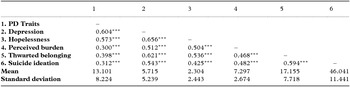
Descriptive statistics and correlations for the variables of interest are presented in Table 1. The mean age of participants was 73.3 (SD = 6.5), with a range of 65– 93. The study consisted of 73 females (51.0%) and 70 males. The ethnic breakdown of the sample was: 89.5% White, 7.0% Hispanic, 2.1% African-American, 0.7% Native American, and 0.7% Asian-American. Additionally, 71.3% of the sample reported being married, 15.4% were widowed, 6.3% were divorced, 2.8% reported living with a partner, 2.8% were single (never married), 0.7% were separated, and 0.7% reported being in an intimate relationship. The mean total years of education in this sample was 14.9 (SD = 3.5).
Correlations and descriptive statistics

Note: *: p < 0.05; **: p < 0.01; ***: p < 0.001.
PD Traits: structured clinical interview DSM-IV-TR axis II personality disorders, patient questionnaire total score; Depression: Beck depression inventory-II total score; Hopelessness: Beck hopelessness scale total score; Perceived burden: interpersonal needs questionnaire perceived burdensomeness score; Thwarted belonging: interpersonal needs questionnaire thwarted belongingness score; Suicide ideation: Geriatric Suicide Ideation Scale total score.
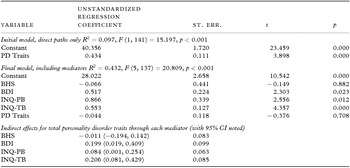
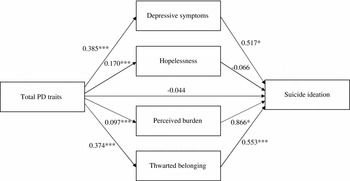
Complete results for the model are presented in Table 2 and Figure 1. A profile of personality disorders and personality disorder symptoms is presented in Table 3. Table 3 provides information about the average number of symptoms endorsed for each personality disorder, the number of participants endorsing any symptoms of each personality disorder, and the three symptoms of each personality disorder endorsed most frequently by participants, along with correlations with suicide ideation.
Total traits mediation model results predicting Geriatric Suicide Ideation Scale total scores

Note: BHS = Beck hopelessness scale; BDI = Beck depression inventory; INQ-PB = interpersonal needs questionnaire, perceived burdensomeness subscale; INQ-TB = interpersonal needs questionnaire, thwarted belongingness subscale; PD Traits = structured clinical interview for DSM-IV-TR axis II personality disorders, patient questionnaire; CI = confidence interval.
Profile of personality disorder traits in older adults

Note: *: p < 0.05; **: p < 0.01; ***: p < 0.001.
# = Item related to suicide ideation removed prior to correlation analysis.
Symptoms listed are three most often endorsed symptoms for each personality disorder. GSIS: Geriatric Suicide Ideation Scale total score. SD: standard deviation.
Unstandardized path regression coefficients for total personality disorder traits predicting suicide ideation. Note: *p < 0.05; **p < 0.01; ***p < 0.001.

The amount of variance predicted by the final model (i.e. with predictor and mediating variables included) was significant, R2 = 0.432, F (5, 137) = 20.809, p < 0.001. The direct path between personality disorder traits and suicide ideation was significant prior to the inclusion of mediators, unstandardized regression coefficient = 0.434, standard error (SE) = 0.111, p < 0.001, though it was not significant after mediators were added, unstandardized regression coefficient = −0.044, SE = 0.118, p = 0.708. In terms of the mediated effects, the indirect effects via depressive symptoms (unstandardized regression coefficient = 0.199, SE = 0.099, 95% CI = 0.019–0.409), thwarted belongingness (unstandardized regression coefficient = 0.206, SE = 0.085, 95% CI = 0.081– 0.429), and perceived burdensomeness (unstandardized regression coefficient = 0.084, SE = 0.063, 95% CI = 0.001– 0.254) were significant. However, the indirect effect via hopelessness was not significant (unstandardized regression coefficient = −0.011, SE = 0.083, 95% CI = −0.194–0.142).Footnote 1
Discussion
Our results partially supported our hypothesis, as hopelessness did not act as a significant parallel mediator of relations between personality disorder traits and suicide ideation, though depressive symptoms did act as a parallel mediator. Additionally, perceived burdensomeness and thwarted belongingness were parallel mediators of the relation between personality disorder traits and suicide ideation. These results suggest that perceived burdensomeness and thwarted belongingness are important risk factors for suicide ideation in older adults with various personality disorder traits, as is depressive symptomatology. Perceived burdensomeness and thwarted belongingness appear to explain a significant amount of the variance in suicide ideation. These findings fit with the previously discussed rationale that personality disorder traits may result in a lack of social contact or belonging, or dependent traits and low self-esteem may create feelings of burdensomeness.
These findings partially support the interpersonal theory of suicide, but also suggest that some revisions may be warranted if the current findings are replicated and verified in other samples. Van Orden et al. (Reference Van Orden, Witte, Cukrowicz, Braithwaite, Selby and Joiner2010) suggested that perceived burdensomeness and thwarted belongingness are important risk factors, which was supported by the mediation findings identified in the current study. However, unlike in previous studies that have identified perceived burdensomeness as a cross-sectional mediator of the relation between depressive symptoms and suicide ideation in older adults (Jahn et al., Reference Jahn, Cukrowicz, Linton and Prabhu2011) and college students (Davidson et al., Reference Davidson, Wingate, Grant, Judah and Mills2011), depressive symptoms appeared to be a mediator parallel to perceived burdensomeness and thwarted belongingness in this model. Hopelessness did not act as a parallel mediator, consistent with Joiner et al.'s (Reference Joiner, Ribeiro and Silva2012) revision of the interpersonal theory of suicide model. Collectively, these results support previous studies that have found support for perceived burdensomeness and thwarted belongingness as risk factors for suicide ideation in older adults (e.g. Cukrowicz et al., Reference Cukrowicz, Jahn, Graham, Poindexter and Williams2013), as well as depressive symptoms as an important risk factor (e.g. Sirey et al., Reference Sirey2008).
Given these findings, clinicians who work with older adults should assess for perceived burdensomeness and thwarted belongingness when conducting suicide risk assessments, as well as depressive symptoms, whether these are brief, one-question assessments conducted in a primary care settings, or structured questionnaires or comprehensive intake interviews in specialized mental health settings. Each of these three variables appears important in determining suicide ideation in older adults with personality disorder traits. Additionally, while no randomized controlled trials have been published that have specifically examined outcomes when targeting perceived burdensomeness and thwarted belongingness in treatment (a limitation that should be addressed by future research), cognitive strategies aimed at reducing cognitive distortions related to being a burden on others or not being cared about by others may be effective in reducing these states (Joiner et al., Reference Joiner, Van Orden, Witte and Rudd2009). Further, behavioral activation strategies aimed at contributing to others and establishing reciprocal caring relationships may be beneficial to clients who believe that they are a burden on others or who believe that they do not have reciprocal caring relationships with others (Joiner et al., Reference Joiner, Van Orden, Witte and Rudd2009).
Previous research suggests that older adults may have difficulties associated with personality disorders, yet there is not a substantial amount of research regarding these difficulties in this age group (van Alphen et al., Reference van Alphen, Derksen, Sadavoy and Rosowsky2012). This study provides additional evidence that personality disorder traits may increase risk for sequelae such as suicide ideation among older adults, consistent with previous research that has found significant relations between personality disorder traits and increased suicide ideation among older adults (Segal et al., Reference Segal, Marty, Meyer and Coolidge2012). Our results are also consistent with previous research indicating that there are important proximal variables driving suicide risk among older adults with personality disorders (Cukrowicz et al., Reference Cukrowicz, Ekblad, Cheavens, Rosenthal and Lynch2008), and that variables from the interpersonal theory of suicide (Cukrowicz et al., Reference Cukrowicz, Cheavens, Van Orden, Ragain and Cook2011; Jahn et al., Reference Jahn, Cukrowicz, Linton and Prabhu2011; Cukrowicz et al., Reference Cukrowicz, Jahn, Graham, Poindexter and Williams2013) and depressive symptoms (Sirey et al., Reference Sirey2008) may be these proximal risk factors for suicide ideation in older adults.
This study, while valuable, has limitations. First, as the study was cross-sectional in design, we could not assess causality. Longitudinal data from future studies would address this limitation. Additionally, our sample consisted of generally healthy, community-dwelling older adults from a limited geographic area. Therefore, these results may not generalize to older adults in other areas, those that reside in assisted living facilities, or those with chronic and severe illness. Therefore, future studies may test the model in other samples of older adults, as well as younger adults, to increase generalizability. This study also focused on suicide risk in the context of the interpersonal theory of suicide, not in the context of a theory of aging; integrating such theories would be beneficial to conceptualizing suicide risk among older adults. Finally, this study relied on self-reported personality traits, as opposed to personality disorder diagnoses. In some respects, this is a strength, as many older adults who present for treatment or who experience suicide ideation may not have a personality disorder diagnosis, and the results of this study apply to such older adults. However, it is important to examine the relations identified in the current study in older adults with various personality disorders, as our ability to address such relations is limited by the design of this study.
Taken together, the results of the current study suggest that thwarted belongingness, perceived burdensomeness, and depressive symptoms act as parallel mediators of the relations between personality disorder traits and suicide ideation in older adults, though hopelessness does not. These findings indicate that perceived burdensomeness and thwarted belongingness may be important risk factors for suicide ideation among older adults, and clinicians should be aware of these issues when assessing and treating suicide risk among older adults.
Conflict of interest declaration
This study was funded in part by a Young Investigator Grant from the American Foundation for Suicide Prevention (Principal Investigator: Kelly C. Cukrowicz). This source provided funding for research assistants’ time, purchase of proprietary measures, and participant payments.
Description of authors’ roles
Danielle R. Jahn formulated hypotheses, conducted analyses, and wrote portions of this manuscript. Erin K. Poindexter also wrote portions of this manuscript. Kelly C. Cukrowicz designed and ran the larger study that included the data utilized for this manuscript, conducted analyses, and provided supervision, conceptual guidance/suggestions, and editorial revision on all aspects of this manuscript. All three authors reviewed this manuscript and collected data for the study from which this manuscript was developed.
Acknowledgments
The authors would like to acknowledge and thank Andrew K. Littlefield, PhD and Amelia E. Talley, PhD for their assistance with statistical analyses.