Significant outcomes
The levels of α-tocopherol were significantly higher and the levels of albumin significantly lower in the acute phase compared with the stable phase of schizophrenia.
The change in α-tocopherol was associated with membrane fatty acid (PUFA) levels in the acute phase.
In the stable phase of schizophrenia the levels of bilirubin were lower and uric acid higher compared with healthy controls after adjusting for sex, age and smoking.
Limitations
The relatively small sample size reduces statistical power and increases the risk of type II errors.
Body weight of the participants, diet and dietary supplements that may influence the levels of membrane fatty acids and antioxidants were not controlled for.
The group of patients not using antipsychotic medication was small, and information of adherence was not obtained, making it difficult to assess the effect of medication.
Introduction
Schizophrenia is regarded as a complex syndrome of developmental defects caused by genetic and environmental factors (van Os et al., Reference van Os, Rutten and Poulton2008; Howes & Murray, Reference Howes and Murray2014), but the underlying pathological mechanisms are still mainly unknown. Antioxidant defence systems may be disturbed in schizophrenia (Bitanihirwe & Woo, Reference Bitanihirwe and Woo2011; Emiliani et al., Reference Emiliani, Sedlak and Sawa2014), and oxidative stress may play a role in the underlying disease mechanisms (Zhang & Yao, Reference Zhang and Yao2013).
Under normal physiological conditions free-radical damage is controlled by the antioxidant defence systems, comprising a series of enzymatic components, including glutathione peroxidase (GPx), glutathione reductase (GR), superoxide dismutase (SOD), catalase (CAT), and non-enzymatic components, including glutathione (GSH), α-tocopherol (vitamin E) and ascorbic acid (vitamin C) (Yao & Keshavan, Reference Yao and Keshavan2011; Pisoschi & Pop, Reference Pisoschi and Pop2015). Oxidative stress is the imbalance of free radicals generated from both normal metabolism, including neurotransmitters associated with schizophrenia, such as dopamine and glutamate, and from various environmental exposures. Several lines of evidence suggest increased oxidative stress in schizophrenia (Boskovic et al., Reference Boskovic, Vovk, Kores and Grabnar2011; Lai et al., Reference Lai, Scarr, Udawela, Everall, Chen and Dean2016). In addition, stress-induced signalling cascades, including those involving inflammatory processes and oxidative stress, will modulate the development and maintenance of synaptic connectivity, and further contribute to the abnormalities seen in schizophrenia (Boulanger, Reference Boulanger2009; Do et al., Reference Do, Cabungcal, Frank, Steullet and Cuenod2009). However, the findings are not consistent and the manner by which free radicals influence schizophrenia pathophysiology is still unclear (Herken et al., Reference Herken, Uz, Ozyurt, Sogut, Virit and Akyol2001; Pandya et al., Reference Pandya, Howell and Pillai2013; Bulbul et al., Reference Bulbul, Virit, Alpak, Unal, Bulut, Kaya, Altindag, Celik and Savas2014; Koga et al., Reference Koga, Serritella, Sawa and Sedlak2016).
Impaired levels of non-enzymatic antioxidants, including glutathione, bilirubin, uric acid, albumin, ascorbic acid and α-tocopherol, have been suggested as a pathophysiological mechanism in schizophrenia (Suboticanec et al., Reference Suboticanec, Folnegovic-Smalc, Korbar, Mestrovic and Buzina1990; McCreadie et al., Reference McCreadie, Macdonald, Wiles, Campbell and Paterson1995; Pae et al., Reference Pae, Paik, Lee, Lee, Kim and Lee2004; Dadheech et al., Reference Dadheech, Mishra, Gautam and Sharma2006; Ben et al., Reference Ben, Mechri, Fendri, Bost, Chazot, Gaha and Kerkeni2008; Labad et al., Reference Labad, Stojanovic-Perez, Montalvo, Sole, Cabezas, Ortega, Moreno, Vilella, Martorell, Reynolds and Gutierrez-Zotes2015; Steullet et al., Reference Steullet, Cabungcal, Monin, Dwir, O’Donnell, Cuenod and Do2016), and antioxidant levels have been associated with clinical severity in schizophrenia (Li et al., Reference Li, Zheng, Xiu, Chen, Kosten and Zhang2011; Bentsen et al., Reference Bentsen, Solberg, Refsum and Bohmer2012; Widschwendter et al., Reference Widschwendter, Rettenbacher, Kemmler, Edlinger, Baumgartner, Fleischhacker and Hofer2016). Further, several studies implicate oxidative stress to be related to symptom severity in schizophrenia (Lai et al., Reference Lai, Scarr, Udawela, Everall, Chen and Dean2016). Oxidative stress may change during the course of schizophrenia, and can be related to symptom severity and medication (Katsuta et al., Reference Katsuta, Ohnuma, Maeshima, Takebayashi, Higa, Takeda, Nakamura, Nishimon, Sannohe, Hotta, Hanzawa, Higashiyama, Shibata and Arai2014). Oxidative DNA damage was found to be higher in patients with non-remission schizophrenia (Sertan et al., Reference Sertan, Virit, Hanifi, Orkmez, Bulbul, Binnur, Semiz, Alpak, Unal, Ari and Savas2015). The levels of protein oxidation were shown to be higher in patients with acute psychosis than in remission and healthy controls (Tuncel et al., Reference Tuncel, Sarisoy, Bilgici, Pazvantoglu, Cetin, Unverdi, Avci and Boke2015).
Membrane polyunsaturated fatty acids (PUFAs) are among the cellular components highly susceptible to oxidative damage, resulting in impaired membrane structure, fluidity and signal transduction (Reddy & Yao, Reference Reddy and Yao1996). Lipid peroxidation may be associated with different phases of schizophrenia (Mico et al., Reference Mico, Rojas-Corrales, Gibert-Rahola, Parellada, Moreno and Fraguas2011; Tuncel et al., Reference Tuncel, Sarisoy, Bilgici, Pazvantoglu, Cetin, Unverdi, Avci and Boke2015), and heterogeneity of lipid levels may reflect the phase of disease, in addition to other modifiers (Medema et al., Reference Medema, Mocking, Koeter, Vaz, Meijer and de2015). Dysregulation of antioxidant defence is a possible modifier that can explain variation in lipid levels in different phases of the disease.
Aims of the study
The first aim was to identify changes in antioxidants and markers of oxidative stress in schizophrenia across a 5-year period, from the acute phase to a later stable phase. The second aim was to explore differences between patients and healthy controls in the stable phase. We hypothesised that the levels of oxidative markers increase in schizophrenia compared with healthy controls; change from the acute to the stable phase; and are associated with the levels of membrane PUFAs and symptom severity.
Material and methods
Study design and patient population
The current observational study includes longitudinal data on antioxidants and markers of oxidative stress from patients with schizophrenia spectrum disorders and from a group of healthy controls. The current study is part of a larger longitudinal study of schizophrenia patients. They were first investigated in an acute phase of the disease and followed up on average 5 years later in a stable phase, and compared with a healthy control group. The patients were examined in the acute phase from 2001 to 2004, and in the stable phase from 2006 to 2010.
Patients with schizophrenia spectrum disorders were recruited to a randomised controlled trial of an omega-3 fatty acid and antioxidants (Bentsen et al., Reference Bentsen, Osnes, Refsum, Solberg and Bohmer2013). At inclusion, the patients were admitted to emergency psychiatric wards in southern Norway, considered to be in an acute phase. The patients were re-assessed 5 years later, and at this follow-up, the patients received treatment at outpatient clinics or at psychiatric long-term care facilities, considered to be in a stable phase of the disease (Solberg et al., Reference Solberg, Bentsen, Refsum and Andreassen2016). The patients were screened for somatic illness both at inclusion and at follow-up.
In addition to longitudinal monitoring and comparison within the patient group, healthy controls were included in the stable phase to provide normal biochemical values, including the levels of antioxidants and oxidative stress markers to compare with the schizophrenia group.
The study was approved by the Regional Committee for Medical Research Ethics. All participants gave written informed consent.
We have previously reported lipid and antioxidant results from the acute phase of the study (Bentsen et al., Reference Bentsen, Solberg, Refsum, Gran, Bohmer, Torjesen, Halvorsen and Lingjaerde2011, Reference Bentsen, Osnes, Refsum, Solberg and Bohmer2013). Further, we have published associations between lipid profiles and clinical characteristics in the stable phase (Solberg et al., Reference Solberg, Bentsen, Refsum and Andreassen2015), and shown that PUFA levels changed from the acute to the stable phase (Solberg et al., Reference Solberg, Bentsen, Refsum and Andreassen2016). In the present report, we investigated the markers of oxidative stress in the stable phase, also including novel laboratory measures not reported earlier.
Clinical assessment
All patients were diagnosed with the Structural Clinical Interview for DSM-IV (SCID) at inclusion (acute phase), and the diagnosis was verified during follow-up assessment (stable phase) (Solberg et al., Reference Solberg, Bentsen, Refsum and Andreassen2016). Those with an initial diagnosis of schizophrenia spectrum disorders were re-diagnosed at follow-up according to ICD-10, similar to DSM-IV. In the following, we use ‘schizophrenia’ to describe schizophrenia, schizoaffective and schizophreniform disorders. The Positive and Negative Syndrome Scale (PANSS), Structured Interview Version, and the Global Assessment of Functioning (GAF), Split version, including Symptom (GAF-S) and Functioning (GAF-F) scales, were used for clinical assessments.
Information about the current and previous use of antipsychotics was obtained via interviews and access to medical records.
Neither the healthy subjects nor their first-degree relatives had any ongoing or past severe psychiatric disorder. This was determined by an interview assessing mental illness, and screening for ongoing and past psychiatric disorder using the Mini International Neuropsychiatric Interview (MINI). In addition, their physical health was assessed with self-report and a short screening interview addressing current and previous somatic illnesses (Solberg et al., Reference Solberg, Bentsen, Refsum and Andreassen2016).
Biochemical analyses
Biochemical parameters were compared between inclusion (acute phase) and the follow-up visit (stable phase). α-Tocopherol, albumin, uric acid and PUFA were analysed in both phases, while the other outcome variables – bilirubin, F2-isoprostane and reactive oxygen metabolites (ROMs) – were only analysed at follow-up (stable phase).
All blood samples for biochemical analyses were drawn after overnight fasting, and samples for analyses of antioxidants, oxidative stress and PUFAs were stored at –80°C and transported frozen (shipped with dry ice) to the analysing laboratory.
Serum α-tocopherol in the acute phase was analysed at the Nutrition Laboratory, Oslo University Hospital, Aker, Oslo, Norway, with kits from Bio-Rad Lab, GmBH (Munich, Germany), by high-performance liquid chromatography (HPLC) and ultraviolet light detection. In the stable phase, serum α-tocopherol was analysed by Vitas AS, Oslo, Norway. Serum was diluted with 2-propanol containing the internal standard tocol and butylhydroxytoluene as an antioxidant. The same HPLC methods were used both in the acute and stable phases and can be considered equivalent. The lipid-adjusted term [α-tocopherol/(triglycerides + cholesterol)] was used in statistical analyses to better define the vitamin E status in groups with elevated serum lipid concentrations (Ford et al., Reference Ford, Farr, Morris and Berg2006).
Uric acid, albumin, total bilirubin and CRP were analysed in serum using standard methods. In the acute phase, analyses were carried out at the hospital to which the patient was submitted. In the stable phase, the analyses were carried out at Diakonhjemmet Hospital, Oslo, Norway.
The test for Diacron reactive oxygen metabolites (D-ROMs) was performed according to the information provided by the manufacturer (Diacron International, Grosetto, Italy). In brief, heparin plasma was diluted in an acidic buffer solution (pH 4.8). Iron present in the sample catalysed the breakdown of plasma hydroperoxides to alkoxyl and peroxyl radicals, which generate a coloured complex, and was quantified with a photometer. The results are denominated by arbitrary units, Carratelli Units (CARR U), and 1 CARR U corresponds to 0.08 mg H2O2/100 ml. The concentration of D-ROMs was used as an index for the production of reactive oxygen species (ROS), with higher values indicating higher oxidative stress (Cesarone et al., Reference Cesarone, Belcaro, Carratelli, Cornelli, De Sanctis, Incandela, Barsotti, Terranova and Nicolaides1999).
The quantification of 8-iso-prostaglandin F2α (8-IsoPGF2α) was done by triple-stage liquid chromatography tandem mass spectrometry (LC/MS/MS). An Applied Biosystems 4000 Q TRAP LC/MS/MS system with ESI was operated in multiple reaction monitoring (MRM) mode. The mass limit of detection (mLOD) was 1 pg of analyte eluting from the column (Bastani et al., Reference Bastani, Gundersen and Blomhoff2009). 8-IsoPGF2α was analysed during the acute phase but with another method (enzyme-linked immunoassay). This yields results that cannot be directly related to those obtained by the method used for the stable phase. Therefore, this variable was not included in longitudinal analyses.
For the analyses of membrane PUFAs, washed red blood cells (RBCs) were stored at −80°C and sent within 3 months in dry ice to Mylnefield Research Services Ltd (Dundee, United Kingdom). For the analyses of membrane PUFAs, lipids were extracted, converted into fatty acid methyl esters, and analysed by gas chromatography, yielding fatty acid profiles (Bentsen et al., Reference Bentsen, Solberg, Refsum, Gran, Bohmer, Torjesen, Halvorsen and Lingjaerde2011). Fatty acids were reported as micrograms per gram of RBCs. The sum of PUFAs with 20 or 22 carbon atoms is classified as long-chain PUFAs (LCPUFAs). We have previously reported that membrane PUFA levels were bimodally distributed among patients in the acute phase (Bentsen et al., Reference Bentsen, Solberg, Refsum, Gran, Bohmer, Torjesen, Halvorsen and Lingjaerde2011). In the present study, we defined low and high PUFA groups by PUFA levels in the acute phase. We have previously reported (Bentsen et al., Reference Bentsen, Solberg, Refsum, Gran, Bohmer, Torjesen, Halvorsen and Lingjaerde2011) that saturated and monounsaturated fatty acids were normally distributed, while fatty acids with at least three double bonds were bimodally distributed in the acute phase. Thus, the data represented a mixture of two distributions assumed to be normal (Bentsen et al., Reference Bentsen, Solberg, Refsum, Gran, Bohmer, Torjesen, Halvorsen and Lingjaerde2011). For PUFAs in the current sample, we found that the point with the lowest density of observations was 183 µg/g RBC, which was used to split the sample into two groups. Twenty-nine per cent of the patients had a value at or below this cut-off score (low PUFA group); 71% had a value above the threshold (high PUFA group).
Statistics
The Wilcoxon signed-rank test was used to evaluate possible changes in the levels of antioxidants from the acute to the stable phase of schizophrenia. The Mann–Whitney test was used to compare the levels of antioxidants and markers of oxidative stress in stabilised patients with those of healthy controls. Subsequently, multiple linear regression analyses were performed for each of the antioxidants and markers of oxidative stress with patient status (‘healthy = 0’, ‘patient = 1’) tested as explanatory variable, including sex, age and smoking habit as potential covariates. The selection of covariates in the final multivariate models was based on sequential backward elimination by excluding covariates with p > 0.1. Multiple regression analyses were also used to explore the influences of phase (acute, stable) and duration of follow-up on changes in α-tocopherol. Finally, Spearman correlation tests were used to evaluate the relationship between levels of antioxidants, markers of oxidative stress and membrane PUFAs.
All statistical analyses were performed using SPSS version 23. The significance level was set to p < 0.05 (two-sided).
Results
Patient characteristics
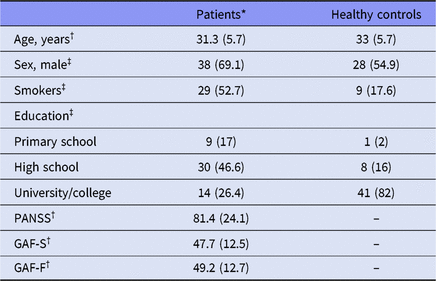
Fifty-five schizophrenia patients and 51 healthy controls were included in the study. The patient group had a significantly higher number of current smokers, low education levels and a higher number of males compared with the control group. Demographics of the included schizophrenia patients and healthy controls are shown in Table 1.
Characteristics of schizophrenia patients and healthy controls

n = 55 schizophrenia patients and n = 51 healthy controls (except for education: n = 53 and 50, respectively).
SD, standard deviation; PANSS, Positive and Negative Syndrome Scale (total score); GAF, Global Assessment of Functioning (S = Symptoms, F = Functioning).
* Data from stable phase
† mean (SD)
‡ n (%).
The mean follow-up time for the 55 patients from the acute phase was 61 months. We intended to follow up everyone in the acute phase sample (n = 99), but 21.2% did not wish to participate, 12.1% could not be located, 9.1% were dead, and 2.0% had moved to other regions of Norway (Solberg et al., Reference Solberg, Bentsen, Refsum and Andreassen2016). The follow-up sample did not differ significantly from the remaining patients in the original acute phase sample with respect to relevant characteristics.
Eleven patients did not use any antipsychotic medication at follow-up. Those who received antipsychotics were compliant with the treatment, as defined by measures of blood levels within the normal concentration range. The results of PUFA and antioxidant investigations from the acute phase have been published earlier (Bentsen et al., Reference Bentsen, Solberg, Refsum and Bohmer2012, Reference Bentsen, Osnes, Refsum, Solberg and Bohmer2013).
Antioxidants
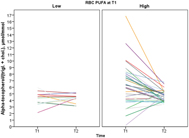
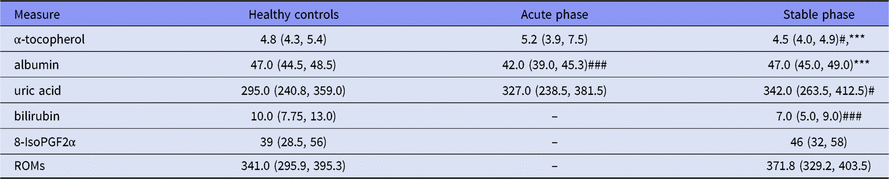
The levels of α-tocopherol in the schizophrenia group decreased significantly from the acute to the stable phase (−1.3 µmol/mmol, 95% CI −2.1 to −0.6 µmol/mmol, p < 0.001) (Tables 2 and 3). α-Tocopherol remained stable in the low-PUFA acute phase group. In contrast, in the high-PUFA acute phase group, α-tocopherol levels decreased significantly (p < 0.001) towards the stable phase, while PUFA levels remained the same (Table 3, Fig. 1). The PUFA group (high, low) had a modifying effect on changes in α-tocopherol (linear mixed model interaction term PUFA × α-tocopherol × time, p = 0.02). In the acute phase, the difference in α-tocopherol in the high and low PUFA groups remained significant after adjusting for sex, age and smoking habits. In the stable phase, the two acute-phase PUFA groups had similar α-tocopherol and PUFA levels (Table 3, Fig. 1, Suppl. Fig. 1A–B). The duration of illness did not predict α-tocopherol levels in the acute or stable phases, and the duration of follow-up did not predict changes in α-tocopherol.
Changes of lipid-adjusted serum α-tocopherol from T1 (baseline, acute phase) to T2 (5 years follow-up, stable phase) in 50 schizophrenia patients. Five subjects had missing baseline α-tocopherol and were excluded. Red blood cells Polyunsaturated fatty acids at T1, red blood cell polyunsaturated fatty acids at baseline, acute phase. Low: patients with ≤183 µg PUFA/g RBC at T1; high: patients with >183 µg PUFA/g RBC at T1.

Univariate analysis of antioxidants and markers of oxidative stress

α-tocopherol (adjusted): α-tocopherol / (triglycerides + cholesterol).
P-value: *#0.01 < P ≤ 0.05; **##0.001 < P ≤ 0.01; ***###<0.001 (median, 25, 75 quartiles).
Schizophrenia n = 50–55; healthy controls n = 46–51. Units: α-tocopherol: µmol/mmol; albumin: g/L; bilirubin: µmol/l; uric acid: µmol/l; 8-IsoPGF2α: pg/mL; ROMs: Carratelli Units.
8-IsoPGF2α: 8-iso-prostaglandin F2α; ROMs: derivatives of reactive oxygen metabolites.
#P-value vs. healthy controls, Mann–Whitney U test.
*P-value vs. acute phase, related samples Wilcoxon signed-rank test.
α-tocopherol in schizophrenia during acute and stable phases stratified by PUFA levels in the acute phase

α-tocopherol, adjusted = α-tocopherol / (triglycerides + cholesterol) (µmol/l)/(mmol/l); mean, 95% confidence interval.
Low PUFA n = 13, high PUFA n = 37. Low and high PUFA groups: acute-phase PUFA <183 and ≥183 µg/g RBC, respectively.
PUFA, omega-3 + omega-6 polyunsaturated fatty acids in red blood cells.
# Student’s t-test.
* Related samples Wilcoxon signed-rank test.
The levels of albumin increased significantly from the acute to the stable phase (p < 0.001) (Table 2). Changes in albumin were not significantly associated with the PUFA acute phase group. There was no significant difference between the levels of uric acid in the acute and stable phases of schizophrenia. Bilirubin was only measured in the stable phase.
When patients in the stable phase were compared with healthy controls in a multivariate model, adjusting for sex, age and smoking, bilirubin was significantly lower (p = 0.046), uric acid was significantly higher (p = 0.009), while α-tocopherol was non-significantly lower (p = 0.06) in the patients compared with healthy controls (Table 4).
Estimated effects of patient status, sex, age and smoking habits on antioxidants and markers of oxidative stress in the stable phase of schizophrenia vs. healthy controls in a multiple linear regression analysis

P-values: *0.01 < P ≤ 0.05; **0.001 < P ≤ 0.01; ***<0.001.
Numbers are absolute effect of the respective variables on the concentrations of α-tocopherol, bilirubin, albumin, uric acid and ROMs. The selection of covariates in the final models was based on a sequential backward elimination by excluding covariates with p > 0.10. All constants were significantly different from zero (p < 0.001).
Units: 8-IsoPGF2α: pg/mL (no significant effects in the model); α-tocopherol: µmol/mmol; bilirubin: µmol/l; albumin: g/l; uric acid: µmol/l; ROMs: Carratelli Units.
ROMs, reactive oxygen metabolites
a Years above 21.
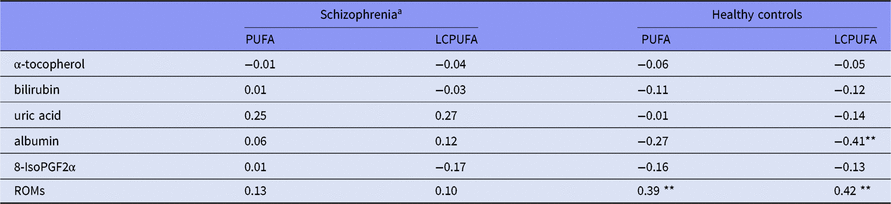
Albumin level was significantly associated with total PANSS score (r = 0.28, p = 0.04) in the stable phase. There was no other significant associations between the levels of antioxidants and symptoms or functioning. Albumin was significantly associated with LCPUFA in healthy controls only (p = 0.004). There was no other significant associations between the levels of antioxidants and PUFAs in patients or in healthy controls (Table 5).
Associations between antioxidants, markers of oxidative stress and membrane PUFAs, stable phase

α-tocopherol: α-tocopherol / (triglycerides + cholesterol).
Schizophrenia n = 50–55; healthy controls n = 46–51. Spearman’s correlation coefficients are reported. PUFA and LCPUFA are non-normally distributed.
PUFA, omega-3 + omega-6 polyunsaturated fatty acids in red blood cells; LCPUFA, long-chain PUFA with 20–24 carbon atoms in red blood cells; PGF2α, isoprostane-8-epi prostaglandin F2 α; ROMs, reactive oxygen metabolites.
a Data from the stable phase.
* 0.01 < P ≤ 0.05
** 0.001 < P ≤ 0.01.
Markers of oxidative stress
No significant differences were found in 8-IsoPGF2α and ROMs between patients in the stable phase and healthy controls (Table 2). In the multivariate model, adjusting for sex, age and smoking, the levels of ROMs were non-significantly (p = 0.09) associated with schizophrenia (Table 4).
No significant associations between markers of oxidative stress and measures of symptom severity were found. The associations between the levels of ROMs and PUFA (r = 0.39, p = 0.007) and LCPUFA (r = 0.42, p = 0.003) were significantly positive in healthy controls, but not significant in schizophrenia patients (Table 5). There were no significant associations between 8-IsoPGF2α and PUFAs (Table 5).
C-reactive protein
CRP was significantly higher in patients than in healthy controls in the stable phase (p < 0.001). In the multivariate model, the difference between patients and healthy controls remained significant after adjusting for sex, age, smoking and use of antipsychotic medication. There was no significant change in patients from the acute to the stable phase (p = 0.81).
Discussion
We found significantly higher levels of α-tocopherol and lower levels of albumin in the acute phase compared with the stable phase of schizophrenia. The change in α-tocopherol was associated with membrane PUFA levels in the acute phase. Further, we found lower levels of bilirubin and higher levels of uric acid in the stable phase of schizophrenia compared with healthy controls when adjusting for covariates. These findings suggest that dysregulation of antioxidants and oxidative stress may be dynamic and related to different phases of the illness.
Antioxidants
The course of α-tocopherol from the acute to the stable phase was heterogeneous, but overall the level was falling and values converging, as shown in Fig. 1. This may indicate dysregulation of α-tocopherol during the acute phase.
In the acute phase, α-tocopherol was positively associated with the levels of membrane PUFAs (Bentsen et al., Reference Bentsen, Solberg, Refsum, Gran, Bohmer, Torjesen, Halvorsen and Lingjaerde2011). We have previously reported that PUFA levels were bimodally distributed in the acute phase of schizophrenia in the original larger sample (Bentsen et al., Reference Bentsen, Solberg, Refsum, Gran, Bohmer, Torjesen, Halvorsen and Lingjaerde2011; Solberg et al., Reference Solberg, Bentsen, Refsum and Andreassen2016). Membrane PUFAs in the low PUFA group increased from the acute to the stable phase in schizophrenia, whereas levels in the high PUFA group remained unchanged (Solberg et al., Reference Solberg, Bentsen, Refsum and Andreassen2015). Here we showed that α-tocopherol levels in the high PUFA group of the acute phase decreased, while in the low PUFA group, levels of α-tocopherol did not change (Fig. 1). Acute psychosis has been associated with inflammation (Bergink et al., Reference Bergink, Gibney and Drexhage2014), and increased serum levels of α-tocopherol may result from catabolism by CYP3A4 being inhibited by inflammatory cytokines (Traber, Reference Traber2007; Christensen & Hermann, Reference Christensen and Hermann2012; Wollmann et al., Reference Wollmann, Syversen, Lie, Gjestad, Mehus, Olsen and Molden2017). The reduction in α-tocopherol levels in the patient group with high PUFA in the acute phase is consistent with lower inflammation activity in the stable phase. In contrast, a lower level of α-tocopherol in the low PUFA group during the acute phase may result from oxidative stress (Raederstorff et al., Reference Raederstorff, Wyss, Calder, Weber and Eggersdorfer2015; Koga et al., Reference Koga, Serritella, Sawa and Sedlak2016). The stability of α-tocopherol among patients with low PUFAs in the acute phase (Fig. 1, Suppl. Fig. 1A–B) could indicate that this group had an enduring deficit in redox regulation, as well as a lack of inflammation indicated by the adverse effect of eicosapentaenoic acid (EPA), 2 g/d, on this group of patients, presumably a pro-oxidant effect (Bentsen et al., Reference Bentsen, Osnes, Refsum, Solberg and Bohmer2013).
The assessment of vitamin E status in critically ill patients with systemic inflammation has been discussed by Vasilaki et al. (Reference Vasilaki, Leivaditi, Talwar, Kinsella, Duncan, O’Reilly and McMillan2009). They found that adjustment for cholesterol alone yielded higher levels of α-tocopherol than in healthy controls, whereas adjustment for triglycerides yielded lower levels. Patients’ cholesterol levels were lower, while triglyceride levels were similar to those of healthy controls. In our study, we adjusted for both cholesterol and triglycerides.
While the uric acid level did not significantly change between the acute and stable phases of schizophrenia in the present study, we found significantly higher levels of uric acid in the stable phase of schizophrenia than in healthy controls after adjusting for age, sex and smoking habits. Earlier studies have somewhat conflicting findings regarding the potential change in uric acid level in schizophrenia (Yao et al., Reference Yao, Reddy, McElhinny and van Kammen1998; Dadheech et al., Reference Dadheech, Mishra, Gautam and Sharma2006). The uric acid’s antioxidative properties would be assumed to deplete during the acute phase of schizophrenia, in conditions of oxidative stress. Still, as with bilirubin, the exact relationship between schizophrenia, oxidative stress and the levels of endogenous antioxidants remains unclear and warrants further study.
The present study showed lower albumin levels in patients in the acute phase compared with the stable phase. In the latter, there was no difference between schizophrenia patients and healthy controls. Earlier studies have shown similar findings, linking low levels of albumin to the acute phase of schizophrenia (Reddy et al., Reference Reddy, Keshavan and Yao2003). Other studies have shown no difference in albumin levels between first episode and chronic schizophrenia (Pae et al., Reference Pae, Paik, Lee, Lee, Kim and Lee2004). Low albumin may be an effect of malnutrition and inflammation (Don & Kaysen, Reference Don and Kaysen2004); both conditions may be present in the acute phase of schizophrenia. In our study, patients in the acute phase were recently admitted to a psychiatric hospital and were at risk of somatic and social stress. Low albumin may also be an effect of oxidative stress and related to the underlying pathogenesis of psychosis (Labad et al., Reference Labad, Stojanovic-Perez, Montalvo, Sole, Cabezas, Ortega, Moreno, Vilella, Martorell, Reynolds and Gutierrez-Zotes2015).
We found that bilirubin was lower in the schizophrenia group compared with healthy controls in the stable phase, independent of smoking status. Low bilirubin concentration confers a potent antioxidant redox amplification cycle and antioxidant protection via recycling of bilirubin to biliverdin (Jansen & Daiber, Reference Jansen and Daiber2012). Altered levels of bilirubin have been shown in schizophrenia. One study has found increased levels in first-episode schizophrenia (Reddy et al., Reference Reddy, Keshavan and Yao2003), while other studies on patients in the stable phase have conflicting findings (Yao et al., Reference Yao, Reddy and van Kammen2000; Semnani et al., Reference Semnani, Nazemi, Azariyam and Ardakani2010). Differences in bilirubin levels between patients and healthy controls have been found independent of smoking status and antipsychotic medication (Yao et al., Reference Yao, Reddy and van Kammen2000; Reddy et al., Reference Reddy, Keshavan and Yao2003). Bilirubin is metabolised by UGT1A1, in which genetic variation might lead to idiopatic unconjugated hyperbilirubinemia (Gilbert’s syndrome). This syndrome is more prevalent among schizophrenia patients than in the general population (Yao et al., Reference Yao, Reddy and van Kammen2000). Altered bilirubin levels during the course of schizophrenia may indicate that oxidative stress is related to symptom severity and need to be further examined in longitudinal studies.
Measures of antioxidants and oxidant markers only partially correlate, regarding change over time as well as differences between healthy controls and patients in the stable phase. This is in line with earlier reports of inconsistent findings of oxidative stress markers and antioxidants in schizophrenia (Ciobica et al., Reference Ciobica, Padurariu, Dobrin, Stefanescu and Dobrin2011). Both antioxidants and markers of oxidative stress are indirect measurements of free radical production, as in vivo measurement of free radical concentrations is impractical because their reactive nature results in short half-lives and low levels. It is possible that oxidative stress and alterations in antioxidant enzyme activities may be involved in the pathophysiology of specific subtypes of schizophrenia. The difference in the direction of changes may be attributed to clinical symptoms, age, BMI and use of antipsychotic medication, but also to the dynamic status of antioxidant enzymes, which have an intricate balance with other biological pathways and systems (Zhang et al., Reference Zhang, Tan, Cao, Wu, Xu, Shen and Zhou2006; Wu et al., Reference Wu, Kosten and Zhang2013).
Antioxidants, markers of oxidative stress and association to symptom severity
The current analyses revealed no significant association between symptom severity and levels of antioxidants or markers of oxidative stress in the stable phase. This is in line with earlier studies of chronic schizophrenia (Lee et al., Reference Lee, Eyler, Wolkowitz, Martin, Reuter and Kraemer2016). We have earlier demonstrated that F2-isoprostane levels were associated with negative symptoms in the same patient group in the acute phase (Bentsen et al., Reference Bentsen, Solberg, Refsum and Bohmer2012). Persistent low levels of antioxidants may be toxic and not compatible with sustainable life, and any associations with symptoms will more likely be present intermittently during the course of the disease.
Antioxidants and markers of oxidative stress, and association with membrane PUFA
The levels of ROMs and albumin were associated with those of PUFAs in healthy controls, but not in patients in the stable phase. Dysregulation of antioxidant defence through a reduction in expression and activity has been implicated in disease pathophysiology (Miller et al., Reference Miller, Chu, Brooks, Richenbacher, Pena-Silva and Heistad2008). PUFAs are especially prone to lipid peroxidation, and one would expect a stable relationship between PUFAs, antioxidants and markers of oxidative stress. During episodes of higher symptom intensity, the levels of membrane lipids may be influenced by neuroinflammation, oxidative stress and lipid peroxidation (Bitanihirwe & Woo, Reference Bitanihirwe and Woo2011; Muller et al., Reference Muller, Weidinger, Leitner and Schwarz2015). Taken together, discrepancies in oxidant markers may indicate a dysregulation of antioxidant defences and suggest that oxidative stress and excessive free radical production may be involved in the pathophysiology of schizophrenia.
The levels of α-tocopherol were associated with those of PUFAs in patients and were lower in the low PUFA group in the acute phase (Bentsen et al., Reference Bentsen, Solberg, Refsum, Gran, Bohmer, Torjesen, Halvorsen and Lingjaerde2011). We showed that changes in α-tocopherol from the acute to stable phase were different between the two groups. Add-on treatment with EPA had different effects between the PUFA groups in the acute phase, leading to increased psychotic symptoms in the low PUFA group (Bentsen et al., Reference Bentsen, Osnes, Refsum, Solberg and Bohmer2013). The fact that the bimodality was no longer present in the stable phase (Solberg et al., Reference Solberg, Bentsen, Refsum and Andreassen2016) suggests a possible stage-specific biological effect. Together, this may indicate a dysregulation of redox regulation in schizophrenia affecting PUFA levels, with different patterns in the acute and stable phases.
Oxidative stress and lifestyle factors
Antioxidant status and oxidative stress are related to lifestyle factors and diet, which have been found to be poorer in schizophrenia patients than in the general population (Dipasquale et al., Reference Dipasquale, Pariante, Dazzan, Aguglia, McGuire and Mondelli2013). Nutrients, including PUFAs and vitamins, have anti-inflammatory and antioxidant mechanisms of action, and an unhealthy diet may contribute to the observed differences between patients and healthy controls (Mitra et al., Reference Mitra, Natarajan, Ziedonis and Fan2017). Though studies have shown diet inadequacy among schizophrenia patients, this may not alone explain the differences in antioxidants and polyunsaturated acids observed between patients and healthy controls (Strassnig et al., Reference Strassnig, Singh Brar and Ganguli2005; Ballesteros et al., Reference Ballesteros, Jiang, Summerfelt, Du, Chiappelli, O’Donnell, Kochunov and Hong2013).
The changes in antioxidant levels in our study were independent of smoking status. Tobacco smoking is known to increase oxidative stress and lipid peroxidation (Kharb & Singh, Reference Kharb and Singh2000; Van’t Erve et al., Reference Van’t Erve, Lih, Jelsema, Deterding, Eling, Mason and Kadiiska2016). Among schizophrenia patients, higher levels of oxidative stress have been shown among first-episode patients that smoked (Jordan et al., Reference Jordan, Dobrowolny, Bahn, Bernstein, Brigadski, Frodl, Isermann, Lessmann, Pilz, Rodenbeck, Schiltz, Schwedhelm, Tumani, Wiltfang, Guest and Steiner2018), but lipid peroxidation has been lower among patients who smoked in a stable phase (Zhang et al., Reference Zhang, Tan, Cao, Wu, Xu, Shen and Zhou2006). The levels of antioxidants were lower in first-episode schizophrenia independent of smoking status (Yao et al., Reference Yao, Reddy and van Kammen2000; Reddy et al., Reference Reddy, Keshavan and Yao2003). Smoking was associated with higher glutathione levels in controls, while smoking in patients was not associated with this effect (Ballesteros et al., Reference Ballesteros, Jiang, Summerfelt, Du, Chiappelli, O’Donnell, Kochunov and Hong2013). Oxidative stress from smoking may stimulate the antioxidant defence, and increased antioxidant activity with greater cigarette consumption is consistent with tobacco smoke, leading to oxidative stress and the stimulation of protective actions of enzymes such as superoxide dismutase and catalase to reverse this stress (Zhang et al., Reference Zhang, Tan, Zhou, Haile, Wu, Cao, Kosten and Kosten2007). Some components of tobacco smoke also appear to inhibit monoamine oxidase, and this might decrease free radical formation (Mazzio et al., Reference Mazzio, Kolta, Reams and Soliman2005). Taken together, this indicates that though smoking may lead to increased oxidative stress, the changes in antioxidant levels observed in schizophrenia patients may be independent of smoking status and related to the pathophysiology of schizophrenia.
Oxidative stress and inflammation
Several lines of evidence suggest that the pathophysiology of schizophrenia involves immune and inflammatory pathways that may have important aetiological and therapeutic implications (Anderson & Maes, Reference Anderson and Maes2013; Muller et al., Reference Muller, Weidinger, Leitner and Schwarz2015; Muller, Reference Muller2018). A possible association between schizophrenia and the immune system is supported by epidemiological studies suggesting links with infection and systemic inflammation (Khandaker et al., Reference Khandaker, Cousins, Deakin, Lennox, Yolken and Jones2015). The use of antipsychotic medication may also affect the inflammatory state, and antipsychotics can impact the expression of genes that code for inflammatory cytokines and immune cells (Chen et al., Reference Chen, Wu, Tsai, Wang and Tsai2013; Debnath, Reference Debnath2015). However, in clinical trials, results are mixed and may reflect different properties of each medication (Roge et al., Reference Roge, Moller, Andersen, Correll and Nielsen2012; de Witte et al., Reference de Witte, Tomasik, Schwarz, Guest, Rahmoune, Kahn and Bahn2014). Aberrant cytokine levels have been observed in schizophrenia independent of antipsychotic medication and associated both to state and trait (Miller et al., Reference Miller, Buckley, Seabolt, Mellor and Kirkpatrick2011; Hope et al., Reference Hope, Ueland, Steen, Dieset, Lorentzen, Berg, Agartz, Aukrust and Andreassen2013; Morch et al., Reference Morch, Dieset, Faerden, Hope, Aas and Nerhus2017). However, several genome-wide association studies have implicated immune genes among the strongest genetic risk factors (Shi et al., Reference Shi, Levinson, Duan, Sanders, Zheng, Pe’er, Dudbridge, Holmans, Whittemore, Mowry, Olincy, Amin, Cloninger, Silverman, Buccola, Byerley, Black, Crowe, Oksenberg, Mirel, Kendler, Freedman and Gejman2009; Sekar et al., Reference Sekar, Bialas, de Rivera, Davis, Hammond, Kamitaki, Tooley, Presumey, Baum, Van Doren, Genovese, Rose, Handsaker, Daly, Carroll, Stevens and McCarroll2016; Miller & Goldsmith, Reference Miller and Goldsmith2017).
We found higher levels of CRP in patients in the stable phase, similar to previous findings in the acute phase (Bentsen et al., Reference Bentsen, Solberg, Refsum and Bohmer2012). This is in line with earlier studies (Fernandes et al., Reference Fernandes, Steiner, Bernstein, Dodd, Pasco, Dean, Nardin, Goncalves and Berk2016; Johnsen et al., Reference Johnsen, Fathian, Kroken, Steen, Jorgensen, Gjestad and Loberg2016) and may indicate a low-grade inflammation among patients, which could play a role in disease progression, either by itself or as a modulator of oxidative stress. Oxidative stress and inflammation are intricately linked (Barron et al., Reference Barron, Hafizi, Andreazza and Mizrahi2017) and have been suggested to reflect developmental redox dysregulation (Do et al., Reference Do, Cabungcal, Frank, Steullet and Cuenod2009). Oxidative stress induces inflammation via the activation of rapid-acting transcriptional activators of inflammatory response that can also lead to the production of more free radicals (Liu et al., Reference Liu, Qu and Shen2008; Bitanihirwe & Woo, Reference Bitanihirwe and Woo2011). In the brain, the activation of microglia to destroy pathogens involves the generation of reactive superoxides, which can also damage neurons if not balanced with antioxidants (Block et al., Reference Block, Zecca and Hong2007). Dysregulation of neuro-immune and redox systems due to genetic and early-life environmental risk factors may contribute to CNS anomalies observed in schizophrenia, and dysregulation of more than one of these systems may be particularly deleterious (Steullet et al., Reference Steullet, Cabungcal, Monin, Dwir, O’Donnell, Cuenod and Do2016). In general, studies of oxidative stress and inflammation in schizophrenia have provided conflicting results, but some studies have suggested poorer outcome among patients with higher oxidative stress and greater inflammation (Fraguas et al., Reference Fraguas, Diaz-Caneja, Rodriguez-Quiroga and Arango2017). These processes may be dynamic and related to different phases of schizophrenia, and apply to subgroups of patients and need to be studied further.
Oxidative stress related to different phases of schizophrenia
The current findings are in line with the notion that different pathological processes may be involved in different phases of schizophrenia. Several lines of evidence from basic neuroscience support this concept. Krystal et al. describe an imbalance in cortical excitation and inhibition that vary throughout the development and progression of schizophrenia across different phases (prodrome, predrome, syndrome and chronic illness) (Krystal & Anticevic, Reference Krystal and Anticevic2015; Krystal et al., Reference Krystal, Anticevic, Yang, Dragoi, Driesen, Wang and Murray2017). This may lead to successive allostatic neuroadaptions that ultimately affect network integrity and function (Krystal & Anticevic, Reference Krystal and Anticevic2015).
A similar scenario may explain why not all markers of oxidative stress increase constantly in schizophrenia, as suggested by the current findings. Oxidative stress may also be a dynamic process, related to different phases of schizophrenia. Oxidative stress abnormalities in first-episode psychosis suggest an effect independent of antipsychotic medications (Zhang et al., Reference Zhang, Chen, Xiu, Wang, Qi, Sun, Chen, He, Wu, Haile, Kosten, Lu and Kosten2009; Jordan et al., Reference Jordan, Dobrowolny, Bahn, Bernstein, Brigadski, Frodl, Isermann, Lessmann, Pilz, Rodenbeck, Schiltz, Schwedhelm, Tumani, Wiltfang, Guest and Steiner2018). It is not clear if later variations are results of disease progression or disease phase. α-Tocopherol has been suggested as a biomarker in schizophrenia (Liu et al., Reference Liu, Zheng, Liu, Xu, Mu and Guo2014). Our results suggest that changes in α-tocopherol and albumin were associated with phase rather than duration of illness, supporting the role of some biomarkers being state markers for acute exacerbations of psychosis, while others might be trait markers (Flatow et al., Reference Flatow, Buckley and Miller2013). Taken together, the possibility of alternating pathobiological processes involving oxidative stress may explain the conflicting findings regarding the levels of antioxidants and antioxidant therapy in schizophrenia, and warrants further longitudinal studies. Disease phase should be taken into account when studying redox regulators in schizophrenia
Strength and limitations
To the best of our knowledge, this is the first longitudinal study of antioxidants in schizophrenia that includes an acute and a stabilised phase. The main strength of the study is the comparison of biomarkers (bilirubin, albumin, uric acid) over time, and the relationship between antioxidants and markers of oxidative stress based on PUFA levels. Changes in the levels of antioxidants from the acute to the stable phase of schizophrenia suggest dysregulation of antioxidant defences. Further, changes in the levels of biomarkers related to disease phase and related to other biomarkers – in our study, PUFA levels in the acute phase – may give insights into conflicting findings of biomarkers in schizophrenia, and indicate dynamic alterations of redox regulation during different phases of schizophrenia.
The study has some limitations. The relatively small sample size reduces statistical power, which makes the results from subgroups harder to interpret and reduces the opportunities for analysing confounders and effect modifiers. Small sample sizes also increase the risk of bias, making the sample size less representative of the population from which it has been drawn. The weight of participants was not obtained, and thus obesity as a factor in relation to lipid and antioxidant levels cannot be adjusted for. Diet, dietary supplements and other lifestyle factors that may influence the levels of membrane fatty acids and antioxidants were not controlled for. Bilirubin and D-ROMs were only analysed at follow-up (stable phase), and the method used to analyse F2-isoprostane in the stable phase differed compared with the acute phase, reducing the possibility of discovering longitudinal differences.
The control group was not fully matched for smoking habits and other lifestyle factors, nor for education level – parameters that may influence membrane fatty acids and antioxidant levels. In a naturalistic study, the long period of time (5 years) between the acute and the stable phase increases the possibility of other factors not adjusted for affecting the lipid and antioxidant levels, including age, BMI and treatment with antipsychotic medication, and the lack of clinical information of the sample over the follow-up period makes it hard to exclude association with other long-term outcomes. Positive and negative symptoms of schizophrenia fluctuate over time, which makes it difficult to identify associations. This will most probably induce noise in the analysis, while systematic bias is less probable, making type II errors more likely than type I errors. Further, the group of patients not using antipsychotic medication in the stable phase was small, and information on adherence to medication prior to evaluation in the acute phase and during follow-up was not obtained, making it difficult to assess the effect of medication on antioxidants and oxidative stress. Thus, the current findings should be confirmed in independent samples.
Concluding remark
The present findings of changing α-tocopherol levels in the acute versus stable phase of schizophrenia suggests that redox regulation is dynamic and changes during different phases of the disorder. Abnormal levels of antioxidants in the stable phase indicate persisting redox dysregulation. The acute versus stable phase should be taken into account when studying redox regulators in schizophrenia.
Supplementary material
To view supplementary material for this article, please visit https://doi.org/10.1017/neu.2019.14.
Author ORCIDs
Dag Solberg, 0000-0003-0328-9092; Ole A Andreasen, 0000-0002-4461-3568; Håvard Bentsen, 0000-0002-6955-0962
Acknowledgements
The authors wish to thank the participants. The authors also thank Espen Jørstad for laboratory management and Prof. Espen Molden for valuable inputs during the writing process.
Author Contributions
DKS and HB were responsible for the study concept and design and study management. DKS was medical officer and responsible for data collection. All authors were responsible for data interpretation, manuscript development and review. All authors have approved the final draft of the manuscript for publication.
Financial Support
This work was principally supported by the Eastern Norway Regional Health Authority (project # 2005132) and Diakonhjemmet Hospital. We received minor grants from Josef and Haldis Andresen’s legacy and Emil Stray’s legacy, Norway. OAA is funded by Research Council of Norway (223273) and KG Jebsen Stiftelsen.
Statement of Interest
The authors declare no conflicts of interest.
Ethical Standards
The authors assert that all procedures contributing to this work comply with the ethical standards of the relevant national and institutional committees on human experimentation and with the Helsinki Declaration of 1975, as revised in 2008.