Genetic variation contributes substantially to variation in psychological traits. This hypothesis has been so thoroughly confirmed by studies of familial resemblance (e.g., twin and adoption studies) that the maxim “All human behavioral traits are heritable” has been enshrined as the “first law of behavior genetics” (Turkheimer, Reference Turkheimer2000). Research on familial resemblance allows one to estimate how much of the variation in a given trait is due to genetic variation as opposed to the effects of the environment. Virtually all traits investigated, from anxiety to religiosity to the tendency to watch television (Bouchard & McGue, Reference Bouchard and McGue2003; Plomin, Corley, DeFries, & Fulker, Reference Plomin, DeFries and Fulker1990) show considerable heritability, most often in the range of 40%–60%. Traits that are particularly well measured, such as intelligence quotient (IQ), or even the Big Five personality traits when assessed by multiple raters, often show heritability estimates in the range of 60%–80% (Bouchard & McGue, Reference Bouchard and McGue2003; Riemann, Angleitner, & Strelau, Reference Riemann, Angleitner and Strelau1997). Diagnoses of psychopathology are also substantially heritable; for example, the heritability of schizophrenia is around 70%–80% (Lee et al., Reference Lee, DeCandia, Ripke, Yang, Sullivan and Goddard2012) and that of major depression is around 40% (Sullivan, Neale, & Kendler, Reference Sullivan, Neale and Kendler2000).
Given this substantial degree of heritability, many scientists expected to be able to identify the specific genetic variants responsible for trait variation relatively easily, once it became possible to examine the entire human genome. The results of such efforts over the last decade, however, have been disappointing. Specific genetic variants identified to date account for a minuscule amount of variance in psychological traits. Even after aggregating all variants for which evidence suggests an effect, the total variance explained is typically only a few percent (Goldstein, Reference Goldstein2009; Maher, Reference Maher2008; Manolio et al., Reference Manolio, Collins, Cox, Goldstein, Hindorff and Hunter2009). Moreover, effects of specific variants that are identified in candidate gene studies, which hypothesize effects of one or a few specific genes on some trait, are often not replicable. For example, this has recently been systematically demonstrated for IQ (Chabris et al., in press). Even for nonpsychological traits that are easy to measure accurately and have extremely high heritability, specific genetic variants are elusive. For example, only about 10% of the variance in height can presently be explained by specific genetic variants, but height is about 90% heritable (Lango Allen et al., Reference Lango Allen, Estrada, Lettre, Berndt, Weedon and Rivadeneira2010). Thus, 80% of the variance in height cannot currently be explained by specific genes, despite evidence that it is due to genetic variance. This pattern has been described as the mystery of the “missing heritability,” and it is one of the great puzzles of current genetic research (Maher, Reference Maher2008; Manolio et al., Reference Manolio, Collins, Cox, Goldstein, Hindorff and Hunter2009).
A number of explanations have been proposed for the missing heritability, and this article focuses on one that has rarely been explicitly considered: gene–trait (G × T) interactions. This explanation is not intended to replace the others, however: the missing heritability is likely to have multiple causes. Before considering G × T interactions, we therefore briefly review other candidate explanations. The most obvious cause of the missing heritability, and the one for which most evidence exists, is massive polygenicity. If myriad genes contribute to the production of a given trait, then a variation in any single contributing gene (and even more so in any single polymorphism within that gene) will predict only a tiny fraction of variance in that trait. Massive polygenicity is likely because each gene typically produces only a single protein. Every biological system involves many proteins, and every trait is likely to be influenced by multiple biological systems (DeYoung, Reference DeYoung2010a; DeYoung & Gray, Reference DeYoung, Gray, Corr and Matthews2009; Zuckerman, Reference Zuckerman2005).
Massive polygenicity assumes that common genetic variants may be responsible for much of the variance in traits, despite being hard to identify. Support for this explanation has been demonstrated for IQ, height, and schizophrenia. Studies using genome-wide scans of single nucleotide polymorphisms (SNPs) found that 40%–50% of the variance in both IQ and height could be predicted by genetic variation across the whole genome; however, the effect of any given SNP was so weak that few specific relevant variants could be identified (Chabris et al., in press; Davies et al., Reference Davies, Tenesa, Payton, Yang, Harris and Liewald2011; Yang et al., Reference Yang, Benyamin, McEvoy, Gordon, Henders and Nyholt2010). If we accept estimates of around 70% heritability for IQ and 90% for height, these studies suggest that only about one-half to one-third of the missing heritability is truly missing; the rest appears to be explainable by common genetic variants with very small effects. A similar study of schizophrenia (Lee et al., Reference Lee, DeCandia, Ripke, Yang, Sullivan and Goddard2012) found that 23% of the variance in risk for schizophrenia could be predicted by SNPs, meaning that common genetic variants make a substantial contribution to risk for schizophrenia (an important finding). Nonetheless, at least two-thirds of the heritability of schizophrenia is still missing, given the estimate of 70%–80% heritability noted above.
Other explanations may account for the rest of the missing heritability. One possibility is that rare genetic variants frequently affect trait-relevant genes, but are not common enough to be detected by standard methods of screening the genome (International HapMap 3 Consortium, 2010; Manolio et al., Reference Manolio, Collins, Cox, Goldstein, Hindorff and Hunter2009). Another possible explanation comes from the phenomenon of heritable epigenetic effects (Hatchwell & Greally, Reference Hatchwell and Greally2007; Maher, Reference Maher2008). Mechanisms that turn the expression of genes on and off (i.e., the epigenome) can be modified during the lifetime of the individual, and some of the pattern of the epigenome is heritable. This discovery is dramatic because it renews the possibility of Lamarckian evolution (the inheritance of acquired characteristics). Epigenetic effects certainly might account for some of the missing heritability.
The last two potential explanations that we review for the missing heritability are the ones most relevant to G × T interactions. These are epistasis (gene–gene interaction) and gene–environment interaction. In epistasis, the effect of a given genetic variant depends on the effect of one or more other variants elsewhere in the genome. Its effect can, therefore, be detected effectively only by modeling that interaction. Epistasis is likely to be common, but testing for it remains difficult because of the vast number of variations throughout the genome and the lack of a strategy for generating specific hypotheses about where epistasis is likely. In gene–environment interaction, a particular genetic variant influences a trait only under certain environmental conditions (or influences it in different directions under different conditions). Its effect is, therefore, difficult or impossible to identify without measuring the relevant variables in the environment and modeling their interaction with the genetic variant.
All of these explanations are likely to identify important factors that complicate the identification of specific genetic effects on psychological traits. The potential importance of G × T interactions as another complicating factor arises from observations about the nature of gene–gene and gene–environment interactions. One gene can interact directly with another, by altering its transcription and expression. In general, however, epistasis is more likely to be indirect, resulting from the interaction of the products of two (or more) genes in the brain. Likewise, the environment does not typically interact with genes directly, but with the brain, which is built and regulated by genes. Both genes and environments are distal contributors to human behavior, but the brain is the proximal driver of behavior. Functional variation in genes creates variation in the functioning of the brain systems in which those genes are expressed. However, the effects on behavior of variation in any particular brain system are likely to depend on the functioning of other brain systems. To understand the consequences of a given genetic variant, therefore, one must understand not only its effect on the particular brain system in which the gene is expressed but also how that affected system interacts with all other brain systems. In other words, in order to understand thoroughly the effect of variation in a single gene, we need to understand the gene in the context of the brain as a whole. We need to consider the gene in its “natural habitat.”
We are a long way from understanding the brain with sufficient accuracy to accomplish this task completely. We can sometimes determine that a specific genetic polymorphism causes a specific functional variation in a single component of some brain system, but the downstream consequences of these changes typically remain uncertain. For example, one variant of the dopamine receptor D4 (DRD4) gene produces receptors that are differently shaped and less efficient than other variants (Asghari et al., Reference Asghari, Sanyal, Buchwaldt, Paterson, Jovanovic and Van Tol1995; Jovanovic, Guan, & Van Tol, Reference Jovanovic, Guan and Van Tol1999), but it remains difficult to model the effects that this change in receptor functionality has on the dopaminergic system as a whole. Moreover, even if we were able to elucidate the consequences of this variation for the dopaminergic system as a whole, many unknowns remain regarding how the dopaminergic system interacts with the rest of the brain and the organism as a whole. In short, our present state of knowledge renders it difficult to determine the effect of a single genetic variation even on limited systems within the brain, let alone account mechanistically for its eventual influence on behavior.
Nonetheless, a preliminary method for studying how single genes interact with variation in the rest of the brain is to investigate gene–trait (G × T) interactions. A psychological trait reflects a characteristic pattern of psychological function (and, therefore, of brain function), which has its origin in the cumulative effects on the brain of both the genome and the environment (DeYoung, Reference DeYoung2010a). In other words, a trait describes a variation in the general organismic context in which any single gene operates. A G × T interaction, therefore, characterizes the interaction between a given genetic variant and the broad characteristics of the organism, which are shaped by both genes and environment. G × T is therefore something like an amalgam of epistasis and gene–environment interaction, but one that allows a more proximal and specific characterization of the features of the organism that may have consequences for the effects of a given genetic variant. Given the presence of a G × T interaction, whatever is known about the neurobiology of the trait in question can guide the development of more specific hypotheses about the underlying biological systems with which the specific gene interacts to produce its effect.
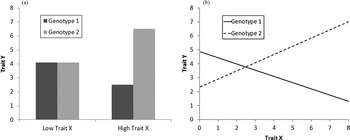
The most straightforward manner to consider a G × T interaction is in a test of the statistical interaction between a genetic variant and one psychological trait in the prediction of a second psychological trait, in other words, moderation of the effect of the gene on the second trait by variation in the first trait. This is depicted schematically in Figure 1. Figure 1a shows the situation in which a hypothetical genetic variation is associated with differing levels of hypothetical trait Y only in individuals who are high in hypothetical Trait X. If Traits X and Y are both continuous variables, these results can be framed slightly differently, as regressions (Figure 1b), allowing one to say that Trait X predicts Trait Y negatively in Genotype 1 but positively in Genotype 2. The latter form of depicting the G × T interaction is preferable to the former, when possible, because it depicts both trait variables as continuous, rather than dichotomizing the Trait X variable. Thus, more information about the same results is conveyed in Figure 1b than in 1a (especially if a scatterplot of individual data points is overlaid on such a graph). The results format in Figure 1a, however, is likely to be common in research on psychopathology, with the two levels of Trait X indicating presence or absence of a diagnosis. In this scenario, Figure 1a indicates that this genotype has an effect in the group diagnosed with psychopathology, but not in controls.
Two different graphs of the same hypothetical gene–trait interaction. Genotype (1 or 2) moderates the association of Trait X with Trait Y. (a) Trait X has been dichotomized, as in the presence or absence of a diagnosis. (b) The association of Trait X and Y is plotted as a separate regression line for each of the two genotypes.

G × T Interactions and Psychopathology
The concept of G × T interaction is likely to be of interest in research on psychopathology because various studies have already identified possible G × T interactions, usually without framing their findings in those terms. Whenever a genetic effect is found in a clinical group, but not a control group (or vice versa), this may indicate a G × T interaction, in which the interacting trait variable is the presence or absence of the diagnosis. For example, multiple studies have found that the serotonin transporter linked polymorphic region gene (5-HTTLPR) has different effects in groups diagnosed with psychopathology versus controls.
The 5-HTTLPR consists of a region of the gene that is either short or long. The short allele appears to be associated with decreased serotonergic function, possibly through developmental pathways (Neumeister et al., Reference Neumeister, Hu, Luckenbaugh, Schwarz, Nugent and Bonne2006). Despite the huge literature on the effects of this polymorphism, association of 5-HTTLPR with psychopathology and other traits remains an open question, as meta-analysis has thus far been inconclusive (Duncan & Keller, Reference Duncan and Keller2011). The tentative conclusion that can be reached based on this literature is that the short allele may be associated with diagnoses and traits associated with negative emotionality, especially in individuals who have experienced high levels of stress (Caspi, Hariri, Holmes, Uher, & Moffitt, Reference Caspi, Hariri, Holmes, Uher and Moffitt2010; Uher et al., Reference Uher, Caspi, Houts, Sugden, Williams and Poulton2011). This characterizes possible main effects of the polymorphism and gene–environment interactions. G × T interactions may be important as well, because the presence of the short allele may be particularly risky for individuals with traits that predispose them to certain types of psychopathology, as in the following examples.
Monteleone et al. (Reference Monteleone, Santonastaso, Mauri, Bellodi, Erzegovesi and Fuschino2006) found that the short allele was associated with increased negative emotionality (assessed with the Harm Avoidance Scale from the Temperament and Character Inventory) and nutritional impairment in individuals diagnosed with bulimia, but not in a control group. Genotype did not predict membership in the bulimic versus control group. Likewise, Marques, Hutz, and Bau (Reference Marques, Hutz and Bau2006) found that the short allele was associated with nicotine dependence in a group diagnosed with alcoholism, but not in a nonalcoholic control group. (The short allele was also associated with depression and drug abuse in the alcoholic group, but the latter findings merely suggest possible additional G × T interactions because these diagnoses were not assessed in the control group.) In this study, genotype did not predict diagnosis, although meta-analysis suggests that the short allele is at least weakly associated with risk for alcoholism (McHugh, Hoffman, Asnaani, Sawyer, & Otto, Reference McHugh, Hofmann, Asnaani, Sawyer and Otto2010).
Another example of G × T interaction based on diagnosis comes from research on the catechol-O-methyltransferase gene (COMT), which produces an enzyme that affects levels of dopamine in the prefrontal cortex (PFC) by breaking down dopamine in the synapse. In the PFC, it is the primary mechanism of dopamine clearance and, therefore, particularly influential (Tunbridge, Harrison, & Weinberger, Reference Tunbridge, Harrison and Weinberger2006). A commonly studied variation in COMT is a SNP, known as Val158Met, which results in the substitution of a methionine (Met) molecule for a valine (Val) molecule in the COMT enzyme. The Val allele is more efficient and, therefore, leads to reduced tonic levels of dopamine in the PFC. In two general population samples, Caspi et al. (Reference Caspi, Langley, Milne, Moffitt, O'Donovan and Owen2008) found that the Val allele was associated with higher levels of antisocial behavior in those with a diagnosis of attention-deficit/hyperactivity disorder (ADHD), but not in those without a diagnosis. This example and those for 5-HTTLPR illustrate the point that differences among brains in people with and without psychopathology are likely to have consequences for the effects of many specific genetic variations.
Traits identify meaningful variations in the population regardless of whether they are conceived as binary categories (like diagnoses) or as continua. In this framework, for example, sex can be considered a binary trait, and there are many examples of sexual dimorphism in the phenotypic consequences of genes. For example, sex appears to moderate the association of variation in COMT Val158Met with a variety of phenotypes (Biederman et al., Reference Biederman, Kim, Doyle, Mick, Fagerness and Smoller2008; Harrison & Tunbridge, Reference Harrison and Tunbridge2008), and these could be considered G × T interactions, with sex as the trait in the interaction term. Sex is clearly a broad and important characterization of the individual context in which any given gene is expressed, much like a diagnosis. The systematic differences between male and female brains mean that any single functional genetic difference is likely to have different consequences for behavior in each sex.
Binary Versus Continuous Models of Psychopathology
Diagnostic categories do not appear to be true binaries, in which a person either has a disorder or does not. Considerable evidence shows that most diagnostic categories are semiarbitrary dichotomizations of continuous dimensions (Eaton, Krueger, South, Simms, & Clark, Reference Eaton, Krueger, South, Simms and Clark2011; Krueger, Watson, & Barlow, Reference Krueger, Watson and Barlow2005; Markon, Chmielewski, & Miller, Reference Markon, Chmielewski and Miller2011). This perspective has become sufficiently mainstream that the next edition of the Diagnostic and Statistical Manual for Mental Disorders (DSM-5) will include a dimensional system for defining personality disorders (Axis II), rather than merely relying on a set of binary diagnoses (Krueger, Eaton et al., Reference Krueger, Eaton, Clark, Watson, Markon and Derringer2011; Krueger, Derringer, Markon, Watson, & Skodol, Reference Krueger, Derringer, Markon, Watson and Skodol2011). In addition, this perspective is likely to hold true for most, if not all, clinical disorders (Axis I) as well, although DSM-5 is unlikely to include a dimensional system for describing them (Krueger, Reference Krueger1999, Reference Krueger2005; Markon, Reference Markon2010). The binary perspective on diagnosis is convenient for clinicians, who must decide whether to treat or not. Disorders may be better conceived, however, in terms of symptom severity, rather than in terms of categorical presence or absence.
One major advantage to conceiving psychopathology dimensionally is that this can account for the extensive comorbidity that is evident in current diagnoses of mental disorders (Kessler, Chiu, Demler, Merikangas, & Walters, Reference Kessler, Chiu, Demler, Merikangas and Walters2005). Individuals with any one diagnosis are highly likely to qualify for additional diagnoses, either concurrently or over the life span. For example, nearly half of those diagnosed with depression will also meet the requirements for diagnosis of an anxiety disorder at some point (Moffitt et al., Reference Moffitt, Harrington, Caspi, Kim-Cohen, Goldberg and Gregory2007; Regier, Rae, Narrow, Kaelber, & Schatzberg, Reference Regier, Rae, Narrow, Kaelber and Schatzberg1998). Such patterns of comorbidity suggest the existence of underlying trait dimensions that influence risk for multiple disorders, even when those disorders have typically been conceived as distinct entities. Research into genetic factors behind psychiatric disorders reinforces this view; many disorders share substantial genetic factors, such as bipolar Type I and schizophrenia (International Schizophrenia Consortium et al., Reference Purcell, Wray, Stone, Visscher and O'Donovan2009) and depression and anxiety (Wolf et al., Reference Wolf, Miller, Krueger, Lyons, Tsuang and Koenen2010). These data suggest that the categories used in current diagnostic practice are not reflective of the underlying nature of psychopathology and that dimensional models may provide better tools for research on etiology and treatment.
Another advantage of modeling psychopathology dimensionally is that it allows for integration with models of normal personality. Many disorders may be described as extreme or dysfunctional variants of normal personality traits or as combinations of such traits (Krueger, Reference Krueger2005; Widiger, Reference Widiger2011). Factor analysis has demonstrated that personality disorder symptoms fall within the same five-dimensional space as normal personality traits (Markon, Krueger, & Watson, Reference Markon, Krueger and Watson2005), and the empirically derived, five-dimensional structure of personality disorder symptoms that will be utilized in the DSM-5 bears a striking resemblance to the Big Five dimensions of normal personality (Krueger, Eaton, et al., Reference Krueger, Eaton, Clark, Watson, Markon and Derringer2011). A similar, though somewhat less consistent, set of dimensions has emerged from factor analyses including clinical disorders and their symptoms (Markon, Reference Markon2010).
The convergence of normal and abnormal trait dimensions is particularly important to the study of the genetic and neurobiological basis of psychopathology because the brain is a single system of interacting elements. Mechanistic theories for all normal or pathological psychological traits should therefore be compatible with each other, so that they may ultimately be unified to achieve a thorough understanding of the causes of human behavior and individual differences (DeYoung, Reference DeYoung2010b; DeYoung, Grazioplene, & Peterson, Reference DeYoung, Grazioplene and Peterson2012). Given that all traits can potentially be explained mechanistically as the result of variation in the functional parameters of the brain (DeYoung, Reference DeYoung2010a), the conjunction of models of psychopathology symptoms with comprehensive models of normal personality traits suggests that both should be explicable in terms of the same set of biological parameters.
The past decade has seen an explosion of work on the dimensional structure of psychopathology, and the two best validated dimensions are most often labeled “internalizing” and “externalizing” (Krueger, Reference Krueger1999; Markon, Reference Markon2010; Wolf et al., Reference Wolf, Miller, Krueger, Lyons, Tsuang and Koenen2010). Internalizing represents risk for anxiety and mood disorders; externalizing represents risk for disorders of impulse control, including antisocial personality disorder, conduct disorder, drug and alcohol abuse, and ADHD. Internalizing and externalizing are both substantially influenced by genetic factors, and they account for much of the genetic influence on the more specific disorders and traits that are subsumed under them (Kendler, Prescott, Myers, & Neale, Reference Kendler, Prescott, Myers and Neale2003; Krueger et al., Reference Krueger, Hicks, Patrick, Carlson, Iacono and McGue2002; Wolf et al., Reference Wolf, Miller, Krueger, Lyons, Tsuang and Koenen2010). In addition to internalizing and externalizing, evidence exists for dimensions of thought disorder (psychoticism) and pathological introversion (detachment; Krueger, Derringer, et al., Reference Krueger, Derringer, Markon, Watson and Skodol2011; Markon, Reference Markon2010).
Regarding correspondence with normal personality traits, internalizing is difficult to distinguish statistically from the Big Five dimension known as “neuroticism,” which reflects negative emotionality and emotional dysregulation (Griffith et al., Reference Griffith, Zinbarg, Craske, Mineka, Rose and Waters2010). Externalizing in Big Five terms corresponds most closely to a blend of low “agreeableness” and low “conscientiousness,” reflecting the tendency toward both antagonism and impulsivity or disinhibition (Markon et al., Reference Markon, Krueger and Watson2005). Detachment or pathological introversion falls at the low pole of Big Five “extraversion,” and thought disorder or psychoticism is positively related to Big Five “openness to experience” (although, because the latter personality dimension also involves traits reflecting “intellect,” this relation is complicated; DeYoung et al., Reference DeYoung, Grazioplene and Peterson2012; Edmundson, Lynam, Miller, Gore, & Widiger, Reference Edmundson, Lynam, Miller, Gore and Widiger2011).
We recommend a dimensional approach using continuous trait measures for research on G × T interactions, not only because this approach appears to accord better with empirical data than the binary, categorical approach but also because dimensional measures of psychopathology have considerably better reliability and validity, leading to increased statistical power (Markon et al., Reference Markon, Chmielewski and Miller2011). Instruments designed to measure both normal and pathological traits can be included in research on G × T interactions, and comparison of results across these types of measures may aid in the development of integrated mechanistic models of the relation of both genes and brain function to psychological traits.
G × T Interactions Involving Continuous Traits
In the G × T Interactions and Psychopathology Section we presented several examples of apparent G × T interactions reported in binary (case-control) designs for studying psychopathology. Other G × T interactions have been reported utilizing continuous traits. One example is a study of a polymorphism associated with the dopamine receptor D2 gene, which found that negative emotionality in a sample of alcoholics was associated with severity of alcohol dependence and antisocial personality symptoms only in those carrying the TaqI A1 allele (Bau, Almeida, & Hutz, Reference Bau, Almeida and Hutz2000). This finding suggests the possibility that the A1 allele moderates the association of negative emotionality with various traits related to externalizing. Consistent with this hypothesis, another study found that negative emotionality was associated more strongly with novelty seeking in adolescent boys carrying the A1 allele than in those without it (Berman, Ozkaragoz, Young, & Noble, Reference Berman, Ozkaragoz, Young and Noble2002).
In another example of G × T interaction with continuous traits, two studies found that the 5-HTTLPR genotype interacted with neuroticism to predict nicotine use and difficulty quitting smoking (Hu et al., Reference Hu, Brody, Fisher, Gunzerath, Nelson and Sabol2000; Lerman et al., Reference Lerman, Caporaso, Audrain, Main, Cobb and Boyd2000). Neuroticism was positively correlated with nicotine use and difficulty quitting only in participants carrying the short allele. This kind of finding is important because it suggests the possibility of targeted interventions based on both genotype and personality. Two studies have demonstrated remarkable effectiveness for personality-targeted intervention in preventing drug and alcohol use by adolescents (Conrod, Castellanos-Ryan, & Strang, Reference Conrod, Castellanos-Ryan and Strang2010; Conrod, Stewart, Comeau, & Maclean, Reference Conrod, Stewart, Comeau and Maclean2006). Such interventions might be even more powerful if the genotype were targeted as well. Of course, personality is considerably easier to assess than genotype but, given the findings reviewed here, which suggest that some genotypes may be particularly risky in those with certain forms of psychopathology, interventions targeting a genotype might be worth the effort in some clinical populations.
DeYoung et al. (Reference DeYoung, Peterson, Séguin, Mejia, Pihl and Beitchman2006) reported a G × T interaction replicated in three samples. Based on what was known about the functional consequences of a polymorphism in DRD4, we hypothesized that the DRD4 variation might moderate the frequently replicated association between externalizing and cognitive dysfunction, which has been shown to be genetically based (Koenen, Caspi, Moffitt, Rijsdik, & Taylor, Reference Koenen, Caspi, Moffitt, Rijsdijk and Taylor2006; Kuntsi et al., Reference Kuntsi, Eley, Taylor, Hughes, Asherson and Caspi2004). DRD4 exhibits a polymorphism consisting of a variable number of tandem repeats in the third exon of the gene. A 48 base pair segment of genetic code repeats anywhere from 2 to 11 times, with the most common variants being the 4- and 7-repeat alleles. This region of the gene codes for a segment of the receptor involved in second-messenger signaling, following binding of dopamine to the receptor. The 7-repeat allele produces D4 receptors that have reduced signaling efficiency relative to other alleles, and is also associated with reduced gene expression (Asghari et al., Reference Asghari, Sanyal, Buchwaldt, Paterson, Jovanovic and Van Tol1995; Jovanovic et al., Reference Jovanovic, Guan and Van Tol1999; Schoots & Van Tol, Reference Schoots and Van Tol2003). Thus, the 7-repeat allele is likely to act as an endogenous D4 antagonist, reducing whatever functions are associated with the D4 receptor.
The D4 receptor is an inhibitory dopamine receptor localized primarily in the cortex, rather than in the subcortical regions where dopamine is involved in reward motivation and approach behavior (Lahti et al., Reference Lahti, Roberts, Cochrane, Primus, Gallager and Conley1998; Meador-Woodruff et al., Reference Meador-Woodruff, Damask, Wang, Haroutunian, Davis and Watson1996). This renders it an excellent candidate for involvement in the cognitive effects of dopamine. Dopamine levels in the PFC exhibit an inverted U-shaped function in relation to cognitive processes like working memory, with both too little and too much dopamine impairing cognition (Arnsten & Robbins, Reference Arnsten, Robbins, Stuss and Knight2002). Because drugs that block D4 receptors have been shown to relieve cognitive deficits in both human and nonhuman primates, D4 receptors may be part of the mechanism by which excess dopamine inhibits cognitive function. The 7-repeat allele therefore might attenuate cognitive dysfunction normally associated with traits, like externalizing, that appear to involve heightened levels of dopamine (Chambers, Taylor, & Potenza, Reference Chambers, Taylor and Potenza2003; Solanto, Reference Solanto1998).
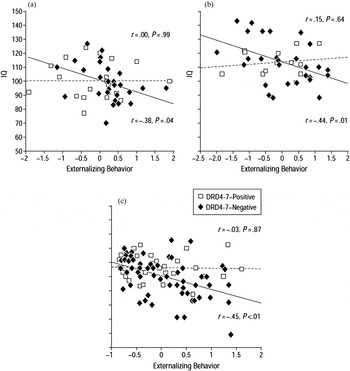
DeYoung et al. (Reference DeYoung, Peterson, Séguin, Mejia, Pihl and Beitchman2006) tested their hypothesis using IQ as a measure of cognitive function, because IQ is strongly related to working memory and the cognitive functions of the PFC (Conway, Kane, & Engle, Reference Conway, Kane and Engle2003; DeYoung, Shamosh, Green, Braver, & Gray, Reference DeYoung, Shamosh, Green, Braver and Gray2009). This study included both clinical and nonclinical samples, and both child and adult samples. Only males were tested because females have considerably lower rates of externalizing problems. In all three samples, externalizing was negatively associated with IQ only in males lacking the 7-repeat allele (Figure 2). Given that the three samples were small and, therefore, underpowered to detect interaction, the G × T interaction was tested meta-analytically across all three samples, rather than separately in each sample. The mean correlation (weighted by sample size) between externalizing and IQ for those not carrying the 7-repeat allele (N = 114) was r = −.43 (p < .001). For those carrying the 7-repeat allele (N = 63) the correlation was r = .02 (p = .45). Demonstrating interaction, these effect sizes differed significantly from each other (z = −2.99, p = .01). One limitation of this study was that all samples were recruited to have higher than normal levels of externalizing, so the generalizability of this G × T effect to other populations is uncertain. Nonetheless, cognitive deficits are of particular concern in populations with high levels of externalizing, and these results suggest that the effectiveness of cognitive interventions in such populations might differ by genotype.
Association between externalizing (standardized within each sample) and IQ in three male samples as a function of dopamine D4 receptor gene 7-repeat allele (DRD4-7) genotype. (a) A clinical sample of children referred for aggression (N = 48). (b) A sample diagnosed with attention-deficit/hyperactivity disorder in adulthood (N = 42). (c) A low economic status community child sample (N = 87). Adapted from “The Dopamine D4 Receptor Gene and Moderation of the Association Between Externalizing Behavior and IQ,” by C. G. DeYoung, J. B. Peterson, J. R. Séguin, J. M. Mejia, R. O. Pihl, J. H. Beitchman, et al., 2006, Archives of General Psychiatry, 63, 1410–1416. Copyright 2006 by the American Medical Association. Adapted with permission.

In addition to practical applications, G × T effects like these are important for basic science. One cannot adequately understand the phenotypic effects of DRD4 without understanding how it interacts with other characteristics of the individual. The 7-repeat allele is a risk factor for ADHD and other externalizing problems (Faraone et al., Reference Faraone, Perlis, Doyle, Smoller, Goralnick and Holmgren2005); yet, in populations with high externalizing, it appears to be protective against cognitive deficits (DeYoung et al., Reference DeYoung, Peterson, Séguin, Mejia, Pihl and Beitchman2006; Gornick et al., Reference Gornick, Addington, Shaw, Bobb, Sharp and Greenstein2007; Swanson et al., Reference Swanson, Oosterlaan, Murias, Schuck, Flodman and Spence2000).
G × T Interactions and Brain Function
Thus far, the examples of G × T interactions we have described have involved phenotypic traits as outcome variables. Of particular interest, however, are G × T interaction effects on neurobiological phenotypes. One advantage of studying the effects of genes on neurobiological phenotypes (sometimes called “intermediate phenotypes” or “endophenotypes”) is that they are more proximal to the product of the gene and hence to its causal effects, which may increase effect sizes (Green et al., Reference Green, Munafo, DeYoung, Fossella, Fan and Gray2008). Meta-analyses have shown, for example, that 5-HTTLPR variation has a larger direct effect on amygdala activation (d = 0.63) than it does on neuroticism (d = 0.18; Munafo, Brown, & Hariri, Reference Munafo, Brown and Hariri2008; Munafo et al., Reference Munafo, Freimer, Ng, Ophoff, Veijola and Miettunen2009). Likewise, meta-analyses have shown that the effect of COMT variation on neural activity during cognitive tasks (d = 0.73) is stronger than its effects on cognitive performance assessed behaviorally, for which the d value ranges from 0.02 to 0.20, depending on task (Barnett, Scoriels, & Munafo, Reference Barnett, Scoriels and Munafo2008; Mier, Kirsch, & Meyer-Lindenberg, Reference Mier, Kirsch and Meyer-Lindenberg2010).
Nonetheless, genetic effects on neural activity in functional magnetic resonance imaging (fMRI) are often heterogeneous, which can lead to seemingly conflicting results. For example, although the effect of COMT Val158Met variation on brain activity during cognitive tasks has been studied extensively, the nature of this effect remains somewhat uncertain. A number of studies have reported negative correlations between the number of Met alleles and neural activity in brain regions involved in cognitive control, suggesting that Met is associated with greater neural efficiency (Mier et al., Reference Mier, Kirsch and Meyer-Lindenberg2010). This would be consistent with evidence that individuals homozygous for Met may have levels of dopamine in the PFC that place them near the top of the inverted U-shaped curve for cognitive function (Meyer-Lindenberg et al., Reference Meyer-Lindenberg, Nichols, Callicott, Ding, Kolachana and Buckholtz2006). Other studies, however, have reported positive correlations between Met and neural activation. This may be partly due to whether the tasks used involved emotional information, because the Met allele seems to be associated with higher sensitivity to emotional information and higher neural activation specifically during emotional tasks (Mier et al., Reference Mier, Kirsch and Meyer-Lindenberg2010).
However, the inconsistency appears to be partially because COMT variation does not have the same effect on all brain regions. In a large sample by the standards of neuroimaging (N = 160), Green, Kraemer, DeYoung, Fossella, and Gray (Reference Green, Kraemer, DeYoung, Fossella and Gray2012) found that the Met allele predicted neural activity negatively in two regions of the PFC, but predicted activity positively in two others (all regions were identified anatomically a priori, based on previous studies of the cognitive control task used). The indirect effects of the Met allele on task performance for all four regions were positive, such that Met allele carriers had improved cognitive performance due to both activations and deactivations of specific regions of the PFC. This highlights that neural efficiency (indicated by reduced activity) may predict better performance in some cases, but greater recruitment of cognitive capacity (indicated by increased activity) may predict better performance in others (DeYoung et al., Reference DeYoung, Shamosh, Green, Braver and Gray2009; Neubauer & Fink, Reference Neubauer and Fink2009).
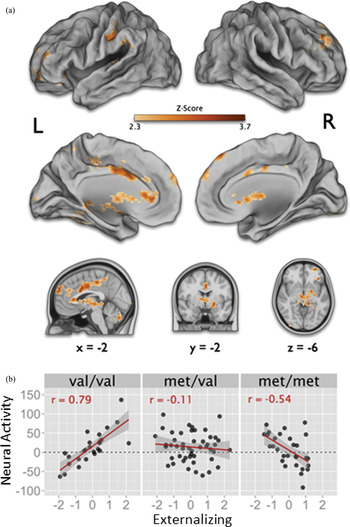
Evidently, many factors contribute to a lack of simplicity in the effects of genes on neural activity. G × T interactions constitute another such factor. In the only study we know of that has explicitly addressed the question of G × T interaction in fMRI, Shehzad, DeYoung, Kang, Grigorenko, and Gray (Reference Shehzad, DeYoung, Kang, Grigorenko and Gray2012) found that COMT variation strongly moderated the association of externalizing with neural activity during a cognitive control task. The sample consisted of 104 healthy males between 20 and 40 years old. The task was a Stroop analog known as the multisource interference task, in which participants must overcome a prepotent incorrect response during interference trials but not control trials. The multisource interference task reliably activates a network of brain regions known to be involved in cognitive control (Bush & Shin, Reference Bush and Shin2006). As shown in Figure 3a, the G × T interaction of Val158Met genotype with externalizing was significant in many regions throughout this network, after correcting for multiple tests. Across all of these regions, the Val/Val group showed a very strong positive correlation between externalizing and neural activation in interference relative to control trials, whereas the Met/Met group showed a very strong negative correlation (Figure 3b). The Val/Met group was intermediate, showing almost no correlation. (Follow-up analyses demonstrated that this pattern held at a variety of specific regions in Figure 3a, albeit with some differences in magnitude, such that collapsing across the significant regions, as in Figure 3b, did not obscure qualitative regional variation in the effect.)
Interaction of catechol-O-methyltransferase gene (COMT) Val158Met genotype and Externalizing predicts neural activity during a cognitive control task. (a) Brain regions exhibiting a significant interaction in whole-brain analysis, corrected for multiple testing to p < .05, based on cluster size. (b) The association between externalizing and neural activity in regions shown in (a) as a function of genotype. Neural activity is measured as the contrast between interference trials and control trials. Adapted from “Interaction of COMT Val158Met and Externalizing Behavior: Relation to Prefrontal Brain Activity and Behavioral Performance,” by Z. Shehzad, C. G. DeYoung, Y. Kang, E. L. Grigorenko, and J. R. Gray, 2012. NeuroImage, 60, 2158–2168. Copyright 2012 by Elsevier. Adapted with permission.

These results provide a dramatic illustration of the importance of G × T interactions for understanding the neural effects of genetic variation. A large body of literature has been devoted to understanding the effects of COMT variation on brain function, yet, this study suggests that the effect of Val158Met genotype on neural activity in a single task depends greatly on the personality of the person carrying the gene. In individuals with high levels of externalizing, the Met allele was associated with reduced brain activity in a cognitive control task in many regions of the brain. This pattern is consistent with the currently dominant neural-efficiency account of the effect of Met on brain function (Mier et al., Reference Mier, Kirsch and Meyer-Lindenberg2010). In individuals with low levels of externalizing, however, precisely the opposite was true: the Met allele was associated with increased brain activity in many of the same regions! This finding needs to be replicated; but if it proves reliable, it will demand that we rethink any simple account of the effects of COMT variation on brain function. Neural effects of COMT variation will not be comprehensible unless we take other individual differences into account.
Other fMRI studies have reported possible G × T interactions influencing functional connectivity, rather than neural activity. In functional connectivity analysis, the variable of interest is the degree to which neural activity in one brain region is correlated (i.e., functionally connected) with neural activity in another region. Functional connectivity has proven to be a compelling concept for understanding a variety of psychological phenomena, given the importance of interactions between different parts of the brain in the control of behavior. For example, functional connectivity between the amygdala and the anterior cingulate cortex (which may represent the ability of cognitive control systems to constrain negative emotion) is negatively correlated with both negative emotionality and with the short allele of 5-HTTLPR (Pezawas et al., Reference Pezawas, Meyer-Lindenberg, Drabant, Verchinski, Munoz and Kolachana2005). This example describes functional connectivity as a potential mediator of the effect of genotype on trait (i.e., a variable through which there is an indirect effect of genotype on trait) and therefore is not an example of G × T.
The following two functional connectivity examples suggest moderation (G × T) instead of mediation, yet they also highlight the importance both of testing the interaction formally and of using the most powerful statistical test available. Blasi et al. (Reference Blasi, Lo Bianco, Taurisano, Gelao, Romano and Fazio2009) found that negative emotionality was negatively correlated with functional connectivity between the medial PFC and the amygdala and the dorsolateral PFC for one dopamine D2 receptor genotype but not another. However, these results appeared in a very small sample (only 12 participants in each genotype), and the interaction was not formally tested. Although the correlation in one genotype was quite large whereas in the other it was near zero, a formal test must be made in order to demonstrate interaction confidently. This is true not just with genotype but also with binary variables like sex or diagnoses of psychopathology. Merely to observe a significant effect in one group but not the other is insufficient to claim interaction.
Drabant et al. (Reference Drabant, Hariri, Meyer-Lindenberg, Munoz, Mattay and Kolachana2006) found that novelty seeking was correlated more than twice as strongly with functional connectivity between the amygdala and the orbitofrontal cortex in participants homozygous for the COMT Met allele than for those homozygous for the Val allele. They were not able to claim moderation, however, because a post hoc test comparing the strength of the two correlations was not significant. Rather than test for a difference in the magnitude of correlations, the authors should have fit a general linear model including novelty seeking, COMT genotype, and their interaction as predictors of functional connectivity. This test would have had more statistical power than the comparison of correlations and would also have allowed them to increase its power by including the heterozygous genotype in the analysis as well. Ideally, all available data should be used and the interaction terms should be modeled. Testing a model containing an interaction term typically yields more power than a post hoc comparison of effect sizes. When possible, the former method should be used in any investigation of G × T interaction.
Future Directions for Research on G × T Interactions
We hope that the examples of G × T interaction described in this article offer at least a proof of concept that G × T is likely to be an important source of difficulty in identifying main effects of specific genetic variants. Replication is particularly crucial in genetic studies because effects tend to be small, and none of the reported G × T effects we described have been replicated enough to know whether they are reliable. Nonetheless, progress is needed in the search for specific genetic effects, and G × T should not be ignored as an avenue for research. The effect of a given genetic variant depends not just on the presence of other specific genetic variants or on environmental influences on gene expression, but also, and more specifically, on the configuration of the brain in which that gene is expressed. That configuration is shaped by the cumulative effects of genes and the environment, and it can be grossly described by measurements of broad psychological traits. The essence of the concept of G × T interaction is that the effects of the genotype at a single genetic locus are likely to vary depending on differences in psychological traits.
Of course, if the goal is a mechanistic explanation of behavior, then trait measurements are, in one sense, merely a stand-in for a complex set of neurobiological parameters. The association of some trait with any criterion variable indicates that the biological causes of that trait are associated with that criterion. Hence, the discovery of a G × T interaction begs for additional research. Given that individual differences in any given trait dimension must logically be the outcome of variations in the parameters of the brain, the discovery of a G × T interaction should lead to attempts to identify the specific parameters that are relevant to that particular G × T interaction. Some of the parameters that produce the trait must interact in the brain with whatever system is influenced by the gene in question. Understanding these interactions requires consideration of what is known about the biological basis of the trait in question.
Most of the G × T effects described above were interactions with traits classifiable as either internalizing or externalizing, which are crucial for understanding psychopathology. Although our knowledge is far from complete, a great deal of evidence exists to suggest biological parameters that help to determine internalizing and externalizing traits. For example, both are likely to be associated with diminished serotonergic function (Chambers et al., Reference Chambers, Taylor and Potenza2003; Neumeister et al., Reference Neumeister, Hu, Luckenbaugh, Schwarz, Nugent and Bonne2006; Pezawas et al., Reference Pezawas, Meyer-Lindenberg, Drabant, Verchinski, Munoz and Kolachana2005; Zuckerman, Reference Zuckerman2005). In contrast, they are likely to be distinct in their association with dopaminergic function in subcortical regions, with internalizing likely to be associated with reduced dopaminergic function and externalizing with increased dopaminergic function (Chambers et al., Reference Chambers, Taylor and Potenza2003; Zuckerman, Reference Zuckerman2005). Although these examples refer to neurotransmitter systems, which are certainly important for understanding individual differences, many other aspects of brain structure and function are relevant as well. Every broad trait is the product of multiple biological mechanisms, and research has begun to compile neurobiological associations with virtually every well-established trait (DeYoung, Reference DeYoung2010a; DeYoung & Gray, Reference DeYoung, Gray, Corr and Matthews2009; Zuckerman, Reference Zuckerman2005). The situation of a researcher attempting to investigate the biological mechanisms responsible for a G × T interaction is complicated but not intractable.
Another factor that complicates the understanding of G × T interactions, and any other genetic effect for that matter, is that genes interact with their biological context as they shape development and as their expression shapes ongoing brain function at any given time. The presence of a G × T interaction does not indicate which of these processes is responsible for the effect (presumably both will typically be in play to some degree). Nonetheless, knowledge of the mechanisms associated with specific functional polymorphisms may allow us to deduce whether developmental or proximal processes are likely to be more important. For example, some evidence suggests that the 5-HTTLPR exerts much of its influence through developmental mechanisms (Jedema et al., Reference Jedema, Gianaros, Greer, Kerr, Liu and Higley2010; Neumeister et al., Reference Neumeister, Hu, Luckenbaugh, Schwarz, Nugent and Bonne2006). The short allele produces fewer serotonin transporters, and therefore one might intuitively expect it to act like an endogenous serotonin reuptake inhibitor, leading to greater serotonin function. The short allele, however, is often associated with phenotypes that seem to indicate lower serotonergic function, and the presence of short versus long alleles has been found in neuroimaging to have no association with the parameters of the serotonergic system, such as the density of serotonin transporters and receptors (Jedema et al., Reference Jedema, Gianaros, Greer, Kerr, Liu and Higley2010). Instead, the short allele may have its effect on the development of structures throughout the brain, which is a likely explanation because of serotonin's crucial role in guiding neural development. In contrast, the Met allele of the COMT Val158Met polymorphism may owe most of its effects to its influence on ongoing dopaminergic function. The reduced efficiency of the enzyme produced by the Met allele appears to lead to higher levels of dopamine in the synapse, especially in the PFC, and hence to increased dopaminergic function (Meyer-Lindenberg et al., Reference Meyer-Lindenberg, Nichols, Callicott, Ding, Kolachana and Buckholtz2006). We hope that the difficulty of understanding the neural effects of genetic variation will encourage rather than discourage research. The more we know about the specific effects of any genetic variant, the better we will be able to understand its interactions with other variables.
To complement the biological caveats just discussed, we close with some methodological caveats for G × T research. First, studies attempting to identify G × T interactions (as well as studies of epistasis and gene–environment interactions) benefit from large samples because larger sample sizes are necessary to achieve adequate power to detect interactions, compared to main effects. Lack of adequate power has two unfortunate consequences. First, it leads to Type II error: one may identify a real effect but not have statistical power to detect it as significant. Less well known, and therefore perhaps more pernicious, is that inadequate power also leads to a higher rate of Type I error relative to accurate identification of real effects (Green et al., Reference Green, Munafo, DeYoung, Fossella, Fan and Gray2008). In other words, the use of small samples is likely to produce spurious results, results that are false despite being statistically significant.
Second, the decision to investigate interactions creates abundant “researcher degrees of freedom” (Simmons, Nelson, & Simonsohn, Reference Simmons, Nelson and Simonsohn2011). Many more statistical tests are available for exploration when one considers interaction effects, as opposed to main effects only. Extensive exploration of data can easily lead to spurious results, if one does not correct for multiple testing, tallying not only those tests one decides to report but also all those made in exploration. Whenever possible, therefore, exploratory analyses should be distinguished from tests of a priori hypotheses. Hypotheses regarding G × T interaction should be specified in advance, based on previous research, on knowledge about the functional effects of specific genes, and on knowledge of the biological substrates of specific traits. We recognize that exploratory analysis cannot be forbidden, and if a G × T interaction is found in exploratory analyses, replication in independent data is of paramount importance. Of course, replication is important for any G × T finding, even when beginning with a sound hypothesis.
Despite the difficulty of doing G × T research well, we believe that it has great promise in the quest to understand how specific genetic variants interact with the organism as a whole to produce phenotypic consequences. Trait constructs are unique in their ability to capture individual differences in broad patterns of psychological functioning that depend on many interacting brain systems and are the cumulative product of both genetic and environmental influences. This is true regardless of whether traits are measured using clinical symptoms, personality questionnaires, or cognitive tests. We would wager that the examples of G × T interaction we have reviewed in this article are merely the tip of the iceberg and that many more will be discovered, once researchers begin looking for them. Characterizing the ways that genetic variants interact with traits will help us to describe how each gene functions in its natural habitat, the complex set of neurobiological parameters that give each human brain its individuality.