Introduction
The existence of integrated communities within the UK has generally been considered to be a ‘public good’ and has been a policy goal of all levels of Government over much of the last half century. However, what this means is contested, ranging from various forms of assimilation and acculturation to the multiculturalism inherent in much race-relations policy. While politicians have often exhibited contradictory impulses regarding integration, the academic debate too has been shrouded in controversy (Spencer, Reference Spencer2011). Such debate has also been complicated by the devolved settlement in the UK, which provides a set of policy areas that are the responsibility of the Scottish Government, while others come under the remit of the UK Government and for some there is a degree of fluidity between the two. This can mean that there are areas of policy that appear to be UK Government competencies but that, in reality, are shared between different levels of government, and these governments can have opposing policy positions (Bowes et al., Reference Bowes, Ferguson and Sim2009; Scholten, Reference Scholten2013). Nevertheless, with very few exceptions, integration under whatever guise is viewed as a good thing.
Migration policy has been even more complex and controversial, encompassing broad economic policy, and all classic areas of social policy, such as health, education, housing and welfare, as well as human rights. This paper seeks to link refugee policy, specifically asylum policy, to immigrant policy in the form of integration, and does so within a multi-level system of Government. The question the paper seeks to address is: is it possible to have a successful refugee integration policy with the present immigration policy? The paper looks specifically at refugees in Scotland as a means of doing so, alongside some suggestions about the relevance of the multi-level context in which it takes place.
In multi-levelled forms of Government, whether federal or not, there can be policy tensions between levels of Government that can lead to divergence (Cairney, Reference Cairney2012) or decoupling (Scholten, Reference Scholten2013). There is evidence within a fairly narrow range of policy issues that divergence between Westminster and Holyrood has occurred. There has also been some contestation between Holyrood and Westminster on migration issues. The initiative of the Scottish Executive (as it then was), entitled Fresh Talent, was aimed at allowing overseas students graduating from Scottish universities to stay and work in Scotland. However, the Home Office was reluctant to make concessions based on Scotland's differing demographic needs and this led to a conflict of powers between the levels of government (Birrell, Reference Birrell2009). Perhaps of more relevance were the blurred boundaries between asylum policy, which is a reserved power and so a UK Government responsibility, and devolved responsibility for child welfare that played out in a dispute over the forced detention of asylum-seeking children, or children of asylum seekers, and prompted Scotland's Children's Commissioner to state that ‘immigration may well be a reserved issue, but children aren’t’ (Mooney and Williams 2006). More generally, there have been regular complaints within the Scottish Parliament that the concordat between the UK and Scottish Governments has not led to the Home Office being open to engagement with Members of the Scottish Parliament (MSP) over constituency issues. That is, MSPs are approached about status or visa issues by constituents who are migrants, but when trying to contact the Home Office the MSPs are told that the Home Office will not speak to them about reserved policy matters. This article lends some support to arguments about diverging policy, but does so without specifically comparing policy in the different jurisdictions. It is enough to highlight some of the differences in policy architecture. Linked to divergence is decoupling which has, thus far, been primarily viewed as an organisational rather than a policy matter, whereby policy and practice within an organisation are seen to diverge. However, if Pierson is correct that policies should be viewed as institutions (Pierson, Reference Pierson, Shapiro, Skowronek and Galvin2006), then policy decoupling opens up a different way of viewing contestation in relation to multi-level politics. Divergence can emerge between levels of Government but can also be seen in some of the consequences of one policy area on another, both within and between governments as well as between devolved and reserved policy.
UK policy regarding refugee integration has had conflicting rationales. Under the previous Labour Government only refugee integration in the form of the Strategic Upgrade of National Refugee Integration (Sunrise) and Refugee Integration and Employment Service (RIES) received formal government support (Spencer, Reference Spencer2011: 215). Thus the particularity of refugees was recognised, and both Sunrise and RIES provided support in relation to employment and housing ‒ support removed by the Coalition Government. However, a myriad of policies, which operated against these integration programmes impacted on the ability of refugees to ‘integrate’. For example only providing refugees with five-years of protected status put temporal limits on refugees’ guaranteed time in the UK, and thus inhibited their ability to make plans for the future (Stewart and Mulvey, Reference Stewart and Mulvey2013). Furthermore, the overall negative policy direction in relation to asylum had significant longer term effects with regard to refugee integration. The effects of immigration policy are linked to integration.
It is within this broad political context that this paper is situated, with a specific focus on refugee integration in Scotland. Knowledge of refugees’ integration in Scotland is sparse, although the Scottish sample of the Survey of New Refugees gives some insight into employment, housing and language issues. This paper provides empirical data about the lives of refugees in Scotland, and relates them to central Government policy. The paper focuses on the interaction of policy and its impacts in just a few key areas, i.e. those of housing, employment and health, which have been selected as areas most indicative of the policy‒ impacts nexus. It argues that, despite support for refugee integration through a variety of Government schemes, other aspects of Government policy actively inhibit that integration.
Methods
This paper is based on data from a mixed methods study of refugees in Scotland conducted between 2009 and 2013. The main survey was conducted between October 2010 and May 2011, and elicited 262 responses with forty follow-up interviews in spring/summer 2011. This was followed by a re-issuing of the survey questionnaire between November 2011 and February 2012 followed by further thematic interviews. The quantitative data reported here come from the larger response numbers to the first questionnaire as there was considerable atrophy in participant numbers, i.e., only fifty-four follow-up responses. The qualitative data come from both initial and follow-up interviews conducted in 2011 and 2012. All interviewees were given a code, e.g., E606, and are referred to in this article by that code.
The sample is 62 per cent refugee and 31 per cent asylum seeker, with the remainder a mixture of British citizens and people who were unsure of their status. Most of the demographics broadly reflect what is known of the refugee population in Scotland, although there is an over-representation of women at 54 per cent of the overall sample. Refugees tend to be young, 76 per cent of participants were forty years of age or younger, coming predominantly from countries with a history of producing refugee movements. The largest national groups were from China, Iran, Iraq, Eritrea and the Democratic Republic of Congo. The year of arrival of participants was spread fairly evenly with around half arriving between 2007 and 2011 and rest arriving before 2007.
There are a couple of significant limitations to the data presented here. The first of these concerns language. Although questionnaires were translated into all of the appropriate languages, the fact that written questionnaires were the starting point of the study meant that refugees who were not literate in their first language were not included. The project also relied on colleges, and community and voluntary organisations to distribute surveys. Individuals not involved or known to any of these groups have not been part of this study. While these are serious limitations, it is unlikely that ‘complete’ data would change the main themes of the paper. The data presented here concern those with some community support, those who have higher literacy levels and those who are more engaged in the city they live in. This might suggest that the reality for those not involved in the research would show similar but worse outcomes than those reported here and therefore does not contradict the general theme of negative policy impacts.
What is known about integration?
It is neither the intention of this article to uncritically accept the concept of integration nor, within its scope, to fully engage in debates about its utility. As a piece focussing on policy and its effects, it is to some degree framed by that policy. Both the UK Government and the Scottish Government use the term integration, although there appears to be significant differences in relation to how it is viewed by these Governments. Integration as a concept has also been prominent at the EU level from the time of the Tampere Programme (a series of EU meetings) in 1999 onwards. Nevertheless, a few words of caution are required. First of all, much of the UK Government's focus on ‘Britishness’ and its relationship to migration and integration is based around the notion of making migrants less different from the dominant culture (Kostakopoulou, Reference Kostakopoulou2010; Threadgold and Court, Reference Threadgold and Court2005). There is a sense that integration can sometimes therefore mean assimilation. Secondly, integration can be subject to considerable conceptual stretching. It is used to describe a wide variety of processes and is used variously as both a means and an end, highlighting processes and outcomes which may or may not be explicitly linked.
Another important criticism of the concept of integration is that it can individualise the structural. The implication is that non-integration, however that is measured, is due to individual action or inaction rather than due to structural matters. This also means that policy that seeks to integrate can often individualise a collective problem by, for example, focusing on an individual's employability rather than structural labour-market barriers. Linked to this, as Miles forcefully argues, the concept of integration can have an ideological foundation, assuming wrongly that migrants have not been an important part of creating the very institutions that they are being told they must now integrate into (Miles, Reference Miles1993). This critique is perhaps less salient when the focus is on new arrivals.
Much international work on integration posits the existence of ‘national models’ (Favell, Reference Favell and Joppke1998; Joppke, Reference Joppke1999), although the differences between models should not be over-stated (Favell, Reference Favell and Joppke1998; Joppke, Reference Joppke2007). However, as Penninx et al. (Reference Penninx, Kraal, Martiniello and Vertovec2004) suggest, immigration within countries is also worth analysis. Zincone and Caponio (Reference Zincone, Caponio, Penninx, Berger and Kraal2006), for example, have looked, in the case of Italy, at both how policy is made and at what levels of Government, with the non-national dimension focusing primarily on a policy network approach. Scholten has compared approaches to integration among different municipal authorities as well as with the national position in the Netherlands, though his work looked at interactions between levels of Government rather than any impact upon migrants (Scholten, Reference Scholten2013).
There has also been research into the impact, direct or otherwise, of policy on migration generally, and refugees particularly, in Britain. Phillimore suggests that ‘while integration has been the focus of some conceptually based discussion in social science literature, little attention has been given to the ways in which social and public policy can facilitate, or militate against, integration’ (Phillimore, Reference Phillimore2011: 577). How these factors play out in the lived experiences of migrants and refugees has been subject to little empirical enquiry, and knowledge of refugee integration, particularly in Scotland, has been somewhat patchy. There has also tended to be something of both a quantitative and an economic bias to research thus far (see Sim, Reference Sim2009; Smyth and Kum, Reference Smyth and Kum2010; Stewart, Reference Stewart2007 for qualitative work on refugees in Scotland).
For Bloch, employment remains one of the key elements of successful settlement, allowing economic independence, which is known to have mental health effects, aiding language learning and creating contacts or bridges with the host society (Bloch, Reference Bloch2000: 86). However, Threadgold and Court point out that refugee unemployment is high; 70 per cent in one study in the UK in 2002 (Threadgold and Court, Reference Threadgold and Court2005: 56). Research suggests that employment problems are partly due to a ‘tendency to place emphasis on human capital rather than the structural, physical and psycho-social factors’ (Ibid.: 25), including inequalities and discrimination related to race and immigration status, low levels of English language proficiency and non-recognition of professional qualifications and employment experience acquired outside the UK (Bloch, Reference Bloch2007: 557).
Housing was prioritised as the most important ‘domain’ of integration by refugees in the work of Phillimore and Goodson who point to the particularity of refugeeness regarding housing issues. ‘For those seeking refuge, it could be argued that the importance of finding a home is particularly symbolic as it marks the end of a journey and the point at which refugees can start to consider their wider needs’ (Phillimore and Goodson, Reference Phillimore and Goodson2008: 316). Education is also highlighted in Phillimore and Goodson's research. They found education to be the third most important factor among refugees, just behind housing and employment. ‘However, if the importance of learning English is included, then education becomes the most important factor to aid settlement’ (Phillimore and Goodson, Reference Phillimore and Goodson2008: 317). With regard to language, Cebulla et al. also find a link between English language acquisition and the likelihood of being in employment (Cebulla et al., Reference Cebulla, Daniel and Zuruman2010: 2).
For this paper, integration is used as a broad concept that reflects Ager and Strang's (Reference Ager and Strang2004) ‘Indicators of Integration’ framework, meaning there are multiple overlapping factors that cumulatively either facilitate or hamper integration. These include employment (access, type, security and match to skill levels), housing (conditions, area and future options), education (in country of origin and here, including access to language learning where necessary), health (pre-existing conditions, access and experiences) social connections, cultural knowledge and the importance of rights and citizenship. Ager and Strang point to the importance of rights and citizenship to integration processes (Ager and Strang, Reference Ager and Strang2008). Indeed, for them it is the foundation on which integration can be built. While not having citizenship can inhibit inclusion in, for example, the labour market, Bloch also points out that ‘anything less than full citizenship will impede settlement because members of the host society do not see the migrant as part of that society’ (Bloch, Reference Bloch2000: 78). Thus the perceptions of the general population have an impact on integration processes, as well as practical issues concerning the absence of rights. It is beyond the scope of this paper to examine all of these factors. The choice of issues should not be taken to imply that they are to be prioritised over other issues, it simply reflects both restrictions in space and that some of the elements of integration have, perhaps, clearer policy dimensions.
The policy context
For many scholars there has been ideological continuity in terms of the relationship between immigration control and integration among policy makers since at least the 1960s (see for example Hansen, Reference Hansen2000; Joppke, Reference Joppke1999; Solomos, Reference Solomos2003). Race relations policies were the internal policy practice, while strict controls on numbers formed the external plank of this dual approach ‒ although government's ability to control numbers is not as easy as is assumed, as the Coalition Government in power since 2010 has found. The large increases in the number of labour migrants since the 1990s question some of the historic external part of the dual approach for wanted labour migrants, although it has broadly held regarding unwanted refugees, with protection being predicated on strict control of numbers alongside the practice of making life in the asylum process less comfortable. The aim of the asylum process has been to discourage migrants whose presumed motivation is the ‘pull’ of ease of life in Britain, based on the idea that, for those ‘genuinely’ fleeing persecution, hardships are tolerable (see Jack Straw, Hansard, 27 July 1998, Col. 46).
However, numbers of applications for asylum fluctuate according to events around the world and individuals’ ability to get to the UK. Applications in the UK reached a peak of 84,130 in 2002 before falling to 21,785 in 2012. This does not suggest that need reduced, just that policy and practice had made it increasingly difficult to get to the UK in order to apply for asylum. Refugees’ countries of origin reflect international conflict, and, in 2012, the top three countries that asylum applicants in the UK came from were Iran, Pakistan and Sri Lanka.
In 1999, the UK Government introduced a new practice of dispersing asylum seekers around the country in order to reduce pressure on the south-east of England where most asylum seekers arrived. Glasgow City Council became not just the only Scottish local authority to take part in dispersal, it was also the single largest local authority in the UK to take part in terms of the numbers of asylum seekers. This meant that, from 2000, approximately 10 per cent of the UK's total asylum application numbers were dispersed to Glasgow, totalling an estimated 20,000 (Shisheva et al., Reference Shisheva, Christie and Mulvey2013). In 2012, the three countries, from which the majority of the 1,029 asylum seekers in Scotland came, were Eritrea, Iran and China.
For those who manage to arrive and are recognised as refugees, policies aimed at integration have tended to be focussed on specific areas, forms or domains of integration. Support in the form of actual policy has perhaps been most prevalent in areas of structural integration through educational programmes, including English language provision and employment support.
However, refugee integration should be conceptualised as a transversal or polycentric policy area, covering, at the very least, immigration, employment, housing, health, education, community planning, naturalisation and citizenship, policing, national security and foreign policy, and operating across multiple layers of government. Thus far, however, unlike some other transversal policies such as social inclusion/exclusion, it has seldom been treated as such. Like integration, ‘social exclusion is a complex and multi-dimensional process’ (Levitas et al., Reference Levitas, Pantazis, Fahmy, Gordon, Lloyd and Patsios2007: 9), encompassing health, employment and employability, housing, education and many others. However, the government's solution to exclusion has been an individualised movement from the periphery to the centre rather than structural change. This individualisation of a collective issue means there can be a gap between the problems that exist, and what policy seeks to alleviate. Assumed policy problems of lack of inclusion or indeed integration, are related by policy and practice to individual capital (see Dorey, Reference Dorey2010 on blaming the poor for their own poverty).
Nevertheless, under New Labour there was some focus on refugee integration. Full and Equal Citizens, published in 2000 (Home Office, 2000) was the government's first refugee integration strategy. For Spencer, one impetus was the desire to have some counterweight to the negative and restrictive asylum measures being simultaneously undertaken (Spencer, Reference Spencer2011: 216). The stated aim was to help refugees access jobs, benefits, accommodation, health, education and language classes, as well as encouraging community participation. This contributed to the Department of Work and Pensions publishing Working to Rebuild Lives, in 2003, which highlighted the transversal nature of refugee integration and focussed on support in accessing the labour market. In 2005, Full and Equal Citizens was superseded by Integration Matters (Home Office, 2005). This provided some monitoring of integration and, for the first time, included funded refugee-integration programmes.
The Sunrise programme began in 2005 to provide individual casework support to newly recognised refugees in relation to housing, employment, benefits and financial advice, access to English language tuition and information on the process of family reunion (Stewart, Reference Stewart2009: 7). Support was intensive and lasted twenty-eight days. Sunrise was replaced by the Refugee Integration and Employment Service (RIES) in 2008 with a narrower but longer-term focus. RIES maintained the caseworker approach but was more limited in that it only provided support in employment and education, and was offered to all newly recognised refugees for a year. Both of these programmes were contracted out to third-sector organisations. As Spencer points out, the level of support provided in each of these programmes was never enough to address the disproportionate disadvantage facing refugees (Spencer, Reference Spencer2011: 216). Indeed the funding for refugee integration accounted for less than 1 per cent of the overall spend on asylum and refugees, ‘managing migration but not managing settlement’ (McGhee, Reference Somerville2006: 124). In addition, UK governments have explicitly stated that integration should only begin after an individual is recognised as a refugee. Thus those in the process, some for a long time, were not subject to any integration measures.
Anti-integration measures, or at least measures which had discernible negative impacts on integration, were numerous under the previous and present government. To name just one, in 2002 the Labour government removed the right to work, or the employment concession as it was called, on the false premise that it acted as a ‘pull’ for labour migrants to claim asylum (see Robinson and Segrott, Reference Robinson and Segrott2002; Crawley, Reference Crawley2010). However, employment not only provides financial independence, and with it improved health outcomes, it also acts as a key socialising venue (Bloch, Reference Bloch2000; Mulvey, Reference Mulvey2013). The denial of the right to work therefore operated against integration and also acted to boost the negative asylum discourse, reinforcing false arguments about pull factors while simultaneously emphasising the fact that asylum seekers relied on benefits.
More recently, the coalition government's approach has broadly reflected its overall political philosophy, with an assumption of integration not requiring central government support. Instead integration is ‘promoted’ through five broad aims, those of social mobility, participation, responsibility, common ground and combatting extremism. What all of these themes have in common is that the onus is on ‘them’ to integrate with ‘us’ (DCLG, 2012).
The status of the individuals involved is also of importance and has gone through a number of changes in the last decade or so. There have been less grants of discretionary leave, that is admitting to the UK those recognised as in need of protection but who are outside the auspices of the Refugee Convention. In addition, from 2006, refugee status included the ‘cessation clause’, meaning refugee status was now granted for just five years. Cases were to be kept under review and, at the end of the five years, refugee status would either be renewed or removed. In practice, the vast majority have had their status renewed, but have nevertheless had to live through a further five years of uncertainty.
Various different levels of government play a role in refugee integration. Indeed Hammar's recognition of the difference between immigration policy and immigrant policy (Hammar, Reference Hammar, Messina and Lahav2006) is of particular relevance in the case of refugee integration in Scotland (see Scholten, Reference Scholten2013 on the multi-level governance of integration). Outside of entry issues, and prior to settlement and naturalisation processes, most immigrant policy, such as health, education, social work and housing is devolved (see Bowes et al., Reference Bowes, Ferguson and Sim2009 on devolution in relation to asylum issues). Nevertheless, the restrictions placed on asylum seekers by reserved policy have enduring impacts, many of which are subsequently dealt with by a combination of the Scottish government and Glasgow City Council.
Within devolved policy, the Scottish Government, including its predecessor the Scottish Executive, has taken a symbolically different approach to refugee integration. That is, beyond the reserved powers that set rules for the asylum process, the Scottish Government's view is that it will use what powers it has to encourage and facilitate integration as soon as an asylum seeker arrives in Scotland. This means, for example, in contrast to policy in Westminster, that those in the asylum process in Scotland can access further education, that healthcare remains available to those whose cases have been refused but who remain in the country, that funds are provided for both English for Speakers of other Languages (ESOL) and for community organisations supporting integration and that the rules on access to social housing in Scotland do not have the restrictions of requiring a ‘local connection’. There is also a different nuance whereby the Scottish Government views integration as a two-way process, rather than something newcomers must do, which is again contrary to the focus on Britishness and British values at Westminster.
Thus the policy context into which refugees and asylum seekers attempt to integrate is complex and often contradictory. Policy areas interact with one another, with the status of individuals, and with the constitutional settlement, to create an environment that can be difficult to comprehend and which often appears to lack coherence.
The effects of policy and practice on refugee integration in Scotland
The rest of this paper focuses on the largely inhibiting effects of UK policy on the lives of refugees in Scotland. Accepting some of the cautions highlighted by scholars about the concept of integration, problems highlighted are not located in individualised processes but in some of the structures and wider processes that operate to exclude. These suggest that integration is, at the very least, very difficult within the parameters of present immigration policy.
Policy, time and integration
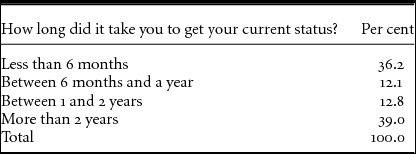
Policy and practice have enduring effects on temporal elements of integration, with numerous time-lags inhibiting quick integration. Refugees in this study talked of time spent waiting to be recognised as a refugee, waiting for work, waiting for suitable homes and waiting to have security of stay. This is, not surprisingly, most profound as people go through the process but is also evident after being recognised as a refugee. Table 1 shows how long it took refugees to be recognised as such.
Time taken to be recognised as a refugee

Table 1 includes only those with refugee status and shows that, despite considerable focus from what was formerly the United Kingdom Border Agency (UKBA), time in the process remains an issue. While there has been some quickening of the asylum process, and this brings with it its own problems, in each year of arrival in this study, up to and including 2009, over 40 per cent of refugees had been in the process for a year or more. Some of the effects of these waiting periods are highlighted later in this paper
There are also temporal issues in relation to housing where new and more established refugees alike often have to wait long periods of time before they can access appropriate housing, leaving many in temporary accommodation for considerable lengths of time. On being recognised as refugees, individuals are required to vacate their Home Office provided accommodation and access appropriate housing within twenty-eight days, a timescale that ensures the majority become homeless and are provided with temporary accommodation prior to securing more permanent housing. It is widely recognised that this twenty-eight-day ‘move-on’ policy is too tight, but the UK Government has thus far refused to countenance change. Local authorities are then required to deal with actual or potential homelessness. Nearly 10 per cent of refugees in this research were in temporary accommodation at the time of the first questionnaire, and a significant minority were in this costly form of housing for over a year. This contributed to large numbers of research participants viewing their housing status as transient, making local integration less of a priority. One man, who had been homeless for eighteen months, described his reliance on friends ‘I’ve been homeless for a year and a half . . . Sometimes it's difficult, sometimes the friends can't handle me anymore because of finances and people don't have enough money as well, people just get status and it's not working, there's not enough money’ (E606).
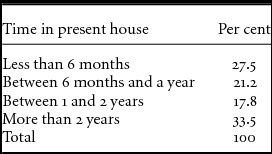
Among both refugees and asylum seekers, there is also considerable housing turnover and this impacts negatively upon local integration. Table 2 shows that over a third of respondents had lived in their present accommodation for a year or less. For those in the asylum process, this was due to the Home Office moving people around their housing estate, while for refugees it often concerned a lack of knowledge of the options they had available to them, a lack of understanding of the different localities in the city and a desire to take anything in order to get out of temporary accommodation. One man described the process of trying to access social housing, ‘They give you the first offer and if you refuse that, they give you a second one. If, after that, you refuse, then they don't help you anymore. So, in effect, you have to accept the second offer . . . I wouldn't have chosen to live there’ (E137). Additionally, refugees with more stable accommodation are concentrated in social housing, none is an owner-occupier, just 11 per cent are renting privately and 6.5 per cent are living with friends.
Time in present housing

Refugees arrive with varied educational backgrounds, with 42 per cent of survey participants having thirteen years or more formal education, higher than the UK population as a whole, whose mean figure stands at 12.6 per cent according to the OECD. However, almost 26 per cent have under ten years of formal education. For the more educated refugees, the level to which their qualifications are subsequently converted leaves many faced with a decision regarding whether to try to upgrade qualifications in order to access the labour market at an appropriate level, or whether to effectively forego past skills and qualifications and look for employment where it is available, usually low-paid, low-skilled work. One woman, for example, stated that ‘it's very difficult to find a job. Because I was a lecturer at university. I was a psychologist, counsellor and researcher. My job is difficult and hard to find something qualified to this kind of job’ (E33). She had taken the decision, after a number of years trying to find work commensurate with her skills, to look at more menial types of employment. Another stated that the reason for such choices are that ‘we have to look for jobs where there are jobs available’ (E137), a pragmatic response but one that can lead to underemployment in terms of both skills and hours.
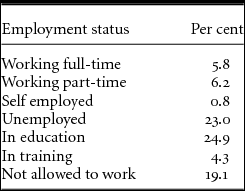
Added to this problem is the time spent trying to access the labour market and the barriers to such access. Despite a wide variety of skills and qualifications, Table 3 shows that just 20 per cent of those with the right to work were in some form of paid employment, primarily in low-paid, low-status and insecure jobs, with some evidence of zero-hours contracts.
Employment status

At least part of the problem, in policy terms, relates back to the removal of the right to work from those in the asylum process, in 2002. The absence of the right to work delays the practical acculturation that often comes with employment. Employment was seen by refugees as having social as well as financial integrative functions. ‘We have to understand that it's not an easy process and that we have to confront these difficulties in order to integrate . . . the biggest problem for people coming to this country is finding a job. And it does seem as if there's a barrier in the job field’ (E137).
A large proportion of asylum seekers arrive in the UK at an age where careers are normally beginning to be thought through and developed. Some 75 per cent of respondents in this study were under the age of forty at the time that they completed the first questionnaire. The barriers to employment faced by asylum seekers and refugees means these formative years are often spent in enforced idleness, with long-term effects on future employment chances and on well-being more generally. One man stated that ‘I’m thirty-five and I’m sitting . . . I’ve got qualifications . . . I’m a healthy person, I can do anything, and that's being wasted’ (E750). What is more, the long-term costs of not being able to access the labour market are well established and have been the focus of considerable government attention (see for example the numerous welfare-to-work programmes under New Labour and welfare reform under the Coalition Government). Thus asylum policy sits in contradiction to other stated government aims of moving people from benefits into work.
The asylum process and its effects on integration
The asylum process, a process that involves most asylum seekers’ first institutional and relational experiences in Britain, has had a profound effect on those subjected to it. For those in the asylum system for long periods of time the impacts are more obvious, but these effects are very often just the general asylum experience in elongated form. Asylum seekers are subject to a multitude of restrictions which prevent their engagement with mainstream society. These limitations have knock-on effects in many if not all of the domains of integration for those recognised as refugees.
The effects of the institutional assumptions made about applicants by state bodies, i.e., the ‘culture of disbelief’ within the asylum system, is raised by many refugees and asylum seekers (Souter, Reference Souter2011). Refugees talk of the impact of going over traumatic experiences and events and of encountering this disbelief through questioning the credibility of statements made. One refugee explained it thus, ‘It's like, you see, I’m a sick person, if I tell you something . . . then you tell me I’m a liar in my face’ (E279). The burden of proof is on the applicant to prove that they are telling the truth rather than the decision-maker to prove otherwise, contrary to most other legal processes in the UK. This can have a profound effect on the ability of refugees to subsequently be open to new people and experiences, demonstrating that government behaviours can have enduring effects. One interviewee expressed this view succinctly. ‘I know people in Scotland are very good, apart from the Home Office’ (E681). Thus the lack of welcome for asylum seekers, not a population that the UK Government seeks to integrate, continues to affect the views and experiences of refugees, a population the UK Government says that it does want to integrate.
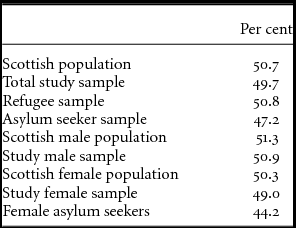
All of these effects appear to combine to impact on the health of asylum applicants. Although respondents self-rated their health relatively highly, with 59 per cent describing it as either excellent or good (compared to 75 per cent of the Scottish population in the Scottish Household Survey, 2010), this masks some significant health issues. When comparing refugees to asylum seekers, over 64 per cent of refugees describe their health as excellent or good compared to just 46 per cent of asylum seekers, suggesting that the process itself contributes to ill-health. This is even starker when looking at mental health and well-being. Using the fourteen questions in the Warwick/Edinburgh scale of mental health and well-being (WEMWBS), the mean well-being score for asylum seekers is well below that of refugees (see Table 4). Women in the asylum process in particular indicate very low WEMWBS scores, lower than the lowest economic quintile of the overall Scottish population (Given, Reference Given2008). Table 4 therefore indicates that asylum seekers have lower self-rated mental health and well-being than refugees, but also that this is most acute for women. One woman related her mental health problems to her experiences in the asylum process, ‘that was the hardest period in my life. I will never, never forget . . . because the problem started there, and after that developed. But now its ok. Partly you find medication and you find GP’ (E751). It is also important to note that, while many refugees ‘recover’ and report better health once no longer in the asylum process and on receiving treatment, others develop longer-term health problems that are an ongoing social and financial cost to the health service.
Warwick/Edinburgh scale of mental health and well-being

These research findings suggest that present immigration policy and practice is having a negative effect on the lives of refugees and asylum seekers in the UK. Poor employment outcomes, lack of housing stability and evidence of health problems all suggest that policy is actively inhibiting integration, however that is measured. The longer-term costs to both the individuals involved and to the public purse are not easily quantifiable. They are likely to be both substantial and shared between the UK Government, who created the immigration system, and other levels of government that have responsibility for much of the social cost. Thus the governance and costs of policy are inherently multi-level.
Discussion and conclusion
While relatively little is known about the interaction between asylum policies and the lived experiences of those subjected to these policies, this paper links the two directly. The evidence suggests that more attention should be paid to immigration policy in relation to its multifaceted impacts on immigrant or integration policy. Such a field of study could learn from some of the work conducted in other transversal policy areas, such as social inclusion/exclusion (Levitas, Reference Levitas2005). Indeed the individualisation of the concept of integration in policy terms has considerable connections to that of social exclusion and the various levels of government involved is also suggestive of commonalities between the two concepts. Links between these fields of study could prove fruitful both conceptually and empirically.
One example of the political crossover is the suggestion in this paper that negative impacts of policy have much broader deleterious effects than a focus on individual capital allows for. For example, despite varied backgrounds and experiences – some with English language skills before arrival, some with no English, some very well educated and some with no formal education, some with high-skilled employment backgrounds and some with no employment history – the negative impacts of policy on employment appear to be largely universal. This being the case, a focus on the individual, with its implicit assumption that lack of integration, like inclusion, is down to that individual and his or her behaviour is unlikely to have positive effects. In the age-old debate about structure and agency, the structure is receiving too little attention in integration policy. The following quotes signify both the impact of the denial of the right to work and some of the impact of not finding work. Regarding the right to work, one man stated that ‘they give me status after eight years, its means during these eight years it means like you did nothing and you lost your age . . . when you were in your thirties is the time when you’re starting to build your career, so for you, you weren't allowed’ (E752). The struggle to access work is then summed up by one refugee thus, ‘It makes you – I don't know how to say that – is it rejected? . . . Just useless yeah. As the time passes, you just get used to being unemployed . . . if you know the benefits of the work, you try hard to get back to work because it makes your life . . . Valuable, it makes your life more valuable’ (E536).
The contradiction between a policy approach that celebrates integration, but that simultaneously makes integration increasingly difficult, suggests that either integration is not a serious aim of policy or that other policy goals are undermining it, or a combination thereof. Without entering into long-standing debates on rationality and policy making, one of the guiding principles, as far as is possible, should be to prevent future problems arising as a direct result of policy. There is evidence here and elsewhere (Somerville, Reference Somerville2007; Spencer, Reference Spencer2011; Castles, Reference Castles2004; Cohen, Reference Cohen2006) that the lack of rationality has allowed policies to develop that have been short-sighted at best and completely contradictory at worst. Policy making that does not reflect the importance of prevention, and therefore creates problems that future policy will have to deal with, goes against much of what is known about what constitutes ‘good’ policy making (see for example the Christie report Reference Christie2011) and is evident both in health and employment outcomes for refugees. The picture is further complicated by the policy or departmental silos that exist in UK politics, meaning, for example, that the results of Home Office policy and practice will often be met by either other UK government departments, or in many cases by sub-national government departments.
More academic focus on the policy effects of immigration on integration would also be able to contribute to and learn from work about multi-level governance and inter-governmental relations. Transversal policies have impacts across all levels of government and some of the policy process literature that posits an implementation gap, for example, could learn from the analysis of such transversal policies, particularly due to contests around policy competences being about more than just implementation. This also has the potential to add to recent work from scholars such as Pierson (Reference Pierson, Shapiro, Skowronek and Galvin2006) and Weir (Reference Weir, Shapiro, Skowronek and Galvin2006) about political contestation but with an inter-governmental focus. Viewing sub-national and local government as mere implementers of reserved or central government policy risks losing the importance of political difference between levels of government, and in the UK case appears to assume a clearer division between what is reserved and what is devolved than is the case.
Many of the policies described above have had negative impacts upon refugees living in Scotland, and the costs subsequently accruing from these impacts are met by a combination of the devolved authority and the local authority, a devolution of penury as Mitchell would have it (Mitchell, Reference Mitchell and Hay2002). Thus policy with regard to refugees is not simply reserved or devolved. Instead there is a marbling of responsibilities in different areas and at different levels, sometimes linking and overlapping, but sometimes paying little cognisance to the transversal nature of policy. For example, housing and health are devolved matters, but the reserved asylum process has a profound impact on both. The devolved institutions then have to address the outcomes of that reserved policy.
The problems that arise are not just inter-governmental but also intra-governmental. At present, reserved UK immigration policy is having contradictory impacts not only on sub-national levels of government, but on central government policy itself. The negative impacts of immigration policy on the lives of immigrants have been highlighted in this paper. Whether refugees feel that they can integrate into a new neighbourhood, city or country is clearly affected by the degree to which they feel welcomed within any particular spatial unit. One clear issue that arose in the research concerned the difference between the welcome experienced from the ‘nation state’ and that experienced from the population. State institutions were associated with Britain and the immigration process, and the lack of welcome emanating from those institutions meant that the state was seen as almost uniformly unwelcoming. The asylum process is the most prominent example of this unwelcoming state behaviour, as well as being the example with the most enduring effects, as expressed by one research participant, ‘for the British society it's okay they say welcome to Britain, and for the Home Office . . . is not welcome in Britain’ (E606). Such sentiments are widespread and can negate positive developments in integration, such that some refugees in this research made a decision not to engage with anything that involves the British state.
Policy at the moment operates against integration by creating time lags in labour market access; preventing local integration through housing decisions; discouraging engagement with state institutions; and contributing to social isolation and health and well-being problems, all of which create issues which national, sub-national and local governments must then address. The Scottish context in which integration either occurs or does not is therefore important. The Scottish Government, for example, has a different discourse around migration, and it is widely accepted that the political climate around migration issues is different in Scotland from the UK as a whole. This more positive political climate reflects and/or refracts opinion polls that show the Scots to be less negative about migration broadly and asylum more specifically than the UK as a whole (Blinder, Reference Blinder2014). Local communities have also, on occasion, rallied to the support of their asylum-seeking neighbours who were subject to removal from the dispersal area to which they were sent by the Home Office; and civil society organisations have been active in their areas of work in mitigating the effects of UK policy. The Scottish Government also has a more politically progressive approach in some of the policy areas in which it has jurisdiction. However, it is not yet known whether this policy divergence and different political climate leads to different experiences and/or outcomes as comparative data are lacking (Cebulla et al., Reference Cebulla, Daniel and Zuruman2010). What can be said, however, is that present immigration policy and practice at the UK level makes integration increasingly challenging. Thus successful integration, however measured, is difficult under the present immigration policy architecture.