INTRODUCTION
In the oceans, there are hundreds of varieties of sea cucumbers. At present 1400 species of sea cucumber have been identified and reported in the seas of the whole world (Conand, Reference Conand and Bruckner2006). Sea cucumbers are among the aquatic creatures that have many important and useful properties known for human health (Mamelona et al., Reference Mamelona, Pelletier, Girard-Lalancette, Legault, Karboune and Kermasha2007). In Iran, sea cucumbers are not well known and they are not consumed as food, although they have been consumed as food in many countries for hundreds of years. This report is the first record of Holothuria hilla from Larak Island with some morphological details of the species.
MATERIALS AND METHODS
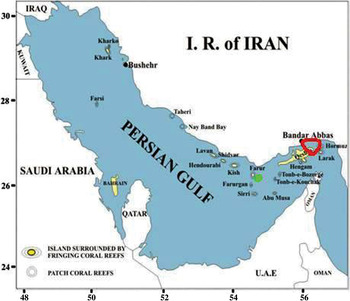
Sea cucumbers were caught around Larak Island in July 2011 by SCUBA diving at depths of 12 m (Figure 1). The samples were transferred to laboratory to be photographed and to extract their ossicles (Hickman, Reference Hickman1998). To identify the samples we used valid identification keys (Conand, Reference Conand1993; Samyn et al., Reference Samyn, Vanden Spiegel and Massin2006). Also, for the correct identification some specimens were sent to Professor Gustave Paulay at the National Museum of Florida, United States.
Sampling site of Holothuria hilla in the Persian Gulf.

RESULTS AND DISCUSSION
SYSTEMATICS
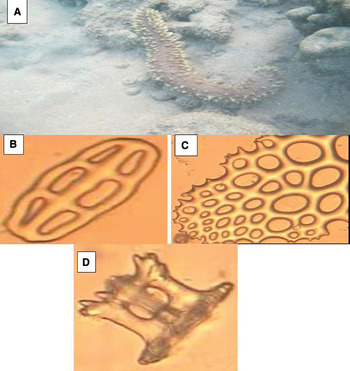
(A) Holothuria hilla; (B and D) ossicles of dorsal tegument; (C) ossicles of ventral tegument; Scale bars: A = 25 cm; B = 20 microns; C = 100 microns; D = 20 microns (all photographs by M. Ehsanpour and M. Afkhami).

DESCRIPTION
Small body wall at the back ends more slender than the anterior. Mouth ventral surrounded by 20 small yellowish tentacles, anus terminal. Ventral podia arranged in 3–4 rows in each ambulacra area. Dorsal papillae, large and conical, scattered in no particular order on the bivium. The spicules of the papillae were buttons with three or five pairs of holes (60–100 µm) and tables (80 µm across). The spicules of podia were similar to those within the papillae. The spicules of the body wall were tables (80 µm across) and buttons (100 µm). The spicules of tentacles were 130–200 µm long; the body wall included tables and buttons, as well as distinct papillae. The background colour was reddish-brown and it is still characterized by the presence of numerous white spots marking the base of creamy white buds.
Heding (Reference Heding1940) recorded 17 species of holothurians found in the waters around Iran. Since there is an expansive coastal area in Iran, most coastal cities include some species of holothurians (Shakouri et al., Reference Shakouri, Aimorirad, Nbavi, Kochanian, Savari and Safahyie2009). Therefore, only a few authors have described their taxonomy, biology and culture (Amini Rad, Reference Amini Rad2004; Shakouri et al., 2009; Dabagh & Kamrani, Reference Dabagh and Kamrani2011).
Holothuria hilla has a body which is long and cylindrical with blunt ends. It reaches a length of 200 mm. The body wall is soft and the upper and lower sides are well demarcated, light brown in colour with scattered white conical papillae. This sea cucumber is primarily found under rocks on the bottom of coarse sand, generally between 0 and 20 m, but also to over 200 m (Lane et al., Reference Lane, Marsh, Vandenspiegel and Rowe2000). They are very common species throughout the tropical part of the Indo-West Pacific. Holothuria hilla is a relatively rare species around Larak Island and has been observed under blocks of rubble on the reefs during the day. This species was recently transferred from the subgenus Thymiosycia Pearson, 1914 to subgenus Mertensiothuria Deichmann, 1958. The reason for this new classification is the presence of ossicles in the form of small buttons and turrets in the longitudinal muscles (Samyn & Massin, Reference Samyn and Massin2003). Some authors have described H. hilla previously (Massin, Reference Massin1996; Samyn, Reference Samyn2003). Although Holothuria hilla was reported in general from the Persian Gulf (Heding, Reference Heding1940) and in particular at Farour Island (Dabagh & Kamrani, Reference Dabagh and Kamrani2011), this is a new observation of this species around Larak Island.
ACKNOWLEDGEMENT
We thank Professor Gustave Pauly, the Chairman of Invertebrate Department of Florida University, for species identification.