Introduction
Invasion of alien weed species is one of the most serious global problems including economic damage to agriculture, forestry or threaten native biodiversity, ecosystem services, and ultimately impair human livelihoods (Schwarzländer et al., Reference Schwarzländer, Hinz, Winston and Day2018). Different bioclimatic conditions of India favour the introduction of different invasive alien weeds (Poudel et al., Reference Poudel, Adhikari and Thapa2019). Among them, mikania (Mikania micrantha L. Kunth; Asteraceae) and parthenium (Parthenium hysterophorus, Asteraceae) are well-established invasive alien weeds in the tropical and sub-tropical countries (Clewley et al., Reference Clewley, Eschen, Shaw and Wright2012). Mikania is a fast-growing plant capable of climbing over other plants to gain more sunshine and also known as plant killer (McFadyen, Reference McFadyen1998). Similarly, parthenium is an annual herb with a deep taproot and an erect shoot with many branches and may eventually reach a height of up to 2 m (McFadyen, Reference McFadyen1998). Chemical, mechanical, and physical control methods have been the mainstay for the management of such weeds (Fowler et al., Reference Fowler, Syrett and Hill2000). As conventional control measures are costly and time consuming, biological control is seen as an ecofriendly and self-sustaining alternative management solution to control these weeds (Hill and Coetzee, Reference Hill and Coetzee2017). The insects like, Liothrips mikaniae (Priesner) (Thysanoptera, Phlaeothripidae) and rust pathogen like, Puccinia spegazzini has been reported as best control measure against Maikania weed in India, Taiwan, China, Papua New Guinea, and Fiji (Poudel et al., Reference Poudel, Adhikari and Thapa2019). Whereas, the stem-galling moth, Epiblema strenuana Walker (Lepidoptera: Tortricidae) and the leaf-feeding beetle, Zygogramma bicolorata Pallister (Coleoptera: Chrysomelidae), are the most prominent biological control agents of parthenium (Jayanth and Visalakshy, Reference Jayanth and Visalakshy1996). To combat the impact of these weeds, various studies have been conducted around the world and realised that biological control is the cheap, environmentally safe, and self-sustaining measure to control these weeds (McFadyen, Reference McFadyen1998). Numerous studies have demonstrated the biocontrol of weeds in terms of impact on the target weed populations (Clewley et al., Reference Clewley, Eschen, Shaw and Wright2012).
A dozen of generalist insect pests has been reported infesting several economic crops and weeds (Das et al., Reference Das, Koner and Barik2019; Mobarak et al., Reference Mobarak, Koner and Barik2022). Groundnut (Arachis hypogaea L., cv. HNG-123; Fabaceae) (Subbiah and Velmurugan, Reference Subbiah and Velmurugan2020) and Soybean (Glycine max L., cv. JS97-52; Fabaceae) (Agarwal et al., Reference Agarwal, Billore, Sharma, Dupare and Srivastava2013) are economically most important legume crops in the worldwhich are grown mainly for its edible seed, oil, and other byproducts. These crops are also infested by several insect pests in the field and create great economic loss in South East Asian countries. Among them Lepidopteran caterpillars like, Bihar hairy caterpillar of Spilosoma obliqua Walker [Arctiidae], red hairy caterpillar of Amsacta albistriga Walker [Erabidae], tobacco caterpillar of Spodoptera litura Fab. [Noctuidae], and buff ermine Spilarctia luteum Hufnagel [Erabidae] are considered as potent generalist pests in different parts of the world including India (Gripenberg et al., Reference Gripenberg, Mayhew, Parnell and Roslin2010; Mobarak et al., Reference Mobarak, Koner, Mitra, Mitra and Barik2020). The most damaging stage of these pest species is their middle age caterpillars that feed gregariously on their host plants (Mobarak et al., Reference Mobarak, Koner and Barik2022; Roy, Reference Roy2021). These pests are known to feed on different weed species including parthenium and mikania. Mainly S. litura and S. obliqua are well-known defoliator of several weed species including the selected two (Kumar and Ray, Reference Kumar and Ray2007, Reference Kumar and Ray2018; Poudel et al., Reference Poudel, Adhikari and Thapa2019; Srivastava et al., Reference Srivastava, Sharma, Anal and Sharma2018). However, additional research should focus on the pests for their ecofriendly management in the crop field and or use them as biocontrol agent for different exotic weeds.
Herbivorous insects recognise their host plants by several physicochemical cues detected through different sensory modalities (Debnath et al., Reference Debnath, Mitra, Das and Barik2021; Lucas-Barbosa et al., Reference Lucas-Barbosa, Sun, Hakman, Van Beek, Van Loon and Dicke2016). Leaf epicuticular waxes play an important role in host recognition and oviposition in different phytophagous insects (Li and Ishikawa, Reference Li and Ishikawa2006; Roy, Reference Roy2022). The epicuticular waxes mainly consist of long-chain alkanes, free fatty acids (FFAs), esters, aldehydes, and primary and secondary alcohols, which composition varies widely within a species (Jetter et al., Reference Jetter, Schaffer and Riederer2000; Konar et al. Reference Koner, Das, Mobarak and Barik2022). The importance of plant leaf alkanes and FFAs as semiochemicals has been demonstrated for different insect species (Parr et al., Reference Parr, Tran, Simmonds, Kite and Credland1998; Rebora et al., Reference Rebora, Salerno, Piersanti, Gorb and Gorb2020). Especially low-volatile alkanes and FFAs have an important role in insect-plant interactions as an olfactory (Mobarak et al., Reference Mobarak, Koner, Mitra, Mitra and Barik2020) and/or oviposition (Das et al., Reference Das, Koner and Barik2019; Udayagiri and Mason, Reference Udayagiri and Mason1997) stimulant. For this reason, epicuticular waxes of two potent hosts, groundnut (Arachis hypogaea L.; Fabaceae) and Soybean (Glycine max L.; Fabaceae) were considered along with the weeds (mikania and parthenium) in this study. Even, there is currently no information about chemical cues mediated attraction and oviposition preference of these pest species (S. obliqua, A. albistriga, S. litura, and S. luteum) towards such crop cultivars or weeds. This behavioural study of the generalists considering their behaviour and population growth may help to improve the monitoring strategies for these pests in integrated pest management (IPM) including their use as biocontrol agent for the noxious weed species. Thus, the aims of the current research were to identify and quantify the compositions of n-alkanes and FFAs present in the epicuticular waxes of the crops (groundnut and soybean) and the weeds (mikania and parthenium), to interpret their role in short-range attraction and oviposition to develop baited trap for pest management of the crops as well as biocontrol of the exotic weeds through ecologically sustainable IPM strategies.
Materials and methods
Plants
Two potent host plant such as groundnut (A. hypogaea, cv. HNG-123) and soybean (G. max, cv. JS97-52) were cultivated in the field near Chinsurah Rice Research Centre (CRRC) (22°53′ N, 88°23′ E), 8.62 m above mean sea level, Hooghly, West Bengal, India during 2021–2023. The plots (plot size 5 m × 5 m; plot gap 0.5 m, soil organic matter 6.2 ± 0.2%, pH 7.6, photoperiod 10 ± 1 h at 30–34°C) were prepared for cultivation of the crops without any insecticide with three replications side by side near CRRC. A space of 1 m was kept for cultivation of two crop cultivars and they were naturally infected by S. obliqua, A. albistriga, S. litura, and S. luteum during early flowering stage in the field and the pests were collected separately for their mass culture. The alien weed species (M. micrantha and P. hysterophorus) were also collected from the same field. Mature intact leaves from each crop cultivars and weeds were collected at 6 a.m. in three separate batches of ca. 100 g from the field for the extraction of epicuticular waxes in the laboratory.
Insects
Using a light trap, adult pests were collected from the field of cultivated sesame plants (Sesamum indicum, cv. Rama, Pedaliaceae), similarly grown like groundnut and soybean cultivars as mentioned above in a separate field near CRRC (West Bengal, India). The adults were placed in a nylon net cage (40 × 30 × 30 cm3) on the turgescent sesame leaves for egg-laying. Newly emerged first generation (F1) were kept on the same sesame leaves for feeding at 27 ± 1°C, 70 ± 10% RH and 10 h L:14 h D photoperiod, and a light intensity of 1500 lux in a biological oxygen demand (BOD) incubator (ADS, Kolkata, India). Freshly cut leaves were provided replacing the wilting ones. Adults were fed with a 10% sucrose-in-tap-water solution soaked in cotton wool. Four generations (F1–F4) of the selected generalists were completed on sesame leaves to avoid any pre-adaptation to the host (groundnut and soybean) plants as well as weeds (mikania and parthenium) used in bioassays. Old gravid females (F3–F4) were used for olfactory and oviposition bioassays.
Epicuticular wax analyses
Extraction of leaf epicuticular waxes: Freshly collected mature leaves of groundnut, soybean, mikania, and parthenium (12–18 days old) of ca. 100 g fresh weight were dipped in 2 L n-hexane separately for 1 min at room temperature to extract the epicuticular wax which yielded slightly yellow extracts without traces of any chlorophyll (Mobarak et al., Reference Mobarak, Koner, Mitra, Mitra and Barik2020). The crude extract was passed through filter paper Whatman No. 41 (Maidstone, UK), and hexane was evaporated at 27°C until the sample became dry. The extraction was repeated three times, separately for each plant species. Each crude extract was then dissolved in 40 ml n-hexane and divided into four equal portions (equivalent to 25 g of leaves). The first and second ones were used for the identification and quantification of n-alkanes and FFAs, respectively, whereas the third and fourth ones were purified and used for olfactory and oviposition bioassays, respectively. All solvents (analytical grade) were purchased from E. Merck (Mumbai, India) and all the standard n-alkanes and FAs (>99% purity) were purchased from Sigma-Aldrich (Darmstadt, Germany).
Identification and quantification of n-alkanes: One-half of the first portions of crude leaf extract of each plant was passed through a column of aluminium oxide (F-20 grade) and eluted with petroleum ether. The eluent was fractioned by thin-layer chromatography (TLC) on silica gel G (Sigma St. Louis, MO, USA) of 0.5 mm thickness by using carbon tetrachloride (CCl4) as the mobile phase. A faint yellowish band appeared on the TLC plate and the plate was air-dried under laboratory conditions. The Rf (retardation factor) value (0.86) was compared with the Rf value of a mixture of synthetic n-alkanes between n-C10 and n-C40. The single hydrocarbon band produced in each TLC plate was eluted from the silica gel layer with chloroform. The purified alkane samples were used for gas chromatography-mass spectrometry (GC-MS) and GC-FID (flame ionisation detector) for identification and quantification, respectively. The extracts were analysed with a Shimadzu GCMS-QP5050A (Koyeto, Japan) to produce electron ionisation (EI) mass spectra using HP-5MS column for GCMS-EI analysis by using a specified oven temperature program: initially 80°C for 2 min, then raised at 15°C min−1 to 320°C, finally held for 15 min (Roy, Reference Roy2021). The volume of the injected sample was 1 µl with a split ratio of 1:10. Identifications were made by comparison of spectra with library databases (NIST 2008) and also confirmed by comparison of their retention times (RTs) with those of standard n-alkanes (n-C10 to n-C40) and the areas of each peak were converted into quantities of n-alkanes based on GC peak area of internal standard n-nonadecane (n-C19 at 100 ng µl−1).
Identification and quantification of FFAs: The remaining half of the first portions of the crude leaf extract of each plant was mixed with diethyl ether and filtered through Whatman No. 41 filter paper. The extract was purified by TLC on silica gel G of 0.5 mm thickness by using n-butanol:acetic acid:water (4:1:5) as the mobile phase after discarding water. The band (Rf value of 0.78) was eluted from the silica gel layer with diethyl ether to get purified FFAs. Then, the purified FFAs were esterified with 3 ml BF3-methanol followed by warming for 5 min in a hot water bath at 50–60°C, and then cooled to 4°C. Hexane (40 ml) was added to this mixture followed by washing with saturated NaCl twice in a separating funnel. The aqueous layer of each sample was discarded and the hexane fraction was passed through 40 g of anhydrous Na2SO4. The esterified FFAs samples were used for GC-MS and GC-FID for the identification and quantification, respectively. The extracts were analysed with a Shimadzu GCMS-QP5050A to produce EI mass spectra using an HP-5MS column for GCMS-EI analysis by setting a specified oven temperature program: initially at 120°C for 2 min, then raised at the rate of 10°C min−1 to 220°C, and finally at 220°C for 15 min (Roy, Reference Roy2021). The volume of the injected sample was 1 µl with a split ratio of 1:10. Identifications were made by the comparison of spectra with library databases (NIST 2008) and also confirmed by the comparison of their RTs with those of methylated (esterified) standard FAs (C10:0 to C24:0). The areas of each peak were converted into quantities of FFAs based on GC peak area of internal standard methyl tricosanoate (C23:0 at 100 ng µl−1).
Insect bioassays
Chemicals: Both n-alkanes and FFAs isolated from leaf epicuticular waxes of the four plants were prepared in leaf equivalent (μg−1 leaf−1 ml−1) amount dissolved in petroleum ether for different bioassays (olfaction, oviposition, and feeding). Petroleum ether was used as the control solvent because both adults and larvae were neither attracted nor deterred in preliminary bioassays. Individual synthetic n-alkanes, FFAs, and their mixtures mimicking the natural leaf wax (μg−1 leaf−1 ml−1) were prepared in petroleum ether. The de-waxed leaves for the bioassay were prepared by dipping freshly cut mature leaves (14–20 days old) in n-hexane for 1 min as described in the wax extraction paragraph above.
Insects: The F3 onward generations of S. obliqua, A. albistriga, S. litura, and S. luteum larvae and adults were collected from the mass rearing for different bioassays in the laboratory condition at 27 ± 1°C, 60 ± 5% RH, and light intensity of 1500 lux. Newly emerged, 1–2 days old females were provisioned with water and starved for 12 h before use in the olfaction bioassay, and 10% sucrose solution was provided as food during the oviposition bioassay. Females were used in bioassay because they are responsible for finding a suitable site for oviposition by using different stimuli for successful generations. Females of each pest species were used once throughout the bioassays with three replications for each plant.
Female olfaction: The effect of n-alkanes and FFAs as olfactory attractants was evaluated by different treatments under specified conditions. The behavioural responses of adult females were investigated in a Y-tube olfactometer: 10 cm long (l) stem and arms, 8 cm diameter (d), 60° Y angle. The stem of the olfactometer was connected to a porous glass vial (d: 8.0 cm × l: 10.0 cm) in which test insects were released. Each arm of the olfactometer was connected to a glass micro kit adapter (d: 4.0 cm × l: 6.0 cm) fitted into a glass vial (d: 8.0 cm × l: 8.0 cm). The aerator producing airflow of 450 ml min−1, which was first purified by passing through a charcoal filter and then adjusted to 150 ml min−1 in left and right glass vials through the micro kit adapters. All the connections between different parts of the setup consisted of silicon tubes. One millilitre of the solvent containing one leaf equivalent (μg leaf−1 ml−1) amount of identified n-alkanes and FFAs and their respective synthetic analogs were separately applied to Whatman No. 41 filter paper pieces (2 × 2 cm2) as volatile sources, another one only with solvent (petroleum ether) as control, and allowed to evaporate the solvent in open space (1 min) under laboratory conditions. These filter papers were introduced into the glass vials attached to the olfactometer. One female of each pest (S. obliqua, A. albistriga, S. litura, and S. luteum) was introduced into the porous glass vial attached to the olfactometer (Mobarak et al., Reference Mobarak, Koner, Mitra, Mitra and Barik2020). The behaviour of each female was observed for 3 min in the Y-tube and the increase in the observation time did not increase the number of responding insects. To eliminate traces from previous trials, the tube was cleaned with petroleum ether followed by acetone and dried in a hot air oven at 50°C after six individuals were tested. Each test with one volatile sample was conducted until a total of 72 (24 × 3) females had responded and the position of the two arms was systematically changed (rotated 180°) to avoid any positional biases.
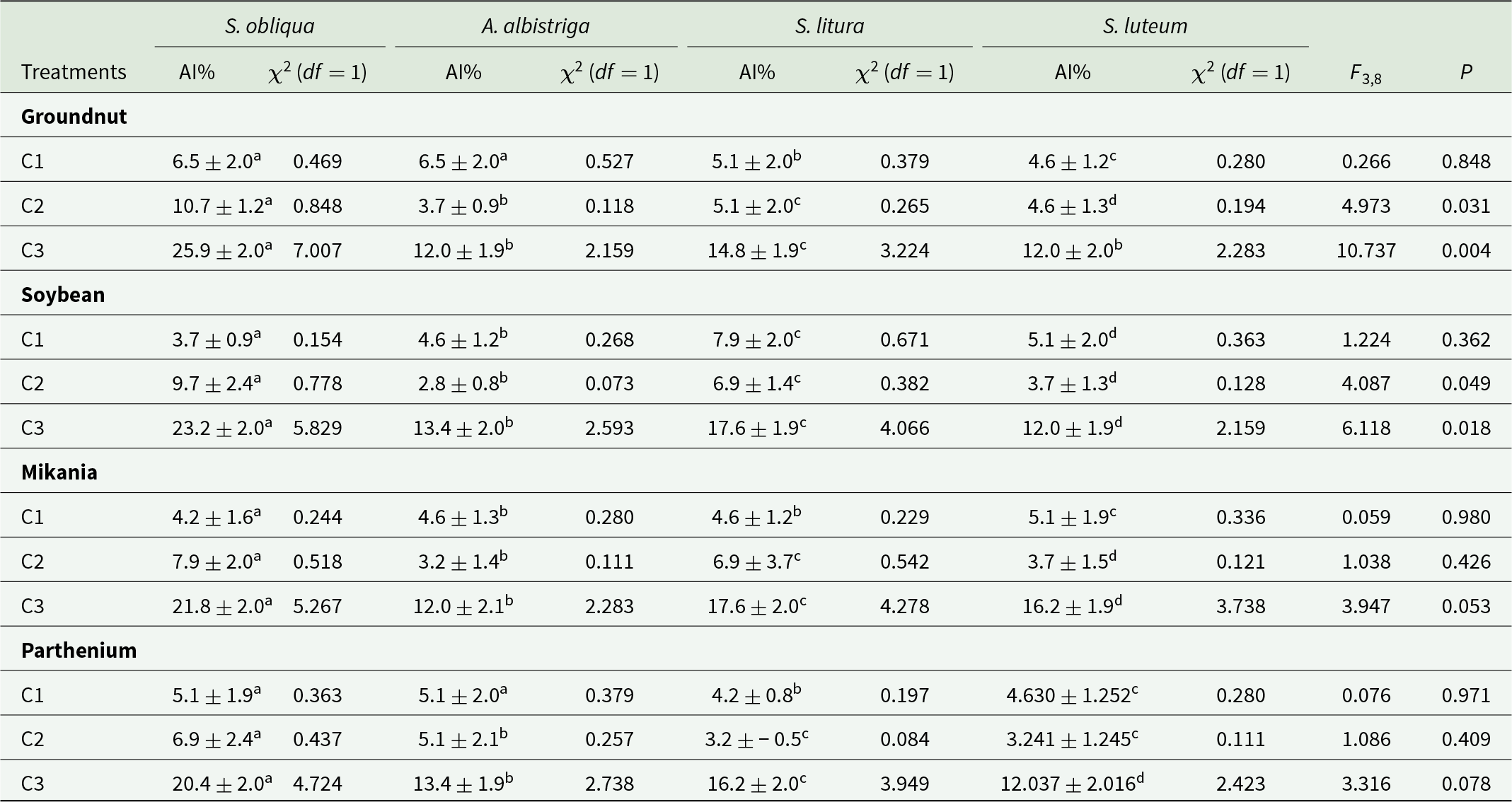
The dual choice tests were conducted for the identified 20 n-alkanes (straight chain) and 15 FFAs individually in leaf equivalent (μg leaf−1 ml−1) amounts present in respective plants to find the most preferred chemicals (Supplementary Table 2). Other tests were conducted in the same manner as for synthetic individual compounds with three replications under three (C1–C3) defined conditions (Supplementary Table 3, table 3) for the four selected plant species as follows:
Adult olfactory attraction (mean ± SE, n = 72) of four insect pest species (S. obliqua, A. albistriga, S. litura, and S. luteum) to plant surface wax chemicals (n-alkanes and FFAs in leaf equivalent amount (µg leaf−1)) of four selected host (groundnut, soybean, mikania, and parthenium) plants under specified bioassay conditions

Note: Within rows means followed by same alphabets are not significantly different (P ≥ 0.05) by Tukey’s HSD test. AI = Attraction index, where C1 = intact leaf vs. de-waxed leaf; C2 = combined synthetic mixture vs. total natural wax treated filter paper; C3 = combined synthetic mixture vs. total natural wax treated intact leaf.
Condition 1 (C1) = Intact leaf vs. de-waxed leaf,
Condition 2 (C2) = Combined synthetic mixture vs. total natural wax treated filter paper, and
Condition 3 (C3) = Combined synthetic mixture vs. total natural wax treated intact leaf.
The adult attraction index (AI %) of each pest species (S. obliqua, A. albistriga, S. litura, and S. luteum) was determined for the three conditions using the formula: [{(T − C)/(T + C)} × 100], where T is the number of adult females attracted to intact leaf or synthetic wax chemicals treated filter paper or intact leaf in defined conditions and C is the number of adult females attracted to de-waxed leaf or natural wax chemicals treated filter paper or intact leaf with a few modifications (Singh et al., Reference Singh, Koul, Rup and Jindal2011).
Female oviposition: The oviposition preference was assessed by using 3 groups of 24 pairs of newly emerged male and female of each pest (S. obliqua, A. albistriga, S. litura, and S. luteum) species (24 × 3 = 72 pairs) kept separately in glass chambers (40 × 40 × 40 cm3). The natural and synthetic mixtures as in the adult olfaction bioassay were applied. The dual choice test was conducted for each treatment in the glass chambers covered with nylon net. The data were collected at a 24 h interval up to 96 h. For the choice experiments, each jute leaf or filter paper was marked separating it into vertically oriented two halves. One half was treated with the test compound and the other half was kept as a control. Each mixture was applied with a micropipette in leaf equivalent (μg leaf−1 ml−1) amount present in the respective plant species and after evaporating the solvent, one pair of newly emerged adults (1:1 sex ratio) were released in each glass chamber. Each chamber was provided with 10% sucrose solution as food and kept in a BOD incubator as used for mass culture. The plant leaf or filter paper sheet of the three replicates with eggs was taken out from the glass chamber and eggs were counted at the black head stage comparing the treatments under three different conditions (C1–C3) as in female olfaction bioassay (Supplementary Table 4, table 4). The oviposition preference index (OPI %) was determined for the eight treatments under four conditions using the formula: [{(P − Q)/(P + Q)} × 100], where P is the number of eggs laid at various conditions (intact leaf or synthetic wax chemicals) and Q is the number of eggs laid at the same conditions in other treatments (de-waxed leaf or natural wax chemicals) with a few modifications (Singh et al., Reference Singh, Koul, Rup and Jindal2011).
Oviposition preference (mean ± SE, n = 72) of four insect pest species (S. obliqua, A. albistriga, S. litura, and S. luteum) to plant surface wax chemicals (n-alkanes and FFAs in leaf equivalent amount (µg leaf−1)) of four selected host (groundnut, soybean, mikania, and parthenium) plants under specified bioassay conditions

Note: Within rows and columns means followed by same alphabets (lower and upper case, respectively) are not significantly different (P ≥ 0.05) by Tukey’s HSD test. OPI = Oviposition preference index (gravid female), where C1 = intact leaf vs. de-waxed leaf; C2 = combined synthetic mixture vs. total natural wax treated filter paper; C3 = combined synthetic mixture vs. total natural wax treated intact leaf.
Statistical analyses
The data on total amounts of n-alkanes and FFAs were analysed by one-way ANOVA followed by Tukey’s Honestly Significant Difference (HSD) test. The data obtained for responses of the selected pest species to the respective leaf epicuticular wax compounds and mixtures of their synthetic analogs were analysed by Chi-squire (χ 2) test based on the null hypothesis whether the ratio of individual choosing the stimulus vs. the control differed significantly from 1:1 (Zar, Reference Zar1999). Insects that did not respond to any one of the treatments were excluded from the analyses.
Results
Leaf epicuticular wax chemistry: The n-hexane extracts of a single mature leaf (n > 36) of groundnut yielded 1189.1 ± 77.7 µg, 1287.4 ± 49.3 µg, 847.3 ± 45.7 µg, and 1304.0 ± 42.9 µg epicuticular wax, respectively (Supplementary Table 1). Out of the extracted waxes from a single leaf of groundnut, soybean, mikania, and parthenium represented by 450.9 ± 28.1 µg, 481.2 ± 20.3 µg, 292.7 ± 22.1 µg, 294.6 ± 19.2 µg of n-alkanes and 103.8 ± 4.7 µg, 92.7 ± 1.9 µg, 57.3 ± 2.9 µg, 67.9 ± 2.9 µg of FFAs, respectively, and remaining unidentified surface wax compounds (Supplementary Table 1). The extracted n-alkanes and FFAs differed significantly between the selected plants (one-way ANOVA, F 3,8 ≥ 19.536, P < 0.001) though their wax contents were without any significant (one-way ANOVA, F 3,8 = 0.129, P = 0.940) differences (Supplementary Table 1).
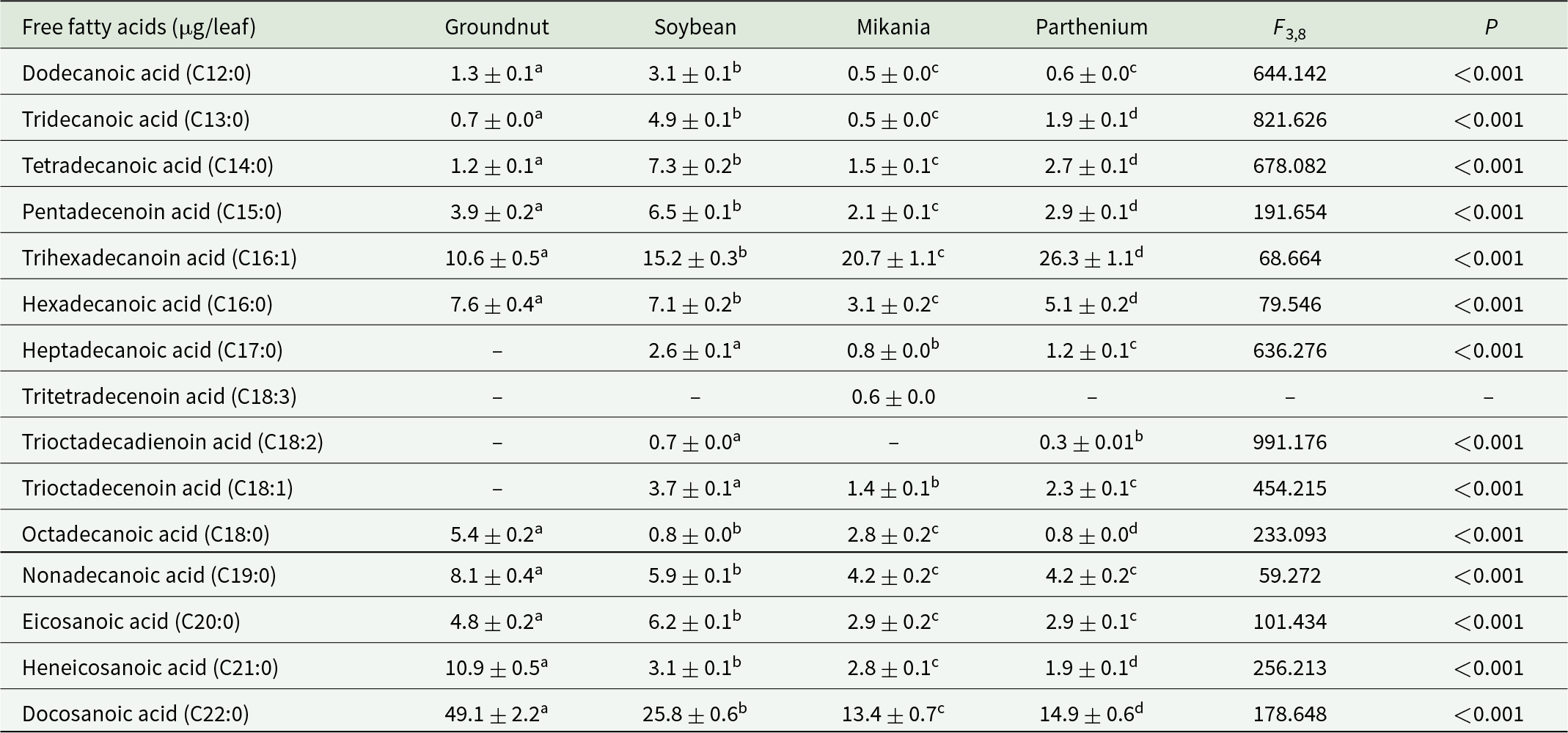
Total 25 different n-alkanes (20 straight chain + 5 branched chain) were identified having chain lengths between n-C14 to n-C36 and further expressed in leaf equivalent (μg leaf−1) amount (table 1). All the identified amounts of n-alkanes except n-C15 (one-way ANOVA, F 3,8 = 2.915, P = 0.101) differed significantly between the selected plants (one-way ANOVA, F 3,8 ≥ 4.537, P ≤ 0.039; table 1), whereas total 15 different FFAs were identified having chain lengths between C12:0 to C22:0 and further expressed in leaf equivalent (μg leaf−1) amount (table 2). All the identified FFAs differed significantly between the selected plants (one-way ANOVA, F 3,8 ≥ 59.272, P < 0.001; table 2). Among the identified n-alkanes and FFAs of the selected plants, n-C34 (167.8 ± 10.4 μg leaf−1) and C22:0 (49.1 ± 2.2 μg leaf−1), respectively, in groundnut were predominant (tables 1–2).
Composition of n-alkanes (µg leaf−1) in plant surface waxes (mean ± SE, n = 3) of four selected host (groundnut, Arachis hypogaea, cv. HNG-123 [Fabaceae], soybean, Glycine max, cv. JS97-52 [Fabaceae], mikania, Mikania scandens [Asteraceae], and parthenium, Parthenium hysterophorus, [Asteraceae]) plants observed during their growing season in 2021–2023

Note: Within rows and columns means followed by same alphabets (lower and upper case, respectively) are not significantly different (P ≥ 0.05) by Tukey’s HSD test.
Composition of free fatty acids (FFAs) (µg leaf−1) in plant surface waxes (mean ± SE, n = 3) of four selected host (groundnut, Arachis hypogaea, cv. HNG-123 [Fabaceae], soybean, Glycine max, cv. JS97-52 [Fabaceae], mikania, Mikania scandens [Asteraceae], and parthenium, Parthenium hysterophorus L., [Asteraceae]) plants observed during their growing season in 2021–2023

Note: Within rows and columns means followed by same alphabets (lower and upper case, respectively) are not significantly different (P ≥ 0.05) by Tukey’s HSD test.
Olfactory and oviposition responses for leaf epicuticular wax compounds: A series of olfactory and oviposition bioassay (three defined conditions) were conducted to study the AI (%) and OPI (%) of each pest (S. obliqua, A. albistriga, S. litura, and S. luteum) species towards leaf wax chemicals (n-alkanes and FFAs) in comparison with most preferred synthetic n-alkanes (n-C16, n-C18, n-C20, n-C22) and FFAs (C14:0, C16:1, C16:0, C20:0) in leaf equivalent amount (μg leaf−1) present in the selected plant (groundnut, soybean, mikania, and parthenium) species (Supplementary Tables 3–4, tables 3–4). All the pest species (S. obliqua, A. albistriga, S. litura, and S. luteum) have more olfactory and oviposition preference towards intact leaves over the de-waxed leaves of respective plant (groundnut, soybean, mikania, and parthenium) species (Supplementary Tables 3–4, tables 3–4). Olfactory attraction (%) of the selected pest species were significantly (P < 0.05) higher to the C3, i.e. combined-synthetic-mixture (4 n-alkanes + 4 FFAs) treated intact leaves, (>60%) compared to the other treatments for all four plant species (Supplementary Table 3). The oviposition (%) to any of the conditions (C1–C3) were always without significant differences (χ 2 ≤ 3.841, df = 1, P ≥ 0.05) with few exceptions due to the wax chemicals of respective plant species and strong selection of the pest species (table 4). The OPI (%) values for the selected plants in different conditions can be arranged in the order of C3 > C2 > C1 with few variations as in olfaction (table 4).
Discussion
Variations in the composition of leaf epicuticular wax compounds are generally occurred between plant species and even within different cultivars (Das et al., Reference Das, Koner and Barik2019; Debnath et al., Reference Debnath, Mitra, Das and Barik2021; Wang et al., Reference Wang, Wang, Chai, Li, Hu, Chen and Wang2015). Similarly, the leaf surface of the selected plants (groundnut, soybean, mikania, and parthenium) represent different patterns of epicuticular wax deposition as in other studies (Jetter et al., Reference Jetter, Schaffer and Riederer2000; Koner et al., Reference Koner, Das, Mobarak and Barik2022). The leaf epicuticular waxes of groundnut, soybean, mikania, and parthenium indicated the presence of 25 different n-alkanes (C14 to n-C36) and 15 FFAs (C12:0 to C22:0). These findings are similar to previous reports for other plants like Ludwigia adscendens (L.) H. Hara (Onagraceae), Polygonum orientale (L.) (Polygonaceae), Vigna radiata (L.) R. Wilczek (Fabaceae), etc. (Malik and Barik Reference Malik, Mitra and Barik2017; Mobarak et al., Reference Mobarak, Koner, Mitra, Mitra and Barik2020; Roy et al., Reference Roy, Laskar and Barik2012).
Numerous studies have been conducted to control insect pests through plant-based semiochemicals (Li and Ishikawa, Reference Li and Ishikawa2006). Generally, host finding require a set of signals (visual, olfactory, tactile, and gustatory) that elicit or inhibit insect attraction, oviposition, and feeding (Gripenberg et al., Reference Gripenberg, Mayhew, Parnell and Roslin2010). After reaching near the host plant, n-alkanes and FFAs acted as short-range attractants and oviposition for different insect pests to respective host plants (Kumbhakar et al., Reference Kumbhakar, Das and Barik2023; Mobarak et al., Reference Mobarak, Koner, Mitra, Mitra and Barik2020). The short-range behavioural responses of different insects have been previously evaluated through different olfactometers (V-shaped, multi-tube, six-arm, Y-tube, etc. (Koner et al., Reference Koner, Das, Mobarak and Barik2022; Koschier et al., Reference Koschier, Kogel and Visser2000; Turlings et al., Reference Turlings, Davison and Tamò2004). The Y-tube olfactometer used in present bioassays revealed clear olfactory responses of each pest (S. obliqua, A. albistriga, S. litura, and S. luteum) species towards leaf cuticular wax chemicals (n-alkanes > FFAs) of selected plant (groundnut, soybean, mikania, and parthenium) species. The AI (%) and OPI (%) of each pest (S. obliqua, A. albistriga, S. litura, and S. luteum) species towards the most preferred combined-synthetic-mixtures (C3) of respective leaf wax chemicals (4 n-alkanes [n-C16, n-C18, n-C20, n-C22] + 4 FFAs [C14:0, C16:1, C16:0, C20:0]) were more preferred than the other conditions (C2 > C1) due to less preferred wax chemicals. Similarly, five long-chain n-alkanes (n-C26 to n-C30) present in the epicuticular wax of corn Zea mays L. (Poaceae) and Japanese knotweed Fallopia japonica (Houtt.) Ronse Decr. (Polygonaceae) leaves act as oviposition stimulants in the European corn borer Ostrinia nubilalis (Hübner) (Lepidoptera, Pyralidae) (Li and Ishikawa, Reference Li and Ishikawa2006; Udayagiri and Mason, Reference Udayagiri and Mason1997). A synthetic blend of n-C17, n-C20, n-C26, and C18:0 in one leaf equivalent surface wax of Trichosanthes anguina L. (cv. MNSR-1) were acted short-range attractants and oviposition stimulants in Diaphania indica (Debnath et al., Reference Debnath, Mitra, Das and Barik2021). The olfactory attraction, oviposition, and feeding preference of three generalist pests (S. obliqua Walker, Helicoverpa armigera Hübner, and S. litura Fabricius) were maximum towards four n-alkanes (n-C16, n-C22, n-C24, n-C26) and three FFAs (C12:0, C14:0, C18:1) mixture in leaf equivalent amount of sesame (Savitri) cultivar (Roy, Reference Roy2021). The synthetic combination mixture of four n-alkanes (n-C17, n-C18, n-C27, n-C29) and five FFAs (C16:0, C16:1, C18:1, C18:2, C18:3) was most attractive to D. casignetum adults, whereas the same mixture excluding two n-alkanes (n-C27, n-C29) also caused a significant oviposition preference of the jute leaf equivalent amount (Roy, Reference Roy2019). In green gram, 4 n-alkanes (n-C25, n-C27, n-C29, n-C36) out of 20 and 3 FFAs (C16:1, C18:0, C18:3) out of 13 in combination acted as short-range attractants and oviposition stimulants in females of S. obliqua at leaf equivalent amount of green gram (Var. PDM 139) (Mobarak et al., Reference Mobarak, Koner, Mitra, Mitra and Barik2020). Visual (Barragan-Fonseca et al. Reference Barragán-Fonseca, Barragán-Fonseca, Verschoor, van Loon and Dicke2020), olfactory (Kumbhakar et al., Reference Kumbhakar, Das and Barik2023), tactile (Foster and Howard, Reference Foster and Howard1998), and gustatory (Feng et al., Reference Feng, Qian and Du2017) cues can themselves or in combinations with each other stimulate insect behaviours in host selection including oviposition (Li and Ishikawa, Reference Li and Ishikawa2006). The importance of visual and olfactory cues for representatives of genera of beetles (e.g. Altica, Alocophora, and Galerucella), butterflies (Pieris and Vanessa), and moths (e.g. Diacrisia) including S. obliqua are well known (Koner et al., Reference Koner, Das, Mobarak and Barik2022; Mobarak et al., Reference Mobarak, Koner and Barik2022; Roy, Reference Roy2019).
The olfaction (AI %) and oviposition (OPI %) towards the combined-synthetic-mixtures (4 n-alkanes + 4 FFAs) of the selected plant species (groundnut > soybean > parthenium > mikania) were in the order of S. obliqua > S. litura > S. luteum > A. albistriga with few variations because of the respective amounts of leaf wax chemicals including other physicochemical properties (fig. 1). This finding can explain how the females of the selected pest species (S. obliqua > S. litura > S. luteum > A. albistriga) were preferably attracted and choose their oviposition sites on the selected host plants (groundnut > soybean > parthenium > mikania) according to different sensory modalities for a better survival and growth of their neonates like other insects. Further, the present study suggests that the synthetic blend of four n-alkanes (n-C16, n-C18, n-C20, n-C22) and four FFAs (C14:0, C16:1, C16:0, C20:0) in respective leaf equivalent amount (µg leaf−1) were acted as the most preferred lure for the pest species (fig. 1).
The overall research scenario for sustainable pest and weed management strategies.

Agricultural sustenance and manipulation in ecosystems for organic food production and ecofriendly weed management is essential for alternative sustainable agricultural strategies (Jandt et al., Reference Jandt, McCall and Toth2024). The study is very much aligned with the sustainable developmental goals (SDGs), more specifically SDG-2 (zero hunger) through ecofriendly crop production and SDG-13 (climate action) through alternative management of pests and weeds to promote climate smart agriculture (Arora and Mishra, Reference Arora and Mishra2023). It will also support other SDGs by responsible management of pests and weeds along with organic production of crops (SDG-12; responsible consumption and production) to maintain good human health (SDG-3; good health) and to sustain quality of our planet (Soni et al., Reference Soni, Mishra and Pandey2024). The integration of cuticular wax as semiochemicals into pest management and the use of such pests as biocontrol agent for the exotic weeds will present innovative approaches to address the usual agricultural challenges (fig. 1). The wax chemicals of the selected host plants were acted both as host protectant and as allelochemicals (kiromones) to the insect pests. The most preferred wax chemicals (4 n-alkanes + 4 FFAs) in leaf equivalent amount (µg leaf−1) can be used as lure to develop baited trap for the pests and also the groundnut may be used as trap crop for soybean by habitat manipulation as an alternative sustainable IPM strategies. In other instances, the synthetic lure may be spread in the weed fields as attractant to the pests as well as the trapped or mass cultured pests may be released directly to the weed fields for biological control of such noxious weeds other than toxic herbicides. Thus, it supports both ecologically sustainable pest management of such crops along with the use of these pests as biocontrol agent against the exotic weed species having specific SDGs (SGD-2, 13, 12, 3) for climate smart agriculture in the near future.
Supplementary material
The supplementary material for this article can be found at https://doi.org/10.1017/S0007485325000094.
Acknowledgements
I wish to express my deep sense of gratitude to West Bengal Department of Science and Technology (WBDST) Project [File No.: ST/P/S&T/1G-29/2018], from Government of West Bengal, India, for financial assistance. I must acknowledge the farmers who help me in every way during my fieldwork.
Competing interests
The author declares that there is no conflict interest other than publication of this paper.