Introduction
Thailand seems to have been caught up in an endless and destructive quest for a long-lasting constitution. Despite being the first in South East Asia to embrace a constitutional regime, the country keeps overturning its basic law, frequently by force, thus resulting in 20 Constitutions within a span of 85 years. This past record prompts one to assume that Thailand is bound for a new national charter more or less every four years—a very striking rate given the fact that the average ‘life expectancy’ of a constitution across the world is practically two decades.Footnote 1 It is therefore understandable why many have accepted the argument that constitutionalism is nothing but a fragile and elusive principle in Thailand. A well-respected historian once noted that ‘[the Constitution] has no real meaning in Thai culture’,Footnote 2 while a legal scholar described Thai charters as ‘ephemeral’ institutions with limited authority over the political system.Footnote 3 In their views, with all the transgressions and outright coups d’état, Thailand is certainly among the last places to search for constitutional supremacy.Footnote 4
Notwithstanding such an unenviable reputation, nevertheless, Thailand has actually been through an intense period during which constitutional supremacy was actively promoted and cherished, albeit in a manner that appears unthinkable to most observers nowadays. In June 1932, when the country was still known as ‘Siam’, the People's Party—a group of fewer than 120 civilians and military officers—seized power from the royalist elite and brought absolute monarchy to a surprising end. With a permanent constitution enacted in December the same year, Siam came under a new political arrangement. It was now a ‘constitutional democracy’ where all were declared equal. The king continued to reign, but would no longer be allowed to rule. The half-elected parliament assumed the highest authority, while universal suffrage was granted to every adult, regardless of sex or class. In the meantime, apart from overhauling the institutional structure, the People's Party also placed much value on ideological reorientation. Chiefly in response to a failed putsch in October 1933, the new regime implemented a plan to indoctrinate and mobilize the entire populace behind the recently promulgated constitution. A determined campaign for the basic law was then launched before reaching its peak within a few years. Unprecedented in size and scope, this campaign culminated in what can be termed the practice of constitution worship. The new regime, as will be shown, encouraged people all over Siam to venerate the basic law, treating it essentially as something sacred in a mystical sense—a spiritual entity to which everyone should pay homage. The regime laboured to spread such a practice to even the most isolated areas in the country, while intending to maintain its hold over the society for years to come. Accordingly, throughout the transition in the 1930s, constitutional supremacy was present in Siam not merely as a guiding principle, but also as a ‘civil religion’ organized by the state.Footnote 5
However, even though the practice of constitution worship affected the lives of countless Siamese and typified the revolutionary era, it has not been examined by any comprehensive study before. This is probably due to the academic trend concerning the People's Party and its rule in general; despite a recent surge in public interest, the fact remains that our knowledge of Siam's experience after the revolution is very limited. So far, there have been a few scholarly works that discuss the practice. The most elaborate ones seem to be Scot Barmé’s and Manit Nuallaor's.Footnote 6 Yet, both works, while making significant contributions to the study of Siamese history, do not deal with the practice of constitution worship in its own right. The former is a critical biography of one political figure who used to occupy an essential role behind the creation of the practice,Footnote 7 whereas the latter dwells on how a leader of the People's Party who later served as prime minister consolidated his position through a range of political symbols, including constitutional imagery.Footnote 8 It is therefore unavoidable to conclude that much research is still needed before we may appreciate the practice of constitution worship in revolutionary Siam. Given such a lacuna, this article sets out to reveal the nature of the practice by analysing the official campaign in the 1930s that swiftly transformed the first permanent charter into a national symbol. The focus, in essence, is on the attempt by the new regime to popularize the Constitution to the society.
In order to understand the campaign for the Siamese charter, it is instructive for this article to draw on the concept of constitutional culture. Not a few scholars suggest that constitutions generally have two fundamental aspects that we should take into account: one is institutional and the other is cultural. The former aspect concerns what a constitution stipulates and how it arranges or simply describes the power distribution within the polity; the latter, in contrast, is about what a constitution signifies and how it interacts with the attitudes of the society.Footnote 9 It is the second aspect that provides the cornerstone for the concept of constitutional culture. While there is no standard definition, Silke Hensel proposes that this concept ‘refers to the problem of how a fundamental legal text represents the political order and how it may become a symbol of the polity and thereby evolve integrating power’.Footnote 10 The aim, she suggests, is to delve into the protracted cultural process through which a basic law is communicated to and understood by the people who may or may not internalize it.Footnote 11 The concept reminds us that, in addition to being a legal code, a constitution could exist as a symbol that stands for something far beyond itself. A constitution acquires cultural meanings through representation and visualization that translate abstract ideas into realityFootnote 12; such meanings, in turn, will determine the likelihood of the document becoming a ‘structuring, action-guiding and community-building force’ within its surrounding social context.Footnote 13 In this sense, how a basic law is realized symbolically shapes how it functions politically. Therefore, to recognize the actual role of a given constitution, one ought to ask not only what the Constitution says, but also what it represents in the minds of the people. As Jason Mazzone comments in the context of American constitutional studies:
Constitutional historians [in the United States] have never provided a very satisfying account of how it was that after the drafting and ratification of the federal and state constitutions, the population at large came to understand what these constitutions meant, accepted them as law, and went along with the arrangements that had been put in place and the consequences that followed. The failure to appreciate the creation of a constitutional culture is a serious oversight.Footnote 14
Such failure is also the case for Siamese history, making it all the more important to study the campaign for the first permanent charter, especially through the concept of constitutional culture. With its focus on social meanings surrounding a constitution, the concept prevents us from regarding the campaign merely as a matter of propaganda. But much more than that, it was part of the process underlying the emergence of a constitutional culture in Siam.
One must be aware that a national charter was very novel in the country at the time; it was only after the revolution in June 1932 that the Siamese as a whole could experience life under a constitution. Before then, even the term ‘constitution’ did not exist in the local vocabulary and, except for the elite and the urban middle class, virtually none had a clear picture of what constitutional rule might look like.Footnote 15 The revolutionaries, as a result, found themselves with a rare opportunity: aside from paving the way for the first permanent constitution, they also had the authority to decide on how to unveil and explain it to the people who were unfamiliar with constitutional rule to a great extent. The official campaign for the Constitution was therefore a mechanism for managing a constitutional culture—a prime instrument whereby the new regime guided, if not manipulated, the people on what to think of a basic law, what feeling they should harbour when talking about it, or what values they were supposed to associate it with. To be sure, the people's minds were not just a tabula rasa waiting to be painted at will and the new regime was not the only actor that proved relevant. However, as will be seen, it is difficult to overestimate the centrality of the new regime in this matter. With large resources and the state apparatus under their control, the revolutionaries were a dominant influence on the course of development, while enjoying the edge over other actors in the society, many of whom simply went along and helped promote the Constitution in the way preferred by the regime. This was why the official campaign could exert an enormous impact upon the Siamese, thus permitting the practice of constitution worship to flourish for over half a decade.
Ultimately, as the popular perceptions of constitutional rule started to form and take root in the early years following the revolution, this article reveals how the new regime disseminated the permanent constitution as much as how the Siamese at large encountered and experienced a basic law for the first time. To put it differently, in studying the official campaign in detail, the article also casts light on the formation of a constitutional culture in Siam—a major issue that most scholars seem to have overlooked. Through a range of archival materials, it will be evident that the permanent charter as well as constitutional rule were obscured and absorbed into the cultural framework that had long dominated the society. The new regime apparently wanted its charter to emerge as a traditional totemic object, as opposed to a modern piece of legislation. This might be a quick way in bringing the basic law to the people at that time, but it arguably gave rise to some repercussions by preventing the idea of constitutional supremacy from becoming fixed in the minds of the people.
Into the storm: the revolution and its aftermath
The People's Party managed to topple the ancien regime without a casualty. King Prajadhipok promptly agreed to serve as a limited monarch. He granted a full pardon to the revolutionaries before passing a provisional charter on 27 June 1932.Footnote 16 The parliament then met on the next day, with all the members selected by the People's Party. Among the decisions reached in the inaugural session was to elect Phya Manopakorn Nititada as prime minister; it was hoped that this reputable jurist who had no ties to the revolution would act as a principled intermediary between the palace and the new elite.Footnote 17 In the meantime, a committee was set up under Mano's chairmanship to write a permanent constitution. It turned out to proceed in close collaboration with the king and be able to finalize a draft constitution by mid-November.Footnote 18 The parliament then laboured to revise the draft article by article before seeing it promulgated with fanfare on 10 December 1932.
To a large degree, the permanent constitution came as a relief to all major political actors. King Prajadhipok was ‘greatly satisfied’ with the political arrangement set up under this new charter,Footnote 19 while the revolutionaries could solidify their success in doing away with absolutism and turning Siam into a constitutional state. Ultimately, despite some distressing rumours, the country at the birth of the Constitution was fairly calm and characterized by reconciliation.Footnote 20 The Japanese minister who stationed in Bangkok between 1928 and 1936 later recalled in his memoir that the permanent constitution signalled a return to political stability; extremism was on the wane and the transition finally appeared to proceed in an orderly fashion.Footnote 21 Similarly, when describing the overall situation in late 1932, Virginia Thompson writes: ‘It looked as if the Siamese talent for compromise and common sense had brought about a happy solution. Fears generally relaxed, and all forces seemed to have accepted the revolution.’Footnote 22
The hopeful atmosphere, however, did not last long. The situation took a turn for the worst in March 1933, after Pridi Banomyong—the leader of the civilian faction within the People's Party—unveiled a grand economic scheme that involved collectivized agriculture and central economic planning. Once he tabled such a scheme in a cabinet meeting, criticism erupted and discontent spread even within the ranks of the revolutionaries.Footnote 23 But, in spite of that, Pridi was more than resolute. When his proposal was censured by the king and rejected by the Cabinet, he turned to rally support from the national assembly. As a result, Prime Minister Mano and some conservative ministers pre-empted by staging a ‘silent coup’ on 1 April. They suspended the parliament before purging Pridi and his supporters from the Cabinet, enacting a draconian anti-communist law, and shutting down several dissident newspapers. Mano, at this point, had turned against the revolution and seemingly hoped to splinter the People's Party into pieces.Footnote 24 In response, the revolutionaries launched yet another coup on 20 June and successfully forced the Mano Cabinet to resign. Colonel Phya Phahon Phonphayuhasena—the most senior member of the People's Party—became the new premier, with an endorsement from Prajadhipok.
While making it possible to salvage the new regime, the countercoup radicalized all parties in the conflict. The political climate then became increasingly and alarmingly divisive. Much to the outrage of the diehards, a labour leader insulted Prajadhipok publicly with a libel lawsuit in September and Pridi—now a wild communist in the eyes of many—was reappointed to the Cabinet at the end of the same month. Members of the old elite thus started to contemplate an uprising; they hatched a plot and actively recruited others from their peers, inviting even more suspicion from the revolutionaries who reacted angrily with intimidation.Footnote 25 In the end, as the first general elections were taking place around the country,Footnote 26 the growing tension exploded into a semi-civil war. Under the leadership of Prince Bovoradet, provincial troops entered the outskirts of Bangkok on 11 October to unseat Phahon and his cabinet. Fierce fighting broke out thereafter, but the revolutionaries proved more capable and managed to defeat the royalist rebellion within two weeks.Footnote 27
Nevertheless, during the crisis, the revolutionaries found it rather difficult to mobilize the people to come out in their support. A British diplomat in the capital believed that ‘the rebels might easily have walked into Bangkok, where there were plenty of sympathisers ready to join hands with them’Footnote 28; such an observation was also shared by his colleague in the North.Footnote 29 As a result, the People's Party won the battle, only to be engulfed in fear; the government came to see its enemies lurking everywhere. The situation at large was as commented in early 1934 by a prominent British adviser to the Siamese government:
Since [the rebellion] however Siam's nerves have been pretty ragged, the Government's most of all. It is frightened of its own shadow. It arrests at sight; it dismisses officials right and left without showing cause; it has recently put 29 governors on pension and God knows how many [district chief officers]. The merest suspicion that Mr. A. does not think the Government [is] the Buddha's vicar on earth is enough to deprive him of his post, probably of his pension and possibly to put him in jug.Footnote 30
After the latest royalist backlash, the revolutionaries grew even more insecure and wanted the entire society to commit itself to the new regime. They found it increasingly necessary to uproot any remaining popular support that the former ruling elite could exploit as well as to guarantee that the Siamese would side with the People's Party and make sacrifices in order to safeguard the revolution in difficult times. Hence, given such necessity, it is foreseeable that a potent symbol would become much needed. The new regime had to find something by which the people could be mobilized—something evocative and noble enough to move them, but not too rigid to be manipulated or appropriated. In the end, the permanent constitution presented itself as an attractive solution. Still largely unknown to the general public and detached from the princely elite, the Constitution could be moulded rather conveniently in terms of its social meanings and symbolic manifestations to fit the needs of the revolutionaries. As will be clear, following the victory over the rebellion, the new regime started treating the popularity of the Constitution much more seriously as a key to its survival. The regime stepped up its effort to control the emerging constitutional culture; how people perceived and felt about the basic law became a major state affair. This development eventually translated into a massive campaign that would introduce Siam to the practice of constitution worship.
Setting the stage: the Constitution Association
To be sure, the revolutionaries had been considering a nationwide campaign for the basic law at least since Mano's downfall.Footnote 31 They appointed a commission to study the possibility, with members like Pridi and Luang Wichit Wathakan.Footnote 32 On the one hand, this official commission highlighted the need for a preventive legal measure against anyone plotting to bring down the Constitution. On the other hand, it focused instead on winning over the public and prepared a long-term plan to dispatch propaganda units to every sub-district (Tambon) in the country.Footnote 33 However, despite such progress, it is clear that the effort at this point was limited; the project needed to wait until the Bovoradet rebellion broke out before gaining momentum. Once the revolutionaries had learned at first hand how vulnerable they were in the struggle against the former ruling elite, the effort to promote the Constitution suddenly entered a new phase and a grand scheme began to appear on the government's drawing board.
Just around a month after the rebellion, an elected representative wrote a letter to the cabinet secretariat on 24 November 1933 stating the intention to form a ‘Love the Charter Association’ (Samākhom rak thammanūn) in his northern Chiang Mai province; he explained that this local body would help defend the Constitution but, given the fact that such an organization had never existed before in Siam, he wished to consult with the government first on whether or not it was appropriate. The secretariat, nonetheless, replied within days by asking the representative to wait and bring his project to a halt. The reason was that the government itself had already formulated a plan to set up a similar association at the national level in the near future.Footnote 34 Then, on 14 December, the Phahon Cabinet announced the founding of a ‘Constitution Association’ (Samākhom khana ratthathammanūn) professedly to support the basic law, foster unity among the Siamese, and assist the government in developing the nation.Footnote 35 The British minister, Cecil Dormer, took the view that this new organization ‘probably owes its formation to [Prince Wan Waithayakon], who hopes, no doubt, to use it for his own political advancement’.Footnote 36 Meanwhile, according to the much-publicized inaugural statement, which seemed to be authored by Wichit, the birth of the Association was recounted in a way that very much resembled the mainstream narrative regarding the origins of the permanent constitution:
His Majesty once told [Mano] when the latter was still the prime minister that this Association should be established in order to allow people from all walks of life to unite with one another. . . . And if the Constitution Association was founded, [His Majesty] would bestow royal patronage on it. Establishing the Constitution Association was therefore highly desirable, but a chance to do so was yet to come.
Then, following the Rebellion, there was a strong feeling that something must be done to strengthen the unity so as to help protect the Constitution forever. Founding the Constitution Association was one way of achieving this. Justice Minister Phya Nitisatphaisan had an audience with His Majesty in Songkhla [province] and suggested the idea. [His Majesty] concurred and kindly granted a building inside the Saranrom Royal Garden to be used as the headquarters of this Association. . . . [Accordingly], Colonel Phya Phahon Phonphayuhasena held a meeting with eight army officers, nine navy officers, and nine civilians on 2 December. . . . They all agreed to create the Constitution Association.Footnote 37
The story was undoubtedly on a royalist theme. Ever since the promulgation ceremony, the authorities had often depicted the permanent constitution as a ‘royally granted object’ (Khǭng phrarātchathān): the People's Party humbly asked the king to enact a basic law and the latter did so out of his altruism and concern for the whole nation.Footnote 38 Even the revolutionaries had no qualms about propagating such a euphemistic narrative, causing the general public to identify the Constitution with the monarchy to a significant extent. As Thak Chaloemtiarana sums up, ‘the constitution became not a product of the people's work and toil but a royal gift from a benevolent king’.Footnote 39 Hence, similar to the document it proclaimed to cherish, the Constitution Association was unveiled more or less as another present handed down from the throne; the king was credited as the prime mover behind the project. The government probably hoped to exploit the royal prestige, which remained immense among the Siamese, in popularizing the newly founded Association, especially amid the divisive atmosphere after the rebellion.
As soon as the Ministry of Interior had approved its founding, the Constitution Association swiftly developed into the most prominent mass-based organization in Siam. To begin with, it could be said that anyone who occupied a meaningful position in the new regime also took part in this Association one way or another. The central committee that governed the Constitution Association was filled only with influential figures. Prime Minister Phahon served as the first president before passing the baton to Pridi in March 1934. Colonel Luang Phibul Songkhram and Captain Luang Suphachalasai, two of the most powerful military leaders,Footnote 40 were among the vice presidents, while Wichit was appointed executive secretary.Footnote 41 The general assembly, likewise, included every elected parliamentarian, virtually all cabinet ministers, senior public officials, countless military commanders, and even a few famous business tycoons.Footnote 42 Against such composition, the Constitution Association was nurtured carefully by the state, despite its legal status as a non-governmental body. For example, the Cabinet Secretariat, the Fine Arts Department, and the Publicity Bureau were all involved actively in the recruitment process; these agencies distributed application forms and helped mobilize the people to guarantee that the Association would have as many members as possible.Footnote 43 In fact, during the early months when the building received from the king was still unready, the Fine Arts Department even let the Constitution Association set up its head office inside the National Library.Footnote 44 Meanwhile, the Ministry of Interior played a vital role at the local level by welcoming the Association to open branches in many of its provincial halls; in addition to this, the ministry's officials also guided and occasionally reported on the Association's activities in their jurisdictions.Footnote 45 It thus became almost impossible to separate the Constitution Association from the state: the former apparently served the latter as a popular front.Footnote 46
Among the first tasks that the Constitution Association needed to carry out was to create a national network. With strong backing from the state, the Association could have branches in most provinces by late 1935 before penetrating further by setting up cells at the district level (Amphoē).Footnote 47 Meanwhile, it attempted to drum up support from the public and started recruiting members around April 1934. Any adult Siamese was entitled to membership without charge, whereas persons aged between 11 and 20 could apply instead for junior membership.Footnote 48 The Association declared it would enlist only those ‘who are willing to die with the Constitution, who put common interests before self-interests, [and] who are always ready to sacrifice their lives for the Nation and the Constitution’.Footnote 49 In keeping with this, all members were obliged to ‘support the Constitution’ and ‘resist any action against [it]’.Footnote 50 Given the available archival evidence, the Constitution Association appeared to win popularity rather quickly and enjoy a large membership across the nation. Letters asking for membership application forms started to reach the Cabinet Secretariat as early as 17 December 1933, or merely three days after the unveiling of the Association.Footnote 51 There was also a report in May 1934 that the application forms were out of supply in the easternmost Ubon Ratchathani province, while a number of districts seemed keen on having their own local branches of the Association.Footnote 52 In a statement given in mid-1934, the Constitution Association claimed that the number of applicants for membership had ‘surpassed its expectations’ and there were individuals who intended to set up branches in their sub-districts; the Association thus spent the rest of the statement outlining the relevant procedure and urging everyone to follow carefully in order to avoid confusion.Footnote 53 Furthermore, numerous state officials were interested in joining the Association themselves. The government was repeatedly questioned about the matter, so much so that a declaration had to be made in April 1934 to clarify once and for all that everyone on its payroll was free to become a member of the Association without having to secure a permission first.Footnote 54 This freewheeling approach helped boost the Association's membership and also represented a departure from the previous policy that aimed to discourage government employees from enrolling in associations.Footnote 55
By all means, the Constitution Association was a striking development not only for the new regime, but also for the country. One must be aware that the Association was the first sustained political movement in Siam that rallied the masses openly on a national scale.Footnote 56 Prajadhipok's predecessor, King Vajiravudh, founded the Wild Tiger Corps in 1911 to unite his supporters. But, in light of its size and scope, the Corps turned out to be a semi-private society, rather than a mass-based organization. As Walter F. Vella concludes, ‘the number of men directly involved in the Wild Tigers was not large, and most members seem to have come from the ranks of government officials’.Footnote 57 Then, after the fall of absolute monarchy, the revolutionaries and the old guards tried to form political parties, only to find their efforts thwarted by decisive objections from Mano and Prajadhipok. The Constitution Association thus existed as the first and the only of its kind—a novelty for the country to a large extent. Meanwhile, even though it is impossible to tell with certainty why people decided to join the Constitution Association, there were at least two factors that must be taken into account. First, despite its top-down nature, the Constitution Association seemed to hold immediate appeal for countless Siamese who had never been in a movement that linked them with the rulers of their country; the high status of the Association should attract not a few people, ranging from those who believed in the revolution to those who just wanted to climb on the bandwagon. Second, the prevailing political atmosphere also exerted positive effects; particularly in the case of public officials, many might consider it wise to take part in the Association to express loyalty towards the new regime and avoid suspicion from the government, amid the ongoing crackdown following the Bovoradet rebellion.
Becoming sacred: the Constitution and its replicas
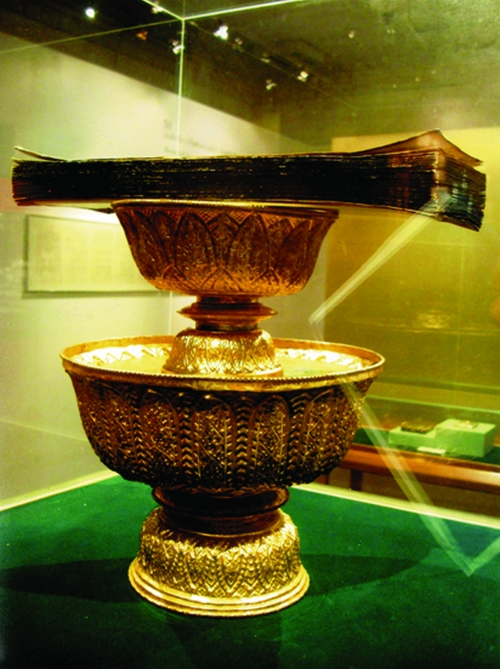
As its organization and network had become fairly developed, the Constitution Association began to serve the revolutionaries by taking charge of a far-reaching project that enabled them to impose a particular version of constitutional culture upon their fellow countrymen. In April 1934, Chamrat Mahawongsanan, the assemblyman for the northern province of Nan, wrote a letter to request a replica of the permanent constitution from Prime Minister Phahon; Chamrat explained that he wanted to place the replica at the provincial hall in Nan, so that the people there would have a ‘pillar to cling on spiritually’. In his view, ‘the people shall be overjoyed once they receive [the replica] as a substitute for the royalty, who used to be revered for so long in the past’.Footnote 58 The cabinet secretariat responded positively within a week and told Chamrat to get in touch with the Constitution Association.Footnote 59 Shortly afterwards, his request was put to the cabinet meeting on 1 May personally by Pridi, then the minister of interior and the recently elected president of the Constitution Association. In spite of his reputation as a progressive, Western-educated leader with a burning ambition to modernize the country, Pridi agreed with Chamrat and apparently tried to push the request through. In the end, the Cabinet did not only accept Chamrat's proposal, but also elevated it to the national level. The ministers concluded: ‘[Chamrat's] idea is good, but we think such replicas should be placed (Praditsathān) in every province.’ The government then announced a plan to produce replicas of the Constitution and distribute them as ‘royally granted objects’ to all provinces in the coming August.Footnote 60 In terms of physical appearance, however, it must be pointed out that the permanent constitution was not simply a parchment or a piece of paper; the law was inscribed in a thick accordion-style codex called ‘Samutthai’ and placed on a two-tiered golden pedestal tray at all times. It was King Prajadhipok who suggested the use of a Samutthai in order to make the Constitution look ‘mystical’ (Khlang).Footnote 61 Traditionally, the Siamese tended to preserve the Samutthai format for Buddhist scriptures, especially the Tripitaka, while using the pedestal tray to honour royal or religious items. Any replica of the permanent charter must therefore include both elements—the Samutthai codex and the pedestal tray (Figure 1). The government entrusted Wichit with the project and authorized Pridi to supervise the design.Footnote 62 Under Wichit's direction, the Fine Arts Department aimed to produce the replicas as ‘objects of worship’. Eventually, it managed to fulfil the mission on time and complete 70 replicas in total—one for each province as well as the head office of the Constitution Association in Bangkok.Footnote 63
Replica of the permanent Constitution from the 1930s. Source: King Prajadhipok Museum, Thailand; photograph taken by the author.

On 28 August 1934, with the approval of the Cabinet, the Constitution Association hosted a public ceremony at the Saranrom Royal Garden so as to celebrate the newly minted replicas. Though Prajadhipok was still abroad, the regent came to preside over the event on his behalf. At the beginning, each elected assemblyman went to stand behind the replica of the province he represented, while senior monks chanted a prayer. The regent then blessed the replicas one after the other by anointing them with a mixture of water and soft-prepared chalk—a Hindu practice commonly used in Siam to sanctify important spiritual objects like Buddha images, amulets, scriptures, and so on. Following the anointment, the public were allowed to view and pay respect to the replicas. The Constitution Association also had amusements at the garden until midnight. On the next day, the Association celebrated and blessed the replicas one more time with a traditional light waving rite before enshrining them at a palace nearby.Footnote 64
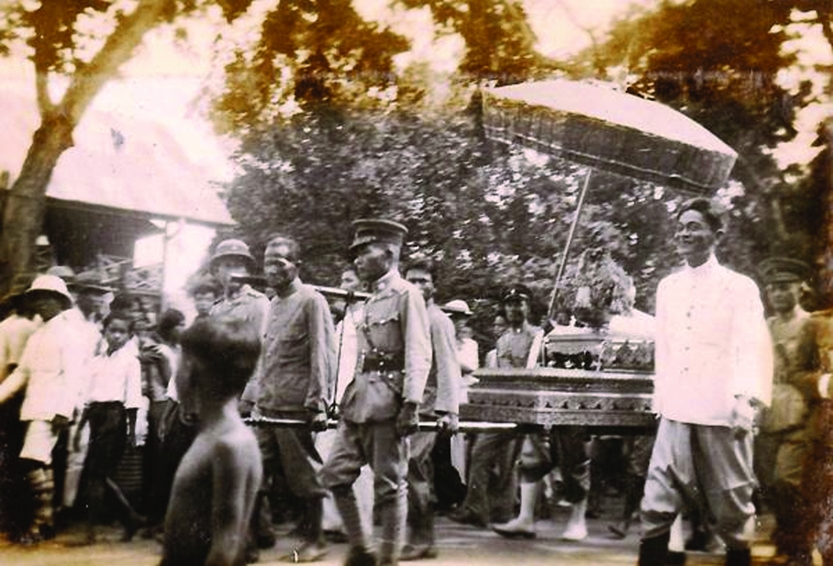
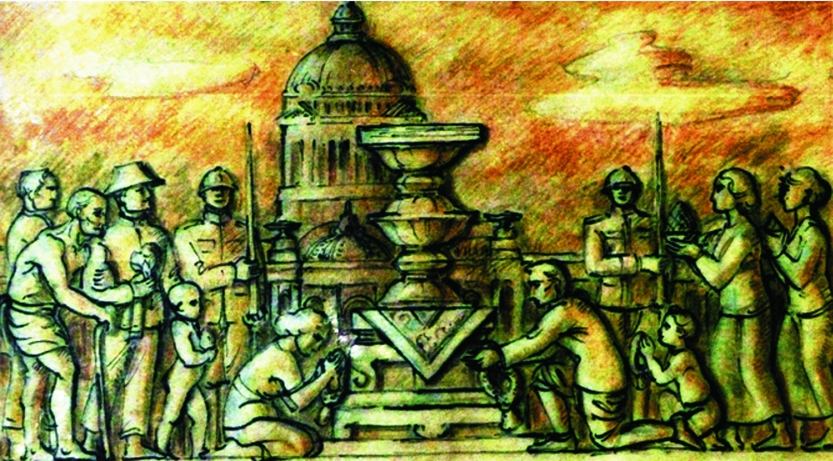
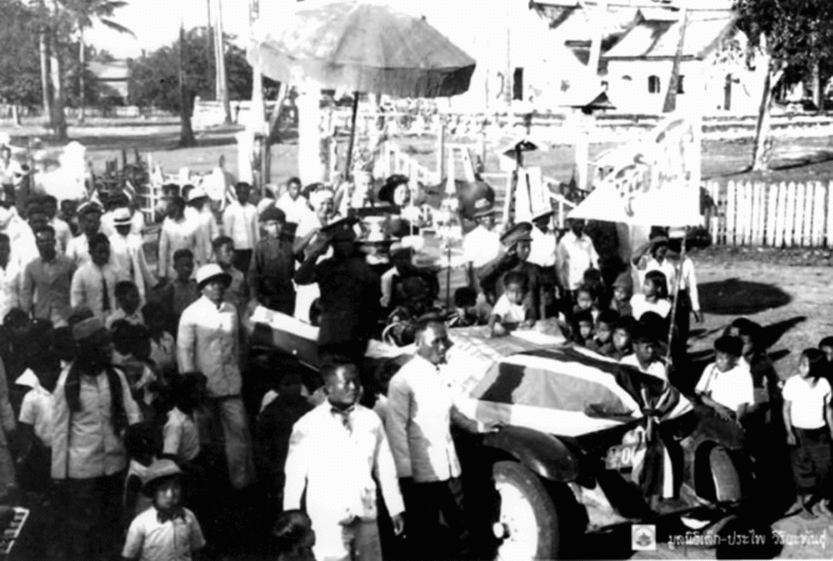
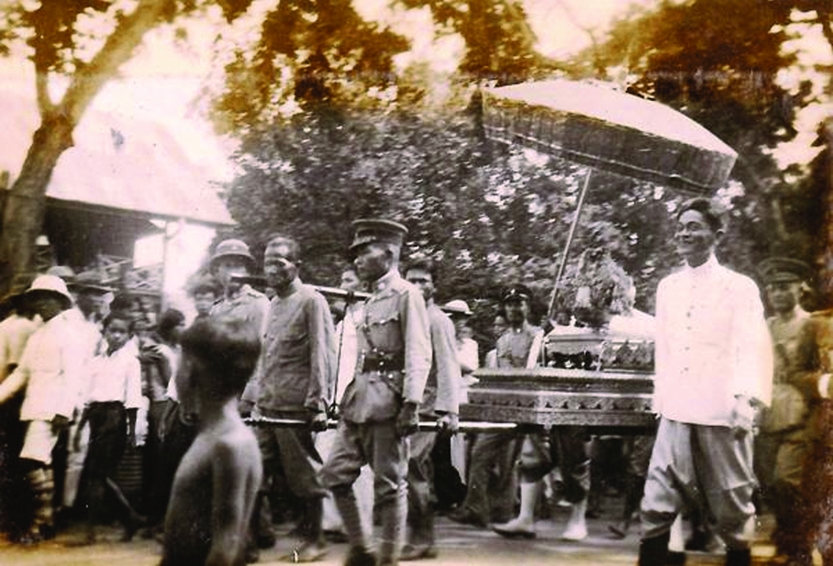
Soon thereafter, the Constitution Association assigned all elective legislators, then serving also in its general assembly, to deliver the replicas to their respective provincial constituencies. As it turned out, these representatives and the local officials were very keen on presenting the replicas as being sacred and ensuring that the delivery would be done with fanfare and pomp. Such enthusiasm on the part of the authorities was probably due to the government directive on 27 August 1934 that instructed every governor to ‘organise a reception for [the replicas] in an appropriate manner’.Footnote 65 In the case of Phetchaburi province, for example, the replica left the capital on a special train and arrived in the province on 9 September. The local authorities celebrated the replica at the train station with a Buddhist blessing ritual and then paraded it to the provincial hall. In front of a large crowd there, the governor gave a speech praising the Constitution before leading his audience to pay tribute to the king and swear allegiance to their basic law. Subsequently and significantly, the replica was put on display for people to come and present flowers, joss sticks, and candles to it.Footnote 66 This was a very typical ritualistic act that the Siamese had employed for generations to honour religious or magical objects; flowers, joss sticks, and candles were the three most customary offerings in Buddhism representing the Triple Gem, namely the Buddha, the precepts, and the monkhood. Aside from Phetchaburi, public officials appeared to promote this unprecedented practice of constitution worship in other parts of the country, thus turning the replicas and their original into fetishes within a very short period of time (Figures 2 and 3).Footnote 67 Even in the far southern Pattani province, where the vast majority of the residents were devout Muslims, the authorities did not hesitate to introduce the replica of the Constitution as a god-like idol. According to the programme of the welcome ceremony on 20 September, the crowd had to bow to the replica to make an obeisance before shouting ‘Long live the Constitution!’ in unison; both Buddhist and Islamic rites were also held to mark the occasion. Later, in the street procession on the following day, schoolchildren marched behind the replica around the city of Pattani with their palms pressed together in a prayer-like manner, while holding flowers, incense sticks, and lit candles.Footnote 68
A replica of the Constitution being paraded on a litter in Ayutthaya province on 23 September 1934; there is a man holding a ceremonial umbrella over it at all times. Source: Thammasat University Archives, Thailand.
A prototype drawing by the Fine Arts Department in the late 1930s romanticizing the practice of constitution worship. Source: Hall of Sculpture, Silpakorn University, Thailand.

Furthermore, as the Constitution increasingly took on an aura of religiosity, people around the country came to observe the custom that, whenever they put a replica of the basic law on display, they must place it in the type of altar normally used for enshrining a Buddha image. In late 1934, some parliamentarians even moved to elaborate this new custom further by asking Wichit, the director-general of the Fine Arts Department at that time, to help build shrine-like cabinets for the replicas in their provinces. Wichit came up with a design in January 1935 and purchase orders shortly started to flow to his department.Footnote 69 Meanwhile, a few assemblymen officially complained that just one replica per province was not enough and the government ought to give the replicas to every single district to serve as ‘the centres of veneration’ there. Prime Minister Phahon lodged no objection against the idea, but expressed concerns over the maintenance burden that would fall upon the local authorities. As a result, instead of carrying out the distribution on a collective basis, the government announced that any district wishing to have its own replica would need to make a request by itself.Footnote 70 The regime, as it turned out, was not entirely convinced that having the replicas at the district level would help strengthen the sacredness of the Constitution. In August 1937, a very remote district in Ubon Ratchathani followed the procedure and asked for a replica of the Constitution; the Fine Arts Department then forwarded the request to the Cabinet for approval, resulting in a brief yet revealing debate among those behind the campaign for the basic law. At a cabinet meeting in mid-September, Wichit urged his fellow ministers not to make it all too easy to obtain the replicas. He reminded them that it was by no means simple even for the provinces to get their own replicas—a ritual ‘no different from the casting ceremony for Buddha statues’ had to be performed first. Another cabinet member seconded Wichit. He warned that districts, villages, and individuals might fail to handle and enshrine the replicas properly; in his opinion, ‘having too many [replicas] will dilute their sacredness’. Prince Wan, however, expressed a slightly different view. While not denying the need to preserve the ‘mystical’ appearance of the Constitution, the prince believed it remained an unsettled ‘psychological’ question whether having more replicas would weaken or reinforce such appearance.Footnote 71 In the end, after consulting the Constitution Association,Footnote 72 the Cabinet decided on 21 October to adopt a case-by-case approach and delegate the matter to the Association. According to the new procedure, every district must get a supporting letter from the Constitution Association before filing a request for the replica; the Association now had the authority to review and decide on each request.Footnote 73 The regime, all in all, certainly wished to transform the basic law into a sacred entity, but it was also careful not to go overboard and let the sacredness become exhausted, especially at the hands of the worshippers. In addition, it should be noted that every leading figure of the new regime seemed to welcome the emerging practice of constitution worship without much hesitation; in spite of their differing ideologies and political ambitions, all turned out to accept the religious theme employed by the campaign and take part in the sacralization of the Constitution to varying degrees. This unity would last until the early 1940s, when the collective leadership of the revolutionaries began to give way to the personal rule of one supreme leader.
Another episode that helps highlight the sensitivity that the new regime had towards the sacredness of the basic law comes from an attempt to protect constitutional symbolism from derision. In July 1935, the police placed a villager in Nakhon Si Thammarat province under investigation for ridiculing the Constitution. According to an internal report by the Ministry of Interior, which was translated into English for foreign legal advisers:
It appears that . . . the accused has put a rag around the frame containing Constitution's representation which was hung in front of the Buddhist image . . . and he also placed around the same, [a] ladle, [a] colander, and an iron dented instrument for grasping the pulp of coconut and he lay laughing nearby. When questioned by on-lookers, he said that he was celebrating the Constitution.Footnote 74
Even though the authorities decided not to prosecute the man, for his conduct was ‘not yet punishable by law’, they arrived at the conclusion that there must be a statute prohibiting any derision committed against the Constitution.Footnote 75 In a memorandum submitted to the Cabinet in early 1936, Pridi, the minister of interior, attempted to make a case by drawing a comparison between the basic law and Buddhism:
[The permanent constitution] has representation for idolatry analogous to that of the Buddhist image. . . . The religion is already protected as regards the act of derision and deterioration. The Constitution is perceived as a supreme object which should deserve same protection.Footnote 76
Eventually, in early 1938, after expanding on the idea and considering case studies from a range of countries, the Council of State finished designing a legal measure for protecting the Constitution, as well as other official symbols, from disrespectful treatment. The government was about to insert into the Penal Code an article that read that ‘whoever does anything with an intention to contempt any emblem of the State or of the Constitution . . . shall be punished with a fine not exceeding 500 baht or imprisonment not exceeding one year or both.’Footnote 77 Nonetheless, it later turned out that the government did not carry on with this project until the end. In late 1938, Phibul replaced Phahon as prime minister, resulting in a new set of national ideologies. The campaign for the Constitution was quickly downgraded and forsaken, as will be discussed. This was arguably why the legal measure for the basic law never materialized, despite the fact that the regime had come close to implementing it.Footnote 78
Preserving the sacredness: Constitution Day celebrations
Aside from bringing the practice of constitution worship into being, the revolutionaries also wished to maintain and prolong its hold over the Siamese. Predictably, they soon came to see Constitution Day as their perfect opportunity to pursue such a goal. The day, which fell on 10 December, signified the moment when the permanent charter was promulgated in 1932. The new regime had designated 10 December as a public holiday since then and regularly observed it with extensive national celebrations that lasted between 8 and 12 December each year. The regime took the occasion seriously and devoted a great deal of effort into making 10 December the ‘most notable date in the Siamese calendar’, outshining even the king's birthday.Footnote 79 In the end, throughout the 1930s, Constitution Day was essentially the time to renew the sacredness of the national charter on a massive scale—the most convenient annual period whereby the new elite reaffirmed their preferred version of constitutional culture by having countless Siamese line up before the basic law, pledge allegiance to it, and even offer sacrifices.
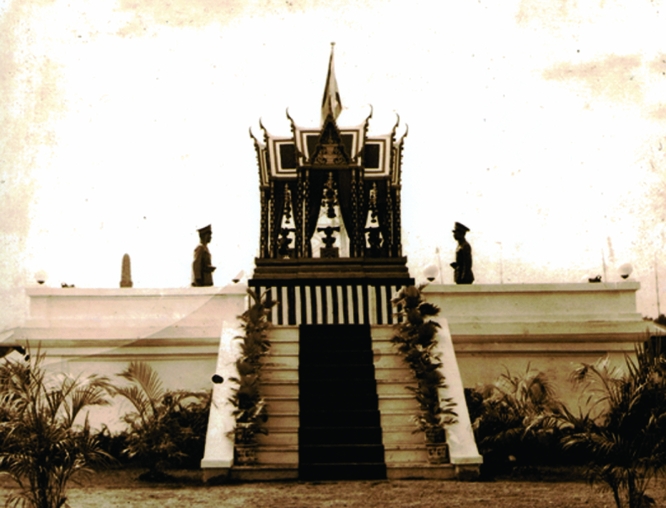
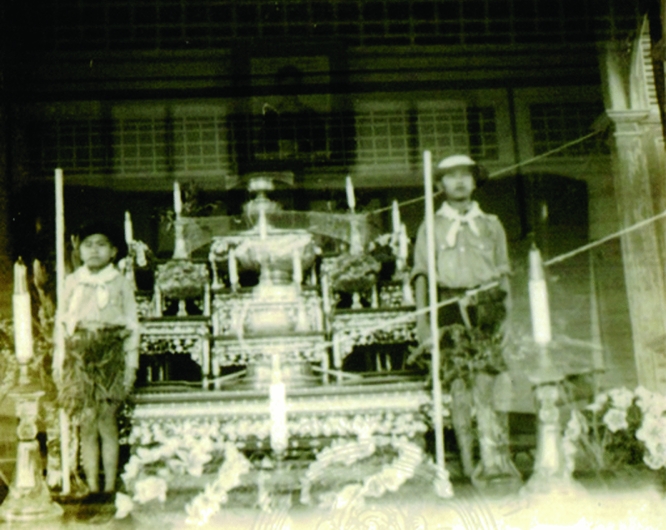
In Bangkok during the occasion, the original copy of the permanent charter normally went on display inside a temporary pavilion at Sanam Luang, the large public ground opposite the Grand Palace. This pavilion—the centre of the nation's Constitution Day observances—was undoubtedly a shrine; it resembled a Southeast Asian spirit house in design and was guarded round the clock by two ceremonial sentries (Figure 4). Different religious functions, such as Buddhist merit-making rites and Hindu blessing rituals, were also performed here all through the celebrations.Footnote 80 Meanwhile, each province marked the beginning of the Constitution Day period with a street procession featuring a replica of the basic law (Figure 5). A relatively good crowd usually turned out to pay homage. In various provinces, ranging from Phang Nga to Uttaradit and from Nakhon Nayok to Mae Hong Son, people even set up small altars along both sides of the street to welcome the replica with votive offerings.Footnote 81 During the procession in Buriram on 9 December 1936, specifically, the onlookers tossed popped rice and petals at the passing replica before cheering in a prayer-like manner.Footnote 82 Also, throughout the celebrations, every province displayed its replica on an altar surrounded by religious adornments. Police officers or boy scouts would stand guard over the replica at all times, while people came to worship it by swearing allegiance, offering sacrifices, or attending religious rites in its honour (Figure 6).Footnote 83 Even in a Muslim province like Yala, the local officials urged everyone to take an oath of loyalty to the Constitution and show respect to its replica with flowers, joss sticks, and candles.Footnote 84 Not a few provinces, furthermore, paraded their replicas far beyond urban areas, so that the villagers in some of the most isolated parts of the country would be able to experience the practice of constitution worship at first hand.Footnote 85 For example, as part of the Constitution Day celebrations in 1936, Uttaradit province dispatched a propaganda team to promote its replica of the Constitution in the outlying districts, including ones that had to be reached by elephant riding. The team ended up spending almost a month travelling through jungle; they organized worship rituals in villages and, according to the official report, managed to induce numerous natives to participate.Footnote 86 Additionally, many rural districts also had their own Constitution Day celebrations alongside those at the provincial centres. These local celebrations were modest in scale, of course, but they proved the most elaborate annual event in their respective districts. The authorities would use a picture of the basic law as the sacred focal point around which the celebrations took place.Footnote 87 Such activities allowed the practice of constitution worship to spread more widely and represent not just a phenomenon of the towns.
The Constitution and its two replicas—one from the head office of the Constitution Association and one from Thonburi province—go on display inside a shrine during the 1938 Constitution Day celebrations in the capital. Source: National Archives of Thailand.

Sakon Nakhon province parades its replica of the Constitution in December 1935. Source: Miss Rachaneeboon Tangkhanasingha, Lek-Prapai Viriyahpant Foundation, Thailand.

A replica of the Constitution is placed on an altar and guarded by Boy Scouts during the 1935 celebrations in Phuket province. Source: National Archives of Thailand.

At least until the late 1930s, the Constitution Association was responsible for working out an overall plan for the celebrations each year, while its branches cooperated with the local authorities in preparing the event on the ground. The government made it clear to all that 10 December would need to be taken seriously. In 1940, Satun province requested permission to postpone the Constitution Day celebrations until late December; the province explained to Bangkok that it was suffering a monsoon season that may incur a heavy financial loss if the celebrations went ahead as scheduled. The central authorities, however, were unsympathetic. In a reply that was forwarded to all provinces, they flatly rejected the request on the grounds that ‘the Constitution Day celebration is an important national commemoration [and therefore] every province will have to organise [it] on [10 December] in concert’.Footnote 88 Besides laying down such an uncompromising guideline, the authorities in the capital monitored all public activities during the Constitution Day period with interest. The provinces were required to keep Bangkok informed; failing to do so would result in a reprimand.Footnote 89 According to the Ministry of Interior, every governor ‘should realise that the Constitution Day commemoration is the nation's crucial event; anything that has been done should be reported to the Ministry’. The ministry would in turn summarize and forward the matter to the Cabinet.Footnote 90 Furthermore, the importance that the revolutionary government attached to Constitution Day was also reflected in a lawsuit against a public prosecutor. In mid-1935, the state accused Luang Uchungkhadi of being disloyal to the constitutional regime. During the internal investigation, it appeared that much attention was given to whether he was unwilling to partake in the recent Constitution Day celebrations in Phetchabun, the province where he was stationed; the investigators told Uchungkhadi to ‘describe your undertakings during the celebrations which may demonstrate your respect and admiration for the Constitution’, while a police sergeant testified that he was the only official who was absent from the street procession on Constitution Day. Finally, the investigators brought the case to the criminal court, even though they were aware that the evidence against Uchungkhadi was not particularly strong.Footnote 91
Significantly, when considering in detail the public ceremonies and symbolic displays that dominated the Constitution Day celebrations throughout the 1930s, one would be struck by their resemblances to the customs that the Siamese had applied for centuries to spiritual items like Buddha statues, deities, amulets, or scriptures. All the mystical pageantry and ornaments that the new regime exploited in creating an aura of sacredness for the permanent constitution and its replicas were simply appropriated from the established pattern of worship. The regime, in other words, tapped into the existing cultural repertoire of the society without making any adjustment; the traditional spectacles and icons were employed not only as media in promoting the Constitution, but also as messages. According to a report written by the British Minister in 1934 right after witnessing the Constitution Day observances in Lopburi:
In a pavilion set apart for a religious service to be held . . . I observed that three altars had been erected. One was dedicated to the Buddha, whose statue rose above it, whilst another was for the King and was, in conformity with time-honoured custom, surmounted by a portrait of His Majesty. The third altar was that of the Constitution, a miniature copy of which was placed upon it; this altar, the largest of the three, occupied the centre of the stage, the other being relegated to the background, and I was surprised to find that the same offerings of candles and of flowers had been arranged in front of it as in the case of the latter. In other words, semi-divine honours were being paid to the Constitution, in the hope, presumably, that the simple-minded Siamese peasant would be induced thereby to regard it as a real entity upon which he could lavish some of that personal devotion which he had reserved hitherto for the monarch of the land. I must confess that as an admirer of the old-time traditions of Siam, I was somewhat shocked by this travesty of an ancient practice.Footnote 92
Drawing profoundly on the traditional conception of the sacred, the new regime seemingly intended no more than to have the populace perceive and treat the basic law in the same manner as they had adopted towards any object that was deemed to possess magical power. The ruling elite in general and the Constitution Association in particular preached that the people must have faith in the Constitution, so that its merit would permit Siam to thrive. For example, in November 1934, while presiding over the opening of the Constitution Association branch in Nan, Phahon explained:
The Constitution is a sacred object that we all must worship. But in order for the Constitution to continue eternally as a pillar that facilitates the prosperity of the nation, [it] must be embedded in the minds of the Siamese people.Footnote 93
One month later, the prime minister's point was reiterated in a radio speech by Pridi, in his capacity as the president of the Constitution Association. Despite his remark at the beginning that ‘the age of superstitions and things held sacred is a thing of the past’, Pridi told the nation:
The Constitution, apart from being the highest law, is the highest form of Dharma as well. The appreciation for and adherence to the Constitution with a purity of heart should produce good results both in a worldly manner and also in the Dharma direction.Footnote 94
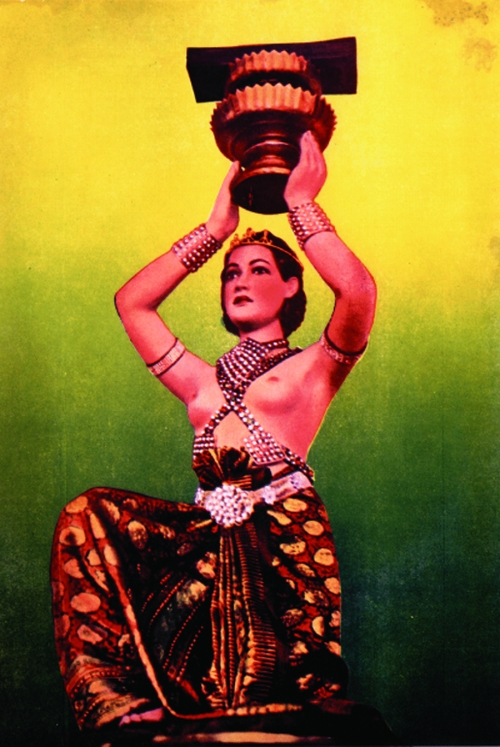
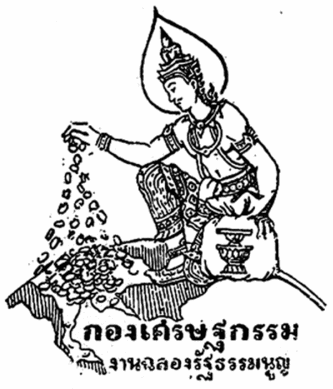
On the one hand, Pridi's reference to Dharma or the teachings of the Buddha could be part of an attempt to portray the Constitution as a religious object to which the public should devote their reverence in the hope that they may receive ‘good results’ in return. On the other hand, it may also be argued that the reference simply linked the Constitution to the Buddhist notion of just laws and virtue. This ambiguity, however, did not arise in the case of Netr Phunwiwat—an appointed assemblyman and the secretary of the Constitution Association. In 1934, Netr delivered a public lecture on behalf of the government. He declared that ‘those who see our Constitution as Lord Buddha's scripture were absolutely correct’. The people, he continued, ‘must be willing to sacrifice the last drop of blood to protect the sacred Constitution as if [they are] defending Buddhism’.Footnote 95 Similarly, in his article entitled ‘Providence of the Constitution’, which appeared in the commemorative book for the Constitution Day celebrations in 1933, Netr equated the Constitution to the spirit house that people must respect, otherwise bad things would happen to them, including a stomach ache; in Netr's view, Prince Bovoradet and his accomplices were doomed to failure because they disregarded and challenged ‘the providence of the constitution’.Footnote 96 Moreover, the mystical theme was very much evident in many artworks that could be found in the Constitution Day events during the late 1930s. There were famous paintings like one with an angel lifting Siam up to the moon that had the figure of the basic law in the centre or one that was called ‘Miss Constitution’ depicting a goddess-like woman bearing the Constitution high above her head (Figure 7).Footnote 97 Even the emblem of the Economic Office, a division within the committee in charge of holding the Constitution Day celebrations in Bangkok, implied the spiritual nature of the charter (Figure 8). The Office was responsible for exhibitions that showcased national achievements in the fields of agriculture, industry, and commerce.
The Miss Constitution, a painting that won the national art contest in 1939; the Publicity Bureau later used it to promote the basic law. Source: Museum and Archive of the Public Relations Department, Thailand.

The emblem of the Economic Office showing a Siamese-style angel scooping prosperity from a bag that represents the Constitution and pouring it on Siam. Source: National Archives of Thailand.

Given its intent to advance a version of constitutional culture that bordered on religiosity, the new regime had to focus on convincing the Siamese of the sacredness of their basic law; emphasis was laid on the traditional pomp and circumstance that may affect the document's outward appearance. The regime, accordingly, did not seem to direct much attention to telling the general public about what was written in the Constitution. As Scott Barmé critically notes, ‘the [Constitution] Association decided to promote the Constitution not as a practical code defining the relationship between the people and the state, but as a revered object of national importance’.Footnote 98 This conclusion is also in agreement with the view expressed in 1934 by the British Minister in Siam:
By dint of assiduous propaganda [Ratthathammanūn—the term for constitution in Thai] is now on every lip, though, as I have intimated, it probably conveys no more to the average person than did ‘that blessed word Mesopotamia’ to the old lady in the story who employed it without having the slightest conception of its meaning! . . . The method adopted by the authorities is to teach the people that the Constitution is not to be looked upon as a mere symbol, but as something more tangible than that, as an object of religion, in fact, which merits all the external marks of veneration usually accorded to things partaking of a sacred character.Footnote 99
While it is very difficult, if not impossible, to tell how far the society regarded the basic law genuinely as a sacred entity, the practice of constitution worship was widespread and became part of the Siamese public life throughout the 1930s. Apparently, much of this success lay in the fact that Constitution Day was the most festive and exciting occasion in the country at that time. The people at large looked very much forward to 10 December; families flocked to the Constitution Day celebrations to have fun, while it was common for teenagers, at least in the capital, to use the events as dating opportunities.Footnote 100 To be sure, these people may not give much thought to the basic law; they might be willing to go through all the solemn ceremonies simply in exchange for the entertainment that Constitution Day would provide. However, as long as most Siamese behaved like faithful worshippers of the Constitution, the regime was content. The success of the campaign seemed to be evaluated by the size of the crowds who turned out to pay homage to the Constitution or its symbolism. As declared on the radio by Prime Minister Phahon in December 1934:
According to what I have personally observed in the celebrations of the Constitution in different places, in [the Northwest] and Bangkok principally, I have had the greatest delight in seeing that the people of Siam are strongly in fervour of and really love their Constitution; and also in seeing that the Constitution is held to be sacred and that its prestige will keep the Kingdom one and indivisible.Footnote 101
Likewise, in January 1937, the governor of Uttaradit reported on the latest Constitution Day observances in his province; he told Bangkok with pleasure that:
There was a few sprinkles of rain tonight, causing the people to become even more faithful to the virtue of the Constitution. . . . People—both women and men, both children and elders—all came to pay respect and worship our beloved Constitution collectively, with flowers, incense sticks, candles, and flags presented as sacrifices. . . . [This] demonstrates that the people in the rural areas of this Uttaradit province believe in . . . [and] respect [the Constitution] just like Lord Buddha's teachings.Footnote 102
Interestingly, this governor was probably the one whose comments caught attention from the British Minister a few years earlier. In 1934, the minister wrote to London that:
Another, but a more humorous, note . . . was struck not long ago by the Governor of [Uttaradit], who had occasion to report upon the loss of life caused to the onlookers by an accident to an aeroplane which was carrying a miniature copy of the Constitution to the town of Nan (in North-Eastern Siam). This official solemnly expressed his belief that, but for ‘the prestige attaching to the Constitution’, the number of lives lost would have been greater still!Footnote 103
Conclusion
Constitution worship remained the order of the day until about the early 1940s. After Phahon stepped down in 1938, the Constitution and its symbolism began to fall out of favour. Phibul, the new prime minister, sought to concentrate all power in his hands, while depicting himself as ‘the Leader’ whose visionary guidance was indispensable to the nation's survival.Footnote 104 The state, accordingly, moved away from depending on the Constitution as its main legitimizing symbol.Footnote 105 Siam now wanted the society to be loyal to the premier, rather than the basic law; Phibul's personality cult took priority over the campaign for the Constitution. As explained to the Cabinet by Phibul himself during the heyday of his rule in 1942:
Japan has something to believe in: their Emperor. We do not have anything concrete to believe in. What we have now are the Nation, the Religion, the Monarchy, and the Constitution. The Nation does not exist yet; the Religion does not make people devoted enough; the Monarchy is merely a boy who can only be seen from a portrait; the Constitution is a book. When the country is in crisis, we cannot believe in [any of these institutions]. I therefore have [us] follow the Prime Minister.Footnote 106
In the end, the state quietly abandoned the effort to popularize and sacralize the basic law. A registrar of the Constitution Association described the situation during Phibul's leadership:
Not even a single meeting was held. . . . The Association was forsaken [and] left to its fate. Sometimes there was work to do; sometimes there was not. As each month passed, the salaries were paid. This situation continued for years and then some staff members stopped turning up for work, causing the situation to deteriorate further. The office became empty.Footnote 107
The Constitution Association was financially ruined and became inactive in the mid-1940s; the available evidence suggests that it completely disappeared within four or five years after the Pacific War.Footnote 108 For the meantime, the once-revered replicas of the Constitution were no longer paraded or enshrined, while 10 December lost its standing as the most prestigious date in Siam's calendar.Footnote 109 All in all, by the 1950s, it was as if the practice of constitution worship had never existed. Despite all the support that had been showered, the practice failed to take on a life of its own and could not survive after the state shifted its ideological underpinning. The Siamese, as it turned out, did not develop a strong attachment to the permanent Constitution, nor did they appear to believe passionately in constitutional rule. Eventually, the parliament was able to annul the permanent Constitution in May 1946 without any outcry and, when the military staged a coup d’état in the following year to abolish a basic law, the general public were indifferent, forcing the resistance to die out within weeks.Footnote 110
With hindsight, the fact that the first permanent charter as well as the constitutional regime itself could be easily overthrown is particularly telling. It suggests, at the very least, that the vigorous campaign by the Siamese state during the 1930s turned out to be a failure in the end. Besides giving birth to the permanent Constitution, the revolutionaries sought to dictate and manipulate its cultural meanings. In doing so, they chose to draw on traditional customs and advance a version of constitutional culture that was firmly grounded in Siam's existing ‘webs of significance’, to use Clifford Geertz's term.Footnote 111 The new regime introduced the basic law to the people in the guise of other symbols to a substantial extent; its campaign merely borrowed identities from traditional elements in the society, rather than developing distinctive ones for the Constitution. Such an approach may prove convenient, especially in view of the country's high illiteracy rate and limited education infrastructure,Footnote 112 but it also seemed to prevent the Constitution from standing out as an important institution per se. The revolutionaries promoted the charter not so much a unique legal code as another sacred object. It is thus understandable when a famous activist recalls his life in the early 1940s that:
[As] a young boy, I remember visiting a constitution festival. I saw soldiers and police officers solemnly guarding the pedestal tray supporting the constitution. This misled me to believe that the constitution and democracy were divine and transcendental things in the manner of religion and the kingship.Footnote 113
In many ways, by popularizing the first permanent Constitution as something traditionally sacred, the campaign was self-defeating. Standing at the historical juncture where the public perceptions of constitutional rule were taking shape in Siam, the revolutionaries appeared to waste an unparalleled opportunity to instil a constitutional culture that was truly conducive to the permanent charter and the principle of constitutional rule in general. Instead of ‘passive subjects’ who showed up at worship rituals, the new regime could have created ‘active citizens’ who viewed a constitution as a binding legal instrument they could actually use. It is possible to argue that a shift in the theme adopted—for example, by turning to focus on the content of the Constitution—may lead to a different outcome and affect the prospects for constitutional stability in the country. To a certain degree, the decision to sacralize the Constitution could be attributed to the new regime's distrust in the people. Arjun Subrahmanyan concluded that the revolutionaries believed their compatriots to be ‘politically immature’ and that ‘democratic paternalism’ was needed.Footnote 114 Such a conviction might be a factor that induced them to run the campaign in the manner they did; the people were ready for a national symbol, not a supreme law. Moreover, having turned the Constitution into an icon, the revolutionaries also seemed to avoid much difficulty from below; the Siamese were supposed to dedicate themselves to the ‘sacred’ Constitution, rather than using it to assert their rights or keep the rulers in check.
Additionally, another serious drawback arose from the fact that the campaign made it hard for the ideal of constitutional supremacy to take root in the public perception. The new regime seemed to overlook the need to challenge the hegemonic values and establish the permanent constitution symbolically as the only source of political legitimacy in the country. The regime instead relied on those values and persuaded the people into associating the Constitution with traditional elements. In this sense, what the campaign actually did was to promote a basic law as part of the existing cultural structure that had dominated the society and served the royalist elite for decades. The revolutionary regime, as Scot Barmé points out, ‘had compromised its stated democratic ideals by having the constitution absorbed into a conservative, elite-centred discourse’.Footnote 115 In the end, together with the popular narrative that portrayed the first permanent charter as a ‘royally granted object’, the campaign apparently brought about a constitutional culture in which the supremacy of a constitution remained vulnerable, especially in the face of long-established institutions like the throne.
Lastly, it should be noted that examining the campaign for the permanent Constitution in detail also presents the revolutionary period in an unusual light. The period is often seen as a moment of political modernization in Siam, representing the turning point when absolutism gave way to democracy, when a semi-divine right regime was replaced by a modern one, and when subjects became citizens.Footnote 116 However, by looking at the campaign and the practice of constitution worship, this article demonstrates that the revolutionary period was a moment of ‘traditionalization’ as well. Rather than promoting the Constitution as part of modernity, the new regime turned it into part of the mystical; rather than creating constitutional citizens, the regime brought about constitutional subjects, at least in the sense that everyone was expected to be obedient and display complete loyalty towards their ‘sacred’ national charter. The new regime, to sum up, transformed the modern into the traditional, instead of the other way around. In this sense, while the revolutionaries had swept away the ancient regime, they still observed and resorted to the old cultural fabric of the society; much continuity was therefore preserved, if not reinforced.