



1 Introduction
Let
 $\mu $
be a compactly supported Borel probability measure on
 $\mathbb {R}.$
We say that
 $\mu $
is a spectral measure if there exists a countable discrete set
 $\Lambda \subset \mathbb {R}$
such that the set of exponential functions
 $E(\Lambda ):=\{e^{2\pi i\lambda x}:\lambda \in \Lambda \}$
forms an orthonormal basis for
 $L^2(\mu )$
, and then
 $\Lambda $
is called a spectrum of
 $\mu $
. If a spectral measure
 $\mu $
is the Lebesgue measure on a measurable set
 $\Omega ,$
then we say that
 $\Omega $
is a spectral set.
The research of spectral measures originated from Fuglede [Reference Fuglede11], whose famous conjecture asserted that the normalized Lebesgue measure restricting on a domain
 $\Omega \subset \mathbb {R}^d$
is a spectral measure if and only if
 $\Omega $
is a translational tile. The conjecture was disproved eventually by Tao and others in the cases of three and higher dimensions [Reference Kolountzakis and Matolcsi15, Reference Kolountzakis and Matolcsi16, Reference Tao22]. However, the situation in dimensions
 $d\leq 2$
is much less understood. In 1998, Jorgensen and Pedersen [Reference Jorgensen and Pedersen14] studied the spectral property of the self-similar measures and constructed the first singular, nonatomic spectral measure
 $\mu _{4,\{0,2\}}$
. Their construction is based on a scale 4 Cantor set, where the first and third intervals are kept and the other two are discarded, that is,
 $\mu _{4,\{0,2\}}$
is the standard one-fourth Cantor measure. In the same paper, they also showed that
 $\Lambda _{4,2}$
is a spectrum of
 $\mu _{4,\{0,2\}}$
, where
 $$ \begin{align} \Lambda_{4,2}=\{0,1\}+4\{0,1\}+4^2\{0,1\}+\cdots\quad(\text{all finite sums}). \end{align} $$
Jorgensen and Pedersen’s example opened up a new area of research and many other examples of singular measures that admit orthonormal bases have been constructed including self-similar/self-affine/Moran fractal measures (see [Reference An, Fu and Lai2, Reference Dai, He and Lau4, Reference Dutkay, Haussermann and Lai8] and so on). At the same time, many differences between singular spectral measures and absolutely continuous spectral measures have been discovered. For example, a typical difference is that there is only one spectrum
 $\Lambda =\mathbb {Z}$
containing 0 for
 $L^2([0,1]),$
while there are uncountable spectra (up to translations) for
 $L^2(\mu _{4,\{0,2\}})$
[Reference Dutkay, Han and Sun5]. Moreover, for the spectrum
 $\Lambda _{4,2}$
given by (1-1), there exist infinitely many t such that each
 $t\Lambda _{4,2}$
is also a spectrum of
 $\mu _{4,\{0,2\}}$
[Reference Dutkay and Haussermann7]. Motivated by these exotic facts, Fu et al. [Reference Fu, He and Wen9] proposed the spectral eigenvalue problems more systematically.
Spectral eigenmatrix problems
For a given singular spectral measure
 $\mu $
, there are two basic problems as follows.
Problem 1. Let
 $\Lambda $
be a spectrum of
 $\mu .$
Find all real matrices R (or real numbers r) such that
 $R\Lambda $
(or
 $r\Lambda $
) is also a spectrum of
 $\mu .$
In this case, we call R (or r) a spectral eigenmatrix (or eigenvalue) of the first type of
 $\mu $
.
Problem 2. Find all real matrices R (or real numbers r) for which there exists a set
 $\Lambda $
such that both
 $\Lambda $
and
 $R\Lambda $
(or
 $r\Lambda $
) are spectra of
 $\mu .$
In this case, we call R (or r) a spectral eigenmatrix (or eigenvalue) of the second type of
 $\mu .$
The importance of the spectral eigenvalue problems is that different spectra may have different convergence for a given spectral measure (see [Reference Dutkay, Han and Sun6, Reference Fu, Tang and Wen10, Reference Pan and Ai19, Reference Strichartz21]). In
 $\mathbb {R}$
, there are many people studying the spectral eigenvalues of
 $\mu _{r,D}$
with
 $\#D=2, 3, 4$
or consecutive digits
 $D=\{0,1,2,\ldots ,N-1\}$
(see [Reference Ai1, Reference Dai3, Reference Dutkay and Haussermann7, Reference He, Tang and Wu12] and so on). However, it is difficult to express or characterize all the eigenvalues for any spectral measure.
Let
 $M>1$
and D be a finite set in
 $\mathbb R$
. Define the iterated function system (IFS)
 $$ \begin{align*} \tau_d(x)=M^{-1}(x+d) \quad (x\in \mathbb{R},\ d\in D). \end{align*} $$
By Hutchinson’s theorem [Reference He, Tang and Wu12], there exists a unique Borel probability measure
 $\mu _{M,D}$
such that
 $$ \begin{align} \mu_{M,D}(E)=\frac{1}{\#D} \sum_{d\in D} \mu_{M,D}(\tau^{-1}_d(E)) \quad \text{for any Borel set }E\subset \mathbb{R}, \end{align} $$
where # denotes the cardinality. In 2022, Li and Wu [Reference Li and Wu18] studied the spectral eigenvalue problems of the self-similar measure
 $\mu _{R,B}$
generated by the integer
 $R=N^q\geq 2$
and the product-form digit set
 $B=\{0,1,\ldots ,N-1\}\oplus N^p \{0,1,\ldots ,N-1\}$
, where the integers
 $q>p\geq 2$
and
 $N\geq 2$
. They completely settle two types of spectral eigenvalue problems for
 $\mu _{R,B}$
. Motivated by their work, we focus on the spectrality and spectral eigenvalue problems of a class of self-similar measures
 $\mu _{M,D}$
generated by
 $M=RN^q\geq 2$
and the product-form digit set
 $$ \begin{align*}D=\{0,1,\ldots,N-1\}\oplus N^{p_1}\{0,1,\ldots,N-1\}\oplus \cdots \oplus N^{p_s}\{0,1,\ldots,N-1\},\end{align*} $$
where
 $R\geq 2$
,
 $N\geq 2$
, q,
 $p_i$
are integers for all
 $1\leq i\leq s$
with
 $\gcd (R,N)=1$
and
 $1\leq p_1<p_2<\cdots <p_s<q$
.
Our main results of this paper are as follows.
Theorem 1.1. Let
 $M=RN^q$
and
 $D=\{0,1,\ldots ,N-1\}\oplus N^{p_1}\{0,1,\ldots ,N-1\}\oplus \cdots \oplus N^{p_s}\{0,1,\ldots ,N-1\}$
, where
 $R \geq 2$
,
 $N\geq 2$
, q,
 $p_i$
are integers for all
 $1\leq i\leq s$
with
 $\gcd (R,N)=1$
and
 $$ \begin{align*}1 \leq p_1<p_2<\cdots<p_s<q.\end{align*} $$
Then, the self-similar measure
 $\mu _{M,D}$
defined in (1-2) is a spectral measure with a spectrum
 $$ \begin{align} \Lambda=\bigg\{\kern-2pt\sum_{j=1}^{k}(RN^q)^{j-1}l_j:k\geq1 ,\ l_j\in{L}\bigg\}, \end{align} $$
where
 $$ \begin{align*}L=RN^q\bigg(\frac{1}{N}\{0,1,\ldots,N-1\}\oplus\frac{1}{N^{p_1+1}}\{0,1,\ldots,N-1\}\oplus\cdots\oplus\frac{1}{N^{p_s+1}}\{0,1,\ldots,N-1\}\bigg).\end{align*} $$
Remark 1.2. In Theorem 1.1, to avoid the classical case
 $\mu _{M,D}$
is Lebesgue measure, we assume that
 $R\geq 2$
. If
 $R\geq 1$
, we have to replace the condition
 $1 \leq p_1<p_2< \cdots <p_s<q$
by
 $ 2\leq p_1<p_2<\cdots <p_s<q$
or
 $ 1\leq p_1<\cdots <p_i<p_i+1<p_{i+1}<\cdots <p_s<q$
or
 $1\leq p_1<p_2<\cdots <p_s<p_s+1<q$
; see our Theorem 5.6.
For the spectral measure
 $\mu _{M,D}$
defined in Theorem 1.1, we completely settle two types of spectral eigenvalue problems for
 $\mu _{M,D}$
.
Theorem 1.3. Let
 $\mu _{M,D}$
be the self-similar spectral measure with a spectrum
 $\Lambda $
defined in Theorem 1.1. Suppose that t is a real number, then
 $t\Lambda $
is also a spectrum of
 $\mu _{M,D}$
if and only if t is an integer with
 $\gcd (t,N)=1$
and there is no
 $I=i_1i_2{\cdots }i_n(I\neq {0^n})$
with all
 $i_j\in L$
such that
 $$ \begin{align} ((RN^q)^n-1)|t(i_1+(RN^q)i_2+\cdots+(RN^q)^{n-1}i_n) \end{align} $$
for all
 $n\leq \#\{T(RN^q,tL)\cap \mathbb {Z}\}$
, where
 $$ \begin{align*} T(RN^q,tL)=\bigg\{\sum_{j=1}^{\infty}(RN^q)^{-j}c_j:c_j\in{tL} \bigg\}. \end{align*} $$
Theorem 1.4. Let
 $\mu _{M,D}$
be the self-similar spectral measure defined in Theorem 1.1. For a real number t, there exists a countable set
 $\Lambda '\subset \mathbb {R}$
such that
 $\Lambda '$
and
 $t\Lambda '$
are both spectra of
 $\mu _{M,D}$
if and only if
 $t={t_1}/{t_2}$
for some
 $t_1,t_2\in \mathbb {Z}$
, where
 $\gcd (t_1,t_2)=1$
and
 $\gcd (t_i,N)=1$
for
 $i=1,2$
.
The paper is structured as follows. Section 2 is devoted to summarizing some basic results and proving Theorem 1.1. Section 3 provides the proof of Theorem 1.3. In Section 4, we prove Theorem 1.4 by using contradiction and constructing a new class of spectra. In Section 5, we give several examples and a concluding remark to illustrate our theorems.
2 Preliminaries and proof of Theorem 1.1
In this section, we introduce some basic results that are used in our proofs. In particular, we prove Theorem 1.1.
For the self-similar measure
 $\mu _{M,D}$
defined in (1-2), it can also be expressed as an infinite convolution product
 $$ \begin{align*} \mu_{M,D}= \delta_{M^{-1}D}*\delta_{M^{-2}D}*\delta_{M^{-3}D}*\ldots, \end{align*} $$
where
 $\delta _{E}=({1}/{\#E})\sum \nolimits _{e\in E}\delta _e$
,
 $\delta _e$
is the Dirac measure at the point
 $e\in E$
, and the convergence is in a weak sense. The Fourier transform of
 $\mu _{M,D}$
is defined as usual,
 $$ \begin{align} \hat{\mu}_{M,D}(\xi)={\int}e^{2\pi{i}\langle \xi,x\rangle}d\mu_{M,D}(x)=\prod_{k=1}^{\infty}m_{D}(M^{-k}\xi), \quad \xi\in\mathbb{R}, \end{align} $$
where
 $m_D(x)$
is the Mask polynomial of D, which is defined by
 $$ \begin{align*}m_D(x)=\hat{\delta}_D(x)=\frac{1}{\#D}\sum\limits_{d\in{D}}e^{2\pi{i}\langle d,x \rangle}, \quad x\in\mathbb{R}.\end{align*} $$
Let
 $$ \begin{align*}\mu_n=\delta_{M^{-1}D}*\delta_{M^{-2}D}*\cdots*\delta_{M^{-n}D} \end{align*} $$
for
 $n\geq 1$
. Then,
 $$ \begin{align*}\hat{\mu}_{M,D}(\xi)=\hat{\mu}_n(\xi)\hat{\mu}_{M,D}(M^{-n}\xi).\end{align*} $$
Let
 $\mathcal {Z}(f)=\{\xi :f(\xi )=0\}$
. From (2-1), it is easy to see that
 $$ \begin{align*}\mathcal{Z}(\hat{\mu}_{M,D})=\bigcup_{k=1}^{\infty}M^k\mathcal{Z}(m_D).\end{align*} $$
Lemma 2.1.
 $\mathcal {Z}(\hat {\mu }_{M,D})\kern1.4pt{=}\kern1.4pt({RN^q}/{N^{p_s+1}})\bigcup _{k=0}^{\infty }(RN^q)^k(\bigcup _{j=0}^{s}\{N^{p_s-p_j}l:N\kern1.4pt{\nmid}\kern1.4pt l\})$
, where
 ${p_0=0}$
.
Proof. For any positive integer m,
 $$ \begin{align*} \hat{\mu}_{M,D}(\xi)&=\prod_{k=1}^{m}\bigg(\frac{1}{N^{s+1}}\sum\limits_{d\in D}e^{2\pi{M^{-k}d\xi i}}\bigg)\hat{\mu}_{M,D}(M^{-m}\xi){} \nonumber\\&=\prod_{k=1}^{m}\bigg(\frac{1}{N^{s+1}}\sum_{d_1=0}^{N-1}\sum_{d_2=0}^{N-1}\cdots\sum_{d_{s+1}=0}^{N-1}e^{2\pi{M^{-k}(d_1+N^{p_1}d_2+\cdots+N^{p_s}d_{s+1})\xi i}}\bigg)\hat{\mu}_{M,D}(M^{-m}\xi){} \nonumber\\&=\prod_{k=1}^{m}\bigg(\frac{1}{N^{s+1}}\prod_{j=1}^{s+1}\bigg(\sum_{d_j=0}^{N-1}e^{2\pi{M^{-k}N^{p_{j-1}}d_j\xi i}}\bigg)\bigg)\hat{\mu}_{M,D}(M^{-m}\xi). \end{align*} $$
Since
 $\hat {\mu }_{M,D}(M^{-m}\xi )\rightarrow 1$
as
 $m \rightarrow \infty $
,
 $\hat {\mu }_{M,D}(\lambda )=0$
if and only if there exist
 $k\in \mathbb {N}$
and
 $j\in \{1,2,\ldots ,s+1\}$
such that
 $$ \begin{align*}\sum_{d_j=0}^{N-1}(e^{2\pi M^{-k}N^{p_{j-1}}\lambda i})^{d_j}=0.\end{align*} $$
We see that the above equation is equivalent to
 $$ \begin{align*}1-(e^{2\pi M^{-k}N^{p_{j-1}}\lambda i})^N=0,\quad e^{2\pi M^{-k}N^{p_{j-1}}\lambda i}\neq1.\end{align*} $$
Hence,
 $\hat {\mu }_{M,D}(\lambda )=0$
if and only if
 $\lambda ={(RN^q)^kl}/{N^{p_{j-1}+1}}$
with
 $l\in \mathbb {Z}\setminus N\mathbb {Z}$
,
 $k \in \mathbb {N}$
and
 $j\in \{1,2,\ldots ,s+1\}$
. The conclusion follows.
It is clear that
 $E_{\Lambda }=\{e^{2\pi {i}\langle \lambda ,x \rangle }:\lambda \in \Lambda \}$
is an orthonormal family for
 $L^2(\mu )$
if and only if
 $$ \begin{align*}(\Lambda-\Lambda)\backslash \{0\}\subset\mathcal{Z}(\hat{\mu}).\end{align*} $$
In this case, we say that
 $\Lambda $
is a bi-zero set of
 $\mu $
. Since the bi-zero set is invariant under translation, it is convenient to assume that
 $0\in \Lambda $
, and thus
 $\Lambda \subset \Lambda -\Lambda $
.
Next, we introduce the Hadamard triple, which plays a major role in the study of spectral measures.
Definition 2.2 (Hadamard triple).
Let
 $M\in M_n(\mathbb {Z})$
be an
 $n\times n$
expansive matrix (that is, all eigenvalues have modulus strictly greater than 1) with integer entries. Let
 $D, C\subset \mathbb {Z}^n$
be two finite subsets of integer vectors with
 $\#D=\#C\geq 2$
. We say that the system
 $(M,D,C)$
forms a Hadamard triple (or
 $(M^{-1}D,C)$
is a compatible pair) if the matrix
 $$ \begin{align*}H=\frac{1}{\sqrt{\#D}}[e^{2\pi{i}\langle M^{-1}d,c \rangle}]_{d\in D,c\in C}\end{align*} $$
is unitary, that is,
 $H^*H=I$
, where
 $H^*$
denotes the conjugated transposed matrix of H.
Łaba and Wang [Reference Łaba and Wang17] proved that the Hadamard triple guarantees the spectrality of the self-similar measure in
 $\mathbb {R}$
. Recently, Dutkay et al. [Reference Dutkay, Han and Sun6, Theorem 1.3] extended the result to the self-affine measure in higher dimensions.
Theorem 2.3 [Reference Łaba and Wang17, Theorem 1.2].
Let
 $N\in \mathbb {Z}$
with
 $|N|>1$
and let
 $\mathcal {D}$
be a finite set of integers. Let
 $\mathcal {J} \subset \mathbb {Z}$
be such that
 $0\in \mathcal {J} $
and
 $(({1}/{N})\mathcal {D},\mathcal {J} )$
is a compatible pair. Then, the self-similar measure
 $\mu _{N,\mathcal {D}}$
is a spectral measure. If moreover
 $\gcd (\mathcal {D}-\mathcal {D})=1$
and
 $0\in \mathcal {J} \subseteq [2-|N|,|N|-2]$
, then
 $\Lambda (N,\mathcal {J})$
is a spectrum of
 $\mu _{N,\mathcal {D}}$
, where
 $$ \begin{align*}\Lambda(N,\mathcal{J})=\bigg\{\sum_{j=0}^{k}a_jN^j:k\geq1, \ a_j\in \mathcal{J} \bigg\}.\end{align*} $$
We record the following equivalent conditions, whose proof is now standard.
Lemma 2.4. The following conditions are equivalent.
-
(i)
 $(N,\mathcal {D},\mathcal {L})$
forms a Hadamard triple.
-
(ii)
$\delta _{{\mathcal {D}}/{N}}$
is a spectral measure with spectrum
$\mathcal {L}$
.


Dai et al. [Reference Dai, He and Lau4] found an effective method to illustrate that a countable set
 $\Lambda $
cannot be a spectrum of a measure
 $\mu $
.
Lemma 2.5 [Reference Dai, He and Lau4, Lemma 2.2].
Let
 $\mu =\mu _0*\mu _1$
be the convolution of two probability measures
 $\mu _i,i=0,1$
that are not Dirac measures. Suppose that
 $\Lambda $
is a bi-zero set of
 $\mu _0$
, then
 $\Lambda $
is also a bi-zero set of
 $\mu $
, but cannot be a spectrum of
 $\mu $
.
To prove Theorem 1.1, we first construct a Hadamard triple.
Lemma 2.6. If
 $R\geq 2$
,
 $N\geq 2$
, q,
 $p_i$
are integers for all
 $1\leq i\leq s$
with
 $\gcd (R,N)=1$
and
 $1\leq p_1<p_2<\cdots <p_s<q$
, then
 $(M,D,L)$
forms a Hadamard triple, where
 $$ \begin{align*}M=RN^q, D=\{0,1,\ldots,N-1\}\oplus N^{p_1}\{0,1,\ldots,N-1\}\oplus \cdots \oplus N^{p_s}\{0,1,\ldots,N-1\}\end{align*} $$
and
 $$ \begin{align*}L=RN^q\bigg(\frac{1}{N}\{0,1,\ldots,N-1\}\oplus\frac{1}{N^{p_1+1}}\{0,1,\ldots,N-1\}\oplus\cdots\oplus\frac{1}{N^{p_s+1}}\{0,1,\ldots,N-1\}\bigg).\end{align*} $$
For convenience, we write
 $ L=({RN^q}/{N^{p_s+1}})B$
, where
 $$ \begin{align*}B=\{0,1,\ldots,N-1\}\oplus N^{p_s-p_{s-1}}\{0,1,\ldots,N-1\}\oplus\cdots\oplus N^{p_s-p_0}\{0,1,\ldots,N-1\}\end{align*} $$
with
 $p_0=0.$
Proof. By Lemma 2.4, it is enough to prove the result if L is a spectrum of the measure
 $\delta _{M^{-1}D}$
. We first claim that L is an orthogonal set of
 $\delta _{M^{-1}D}$
. Indeed, it is easily seen that
 $$ \begin{align*}\mathcal{Z}(\hat{\delta}_{M^{-1}D})=M\mathcal{Z}(\hat{\delta}_D)=\frac{RN^q}{N^{p_s+1}}\bigg(\bigcup_{j=0}^{s}\{N^{p_s-p_j}l:N\nmid l\}\bigg),\end{align*} $$
where
 $p_0=0.$
For any two distinct elements
 $l,l'\in L$
, write
 $$ \begin{align*}l=RN^q\sum_{i=1}^{s+1}\frac{l_i}{N^{p_{i-1}+1}} \quad\text{and}\quad l'=RN^q\sum_{i=1}^{s+1}\frac{l_i'}{N^{p_{i-1}+1}},\end{align*} $$
where
 $l_i,l_i'\in \{0,1,\ldots ,N-1\}$
for all
 $i\in \{1,2,\ldots ,s+1\}$
. Then,
 $$ \begin{align*}l-l'=\frac{RN^q}{N^{p_s+1}}\sum_{i=1}^{s+1}N^{p_s-p_{i-1}}(l_i-l_i').\end{align*} $$
Case 1:
 $l_{s+1}\neq l_{s+1}'$
. Then,
 $N\nmid (l_{s+1}-l_{s+1}')$
and
 $l-l'\in \mathcal {Z}(\hat {\delta }_{M^{-1}D})$
.
Case 2:
 $l_{s+1} = l_{s+1}', l_s\neq l_s'$
. We have
 $$ \begin{align*}l-l'=\frac{RN^q}{N^{p_s+1}}\bigg(N^{p_s-p_{s-1}}\bigg(\sum_{i=1}^{s}N^{p_{s-1}-p_{i-1}}(l_i-l_i')\bigg)\bigg)\end{align*} $$
and
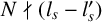 $N\nmid (l_s-l_s')$
. Hence,
 $l-l'\in \mathcal {Z}(\hat {\delta }_{M^{-1}D})$
.
 $\vdots $
Case s+1:
 $l_{s+1} = l_{s+1}', \ldots ,l_2 = l_2' ,l_1 \neq l_1'.$
Then,
 $l-l'=({RN^q}/{N^{p_s+1}})N^{p_s}(l_1-l_1')$
. Similarly as above, we have that
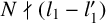 $N\nmid (l_1-l_1')$
and thus
 $l-l'\in \mathcal {Z}(\hat {\delta }_{M^{-1}D})$
.
Consequently, the claim follows. It is also a simple matter that the cardinality of the set L is equal to the dimension of the Hilbert space
 $L^2({\delta }_{M^{-1}D})$
and thus L is a spectrum of
 ${\delta }_{M^{-1}D}$
. This completes the proof.
The proof of Theorem 1.1 is now immediate.
Proof of Theorem 1.1.
We know
 $(M^{-1}D,L)$
is a compatible pair by Lemma 2.6. It is easy to check that the conditions of Theorem 2.3 hold for the measure
 $\mu _{M,D}$
. Therefore, we obtain a spectrum
 $\Lambda $
of the measure
 $\mu _{M,D}$
, which has the following form:
 $$ \begin{align*}\Lambda=\bigg\{\sum_{j=1}^{k}(RN^q)^{j-1}l_j:k\geq1, \ l_j\in{L}\bigg\}.\end{align*} $$
The proof is complete.
3 Proof of Theorem 1.3
In this section, we prove Theorem 1.3. For that purpose, we need several lemmas.
Lemma 3.1. The following conditions are equivalent.
-
(i)
$\gcd (t,N)=1$
. -
(ii)
$t\mathbb {Z}$
contains a complete set of the set
$\mathbb {Z}\setminus N\mathbb {Z}$
.



Proof.
 $(i)\Rightarrow (ii).$
Suppose in contrast that there exists
 $d\in \{0,1,\ldots ,N-1\}$
such that
 $t\mathbb {Z}\cap (d+N\mathbb {Z})=\emptyset $
. It follows that
 $tk\notin d+N\mathbb {Z}$
for all integers k. Since
 ${\gcd (t,N)=1}$
, there exist two integers
 $u,v$
such that
 $tu+Nv=1$
. Hence,
 $tud=d-Nvd\in d+N\mathbb {Z}$
, which is a contradiction.
 $(ii)\Rightarrow (i).$
Suppose
 $\gcd (t,N)=d>1$
. It is easy to see
 $t^{-1}(d-1+N\mathbb {Z})\cap \mathbb {Z}\neq \emptyset $
. We can choose
 $k\in t^{-1}(d-1+N\mathbb {Z})\cap \mathbb {Z}$
such that
 $\gcd (tk,d)=1$
. This is impossible since
 $\gcd(tk,d)=d>1$
.
Lemma 3.2. Let
 $\mu _{M,D}$
be the self-similar spectral measure with a spectrum
 $\Lambda $
defined in Theorem 1.1. Let
 $ t$
be a real number. If
 $t\Lambda $
is a spectrum of
 $\mu _{M,D}$
, then
 $t\in \mathbb {Z}$
and
 $\gcd (t,N)=1$
.
Proof. The proof is divided into four steps.
Step 1. We prove that
 $t\in \mathbb {Z}$
. Note that
 $$ \begin{align} t\Lambda=\bigg\{t\frac{RN^q}{N^{p_s+1}}\sum_{j=1}^{k}(RN^q)^{j-1}b_j:k\geq1, \ b_j\in B\bigg\}, \end{align} $$
where B is defined in Lemma 2.6. By Lemma 2.1,
 $$ \begin{align} t\Lambda\setminus\{0\}\subset\mathcal{Z}(\hat{\mu}_{M,D})=\frac{RN^q}{N^{p_s+1}}\bigcup_{k=0}^{\infty}(RN^q)^k\bigg(\bigcup_{j=0}^{s}\{N^{p_s-p_j}l:N\nmid l\}\bigg) \end{align} $$
with
 $p_0=0$
. Combining (3-1), (3-2), and
 $\gcd (\sum _{j=1}^{k}(RN^q)^{j-1}B)=1$
, we have
 $t\in \Bbb Z$
.
Step 2. We claim that
 $t\Lambda \cap \Lambda _0\neq \emptyset $
, where
 $\Lambda _0={RN^q}/{N^{p_s+1}}(\bigcup _{j=0}^{s}\{N^{p_s-p_j}l:N\nmid l\})$
. If
 $t\Lambda \cap \Lambda _0=\emptyset $
, then it follows from (3-2) that
 $$ \begin{align*}t\Lambda\subseteq\{0\}\cup \mathcal{Z}(\hat{\mu}_{M,D})\setminus \Lambda_0= \{0\}\cup\frac{1}{N^{p_s+1}}\bigcup_{k=2}^{\infty}(RN^q)^{k}\bigg(\bigcup_{j=0}^{s}\{N^{p_s-p_j}l:N\nmid l\}\bigg).\end{align*} $$
For any two distinct elements
 $t\lambda _1,t\lambda _2\in t\Lambda \setminus \{0\}$
, write
 $t\lambda _1={1}/{N^{p_s+1}}(RN^q)^{k_1}N^{p_s-p_{j_1}}l_1$
and
 $t\lambda _2={1}/{N^{p_s+1}}(RN^q)^{k_2}N^{p_s-p_{j_2}}l_2$
, where integers
 $k_i\geq 2$
,
 $j_i\in \{0,1,\ldots ,s\}$
, and
 $N\nmid l_i$
for
 $i=1,2$
. Then, for the cases
 $k_1\neq k_2$
or
 $j_1\neq j_2$
, it is easy to check
 $$ \begin{align} t\lambda_2-t\lambda_1\in \frac{1}{N^{p_s+1}}\bigcup_{k=2}^{\infty}(RN^q)^{k}\bigg(\bigcup_{j=0}^{s}\{N^{p_s-p_j}l:N\nmid l\}\bigg). \end{align} $$
For the case
 $k_1=k_2,j_1=j_2,l_1\neq l_2,$
we have
 $N|{(RN^q)^{k_1-1}}/{N^{p_{j_1}}}(l_2-l_1)$
and
 $$ \begin{align} t\lambda_2-t\lambda_1=\frac{1}{N^{p_s+1}}(RN^q)^{k_1}N^{p_s-p_{j_1}}(l_2-l_1)\notin \Lambda_0. \end{align} $$
Since
 $t\Lambda $
is a spectrum of the measure
 $\mu _{M,D}$
, by Lemma 2.1,
 $$ \begin{align} t\lambda_2-t\lambda_1\in\mathcal{Z}(\hat{\mu}_{M,D})=\frac{RN^q}{N^{p_s+1}}\bigcup_{k=0}^{\infty}(RN^q)^k\bigg(\bigcup_{j=0}^{s}\{N^{p_s-p_j}l:N\nmid l\}\bigg). \end{align} $$
Combining (3-4) with (3-5), we also obtain (3-3).
Hence,
 $$ \begin{align*}(t\Lambda-t\Lambda)\subseteq\{0\}\cup\frac{1}{N^{p_s+1}}\bigcup_{k=2}^{\infty}(RN^q)^{k}\bigg(\bigcup_{j=0}^{s}\{N^{p_s-p_j}l:N\nmid l\}\bigg), \end{align*} $$
which implies that
 $t\Lambda $
is an orthogonal set of the measure
 $v=\delta _{M^{-2}D}*\delta _{M^{-3}D}*\ldots $
. Note that
 $\mu _{M,D}=\delta _{M^{-1}D}*v$
. By Lemma 2.5,
 $t\Lambda $
is not a spectrum of
 $\mu _{M,D}$
, which is a contradiction.
Step 3. Our goal is to prove that
 $c^{-1}(t\Lambda \cap \Lambda _0)\cup \{0\}$
contains a complete residue system (mod N), where
 $c={RN^q}/{N^{p_s+1}}$
. Suppose, in contrast, that there exists
 $n_0\in \{0,1,\ldots ,N-1\}$
such that
 $$ \begin{align} c^{-1}(t\Lambda\cap\Lambda_0)\cap(n_0+N\mathbb{Z})=\emptyset. \end{align} $$
For any
 $t\lambda \in t\Lambda $
, if
 $t\lambda \in t\Lambda \cap \Lambda _0$
, it follows from (3-6) and Lemma 2.1 that
 $\lambda -cn_0\in c(\mathbb {Z}\setminus N\mathbb {Z})\subseteq \mathcal {Z}(\hat {\mu }_{M,D})$
. If
 $t\lambda \in t\Lambda \setminus \Lambda _0$
, write
 $t\lambda =c(RN^q)^kN^{p_s-p_j}l$
with
 $k\geq 1$
,
 $j\in \{0,1,\ldots ,s\}$
, and
 $N\nmid l$
or
 $0$
. We have
 $t\lambda -cn_0=c((RN^q)^kN^{p_s-p_j}l-n_0)$
or
 $-cn_0$
. In these two cases, by Lemma 2.1, we also obtain
 $\lambda -cn_0\in c(\mathbb {Z}\setminus N\mathbb {Z})\subseteq \mathcal {Z}(\hat {\mu }_{M,D})$
. Hence,
 $cn_0$
is orthogonal to all elements in
 $t\Lambda $
. This contradicts that
 $t\Lambda $
is a spectrum of
 $\mu _{M,D}$
.
Step 4. We prove that
 $\gcd (t,N)=1$
. Suppose otherwise,
 $\gcd (t,N)>1$
. Then,
 $t\mathbb {Z}$
does not contain a complete set of the set
 $\mathbb {Z}\setminus N\mathbb {Z}$
by Lemma 3.1. Note that
 $c^{-1}(t\Lambda \cap \Lambda _0)\subseteq c^{-1}t\Lambda \subseteq t\mathbb {Z}$
, where
 $c={RN^q}/{N^{p_s+1}}$
. This leads to a contradiction.
Using a proof similar to that of Lemma 2.6, we obtain the following lemma.
Lemma 3.3. Let L be as defined in Lemma 2.6. If
 $\gcd (t,N)=1$
, then
 $((RN^q)^{-1}D,tL)$
is a compatible pair.
If
 $(({1}/{N})\mathcal {D},\mathcal {J})$
is a compatible pair, then
 $\mu _{N,\mathcal {D}}$
is a spectral measure [Reference Dutkay, Han and Sun6, Theorem 1.3]. The following theorem gives a necessary and sufficient condition under which
 $(\mu _{N,\mathcal {D}},\Lambda (N,\mathcal {J}))$
is not a spectral pair.
Theorem 3.4 [Reference Łaba and Wang17, Theorem 1.3].
Let
 $N\in \mathbb {Z}$
with
 $|N|>1$
, and
 $\mathcal {D}\subset \mathbb {Z}$
with
 $0\in \mathcal {D}$
and
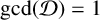 $\gcd (\mathcal {D})=1$
. Let
 $\mathcal {J} \subset \mathbb {Z}$
with
 $0\in \mathcal {J} $
be such that
 $(({1}/{N})\mathcal {D},\mathcal {J})$
is a compatible pair. Then,
 $(\mu _{N,\mathcal {D}},\Lambda (N,\mathcal {J}))$
is NOT a spectral pair if and only if there exist
 $s_j^*\in \mathcal {J}$
and nonzero integers
 $\eta _j$
,
 $0\leq j \leq m-1$
, such that
 $\eta _{j+1}=N^{-1}(\eta _j+s_j^*)$
for all
 $0\leq j \leq m-1\ (with \ \eta _m:=\eta _0 \ and \ s_m^*:=s_0^*)$
.
With the help of the preceding lemmas and theorem, we can obtain a useful lemma for proving Theorem 1.3. For the sake of convenience, we introduce some notation. Let
 $A\subset \mathbb {Z}$
. Denote
 $$ \begin{align*}\Sigma_{A}^{n}=\{i_1i_2\cdots i_n:i_k\in A,1\leq k \leq n\}, \quad \Sigma_{A}^{*}=\bigcup_{n=1}^{\infty}\Sigma_{A}^{n},\end{align*} $$
and
 $$ \begin{align*}\Sigma_{A}^{\infty}=\{i_1i_2\ldots:i_k\in A,k\geq1\},\end{align*} $$
be the set of all words with length n, the set of all finite words, and the set of all infinite words, respectively. For any
 $I\in \Sigma _{A}^{*},J\in \Sigma _{A}^{*}\cup \Sigma _{A}^{\infty }$
, we denote by
 $IJ$
the natural concatenation of I and J. Furthermore, we adopt the notation
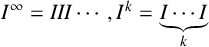 $I^{\infty }=III\cdots , I^k=\underbrace {I\cdots I}_k$
for
 $I\in \Sigma _{A}^{*}$
. Let
 $I=i_1i_2\cdots \in \Sigma _{A}^{\infty }$
. We define
 $I|_k=i_1i_2\cdots i_k$
for
 $k\geq 1$
and
 $I_{n,m}=i_ni_{n+1}\cdots i_{m-1}$
for
 $1\leq n<m\leq \infty $
.
Lemma 3.5. Let
 $\gcd (t,N)=1$
and let B be defined as in Lemma 2.6. Then, the following statements are equivalent:
-
(i)
$t\Lambda $
is not a spectrum of
$\mu _{M,D}$
; -
(ii) there exists a word
$I=i_1\cdots i_m\in \Sigma _{B}^{*}$
with
$I\neq 0^m$
such that
$$ \begin{align*}((RN^q)^m-1)|t\frac{RN^q}{N^{p_s+1}}(i_1+(RN^q)i_2+\cdots+(RN^q)^{m-1}i_m).\end{align*} $$





Proof.
 $(i)\Rightarrow (ii).$
Since
 $\gcd (t,N)=1$
, by Lemma 3.3,
 $((RN^q)^{-1}D,tL)$
is compatible. Then, by Theorem 3.4, there exist
 $s_j^*\in tL$
and nonzero integers
 $\eta _j$
such that
 $\eta _{j+1}={1}/({RN^q})(\eta _j+s_j^*)$
for all
 $0\leq j\leq m-1$
(with
 $\eta _m:=\eta _0$
and
 $s_m^*:=s_0^*$
). We have
 $$ \begin{align*} \eta_1&=\frac{1}{RN^q}\eta_m+\frac{1}{RN^q}s_m^*{} \nonumber\\&=\frac{1}{(RN^q)^2}\eta_{m-1}+\frac{1}{(RN^q)^2}s_{m-1}^*+\frac{1}{RN^q}s_m^*{} \nonumber\\&=\cdots{} \nonumber\\&=\frac{1}{(RN^q)^m}\eta_1+\frac{1}{(RN^q)^m}s_1^*+\frac{1}{(RN^q)^{m-1}}s_2^*+\cdots+\frac{1}{RN^q}s_m^*. \end{align*} $$
Hence,
 $$ \begin{align*} ((RN^q)^m-1)\eta_1&=s_1^*+(RN^q)s_2^*+\cdots+(RN^q)^{m-1}s_m^*{} \nonumber\\&=t\frac{RN^q}{N^{p_s+1}}(i_1+(RN^q)i_2+\cdots+(RN^q)^{m-1}i_m), \end{align*} $$
where
 $i_j={s_j^*}/{(t{RN^q}/{N^{p_s+1}})}\in B$
for
 $1\leq j\leq m$
.
 $(ii)\Rightarrow (i).$
Suppose there exists a word
 $I=i_1i_2\cdots i_m\in \Sigma _{B}^{*}$
with
 $I\neq 0^m$
such that
 $$ \begin{align*}((RN^q)^m-1)|t\frac{RN^q}{N^{p_s+1}}(i_1+(RN^q)i_2+\cdots+(RN^q)^{m-1}i_m).\end{align*} $$
Let
 $\tau (\sigma )=t(\sigma _1+(RN^q)\sigma _2+\cdots +(RN^q)^{n-1}\sigma _n)$
for
 $\sigma =\sigma _1\sigma _2\cdots \sigma _n\in \Sigma _{B}^{*}\cup \Sigma _{B}^{\infty }$
. We have
 $((RN^q)^m-1)|({RN^q}/{N^{p_s+1}})\tau (I)$
. The proof is completed in two steps.
Step 1. Denote
 $d=(RN^q/N^{p_s+1})(\tau(I)/(1-(RN^q)^m)):=({RN^q}/{N^{p_s+1}})d'$
. We claim that
 $d\notin t\Lambda $
.
It follows from
 $\gcd ((RN^q)^m-1,{RN^q}/{N^{p_s+1}})=1$
that
 $d'\in \mathbb {Z}$
. Let
 $$ \begin{align*}\Lambda'=\bigg\{\sum_{j=1}^{k}(RN^q)^{j-1}b_j:k\geq1, \ b_j\in B\bigg\}.\end{align*} $$
Notice that
 $$ \begin{align*}d'=\tau(I)+d'(RN^q)^m=\tau(I)+\tau(I)(RN^q)^m+d'(RN^q)^{2m}=\tau(I^2)+d'(RN^q)^{2m}.\end{align*} $$
Proceeding inductively,
 $$ \begin{align*}d'=\tau(I^j)+d'(RN^q)^{jm} \end{align*} $$
for any
 $j\geq 1$
. Since
 $ \tau (I^{\infty }|_n)=\tau (I^{j}|_n)$
for any
 $1\leq n\leq mj$
,
 $$ \begin{align*} \tau(I^{\infty})&=t(i_1+(RN^q)i_2+\cdots+(RN^q)^{m-1}i_m+\cdots\\ &\qquad+(RN^q)^{(j-1)m}i_1+(RN^q)^{(j-1)m+1}i_2+\cdots+(RN^q)^{jm-1}i_m+\cdots)\\ &=\tau(I^{\infty}|_{jm})+(RN^q)^{jm}\tau(I^{\infty})=\tau(I^{j})+(RN^q)^{jm}\tau(I^{\infty}) \end{align*} $$
for any
 $j\geq 1$
. It is easy to see that
 $I^{\infty }\in \Sigma _{B}^{\infty }\setminus \Sigma _{B}^{*}0^{\infty }$
. Then, we get
 $d'=\tau (I^{\infty })\notin t\Lambda '$
. Therefore,
 $d\notin t\Lambda $
.
Step 2. We show that d is orthogonal to
 $\lambda $
for any
 $\lambda \in t\Lambda $
, that is,
 $t\Lambda $
is not a maximal orthogonal set of
 $\mu _{M,D}$
.
Write
 $\lambda =t({RN^q}/{N^{p_s+1}})\lambda '$
with
 $\lambda '\in \Lambda '$
. Then, there exists
 $J=j_1j_2\cdots j_n\in \Sigma _{B}^{n}$
such that
 $\tau (J)=t\lambda '$
. Let
 $s\geq 1$
be the first index such that
 $(I^{\infty })_{s,s+1}\neq (J0^{\infty })_{s,s+1}$
. We have
 $$ \begin{align*} d-\lambda&=\frac{RN^q}{N^{p_s+1}}(d'-t\lambda')\\ &=t\frac{RN^q}{N^{p_s+1}}(RN^q)^{s-1}((I^{\infty})_{s,s+1}-(J0^{\infty})_{s,s+1}+RN^qK) \end{align*} $$
for some integer K and
 $(I^{\infty })_{s,s+1},(J0^{\infty })_{s,s+1}\in B$
. Next, we write
 $(I^{\infty })_{s,s+1}= b_1+N^{p_s-p_{s-1}} b_2+\cdots +N^{p_s-p_0}b_{s+1}$
and
 $(J0^{\infty })_{s,s+1}=b^{\prime }_1+N^{p_s-p_{s-1}}b^{\prime }_2+\cdots +N^{p_s-p_0}b^{\prime }_{s+1}$
, where
 $b_i,b_i'\in \{0,1,\ldots ,N-1\}$
. Put
 $i_0=\min \{i:b_i\neq b_i'\}$
. Then,
 $$ \begin{align*} (I^{\infty })_{s,s+1}-(J0^{\infty })_{s,s+1}=N^{p_s-p_{s-i_0+1}}(b_{i_0}-b_{i_0}'+N^{p_{s-i_0+1}-p_{s-i_0}}G) \end{align*} $$
for some integer G and
 $$ \begin{align*} d-\lambda=t\frac{RN^q}{N^{p_s+1}}(RN^q)^{s-1}(N^{p_s-p_{s-i_0+1}}(b_{i_0}-b_{i_0}'+NG')) \end{align*} $$
with
 $G'$
an integer. Since
 $\gcd (t,N)=1$
and
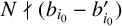 $N\nmid (b_{i_0}-b_{i_0}')$
, by Lemma 2.1, we have
 $d-\lambda \in \mathcal {Z}(\hat {\mu }_{M,D})$
. Hence,
 $t\Lambda $
is neither a maximal orthogonal set nor a spectrum of
 $\mu _{M,D}$
.
We have all ingredients for the proof of Theorem 1.3.
Proof of Theorem 1.3.
The necessity follows immediately by Lemmas 3.2 and 3.5. For the sufficiency, by Lemma 3.5 again, we need to show that there is not a word
 $I=i_1\cdots i_m\in \Sigma _{B}^{*}$
with
 $I\neq 0^m$
such that
 $$ \begin{align} ((RN^q)^m-1)|t\frac{RN^q}{N^{p_s+1}}(i_1+(RN^q)i_2+\cdots+(RN^q)^{m-1}i_m). \end{align} $$
By the condition, we only need to show that there is not a word
 $I=i_1\cdots i_m\in \Sigma _{B}^{*}$
with
 $I\neq 0^m$
such that (3-7) holds for all
 $m> l$
, where
 $l=\#\{T(RN^q,tL)\cap \mathbb {Z}\}$
. Suppose, in contrast, that there exists
 $I=i_1i_2\cdots i_n\in \Sigma _{B}^{n}\setminus \Sigma _{B}^{l}0^{n-l}$
for some
 $n>l$
, such that (3-7) holds. Our next goal is to construct
 $I'=i_1'\cdots i_r'\in \Sigma _{B}^{*}(I' \neq 0^r)$
with
 $r<l$
satisfying (3-7), which is a contradiction.
Let
 $\tau (\sigma )=t(\sigma _1+(RN^q)\sigma _2+\cdots +(RN^q)^{k-1}\sigma _k)$
for
 $\sigma =\sigma _1\sigma _2\cdots \sigma _k\in \Sigma _{B}^{*}$
. For
 $\sigma =\sigma _1\sigma _2\cdots \sigma _m$
, denote
 $\Pi (\sigma )=\sigma _2\cdots \sigma _m\sigma _1$
. We claim that
 $$ \begin{align} \frac{\frac{RN^q}{N^{p_s+1}}\tau(\Pi^k(I))}{(RN^q)^n-1}\in T(RN^q,tL)\cap\mathbb{Z}. \end{align} $$
In fact,
 $$ \begin{align*}\frac{\frac{RN^q}{N^{p_s+1}}\tau(\Pi^k(I))}{(RN^q)^n-1}=\sum_{i=1}^{\infty}(RN^q)^{-in}\frac{RN^q}{N^{p_s+1}}\tau(\Pi^k(I)) \end{align*} $$
and
 $\tau (\Pi ^k(I))=t\sum _{k=0}^{n-1}(RN^q)^ki^{\prime }_{k+1}$
, where
 $\{i^{\prime }_k\}_{k=1}^{n}$
is a rearrangement of
 $\{i_k\}_{k=1}^{n}$
. We have
 $$ \begin{align*}\frac{\frac{RN^q}{N^{p_s+1}}\tau(\Pi^k(I))}{(RN^q)^n-1}=\sum_{i=1}^{\infty}\sum_{k=0}^{n-1}(RN^q)^{-in+k}t\frac{RN^q}{N^{p_s+1}}i^{\prime}_{k+1}\in T(RN^q,tL).\end{align*} $$
Moreover,
 $$ \begin{align*} \frac{\frac{RN^q}{N^{p_s+1}}\tau(\Pi(I))}{(RN^q)^n-1}&=\frac{\frac{RN^q}{N^{p_s+1}}{t(i_2+(RN^q)i_3+\cdots+(RN^q)^{n-2}i_n+(RN^q)^{n-1}i_1)}}{(RN^q)^n-1}\\ &=\frac{\frac{RN^q}{N^{p_s+1}}{t(i_1+(RN^q)i_2+\cdots+(RN^q)^{n-1}i_n+(RN^q)^{n}i_1-i_1)}}{RN^q((RN^q)^n-1)}\\ &=\frac{\frac{RN^q}{N^{p_s+1}}{(\tau(I)+t((RN^q)^n-1)i_1)}}{RN^q((RN^q)^n-1)}. \end{align*} $$
Hence,
 $$ \begin{align*}{RN^q}\frac{RN^q}{N^{p_s+1}}\tau(\Pi(I))=\frac{RN^q}{N^{p_s+1}}(\tau(I)+t((RN^q)^n-1)i_1).\end{align*} $$
It is known that
 $((RN^q)^n-1)|({RN^q}/{N^{p_s+1}})\tau (I)$
. It follows from the fact that
 ${\gcd (RN^q, (RN^q)^n- 1)=1}$
that
 $((RN^q)^n-1)|({RN^q}/{N^{p_s+1}})\tau (\Pi (I)).$
By induction, we have
 ${({RN^q}/{N^{p_s+1}}) \tau (\Pi ^k(I))} /((RN^q)^n-1) \in \mathbb {Z}$
and (3-8) is proved.
Since
 $I=\Pi ^n(I)$
, there exists a smallest positive integer r such that
 $I=\Pi ^r(I)$
. Then,
 $I,\Pi (I),\ldots ,\Pi ^{r-1}(I)$
are pairwise different. By (3-8) and since
 $\tau $
is injective, we have
 $r\leq l<n$
. Moreover,
 $\{k\in \mathbb {Z}:\Pi ^k(I)=I\}=r\mathbb {Z}$
is a subgroup of
 $\mathbb {Z}$
, where
 $\Pi ^{-1}(\sigma )=\sigma _n\sigma _1\cdots \sigma _{n-1}$
for
 $\sigma =\sigma _1\sigma _2\cdots \sigma _n$
. Then,
 $r|n$
. Write
 $n=kr$
and thus
 $I=(I|_r)^k$
. Note that
 $$ \begin{align*}\tau(I)=\tau((I|_r)^k)=\tau(I|_r)\frac{1-(RN^q)^{kr}}{1-(RN^q)^r}=\tau(I|_r)\frac{1-(RN^q)^{n}}{1-(RN^q)^r}.\end{align*} $$
We have
 $$ \begin{align*}\frac{\frac{RN^q}{N^{p_s+1}}\tau(I)}{(RN^q)^n-1}=\frac{\frac{RN^q}{N^{p_s+1}}\tau(I|_r)}{(RN^q)^r-1},\end{align*} $$
which contradicts the sufficient condition and thus by Lemma 3.5, the proof is complete.
4 Proof of Theorem 1.4
In this section, we prove Theorem 1.4. First, we use contradiction to prove the necessity of Theorem 1.4.
Proof of the necessity of Theorem 1.4.
Suppose that there exist
 $\Lambda $
and
 $t\Lambda $
that are both spectra of
 $\mu _{M,D}$
. Without loss of generality, we can assume that
 $0\in \Lambda $
. By Lemma 2.1,
 $$ \begin{align*} \Lambda,t\Lambda\subseteq\mathcal{Z}(\hat{\mu}_{M,D})\cup\{0\}=\frac{RN^q}{N^{p_s+1}}\bigcup_{k=0}^{\infty}(RN^q)^k\bigg(\bigcup_{j=0}^{s}\{N^{p_s-p_j}l:N\nmid l\}\bigg)\cup\{0\}, \end{align*} $$
which implies that t is a rational number. Let
 $t={t_1}/{t_2}$
with
 $t_1,t_2\in \mathbb {Z}\setminus \{0\}$
and
 ${\gcd (t_1,t_2)=1}$
.
Suppose
 $\gcd (t_1,N)=d_1>1$
. By Lemma 3.1,
 $t_1\mathbb {Z}$
does not contain a complete set of the set
 $\mathbb {Z} \setminus N\mathbb {Z}$
. Let
 $\Lambda _0={RN^q}/{N^{p_s+1}}(\bigcup _{j=0}^{s}\{N^{p_s-p_j}l:N\nmid l\})$
with
 $p_0=0$
. By the same argument as in the third step of the proof of Lemma 3.2, we conclude that
 $c^{-1}(t\Lambda \cap \Lambda _0)\cup \{0\}$
contains a complete set of the set
 $\mathbb {Z}\setminus N\mathbb {Z}$
, where
 $c={RN^q}/{N^{p_s+1}}$
. Since
 $\Lambda \subseteq c\mathbb {Z}$
and
 $t\Lambda \subseteq c\mathbb {Z}$
, we have
 $$ \begin{align*}c^{-1}(t\Lambda\cap \Lambda_0)\cup\{0\}\subseteq c^{-1}\frac{t_1}{t_2}\Lambda\cup\{0\}\subseteq t_1\mathbb{Z}.\end{align*} $$
This contradicts that
 $t_1\mathbb {Z}$
does not contain a complete set of the set
 $\mathbb {Z}\setminus N\mathbb {Z}$
.
Suppose
 $\gcd (t_2,N)=d_2>1$
. Similarly to the third step in the proof of Lemma 3.2, we have
 $c^{-1}(\Lambda \cap \Lambda _0)\cup \{0\}$
contains a complete set of the set
 $\mathbb {Z}\setminus N\mathbb {Z}$
. Then, we can choose
 $\lambda _0\in c(d_2-1+N\mathbb {Z})\cap (\Lambda \cap \Lambda _0)$
such that
 $\gcd (d_2,{\lambda _0}/{c})=1$
. It follows from
 $\gcd (t_1,d_2)=1$
and
 $\gcd (d_2,{\lambda _0}/{c})=1$
that
 $t({\lambda _0}/{c})=(t_1(\lambda_0/c))/((t_2/d_2)d_2)\notin \mathbb {Z}$
. We have
 $t\lambda _0\notin c\mathbb {Z}$
and thus
 $t\lambda _0\notin \mathcal {Z}(\hat \mu _{M,D})$
. This contradicts that
 $t\Lambda $
is a spectrum of
 $\mu _{M,D}$
.
To show the sufficiency of Theorem 1.4, we first consider the case that t is an integer with
 $\gcd (t,N)=1.$
In this case, we cannot guarantee that the scaling set
 $t\Lambda $
is also a spectrum, where
 $\Lambda $
is defined in (1-3). Hence, we find a new class of spectra by means of using an infinite word in
 $\Sigma _{\{-1,1\}}^{\infty }$
acting on
 $\Lambda $
. Before that, we give a useful theorem proved by Strichartz.
Theorem 4.1 [Reference Strichartz20, Theorems 2.7 and 2.8].
Given an infinite compatible tower whose compatible pairs
 $\{B_j,L_j\}$
and expanding matrices
 $\{R_j\}$
are all chosen from a finite set of compatible pairs and expanding matrices, the infinite convolution product measure
 $$ \begin{align*}\mu=\mu_0*(\mu_1\circ R_1)*\cdots*(\mu_k\circ(R_k\cdots R_1))*\cdots\end{align*} $$
exists as a weak limit and is a compactly supported probability measure, whose Fourier transform is given by the infinite product
 $$ \begin{align*}\hat{\mu}(t)=\prod_{k=0}^{\infty}\hat{\mu}_k((R_k^*)^{-1}\cdots(R_1^*)^{-1}t).\end{align*} $$
Moreover, the set of functions
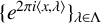 $\{e^{2\pi {i}{ \langle x,\lambda \rangle }}\}_{\lambda \in \Lambda }$
for
 $$ \begin{align*}\Lambda=L_0+R_1^*L_1+\cdots+R_1^*\cdots R_k^*L_k+\cdots\end{align*} $$
is an orthogonal set. Suppose that the zero set
 $\mathcal {Z}_k$
of the trigonometric polynomial
 $\hat {\mu }_k$
is separated from the set
 $$ \begin{align*}(R_k^*)^{-1}\cdots(R_1^*)^{-1}L_0+(R_k^*)^{-1}\cdots(R_2^*)^{-1}L_1+\cdots+(R_k^*)^{-1}L_{k-1}\end{align*} $$
by a distance
 $\delta>0$
, uniformly in k, for all large k. Then,
 $\Lambda $
is a spectrum for
 $\mu $
.
Proposition 4.2. For every
 $\omega =\omega _1\omega _2\cdots \in \Sigma _{\{-1,1\}}^{\infty }$
, the set
 $$ \begin{align*} \Lambda_{\omega}=\bigg\{\sum_{j=1}^{k}l_j\omega_j(RN^q)^{j-1}:k\geq1, \ l_j\in L \bigg\},\end{align*} $$
where
 $$ \begin{align*} L\ {=}\ RN^q({1}/{N}\{0,1,\ldots ,N\ {-}\ 1\}\ {\oplus}\ {1}/{N^{p_1+1}}\{0,1,\ldots ,N\ {-}\ 1\}\oplus \cdots \oplus {1}/{N^{p_s+1}} \{0,1,\ldots ,N-1\})\end{align*} $$
is a spectrum of
 $\mu _{M,D}$
.
Proof. Given an
 $\omega =\omega _1\omega _2\cdots \in \Sigma _{\{-1,1\}}^{\infty }$
, for any
 $n\geq 1$
, write
 $$ \begin{align*}T_n=\bigg\{(RN^q)^{-n}\sum_{i=1}^{n}l_i\omega_i(RN^q)^{i-1}:l_i\in L \bigg\}.\end{align*} $$
Notice that
 $$ \begin{align*} &(RN^q)^{-n}\sum_{i=1}^{n}\frac{RN^q}{N^{p_s+1}}(N-1+N^{p_s-p_{s-1}}(N-1)+\cdots+N^{p_s-p_0}(N-1))(RN^q)^{i-1}\\ &\quad=(RN^q)^{-n}\frac{RN^q}{N^{p_s+1}}(N-1)(1+N^{p_s-p_{s-1}}+\cdots+N^{p_s-p_0})\frac{(RN^q)^n-1}{RN^q-1}\\ &\quad<\frac{RN^q}{N^{p_s+1}}\frac{(N-1)(1+N^{p_s-p_{s-1}}+\cdots+N^{p_s-p_0})}{RN^q-1}<\frac{RN^q}{N^{p_s+1}}. \end{align*} $$
Therefore, the set
 $$ \begin{align*}\mathcal{Z}(\hat{\mu}_{n})=\frac{RN^q}{N^{p_s+1}}\bigcup_{k=0}^{n-1}(RN^q)^k\biggl(\bigcup_{j=0}^{s}\{N^{p_s-p_j}l:N\nmid l\}\biggr)\end{align*} $$
is uniformly disjoint from the sets
 $T_n,n\geq 1$
. By Lemma 3.3,
 $((RN^q)^{-1}D,\omega _kL)$
is a compatible pair for each
 $\omega _k$
. Then, we have
 $\Lambda _\omega $
is a spectrum of
 $\mu _{M,D}$
by Theorem 4.1.
Using a proof similar to that of Theorem 1.3, we can obtain the following theorem.
Theorem 4.3. Let
 $\omega =(\omega _1\omega _2\cdots \omega _r)^{\infty }\in \Sigma _{\{-1,1\}}^{\infty }$
be a periodic word with periodicity r. Let t be an integer number with
 $\gcd (t,N)=1$
. Then,
 $t\Lambda _\omega $
is a spectrum of
 $\mu _{M,D}$
if and only if there is no
 $I=i_1i_2\cdots i_n(I\neq 0^n)$
with all
 $i_j\in \Sigma _{\omega ,r}$
such that
 $$ \begin{align*}((RN^q)^{nr}-1)|t(i_1+(RN^q)^ri_2+\cdots+(RN^q)^{(n-1)r}i_n)\end{align*} $$
for all
 $n\leq \#\{T((RN^q)^r,t\Sigma _{\omega ,r})\cap \mathbb {Z}\},$
where
 $\Sigma _{\omega ,r}=\{\sum _{k=1}^{r}l_k\omega _k(RN^q)^{k-1}: l_k\in L \}$
and
 $$ \begin{align*}T((RN^q)^r,t\Sigma_{\omega,r})=\bigg\{\sum_{j=1}^{\infty}\frac{d_j}{(RN^q)^{rj}}:d_j\in{t\Sigma_{\omega,r}}\bigg\}.\end{align*} $$
We can now determine the forms of some spectral eigenvalues of the second type of
 $\mu _{M,D}$
.
Theorem 4.4. If
 $t\in \mathbb {Z}$
and
 $\gcd (t,N)=1$
, then there exists an infinite word
 $\omega =\omega _1\omega _2\ldots \in \Sigma _{\{-1,1\}}^{\infty }$
such that
 $t\Lambda _{\omega }$
is a spectrum of
 $\mu _{M,D}$
.
Proof. There exists
 $\omega =(\omega _1\omega _2\ldots \omega _r)^{\infty }$
with sufficiently large periodicity r such that for any
 $I=i_1i_2\ldots i_n(I\neq 0^n)$
with all
 $i_j\in \Sigma _{\omega ,r}$
, one has
 $$ \begin{align*}(RN^q)^{nr}-1> |t(i_1+(RN^q)^ri_2+\cdots+(RN^q)^{(n-1)r}i_n)|\end{align*} $$
(to achieve it, we can require that the last few items of the repetend take values
 $-$
1) and thus
 $$ \begin{align*}((RN^q)^{nr}-1)\nmid |t(i_1+(RN^q)^ri_2+\cdots+(RN^q)^{(n-1)r}i_n)|.\end{align*} $$
By Theorem 4.3,
 $t\Lambda _{\omega }$
is a spectrum of
 $\mu _{M,D}.$
To this end, we show the sufficiency of Theorem 1.4.
Proof of the sufficiency of Theorem 1.4.
By Theorem 4.4, for any two distinct integers
 $t_1,t_2$
with
 $\gcd (t_i,N)=1$
, there exist
 $\omega _1,\omega _2$
such that
 $t_1\Lambda _{\omega _1}$
and
 $t_2\Lambda _{\omega _2}$
are spectra of
 $\mu _{M,D}$
. Similarly, as in the proof of Theorem 4.4, there exists a common periodic word
 $\omega $
with sufficiently large periodicity r. One has
 $$ \begin{align*}(RN^q)^{nr}-1>|t_i(i_1+(RN^q)^ri_2+\cdots+(RN^q)^{(n-1)r}i_n)|\end{align*} $$
for
 $i=1,2$
. Then,
 $$ \begin{align*}((RN^q)^{nr}-1)\nmid|t_i(i_1+(RN^q)^ri_2+\cdots+(RN^q)^{(n-1)r}i_n)|\end{align*} $$
for
 $i=1,2$
. Therefore, we can require that
 $\omega _1=\omega _2=\omega $
. Writing
 $t={t_1}/{t_2}$
and
 ${\Lambda '=t_2\Lambda _{\omega }}$
, we have
 $t\Lambda '=t_1\Lambda _{\omega }$
. Hence,
 $\Lambda '$
and
 $t\Lambda '$
are spectra of
 $\mu _{M,D}$
.
5 Examples
As an application of Theorem 1.3, we give several examples in this section. Before that, we use Theorem 1.3 to obtain an important theorem.
Theorem 5.1. Let
 $\mu _{M,D}$
be the self-similar spectral measure defined in Theorem 1.1 with a spectrum
 $\Lambda $
. If t is a divisor of R, then
 $t^k\Lambda $
is a spectrum of
 $\mu _{M,D}$
for all nonnegative integers k. If t has a divisor N or
 $M-1$
, then
 $t^k\Lambda $
is not a spectrum of
 $\mu _{M,D}$
for all positive integers k.
Proof. If t is a divisor of R, it follows from
 $\gcd (R,N)=1$
that
 $\gcd (t^k,N)=1$
. Since
 $\gcd ((RN^q)^n-1,t)=1$
for all
 $n\in \mathbb {N}$
, we have (1-4) in Theorem 1.3 is equivalent to
 $$ \begin{align} ((RN^q)^n-1)|(i_1+(RN^q)i_2+\cdots+(RN^q)^{n-1}i_n),\;i_j\in L. \end{align} $$
For any
 $i_j\in L$
,
 $$ \begin{align*} i_1+(RN^q)i_2+\cdots+(RN^q)^{n-1}i_n\leq (RN^q-R)(1+RN^q+\cdots+(RN^q)^{n-1})<(RN^q)^n-1, \end{align*} $$
which implies there is no
 $I=i_1i_2\cdots i_n(I\neq 0^n)$
with all
 $i_j\in L$
such that (5-1) holds for all
 $n\in \mathbb {N}$
. Hence,
 $t^k\Lambda $
is a spectrum of
 $\mu _{M,D}$
by Theorem 1.3.
If t has a divisor N, by Theorem 1.3,
 $t^k\Lambda $
is not a spectrum of
 $\mu _{M,D}$
. If t has a divisor
 $M-1$
, there exists
 $i_1= (M/ N)\in L=M(\oplus _{i=0}^s( 1 /{N^{p_i+1}})\{0,1,\ldots , N-1\})$
with
 $p_0=0$
such that
 $(M-1)|t^ki_1$
. Since
 $0\in T(RN^q,tL)\cap \Bbb Z$
, using Theorem 1.3 again, we have
 $t^k\Lambda $
is not a spectrum of
 $\mu _{M,D}$
.
Example 5.2. Let
 $R=15$
,
 $q=3$
,
 $N=2$
, then the self-similar measure
 $\mu _{M,D}$
generated by
 $M=RN^q=120$
and the product-form digit set
 $D=\{0,1\}\oplus 2\{0,1\}\oplus 2^2\{0,1\}=\{0,1,2,3,4,5,6,7\}$
is a spectral measure with a spectrum
 $$ \begin{align*} \Lambda=\bigg\{\sum_{j=1}^{k}120^{\kern1.2pt j-1}l_j:k\geq1, \ l_j\in \{0,15,30,45,60,75,90,105\} \bigg\}. \end{align*} $$
Furthermore, for
 $t=3^k, 5^k, 15^k$
with
 $k\in \mathbb {N}$
,
 $t\Lambda $
are also spectra of
 $\mu _{M,D}$
. If
 $t=2m,119m$
for some
 $m\in \Bbb N$
,
 $t^k\Lambda $
is not a spectrum of
 $\mu _{M,D}$
for all positive integers k.
Example 5.3. Let
 $R=3, N=2, q=4$
, then the self-similar measure
 $\mu _{M,D}$
generated by
 $M=RN^q=48$
and
 $D=\{0,1\}\oplus 2^3 \{0,1\}=\{0,1,8,9\}$
is a spectral measure with a spectrum
 $$ \begin{align*} \Lambda=\bigg\{\sum_{j=1}^{k}48^{j-1}l_j:k\geq1, \ l_j\in \{0,3,24,27\} \bigg\}. \end{align*} $$
In addition,
 $3^k \Lambda (k\in \mathbb {N})$
are also spectra of
 $\mu _{M,D}$
. If
 $t=2m,47m$
for some
 $m\in \Bbb N$
,
 $t^k\Lambda $
is not a spectrum of
 $\mu _{M,D}$
for all positive integers k.
Example 5.4. Let
 $R=3$
,
 $N=q=2$
, then, the self-similar measure
 $\mu _{M,D}$
generated by
 $M=RN^q=12$
and
 $D=\{0,1\}\oplus 2 \{0,1\}=\{0,1,2,3\}$
is a spectral measure with a spectrum
 $$ \begin{align*} \Lambda=\bigg\{\sum_{j=1}^{k}12^{j-1}l_j:k\geq1,\ l_j\in \{0,3,6,9\} \bigg\}. \end{align*} $$
In addition,
 $3^k \Lambda (k\in \mathbb {N})$
are also spectra of
 $\mu _{M,D}$
. If
 $t=2m,11m$
for some
 $m\in \Bbb N$
, then
 $t^k\Lambda $
is not a spectrum of
 $\mu _{M,D}$
for all positive integers k. Moreover, except for the number
 $11$
, all positive odd numbers t smaller than
 $20$
can make
 $t\Lambda $
a spectrum of
 $\mu _{M,D}$
.
Proof. The first two conclusions can be directly obtained from Theorem 5.1. It is easy to check
 $\#\{T(RN^q,tL)\cap \mathbb {Z}\}\leq \lfloor {9t}/{11} \rfloor +1$
. With some calculations, for odd numbers
 $t(t\neq 11,0<t<20)$
, there is no
 $I=i_1i_2{\cdots }i_n(I\neq {0^n})$
with all
 $i_j\in L$
such that (1-4) in Theorem 1.3 holds for all
 $n\leq \lfloor {9t}/{11} \rfloor +1$
. Hence,
 $t\Lambda $
is a spectrum of
 $\mu _{M,D}$
by Theorem 1.3.
Example 5.5. Let
 $R=4, N=3, q=3$
, then the self-similar measure
 $\mu _{M,D}$
generated by
 $M=RN^q=108$
and
 $D=\{0,1,2\}\oplus 3^2 \{0,1,2\}=\{0,1,2,9,10,11,18,19,20\}$
is a spectral measure with a spectrum
 $$ \begin{align*} \Lambda=\bigg\{\sum_{j=1}^{k}108^{j-1}l_j:k\geq1, \ l_j\in \{0,4,8,36,40,44,72,76,80\} \bigg\}. \end{align*} $$
In addition, for
 $t=2^k, 4^k$
with
 $k\in \Bbb N$
,
 $t \Lambda (k\in \mathbb {N})$
are also spectra of
 $\mu _{M,D}$
. If
 $t=3m,107m$
for some
 $m\in \Bbb N$
,
 $t^k\Lambda $
is not a spectrum of
 $\mu _{M,D}$
for all positive integers k.
At the end of this section, it is worth pointing out that our theorems contain the results obtained by Li and Wu [Reference Li and Wu18]. In our paper, the self-similar measure
 $\mu _{M,D}$
generated by
 $M=RN^q$
and
 $D=\{0,1,\ldots ,N-1\}\oplus N^{p_1}\{0,1,\ldots ,N-1\}\oplus \cdots \oplus N^{p_s}\{0,1,\ldots ,N-1\}$
, satisfying
 $R\geq 2$
,
 $N\geq 2$
,
 $\gcd (R,N)=1$
, and
 $1 \leq p_1<p_2<\cdots <p_s<q$
. While Li and Wu [Reference Li and Wu18] consider the case
 $M=N^q$
and
 $D=\{0,1,\ldots ,N-1\}\oplus N^{p}\{0,1,\ldots ,N-1\}$
with
 $N\geq 2, q>p\geq 2$
. In fact, if we assume
 $ 2\leq p_1<p_2<\cdots <p_s<q$
(the same as Li and Wu [Reference Li and Wu18]) or
 $ 1\leq p_1<\cdots <p_i<p_i+1<p_{i+1}<\cdots <p_s<q$
or
 $1\leq p_1<p_2<\cdots <p_s<p_s+1<q$
, we can choose
 $R\geq 1$
such that the results of our Theorems 1.1, 1.3, and 1.4 hold. Hence, our results extend the results of Li and Wu [Reference Li and Wu18]. For clarity, by Theorem 2.3, we can prove the following theorem using a proof similar to that of Theorem 1.1.
Theorem 5.6. Let
 $M=RN^q$
and
 $D=\{0,1,\ldots ,N-1\}\oplus N^{p_1}\{0,1,\ldots ,N-1\}\oplus \cdots \oplus N^{p_s}\{0,1,\ldots ,N-1\}$
, where
 $R\geq 1$
,
 $N\geq 2$
, q,
 $p_i$
are integers for all
 $1\leq i\leq s$
with
 $\gcd (R,N)=1$
and
 $$ \begin{align*} &2\leq p_1<p_2<\cdots<p_s<q \ \nonumber\\ \text{or} \ &1\leq p_1<\cdots<p_i<p_i+1<p_{i+1}<\cdots<p_s<q \ \nonumber\\ \text{or} \ &1\leq p_1<p_2<\cdots<p_s<p_s+1<q. \end{align*} $$
Then, the self-similar measure
 $\mu _{M,D}$
defined in (1-2) is a spectral measure with a spectrum
 $$ \begin{align*} \Lambda=\bigg\{\sum_{j=1}^{k}(RN^q)^{j-1}l_j:k\geq1 ,\ l_j\in{L}\bigg\}, \end{align*} $$
where
 $$ \begin{align*}L=RN^q\bigg(\frac{1}{N}\{0,1,\ldots,N-1\}\oplus\frac{1}{N^{p_1+1}}\{0,1,\ldots,N-1\}\oplus\cdots\oplus\frac{1}{N^{p_s+1}}\{0,1,\ldots,N-1\}\bigg).\end{align*} $$
Let
 $\mu _{M,D}$
be the self-similar spectral measure with a spectrum
 $\Lambda $
defined in Theorem 5.6. We also can completely settle two types of spectral eigenvalue problems for
 $\mu _{M,D}$
. Since the results and proofs are exactly the same as those of Theorems 1.3 and 1.4, we omit them.



