Introduction
With rapidly aging populations, dementia has become a serious public health concern, particularly in Asia (Catindig et al., Reference Catindig, Venketasubramanian, Ikram and Chen2012). Patients with dementia are reported to display more neuropsychiatric symptoms (NPS), which become more severe as the disease progresses (Lyketsos et al., Reference Lyketsos, Steinberg, Tschanz, Norton, Steffens and Breitner2000; Shinosaki et al., Reference Shinosaki, Nishikawa and Takeda2000). NPS in dementia significantly increase caregivers’ burden and are associated with earlier institutionlization and worse prognosis (Steele et al., Reference Steele, Rovner, Chase and Folstein1990; Paulsen et al., Reference Paulsen2000). In addition, NPS can have negative consequences for people with dementia, as these symptoms are associated with poor quality of life for patients and their families, premature referral to institutional care, higher healthcare utilization, healthcare costs, and more rapid disease progression (Steele et al., Reference Steele, Rovner, Chase and Folstein1990).
Furthermore, in the preclinical stages of dementia, such as cognitive impairment - no dementia (CIND), participants with NPS have a higher risk of converting to dementia (Beaudreau et al., Reference Beaudreau, Fairchild, Spira, Lazzeroni and O’Hara2013). However, most studies examining NPS in participants with cognitive impairment have mainly focused on Caucasian populations (Lyketsos et al., Reference Lyketsos, Lopez, Jones, Fitzpatrick, Breitner and DeKosky2002; Tatsch et al., Reference Tatsch2006; Geda et al., Reference Geda2008; Okura et al., Reference Okura, Plassman, Steffens, Llewellyn, Potter and Langa2010; Peters et al., Reference Peters2012; Beaudreau et al., Reference Beaudreau, Fairchild, Spira, Lazzeroni and O’Hara2013). In these populations, the cumulative prevalence of any NPS has been reported to be as high as 50% in participants with mild cognitive impairment (MCI) (Geda et al., Reference Geda2008). Thus far, there are limited information available on the occurrences of NPS in participants with cognitive impairment in Asian populations (Ikeda et al., Reference Ikeda2004; Muangpaisan et al., Reference Muangpaisan, Intalapaporn and Assantachai2008; Feng et al., Reference Feng, Yap, Lee and Ng2009; Chan et al., Reference Chan2010; Haibo et al., Reference Haibo2013).
Moreover, there may be differing patterns of NPS in Asian populations as suggested by a Chinese study from Shanghai which reported a lower prevalence of NPS (Haibo et al., Reference Haibo2013). Apart from potential differences in pathophysiological mechanisms (e.g. specific brain areas that may be affected by neuronal loss, depositions of amyloid or tangles, cerebrovascular lesions) (Shinosaki et al., Reference Shinosaki, Nishikawa and Takeda2000), these variations in the prevalence and patterns of NPS may be due to diversity in the cultural background and psychosocial environment of study participants (Ikeda et al., Reference Ikeda2004; Muangpaisan et al., Reference Muangpaisan, Intalapaporn and Assantachai2008; Feng et al., Reference Feng, Yap, Lee and Ng2009; Chan et al., Reference Chan2010; Haibo et al., Reference Haibo2013). Furthermore, specific symptoms such as nighttime behaviors and changes in appetite/eating, have not been examined in previous studies (Ikeda et al., Reference Ikeda2004; Feng et al., Reference Feng, Yap, Lee and Ng2009); an omission which may be of importance as several studies have suggested that nighttime behaviors were one of the most commonly reported NPS in the elderly (Geda et al., Reference Geda2004; Tatsch et al., Reference Tatsch2006; Muangpaisan et al., Reference Muangpaisan, Intalapaporn and Assantachai2008; Chan et al., Reference Chan2010).
Finally, in recent years, it has been suggested that aggregating related NPS into sub-syndromes may have important advantages since sub-syndromes correspond to clinical observations (Cheng et al., Reference Cheng, Kwok and Lam2012), could represent different underlying neurobiological pathology (Kang et al., Reference Kang, Ahn, Kim and Kim2010), and may respond to particular treatments (Gauthier et al., Reference Gauthier, Wirth and Mobius2005). Furthermore, there is evidence that sub-syndromes are stable across the course of dementia (Selbæk and Engedal, Reference Selbæk and Engedal2012) and are robust despite the use of different analytical methods (Aalten et al., Reference Aalten2007). Although there are studies reporting on the prevalence of sub-syndromes in patients with dementia from memory clinics and nursing homes (Gauthier et al., Reference Gauthier, Wirth and Mobius2005; Aalten et al., Reference Aalten2007; Kang et al., Reference Kang, Ahn, Kim and Kim2010; Cheng et al., Reference Cheng, Kwok and Lam2012; Selbæk and Engedal, Reference Selbæk and Engedal2012), there have been no studies on sub-syndromes in community-dwelling elderly or in the preclinical stages of dementia.
In view of these gaps in knowledge, we examined in an Asian population of Chinese and Malay participants, the presence of NPS and sub-syndromes in different diagnostic groups, including no cognitive impairment (NCI), CIND, and dementia. We hypothesized that participants with more severe cognitive impairment would demonstrate a higher presence of NPS and sub-syndromes. We also hypothesized that impairment on specific cognitive domains would reveal distinctive association with the presence of neuropsychiatric sub-syndromes.
Methods
Sampling, screening, and procedure
The EDIS study draws participants from the Singapore Epidemiology of Eye Disease (SEED) study, a multi-ethnic population-based study among persons aged 40 to 85 years among Chinese (Singapore Chinese Eye Study [SCES]), Malay (Singapore Malay Eye Study [SiMES-2]), and Indians (Singapore Indian Eye Study [SINDI-2]). For this study, we focused on the Chinese (Hilal et al., Reference Hilal2013) and Malay components (Rosman et al., Reference Rosman2012) of the EDIS Study, as the recruitment of the Indians is ongoing. In the first phase of the EDIS study, participants aged ≥ 60 years (n = 2,666 Chinese and Malays) were screened using the Abbreviated Mental Test (Sahadevan et al., Reference Sahadevan, Lim, Tan and Chan2000) and a self-report of progressive forgetfulness (Chong et al., Reference Chong2006). Screen-positive participants (n = 1,097) were invited to take part in the second phase of this study, which included an extensive neuropsychological test battery and brain MRI. Of these 1,097 participants, 623 agreed to participate in a second phase between August 2010 and December 2013 and hence were included in the present study. Of these, ten did not have a reliable informant and were excluded, leaving 613 participants (295 Chinese and 318 Malays) included in the final analysis. The details of the study methodology have been described elsewhere (Hilal et al., Reference Hilal2013). Ethics approval for EDIS study was obtained from the Singapore Eye Research Institute, and National Healthcare Group Domain-Specific Review Board. Written informed consent was obtained in the preferred language of the participants by bilingual study coordinators prior to their recruitment into the study.
Neuropsychological assessment
An extensive neuropsychological battery, which has been previously validated in Singaporean elderly, was administered to assess cognitive function (Hilal et al., Reference Hilal2013). The following seven domains were tested: Executive Function, Attention, Language, Visual Memory, Verbal Memory, Visuoconstruction, and Visuomotor speed.
Composite Z-scores for cognitive tests were generated based on the mean and standard deviation of the entire sample. Z-scores were derived for individual sub-tests, and Z-scores for individual domains were generated by summing up the Z-scores of each sub-test under that domain and dividing by number of sub-tests. A final global composite Z-score was computed using all domain specific Z-scores. Participants were considered to have failed a test if they scored lower than education-adjusted 1.5 standard deviations (SDs) below established normal means on each individual test. Failure in at least half of the tests in each domain was considered as impairment in that domain.
Assessment of NPS
In addition to the above-mentioned neuropsychological battery, the 12-item NPI (Cummings, Reference Cummings1997) was administered to a reliable informant. The NPI is a structured interview which investigates the presence, frequency, severity, and caregiver distress in 12 behavioral domains, namely: (1) aberrant motor behaviors, (2) agitation, (3) anxiety, (4) apathy, (5) delusions, (6) depression, (7) disinhibition, (8) elation, (9) hallucinations, (10) irritability, (11) nighttime behaviors, and (12) eating/appetite change. For each domain, the informant is first asked a screening question as to whether the behavior has been present in the past month and if it represents a change from the participant's usual behavior. If this is answered “yes,” additional questions are then asked. Informants are asked to rate the frequency of the symptoms in that domain (1 = occasionally; 2 = often; 3 = frequently; or 4 = very frequently or continuously), the severity of the symptoms (1 = mild; 2 = moderate; or 3 = severe), and the distress that they as caregivers experience in response to those symptoms (0 = not at all; 1 = minimal; 2 = mild; 3 = moderate; 4 = severe; or 5 = very severe). A participant is considered as having a particular symptom when the screening question for a particular NPI item is answered “yes.” Presence of NPS is defined as the presence of at least one of the symptoms in the NPI in the past month.
We classified NPS into four sub-syndromes as previously suggested by the European Alzheimer's Disease Consortium (Aalten et al., Reference Aalten2007; Reference Aalten2008):
-
1. hyperactivity (agitation, elation, disinhibition, irritability, and aberrant motor behaviors),
-
2. psychosis (delusions, hallucinations, and nighttime behaviors),
-
3. affective symptoms (depression and anxiety),
-
4. apathy (apathy and appetite/eating change).
Presence of a sub-syndrome is defined as the presence of at least one of the symptoms in the sub-syndrome in the past month.
Sub-analysis was conducted using the current study sample to generate Principle Component Analysis (PCA) models for sub-syndromes and the results are consistent with the sub-syndrome model we adopted in our current study as mentioned above (data not shown).
Diagnosis of dementia
Weekly consensus meetings were held with clinicians, neuropsychologists, clinical research fellows, research coordinators, and research assistants. Details from the clinical assessment, blood investigations, neuropsychological testing, and MRI scans were reviewed. NCI was diagnosed when participants were not impaired in any of the domains tested. The diagnosis of CIND was determined by clinical judgment and was anchored in the following guidelines, as previously published (Hilal et al., Reference Hilal2015): self and/or informant report of problems with cognition and impairment in at least one domain of the neuropsychological test battery using education-adjusted cut-offs of 1.5 SDs below established normal means within a domain, without any significant loss of independence in daily activities. CIND was classified into mild (when ≤2 domains were impaired) and moderate (when >2 domains were impaired). The diagnosis of dementia was made according to DSM-IV criteria (American Psychiatric Association, 1994).
Statistical analysis
The presence of NPS was compared among the following three groups: NCI/CIND-mild, CIND-moderate, and dementia. This categorization was used because it has been shown that participants with NCI and CIND-mild have a similar risk of converting to dementia, whereas those with CIND-moderate have a significantly higher risk of conversion (Narasimhalu et al., Reference Narasimhalu2009). In order to compare characteristics, one-way analysis of variance (ANOVA) was used for continuous variables and χ2 test for dichotomous variables. Test for trend analyses were performed to compare the presence of NPS and individual NPS domain among these three groups. We carried out multivariate logistic regression analyses to compare the presence of sub-syndromes among CIND-moderate groups and groups with dementia with NCI/CIND-mild and calculated OR together with corresponding 95% CI. Additional logistic regression models were employed to compare the presence of sub-syndromes among participants with impairment on cognitive domains with those who were unimpaired/borderline on these domains. We adjusted the models for age, gender, ethnicity, and years of education. All analyses were performed with SPSS version 21 software and two-tailed p-value < 0.05 was considered statistically significant.
Results
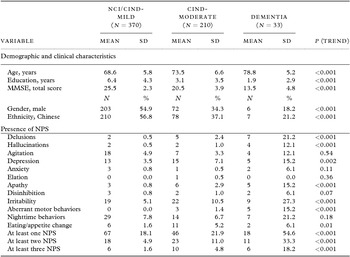
A total of 613 participants were recruited in the EDIS study, of these 370 were NCI/CIND-mild, 210 had CIND-moderate and 33 had dementia. There were significant differences among the three diagnostic groups in demography. The 30-day presence of NPS between participants with NCI/CIND-mild, CIND-moderate, and dementia was compared. On individual NPS domains, the presence of specific NPS increased from NCI/CIND-mild to CIND-moderate to dementia, including delusions, hallucinations, depression, apathy, irritability, aberrant motor behaviors, and eating/appetite change. (Table 1) Nevertheless, there was no ethnic difference between Chinese and Malays in the presence of NPS (data not shown).
Demographic and clinical characteristics and neuropsychiatric data of participants

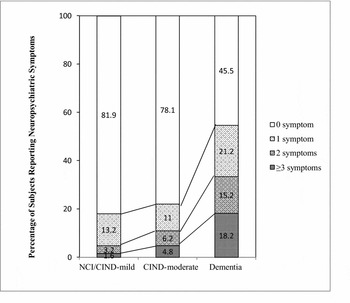
Figure 1 shows that the number of NPS increased with increasing severity of cognitive impairment. Participants with two or more NPS increased significantly from NCI/CIND-mild to CIND-moderate to dementia (p < 0.001).
Total number of NPS in the past 30 days by diagnostic group (percentages are displayed in the graph).

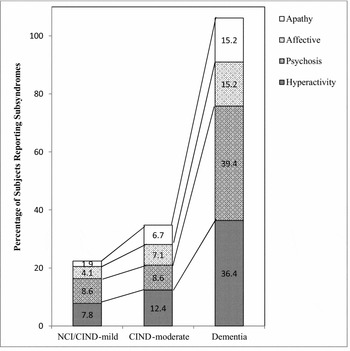
Figure 2 shows the type of sub-syndromes for each diagnostic group. The number of sub-syndromes increased from NCI/CIND-mild to CIND-moderate to dementia.
Presence of specific neuropsychiatric sub-syndrome in the past 30 days by diagnostic group (percentages are displayed in the graph).

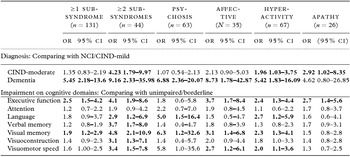
Table 2 shows that participants with CIND-moderate are more likely to demonstrate symptoms in the apathy (OR: 2.9, 95% CI: 1.0–8.4) and hyperactivity (OR: 2.0, 95% CI: 1.0–3.8) sub-syndromes but not in the psychosis (p = 0.85) and affective (p = 0.08) sub-syndromes compared to NCI/CIND-mild participants.
Adjusteda odds ratios (ORs) by neuropsychiatric sub-syndrome

aORs were adjusted for age, years of education, gender, and ethnicity. Bold indicate significance.
By comparison, patients with dementia showed significant differences in affective (OR: 8.7, 95% CI: 1.8–42.9), hyperactivity (OR: 5.4, 95% CI: 1.8–16.1), and psychosis (OR: 6.9, 95% CI: 2.4–20.1) sub-syndromes but not in the apathy sub-syndrome (p = 0.09) when compared to NCI/CIND-mild participants.
With respect to specific cognitive domains, executive dysfunction was associated with the presence of three sub-syndromes: affective (OR: 3.7, 95% CI: 1.7–8.4), hyperactivity (OR: 2.4, 95% CI: 1.3–4.4), and apathy (OR: 4.3, 95% CI: 1.4–5.6); Visual memory impairment was also associated with three sub-syndromes: psychosis (OR: 6.3, 95% CI: 1.2–32.6), affective (OR: 3.1, 95% CI: 1.4–6.8), and hyperactivity (OR: 2.3, 95% CI: 1.3–4.1). At the same time, language deficits were found to be related to two sub-syndromes: psychosis (OR: 5.0, 95% CI: 1.5–16.4) and hyperactivity (OR: 2.7, 95% CI: 1.2–5.9); Whilst visuomotor speed impairment was related to affective (OR: 2.7, 95% CI: 1.2–6.1) and hyperactivity (OR: 2.0, 95% CI: 1.1–3.6). By contrast, impairment in attention, verbal memory, and visuoconstruction domains was not associated with presence of any sub-syndrome. (Table 2)
Discussion
This study is the first to investigate the prevalence of neuropsychiatric sub-syndromes in community-dwelling Asian elderly and to relate the presence of sub-syndromes with impairment on specific cognitive domains. We found that CIND-moderate participants had significantly more neuropsychiatric sub-syndromes, specifically greater odds of having hyperactivity and apathy sub-syndromes, compared to NCI/CIND-mild participants. This novel finding suggests that the study of sub-syndromes is equally important in participants with CIND as most previous studies have only reported on sub-syndromes in patients with dementia (Gauthier et al., Reference Gauthier, Wirth and Mobius2005; Aalten et al., Reference Aalten2007; Kang et al., Reference Kang, Ahn, Kim and Kim2010; Cheng et al., Reference Cheng, Kwok and Lam2012; Selbæk and Engedal, Reference Selbæk and Engedal2012). We have also found that patients with dementia were more likely to have psychosis, affective, and hyperactivity sub-syndromes compared to NCI/CIND-mild participants. This is in agreement with previous studies which have highlighted that psychosis, affective, and hyperactivity sub-syndromes are highly prevalent in patients with dementia (Aalten et al., Reference Aalten2007; Reference Aalten2008). Furthermore, we found that CIND-moderate participants were significantly more likely to display at least two sub-syndromes when compared to NCI/CIND-mild participants. Therefore, different patterns of sub-syndromes may be associated with the severity of cognitive impairment and hence be targets for earlier disease management and treatment. (Gauthier et al., Reference Gauthier, Wirth and Mobius2005; Kang et al., Reference Kang, Ahn, Kim and Kim2010).
A novel finding is the association between the presence of certain sub-syndromes with impairment on specific cognitive domains. The current study shows that executive and visuomotor speed dysfunction is significantly associated with the presence of hyperactivity and affective syndromes. It has been suggested that executive and visuomotor speed dysfunction is common in mania and depression which may reflect frontal cortex dysfunction (Marchand et al., Reference Marchand, Bennett and Dilda2005).
On the other hand, the presence of psychosis sub-syndrome, characterized by the presence of delusion, hallucination, and nighttime disturbance, is significantly associated with deficits on language and visual memory domains. Psychosis is common in schizophrenia, where there may also be underlying thalamic dysfunction. Such thalamic dysfunction could lead to disruption in the sensory gating system, and subsequently cause language production and memory retrieval problems. Interestingly, it has been reported that thalamic stimulation in schizophrenia improves speech production and reduces recalling errors (Johnson and Ojemann, Reference Johnson and Ojemann2000). Our finding hence may improve early detection and treatment of these neuropsychiatric sub-syndromes.
We compared the presence of NPS in our current study with other Asian (Ikeda et al., Reference Ikeda2004; Feng et al., Reference Feng, Yap, Lee and Ng2009; Chan et al., Reference Chan2010; Haibo et al., Reference Haibo2013) and Western population-based studies (Lyketsos et al., Reference Lyketsos, Lopez, Jones, Fitzpatrick, Breitner and DeKosky2002; Tatsch et al., Reference Tatsch2006; Geda et al., Reference Geda2008; Okura et al., Reference Okura, Plassman, Steffens, Llewellyn, Potter and Langa2010; Peters et al., Reference Peters2012; Beaudreau et al., Reference Beaudreau, Fairchild, Spira, Lazzeroni and O’Hara2013): 17.9% of NCI participants and 54.5% of patients with dementia in our study demonstrated at least one NPS which is similar to both Asian-based (NCI: 5.9% to 29%, dementia: 50% to 88.3%) and Western-based studies (NCI: 15.1% to 25%, dementia: 57% to 80.1%). Hence, there is no difference in NPS prevalence in NCI and dementia populations.
However, we found a slightly lower presence (20.7%) of at least one NPS in Singaporean participants with CIND given that the prevalence rate in Western CIND/MCI participants ranges from 31% to 50% (Lyketsos et al., Reference Lyketsos, Lopez, Jones, Fitzpatrick, Breitner and DeKosky2002; Tatsch et al., Reference Tatsch2006; Geda et al., Reference Geda2008; Okura et al., Reference Okura, Plassman, Steffens, Llewellyn, Potter and Langa2010; Peters et al., Reference Peters2012; Beaudreau et al., Reference Beaudreau, Fairchild, Spira, Lazzeroni and O’Hara2013). One explanation to account for the variation in NPS is cultural differences as Asian societies tend to be conservative in nature, NPS may carry a social stigma (Wu et al., Reference Wu, Low, Xiao and Brodaty2009). Hence, NPS might have been underreported. When compared to other Asian population-based studies which assessed CIND/MCI participants, we observed a lower presence of participants with at least one NPS in this study when compared to Hong Kong (36.7%) (Chan et al., Reference Chan2010) but a higher presence when compared to a previous Singaporean community-based study (12.9%) (Feng et al., Reference Feng, Yap, Lee and Ng2009). A possible reason to explain the former is selection bias as only participants who had subjective cognitive complaints were recruited into the present study. The difference with the latter study may be due to nighttime behaviors, which was observed to be highly prevalent in the current study but were not assessed in the earlier study (Feng et al., Reference Feng, Yap, Lee and Ng2009).
Nevertheless, we found a graded increase in NPS with increasing severity of cognitive impairment in that the number of participants having at least two NPS or at least three NPS increased significantly from NCI/CIND mild to CIND moderate to dementia. These results support the findings from a previous study in Caucasian population (Okura et al., Reference Okura, Plassman, Steffens, Llewellyn, Potter and Langa2010). We have extended this to an Asian population hence emphasizing the global importance of NPS in populations with increasing severity of cognitive impairment.
Interestingly, across all groups in the current study, irritability was identified to be one of the most prevalent symptoms. Affective symptoms, particularly irritability, had been frequently reported to be present in CIND participants in earlier community-based studies (14.7% (Lyketsos et al., Reference Lyketsos, Lopez, Jones, Fitzpatrick, Breitner and DeKosky2002) to 19.4% (Geda et al., Reference Geda2008)). Similarly, nighttime behaviors was also observed to be one of the most prevalent symptoms across all groups. An earlier study (Peters et al., Reference Peters2013) had highlighted that NPS, in particular nighttime behaviors was a risk factor for dementia. Furthermore, a tertiary center study (Geda et al., Reference Geda2004) reported that nighttime behaviors (7.7%, 16.7%) and irritability (2.1%, 12.9%) were the most common symptoms in NCI and MCI participants respectively, similar to the current study.
A limitation to our study is that 43.2% of the screened positive participants did not participate in the second phase of the study. Since these participants were older and as older participants showed more NPS (Steinberg et al., Reference Steinberg2006), there may be an underestimation of the presence of NPS in our current study. As the comparison of Asian countries’ prevalence rates is based on a limited number of Asian studies, further studies are needed to confirm whether there is a difference in NPS prevalence rates when compared with other population-based studies. In addition, future studies should be conducted to assess cultural differences in the presence of NPS across more dissimilar ethnicities, e.g. Caucasians versus Asians.
In conclusion, we have confirmed in an elderly Asian population, there is an increasing frequency of NPS with increasing severity of cognitive impairment, thus emphasizing the importance of NPS in patients with cognitive impairment. A novel finding is that the number and type of sub-syndromes are associated with severity of cognitive impairment and specific impairments on cognitive domains. Our study confirms that NPS and sub-syndromes are associated with various severity and types of cognitive impairment. Hence, they may be important targets for treatment.
Conflict of interest
None.
Description of authors’ roles
X. Xu designed the study, collected the data, conducted statistical analysis, interpreted data, and drafted the paper. S. L. Ang designed the study, collected the data, conducted statistical analysis, interpreted data, and revised the paper. S. Hilal collected the data and revised the paper. Q. L. Chan was responsible for the collection of data. T.Y. Wong revised the paper. N. Venketasubramanian was responsible for supervising and revising the paper. M. K. Ikram was responsible for the study design, supervision, and revision of the paper. C. L. Chen designed the study, supervised statistical analysis, interpreted data, and was responsible for the critical revision of the paper.
Acknowledgments
The authors thank all staff and participants of the EDIS Study and the SEED Study for their important contributions. The EDIS study is supported by the National Medical Research Council (NMRC), Singapore (NMRC/CG/NUHS/2010 [Grant no.: R-184-006-184-511]). Additional funding was received from the Singapore Ministry of Health's National Medical Research Council (NMRC/CSA/038/2013). The sponsors of the study had no role in study design, data collection, data analysis, data interpretation, or writing of the report.