Lichens produce various oxidoreductases such as the copper-containing phenol oxidases tyrosinase and laccase (Laufer et al. Reference Laufer, Beckett and Minibayeva2006a , Reference Laufer, Beckett, Minibayeva, Luthje and Bottger b , Reference Laufer, Beckett, Minibayeva, Luthje and Bottger2009; Zavarzina & Zavarzin Reference Zavarzina and Zavarzin2006; Beckett et al. Reference Beckett, Minibayeva and Liers2012) and heme-containing peroxidases (Liers et al. Reference Liers, Ullrich, Hofrichter, Minibayeva and Beckett2011; Beckett et al. Reference Beckett, Minibayeva and Liers2013a ). In free-living fungi, the main role of oxidoreductases appears to be to participate in the breakdown of lignocellulose. It seems likely that in lichens these enzymes may play this, and additional roles, for example melanin biosynthesis (for review see Beckett et al. Reference Beckett, Zavarzina and Liers2013b ). Significant oxidoreductase activity appeared only to occur in lichens from the order Peltigerales. However, we have detected oxidoreductase activity in non-Peltigeralean lichens, particularly in samples that had been hydrated for several days. Here we show that, in non-Peltigeralean lichens, hydration in the dark often induces significant laccase and peroxidase activity, suggesting that the occurrence of these enzymes may be more widespread in lichens than previously thought.
Lichens were collected from Nottingham Road, South Africa, except for Pseudevernia furfuracea and Cladonia rangiformis, which were collected from the outskirts of Kazan, Russian Federation and Lasallia pustulata and Peltigera canina, which were collected from the outskirts of Colmar, France. Material was collected dry, and stored refrigerated for a maximum of 4 weeks before use. In all cases, large collections of lichens were made, and the thalli randomly selected from those that appeared most healthy. To minimize variation, 1 cm discs were cut wherever possible. For each species, three replicates of c. 0·1 g each were used. Enzymes were assayed by grinding lichen material in 10 ml of 50 mM phosphate buffer pH 7 using c. 0·1 g of aluminium oxide to facilitate grinding. Extracts were centrifuged at 5000 g for 20 min, and the supernatant taken for further analysis. Laccase activity was estimated by following the oxidation of 0·3 mM 2,2-azino-bis(3-ethylthiazoline-6-sulfonate) (ABTS; Sigma) at 420 nm (A420=36 mM–1 cm–1) in 50 mM sodium acetate buffer pH 4·5 (Eggert et al. Reference Eggert, Temp and Eriksson1996) in 1 ml quartz cuvettes. Aliquots of extracts varied between 10 and 200 µl according to the activities of enzymes. Peroxidase activity was estimated as the stimulation of the rate of ABTS oxidation following the addition of 0·1 mM H2O2 (Liers et al. Reference Liers, Ullrich, Hofrichter, Minibayeva and Beckett2011). To test the effect of hydration on enzymes, activities were initially measured in desiccated lichens, and then following rehydration by storage at 10°C in darkness on wet non-cellulosic cloth for seven days. Estimates of dry mass were made using replicate samples. For Lobaria scrobiculata, a detailed time course of changes in enzyme activity was carried out. At each time point, three replicates comprising c. 0·1 g dry mass of 1 cm discs were sampled, and the activities of laccase, peroxidase and tyrosinase were measured. Tyrosinase activity was estimated by following the oxidation of 2 mM L-dihydroxyphenylalanine (DOPA; Sigma) to 2-carboxy-2,3-dihydroindole-5,6-quinone (dopachrome; Horowitz et al. Reference Horowitz, Gling and Horn1970) in 50 mM phosphate buffer pH 6 in 1 ml quartz cuvettes. The extinction coefficient of the product measured at A475 is 3·6 mM–1 cm–1. For the time course, activity was measured in dry material, and then the remaining replicates were transferred to air at 100% RH. Enzyme activities were measured after one and two days, and then the remaining replicates were transferred to wet non-cellulosic cloth. Activity was measured after one day, and then at intervals until 25 days after the start of the experiment.
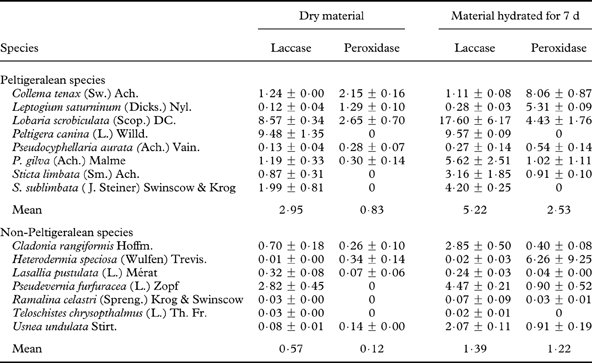
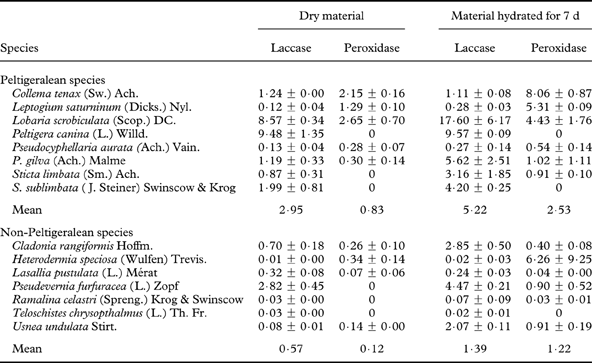
The laccase and peroxidase activities in a range of lichens, dry and following hydration for seven days are presented in Table 1. Peltigeralean lichens had significant laccase activity even when dry, but not all species displayed peroxidase activity. While hydration increased laccase activities by an average of 75%, peroxidase activities increased by more than three times. However, hydration failed to induce any peroxidase activity in two Peltigeralean species (Peltigera canina and Sticta sublimbata). By contrast, in dry non-Peltigeralean lichens, with the exception of Pseudevernia furfuracea, laccase activity was very low, and no species contained significant peroxidase activity. Hydration significantly increased laccase activity in Cladonia rangiformis, Pseudevernia prunastri and Usnea undulata. However, hydration has a greater effect on peroxidase activity. After hydration, significant activity occurred in six of the seven species tested, increasing on average by ten times, with a particularly large increase occurring in Heterodermia speciosa.
The effect of hydration for one week on the activities of laccase and peroxidase. Units are units of enzyme g–1 dry mass. Figures are given ± the standard deviation, n=3.
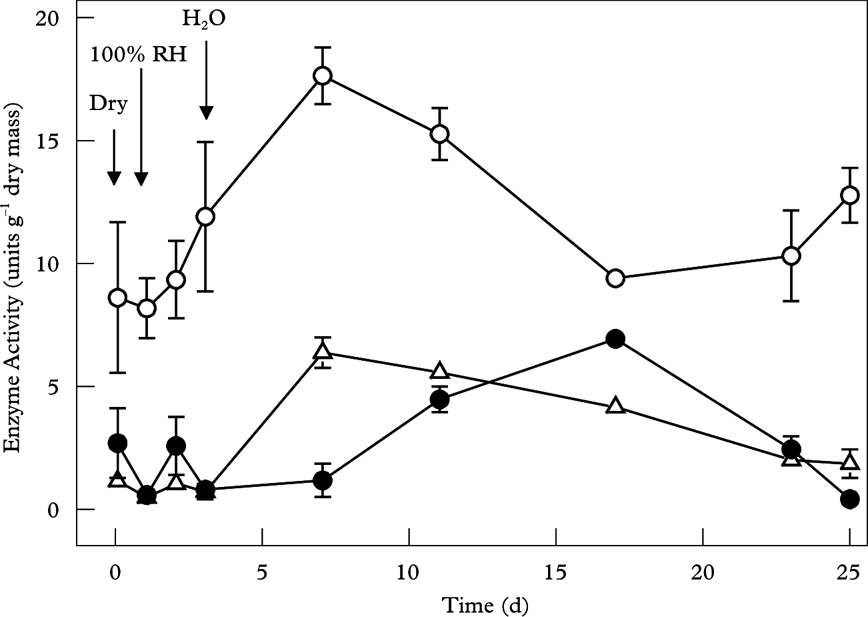
A detailed time course on the effect of hydration on enzyme activity in Lobaria scrobiculata is presented in Figure 1. The health of the lichens visibly declined between 17 and 23 days, with occasional necrotic spots appearing on the surface of the thalli. Laccase and tyrosinase activities increased until seven days after the start of the experiment (five days after full hydration), and then declined, with laccase activities increasing towards the end of the experiment. We have previously reported on the tight correlation between laccase and tyrosinase activities in healthy lichens (Laufer et al. Reference Laufer, Beckett and Minibayeva2006a ), later speculating that possibly tyrosinases may be involved in synthesizing compounds such as quinones that laccases use in extracellular redox cycling. For peroxidase, hydration in air of 100% relative humidity decreased activity, but after 48 h in moist air activity increased back to original values. Fully saturating lichens by placing them on wet non-cellulosic cloth again decreased activity. Activity then gradually increased until 17 days after the start of the experiment, and then declined, corresponding to the deterioration of the visual appearance of the lichens.
The effect of rehydration on the activities of laccase (○), peroxidase (•), and tyrosinase (Δ) in Lobaria scrobiculata. Material was transferred to air at 100% RH immediately after measurement of activity in dry material at time=0 d, activity measured after 1 and 2 d, and then transferred to wet non-cellulosic cloth. Activity was measured after 1 d, and then at intervals until 25 d after the start of the experiment. After 17 d, the health of lichens visibly declined. Mean values (n=3) are plotted ±1 SE.

In our earlier survey of laccase and peroxidase activity in lichens (Beckett et al. Reference Beckett, Minibayeva and Liers2013a ), we used a standardized protocol for carrying out assays. Lichens were collected from the field, and if wet allowed to dry. Activity was then measured first after storage dry at 4°C for times varying from a few days to several weeks, and second following storage at 10°C in darkness in air at 100% RH for 24 h, and then for a further 24 h on wet non-cellulosic cloth under the same conditions. This hydration typically causes small increases in activity. Results presented here clearly show that in many species enzyme activities increase significantly more following hydrated storage for a week. Lobaria scrobiculata is a model species in many of our investigations. Careful examination of the time course of the changes in enzyme activities during hydration in this lichen shows that only measuring 48 h after hydration underestimates the potential activities of laccase, but even more so of peroxidase (Fig. 1). A survey (Table 1) indicates that, while most non-Peltigeralean species contain no or extremely low laccase or peroxidase activities when dry, hydration for seven days often induces significant activities. These new findings suggest that laccases and peroxidases are expressed more widely in lichens than previously reported (Beckett et al. Reference Beckett, Minibayeva and Liers2013a ).
The significant increases in the activities of laccases and peroxidases that occur in lichens hydrated for seven days could have several explanations. Possibly, lichens may need to fully recover from the desiccation stress following collection, which in the present study was up to four weeks. However, many studies show that physiological parameters such as photosynthesis, respiration and the activity of other enzymes recover within a few hours of rehydration, even in lichens desiccated for many months (Kranner et al. Reference Kranner, Beckett, Hochman and Nash2008). It seems more likely that the gradual increase in the activities of the laccases and peroxidases may be a consequence of their possible physiological functions. Although these enzymes are capable of directly metabolizing a wide variety of substrata, it is often suggested that their main role is to produce reactive oxygen species (ROS) (Beckett et al. Reference Beckett, Zavarzina and Liers2013b ). ROS production can occur directly if a suitable reductant such as NADH is available, or indirectly via extracellular redox cycling involving quinones and chelated Fe such as has been shown to occur in free-living fungi (Gómez-Toribio et al. Reference Gómez-Toribio, García-Martín, Martínez, Martínez and Guillén2009). These ROS may participate in pathogen and abiotic stress defence, but also in facultative saprotrophy. Saprophytic activities may provide additional mycobiont nutrition during periods of low photosynthate supply or during intensive growth periods, as suggested for mycorrhizal fungi (Talbot et al. Reference Talbot, Allison and Treseder2008). Prolonged storage in darkness is likely to induce carbon depletion. In free-living ascomycetes, the creA (cAMP mediated glucose repression) site is well known to take part in the glucose repression mechanism, and is widely used to boost laccase production (Janusz et al. Reference Janusz, Kucharzyk, Pawlik, Staszczak and Paszczynski2013). Upregulation of laccases and peroxidases may therefore represent an attempt by the lichens to increase their supply of carbon.
Data presented here do not support a role for peroxidases in ROS scavenging in lichens. Following desiccation stress, the rehydration of lichens is associated with a burst of ROS (Weissman et al. Reference Weissman, Garty and Hochman2005). In Lobaria scrobiculata, peroxidase activity is low exactly at those times when ROS production is likely to be highest, for example when transferring dry lichens to humid air and again to wet cloth (Fig. 1). Peroxidases are therefore unavailable to scavenge ROS when they are most needed, but lichens contain other mechanisms to remove such ROS (Kranner et al. Reference Kranner, Beckett, Hochman and Nash2008). It is possible, however, that maintaining lichens in a continually hydrated state is likely to induce mild anoxia, which in higher plants is known to induce ROS formation (Blokhina & Fagerstedt Reference Blokhina and Fagerstedt2010). Possibly, therefore, peroxidases may be induced to scavenge these ROS. However, it seems more likely that the roles of laccases and peroxidases are more concerned with producing rather than scavenging ROS.
In conclusion, results from the survey presented here support our earlier reports that laccase and peroxidase activities tend to be higher in Peltigeralean than in non-Peltigeralean lichens (Beckett et al. Reference Beckett, Zavarzina and Liers2013b ). However, they also clearly show that, following hydration for seven days, many non-Peltigeralean lichens can display significant oxidoreductase activity. Interestingly, the analysis of a recently available genome sequence of the non-Peltigeralean lichen Cladonia greyi suggests that this species possesses multicopper oxidase and peroxidase genes. It seems most likely that increased enzyme activities represent the initiation of saprophytic activities in response to carbohydrate shortage. The higher initial values and lower hydration-induced increases in the activities of these enzymes in Peltigeralean lichens may be because these lichens tend to occupy moister habitats, allowing them to participate in saprophytic activities more often than non-Peltigeralean species. However, under the appropriate conditions, laccase and peroxidase activities can be expressed in a wide range of lichens.
DAAD (grant no. A/13/06052), the European Union (integrated project Peroxicats) and the Russian Foundation for Basic Research (grant no. 14-04-93962) are thanked for financial support. We are grateful to Shuttleworth Weaving, Nottingham Road, South Africa, for allowing us to collect lichens on their premises.