Echoing an earlier paper by Rasmussen et al.,Reference Rasmussen, Jamieson, Honein and Petersen 1 a recent comprehensive systematic review of the literature by a World Health Organization Expert Panel concluded that the most likely explanation of observations of clusters of microcephaly associated with outbreaks of Zika virus infection is that the Zika virus infection during pregnancy is a cause of congenital brain abnormalities.Reference Krauer, Riesen and Reveiz 2 Zika virus infections acquired by pregnant women while traveling in an area with risk of Zika outside of the 50 US states, along with local transmission of Zika virus in Florida and Texas,Reference Likos, Griffin and Bingham 3 , 4 resulted in reports of 1,297 pregnant women from 44 states to the US Zika Pregnancy Registry in 2016.Reference Reynolds, Jones and Petersen 5 The US Zika Pregnancy Registry includes all pregnant women with any laboratory evidence of possible Zika virus infection from all US states, the District of Columbia, and US territories with the exception of Puerto Rico, which has a similar system – the Zika Active Pregnancy Surveillance System. Zika virus-associated birth defects were reported for 24 of the 250 fetuses/infants from completed pregnancies with laboratory-confirmed Zika virus infection (10%, 95% confidence interval [CI] = 7%-14%) reported to the US Zika Pregnancy Registry, including brain abnormalities and/or microcephaly and other early brain malformations, eye abnormalities, other consequences of central nervous system dysfunction, and neural tube defects.Reference Reynolds, Jones and Petersen 5 It is unclear how many cases of congenital Zika infection (CZI) might occur in the next few years. If a large number of infants are affected in the United States, as in other countries in the Americas,Reference Calvet, dos Santos and Sequeira 6 workforce capacity may be insufficient to provide the care that congenitally infected children will need.
Rubella provides a historical precedent for this scenario. The widespread rubella epidemic in 1964 to 1965 resulted in the birth of approximately 20,000 children with serious congenital rubella-associated birth defects.Reference Cooper 7 Many of these children had sensorineural hearing loss (SNHL) at birth, brain abnormalities, and vision loss, similar to children with CZI.Reference Cooper, Ziring and Ockerse 8 , Reference Broutet, Krauer and Riesen 9 In addition to congenital anomalies, delayed onset endocrine and neurologic disorders, progressive hearing loss, and behavioral and developmental disorders attributable to rubella infection in utero were also documented.Reference Ziring, Fedun and Cooper 10 – Reference Chess, Fernandez and Korn 13 At the time, the medical community struggled to assemble the multidisciplinary, coordinated care needed by children with long-term sequelae of congenital rubella infection. Their need for intensive diagnostic and therapeutic services required the joint assistance of a wide variety of medical and paramedical professionals with specialized expertise. Identifying and ensuring appropriate timing and use of available services to optimize outcomes and coordinating the large number of service providers were particular challenges. 14 Fortunately, with the licensure of a rubella vaccine in 1969 and subsequent widespread vaccination coverage, widespread rubella outbreaks were eliminated in the United States. 15
Today, health care systems in the United States face similar challenges in coordinating care for children with complex medical needs; the generally low numbers and uneven distribution of pediatric medical subspecialists add to the challenge. 16 Congenital cytomegalovirus (CMV) infection, the most common nongenetic cause of SNHL as well as a cause of permanent neurologic disabilities and cognitive deficits in childhood, affects approximately 20,000 to 40,000 infants born each year in the United States.Reference Cannon and David 17 In addition, noninfectious congenital conditions like complex congenital heart disease, extreme prematurity, and genetic conditions, like DiGeorge syndrome and Down syndrome, which are associated with neurodevelopmental disabilities, continue to affect children who need complex care.Reference Houtrow, Larson and Olson 18 The possibility that increased CZI could add to the number of children with neurodevelopmental disabilities in the coming years raises additional concerns about workforce capacity. Like children with neurodevelopmental disabilities from the infectious and noninfectious congenital causes mentioned previously, children with disabilities related to CZI will need multidisciplinary care from pediatric subspecialists, such as neurologists, clinical geneticists, developmental pediatricians, ophthalmologists, audiologists, endocrinologists, orthopedists, physiatrists, pulmonologists or otolaryngologists, and gastroenterologists.Reference Russell, Oliver and Lewis 19 , Reference Mayer, Skinner and Slifkin 20 We assessed the geographic distribution of pediatric subspecialty care across the United States, in light of the continuing need and the possibility of increased demand for these services.
METHODS
We described the distribution of pediatric medical subspecialty services geographically across the United States, including US states with a high likelihood of local Zika virus transmission (ie, Alabama, Florida, Louisiana, Mississippi, Texas) and states reporting the majority of adult travel-associated cases of Zika virus disease as of April 2017 (ie, California, Florida, Georgia, Illinois, Massachusetts, Maryland, North Carolina, New Jersey, New York, Pennsylvania, Texas, Virginia). Data from the February 2017 version of the American Medical Association (AMA) Physician Masterfile (https://www.ama-assn.org/life-career/ama-physician-masterfile) were used to determine the county-specific locations of 9 relevant pediatric subspecialties across the continental United States and Hawaii and a subset of 4 pediatric subspecialties that we judged to be essential for the care of children with CZI, given the frequencies of specific disorders in these children.Reference Moore, Staples and Dobyns 21 The 9 subspecialties included child neurology, developmental-behavioral pediatrics and neurodevelopmental disabilities (combined for analytic purposes), pediatric orthopedics, pediatric endocrinology, pediatric infectious diseases, pediatric otolaryngology, pediatric gastroenterology, pediatric ophthalmology, and pediatrics/physical medicine and rehabilitation and pediatric rehabilitation medicine (combined for analytic purposes). The subset of essential subspecialties included child neurology, pediatric gastroenterology, pediatric ophthalmology, and either developmental-behavioral pediatrics or neurodevelopmental disabilities. Full complements of essential pediatric subspecialists (ie, one of each of the 4 subspecialties) were counted by county and state, focusing on the 5 Gulf states with the highest likelihood of local transmission of Zika virusReference Messina, Kraemer and Brady 22 , Reference Monaghan, Morin and Steinhoff 23 and the 12 states with more than 100 reported laboratory-confirmed travel-associated cases of Zika virus disease in adults as of April 27, 2017. 24 A state was considered to have a full complement if it had one of each of the essential pediatric subspecialists, even if the subspecialists were dispersed across multiple counties.
Next, we examined the proximity of pediatric subspecialists to in-state children’s hospitals to determine whether children’s hospitals might serve as indicators of clusters of pediatric subspecialists. We geocoded street addresses of children’s hospitals that comprise the members of the Children’s Hospital Association, which include specialty children’s hospitals, hospitals that serve as primary teaching sites of organized pediatrics departments of approved medical schools, and hospitals that are pediatric referral centers. 25
The proximity of children under age 5 years in each census tract to subspecialists was assessed by calculating the travel distance on streets from each census tract’s centroid (geographical center) to the nearest in-state children’s hospital. We calculated the distance to the nearest in-state children’s hospital, without accounting for border crossing, because of restrictions on reimbursement for out-of-state service providers in some health insurance plans. Census tract boundaries and population data by census tract for children under age 5 years were obtained from the 2011-2015 American Community Survey 5-year estimates (US Census).
Network analysis was performed in ArcMap 10.3 (Esri™) to calculate these travel distances on a US street network (StreetMap Premium for ArcGIS Desktop, HERE North America 2016R2). A search radius of 5 km was used to locate the street nearest each census tract centroid and hospital. For any census tract for which the street closest to the centroid was not connected to the network, or for which the centroid was greater than 5 km from the nearest street connected to the network, the travel distance was calculated from the nearest point to the centroid that was on a street within the tract connected to the street network. Some census tracts with a population under age 5 years greater than zero had no street within the tract connected to the street network. In this case, a street connected to the network was on the boundary of the tract or ≤ 10 km from the boundary of the tract, and the travel distance was calculated from the nearest point on that street. Census tracts with zero land area (ie, water-only census tracts), with no streets and zero population under age 5 years (n = 4), or no streets connected to the street network and zero population under age 5 years (n = 2) were excluded from the analysis.
Analytically, some states were handled differently than others because of a variety of unique scenarios. Neither Montana nor Wyoming has a children’s hospital, and they have few pediatric subspecialists (n = 5 and n = 1, respectively). For all census tracts in both of these states, distance to the nearest out-of-state children’s hospital was calculated. Kansas does not have a children’s hospital, but Johnson County, in which Kansas City is located, has 30 subspecialists representing 8 of the 9 types of interest; Sedgwick County, containing Wichita, has 10 subspecialists representing 6 of the 9 types of interest. Therefore, both counties are likely able to provide care for many complex medical cases; these county centroids were processed in the same way as the geocoded children’s hospitals. Finally, for Alaska and Hawaii, geodesic distances between census tract centroids and the nearest in-state children’s hospitals, rather than travel distances on streets, were calculated in ArcMap 10.3 using the Near tool because travel by air is required between some locations. All census tracts with land area in Alaska (n = 167) and Hawaii (n = 326) were included in these data sets.
We used SAS version 9.4 (SAS Institute, Inc., Cary, NC) to examine minimum and maximum travel distances to the nearest in-state children’s hospital for census tracts with children under age 5 years, for each state, as well as percentiles of children under age 5 years according to travel distances from the centroids of their census tracts. The travel distance for 50% of children under age 5 years is hereafter referred to as the median travel distance, and the travel distance for 25% to 75% of children under age 5 years is referred to as the interquartile range. Percentiles of travel distance to the nearest in-state children’s hospital were also calculated in the same way for children under age 5 years in groups of states: (1) those on the Gulf of Mexico, (2) those with more than 100 reported cases of Zika virus disease in adults as of April 2017, and (3) the remaining states. In addition, travel distance percentiles were compared for children in states within and outside of the expected range of Aedes aegypti mosquitoes (states “within the range” are those with at least half of their land area covered by the range). 26
RESULTS
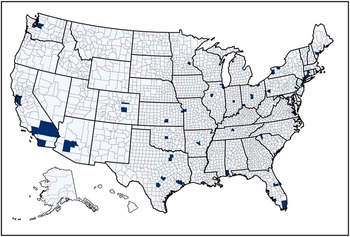
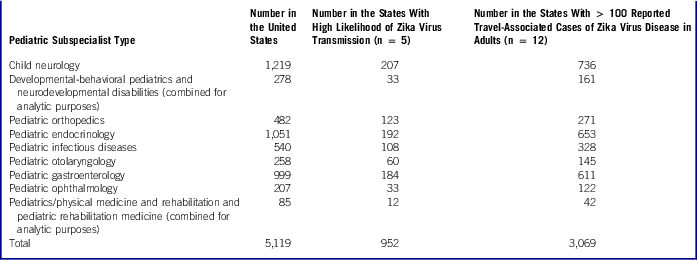
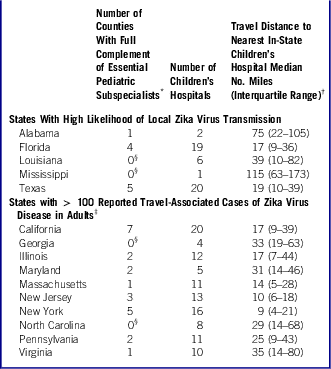
The frequencies of the 9 pediatric subspecialist types are displayed in Table 1. Child neurology is the most common subspecialist type (n = 1,219), followed by pediatric endocrinology (n = 1,051) and pediatric gastroenterology (n = 999). Nationwide, 20 states have all of the pediatric subspecialist types, 28 states have at least 8 of the 9 types, and 31 states have at least 7 of the 9. The distribution of the subset of subspecialist types that we consider to be essential for the care of children with neurodevelopmental disorders like congenital Zika syndrome is also limited: 35 states have all 4 of the essential subspecialist types, and 42 states have at least 3 of the 4. Two of the 5 Gulf States where local transmission of Zika virus has the highest likelihood of taking hold lack a full complement of essential pediatric subspecialists in any county, although the 4 essential subspecialist types can be found within the states included in Table 2 and Figure 1. Of the 12 states that have reported more than 100 cases of Zika virus disease in adults as of April 2017, all but 2 have a full complement of essential pediatric specialists localized within a county or counties, and these 2 have a full complement dispersed across multiple counties.
Counties With at Least One of Each of the Essential Pediatric Subspecialist Types. Notes: Essential pediatric subspecialist types are child neurology, pediatric gastroenterology, pediatric ophthalmology, and either developmental-behavioral pediatrics or neurodevelopmental disabilities. Counties with at least one of each of the essential pediatric subspecialist types are indicated in dark blue. Data source: American Medical Association Physician (AMA) Masterfile. https://www.ama-assn.org/life-career/ama-physician-masterfile. Accessed February 16, 2017.

Numbers of Pediatric Subspecialists Nationwide, in States With a High Likelihood of Zika Virus TransmissionFootnote * and in States With Greater Than 100 Reported Travel-Associated Cases of Zika Virus Disease in Adults,Footnote † by Subspecialty

* Includes Alabama, Florida, Louisiana, Mississippi, and Texas.
† Includes California, Florida, Georgia, Illinois, Maryland, Massachusetts, New Jersey, New York, North Carolina, Pennsylvania, Texas, and Virginia.
Number of Counties with Full Complement of Pediatric Subspecialists and Travel Distance to the Nearest In-State Children’s Hospital, in States with a High Likelihood of Local Zika Virus Transmission and Greater Than 100 Reported Travel-Associated Zika Virus Cases in Adults to Date

* Full complement of subspecialties for care of children with congenital Zika syndrome include child neurology, pediatric gastroenterology, pediatric ophthalmology, and either developmental-behavioral pediatrics or neurodevelopmental disabilities.
† Median and interquartile range represent distance from the nearest in-state children’s hospital from centroids of census tracts accounting for 50% and 25%-75% of each state’s children under age 5 years, respectively.
‡ Cases reported through April 27, 2017; also includes Florida and Texas (not repeated because these states are listed in the previous group).
§ States with a full complement of essential pediatric subspecialists dispersed across multiple counties, rather than within a county or counties.
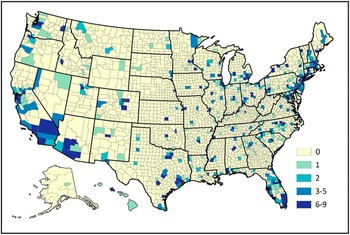
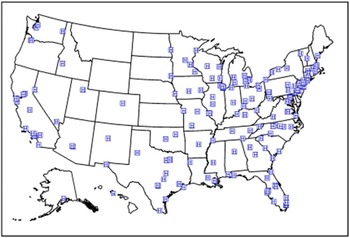
Overall, 95% of subspecialists are located in the same county or a neighboring county as a children’s hospital, and no children’s hospitals are without pediatric subspecialists nearby (all hospitals except 1 have at least 3 subspecialists in the same or a neighboring county; 1 hospital has 2, and most hospitals have at least 6 subspecialists). Therefore, children’s hospitals were used as a proxy for a subspecialist location in subsequent analyses. The distributions of pediatric subspecialists and children’s hospitals across the country are displayed in Figures 2 and 3. Similar to the observed distribution of pediatric specialists, numbers of children’s hospitals are higher around large cities and in the mid-Atlantic, northeastern corridor. Moreover, the hospitals are clustered geographically on the East and West Coasts, with significant gaps in the middle of the country.
Number of Pediatric Subspecialties Represented in Each County. Data source: American Medical Association Physician (AMA) Masterfile. https://www.ama-assn.org/life-career/ama-physician-masterfile. Accessed February16, 2017.

Children’s Hospitals in the United States. Note: Each “H” indicates the location of a children’s hospital. Data source: Children’s Hospital Association. Children’s hospital directory. https://www.childrenshospitals.org/Directories/Hospital-Directory. Accessed March 2, 2017.

Of the 5,119 pediatric subspecialists, 4,059 (79.3%) are located in a county with a children’s hospital, and 785 (15.3%) are located in a county adjacent to a county with a children’s hospital. In total, 5.4% of the pediatric subspecialists of interest are located more than one county away from a county with a children’s hospital (data are not shown).
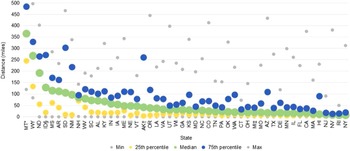
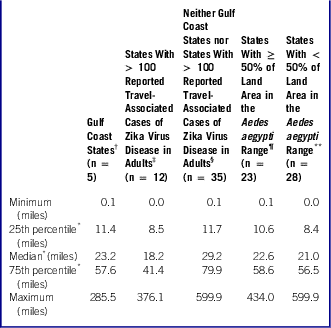
Figure 4 shows the minimum, maximum, median, and interquartile range of travel distance for children under age 5 years to the nearest in-state children’s hospital, by state. Table 3 provides this information for groups of states: the 5 states bordering the Gulf of Mexico, which have the greatest potential for future local transmission; the 12 states that have reported more than 100 cases of travel-associated Zika virus disease among adults as of April 2017; and the remaining states. For 2 of the 5 Gulf states, 50% of children live in census tracts with centroids 50 or more miles from the nearest children’s hospital in the state. For 4 of these 5 states, 25% of children are in census tracts with centroids 50 or more miles from the nearest in-state children’s hospital. In contrast, in the 12 states that account for 75% of the reported travel-associated cases of Zika virus disease among adults to date, travel distances for 50% of the state’s population under age 5 years range from 9 to 35 miles. For 8 states – Alaska, Montana, Wyoming, North Dakota, Idaho, Mississippi, Arkansas, South Dakota – 50% of children live in census tracts with centroids more than 100 miles from the nearest children’s hospital in the state. In Alaska, Montana, and Wyoming, 50% live in census tracts with centroids more than 250 miles away from an in-state children’s hospital. In 21 states, travel distance to an in-state children’s hospital for 50% of children is 25 miles or less. The 75th percentiles for 17 states show that 25% of children under age 5 years live 100 or more miles from a children’s hospital.
Travel Distance by State to the Nearest In-State Children’s Hospital from Census Tracts in Which Children Less Than 5 Years Old Live. Notes: Percentiles reflect maximum travel distances by streets from census tract centroids for 25%, 50%, and 75% of children under age 5 years. Minimum and maximum distances are from census tracts that have a non-zero population of children under age 5 years and have the shortest or longest distance, respectively, from the nearest in-state children’s hospital. The nearest hospital in any state was used for Montana (MT) and Wyoming (WY) calculations. For Kansas (KS), centroids of Johnson and Sedgwick Counties were treated as children’s hospitals. Geodesic distances, not on-street travel distances, were used for Alaska (AK) and Hawaii (HI). Maximum travel distances from the nearest in-state children’s hospital exceeded 500 miles in MT, Idaho (ID), AK, and Michigan (MI). Exact maximum distances for these states are as follows: *Max (MT): 569 miles §Max (ID): 501 miles †Max (AK): 1,142 miles ‡Max (MI): 599 miles Data source: Children’s Hospital Association. Children’s hospital directory. https://www.childrenshospitals.org/Directories/Hospital-Directory. Accessed March 2, 2017.

Travel Distance to the Nearest In-State Children’s Hospital for Children Under Age 5 Years in Selected Regions

* Distance from the nearest in-state children’s hospital from centroids of census tracts accounting for 25%, 50%, and 75% of each region’s children under age 5 years, respectively.
† AL, FL, LA, MS, TX.
‡ CA, FL, GA, IL, MA, MD, NC, NJ, NY, PA, TX, VA.
§ AR, AK, AZ, CO, CT, DC, DE, HI, IA, IN, ID, KS, KY, MI, ME, MN, MO, MT, ND, NE, NH, NM, NV, OH, OK, OR, RI, SC, SD, TN, UT, VT, WA, WI, WY.
¶ AL, AR, AZ, CA, DC, DE, FL, GA, HI, KY, LA, MD, MO, MS, NC, NM, NJ, OK, SC, TN, TX, VA, WV
** AK, CO, CT, IA, ID, IL, IN, KS, MA, MI, ME, MN, MT, ND, NE, NH, NV, NY, OH, OR, PA, RI, SD, UT, VT, WA, WI, WY.
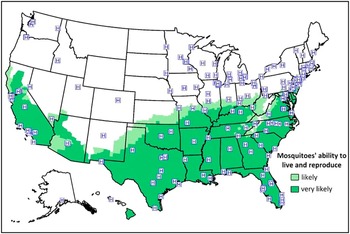
Mapping of estimated ranges of Ae. albopictus and Ae. aegypti, together with locations of children’s hospitals, reveals that there are states in addition to the 5 Gulf states where access to children’s hospitals, and hence pediatric subspecialists, could be limited (Figure 5) and where there may be potential for Zika virus transmission. Arizona, Arkansas, and New Mexico each have a single children’s hospital, and Kansas has none, although 2 Kansas counties have full complements of essential pediatric subspecialists. The median and interquartile range of travel distances to a children’s hospital within these states (subspecialist location in Kansas) are 19 miles (10-110) for Arizona, 112 miles (41-163) for Arkansas, 97 miles (10-220) for New Mexico, and 31 miles (12-98) for Kansas.
Children’s Hospitals and Estimated Range of Aedes aegypti. Note: Each “H” indicates the location of a children’s hospital. Data sources: Children’s Hospital Association. Children’s hospital directory. https://www.childrenshospitals.org/Directories/Hospital-Directory. Accessed March 2, 2017. Centers for Disease Control and Prevention. Estimated range of Aedes aegypti and Aedes albopictus in the United States; 2017. https://www.cdc.gov/zika/vector/range.html. Accessed November 21, 2017.

DISCUSSION
Like other investigators,Reference Ray, Bogen and Bertolet 27 , Reference Mayer 28 we found that access to pediatric subspecialists is uneven across the United States and that pediatric subspecialists practice in close proximity to children’s hospitals.Reference Mayer and Skinner 29 Further, results of our analysis suggest cause for concern about the degree of preparedness for an increase in cases of CZI. Our data indicate that at least 25% of the children under age 5 years in most of the states with the highest likelihood of establishing local Zika virus transmission must travel at least 50 miles to the nearest in-state children’s hospital. This distance may be unmanageable for families with limited transportation, resources, and sick leave benefits when children require frequent health care visits. The data also indicate that this distance barrier exists to a similar extent for children in states for which at least half of the land area is located within the range of the Ae. aegypti mosquitoes that transmit the Zika virus. However, travel-associated cases of the Zika virus disease in adults tend to be reported from population centers in states where there is a large international airport(s), and we also might expect most travel-associated CZI cases to be reported from these population centers in these states, which are well covered by pediatric subspecialist services.
Although only the severe end of the spectrum of CZI outcomes has been described, a pattern of structural anomalies and functional disabilities secondary to central and, perhaps, peripheral nervous system damage is recognized.Reference Moore, Staples and Dobyns 21 Congenital Zika syndrome is a medically complex condition, involving multiple organs, functional limitations, and high resource need/use,Reference Kuo and Houtrow 30 and requires coordinated care by multiple pediatric medical subspecialists and allied health professionals.Reference Russell, Oliver and Lewis 19 A survey of parents of children with special health care needs (SHCN) indicated an inverse relationship between the number of pediatric subspecialists in their states and unmet need for pediatric subspecialty care.Reference Mayer, Skinner and Slifkin 20
A subset of children with SHCN, including children with congenital Zika syndrome, requires complex medical care. Among children in the United States, an estimated 400,000 require complex medical care.Reference Mayer 28 Neurodevelopmental disorders, like those associated with CMV infections and Down syndrome, are prevalent among children with complex medical conditions.Reference Kuo and Houtrow 30 These children tend to have functional limitations and multisystem comorbidities, including gastrointestinal (eg, feeding or swallowing), musculoskeletal (eg, spasticity), and respiratory (eg, difficulty in handling secretions).Reference Neff, Sharp, Popalisky and Fitzgibbon 31 – Reference Murphy and Such-Neibar 34 We found that 50% of children under age 5 years in states that neither are at high risk of local Zika transmission nor have a higher likelihood of travel-associated CZI were even farther from pediatric subspecialist care than those in states with these characteristics. This highlights the uneven access to pediatric subspecialty care for children with other conditions requiring complex medical care.
Our data indicate that geographic barriers to accessing pediatric subspecialty care are not limited to states that have had local transmission of Zika virus or have the potential for such transmission. The American Board of Pediatrics has also published detailed data showing the variation in ratios of pediatric subspecialists to children, by state. 35 Our findings are consistent with the observation that parents of children with SHCN with neurologic conditions were more likely to report that their child had unmet health care needs than parents of children without SHCN.Reference Bitsko, Visser and Schieve 36 Other investigators have found that, across the socioeconomic spectrum, children with medical complexity have high levels of unmet need.Reference Kuo, Cohen and Agrawal 37 , Reference Kuo, Goudie and Cohen 38
An increase in the supply of pediatric subspecialists alone is unlikely, at least in the short run, to improve the distribution of these subspecialists.Reference Mayer and Skinner 29 The Health Resources and Services Administration National Health Service Corps Zika Response and Preparedness Act loan forgiveness initiative, 39 which aims to increase pediatric subspecialist placement in affected areas, is an important step toward improving access to pediatric subspecialist care needed by families affected by the Zika virus. In addition, the Centers for Disease Control and Prevention (CDC) is collaborating with the March of Dimes on Zika Care Connect – a service that helps families find specialty health care services and identify providers whose practices meet their needs through a provider referral network, a website with a searchable database and information resources (https://www.zikacareconnect.org/), and a helpline. 40 Through the Zika Care Connect website, pediatric medical subspecialists can be located in the District of Columbia and 19 states, including 3 of the 5 states with a high likelihood of the local Zika virus transmission (Florida, Louisiana, and Texas).
Other possible actions to improve access to pediatric subspecialty care include Internet triage systems and telephone consultation to address scheduling barriers in areas with a high supply of subspecialists,Reference Monaghan, Morin and Steinhoff 23 and support for telehealth and satellite clinics in areas of low supply. A national pediatric telehealth research network, Supporting Pediatric Research on Outcomes and Utilization of Telehealth (SPROUT), established in 2015, conducted a survey between October 2016 and March 2017 to assess the current state of pediatric telehealth programs across the United States. More than 50 programs in 30 states responded to the survey, including 22 sites (40%) with dedicated pediatric programs, and 29 (53%) with combined programs for pediatric and adult telehealth.Reference Olson, McSwain, Curfman and Chuo 41 Twenty-two (25%) of the responding programs were regional, 10 (20%) were statewide, 14 (29%) were multistate, and 8 (16%) were nationwide. Neurology and developmental pediatrics, 2 of the 4 pediatric subspecialties that we determined to be essential for the care of children with CZI, were among the top 5 most common (established/pilot) pediatric telehealth service lines.Reference Olson, McSwain, Curfman and Chuo 41 However, barriers to implementing telehealth programs remain, including policy barriers. According to the American Telemedicine Association’s 2017 State Gaps Analysis, only 21 states, including 3 of the 5 with a high likelihood of local Zika virus transmission, averaged the highest “composite grade,” signifying a supportive policy landscape that accommodates telemedicine adoption and implementation. 42
LIMITATIONS
In this article, we measured access to care by distance to services. Investigating the extent to which the distances documented are barriers to subspecialty care was beyond the scope of this analysis. We presume that they would present a challenge to families with limited access to transportation and/or sick leave benefits. Geographic proximity is an important determinant of access to care, yet we did not consider other factors that affect access, such as demographic factorsReference Mayer 28 and insurance status or provider reimbursement.Reference Skinner and Mayer 43 Other investigations have found that the supply of pediatric specialists is associated with a significantly higher likelihood of receiving needed specialty care,Reference Mayer, Skinner and Slifkin 20 although parents in areas of high supply often report financial and scheduling barriers.Reference Ray, Bogen and Bertolet 27 Analyses taking into account demand as well as supply ratios are needed to account for such access challenges as appointment wait lists. Such analyses were beyond the scope of this paper.
The data we used, and hence, our analyses, were focused on pediatric medical subspecialists, of which our “full complement of essential pediatric subspecialists” required by children with congenital Zika syndrome is a subset. However, we recognize that pediatric subspecialists in allied health professions, such as audiologists and physical therapists, are also essential to the care of children with congenital Zika syndrome. Reference Russell, Oliver and Lewis 19 Ideally, an evaluation of readiness for an increase in CZI in the United States would include an assessment of the ability to access quality care in a pediatric medical home within a network of coordinated community services; such an assessment was beyond the scope of this paper. Additionally, the analyses we performed may have missed areas with a full complement of essential pediatric subspecialists where subspecialists are in close proximity, although dispersed across county or state lines. Also, although the AMA Physician Masterfile is used frequently for physician workforce analyses, it may have limitations with respect to estimating the number of pediatric subspecialists. A documented limitation of the Masterfile, which is continuously updated, is that changes to the locations of physicians who have moved and removal of retired and deceased physicians may be delayed. Taken together, these limitations may have caused us either to underestimate or overestimate the pediatric subspecialist workforce.Reference Rittenhouse, Mertz, Keane and Grumbach 44
The simple method that we used to assess geographic proximity to hospitals involved the assumption that the travel distance measured from a census tract centroid was a reasonable estimation of the distance that a given child in that tract would have to travel. Populous, typically urban, census tracts tend to be smaller, with a relatively uniform spatial distribution of population. However, we acknowledge that our assumption is less reasonable for some large, rural tracts, especially in some Western states, for which the centroid is a poor estimate of the location of the tract’s residences.
Finally, our findings are not generalizable to other countries. Countries where CZI is having the heaviest impact may have different distance barriers to accessing pediatric subspecialty care.
CONCLUSION
The travel distance to pediatric subspecialty care varies widely by state and may be a barrier to care access in some areas, particularly in states bordering the Gulf of Mexico, which may have increasing numbers of CZI cases. In addition, our analysis highlights the uneven distance to pediatric subspecialty care across the United States for children with other conditions requiring complex medical care.
Acknowledgments
This project was supported in part by an appointment to the Research Participation Program at the CDC, administered by the Oak Ridge Institute for Science and Education through an interagency agreement between the U.S. Department of Energy and CDC’s Agency for Toxic Substances and Disease Registry.
Contributor’s Statement
Dr Bertolli drafted the initial manuscript, and reviewed and revised the manuscript. Dr Holbrook designed the study, performed analyses of data, contributed to the initial draft of the manuscript, and reviewed and revised the manuscript. Ms Dutton and Mr Jones carried out the geospatial analyses, contributed to the initial draft of the manuscript, and reviewed and revised the manuscript. Dr Dowling contributed to the initial draft of the manuscript, and reviewed and revised the manuscript. Dr Peacock conceptualized the study, and reviewed and revised the manuscript.
All authors approved the final manuscript as submitted and agree to be accountable for all aspects of the work. The findings and conclusions in this publication are those of the authors and do not necessarily represent the official position of the Centers for Disease Control and Prevention.
Conflict of Interest
The authors declare no conflict of interests.