1 Introduction
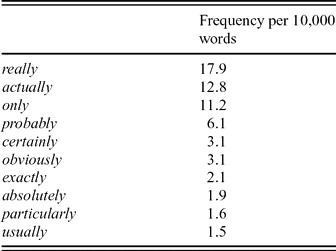
Actually and really are among the most frequently occurring -ly adverbs in the spoken part of the British National Corpus (BYU–BNC; Davies Reference Davies2004), as can be seen in table 1.
Frequency of occurrence per 10,000 words of the ten most common -ly adverbs in the spoken part of the BYU–BNC

Previous studies have highlighted the considerable variability of the syntactic positions that actually may occupy (see Quirk et al. Reference Quirk, Greenbaum, Leech and Svartvik1985; Oh Reference Oh2000; Taglicht Reference Taglicht2001; Clift Reference Clift2001; Aijmer Reference Aijmer2002; Gournay Reference Gournay, Col and Osu2011). Other studies have similarly pointed to the syntactic flexibility of really (Stenström Reference Stenström, Gunnel and Bäcklund1986; Paradis Reference Paradis, Facchinetti, Krug and Palmer2003). Corpus-based research has often used a broad three-way classification, with occurrences sorted according to whether the adverb appears in initial, medial or final position within the utterance (Lenk Reference Lenk1998; Oh Reference Oh2000; Aijmer Reference Aijmer2002). Following Lenk (Reference Lenk1998) and Oh (Reference Oh2000), the ‘initial’ category usually includes any examples where the adverbial is preceded by a marker such as well, and, but, then and because. As an illustration, in examples (1–2) actually and really are in utterance-initial position, while in (3–4) both adverbs appear preverbally and so are categorised as being in medial position. The adverbs appear in final position in examples (5–6).
(1) Actually for a second there I forgot it. (BYU–BNC extract KD0 S_conv)
(2) So really it sounds the sort of thing that'll be nice for you. (BYU–BNC extract KCH S_conv)
(3) I actually got them back. (BYU–BNC example KST S_conv)
(4) I don't really look at the shops. (BYU–BNC extract KPE S_conv)
(5) I'd forgotten all about it actually Gav. (BYU–BNC extract KC6 S_conv)
(6) That was a good morning's work really. Got the shopping done for the next fortnight. (BYU–BNC extract KBB S_conv)
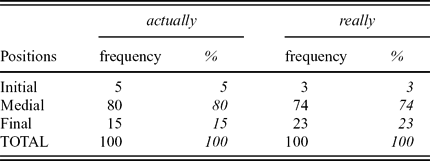
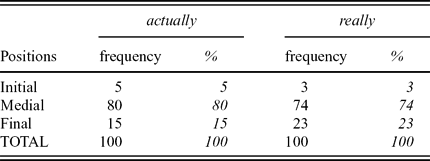
A manual search through random samples of 100 occurrences of both actually and really in the spoken BYU–BNC reveals that medial position predominates for both adverbs with 80 per cent in the case of actually, and 74 per cent in the case of really (see table 2). These findings are broadly in line with previous studies.Footnote 2
Distribution of actually and really across initial, medial and final position in random samples of 100 occurrences from the spoken part of BYU–BNC
A considerable amount of research has been carried out into how the syntactic position occupied by actually can have a bearing on the nature of its contribution to the meaning of the utterance. In initial and final position actually has been analysed as a ‘discourse particle with textual or interpersonal function’ (Aijmer Reference Aijmer2002: 53–4), while in medial position it appears to be able to function either as a parenthetical discourse marker or as modifier of some element within the phrase (see Taglicht Reference Taglicht2001; Aijmer Reference Aijmer2002). Less research seems to have been carried out into the case of really, but Stenström (Reference Stenström, Gunnel and Bäcklund1986) argues that it too functions as an intensifier in preadjectival position, while in initial position it conveys a comment on the whole of the following proposition.
Although corpus-based studies of actually in both spoken British English (Aijmer Reference Aijmer2002) and spoken American English (Oh Reference Oh2000) have found that medial position is the most frequently occurring position of the three, a large part of the research carried out into the functions of actually has tended to focus on the so-called ‘discourse functions’ of the adverb, in utterance-initial or utterance-final position. Various accounts have been proposed. Hickey (Reference Hickey1991), for example, analyses actually within the framework of Brown & Levinson's politeness theory (Brown & Levinson Reference Brown and Levinson1987). For Hickey, initial actually mitigates potential surprises or contradictions in much the same way as the phrase I'm sorry to say. The politeness conveyed by the use of actually in example (7), which is taken from Hickey, is derived from the fact that speaker B is indicating that he understands why speaker A might have thought, erroneously, that he went to the cinema. The use of actually here signals the contradiction as being only ‘partial or unimportant’ (Hickey Reference Hickey1991: 371):
- (7)
A: Did you enjoy the film last night?
B: Actually, I didn't go to the cinema.
Taglicht takes a similar view, considering that in both initial and final position, the use of actually ‘merely indicates that the speaker is asserting something that is incompatible with some other proposition which has been expressed or implied’ (2000: 2), as can be seen his example, reproduced as (8) below:
- (8)
A: How was the bus ride?
B: Actually, we went by train.
A number of other discourse functions of actually have been posited which converge around the idea that actually is an ‘expectation marker’ (Aijmer Reference Aijmer2002; Lenk Reference Lenk1998). Speakers appear to use utterance-initial actually to indicate that, for whatever reason, the following part of their contribution to the discourse will be ‘different from the expected normal course of the conversation’ (Lenk Reference Lenk1998: 160). The expectation thus contrasted may or may not have been expressed explicitly in the previous discourse. In the following example, quoted by Aijmer from the London–Lund Corpus (LLC), there is no explicit contrast – speaker A is correcting something they assume the other speaker thinks is the case rather than something that has been said:
- (9)
A: This is Professor Dwight's secretary from Polymania college
B: Oh yes.
A: erm. About the lexicology seminar
B: Yes
A: Actually Professor Dwight says in fact they've only got two more sessions to go because I didn't realise it finishes at Easter
(adapted from Aijmer Reference Aijmer2002: 267)
Clift (Reference Clift2001) provides evidence to support the classification of utterance-final actually as an expectation marker. She provides a number of adjacency pairs where actually occurs at the end of negative utterances produced in answer to questions designed to elicit a positive response, and vice versa. In examples (10–11), actually seems to be signalling some sort of counter-expectation.
- (10)
A: Did you have help in the house? You probably did.
B: Erm, not very much actually.
(Adapted from Clift Reference Clift2001: 255)
- (11)
A: You don't off hand know Bodwin's number?
B: Yeah, I've got it down here actually.
(Adapted from Clift Reference Clift2001: 256)
In contrast to the considerable body of work that has been carried out concerning the use of actually as a discourse marker, its use in medial position has attracted relatively little attention. The general consensus appears to be that in this position the major problem to be addressed is that of deciding whether a specific occurrence of actually is functioning as a parenthetical discourse marker of counter-expectation or as some sort of ‘intensifier’ (see for example Taglicht Reference Taglicht2001; Aijmer Reference Aijmer2002). However, the concentration of the research effort on analysing the adverb's discourse marker function has meant that the precise nature of the apparent intensifying function of actually has not been subjected to sufficient scrutiny.
There are two main reasons why this issue needs to be addressed in more detail than has hitherto been the case. Firstly, and most obviously, there is a need to develop a more satisfactory account of the semantic differences between different ‘intensifiers’ such as actually and really. Secondly, and in the light of the argument that the adverb's discourse function has evolved from its role as a phrase modifier via a process of grammaticalisation (Traugott Reference Traugott, Blank and Koch1999; Aijmer Reference Aijmer2002), a better understanding of the intensifying function of actually could also provide a basis on which to develop further the account of the discourse functions of the marker.
2 Medial actually and really – the interchangeability hypothesis
In medial position, actually is often compared to, and indeed paraphrased by, really. Dictionary definitions of the two adverbs are very similar: the New Oxford English dictionary defines actually (in its modifying adverbial guise) as meaning ‘the truth or facts of a situation’, while really is defined as meaning ‘in actual fact, as opposed to what is said or imagined to be true or possible’. Even more categorically, Swan's pedagogical grammar simply states that actually ‘means “really” or “in fact”’ (Swan Reference Swan1995: 6). A similar view has been adopted by researchers such as Aijmer, Lenk and Oh, which Lenk sums up as follows: ‘When actually is used as a preverbal intensifier, the best paraphrase is really or in fact’ (Lenk Reference Lenk1998: 157).
What I term the ‘interchangeability hypothesis’ is stated in perhaps its strongest form by Oh, who suggests that when used as a modifier, actually can often be replaced by really with no significant difference to the interpretation of the utterance (Oh Reference Oh2000: 260). For instance, in the following example Oh claims that actually can be replaced by really without altering the meaning of the utterance:
- (12)
A: I do more television watching than most people because I'm at home alone all day – and I like it just for the noise.
B: That's right, but do you actually/really watch it?
(Adapted from Oh Reference Oh2000: 260)
In her study, Oh found that medial actually could be readily replaced by really in around 50 per cent of cases. She offers the example given in (13) below as an illustration of where she considers that medial actually cannot be replaced with really without changing the meaning of the utterance. In this example the speakers are discussing adolescents’ attitudes to breaking the law in general and drug-taking in particular:
- (13)
A: I'm glad it is not the kind of problem I have to come up with an answer to because it's not easy.
B: Well, I think that the drug thing would actually be relatively easy to solve. . .
(Adapted from Oh Reference Oh2000: 261)
To account for this apparent disparity, Oh proposes a distinction between two different functions of actually in medial position – a ‘local function’ and a ‘global function’. In cases such as (12) above, actually is said to function locally ‘as a “clause-emphasiser” which has a reinforcing effect on the truth value of the clause, and can be rephrased with really’ (Oh Reference Oh2000: 260). In contrast, when it is used to signal disagreement with a previous speaker as in (13), Oh considers that actually has a ‘global function’ and that it cannot be replaced with really. The distinction made by Oh in this respect is broadly equivalent to that made by Taglicht (Reference Taglicht2001) between ‘scalar actually’ (similar to Oh's local function) and ‘truth-insistent actually’ (similar to Oh's global function).
According to Oh, this apparent dual function of actually explains why in her data it is not used in conjunction with certain types of verbs. In her study of the preverbal collocation patterns present in the Switchboard Corpus,Footnote 3 she reports that actually appears either rarely or not at all before verbs denoting feeling, opinion or belief such as think, feel and believe, whereas really appears more frequently than actually in the same context by a factor of up to fifty. Oh argues that speakers tend to avoid saying things like I actually think, I actually believe, etc. . . because to do so might lead the hearer to the erroneous understanding that they were being disagreed with (2000: 261). In fact, as we shall see later, it would appear that the figures quoted by Oh in this regard are likely to be an artefact of the nature of the language recorded in the corpus studied (i.e. informal telephone conversations between speakers of American English). Indeed, in the transcripts of the radio debates studied here, not only are there a number of occurrences of both I actually think and of I really think, but think is in fact the most frequently occurring verb in the frame actually + VERB.
3 Some shortcomings of the interchangeability hypothesis
Let us briefly reconsider the distinction between the two categories of medial actually suggested by Oh in her analysis of examples (12–13). In the case of (12), I would take issue with Oh's assertion that there is no discernable difference in meaning between do you actually watch it and do you really watch it. For the time being, it is sufficient to remark that by replacing actually with really, the utterance might have to be interpreted as suggesting that speaker A was not telling the truth, or at least not telling the whole truth, when claiming to ‘do more television watching than most people’. In contrast, the use of actually carries no such implication, but simply conveys the idea that the speaker is calling into question whether or not it is appropriate to describe the activity concerned as ‘watching television’. In other words, example (12) could also be analysed in terms of speaker B ‘correcting’ speaker A – you say you watch a lot of television, but I don't think that you do because you are more interested in the noise it makes.
On the other hand, in the case of (13), it is not immediately obvious why really should be excluded as a potential replacement for actually. Oh states that speaker B in this case is disagreeing with the previous speaker – yet this is not so very different from the case in (12) where, as we have just seen, speaker B also seems to be disagreeing with A by calling into question his choice of describing the way he uses the television as watching it.
The problem of deciding whether, or to what extent, actually and really are interchangeable is also apparent when we seek to carry out the commutation in the opposite direction, as in the following exchange taken from a debate, broadcast on the BBC's Any Questions programme:
- (14)
A: He's not really (?actually) answering the question
B: I am answering it perfectly properly
(Any Questions, 3 July 2009)
Again, it might appear at first glance that actually and really are interchangeable here. However, had speaker A used actually in his utterance, I would contest that speaker B would have been far more likely to respond with something along the lines of the simple counter-assertion – ‘Yes, I am!’, as the use of actually can allow the speaker to oppose what is the case with what is not the case. In contrast, the use of really in preverbal position is often compatible with the speaker's expression that the action denoted by the verb is being carried out in the proper manner or to a certain extent. This allows speaker B in (14) to quibble over the way in which he was answering the question, i.e. properly.
One of the most thorough treatments of medial actually is to be found in Taglicht's discussion of two principal uses of medial actually (Taglicht Reference Taglicht2001). Example (15) below is used by Taglicht as an illustration of the so-called ‘scalar’ use of actually where the speaker ‘is envisaging a scale of properties with the content of that phrase at the top, and implying that any property below it on the scale would make the expression too weak’ (2001: 2).
(15) (‘scalar’ actually)
This isn't (just) hearsay, you know; I actually saw it with my own eyes.
In contrast, example (16) is presented by Taglicht as an example of the ‘truth-insistent’ use of actually:
(16) (‘truth-insistent’ actually)
A: what's happened to your finger?
B: well I've told a lot of people that I dropped an Anglo-Saxon cross on it but what I actually did was slam it in a car door
Taglicht does not provide a detailed analysis to support this subcategorisation, but rather seems to take it for granted that the distinction between the two uses of actually in these examples is plain to see. Let us therefore take a little time to consider in what sense the actually in example (15) might be labelled ‘scalar’ while the actually in example (16) might not.
A first logical step towards analysing this problem of ‘scalar actually’ could be to construct a scale of properties at the top of which the assertion containing actually could be placed. In the case of example (15) we might imagine a four-point decreasing scale along the following lines:
Scale of properties for example (15)
I saw it with my own eyes
I saw a film of it on television
I saw it just after it happened
I was standing behind someone who saw it
The four points on the above scale have of course been chosen rather arbitrarily, and necessarily so. A longer scale might have been constructed and other labels such as I caught a glimpse of it through the viewfinder of my camera, etc. . . might have been found to label other points on it. But whatever the merits or demerits of any particular scale we might come up with, the question remains as to why we should not be able to construct a similar scale for example (16). Indeed, the following four-point scale appears to me to be no less plausible in this respect than the one constructed for example (15):
Scale of properties for example (16)
I slammed it in a car door
I shut it in a car door
I caught it in a car door
I nearly caught it in a car door
In other words, an argument can be made in favour of categorising both (15) and (16) as examples of ‘scalar’ actually, in Taglicht's sense, just as an argument can be made in favour of considering examples (12–13) as having a ‘global function’, in the sense of Oh.
And the difficulties do not end there – it is also possible to make a case for analysing both (15) and (16) as being ‘truth-insistent’. In both cases, that part of the utterance to which actually is applied is being used to correct some previously mentioned (or implied) erroneous assertion. In (15), this assertion may be glossed by what the speaker is recounting is hearsay, and in (16) it may be glossed as the speaker dropped an Anglo-Saxon cross on his finger. It might therefore be appropriate to append the label ‘truth-insistent’ to both of these uses of actually, for in each case the actually phrase serves to contrast what is not the case with what is the case.
The main shortcoming of the categories set up by scholars such as Oh and Taglicht is therefore that they are founded more on differences in the context than on the existence of different subtypes of the marker itself. For example, perhaps the main difference between (12) and (13) is that the first is in the interrogative form and the latter is in the form of an assertion. By its very nature, an interrogative structure enables the speaker to at least pretend not to be taking position vis-à-vis the propositional content of the utterance (for a more detailed discussion of the interpretation of interrogative structures see Nicaise & Gray Reference Nicaise and Gray1998; Nicaise Reference Nicaise1999), which in turn might lead us towards the conclusion drawn by Oh that the utterance in (12) does not primarily serve to correct the other speaker. Similarly, perhaps the difference between (15) and (16) stems from the source of the erroneous assertion that the actually phrase sets out to correct. In (15), the source is clearly somebody other than the speaker, while in (16) it is made explicit by the speaker that it is he himself who is responsible for the false assertion.
It can be seen, therefore, that there remains a degree of confusion over the interpretation of actually in medial position and to what extent it is replaceable by really. In the remainder of this article I will therefore attempt to resolve some of the problems raised so far. As a first step, I will look at statistical evidence from the BYU–BNC in order to build up a picture of the collocation patterns of the two adverbs and to cast more light onto the question of interchangeability.Footnote 4 After this initial quantitative analysis, I will carry out a detailed qualitative study of examples from a smaller corpus of broadcast speech where actually and really collocate with the verb think. I shall attempt to demonstrate that the interpretation of actually in any given case as being either ‘intensifying’ or ‘marking disagreement with the other speaker’ is very much a function of the combination of the core meaning of the adverb with the surrounding discourse context.
The approach adopted here falls broadly within the framework of the utterance-centred approach to linguistic grammar as outlined in Bouscaren et al. (Reference Bouscaren, Chuquet, Laurent, Flintham and Bouscaren1992). One of the central tenets of this approach is the hypothesis that linguistic markers have stable core values from which their meaning in any given discourse situation may be derived. Consequently, a difference in linguistic form corresponds to a difference in linguistic meaning, however subtle that difference may be.
4 Collocations of actually and really in the British National Corpus
If it can be established that the collocation patterns of the two adverbs differ significantly, then the interchangeability hypothesis will be weakened and we will be further along the road towards identifying the underlying semantic differences between actually and really. Two positions are analysed in this section: preadjectival position and preverbal position.
4.1 Preadjectival position
Based on evidence from the BYU–BNC, Gournay (Reference Gournay, Col and Osu2011) reports that really is considerably more frequent than actually in preadjectival position by a ratio of over 10:1 (5,070 and 470 occurrences, respectivelyFootnote 5). The most frequent adjectival collocations in the case of actually seem to come from one or other of two broad classes of adjectives: those that refer to antonymic properties such as true vs false or present vs absent; and those that imply a binary comparison (better). On the other hand, adjectives which commonly collocate with really (such as good, nice, bad, big, important, etc. . .) have gradable qualities and readily collocate with other intensifying adverbs such as very. This is clear evidence against the interchangeability hypothesis.
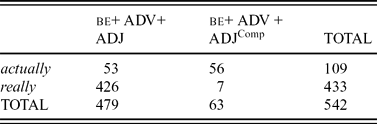
Further analysis of adjectival collocations in BYU–BNC carried out for the present study also seems to weaken any statistical case for interchangeability in preadjectival position. As can be seen in table 3, really is far more common than actually in the frame be + X + ADJ (as in it was really loud) whereas the proportions are inversed when we consider the frame be + X + ADJComp (as in it was actually louder than I expected).
Preadjectival collocations of actually and really in the spoken BYU–BNC
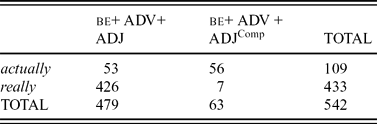
The analysis of the preadjectival data presented here suggests that actually and really are operating on different semantic levels. Many of the frequent adjectival collocates of actually cannot readily be situated on a gradable scale, which is clearly the case with adjectives such as available or present and with comparative adjectives such as better or easier. In contrast, most of the adjectival collocates of really refer to gradable qualities (such as big, nice, bad).
4.2 Preverbal position
Preverbal position is the most frequent medial position for both adverbs,Footnote 6 and it is in this position that actually and really are most often claimed to be interchangeable. As has been indicated already, in her study of American English, Oh (Reference Oh2000) found considerable differences in the types of verb which collocated with really and actually, noting in particular that the latter was rarely used in front of verbs expressing belief, feeling or opinion such as believe, feel and think.
In order to gain further insight into the verbal collocations of actually and really in British English and to compare these with Oh's findings from American English, two distinct searches of the BYU–BNC were carried out. The purpose of these searches was to ascertain whether there were any statistical differences in (i) the subject pronouns which occur in the frame PRONOUN ADV VP, and (ii) the types of verbs which collocate with the adverbs in the frame I ADV VP.
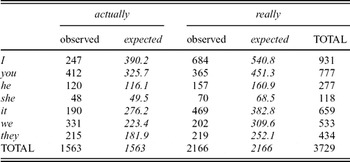
The first search revealed that actually and really have different patterns of collocation with the various subject pronouns.Footnote 7 The difference is perhaps most notable in the case of the subject pronoun I, for which the number of occurrences of I actually VP is disproportionately low, as shown in table 4, where the number of ‘expected occurrences’ of each collocation is calculated on the assumption that the adverbs occur in each frame in proportion to their overall frequency of occurrence in the corpus.
Observed and expected occurrences of actually and really in BYU–BNC in the frame PRONOUN X VP

The second search concerned a comparison of the verbs which collocate with the adverbs in the frame I ADV VP. Two important trends emerge from this search:
(i) Certain verbs occur more frequently with one of the adverbs than the other.
(ii) Certain verbs, including think, occur frequently with either adverb.
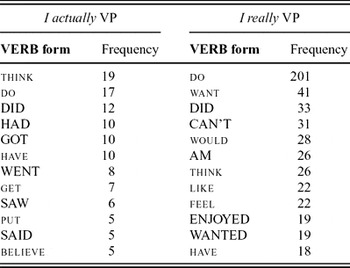
The sequence I actually VP occurs 247 times in the BYU–BNC corpus, compared with 684 occurrences of the sequence I really VP. In the case of I actually VP, 12 different VPs occur at least five times. In the case of I really VP, there are 25 different verbs, which occur at least five times. In the data set summarised in table 5, present and past tense verb forms are listed as separate items. This is justifiable as an utterance in the past tense should not be analysed as simply a grammatically modified version of a corresponding present tense utterance. For example, the discourse conditions under which a speaker might utter a phrase in the past tense such as I actually saw her leave the building are quite different from those under which they might utter a corresponding present tense phrase such as I actually see her leave the building. Indeed, it is rather difficult to think of a discourse situation in which the present tense ‘version’ of this phrase would be interpretable. It is therefore preferable to treat occurrences of past tense forms and present tense forms separately.
Twelve most frequently occurring verb forms in the frame I actually/really VP

A comparison of the verb forms which occur with each of actually and really reveals that certain verb forms only occur with one or other of the adverbs. For example, saw (6 occurrences) and put (5 occurrences) collocate with actually but not with really, while hate (6 occurrences) and liked (8 occurrences) collocate with really but not with actually. Similarly, verb forms such as enjoyed and feel collocate far more frequently with really than with actually, while the opposite tendency can be observed in the case of said and get.
This first set of findings constitutes more evidence against the interchangeability hypothesis. The different verbal collocation patterns observed here suggest once again that actually is not in fact an intensifier, as the verbs with which it collocates do not themselves collocate with intensifying expressions such as very much. A speaker is very unlikely to produce an utterance such as *I very much saw the show or *I saw the show very much, whereas utterances such as I very much enjoyed the show or I enjoyed the show very much are far more likely to be produced.
In addition, the BYU–BNC data do not confirm all of Oh's findings concerning the differing collocation patterns of actually and really with verbs of opinion, feeling or belief. While really is indeed far more frequent in the frame I ADV feel (22 occurrences of really, but only 4 occurrences of actually), the same is not true in the case of the verbs believe (1 occurrence of really, 5 occurrences of actually) and think (26 occurrences of really, 19 occurrences of actually). Indeed, not only is the sequence I actually think the most frequently occurring pattern in the case of actually, but taking into account the relative overall frequencies of the adverbs in the frame I ADV VP, the BYU–BNC data suggest that actually is in fact more likely to collocate with think than is really (19/247 vs 26/684).
In contrast to the first set, this second set of findings seems therefore to provide evidence which is more in line with the interchangeability hypothesis. Clearly then, statistical analysis of collocation patterns is not in itself a sufficient basis on which to develop a satisfactory account of how linguistic markers such as actually and really function. At best it is only able to provide us with a general picture of tendencies. So in order to try to develop a linguistically motivated account of a speaker's choice to use one or other of the adverbs in a given discourse context, we will now turn our attention to a detailed qualitative study of examples where the two adverbs do in fact occur in exactly the same frame. The examples discussed here are all taken from a corpus of spontaneous radio speech, extracted from a corpus of radio debates broadcast on BBC Radio 4.
5 Actually and really in the radio corpus data
5.1 Overview
The corpus used for this part of the study consists of the published transcripts and sound files of eleven different editions of the BBC Radio 4 programme Any Questions from 2008 and 2009. The programme is broadcast every Friday evening in front of a live audience from a different venue each week. In addition to the BBC presenter, there are four guest panellists, usually one representative from each of the major political parties, as well as one other well-known personality from the world of politics, business, journalism, the trade union movement, entertainment, academia, etc. The panel is asked questions by members of the live audience to which each member is invited to respond. The BBC presenter who chairs the discussion also sometimes intervenes to ask supplementary questions or to invite the audience to add any comments they might have as a result of the panellists’ contributions. The programme therefore provides a good source of examples of unscripted yet carefully constructed public discourse, and the eleven editions under study here provide us with a large number of examples of both actually and really.
Once downloaded from the BBC website,Footnote 8 the eleven transcripts were converted to Text File format in order to make it possible to carry out concordance analyses using the AntConc software package.Footnote 9 Analysis of the 92,000-word corpus revealed that actually (201 occurrences) was the most commonly occurring -ly adverb in this corpus, followed by really (150 occurrences).
Although fairly small in size, the Any Questions corpus is highly suitable for the type of qualitative analysis carried out here. The nature of the discourse contained in the BBC Any Questions transcripts studied here would seem to make it directly comparable to that part of the LLC corpus labelled ‘discussion’ which was analysed by Aijmer (Reference Aijmer2002). Aijmer reports that this subsection of the LLC contains around 100,000 words taken from twelve texts of interviews and public discussions, while the Any Questions transcripts used for analysis in the present article consist of a total of around 92,000 words. These two corpora would therefore appear to be of a comparable nature in terms of both their size and of the type of discourse they represent.
In her study of the discussion section of the LLC Aijmer found a total of 67 tokens of actually – a frequency count of 6.7 tokens per 10,000 words. By contrast, my study of the Any Questions transcripts (henceforth AQT) revealed a far higher frequency count, with 22.8 tokens per 10,000 words. The AQT corpus would therefore appear to represent a type of discourse in which the use of actually is disproportionately favoured by speakers. While a discussion of changes in language usage over time goes beyond the purposes of the present article, these figures may suggest that actually might now be more frequent in formal public discussions than it was at the time the LLC was collected in the 1960s and 1970s.
One big advantage of using data from a radio broadcast such as Any Questions is that it allows the researcher to analyse many different aspects of the situation in which the utterances are made (the time, the place, the other speakers’ identities, etc.). This is not necessarily the case with corpora such as the BNC which, while much larger and containing many more examples, do not necessarily provide sufficient insight into the discourse situation in which the utterances were produced. Moreover, in addition to the transcripts of the programmes, the BBC website also provides access to the sound files for each Any Questions programme, something which is not always possible or convenient when working with published corpora and which would make it possible to carry out prosodic analysis of the examples.Footnote 10
5.2 Distribution of actually and really in medial position in the AQT
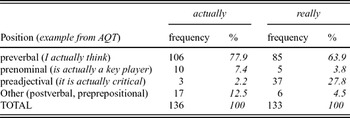
In the AQT, medial position is the most common position for both actually (148/201) and really (139/150). After excluding twelve occurrences of actually and six occurrences of really for reasons of unfinished or self-repaired utterances,Footnote 11 the remaining 269 examples were sorted according to whether they appeared preverbally, preadjectivally, prenominally or elsewhere. This initial classification revealed that in medial position the majority of tokens of both actually (77.9 per cent) and really (63.9 per cent) appear preverbally (see table 6).
Distribution of actually and really in medial position in AQT corpus

The figures from the AQT are therefore broadly in line with Gournay's findings (2011) concerning preadjectival position in the BNC, with really being far more frequent in this position than actually. In order to find examples of cases where actually and really appear in an identical frame it was necessary to look at the preverbal category. The most frequent common frame is in fact I ADV think.
6 Qualitative analyses: I actually think vs I really think
In AQT the sequence I actually think occurs three times and I really think occurs six times. However, two of the six examples containing I really think contained false starts or self-corrections and so were not included for detailed analysis. I propose therefore to analyse in depth the following seven examples of I ADV think contained in AQT:
(17) but I actually think there is a huge degree of self-interest
(18) because I actually think we need to open up our democracy
(19) I actually think that the Americans should be paying him
(20) but I really think we should get a grip of ourselves
(21) and I really think it's now down to the people in Salford
(22) and I really think that they should be doing that
(23) but I really think we should go out front and really work for non-proliferation
At first sight, it appears that the adverbs are interchangeable in each of the utterances (17–23), but on closer analysis of the surrounding discourse it will become possible to account for the speaker's choice in each case.
In each of the examples (17–19), I actually think appears when the speaker is stating a novel opinion or when the opinion stated is somehow in contrast with expectations. Let us consider each of them in turn. The surrounding discourse for example (17) is reproduced below. The extract is part of a panellist's reply to a question concerning the reluctance of the banks to make loans in the aftermath of the financial crisis of 2007/2008:
(17) . . . That is what we need to see happen and I think there is not only, if you like, a moral responsibility on the part of the banks but I actually think there is a huge degree of self-interest because we are in a very difficult situation. I said earlier this is unprecedented in the whole of my adult lifetime unless we can kick start people spending then we are all in a very serious situation and banks in the longer term will pay a price for that as well.
(Any Questions, 21 November 2008)
The view that there is a huge degree of self-interest (i.e. that the banks have something to gain from starting to lend again, and that it would not just be in the national interest) is presented here as being novel with respect to the implication of the question that lending is not in the banks’ interest.
If we were to replace actually with really in this example, the utterance would receive a radically different interpretation and would lack congruity. I really think there is a huge degree of self-interest would be interpreted as an endorsement of the widely held view that the banks’ current reluctance to lend money is due to the fact that it is not in their self-interest to do so. The use of really here would, however, be incompatible with the use of the structure not only. . . but in the earlier part of the utterance: I think there is not only if you like a moral responsibility on the part of the banks but . . . The speaker's use of this structure in the original utterance clearly prepares the discursive ground for giving two reasons why the banks should lend (it is their moral responsibility, and it is in their self-interest), rather than one reason why they should (it is their moral responsibility) and one reason why they will not (it is not in their interest).
Example (18), which is reproduced with its surrounding context below, is produced in answer to a question about a possible referendum on electoral reform posed by the presenter of the programme, Jonathan Dimbleby. A possible implication of Dimbleby's preceding remark – I wasn't quite sure whether Shaun Woodward went along with the referendum being held at the next election because he wouldn't answer that – is that Woodward might not be in favour of a referendum to reform the electoral system. In his reply, Woodward clearly wishes to refute this implication and by his use of actually in I actually think we should open up our democracy he is also identifying a further assumption in Dimbleby's remark – that ‘being against the referendum’ means ‘being against opening up democracy’. We might paraphrase actually here by ‘contrary to what you seem to think, I think we need to open up our democracy’. If we were to replace actually with really in this example, the effect would be different, as the speaker would simply be stating that he holds the opinion that we should open up our democracy to a high degree.
(18) DIMBLEBY:. . . I wasn't quite sure whether Shaun Woodward went along with the referendum being held at the next election because he wouldn't answer that but you can say now is your chance. Would you have a referendum at the next election?
SHAUN WOODWARD: Speaking personally I would have no reason why I wouldn't want to see a referendum because I actually think we need to open up our democracy.
(Any Questions, 5 June 2009)
The third example of I actually think is similar to example (17) in that we have a speaker who is presenting a novel thought, and one which is unexpected in the given discourse situation. The question asked in example (19) is whether or not the panel think that the computer hacker Gary McKinnon should be extradited to face trial in the United States for breaking into their defence computer systems. In expressing the view that the Americans should be paying him, the speaker presents her utterance as going beyond the remit of the question, and as such her contribution is both novel and unexpected.
If we were to replace actually here with really, the speaker would more likely be understood to be simply expressing a firm opinion, and one which perhaps had already been expressed earlier in the discourse.
(19) Gary McKinnon is not a terrorist. What he is is a man with Asperger's, Asperger's Syndrome. He is mentally ill. And there should be provision within the law for mentally ill people. I understand that he was only looking for existence of alien, of alien life which he believed the US had secretly locked away in their computers. And for that he's supposed to spend sixty, up to sixty years in a US jail where his doctors seem to think he could self-harm or worse. He did write on one of the sites that he was going to continue to disrupt. But he was probably talking to the Klingons rather than the Americans. I actually think that the Americans should be paying him because he exposed a flaw in their system and he's actually done them a favour.
In contrast to the examples with actually, in the each of the four examples of I really think, the adverb does indeed seem to be intensifying the extent to which the speaker holds the opinion described by the subsequent part of the utterance. The surrounding discourse for example (20) is reproduced below.
(20) So I do think he needs to probably find a new role for himself as I think Angus Deayton found that once you become a figure of fun yourself it is very difficult to poke fun at others but I really think we should get a grip of ourselves.
(Any Questions, 21 November 2008)
We might gloss this effect with ‘I am of the firm opinion that we should get a grip of ourselves’. It might appear at first glance that actually could replace really in the above example without changing the meaning of the utterance. However, this is not the case. The question being asked at this point in the programme was whether or not the panel thought that the radio presenter Jonathan Ross should be allowed to return to his BBC job after being suspended following the broadcast on his radio show of an item that was later deemed offensive. By saying I do think he (i.e. Jonathan Ross) needs to find a new role for himself the speaker here implies that he does indeed consider the actions of celebrities worthy of comment. If he had said I actually think we should get a grip of ourselves it would have come across as an attack on the view that the antics of celebrities are worthy of comment in the media – which would be somewhat incongruous in the present context as the speaker has just joined in the debate himself. The use of actually here would be appropriate only if the speaker were not taking an active part in the discussion of Ross's behaviour. If the speaker had begun his intervention by saying I actually think we should get a grip of ourselves before going on to suggest it was a waste of time to discuss the antics of show business personalities, the use of actually would then have served to indicate that the assertion I think we should get a grip on ourselves was in some way incompatible with some previously stated or implied view of the matter which might be glossed as ‘a lot of people are taking the Ross affair very seriously, but I don't think we should’. As we have seen in the case of adjectival constructions, the use of actually here is not of itself intensifying, even if it may well be compatible with such an interpretation for pragmatic reasons, because to individually assert an opinion with no reference to the opinion of others may well appear to be intensifying the expression of that opinion.
A similar analysis applies to (21). Again, given the discourse situation, the utterance would be incongruous if we replaced really with actually because it would indicate either that the speaker assumed that the other participants in the discussion had rejected the idea that the Director of Public Prosecutions should instruct the police to reopen the phone hacking investigation, or that she was asserting a new and novel idea that no one else had yet alluded to in the discussion.
- (21)
A: Should Yates of the Yard reopen the investigation into phone hacking?
B: Yes I'd agree, I'd agree with that, that the DPP can instruct of course the Metropolitan Police to reopen the case. And I really think they should be doing that.
(Any Questions, 10 July 2009)
Neither of these conditions applies in (21). So once again we see that actually does not fulfil the same intensifying function as really.
(22) QUESTIONER: Is it not contradictory for Britain to agree to join talks to reduce the number of our nuclear warheads while continuing with plans to replace the Trident missile system?
CLARE SHORT: Yes I think Britain has a nuclear weapon pointed at no one and no one in the world is pointing it at us and that's the official position. And yet we say the future's so uncertain, better have a new one. Well that means every country in the world needs one. And if everyone had one, they would be used and we'd have nuclear explosions. So I think the only point now of Britain's weapon is to help to get agreement on non-proliferation. We should be willing to give it up in the most constructive possible way that reduces the amount of nuclear proliferation in the world. And the commitment to new Trident submarines is enormously expensive. We can't afford it. We don't need it. I mean you can actually have a little, a smaller nuclear weapon if you want one. But I really think we should go out front and really work for non-proliferation and that would be an honourable role for Britain, given that no one's targeting us and we're not targeting anyone, that's the role that we should take.
(Any Questions, 10 July 2009)
In the above extract, the replacement of really by actually again appears at first glance to be possible without much change in the meaning. Both adverbs might be compatible with a speaker wishing to emphasise their commitment to the idea that Britain should work for the non-proliferation of nuclear weapons. But the speaker's choice of really is far from fortuitous here. The speaker's identity is significant and needs to be taken into account. Clare Short is a former senior Labour politician and minister, whose strong anti-war views are widely known in Britain, and who is also known for having resigned from the government in 2003 after the Blair government's decision to go to war in Iraq. Had Ms Short said I actually think we should really work for non-proliferation, her utterance would have sounded rather incongruous to a well-informed BBC Radio 4 audience, as she would have appeared to be assuming that her views on the subject of nuclear weapons and war were as yet unknown to them.
Finally, in example (23) below, the speaker is reacting to a question concerning the MPs’ expenses scandal,Footnote 12 and former minister Hazel Blears’ apology for claiming expenses for a house she didn't live in. The questioner is asking whether she should stand down as an MP. The difference between really and actually is less easy to account for here, but it is nonetheless difficult to imagine the speaker replacing I really think with I actually think in this case.
(23) Hazel Blears is a very able and a very able politician but she has proved that clever people can do stupid things and to think Communities Secretary as she then was resigning from local elections wouldn't have an impact not just electorally but in terms of her own party is quite frankly amazing and part of being grown up is you take responsibilities for your actions and I really think it is now down to the people in Salford in her constituency who she you know she is an MP because they supported her and put her forward. It is really a matter for them to decide whether they want to continue with her.
The speaker here is Billy Hayes, leader of the Communication Workers’ Union, and he is clearly of the view that Hazel Blears has done the right thing to apologise for her mistakes and should now await the verdict of her constituents rather than cause any more damage to her party by resigning as an MP.
The use of actually in this case would again appear incongruous given the speaker's previous arguments stated within the same turn (you take responsibilities for your actions. . .) as its use would again signal the introduction of some novel, unexpected opinion on his part. But he has already stated earlier in the programme that Blears’ decision to resign as a minister caused electoral damage to the party and was an error on her part. The speaker here is manifestly more concerned with developing the justification for his previously stated opinion than with presenting a new opinion. It is perhaps significant that the phrase under analysis is introduced with the conjunction and rather that but. The use of I actually think might make more sense in this context if it were proceeded by but, as a signal that the following thought is incompatible with the current point being developed.
7 Conclusion
Throughout this article we have seen that existing treatments of actually have not paid sufficient attention to the function of the adverb in medial position. In particular, thanks to a detailed textual analysis of a small number of authentic examples, we have shown that actually and really are not in fact interchangeable, even in preverbal position, and that the use of the term ‘intensifier’ to describe both adverbs can be misleading.
In the examples studied here, actually sets up a paradigm in which the speaker endorses a proposition, while simultaneously contrasting it with other possible propositions, which may or may not have been explicitly formulated in the preceding discourse. The ‘unexpectedness’ effect of actually in each case is compatible with the account of the marker put forward by Gournay (Reference Gournay, Col and Osu2011), who has argued that in oral discourse, actually functions as an evidential marker, signalling the truth and relevance of the fact expressed as constructed by the speaker in the very act of discourse. In the case if I actually think, the effect might be paraphrased by ‘what is both true and relevant is that I think X at this very moment of discourse’.
By contrast, the adverb really may indeed often be glossed by an intensifying phrase such as very much, In the examples studied, really appears to function as a ‘marker of quintessence’, such that I really think X, might be paraphrased as ‘the essence of my thoughts is X’. So while actually indicates that the speaker, and the speaker alone, is responsible for endorsing the proposition, really indicates the extent to which the proposition is compatible with the speaker's view of the world.
It is hoped that the evidence presented here might form a basis from which to further pursue a line of research whose aim is to develop a full account of the lexical semantics of adverbs such as actually and really.