1. Introduction
A mobile robot is a mechanical system designed for autonomous or semiautonomous movement across diverse environments. It must be equipped with highly sensitive sensors to perceive its surroundings, accurately determine its position, and construct detailed environmental maps, thereby enabling safe navigation to designated destinations and the completion of predefined tasks [Reference Xu, Li, Xu, Yang and Chen1]. In the context of path planning, methods are generally categorized into global and local path planning, depending on the extent of environmental knowledge available. Global path planning assumes that the robot has comprehensive information about the environment, allowing it to follow a predetermined path to reach its destination [Reference Liu, Wang, Yang, Liu, Li and Wang2]. Traditional global path planning algorithms include Dijkstra’s algorithm [Reference Zhang and Bai3], the A* algorithm [Reference Zhang, Tao and Zhu4], rapidly exploring random trees (RRTs) [Reference Hao, Yang, Li, Liu and Zhao5], and the probabilistic roadmap (PRM) [Reference Liu, Xie, Sui, Huang, Ma, Guo and Yang6]. In contrast, local path planning is employed when the robot has limited or no prior knowledge of the environment, relying on real-time sensing and dynamic decision-making. Traditional local path planning algorithms include the artificial potential field (APF) method [Reference Yang, Luo, Li, Liu, Ye and Liang7] and the dynamic window approach (DWA) [Reference Yin, Cai, Zhao, Zhang, Zhou and Yao8].
Significant advancements have been made in the field of path planning. Savkin et al. [Reference Savkin and Hoy9] proposed a reactive randomized algorithm that ensures the robot avoids obstacles with probability 1 and reaches the specified goal; however, the planned path is not guaranteed to be the shortest, and the handling of dynamic obstacles is not addressed. Zhou et al. [Reference Zhou, Xie, Zhou and Tan10] applied an improved Dijkstra algorithm to complex product integration scheduling, enhancing path connectivity; however, this approach introduced relatively high computational complexity. Jabbar et al. [Reference Jabbar, Abass and Hasan11] addressed the shortest path problem by enhancing the Dijkstra algorithm with a reverse priority queue, improving computational efficiency. Tang et al. [Reference Tang, Tang, Claramunt, Hu and Zhou12] proposed a geometric A* algorithm tailored for port environments, optimizing paths using a screening function and interpolation technique, which reduced the number of turns and shortened the path length. Li et al. [Reference Li, Hao, Zhao and Lu13] combined an improved A* algorithm with the DWA, significantly improving dynamic obstacle avoidance, reducing both path length and planning time, and enhancing the robot’s speed. Additionally, Dang et al. [Reference Dang and Tan14] proposed a hybrid path planning method that integrates an enhanced A*, Jump Point Search, and the improved DWA, while further augmenting the IRDC-Net model to achieve better navigation in dynamic environments with moving obstacles. Liang et al. [Reference Liang and Zhao15] developed the CCPF-RRT* algorithm for crowded environments, incorporating a mobility cost function based on congestion intensity and path length to obtain an optimal path with minimal cost. Novosad et al. [Reference Novosad, Penicka and Vonasek16] introduced the CTopPRM algorithm, which can identify multiple topologically distinct paths in complex 3D environments, increasing the likelihood of exploring all potential routes. In the realm of local path planning, Zhang et al. [Reference Zhang, Wang and Wu17] addressed the speed issue for Autonomous Underwater Vehicles (AUVs) in complex obstacle-laden environments by combining the A* and APF algorithms for fast and effective obstacle avoidance. Li et al. [Reference Li, Li, Qi, Li and Wu18] proposed the APF-ant colony optimization (ACO) algorithm, enhancing collision avoidance and trajectory planning for ships in dynamic environments by optimizing the APF method and integrating it with the ACO algorithm. Pan et al. [Reference Pan, Yuan, Wang, Wen, Bi, Yuan and Zhang19] designed the D2WA algorithm, which dynamically incorporates obstacle velocity information to improve the navigation safety of Automated Guided Vehicles (AGVs).
In recent years, heuristic optimization algorithms have garnered significant attention in the field of path planning, becoming a focal point for scholarly research. Several classical heuristic optimization algorithms have been widely applied, including the genetic algorithm (GA) [Reference Holland20], particle swarm optimization (PSO) [Reference Kennedy and Eberhart21], ACO [Reference Dorigo, Birattari and Stutzle22], Grey Wolf optimization (GWO) [Reference Mirjalili, Mirjalili, Lewis and wolf optimizer23], Whale optimization algorithm (WOA) [Reference Mirjalili and Lewis24], and pigeon-inspired optimization (PIO) [Reference Duan and Qiao25]. As research has advanced, efforts have been made to refine and optimize these algorithms to improve their performance in path planning, yielding promising results. For example, Li et al. [Reference Li, Zhao, Chen, Xiong and Liu26] proposed an improved algorithm that combines GA with the DWA, significantly enhancing pick-up efficiency in logistics systems and generating smoother paths with fewer turns. Lin et al. [Reference Lin, Liu, Wang and Kong27] developed a hybrid PSO-SA algorithm aimed at minimizing the path length of AGVs, while ensuring collision-free and smooth paths. Zhou et al. [Reference Zhou and Wei28] introduced an initialization method with unevenly distributed pheromones for ACO to improve its search capabilities in the initial path planning stage. By incorporating adaptive pheromone evaporation factors and an update mechanism, the algorithm was able to generate smoother and shorter paths. Furthermore, Yu et al. [Reference Yu, Jiang, Wang and Li29] combined GWO with differential evolution, resulting in enhanced optimization performance for path planning. To address challenges faced by indoor mobile robots in obstacle avoidance, Dai et al. [Reference Dai, Yu, Zhang, Zhan and Zheng30] proposed an improved WOA algorithm that incorporates adaptive techniques, an enhanced potential field factor, and a virtual obstacle mechanism, improving convergence speed and avoiding local optima. Additionally, Jiang et al. [Reference Jiang, Bai, Wang and Wang31] successfully integrated an improved fuzzy clustering algorithm with PIO for fixed-wing UAV trajectory planning, achieving a more balanced clustering effect and enhancing the comprehensiveness and accuracy of trajectory exploration.
The sparrow search algorithm (SSA), introduced by Xue [Reference Xue and Shen32] in 2020, is a novel metaheuristic optimization algorithm inspired by the foraging behavior of sparrows. Due to its exceptional global search capabilities and strong optimization performance, SSA has garnered significant attention from researchers. Zheng et al. [Reference Zheng, Li, Qian, Cheng, Hou and Zhuang33] improved SSA to optimize a backpropagation (BP) neural network for inland vessel trajectory prediction, resulting in significant improvements in prediction accuracy and stability. Khedr et al. [Reference Khedr, Aghbari and Raj34] proposed a path planning method for mobile receivers in wireless sensor networks based on an enhanced SSA, which notably improved data collection efficiency and network robustness in dynamic environments. Liu et al. [Reference Liu, Zhang, Ma and Pan35] applied SSA to unmanned ship path planning, incorporating cubic chaotic mapping and Gaussian random walk strategies to generate stable and reliable navigation paths. Wang et al. [Reference Wang, Sun, Zhou and Zhu36] implemented PSO in parallel with an Enhanced SSA, achieving more feasible and effective path planning outcomes. Liu et al. [Reference Liu, Liang, Guo, Ke, He and Chen37] further Improved SSA by integrating it with the DWA to develop the ISSA-DWA algorithm for optimal path planning in mobile robots. This approach demonstrated faster convergence and higher path quality, though it has yet to see widespread validation in practical applications. Hou et al. [Reference Hou, Jiang, Luo, Yang, Hu and Guo38] proposed a multistrategy enhanced SSA integrated with the dynamic window approach (MISSA-DWA), improving both the efficiency and safety of robot motion. However, the generated path still exhibits limitations in smoothness.
This article tackles the challenges faced by mobile robots in complex environments, where the SSA often falls into local optima, produces excessively long paths, and struggles with dynamic obstacle avoidance. Building upon the existing body of research, this article proposes a hybrid algorithm that combines the enhanced sparrow search algorithm (ESSA) with the DWA. ESSA incorporates several advanced techniques, including Tent chaotic initialization, dynamic inertia weighting, a local search strategy, and the Floyd path optimization algorithm, to enhance both the global search capability and convergence speed of the algorithm. First, ESSA employs Tent chaotic initialization to increase population diversity, effectively mitigating the risk of premature convergence to local optima. Second, dynamic inertia weighting is incorporated, adapting during the search process to strike an optimal balance between exploration and exploitation. Additionally, the inclusion of a local search strategy refines individual updates, improving the precision of the search and enhancing the algorithm’s local search ability. Furthermore, the Floyd path optimization algorithm is applied to optimize the generated path, making it smoother and enhancing both the practical applicability and accuracy of the algorithm. Finally, the ESSA and DWA algorithms are integrated by extracting key nodes from the global path planning of the ESSA algorithm, which are then used as references for the local path planning in the DWA algorithm. This integration ensures that the local path is more aligned with the global path, enabling dynamic obstacle avoidance. The algorithm’s effectiveness and practicality have been confirmed through both simulation and practical experiments, offering an efficient and viable solution to path planning problems.
The main contributions of this study are as follows:
-
• The ESSA is proposed, which improves the search performance and stability of the SSA algorithm by incorporating Tent chaotic mapping, dynamic inertia weights, and local search strategies. The Floyd algorithm is then employed to optimize the path, resulting in a smooth, optimal trajectory.
-
• The ESSA and DWA algorithms are integrated by extracting key nodes from the global path planning phase and using them as reference points for local path planning in DWA. This integration allows for dynamic obstacle detection and the generation of local avoidance paths, which better meet practical requirements. The effectiveness and superiority of the integrated algorithm are validated through simulation experiments in complex environments.
-
• The ESSA-DWA fusion algorithm is applied to mobile robots, and its effectiveness is verified through both dynamic and static experiments, providing an efficient and viable solution to path planning challenges.
The remainder of this article is organized as follows: Section 2 introduces the standard SSA. Section 3 details the SSA with multiple strategic improvements. Section 4 provides an overview of DWA and explains the principles behind the fusion of the two algorithms. Section 5 presents simulation results for global path planning, the integrated fusion algorithm, and practical applications of the hybrid algorithm in both dynamic and static environments with mobile robots. Finally, Section 6 concludes the study and outlines directions for future research.
2. Sparrow search algorithm
In the SSA, sparrows are categorized into three roles based on their foraging and antipredation behaviors: producers, scroungers, and vigilantes. Each sparrow’s position in the search space corresponds to a potential solution. Producers identify optimal foraging areas for the group, scroungers follow producers to obtain food, and vigilantes monitor for predators and alert the group. Sparrows can switch roles, though the overall distribution of roles remains constant. When the vigilance level exceeds a predefined threshold, the group enters antipredation mode and flies to a safe zone.
The position of the sparrow swarm in the search space is represented by
 \begin{equation}X=\left(\begin{array}{ccc} x_{1,1} & \quad\cdots\quad & \quad x_{1,d}\\ \vdots & \quad\ddots\quad & \quad\vdots \\ x_{n,1} & \quad\cdots\quad & \quad x_{n,d} \end{array}\right)\end{equation}
where
 $n$
is the number of sparrows and
 $d$
is the dimension of the optimization variable space. The fitness of all sparrows is given by
 \begin{equation}F_{X}=\left[\begin{array}{ccc} f([X_{1,1} & \quad\ldots\quad & \quad X_{1,d}])\\ f([X_{2,1} & \quad\ldots\quad & \quad X_{2,d}])\\ & \vdots & \\ f([X_{n,1} & \quad\ldots\quad & \quad X_{n,d}]) \end{array}\right]\end{equation}
where each function
 $f_{x}$
in the row represents the fitness of each sparrow. Producers with better fitness lead the group and have priority access to food. Their position update formula is
 \begin{equation}X_{i,j}^{t+1}=\left \{ \begin{matrix} & X_{i,j}^{t}\cdot \exp\left(\frac{-i}{a\cdot \textit{MaxIter}}\right),\,\,\,\, & {\rm if}\,R_{2}\lt ST\\ & X_{i,j}^{t}+Q\cdot L,\quad\quad\,\,\,\,\,\,\, & {\rm if}\,R_{2}\geq ST \end{matrix}\right .\end{equation}
where
 $t$
is the current iteration,
 $X_{i,j}^{t+1}$
is the position information of the
 $i$
-th sparrow in the
 $j$
-dimension at the
 $(t+1)$
-th iteration,
 $\textit{MaxIter}$
is the maximum number of iterations,
 $\alpha \in (0,1)$
is a random number,
 $R_{2}\in [0,1]$
is the warning value,
 $ST\in [0.5,1]$
is the safe value,
 $Q$
is the random number that obeys the normal distribution,
 $L$
is the matrix with a size of
 $1\times d$
and all elements are
 $1$
, and
 $d$
is the dimension. If
 $R_{2}\lt ST$
, there are no predators, and the producer can explore for better food sources, if
 $R_{2}\gt ST$
, the group must perform antipredation behavior.
Scroungers update their positions based on the producers’ best positions and the worst position in the current population:
 \begin{equation}X_{i,j}^{t+1}=\begin{cases}\!\!\! &\!\!\!\!\! Q\cdot \exp\left(\frac{X_{\textit{worst}}^{t}-X_{i,j}^{t}}{i^{2}}\right),\quad\quad\quad\quad\quad\quad\quad\, {\rm if}\, i\gt \frac{n}{2}\\ & \!\!\!\!\! X_{P}^{t+1}+\left| X_{i,j}-X_{P}^{t+1}\right| \cdot A^{T}(AA^{T})^{-1}\cdot L,\quad {\rm if}\, i\leq \frac{n}{2} \end{cases}\end{equation}
where
 $t$
indicates the current iteration,
 $X_{P}^{t}$
represents the current best position of the producers,
 $X_{\textit{worst}}^{t}$
represents the worst position in the current iteration population,
 $A$
is a
 $1\times d$
matrix where each element is randomly chosen as
 $\pm 1$
,
 $n$
represents the population size, and
 $L$
is a
 $1\times d$
matrix where all elements are
 $1$
. If
 $i\gt n/2$
, the scrounger searches for new food sources; if
 $i\lt n/2$
, the scrounger follows the producers.
The algorithm assumes that
 $10\% \sim 20\%$
of the sparrows can sense danger. Vigilantes update their positions based on the global best and worst positions, as well as their own fitness:
 \begin{equation}X_{i,j}^{t+1}=\begin{cases} X_{best}^{t}+\beta \cdot \left| X_{i,j}^{t}-X_{best}^{t}\right|,\quad {\rm if}\, f_{i}\gt f_{g}\\ X_{i,j}^{t}+K\cdot \left(\frac{\left| X_{i,j}^{t}-X_{\textit{worst}}^{t}\right| }{\left(f_{i}-f_{w}\right)+\varepsilon }\right),\quad {\rm if}\, f_{i}=f_{g} \end{cases}\end{equation}
where
 $X_{best}^{t}$
represents the best position during the iteration,
 $\beta$
is a step size adjustment parameter that follows a normal distribution with a mean of
 $0$
and a variance of
 $1$
,
 $K\in [-1,1]$
is a random number, and
 $\varepsilon$
is a small constant to avoid division by zero.
 $f_{i}$
,
 $f_{g}$
, and
 $f_{w}$
are the fitness values of the current, global best, and worst individuals, respectively. The vigilante adjusts its position based on whether its fitness is higher or equal to the global best.
3. Global path planning with ESSA
3.1. Tent map chaotic initialization
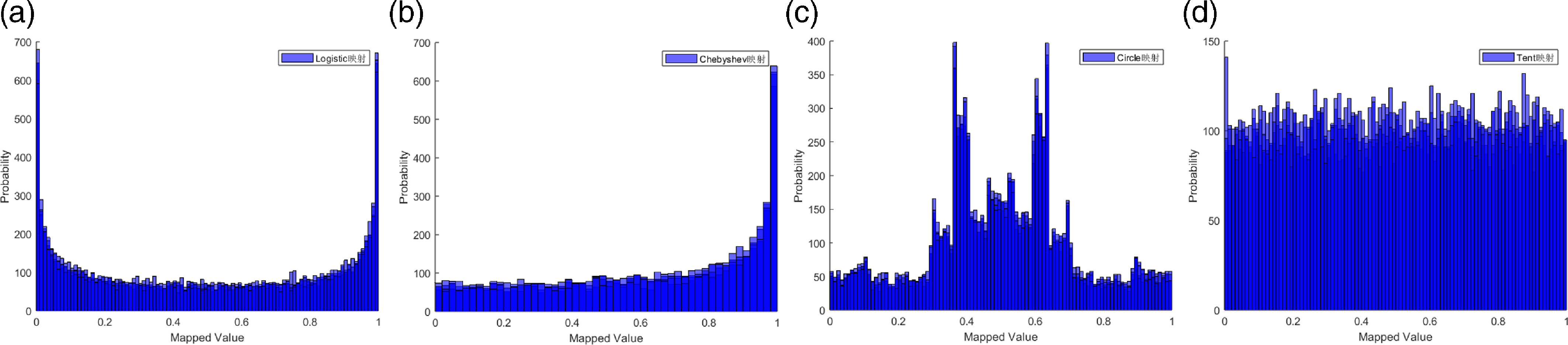
When initializing the sparrow population, random functions are commonly used to generate positions, but this often results in uneven distribution, limiting the global search capability in the early optimization stages. Chaotic maps, nonlinear dynamical systems that appear random but are deterministically generated, can address this issue. These maps exhibit properties such as randomness, ergodicity, sensitivity to initial conditions, and unpredictability. The Logistic, Chebyshev, Circle, and Tent mappings are each iterated 10,000 times to generate distribution frequency histograms within the
 $[0,1]$
range, as shown in Figure 1.
Frequency distribution histograms of chaotic maps.

Figure 1 illustrates the probability distribution characteristics of four chaotic maps within the solution space in the form of histograms. The Logistic map exhibits a pronounced bimodal distribution, with significant spikes occurring at the boundaries. The Chebyshev map demonstrates a unimodal distribution, characterized by a prominent peak near the value of 1. The circle map displays a multipeak and irregular distribution profile. These features may lead to nonuniform exploration of the global search space, requiring sparrow individuals multiple iterations to locate the optimal solution. By comparison, the Tent map presents a more uniform frequency distribution, offering superior ergodicity and faster convergence speed. This characteristic facilitates more effective utilization of the search space and enhances the quality of the algorithm’s initial solutions.
The Tent map system is expressed as
 \begin{equation}x_{n+1}=\left \{ \begin{matrix} r\cdot x_{n},\quad\quad\,\,\, & {\rm if}\, x_{n}\lt 0.5\\ r\cdot (1-x_{n}),\,\, & {\rm if}\, x_{n}\geq 0.5 \end{matrix}\right .\end{equation}
where
 $x_{n+1}$
represents the sparrow individual after mapping iteration, and
 $r$
is the control parameter, typically valued within the interval
 $[0,1]$
. The sparrow population generated using the Tent map exhibits more uniform distribution and greater diversity, reducing edge aggregation and enhancing the algorithm’s global search capability, thus mitigating premature convergence.
3.2. Dynamic inertia weight
In traditional SSA, rapid convergence toward the global optimum early in the process reduces global search capabilities and increases the risk of getting trapped in local optima. To address this, we introduce a dynamic inertia weight to update the positions of the producers in the sparrow population. The inertia weight is increased during early iterations to promote global exploration and gradually decreased in later stages to focus on local search around the best solutions. This approach enhances the algorithm’s local search ability and mitigates premature convergence to local optima.
The improved position update method for producers using inertia weight is shown in Eq. (7):
 \begin{equation}X_{i,j}^{t+1}=\left \{ \begin{matrix} \omega _{t}\cdot X_{i,j}^{t}\cdot \exp\left(\frac{-i}{\alpha \cdot \textit{MaxIter}}\right),\,\,\,\, & {\rm if}\,R_{2}\lt ST\\ \!\!\!\!\!\!\!\!\!\!\!\!\!\!\!\omega _{t}\cdot X_{i,j}^{t}+Q\cdot L, \,\,\,\, & {\rm if}\,R_{2}\geq ST \end{matrix}\right .\end{equation}
where the dynamic inertia weight
 $\omega _{t}$
is defined as in Eq. (8):
 \begin{equation}\omega _{t}=\omega _{1}-\frac{\omega _{1-}\omega _{2}}{\textit{MaxIter}}\cdot t\end{equation}
where
 $\omega _{1}$
and
 $\omega _{2}$
are weight adjustment parameters, which are set to
 $\omega _{1}=0.9$
and
 $\omega _{2}=0.4$
in this study. Other parameters are detailed in Eq. (3) and will not be elaborated further.
3.3. Local search strategy
This study introduces a local search strategy based on the current global optimal solution to enhance its quality. The strategy performs a multidimensional search at each node of the global optimal individual during the current iteration. It systematically explores each dimension, evaluating the results using a fitness function. These results are then compared with the presearch fitness values to determine if an improved solution is found. This approach enhances the algorithm’s global search capability and overall optimization performance. The process is described by Eq. (9).
 \begin{equation}X_{best,i}^{t}=\begin{cases} R_{best,i},\quad {\rm if}\, f_{R}\lt f_{b}\\ X_{best,i}^{t},\quad {\rm if}\, f_{R}\geq f_{b} \end{cases}\end{equation}
where
 $X_{best,i}^{t}$
represents the
 $i$
-th node of the global optimal individual at iteration
 $t$
, and
 $R_{best,i}$
denotes the new node found based on the
 $i$
-th node, which is a random integer within the dimension
 $d$
.
 $f_{R}$
is the new fitness value obtained by searching
 $R_{best,i}$
, and
 $f_{b}$
is the fitness value of the original optimal individual.
 $i$
in
 $[1,d]$
increments gradually, with each increment representing a new search for
 $R_{best,i}$
and an evaluation of its fitness value. If
 $f_{R}\lt f_{b}$
, indicating that a better result has been obtained through local search,
 $R_{best,i}$
will replace the original
 $X_{best,i}^{t}$
, and
 $f_{R}$
will replace
 $f_{b}$
to guide the next generation with the new global optimal fitness value. If
 $f_{R}\geq f_{b}$
, indicating that no better result has been found,
 $X_{best,i}^{t}$
retains its original value.
3.4. Floyd path optimization
The ESSA generates optimal paths based on the grid map, but these paths often contain unnecessary turning points. To address this, We propose a path smoothing optimization method based on the Floyd algorithm to reduce redundant nodes along the path. The process is as follows:
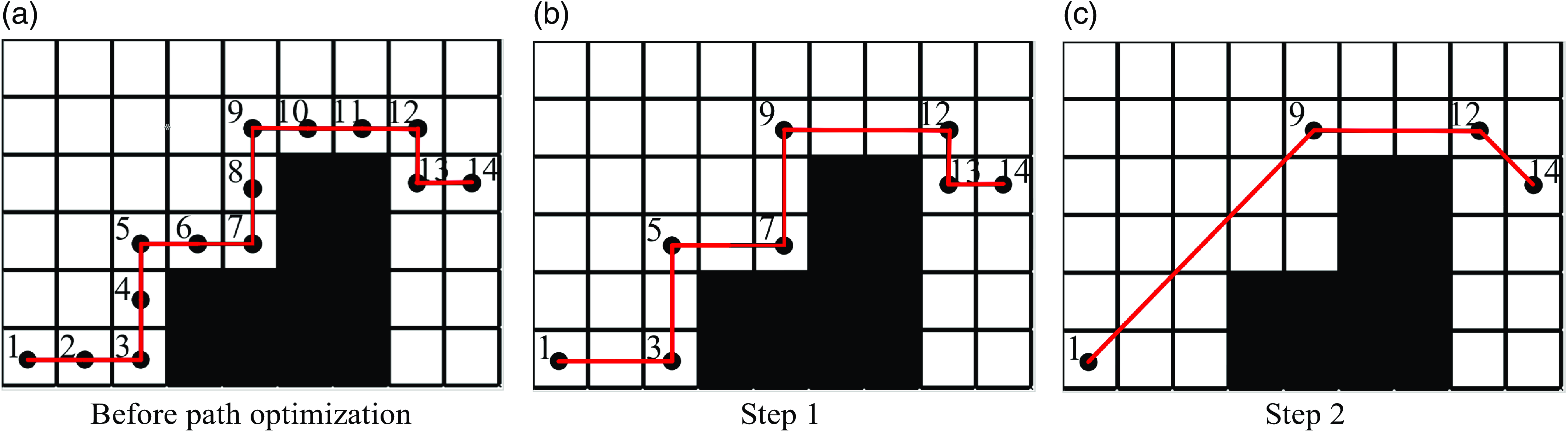
Step 1: From the initial point, identify segments where three or more consecutive nodes are collinear. If the slope of the line connecting these nodes is either zero or undefined, remove the intermediate nodes, retaining only the first and last nodes of each collinear segment. Add the retained nodes to a new list.
Step 2: Starting from the first node, consider the line connecting it to the next node as a candidate path. If the distance from this path to the nearest obstacle exceeds the robot’s expansion radius, remove the intermediate node and replace the path with a direct connection. If the path is obstructed, retain the intermediate node and continue to the next. This process is repeated until the last node is reached.
This optimization method eliminates unnecessary turning points, ensuring smoother, more efficient paths while avoiding obstacles. Step 2 is mathematically described as
 \begin{equation}list=list+\left\{n\left[k-1\right]\right\}, d_{ik}\lt R, k\gt 1, k\gt i\end{equation}
where
 $list$
is the new list,
 $n[k-1]$
represents the
 $(k-1)$
-th node,
 $d_{ik}$
is the straight-line distance between the current node
 $i$
and the
 $k$
-th node, and
 $R$
is the robot’s expansion radius.
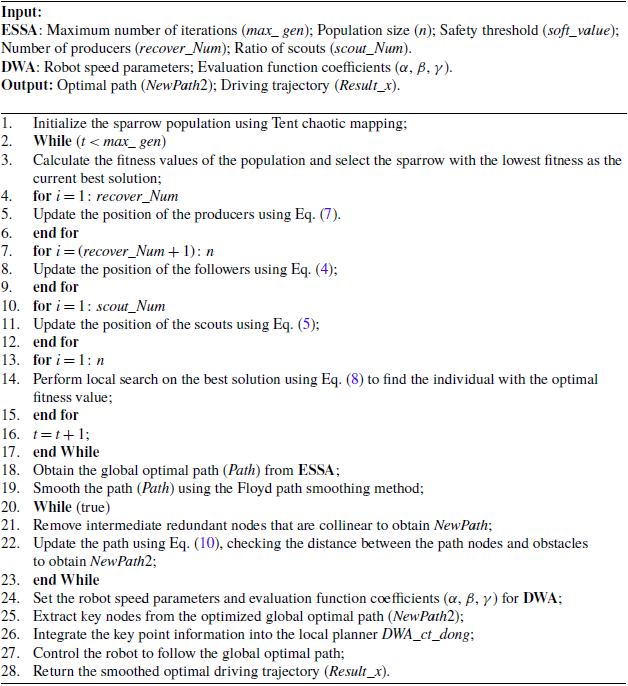
As shown in Figure 2, after Step 1, nodes (2, 4, 6, 8, 10, 11) are removed. After Step 2, nodes (3, 5, 7, 13) are removed, and nodes (1, 9, 12, 14) are selected as the new path nodes.
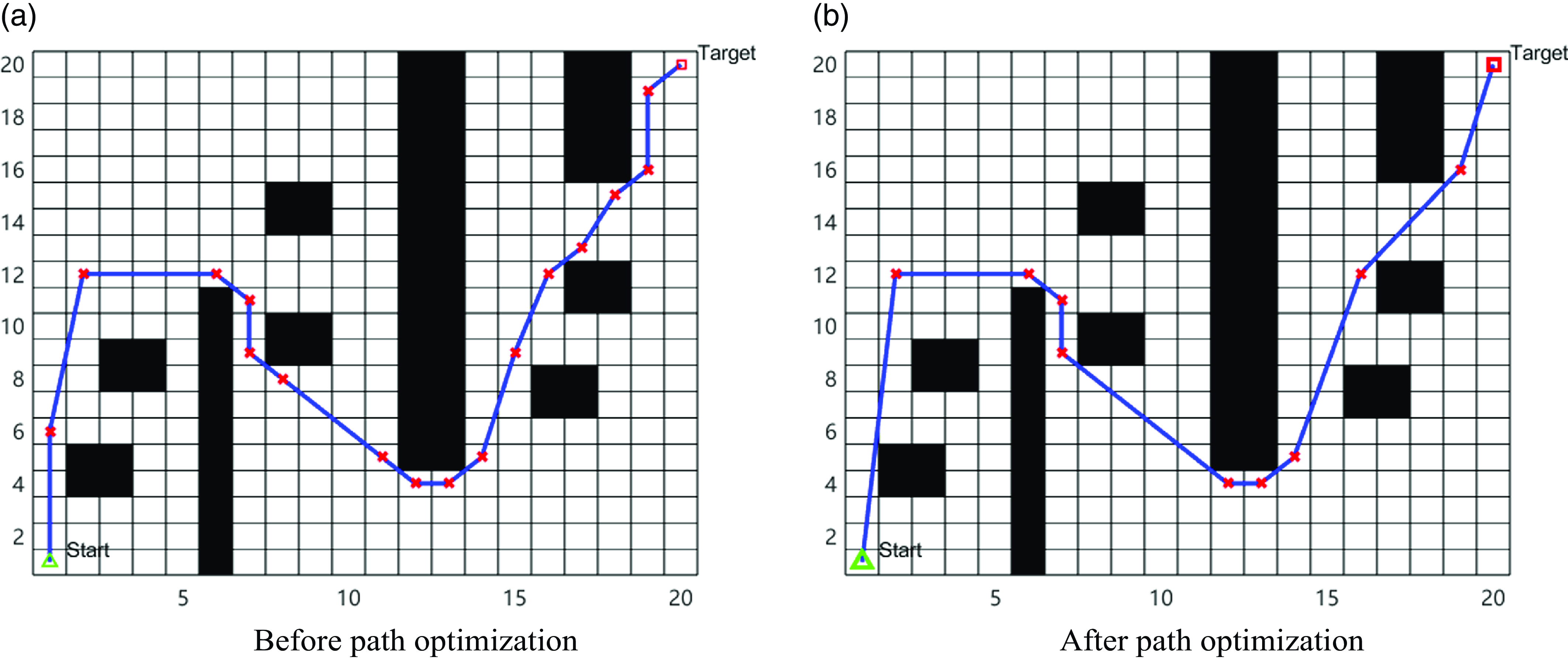
As shown in Figure 3, the red dots represent the search nodes. The left panel displays the original path, while the right panel shows the optimized path. According to Table I, the optimized path is, on average, 0.9% shorter in length, and the number of search nodes is reduced by 43.75% compared to the original path.
Performance comparison of the path before and after optimization.

Principle of the floyd path optimization.

Experiment on removing redundant nodes using the Floyd algorithm.

4. Local path planning algorithm based on DWA and fusion algorithm
4.1. DWA principle
Assume that the mobile robot moves in a straight line with omnidirectional motion over a very short time, with a linear velocity
 $v$
and an angular velocity
 $\omega$
. The robot’s motion trajectory can be expressed by the following Eq. (11):
 \begin{equation}\begin{cases} x=x+v_{x}{\unicode[Arial]{x0394}} t\mathit{\cos } \theta _{t}-v_{y}{\unicode[Arial]{x0394}} t\mathit{\sin } \theta _{t}\\ y=y+v_{x}{\unicode[Arial]{x0394}} t\mathit{\sin } \theta _{t}+v_{y}{\unicode[Arial]{x0394}} t\mathit{\cos } \theta _{t}\\ \theta _{t}=\theta _{t}+\omega {\unicode[Arial]{x0394}} t \end{cases}\end{equation}
where
 $v$
and
 $\omega$
represent the linear velocity and angular velocity, and
 $\Delta t$
is the simulation prediction time interval.
The selection of the actual velocity of the mobile robot is constrained by its inherent physical properties and real-time external environmental factors, facing three main constraints:
-
(1) Velocity range limits
Considering the hardware limitations of the robot and the extreme values of speed, the highest and lowest velocity limits that the robot can achieve are defined. Thus, the velocity set can be expressed as
(12)where \begin{equation}V_{m}=\left\{(v,\omega )|v\in [v_{\min}, v_{\max}],\omega \in \left[\omega _{\min},\omega _{\max}\right]\right\}\end{equation}
$v_{\min}$
and
$v_{\max}$
are the minimum and maximum linear velocities, and
$\omega _{\min}$
and
$\omega _{\max}$
are the minimum and maximum angular velocities.
-
(2) Acceleration and deceleration constraints
Due to the torque limitations of the motors and their driving components, the acceleration and deceleration of the robot are limited. Within the given prediction time, the extreme values of the velocity combinations can be determined by the maximum acceleration and deceleration. Thus, the velocity set can be expressed as
(13)
\begin{equation}V_{d}=\left\{(v,\omega )|v\in \left[v_{t}-\dot{v}{\unicode[Arial]{x0394}} t,v_{t}+\dot{v}{\unicode[Arial]{x0394}} t\right],\omega \in \left[\omega _{t}-\dot{\omega }{\unicode[Arial]{x0394}} t,\omega _{t}+\dot{\omega }{\unicode[Arial]{x0394}} t\right]\right\}\end{equation}
Where
$v_{t}$
and
$\omega _{t}$
are the linear and angular velocities at time
$t$
,
$\dot{v}$
, and
$\dot{\omega }$
are the maximum linear and angular accelerations of the mobile robot, and
$\Delta t$
is the sampling interval. -
(3) Braking safety distance
During path planning, it is essential to ensure that the mobile robot remains collision-free from obstacles, especially under maximum deceleration. Sufficient braking distance must be ensured to avoid collisions before the robot’s speed reaches zero. Therefore, considering the braking safety distance, the velocity set can be defined as the set of velocities that meet this constraint, expressed as
(14)
\begin{equation}V_{a}=\left\{(v,\omega )|v\leq (2dist(v,\omega )\dot{v})^{\frac{1}{2}},\omega \leq (2dist(v,\omega )\dot{\omega })^{\frac{1}{2}}\right\}\end{equation}
Where
$dist(v,\omega )$
is the evaluation function representing the shortest distance from the mobile robot to the obstacle.


4.2. Evaluation function
The DWA algorithm evaluates the robot’s ability to avoid obstacles while efficiently approaching the target. The optimal speed vector, corresponding to the best motion trajectory, is selected based on this evaluation. Once determined, the robot moves toward the target at this speed. The evaluation function is defined as
 \begin{equation}G(v,\omega )=\alpha \cdot head(v,\omega )+\beta \cdot vel(v,\omega )+\gamma \cdot dist(v,\omega )\end{equation}
where
 $head(v,\omega )$
represents the orientation angle towards the target,
 $vel(v,\omega )$
represents the current speed value, and
 $dist(v,\omega )$
represents the shortest safe distance to the nearest obstacle.
In the final evaluation stage, the deviation angle between the robot’s final orientation and the target direction is considered. Minimizing this angle increases the trajectory’s proximity to the target, so a smaller deviation angle receives a higher weight:
 \begin{equation}head(v,\omega )=\frac{\pi -{\unicode[Arial]{x0394}} \theta _{i}}{\sum _{i=1}^{N}(\pi -{\unicode[Arial]{x0394}} \theta _{i})}\end{equation}
where
 $N$
is the total number of simulated trajectories,
 $i$
is the
 $i$
-th simulated trajectory, and
 $\Delta \theta _{i}$
is the deviation angle between the end posture of the
 $i$
-th simulated trajectory and the target orientation.
The robot’s instantaneous speed is a critical factor in performance evaluation. As speed increases, its weight in the evaluation function rises, improving the overall score:
 \begin{equation}vel(v,\omega )=\frac{v_{i}}{\sum _{i=1}^{N}v_{i}}\end{equation}
where
 $v_{i}$
represents the absolute value of the speed at the end of the
 $i$
-th simulated trajectory.
For obstacle avoidance, the minimum distance to the nearest obstacle
 $dist(v,\omega )$
plays a key role. As this distance decreases, its weight in the evaluation function decreases, lowering the overall score:
 \begin{equation}dist(v,\omega )=\frac{d_{i}}{\sum _{i=1}^{N}d_{i}}\left(d_{i}=\begin{cases} d_{i},d_{i}\lt D_{0}\\ D_{0},d_{i}\geq D_{0} \end{cases} \right)\end{equation}
where
 $d_{i}$
represents the closest distance to the obstacle at the end of the
 $i$
-th simulated trajectory, and
 $D_{0}$
is a constant.
4.3. ESSA-DWA fusion algorithm
4.3.1. Algorithm fusion
The DWA has good dynamic obstacle avoidance performance but still suffers from issues such as the lack of global prior information, resulting in nonoptimal paths or even an inability to reach the target point. In this article, the ESSA is proposed, which can acquire global optimal path information in real time but is only applicable for obstacle avoidance in static environments. To address the limitations of the aforementioned algorithms, this study combines the advantages of both approaches and proposes a novel dynamic path planning method for mobile robots, called ESSA-DWA.
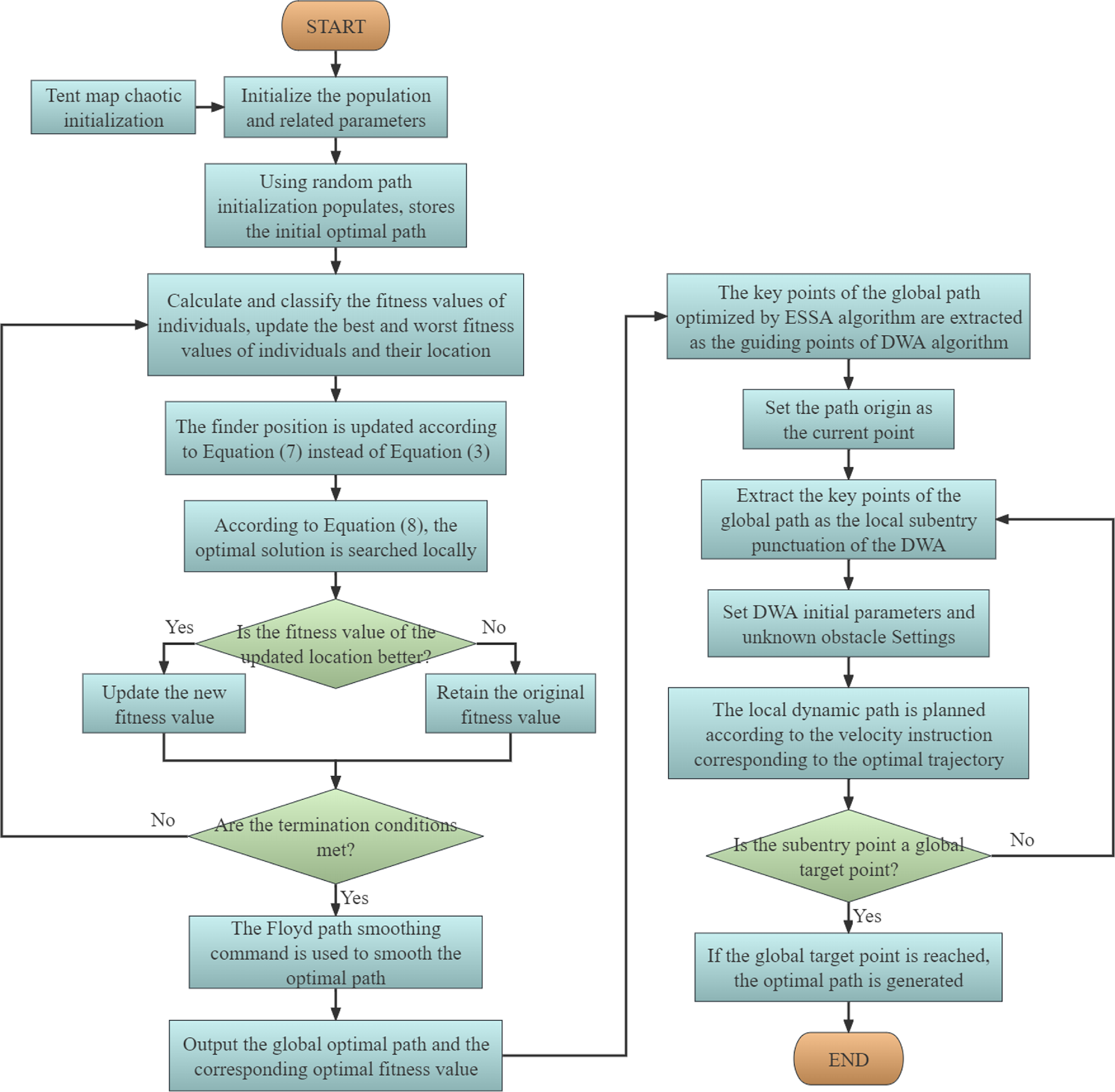
The main steps of the algorithm are as follows: First, the ESSA-related parameters are set, the population is initialized using the Tent chaotic mapping, dynamic inertial weight is updated to adjust the position of the producers, and a local search is performed on the optimal solution to identify the individual with the best fitness value, thereby generating a globally optimal path. Second, the Floyd algorithm is applied to optimize the current path by removing redundant nodes, generating a smooth optimal path, and extracting the path nodes as key nodes for the DWA algorithm. Finally, the DWA-related parameters are set, and the key nodes are incorporated into the DWA algorithm as references for local planning, ultimately generating a smooth trajectory that realizes both global optimal path planning and local dynamic obstacle avoidance. The flowchart of the integrated algorithm is shown in Figure 4.
The flowchart of the ESSA-DWA fusion algorithm.

4.3.2. Complexity analysis
The time complexity of the ESSA algorithm can be represented as
 $O(G\times N\times D)$
, where
 $G$
is the maximum number of iterations,
 $N$
is the population size, and
 $D$
is the path dimension. The runtime of the algorithm is proportional to the product of these three factors. In each iteration, the following operations are performed: Tent chaotic initialization, dynamic inertia weight adjustment, and local search.
The time complexity of the Floyd path smoothing algorithm can be represented as
 $O(k^{2})$
, where
 $k$
is the number of path nodes. The algorithm consists of two-stage optimization: the first stage traverses the path nodes to remove redundant nodes, and the second stage removes nodes by evaluating their distance to obstacles. For example, in a 20 × 20 map, the value of
 $k$
typically ranges between 10 and 20, and the algorithm’s runtime grows quadratically with respect to
 $k$
.
The time complexity of the DWA algorithm is
 $O(n^{2})$
, where
 $n$
represents the number of optimization variables. As the number of optimization variables increases, the runtime of the algorithm grows quadratically. In this article,
 $n=4$
, corresponding to the current robot position, heading angle, linear velocity, and angular velocity.
Based on the above analyses, the time complexity of the ESSA-DWA fusion algorithm is
 $O(G\times N\times D+k^{2}+n^{2})$
.
Compared to traditional SSA, the ESSA algorithm has a higher time complexity. For complex maps with numerous path nodes, the runtime may increase. However, through improvements such as Tent chaotic initialization, dynamic inertia weight adjustment, and local search, combined with the DWA algorithm, the ESSA algorithm provides shorter path lengths, smoother paths, faster convergence, better adaptability to different environments, and enhanced obstacle avoidance performance.
The pseudocode for the ESSA-DWA integrated algorithm is as follows:
ESSA-DWA Fusion Algorithm

5. Simulation experiments and practical experiments
5.1. Simulation experimental environment
To ensure the completeness and comparability of the experimental results, all simulation experiments follow a uniform configuration. A grid-based method was used to construct the grid map for the simulation experiments. The experimental environment for this study consists of a desktop computer with the following specifications: AMD Ryzen 5 5600 6-Core Processor @ 3.50 GHz, 16 GB of RAM, and a 64-bit Windows 10 operating system. The simulation software used is MATLAB R2021a.
5.2. Simulation experiments and analysis of global path planning using the ESSA algorithm
To assess the efficiency and generality of the ESSA algorithm for static path planning, experiments were conducted on grid maps of sizes 20 × 20, 30 × 30, and 50 × 50, each configured with three different environment models of varying complexity. The performance of the ESSA algorithm was compared in detail with the ACO, GWO, and SSA algorithms across various scenarios. ACO and GWO were chosen as benchmarks due to their extensive use and research in path planning. Each algorithm was subjected to 30 simulation experiments in each environmental model. The performance evaluation primarily focused on the average path length and mean execution time, along with their standard deviations (Sd.).
In the simulations, each grid cell had a side length of 1 m. The starting point was marked with a green triangle and the target point with a red square. Obstacles were represented by black grid cells and walkable areas by white grid cells. The parameters for the algorithms were as follows:
-
ACO: 200 iterations, ant population size of 50, pheromone factor of 2, heuristic factor of 6, pheromone evaporation coefficient of 0.1, and pheromone increment coefficient of 5.
-
GWO: 200 iterations, grey wolf population size of 50.
-
SSA: 200 iterations, sparrow population size of 50, safety value of 0.8, 30% producers, and 20% scouts.
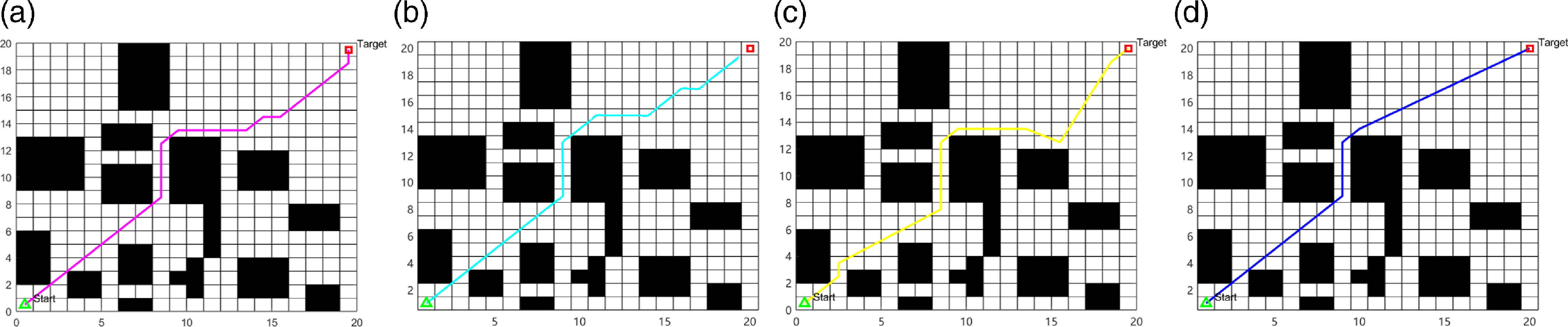
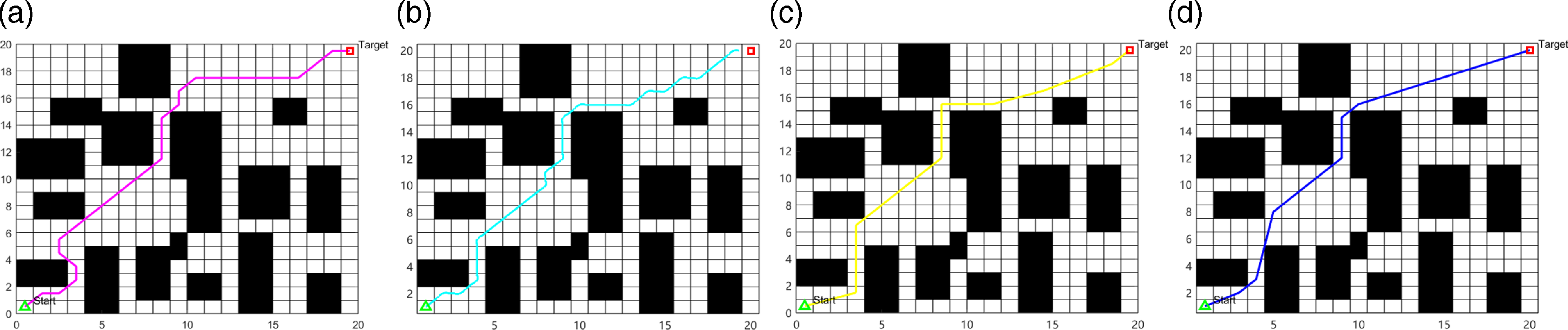
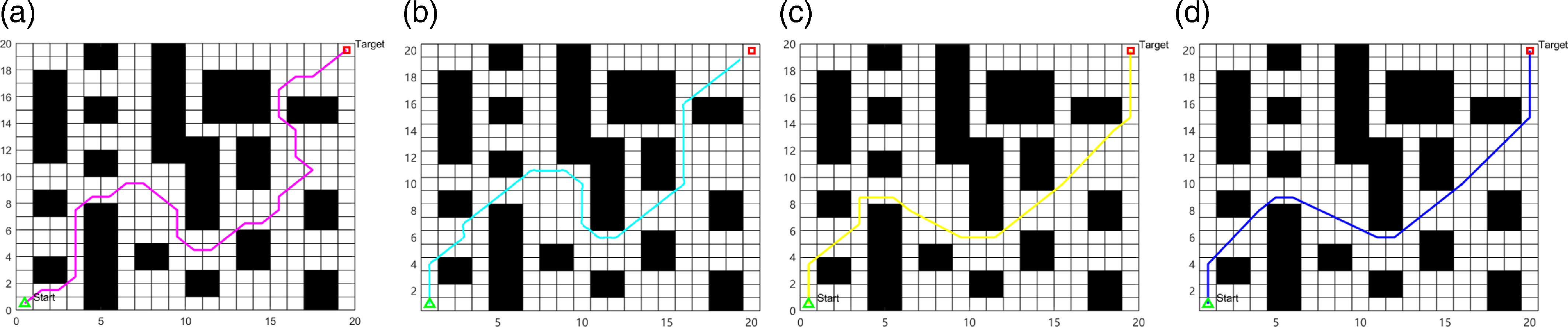
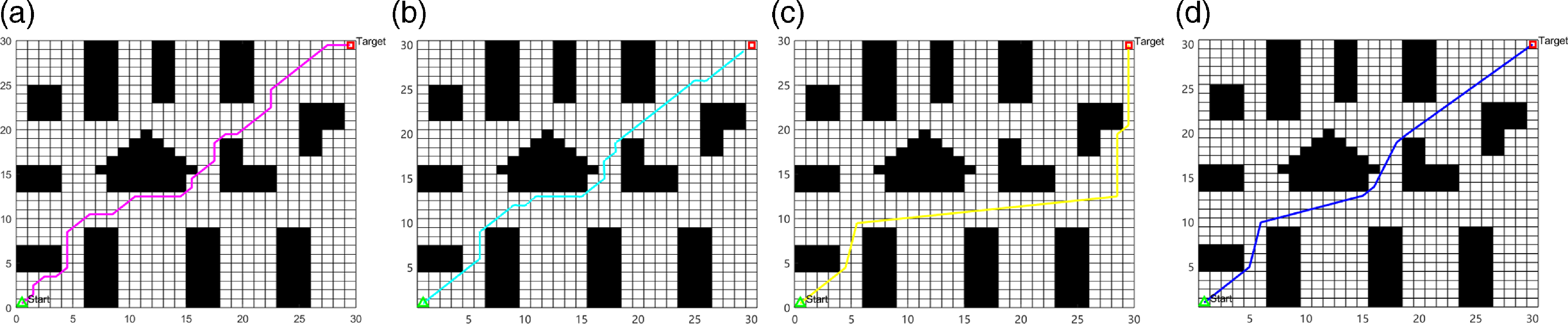
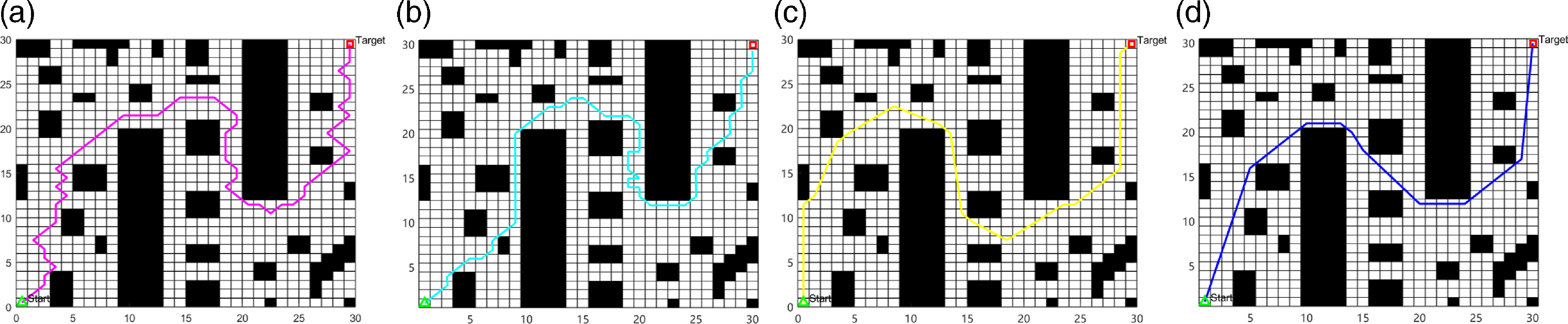
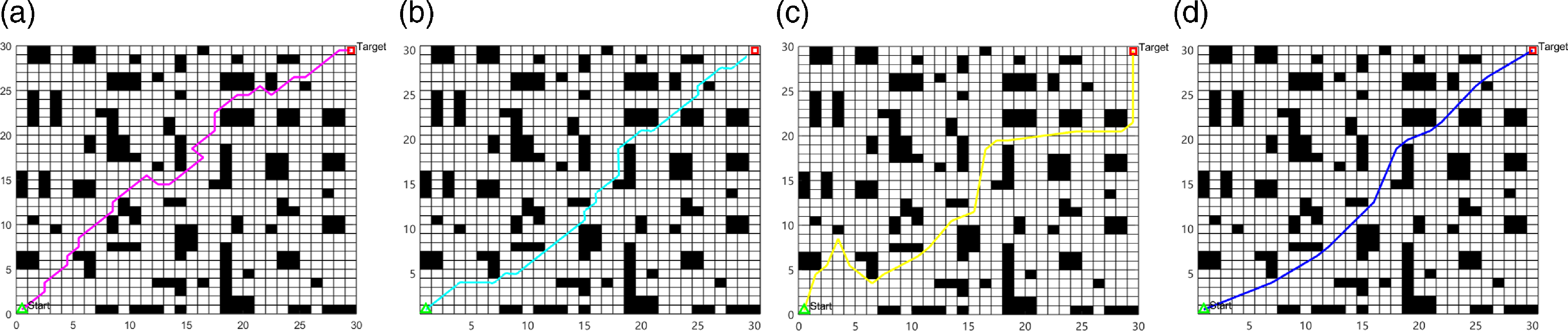
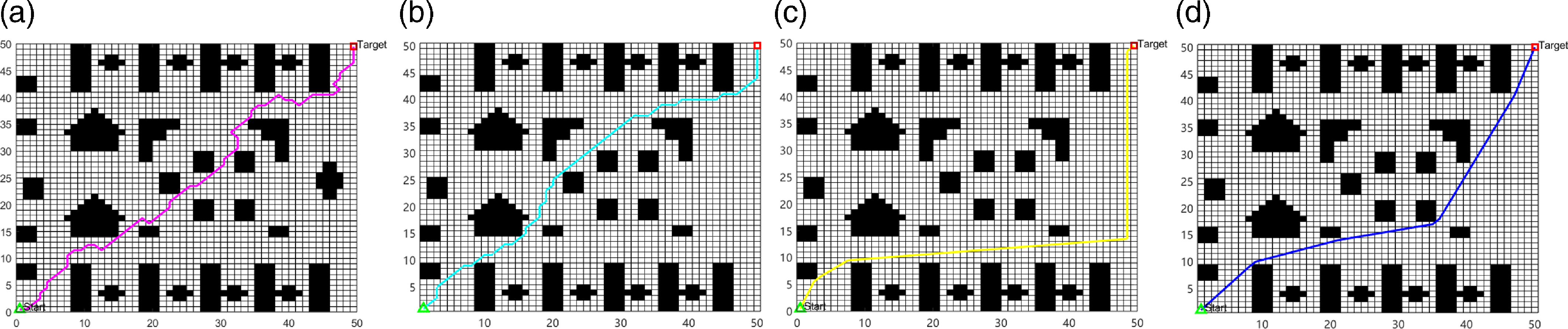
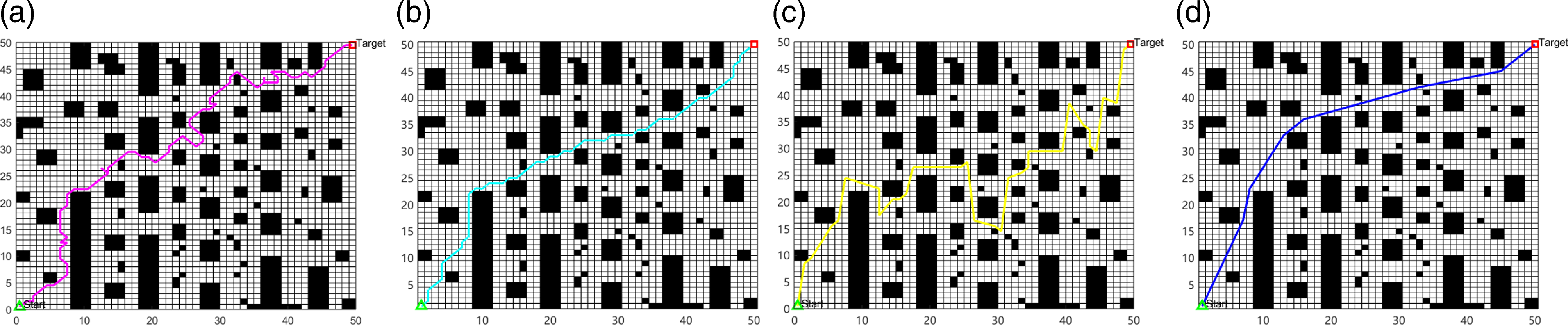
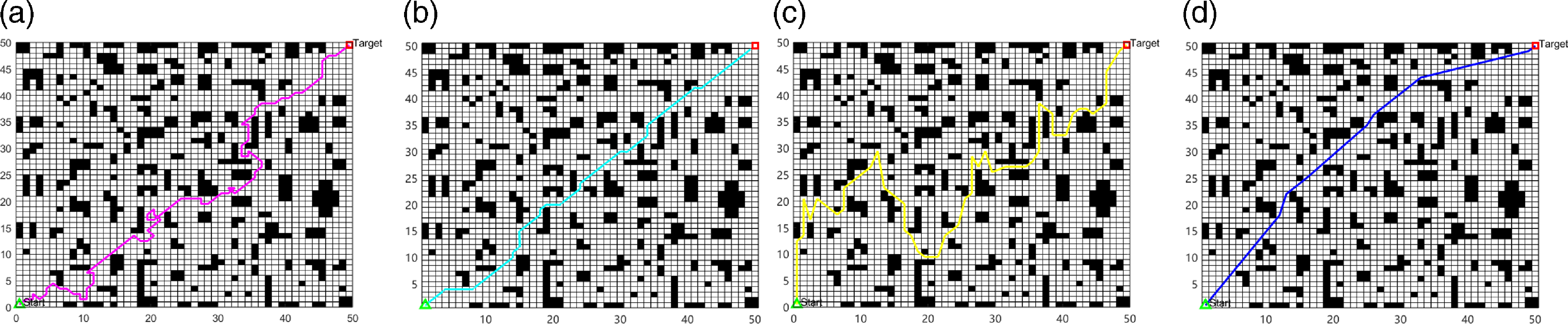
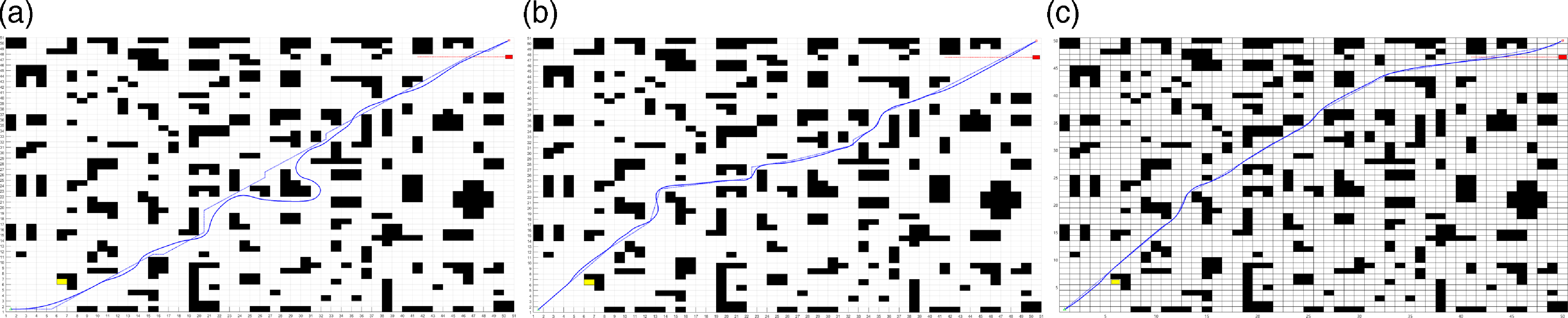
In Figures 5–13, the paths planned by the different algorithms are shown:
-
(1) ACO algorithm (purple solid line);
-
(2) GWO algorithm (cyan solid line);
-
(3) SSA algorithm (yellow solid line);
-
(4) ESSA algorithm (blue solid line).
The initial point is represented by a green triangle and the target point by a red square.
Planned paths of the four algorithms in environment model 1.

Planned paths of the four algorithms in environment model 2.

Planned paths of the four algorithms in environment model 3.

Planned paths of the four algorithms in environment model 4.

Planned paths of the four algorithms in environment model 5.

Planned paths of the four algorithms in environment model 6.

5.2.1. 20 × 20 grid map
To more accurately represent the real-world environment of mobile robots, this study replicated the environmental models used in ref. [Reference Liu, Liang, Guo, Ke, He and Chen37] on a 20 × 20 grid map and compared the proposed ESSA algorithm with the improved SSA algorithm from ref. [Reference Liu, Liang, Guo, Ke, He and Chen37] to highlight the superior performance of the proposed approach. Figures 5–7 illustrate the global path planning results of ACO, GWO, SSA, and ESSA for environment models 1–3, respectively. These three environmental models vary in type and progressively increase in complexity.
Figures 5–7 present the global path planning results of ACO, GWO, SSA, and ESSA across Environment Models 1, 2, and 3. By examining and comparing the results for the three environment models, it is clearly evident that as the complexity of obstacle distribution increases, the superior performance of the ESSA algorithm becomes more pronounced. The ESSA algorithm is capable of efficiently planning the optimal path, and, compared to other algorithms, the resulting path is smoother.
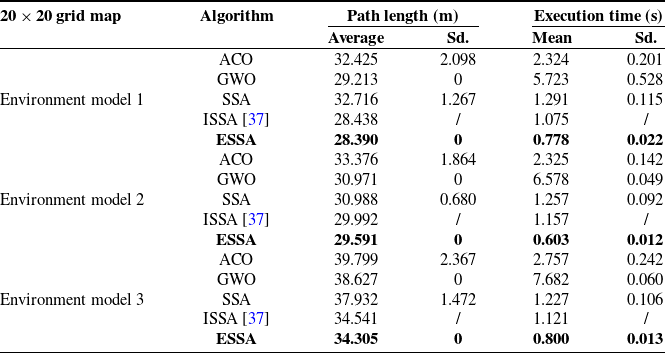
Table II shows that the ESSA algorithm outperforms the other algorithms across all three environmental models on the 20 × 20 grid map. When compared to ACO, GWO, SSA, and ISSA [Reference Liu, Liang, Guo, Ke, He and Chen37], in Environment Model 1, the ESSA algorithm reduced the average path length by 12.44%, 2.82%, 13.22%, and 0.17%, respectively, while the average execution time was reduced by 66.25%, 86.40%, 37.74%, and 27.63%. In Environment Model 2, the ESSA algorithm reduced the average path length by 11.34%, 4.45%, 4.51%, and 1.34%, respectively, while the average execution time was reduced by 74.06%, 90.83%, 52.03%, and 47.88%. In Environment Model 3, the ESSA algorithm reduced the average path length by 13.80%, 11.19%, 9.08%, and 0.68%, respectively, while the average execution time was reduced by 70.98%, 89.59%, 45.65%, and 28.64%.
The experimental results demonstrate that the ESSA algorithm proposed in this article exhibits excellent convergence performance on the 20 × 20 grid map, generating the optimal and smoother paths. This also confirms that the ESSA algorithm effectively enhances the traditional SSA algorithm and outperforms the other four heuristic algorithms.
Planned paths of the four algorithms in environment model 7.

Planned paths of the four algorithms in environment model 8.

5.2.2. 30 × 30 grid map
To demonstrate the superiority of the proposed algorithm in various complex environments, three additional environmental models were created on a 30 × 30 grid map, and comparisons were made among the ACO, GWO, SSA, and ESSA algorithms. Figures 8–10 illustrate the global path planning results for ACO, GWO, SSA, and ESSA in environment models 4–6, respectively. These environmental models differ in type and progressively increase in complexity.
Figures 8–10 illustrate the global path planning results of the ACO, GWO, SSA, and ESSA algorithms in Environment Models 4, 5, and 6. In these three environment models, the paths planned by the ESSA algorithm are notably superior to those of the other algorithms, exhibiting smoother trajectories and fewer turning points.
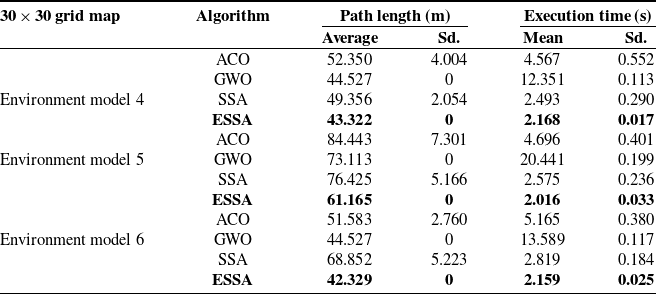
Table III demonstrates that the ESSA algorithm outperforms the other algorithms across all three environment models on a 30 × 30 grid map. As the map size increases, the average planning time for all algorithms increases. Specifically, in Environment Model 4, the average path length generated by ESSA is reduced by 17.25%, 2.71%, and 12.23% compared to ACO, GWO, and SSA, respectively, while the average execution time is reduced by 52.53%, 82.45%, and 13.04%. In Environment Model 5, ESSA reduces the average path length by 27.57%, 16.34%, and 19.94%, and the average execution time by 57.09%, 90.14%, and 21.71%, respectively. In Environment Model 6, the average path length is reduced by 17.94%, 4.94%, and 38.51%, and the average execution time is reduced by 58.20%, 84.11%, and 23.41%, respectively.
Performance comparison of various algorithms in environment models 1–3 on a 20 × 20 grid map (30 simulations).

Performance comparison of various algorithms in environment models 4–6 on a 30 × 30 grid map (30 simulations).

The experimental results indicate that, as environmental complexity and path length increase, the proposed ESSA algorithm maintains a significant advantage on 30 × 30 grid maps.
5.2.3. 50 × 50 grid map
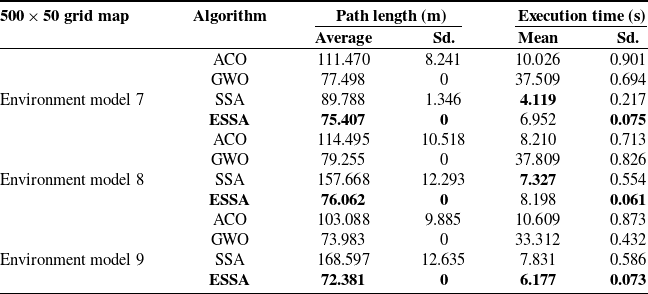
To demonstrate the general applicability of the proposed algorithm, this study also conducted simulation experiments on a 50 × 50 grid map. Three different environment models were used for comparison on the 50 × 50 grid map. Figures 11–13 illustrate the global path planning results of ACO, GWO, SSA and ESSA for environment models 7–9, respectively. Each of the three environment models varies in type and progressively increases in complexity.
Planned paths of the four algorithms in environment model 9.

Figures 11–13 present the global path planning results of the ACO, GWO, SSA, and ESSA algorithms in Environment Models 7, 8, and 9. In these three environment models, ESSA demonstrates strong adaptability to complex environments, with superior global search capabilities. The trajectories generated by ESSA exhibit fewer turning points and are closer to straight lines, resulting in shorter and more efficient paths.
Performance comparison of various algorithms in environment models 7–9 on a 50 × 50 grid map (30 simulations).

Table IV shows that the ESSA algorithm outperforms the other algorithms across all three environment models on a 50 × 50 grid map. Specifically, in Environment Model 7, the average path length generated by ESSA is reduced by 32.35%, 2.71%, and 16.03% compared to ACO, GWO, and SSA, respectively. However, the average execution time is reduced by 31.89% and 81.47% for ACO and GWO but increased by 68.78% for SSA. In Environment Model 8, ESSA reduces the average path length by 33.62%, 4.10%, and 51.79%, with the average execution time reduced by 0.15% and 78.31% for ACO and GWO but increased by 11.88% for SSA. In Environment Model 9, the average path length is reduced by 29.78%, 2.17%, and 57.07%, while the average execution time is reduced by 41.77%, 81.46%, and 21.12%, respectively.
The experimental results indicate that, as the map size increases, the proposed ESSA algorithm continues to perform well in complex environments on 50 × 50 grid maps, generating shorter average path lengths. Due to the increased number of path nodes, the time complexity of path smoothing also rises, leading to longer execution times. Nevertheless, this does not affect ESSA’s excellent performance in other aspects within complex environments.
In summary, ESSA successfully identifies optimal paths on 20 × 20, 30 × 30, and 50 × 50 grid maps. Compared to ACO, GWO, and SSA, ESSA exhibits significant advantages in terms of path length and execution time. In complex environments, ESSA demonstrates stronger adaptability and enhanced global search capabilities, generating smoother optimal paths. However, as the number of path nodes increases, the time complexity also rises, resulting in longer execution times—an aspect that requires further improvement. Overall, the results demonstrate that ESSA performs exceptionally well in finding globally optimal paths in complex environments across different map sizes.
5.3. Simulation experiments and analysis of local dynamic obstacle avoidance using the ESSA-DWA fusion algorithm
5.3.1. Dynamic obstacle avoidance experiment and analysis of the fusion algorithm
Following the demonstration of ESSA’s superiority in global path planning, this study further integrates the ESSA algorithm with the DWA to highlight the dynamic obstacle avoidance capabilities of the ESSA-DWA fusion algorithm. For the DWA algorithm, the following parameter settings were used: the maximum linear velocity was set to 0.5 m/s, the maximum linear acceleration to 1 m/s2, the maximum angular velocity to 30°/s, and the maximum angular acceleration to 50°/s2. The velocity resolution was set to 0.1 m/s, the angular velocity resolution to 3.0°/s, and the prediction horizon to 3.0 s. The parameters of the evaluation function were defined as α = 0.05, β = 0.2, and γ = 0.1. The robot’s inflation radius was set to 0.5 m, and the movement speed of dynamic obstacles was set to 0.1 m/s. In the simulation environment, yellow grid cells represent unknown static objects, while red grid cells indicate dynamic obstacles, with red arrows denoting the direction of movement for dynamic obstacles. The starting grid is marked with a triangle, and the goal grid is marked with a circle. The overall planned path is represented by a dashed line, while the locally generated obstacle-avoidance path is indicated by a solid line.
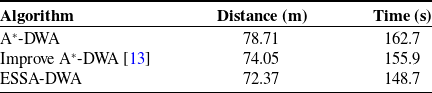
Additionally, this study conducts a comparative analysis of the ESSA-DWA fusion algorithm against the traditional A*-DWA and an improved A*-DWA from ref. [Reference Li, Hao, Zhao and Lu13] under identical environmental conditions and obstacle configurations, aiming to highlight the superior performance of the ESSA-DWA approach. The performance comparison of the evaluated algorithms is visually depicted in Figure 14.
Comparison of fusion algorithms.

As illustrated in Figure 14, the planned paths generated by traditional A*-DWA and improved A*-DWA, and ESSA-DWA differ significantly under identical environmental conditions. According to Table V, under the same obstacle configurations, the ESSA-DWA algorithm achieves notable improvements in both travel distance and execution time. Specifically, compared to A*-DWA and improved A*-DWA, ESSA-DWA reduces the travel distance by 8.05% and 2.27%, respectively, while shortening the execution time by 8.60% and 4.62%, respectively. The experimental results demonstrate that the proposed ESSA-DWA fusion algorithm exhibits superior dynamic adaptability and overall performance, making it a highly effective solution for navigation in complex and dynamic environments.
Performance comparison of the three fusion algorithms.

5.3.2. Dynamic obstacle avoidance experiment and analysis of the fusion algorithm in different maps
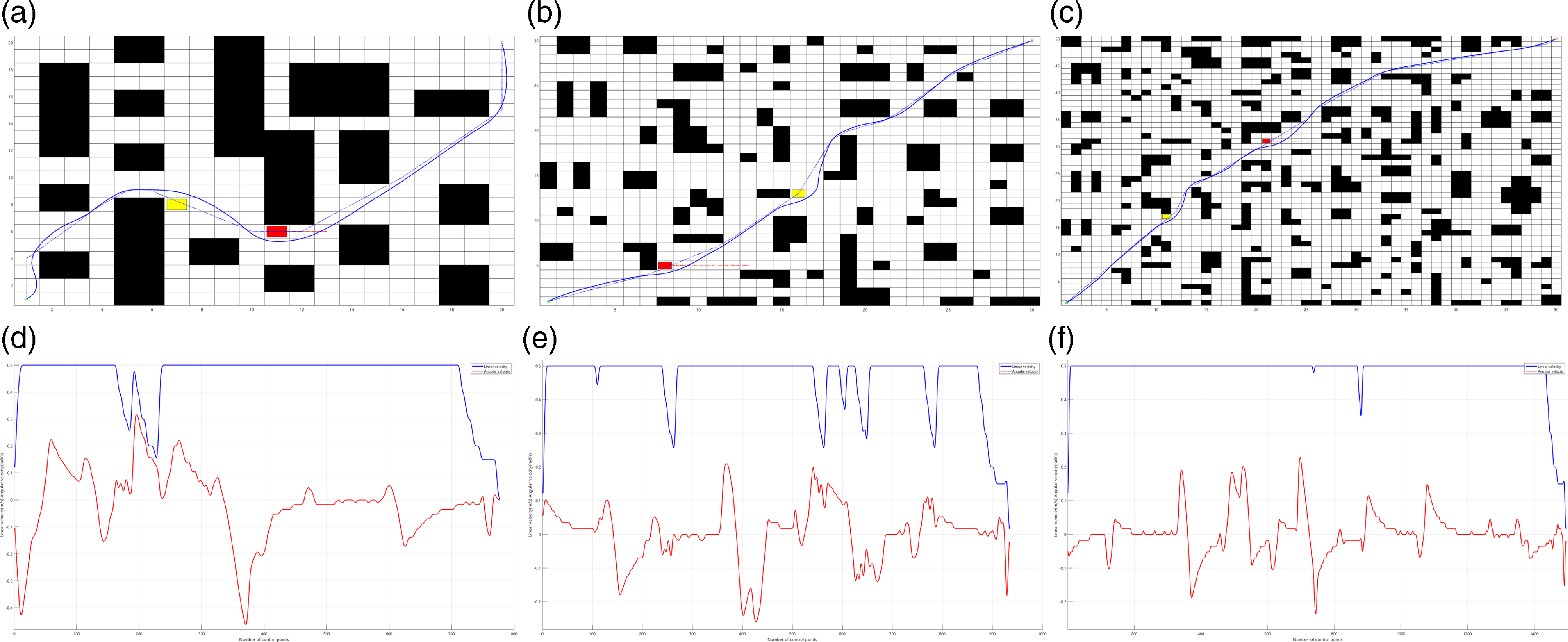
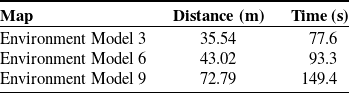
To evaluate the adaptability of the ESSA-DWA fusion algorithm across different environments, this study selects one environment from each of the 20 × 20, 30 × 30, and 50 × 50 grid maps in the simulation experiments, specifically Environment Models 3, 6, and 9. The performance of the ESSA-DWA fusion algorithm was assessed under these varying map conditions. In scenarios involving randomly introduced obstacles, the algorithm was tested to analyze its ability to handle unpredictable environmental changes. The results of the dynamic obstacle avoidance simulations, including the corresponding linear and angular velocity profiles, are illustrated in Figure 15. These results demonstrate the algorithm’s capability to maintain smooth and efficient navigation while dynamically adapting to the presence of random obstacles and varying map complexities.
Dynamic obstacle avoidance simulation and corresponding linear and angular velocities.

Figure 15 illustrates the dynamic obstacle avoidance capabilities of the ESSA-DWA fusion algorithm in Environment Models 3, 6, and 9, along with the corresponding linear and angular velocity profiles. It can be observed that, under different environmental models and in the presence of unknown obstacles, the mobile robot successfully avoids these obstacles and reaches the target destination. Table VI summarizes the performance metrics of the three sets of dynamic obstacle avoidance simulations. The experimental results demonstrate that the proposed ESSA-DWA fusion algorithm effectively achieves real-time obstacle avoidance across varying environments.
Dynamic obstacle avoidance performance of ESSA-DWA in three environmental models.

In summary, the results of the three sets of dynamic obstacle avoidance experiments conducted under different environmental conditions validate the performance of the hybrid algorithm across diverse scenarios. These findings highlight the feasibility, adaptability, and practicality of the ESSA-DWA fusion algorithm.
5.3.3. Randomly added obstacle experiment and analysis
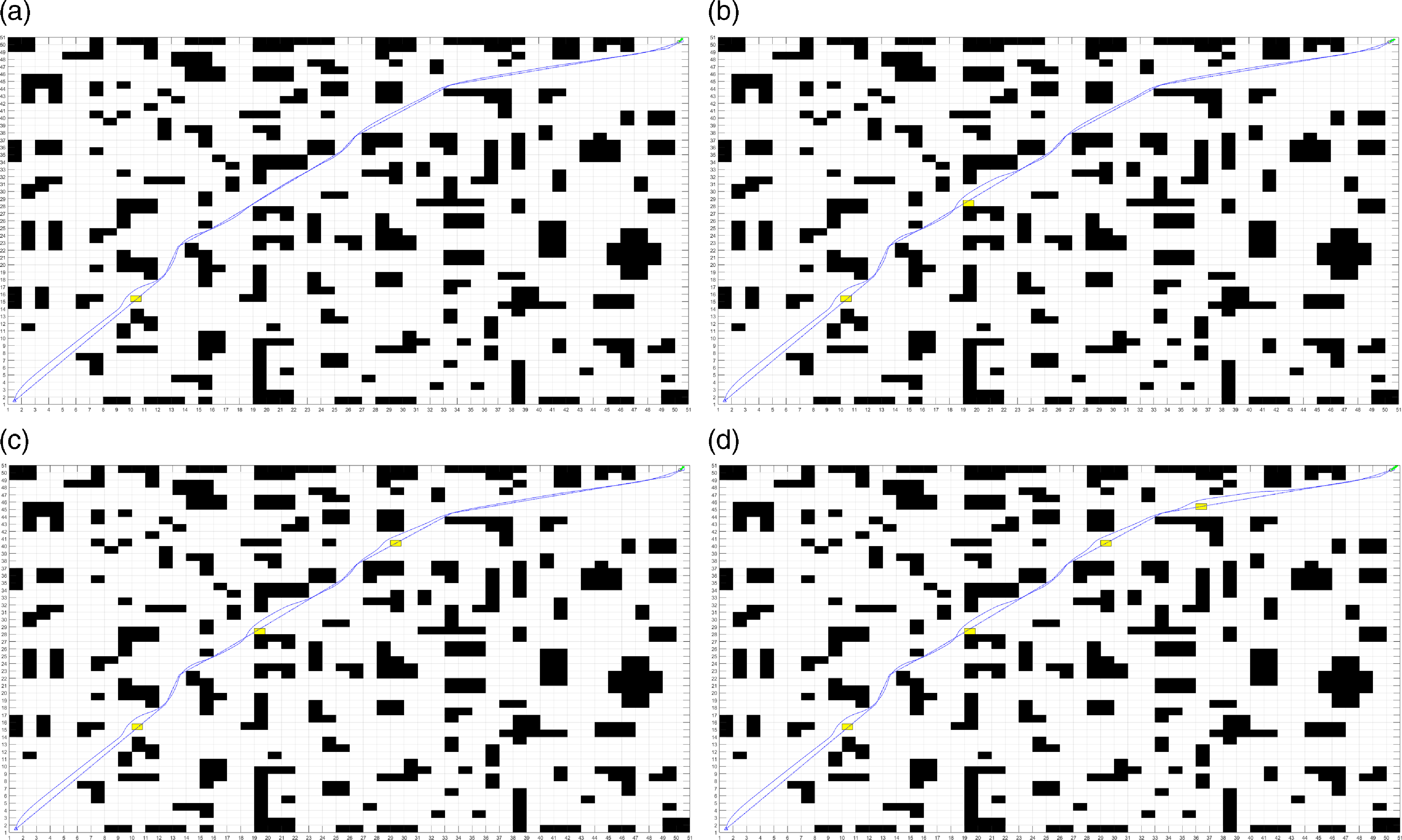
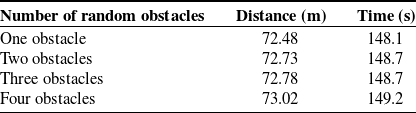
In the absence of newly introduced unknown obstacles, the ESSA-DWA fusion algorithm is capable of successfully achieving the optimal path. To thoroughly evaluate the obstacle avoidance performance of the ESSA-DWA fusion algorithm in dynamic environments, simulations were conducted on a 50 × 50 grid map using four environmental models, with Environment Model 9 serving as a representative example. A number of random unknown obstacles were added to the experimental environment. The starting and ending grids were denoted by a triangle and a circle, respectively, while green cursors indicated the robot’s directional sensing. Unpredictable obstacles were represented by gray rectangles. The path generated by the ESSA algorithm was shown with dashed lines, while the real-time navigation of the fusion algorithm was depicted with solid lines, highlighting the algorithm’s flexibility in rapidly adapting to dynamic changes in the environment.
As shown in Figure 16, the robot effectively navigates around unknown obstacles while following the path generated by the ESSA algorithm. As the number of randomly placed obstacles increases, the planned route consistently demonstrates its effectiveness in both circumventing obstacles and ensuring successful navigation to the predetermined destination. The hybrid algorithm efficiently handles random obstacles within grid maps, maintaining a smooth trajectory that remains closely aligned with the globally optimal path. When multiple unknown obstacles are introduced in Environment Model 9, the performance summary of the ESSA-DWA fusion algorithm is presented in Table VII.
Dynamic obstacle avoidance simulation with newly added unknown obstacles.

Based on the simulation results across four different environments, the path generated by the proposed ESSA-DWA hybrid algorithm is largely consistent with the path planned in static environments. In scenarios involving unknown obstacles, the algorithm successfully circumvents these obstacles, producing a smooth trajectory that effectively balances global optimality and obstacle avoidance. This highlights the algorithm’s capability to perform real-time local dynamic path planning based on the global path. Furthermore, the ESSA-DWA hybrid algorithm seamlessly adapts to complex dynamic obstacle environments, thereby enhancing the operational efficiency of the robot.
Dynamic obstacle avoidance performance of the ESSA-DWA fusion algorithm under newly added unknown obstacles in environment Model 9.

5.4. Simulation experiments and analysis of the ESSA-DWA fusion algorithm
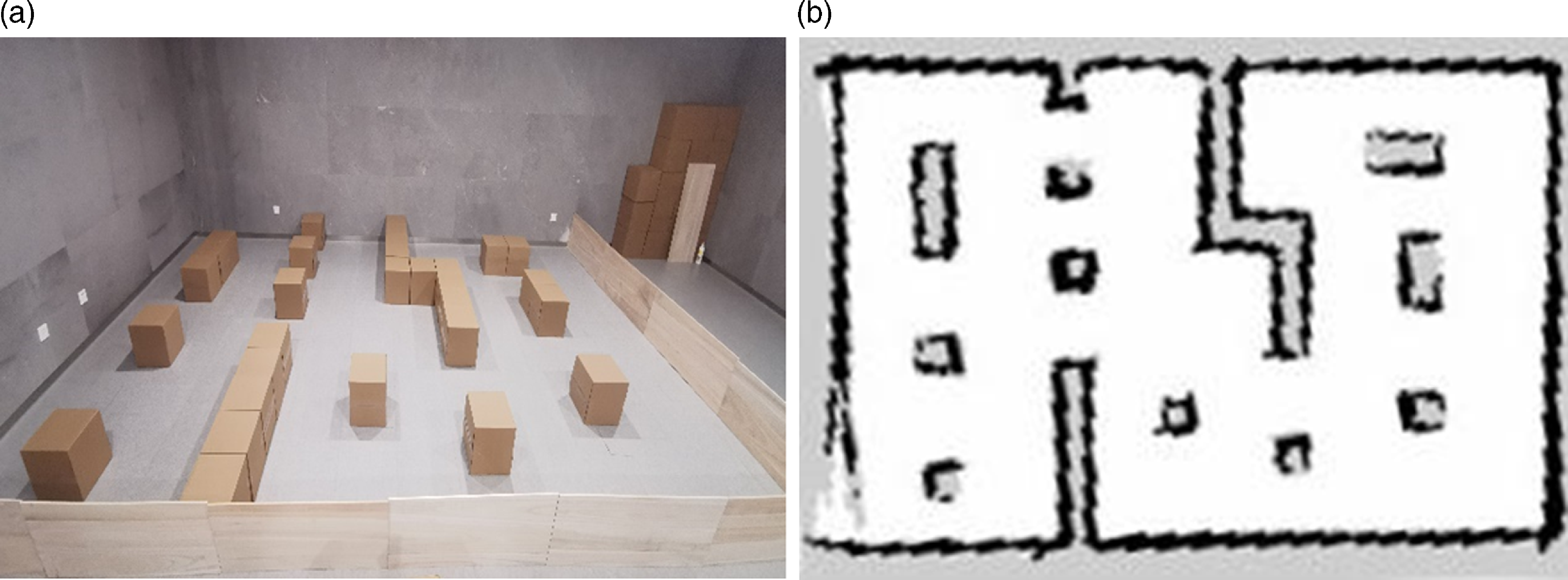
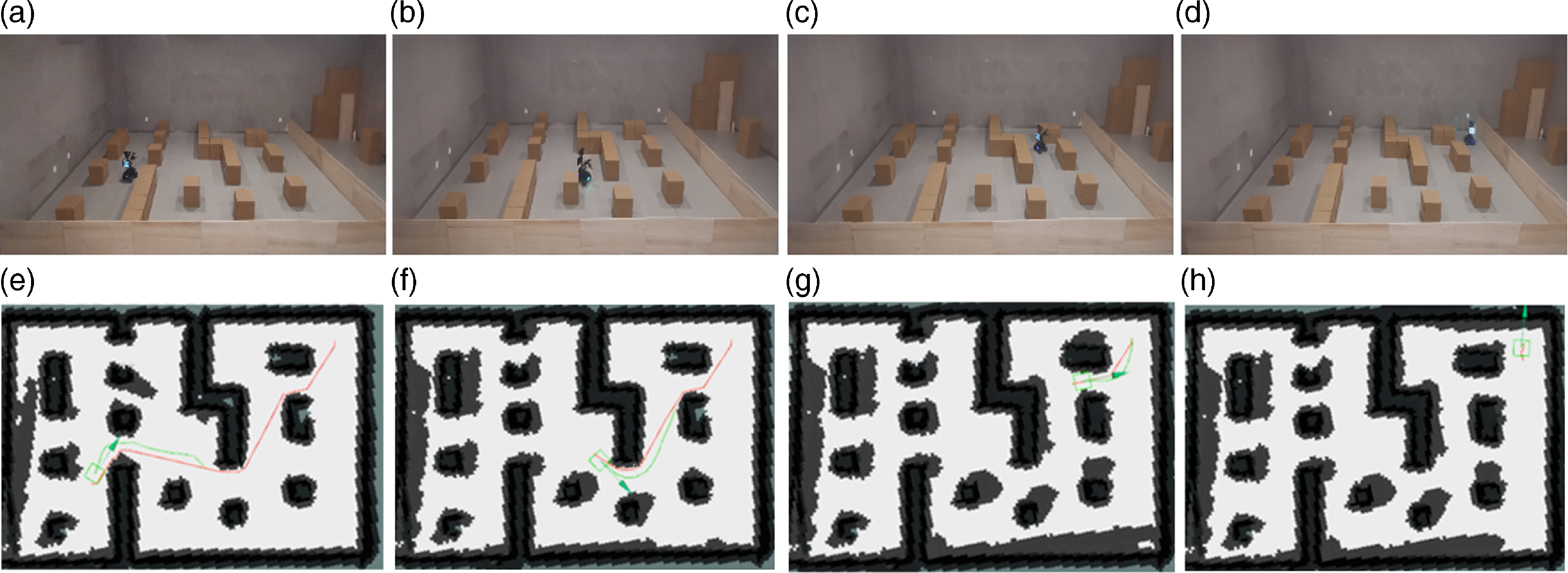
To evaluate the proposed algorithm in real-world applications, practical path planning experiments were conducted using an Mecanum wheel mobile robot (XTARK) on an Ubuntu 18.04 system. The Cartographer-SLAM algorithm generated the cost map for the environment, and the ROS visualization tool, Rviz, was used to display it. In the cost map, white areas represent walkable regions, black areas indicate obstacles, and gray areas show obstacle boundaries. For the robot parameters, the settings for both ESSA and DWA were consistent with those used in the simulation experiments, with the robot’s inflation radius set to 0.2 m. Due to experimental constraints, a simplified environment based on Environment Model 3 was created using cardboard boxes. The experimental setup is shown in Figure 17.
Experimental environment.

The real-world experiments were conducted in two phases: static and dynamic path planning. In the static path planning experiment, the initial and target positions of the robot were predefined, and the ESSA-DWA fusion algorithm was utilized to compute the robot’s path from the starting point to the target within a static environment. Throughout the navigation process, the robot adhered to the planned trajectory. As depicted in Figure 18, the robot successfully departed from its initial position and skillfully maneuvered around all static obstacles encountered along its path. Ultimately, the robot safely reached the target point by following the globally optimal route.
Obstacle avoidance process in static environment and their Rviz in ROS.

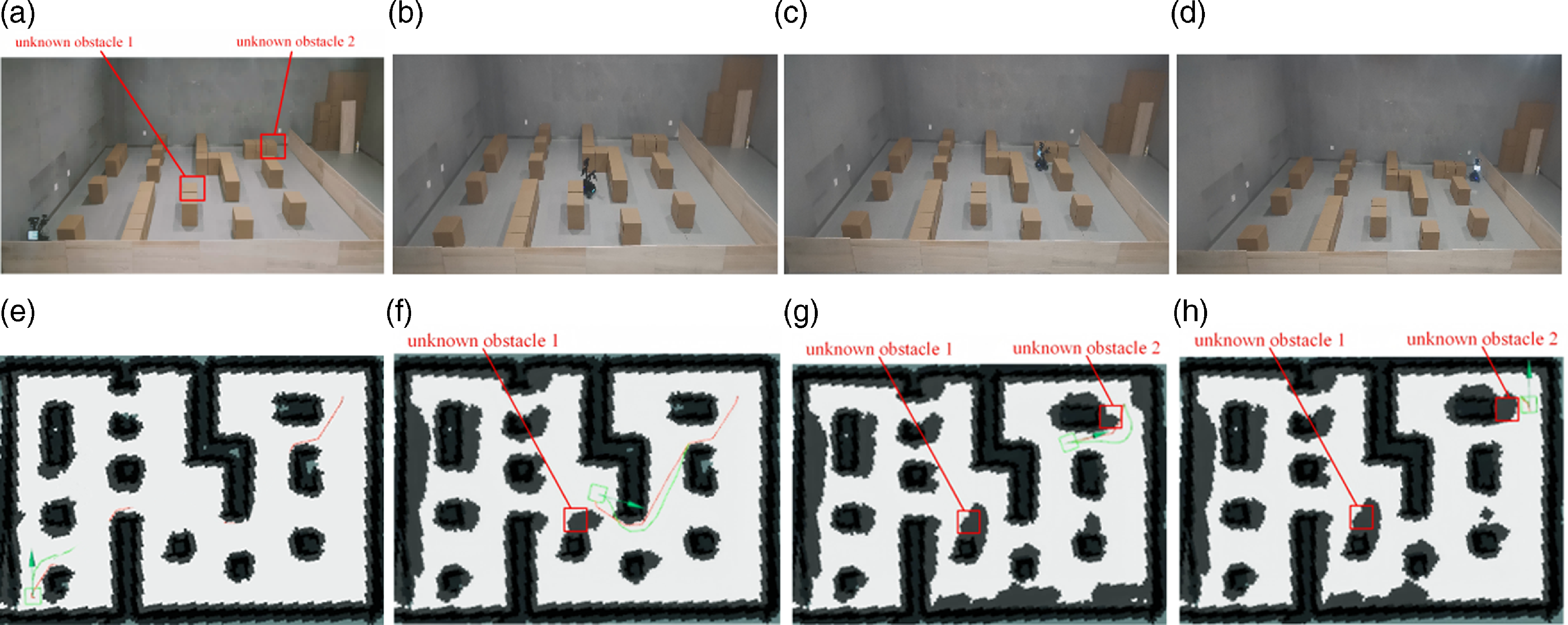
In the dynamic path planning experiment, the robot’s ability to avoid unknown obstacles during motion was evaluated. To simulate newly added unknown obstacles, two cardboard boxes were placed in the experimental environment, as shown in Figure 19. During the static path planning phase, when an unknown obstacle entered the detection range of the local path planning algorithm, the robot promptly detected and responded to the obstacle using the local dynamic fusion algorithm.
Dynamic obstacle avoidance of unknown obstacles and their Rviz in ROS.

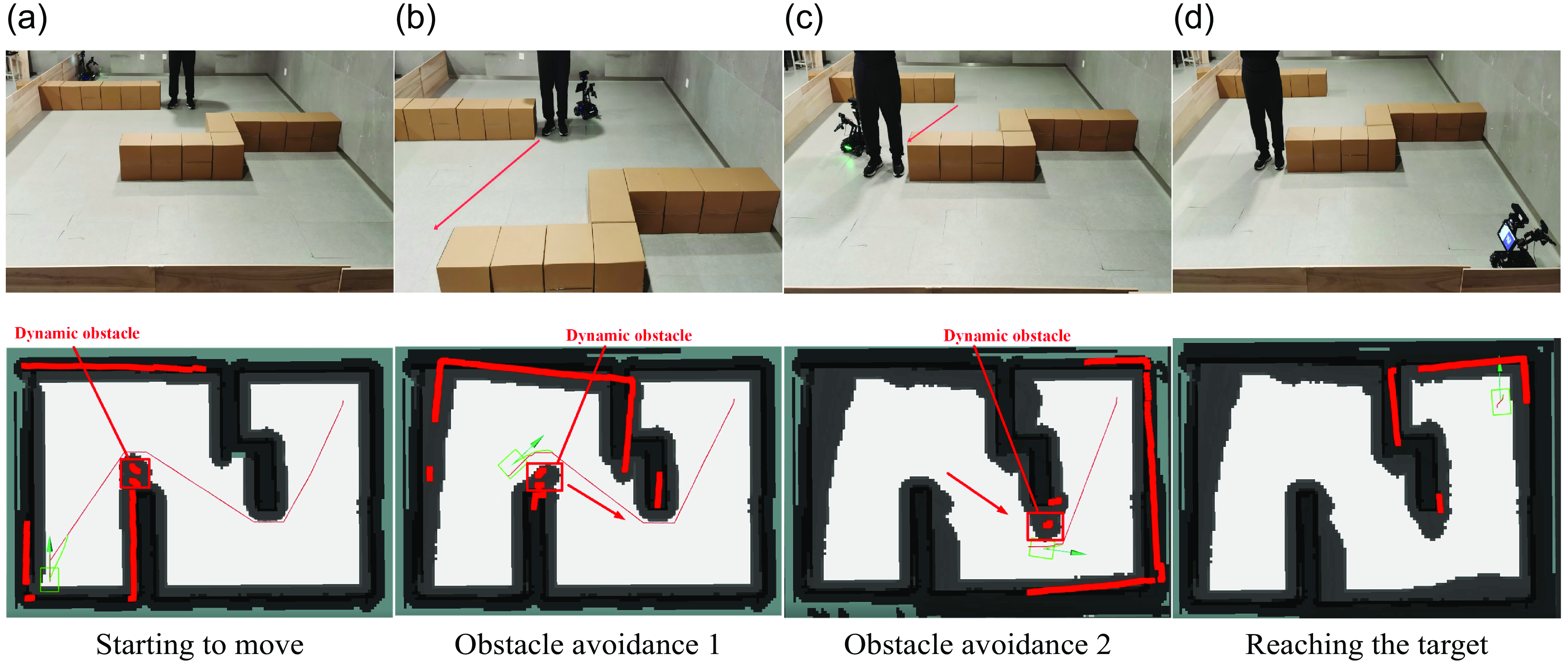
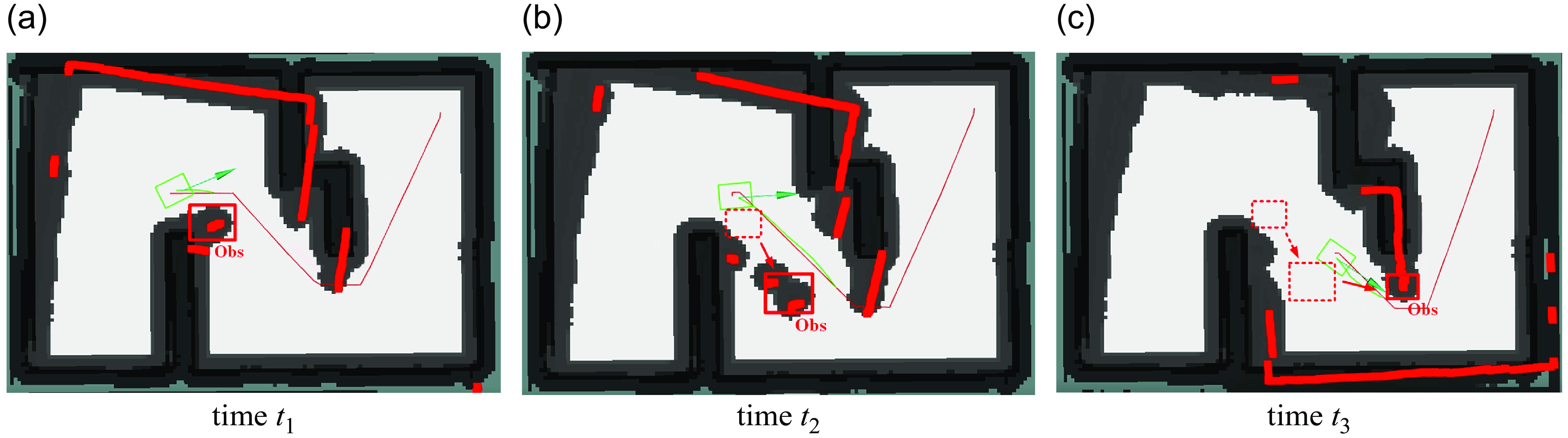
To evaluate the robot’s dynamic obstacle avoidance capability, a dedicated experiment involving a moving obstacle was conducted separately in this study. Due to spatial constraints of the original experimental setup, a new test environment was constructed. In this experiment, the moving obstacle was represented by a human, traveling in the direction indicated by the red arrow at a speed ranging from 1 to 1.4 m/s. Figure 20 provides a detailed illustration of the robot’s dynamic obstacle avoidance process. Additionally, Figure 21 depicts the path replanning procedure executed by the robot when encountering the moving obstacle during the experiment.
Dynamic obstacle avoidance of moving obstacle and their Rviz in ROS.

Path replanning process of dynamic obstacle avoidance.

As shown in Figure 21, the dashed box represents the dynamic trajectory of the moving obstacle. The path replanning process during dynamic obstacle avoidance is divided into three time steps:
 $t_{1}$
,
 $t_{2}$
, and
 $t_{3}$
. At time
 $t_{1}$
, the moving obstacle begins its motion; at time
 $t_{2}$
, the obstacle is in the process of moving; and at time
 $t_{3}$
, the obstacle reaches its target position. During each movement of the obstacle, the robot replans its path based on environmental information, ensuring that each replanned path is optimal. This approach reduces redundant recalculations caused by the DWA during the obstacle avoidance process, demonstrating the strong path replanning capability of the ESSA-DWA hybrid algorithm.
As shown in Figures 19–21, the ESSA algorithm first plans a global path. As the robot moves, its LiDAR continuously scans the environment, enabling real-time perception and response to changes in obstacle positions while progressing toward the target. When approaching unknown obstacles, the robot rapidly performs secondary path planning based on updated environmental information. Each path generated during this process is optimal, relying on the DWA algorithm to avoid obstacles and achieve dynamic obstacle avoidance. Ultimately, the robot successfully reaches its target position.
The experimental results demonstrate that, whether in static or dynamic environments, the mobile robot can still plan its path reasonably using this algorithm and effectively bypass both static and unknown obstacles. This ensures the safe arrival of the robot at the target position, achieving the functions of path planning, autonomous navigation, and obstacle avoidance. These results further validate the effectiveness of the proposed algorithm.
6. Conclusions
This study proposes a path planning solution that integrates an ESSA with the DWA, effectively addressing the challenges faced by mobile robots in complex environments. Traditional SSA often suffers from issues such as susceptibility to local optima and excessively long path lengths during path planning, while dynamic obstacle avoidance remains a critical challenge for mobile robots. The proposed algorithm first employs ESSA to plan a global path, which then guides the DWA in planning local paths.
Firstly, ESSA utilizes Tent chaotic initialization to enhance population diversity, thereby avoiding premature convergence to local optima. Secondly, an adaptive adjustment of dynamic inertia weight is implemented during the search process, effectively balancing the exploration and exploitation capabilities of the algorithm. Subsequently, a local search strategy is introduced to improve the precision of individual updates, further enhancing local search performance. Additionally, the Floyd path smoothing algorithm is applied to optimize the generated path, resulting in smoother trajectories. Finally, the integration of ESSA and DWA is achieved by extracting key nodes from the global path planned by ESSA to serve as references for DWA’s local path planning. This ensures that the local path aligns more closely with the global path while enabling real-time obstacle detection and dynamic avoidance. For global path planning, we conducted three sets of simulation experiments on grid maps of sizes 20 × 20, 30 × 30, and 50 × 50, respectively. These experiments effectively validated the superior performance of the improved algorithm in various complex environments. For local path planning, simulations were performed using environment models 3, 6, and 9. The results demonstrated that the proposed algorithm exhibits remarkable performance across diverse complex scenarios, fully verifying its practicality and theoretical effectiveness.
Practical experiments further confirmed the significant advantages of this integrated algorithm in handling both static and dynamic obstacle avoidance tasks, showcasing its efficiency and reliability in dynamic environments. This approach provides a more effective and feasible solution for mobile robot path planning. However, there are areas for improvement in this study. At the algorithmic level, further refinements to the algorithm’s strategies and structure could reduce time complexity and enhance operational efficiency. Additionally, improvements to the DWA algorithm could be explored, particularly in investigating the impact of dynamic obstacles on the robot’s trajectory. At the application level, extending this algorithm to multirobot path planning problems could be a promising direction for future research.
Author contributions
Conceptualization, Y.L.; methodology, Y.L.; software, Y.L.; validation, Y.W. and K.L.; investigation, Y.L.; resources, S.L.; data curation, Y.L., Y.W. and K.L.; writing – original draft preparation, Y.L.; writing – review and editing, Y.L.; project administration, Y.L., S.L., Y.W. and K.L.; supervision and funding acquisition, S.L. All authors have read and agreed to the published version of the manuscript.
Financial support
This research was supported by the National Natural Science Foundation of China [Grant No. 51905364].
Competing interests
The authors declare no conflict of interest.
Ethical approval
The authors declare that this work is original and does not include experiments with animals.