





Introduction
Maximized crop production and positive environmental effects often result when farmers implement conservation tillage practices. No-tillage and reduced-tillage systems positively affect soil structure, organic matter content, and water retention characteristics (Derpsch et al. Reference Derpsch, Friedrich, Kassam and Li2010; Farmaha et al. Reference Farmaha, Sekaran and Franzluebbers2021). Implementation of minimum tillage production practices can also reduce greenhouse gas emissions, promote carbon sequestration, and enhance overall agriculture sustainability (Lal Reference Lal2018; Srivastava Reference Srivastava2025). These benefits have resulted in an increase in the adoption of on-farm conservation practices. The U.S. Department of Agriculture’s survey of 6,245 producers across the United States, conducted in 2024, indicated that approximately 81% of respondents used conservation practices (USDA-NASS 2024). In addition, 83.3% reported using no-till or minimum tillage to manage pests, which was applied to almost 73% of the cropland surveyed. These findings reflected results of a previous survey conducted from 2013 through 2016, which indicated that producers incorporate conservation tillage for at least one crop in a crop rotation on approximately 87% of U.S. cultivated cropland acres (USDA-NRCS 2022). Adoption of conservation tillage production practices does, however, require alterations in weed management compared with conventional systems.
Elimination or reduction of tillage operations in conservation systems requires managing early-season competition from winter weeds with pre-planting herbicides. Herbicide options are available that provide effective control of these weed populations in corn, cotton (Gossypium hirsutum L.), and soybean (Bond et al. Reference Bond, Avila, Bararpour, Calhoun, Dodds, Eubank, Irby, Larson, Pieralisi, Reynolds and Zurweller2026; McNeal et al. Reference McNeal, Mueller, Reeves, Brown, Raper, Richmond, Rhodes and Hayes2026; Stephenson et al. Reference Stephenson, Orgeron, Price, Miller, Fontenot and Lazaro2026; University of Arkansas 2026). The effectiveness of applying pre-plant herbicides to these crops is limited by resistant and/or hard-to-control weed species, necessitating a goal of maximum control (Salas et al. Reference Salas, Burgos, Tranel, Singh, Glasglow, Scott and Nichols2016; Varanasi et al. Reference Varanasi, Brabham, Norsworthy, Nie, Young, Houston, Barber and Scott2018; Westerveld et al. Reference Westerveld, Soltani, Hooker, Robinson and Sikkema2021).
New herbicides with active ingredients can complement existing herbicides for weed management in conservation systems. Trifludimoxazin, for example, is a new herbicide that inhibits protoporphyrinogen oxidase (PPO). It was developed by BASF Corporation (Research Triangle Park, NC) and is awaiting registration by the U.S. Environmental Protection Agency. The herbicide has demonstrated preemergence and postemergence activity on several grass and broadleaf weed species including annual ryegrass [Lolium perenne (L.) ssp. multiflorum (Lam.) Husnot], giant foxtail (Setaria faberi Herrm), junglerice [Echinochloa crus-galli (L.) P. Beauv], johnsongrass [Sorghum halepense (L.) Pers.], green foxtail [Setaria viridis (L.) P. Beauv.], hairy crabgrass [Digitaria sanguinalis (L.) Scop.], horseweed [Conyza canadensis (L.) Cronquist], redroot pigweed (Amaranthus retroflexus L.), common ragweed (Ambroasia artemisiifolia L.), and kochia [Bassia scoparia (L.) A.J. Scott] (Rapado et al. Reference Rapado, Kolpin, Zeyer, Anders, Piccard, Porri and Asher2025). Additionally, the herbicide has been reported to be a potent PPO-inhibiting herbicide that inhibits the PPO2 enzyme, which carries target-site mutations that could be used to mitigate widespread occurrence of PPO target-site resistance and resistance to herbicides with other modes of action (Porri et al. Reference Porri, Betz, Seebruk, Knapp, Johen, Witschel, Aponte, Liebl, Tranel and Lerchl2023). Saflufenacil, also a PPO-inhibiting herbicide commercialized by BASF, is labeled for preplant application to soybean, corn, cotton, and rice (Oryza sativa L.) crops and exhibits good activity on several common broadleaf winter weeds (BASF 2024; Bond et al. Reference Bond, Avila, Bararpour, Calhoun, Dodds, Eubank, Irby, Larson, Pieralisi, Reynolds and Zurweller2026; McNeal et al. Reference McNeal, Mueller, Reeves, Brown, Raper, Richmond, Rhodes and Hayes2026; Stephenson et al. Reference Stephenson, Orgeron, Price, Miller, Fontenot and Lazaro2026; University of Arkansas, 2026). Improved burndown weed control and longer soil residual activity have been reported with combinations of trifludimoxazin and saflufenacil (Findley Reference Findley2020; Grey et al. Reference Grey, Newsome and Findley2020; Rapado et al. Reference Rapado, Kolpin, Zeyer, Anders, Piccard, Porri and Asher2025). Trifludimoxazin and saflufenacil will be available for burndown use ahead of planting corn, soybean, grain sorghum, and wheat.
Corn was planted on more than 38 million hectares in the United States in 2025 (USDA-NASS 2025). The growth of early planted corn often occurs in conjunction with preplant herbicide applications to fields that will be planted with soybean and grain sorghum. Therefore, the potential for off-target movement of herbicides to corn increases during these application windows. Previous surveys of agronomic crop producers in multiple states have identified drift or off-target movement as the largest challenge to applying herbicides (Butts et al. Reference Butts, Barber, Norsworthy and Davis2021; Virk and Prostko Reference Virk and Prostko2022). Previous research has also characterized the negative effects associated with herbicide drift to nontarget species (Moore et al. Reference Moore, Priest, Brayden, Hanzas, Arpino, Richardson, Stryker, Banman, Rodney, Chapple, Hall, Isemer, Ortego, Rodea-Palomares, Tang, Wang, Xu and Yang2022; Perkins et al. Reference Perkins, Abi-Akar, Goodwin and Brain2022; Strandberg et al. Reference Strandberg, Sørensen, Bruus, Bossi, Dupont, Link and Damgaard2021). Therefore, it is critically necessary to have a good understanding of the implications on corn development and subsequent yield if the crop is exposed to off-target herbicide drift.
Previous reports have indicated serious negative effects following simulated off-target movement of PPO-inhibiting herbicides to corn. Sperry et al. (Reference Sperry, Lawrence, Bond, Reynolds, Golden and Edwards2019) evaluated the effects of applying a reduced rate (12.5% of the rate listed in the product label) of fomesafen to corn at the V1 through V9 vegetative growth stage. Injury 3 d after treatment (DAT) ranged from 0% to 38% and lessened over time. Compared with nontreated control plants, approximately 15% reduction in corn height was observed 14 DAT when fomesafen was applied at the V5 or V7 stage. Yield was reduced 1,220 and 1,110 kg ha−1 following fomesafen application at V1 or V7 stages compared with yield from the nontreated controls. Yield was not reduced following application at any other growth stage. Soltani et al. (Reference Soltani, Shropshire and Sikkema2009) reported that saflufenacil applied at 50 g ha−1 (71% of the amount included in the 1× proposed rate of trifludimoxazin + saflufenacil premix) with an adjuvant resulted in 42% to 99% injury to 2-leaf to 3-leaf corn 21 DAT. Additionally, corn height was reduced 34% to 77% at 42 DAT, and yield was reduced 0% to 58%. Moran et al. (Reference Moran, Sikkema, Hall and Swanton2011) reported 0% to 90% visual injury and 20% to 60% dry weight reduction compared with control plants when saflufenacil (plus an adjuvant) was applied at rates of 2.34, 4.69, 9.38, and 18.75 g ha−1 to 4-leaf corn under growth-room conditions. Miller et al. (Reference Miller, Barber, Bond, Steckel, Stephenson, Foster, Butts and Kouame2024) reported that the PPO-inhibiting burndown herbicide tiafenacil applied at reduced rates ranging from 1/8× down to 1/256× injured corn at the 2-leaf and 4-leaf growth stages by 31% to 6% and by 37% to 9%, respectively, 1 wk after treatment (WAT), whereas at 2 WAT these respective ranges were 21.7% to 4% and 22.5% to 7.2%. By 4 WAT, visible injury following exposure at the 2-leaf and 4-leaf stages was no greater than 8% in all instances except when the highest tiafenacil rate was applied at the 4-leaf growth stage (13%). This early season injury from tiafenacil did not manifest as a reduction in corn height 2 WAT or yield.
To our knowledge, there exists no published information documenting potential negative effects of foliar-applied trifludimoxazin + saflufenacil on early vegetative stage corn growth and subsequent yield at rates encountered in off-target/drift events. Therefore, the objective of this research was to determine the negative effects of drift rates of trifludimoxazin + saflufenacil to corn as affected by growth stage at time of application.
Materials and Methods
Field experiments were conducted in 2024 at seven locations: the Louisiana State University (LSU) AgCenter Northeast Research Station near St. Joseph (31.9184ºN, 91.2335ºW), the LSU AgCenter Doyle Chambers Central Research Station near Baton Rouge (30.3756°N, 91.1712°W), the Mississippi State University Delta Research and Extension Center in Stoneville (33.4240ºN, 90.9151ºW), the University of Arkansas System Division of Agriculture Cotton Research Station near Marianna AR (34.7737° N, −90.7576° W.), the University of Tennessee AgResearch and Education Center in Milan (35.9198°N, 88.7589°W), the Kansas State University Agricultural Research Center-Hays in Hays (38.8574°N, 99.3328°W), and the Kansas State University Southwest Research and Extension Center in Garden City (37.9575°N, 100.8652°W).
The aim of the experiments was to determine the effects of various low rates of trifludimoxazin + saflufenacil (BASF) on corn growth and yield. Experiments were conducted in a randomized complete block design with treatments replicated three or four times. Treatments were applied to each plot via a compressed-air or CO2-pressurized backpack sprayer at 140 L ha−1. Plot size varied by location from 2-row to 4-row and 7.6 m to 12 m in length with border rows separating plots. Treatments included reduced rates of trifludimoxazin + saflufenacil at 0×, 1/8×, 1/16×, 1/32×, 1/64×, 1/128×, and 1/256× of the rate proposed by the manufacturer applied to 2-leaf or 4-leaf corn. The 1× rate is 38.3 g ai ha−1, which we used for calculating the reduced rates. Previous unpublished research has indicated that this rate, in combination with glyphosate, provides effective control of the most common winter weeds prior to planting (D.K. Miller, personal observation). Methylated seed oil (MSO) was added at 10 mL L− 1 to all treatments. A comparison 1% MSO-alone treatment was included but it had no effect on the parameters the experiments were designed to measure in comparison to the 0× rate and therefore was excluded from statistical analysis.
Treatments were applied to corn at the 2-leaf and 4-leaf stage as follows: at the St. Joseph location, on May 19 and 27 to corn hybrid DKC 68-35; at Baton Rouge, on April 26 and May 2 to hybrid P13777PCUE; at Marianna, on May 8 and May 16 to hybrid P1511YHR; at Milan, on May 15 and May 28 to hybrid PO953YHR; at Hays, on June 5 and June 20 to hybrid DKC 59-82; and at Garden City, on May 17 and June 6 to hybrid C10L16-DV. These timings were selected as the most likely to occur when burndown of cotton and soybean normally occurs in the mid-south (authors’ personal observations).
Plots were maintained as follows: at St. Joseph, Baton Rouge, and Stoneville glyphosate (1,120 g ai ha−1, Roundup Powermax 3; Bayer CropScience, St Louis, MO) was applied as needed. At the Marianna location a premixture of S-metolachlor + mesotrione + bicyclopyrone + atrazine (2,890 g ai ha−1, Acuron; Syngenta, Greensboro, NC) and glyphosate (1,120 g ai ha−1) were applied at planting. Study participants at the Milan location weeded by hand. At Hays, a premix of acetochlor + atrazine (2,489 g ai ha−1, Degree Xtra; Bayer) and glyphosate (1,120 g ai ha−1) was applied pre-plant. At the Garden City location, the Acuron premix of S-metolachlor + mesotrione + bicyclopyrone + atrazine premix (2,890 g ai ha−1) was applied at planting. Parameter measurements included visible injury on a scale of 0 (no injury) to 100 (plant death) assessed at 7, 14, and 28 DAT; plant height assessed at 14 and 28 DAT; and yield.
Statistical Analysis
The three-parameter log-logistic model (Eq. 1) was used to assess corn injury (7, 14, and 28 DAT) and height (14 and 28 DAT) after the herbicide was applied to 2-leaf or 4-leaf corn:
 $Y = d/\left( {1 + {\rm exp}\{ b\left[ {{\rm ln}\left( x \right) - {\rm ln} \left( e \right)} \right]\} } \right)$
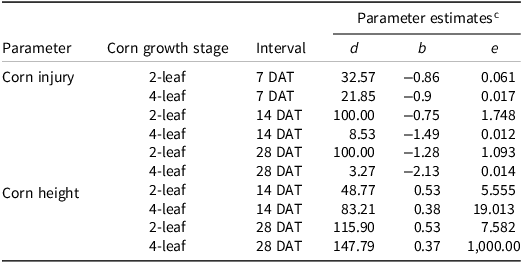
where Y is injury (percent; %) or height (in centimeters; cm), b is the slope at the inflection point, d is the upper limit, e is the dose of herbicide corresponding to the midpoint of plant injury or height response observed between the upper and lower limits, and x is the fraction of the labeled rate of the premixture of trifludimoxazin + saflufenacil tested (Table 1). Nonlinear regression curve fittings were accomplished using the nonlinear least squares regression (nls) function in R software (v. 4.4.3; R Core Team 2025). A lack-of-fit test was used to compare the nonlinear regression model to a more general ANOVA model (Ritz and Streibig Reference Ritz and Streibig2008).
Nonlinear regression parameters for corn visible injury 7, 14, and 28 DAT and corn height 14 and 28 DAT following applications of trifludimoxazin + saflufenacil.a,b

Table 1. Long description
A table with 10 rows and 5 columns. The columns are labeled Parameter, Corn growth stage, Interval, and Parameter estimates with sub-columns d, b, and e. The table compares corn injury and corn height at different growth stages and intervals. Row 1: Corn injury, 2-leaf, 7 DAT, d: 32.57, b: -0.86, e: 0.061. Row 2: Corn injury, 4-leaf, 7 DAT, d: 21.85, b: -0.9, e: 0.017. Row 3: Corn injury, 2-leaf, 14 DAT, d: 100.00, b: -0.75, e: 1.748. Row 4: Corn injury, 4-leaf, 14 DAT, d: 8.53, b: -1.49, e: 0.012. Row 5: Corn injury, 2-leaf, 28 DAT, d: 100.00, b: -1.28, e: 1.093. Row 6: Corn injury, 4-leaf, 28 DAT, d: 3.27, b: -2.13, e: 0.014. Row 7: Corn height, 2-leaf, 14 DAT, d: 48.77, b: 0.53, e: 5.555. Row 8: Corn height, 4-leaf, 14 DAT, d: 83.21, b: 0.38, e: 19.013. Row 9: Corn height, 2-leaf, 28 DAT, d: 115.90, b: 0.53, e: 7.582. Row 10: Corn height, 4-leaf, 28 DAT, d: 147.79, b: 0.37, e: 1000.00.
a Abbreviation: DAT, days after treatment.
b Trifludimoxazin + saflufenacil was applied to corn at the 2- or 4-leaf stage at 0×, 1/8×, 1/16×, 1/32×, 1/64×, 1/128×, and 1/256× of the proposed field-use rate of 38.3 g ai ha−1. Data were pooled from experiments at St. Joseph and Baton Rouge, Louisiana; Marianna, Arkansas; Stoneville, Mississippi; Milan, Tennessee; and Hays and Garden City, Kansas, in 2024.
c Parameter estimates: b is the slope at the inflection point, d is the upper limit, and e is the dose of herbicide corresponding to the midpoint of plant injury or height response observed between the upper and lower limits.
The linear model (Eq. 2) was fit to yield (kg ha−1) for herbicide applied to 2-leaf and 4-leaf corn:
 $Y = {\rm \beta _0} + {\rm \beta _1} \times x + \rm \varepsilon $
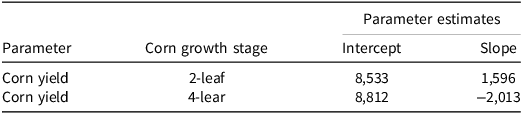
where Y represents corn yield (in kilograms per hectare; kg ha−1); x represents the fraction of the labeled rate of the premixture of trifludimoxazin + saflufenacil tested; β1 is the slope, β0 is the intercept, and ϵ is the residual (Table 2). The lm() function of the stats package was used to fit linear models using R software (v. 4.4.3; R Core Team 2025).
Linear regression parameters for corn yield following application of trifludimoxazin + saflufenacil.

Table 2. Long description
A table with two rows and three columns. The columns are labeled Parameter, Intercept, and Slope. The rows are labeled Corn yield at 2-leaf stage and Corn yield at 4-leaf stage. Row 1: Corn yield, 2-leaf, Intercept, 8,533, Slope, 1,596. Row 2: Corn yield, 4-leaf, Intercept, 8,812, Slope, -2,013.
aTrifludimoxazin + saflufenacil was applied to corn at the 2- or 4-leaf stage at 0×, 1/8×, 1/16×, 1/32×, 1/64×, 1/128×, and 1/256× of a field-use rate of 38.3 g ai ha−1.
Data were analyzed by location, and model parameters were compared (Ritz et al. Reference Ritz, Kniss and Streibig2015) with no statistical differences detected between parameters of locations for herbicide rates applied at the same leaf stage (data not shown). Therefore, data were pooled across locations for curve fitting for a given application stage. In contrast, due to differences observed during application at 2-leaf or 4-leaf corn stages, data were analyzed separately for those stages. Model assumptions of linearity, homoscedasticity, independence, and normality were checked in each case prior to fitting the equation using different statistical tests. Variance homogeneity was evaluated using the Levene test, and the Shapiro-Wilk test was used to assess whether or not the residuals were normally distributed.
Results and Discussion
Corn Injury
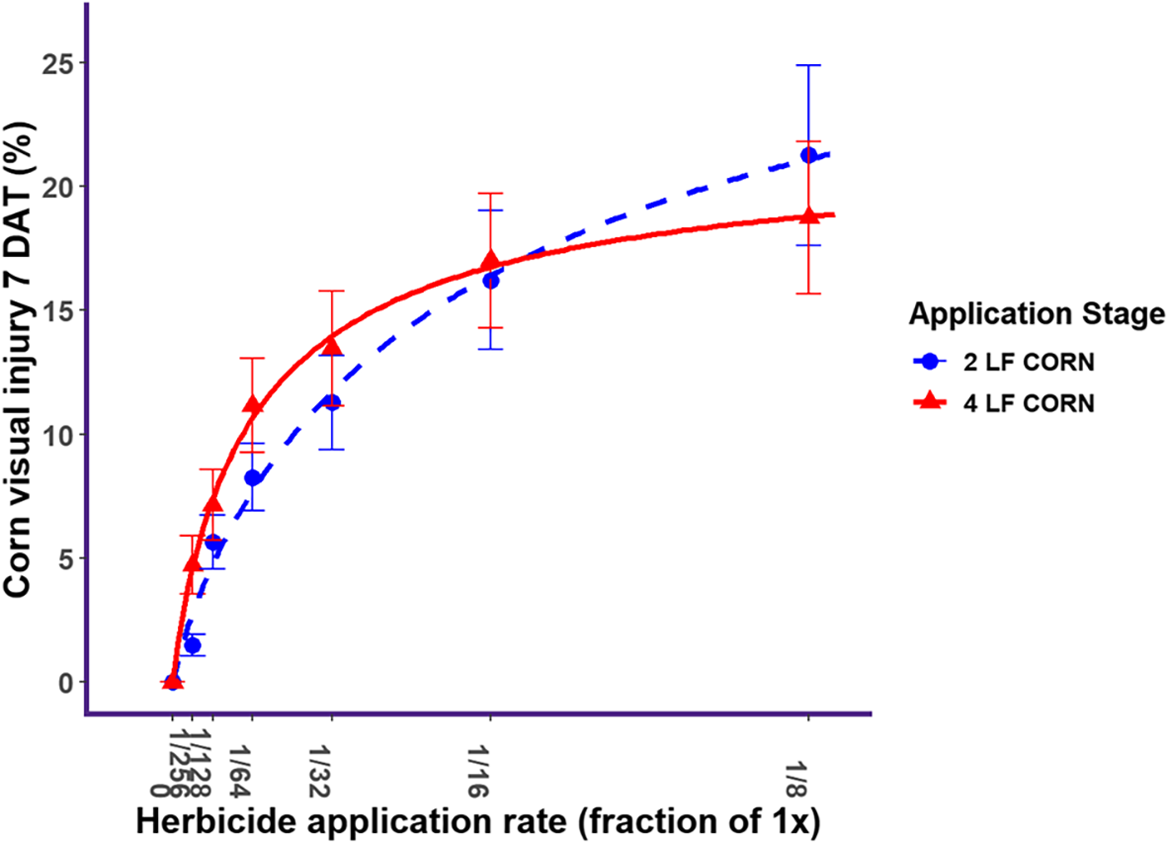
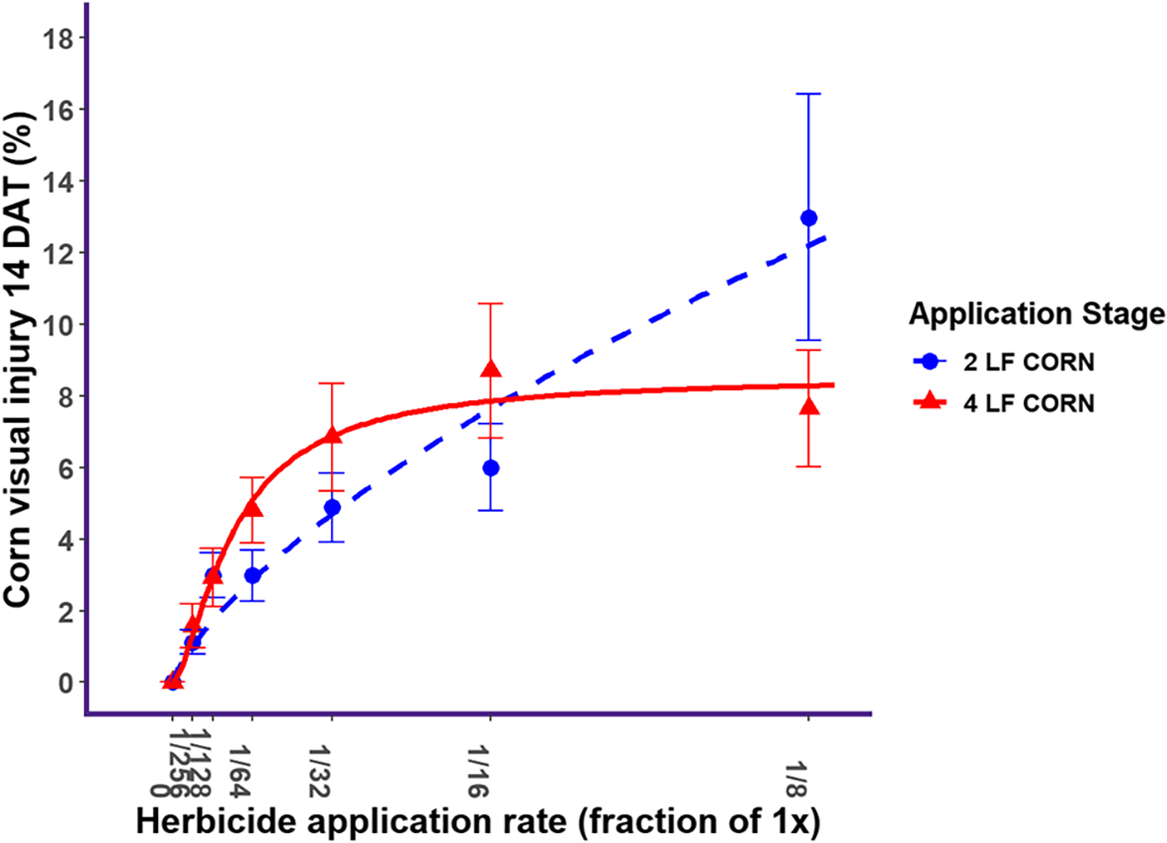
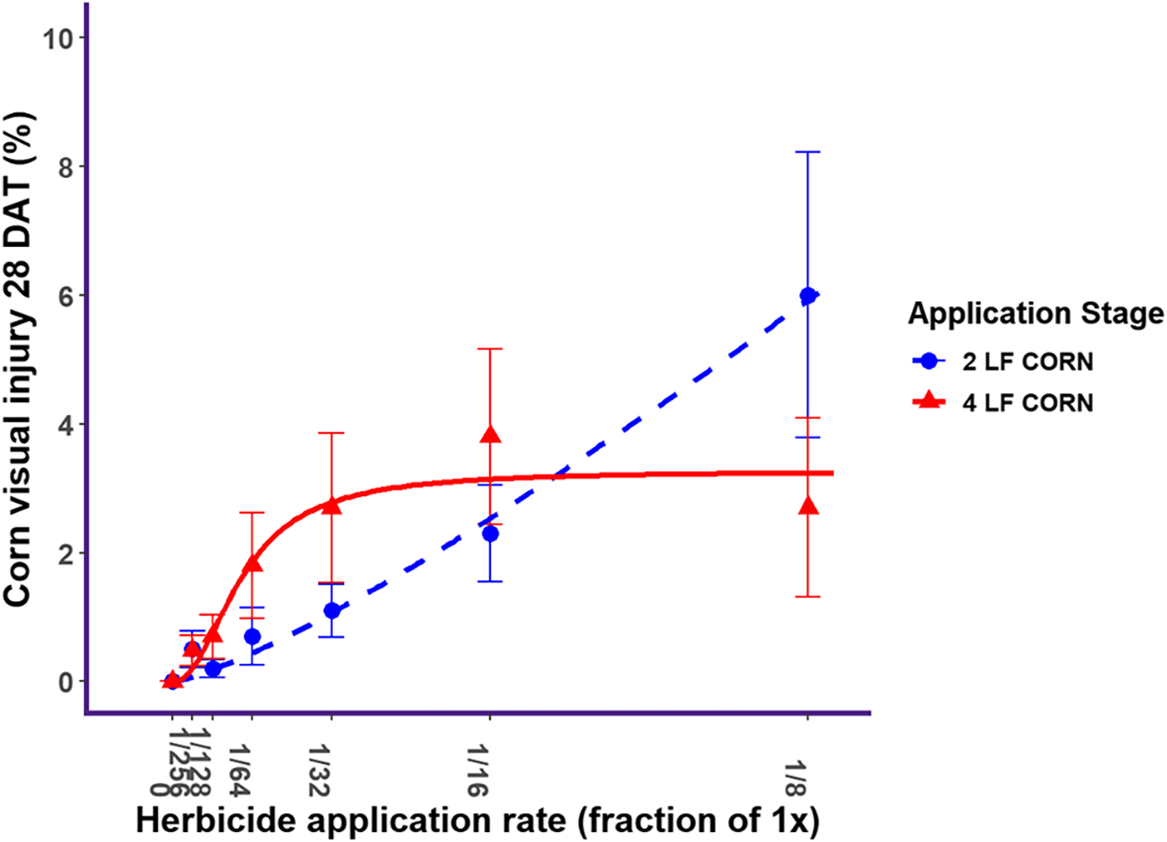
Corn response following trifludimoxazin + saflufenacil treatment was presented as necrotic speckling of leaves present at the time of application. Corn injury was determined to be 21%, 16%, 12%, 8%, 5%, and 3% with each successive rate reduction following application to 2-leaf corn at 7 DAT (Figure 1). Similar injury levels of 19%, 17%, 14%, 11%, 7%, and 5% were observed 7 DAT with the later application (Figure 1). By 14 DAT, corn injury at the 2-leaf growth stage was 12% and 8% at the two highest trifludimoxazin + saflufenacil rates applied (1/8× and 1/16×), while successively lower rates resulted in no greater than 5% visible injury (Figure 2). When the herbicide was applied to corn at the 4-leaf stage, visible injury observed at the four highest rates applied ranged from 5% to 8%, and lower rates resulted in no greater than 3% injury (Figure 2). At 28 DAT, the 1/8× rate of herbicide applied to 2-leaf corn resulted in 6% visible injury, whereas no other treatment surpassed 3% injury (Figure 3). Moran et al. (Reference Moran, Sikkema, Hall and Swanton2011) reported 0% to 90% visual injury and 20% to 60% dry weight reduction compared with control plants when saflufenacil (plus an adjuvant) was applied to 4-leaf corn at doses of 2.34, 4.69, 9.38, and 18.75 g ha−1 under plant growth-room conditions. Miller et al. (Reference Miller, Barber, Bond, Steckel, Stephenson, Foster, Butts and Kouame2024) reported that the PPO-inhibiting burndown herbicide tiafenacil applied at reduced rates ranging from 1/8× down to 1/256× resulted in 31% to 6% and 37% to 9% injury to corn at the 2- and 4-leaf growth stages, respectively, at 1 WAT, while at 2 WAT these percentages were 22% to 4% and 23% to 7%, respectively. By 4 WAT, visible injury following exposure at the 2- and 4-leaf stages was no greater than 8% in all instances except the highest tiafenacil rate applied at the 4-leaf growth stage (13%).
Corn injury 7 d after treatment (DAT) as affected by trifludimoxazin + saflufenacil applied to 2-leaf (LF) or 4-LF corn at 0×, 1/8×, 1/16×, 1/32×, 1/64×, 1/128×, and 1/256× of the proposed field-use rate of 38.3 g ai ha−1. Data were pooled from experiments carried out in 2024 at St. Joseph and Baton Rouge, Louisiana; Marianna, Arkansas; Stoneville, Mississippi; Milan, Tennessee; and Hays and Garden City, Kansas, in 2024. Injury was fit to the three-parameter log-logistic model Y = d/(1 + exp{b[ln(x) − ln(e)]}), where Y represents injury (%), b is the slope at the inflection point, d is the upper limit, e is the dose of herbicide corresponding to the midpoint of plant injury or height response observed between the upper and lower limits, and x is the fraction of the proposed field-use rate of the trifludimoxazin + saflufenacil premixture. Parameter estimates are d = 32.57, b = −0.86, and e = 0.061 for the 2-leaf application; and d = 21.85, b = −0.9, and e = 0.017 for the 4-leaf application.

Corn injury 14 d after treatment (DAT) as affected by trifludimoxazin + saflufenacil applied to 2-leaf (LF) or 4-LF corn at 0×, 1/8×, 1/16×, 1/32×, 1/64×, 1/128×, and 1/256× of the proposed field-use rate of 38.3 g ai ha−1. See Figure 1 for an explanation of data collection and injury determination. Parameter estimates are d = 100, b = −0.75, and e = 1.748 for the 2-leaf application; and d = 8.53, b = −1.49, and e = 0.012 for the 4-leaf application.

Corn injury 28 d after treatment (DAT) as affected by trifludimoxazin + saflufenacil applied to 2-leaf (LF) or 4-LF corn at 0×, 1/8×, 1/16×, 1/32×, 1/64×, 1/128×, and 1/256× of the proposed field-use rate of 38.3 g ai ha−1. See Figure 1 for an explanation of data collection and injury determination. Parameter estimates are d = 100, b = −1.28, and e = 1.093 for the 2-leaf application; and d = 3.27, b = −2.13, and e = 0.014 for the 4-leaf application.

Corn Height
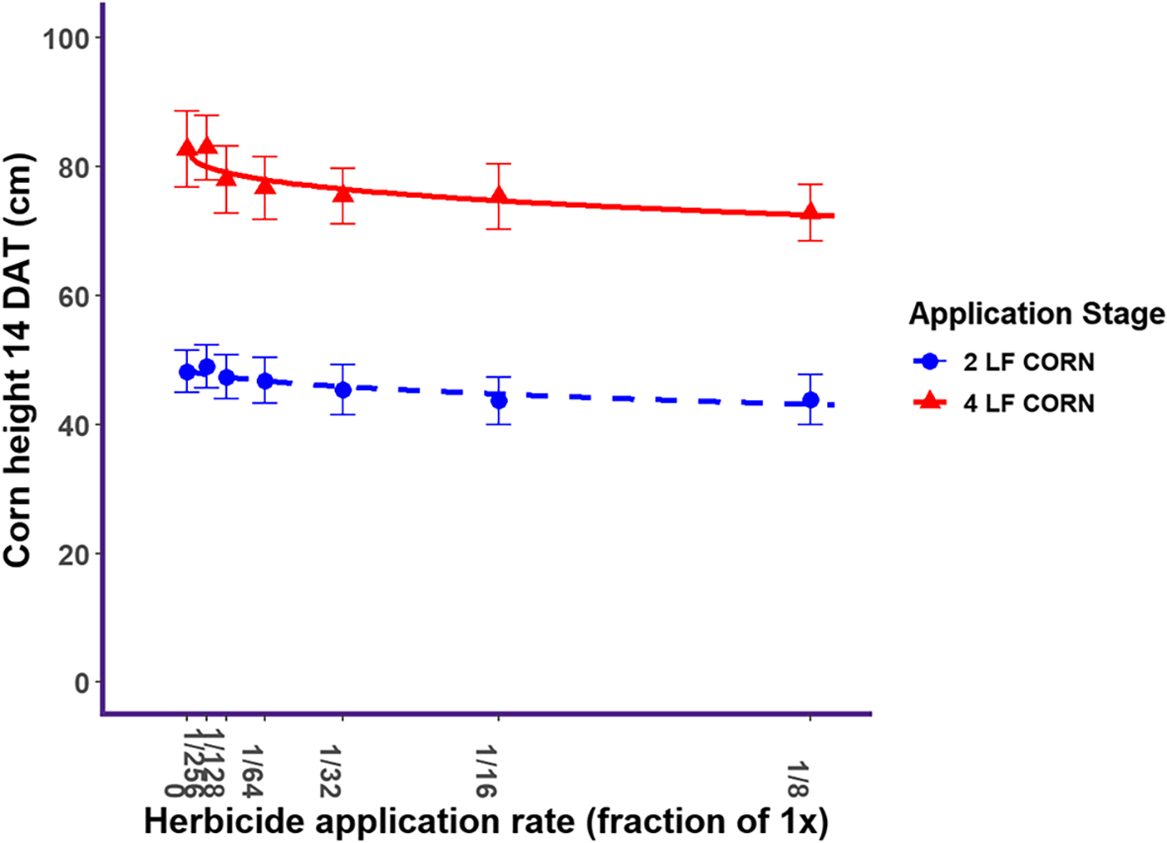
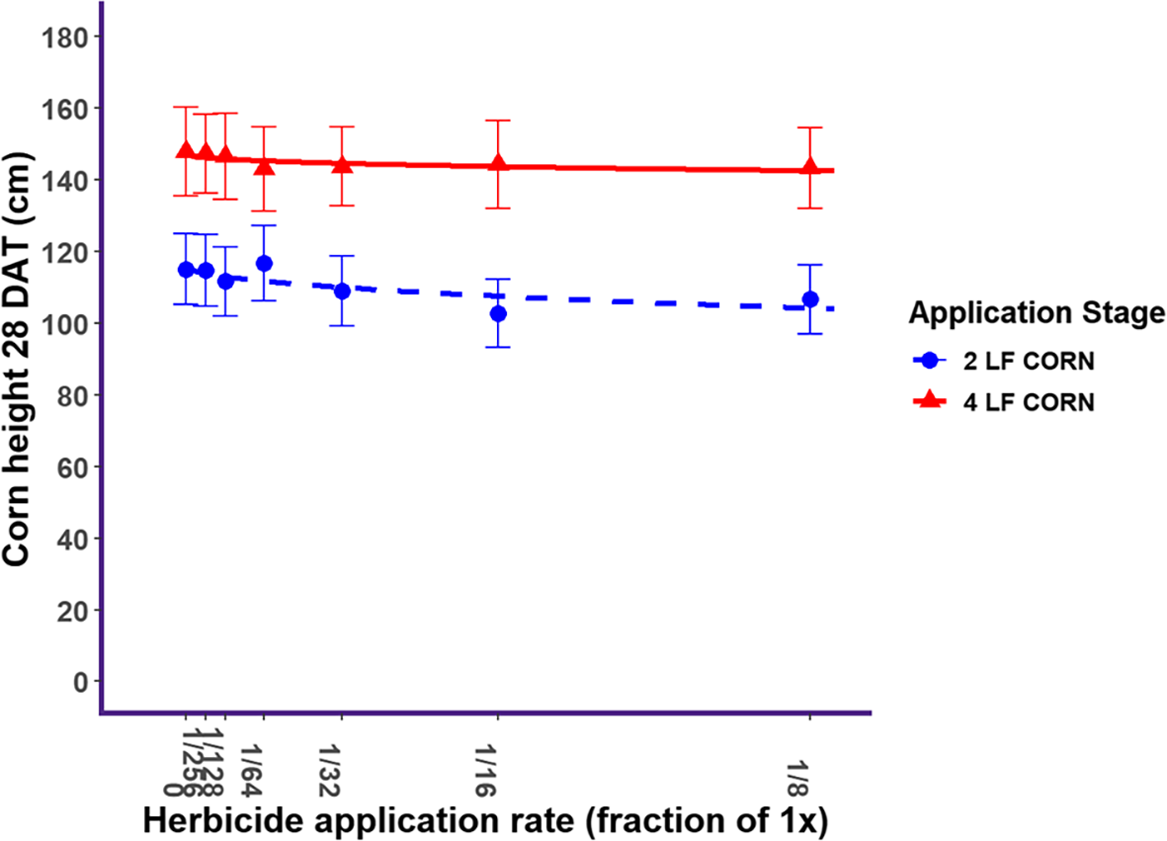
When assessed at 14 DAT corn height was reduced by 12% to 6% when trifludimoxazin + saflufenacil was applied at the three highest rates at the 2-leaf stage and by 4% to 2% at the three lowest rates (Figure 4). Results were similar for later applications with these respective rate ranges resulting in 13% to 8% and 6% to 4% height reduction. By 28 DAT, height was reduced by 10% to 5% with trifludimoxazin + saflufenacil applied to 2-leaf corn at the three highest rates, and by no more than 4% at lower rates (Figure 5). When applied at the later dates, corn height was reduced by no more than 4% with any trifludimoxazin + saflufenacil rate (Figure 5). Soltani et al (Reference Soltani, Shropshire and Sikkema2009) reported that saflufenacil applied to 2- to 3-leaf corn at 50 g ha−1 (71% of the amount included in the 1× proposed rate of trifludimoxazin + saflufenacil premix) with an adjuvant resulted in height reductions of 34% to 77% at 42 DAT. Conversely, Miller et al. (Reference Miller, Barber, Bond, Steckel, Stephenson, Foster, Butts and Kouame2024) reported that the PPO-inhibiting burndown herbicide tiafenacil applied at similar rates as those used in the current study resulted in no negative effects on corn height when applied at the 2- or 4- leaf growth stage.
Corn height 14 d after treatment (DAT) as affected by trifludimoxazin + saflufenacil applied to 2-leaf (LF) or 4-LF corn at 0×, 1/8×, 1/16×, 1/32×, 1/64×, 1/128×, and 1/256× of the proposed field-use rate of 38.3 g ai ha−1. See Figure 1 for an explanation of data collection and injury determination. Parameter estimates are d = 48.77, b = 0.53, and e = 5.555 for the 2-leaf application; and d = 83.21, b = 0.38 and e = 19.013 for the 4-leaf application.

Corn height 28 d after treatment (DAT) as affected by trifludimoxazin + saflufenacil applied to 2-leaf (LF) or 4-LF corn at 0×, 1/8×, 1/16×, 1/32×, 1/64×, 1/128×, and 1/256× of the proposed field-use rate of 38.3 g ai ha−1. See Figure 1 for an explanation of data collection and injury determination. Parameter estimates are d = 115.9, b = 0.53, and e = 7.582 for the 2-leaf application; and d = 147.79, b = 0.37, and e = 1,000.00 for the 4-leaf application.

Corn Yield
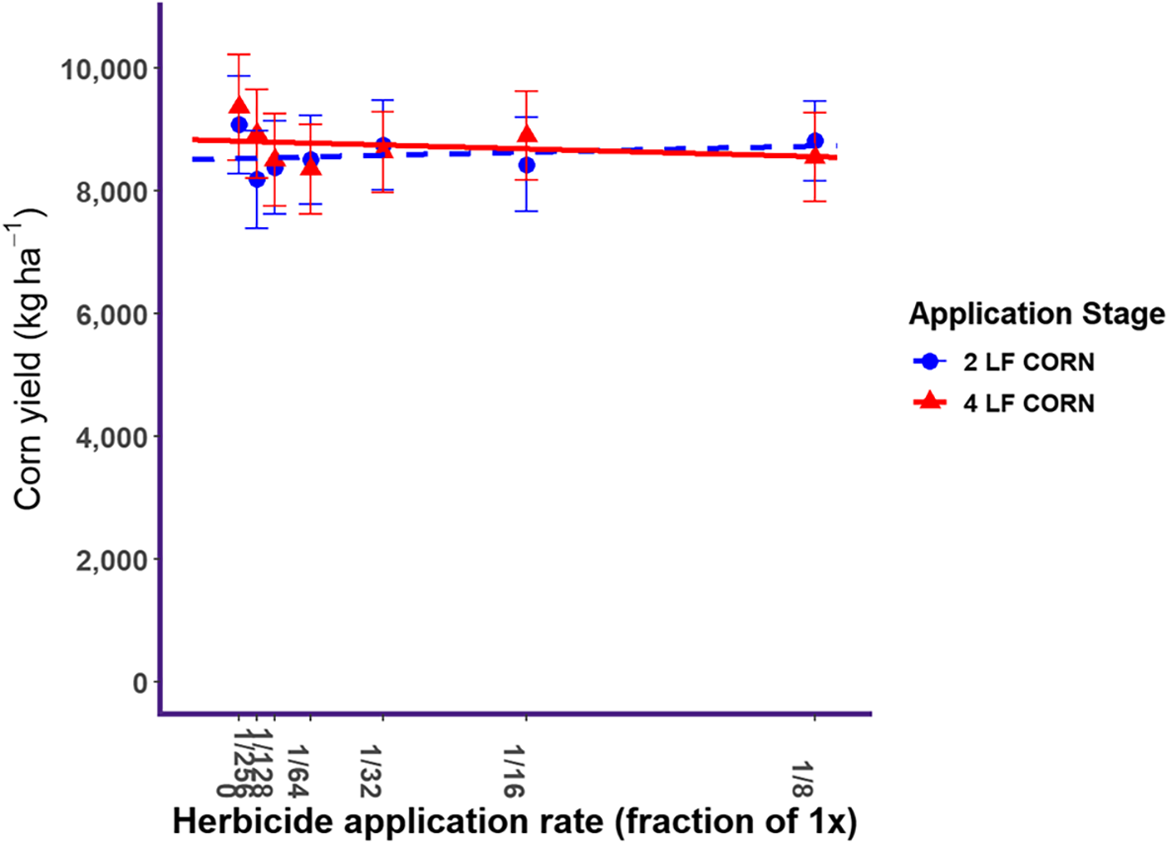
Early season injury and height reduction did not manifest in significant corn yield reduction following trifludimoxazin + saflufenacil exposure (Figure 6). Nontreated corn yield averaged 8,533 and 8,812 kg ha−1 from the early and later applications, respectively. No yield reduction was observed following herbicide application at the 2-leaf growth stage and no greater than 3% at the later timing. Soltani et al. (Reference Soltani, Shropshire and Sikkema2009) reported that saflufenacil at 50 g ha−1 (71% of the amount included in the 1× proposed rate of trifludimoxazin + saflufenacil premix) with an adjuvant applied to 2- to 3-leaf corn resulted in yield reductions of 0% to 58%. Miller et al. (Reference Miller, Barber, Bond, Steckel, Stephenson, Foster, Butts and Kouame2024) reported that the tiafenacil applied at rates similar to those used in the current study resulted in no negative effect on corn yield when applied at the 2- or 4- leaf growth stage.
Corn yield after applications of trifludimoxazin + saflufenacil to 2-leaf or 4-leaf (LF) corn at 0×, 1/8×, 1/16×, 1/32×, 1/64×, 1/128×, and 1/256× of the proposed field-use rate of 38.3 g ai ha−1. Yield was determined using the linear model Y = β0 + β1 × x + ϵ, where Y represents corn yield (kg ha−1); x represents the fraction of the labeled rate of the premixture of trifludimoxazin + saflufenacil tested; β1 is the slope, β0 is the intercept, and ϵ is the residual. Parameter estimates are intercept = 8,533 and slope = 1,596 for the 2-leaf application; and slope = 8,812 and intercept = −2,013 for the 4-leaf application.

Practical Implications
Corn at both the 2-leaf and 4-leaf growth stages responded similarly when trifludimoxazin + saflufenacil was applied at rates ranging from 12.5% to 0.4% of the proposed labeled rate (38.3 g ai ha−1) with visual injury symptoms appearing rapidly but lessening over time. Plant height was negatively affected, more so at the three highest rates applied and when applied earlier, but this reduction resulted in no negative effect on yield following application at the 2-leaf stage and no greater than 2.9% yield reduction when applied later. Compared to tiafenacil, season-long corn response to off-target application of trifludimoxazin + saflufenacil applied at rates evaluated would be similar between the two compounds with no negative yield reduction from early season impacts observed with tiafenacil (Miller et al. Reference Miller, Barber, Bond, Steckel, Stephenson, Foster, Butts and Kouame2024). Applying trifludimoxazin + saflufenacil to fields near corn that is in the early vegetative stages of growth should be avoided because injury and height reduction will occur. Affected corn plants should be expected to fully recover following 2-leaf exposure with no impact on yield and minimal yield impact at the later timing (3% reduction), given that growing conditions and agronomic/pest management practices are adequate.
Funding
The Louisiana Soybean and Feedgrain Research and Promotion Board provided partial funding for this research.
Competing interests
The authors declare they have no competing interests.

 Open access

