1. INTRODUCTION
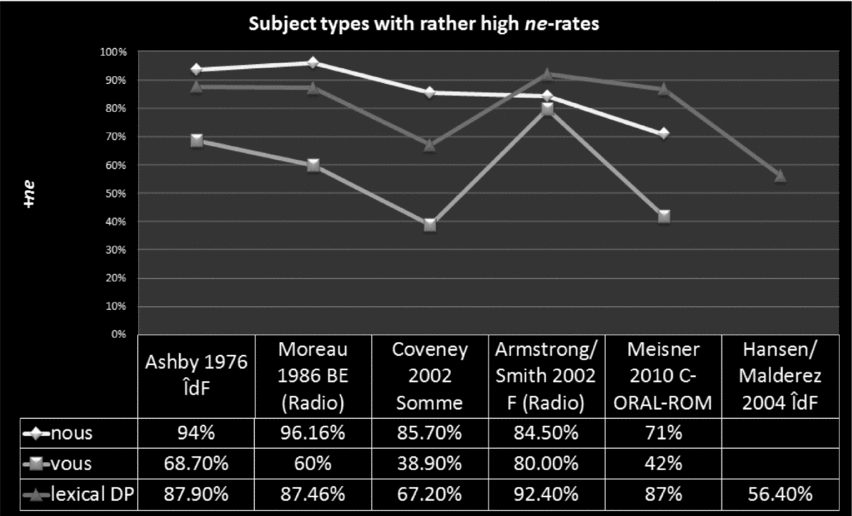
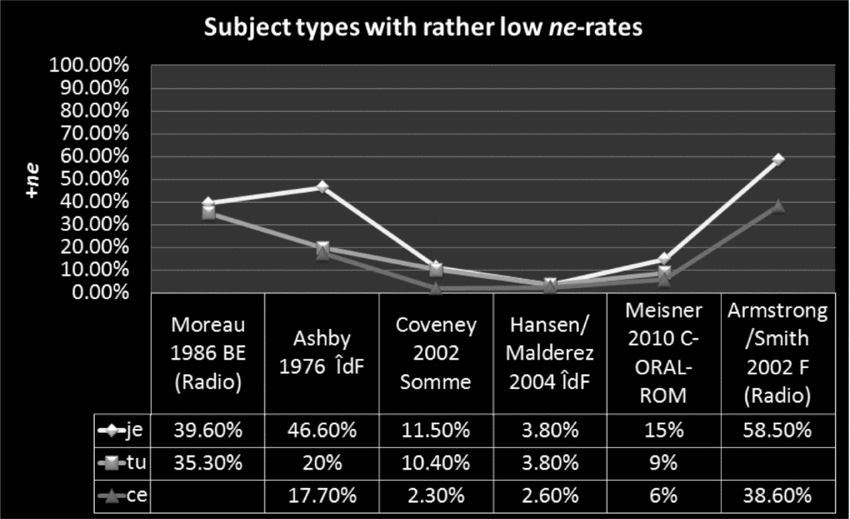
French sentential negation can be expressed formally by using a pre- and a post-verbal negation particle: Je ne chante pas ‘I do not sing’, or by using only the post-verbal particle: Je chante pas ‘I do not sing’, without any interpretational differences. This variation is one of the best known linguistic variables in contemporary French. Several extra-linguistic and linguistic factors which may influence its variation have been proposed in the literature. This contribution focuses on one of those central linguistic factors, namely on the subject type and its influence on ne-omission. In the literature, the leading assumption with respect to this factor is that the particle ne is most frequently retained in combination with a proper name or a full DP. It is commonly omitted when combined with clitic subjects (cf. e.g. Ashby, Reference Ashby1976, Reference Ashby1981, Reference Ashby2001; Armstrong & Smith, Reference Armstrong and Smith2002; Coveney, Reference Coveney2002; Culbertson, Reference Culbertson2010; Hansen & Malderez, Reference Hansen and Malderez2004; Meisner, Reference Meisner and Neveu2010). However, with respect to ne-omission there is no clear-cut distinction between full DPs and clitic pronouns, as we show. In Figure 1 we see that the pronouns nous and vous show high ne-rates just like full DPs do (nearly always above 50%). With respect to ne-omission, nous and vous are not very clitic-like; as illustrated in Diagram 2, we observe instead that ne is omitted with the clitics je, tu and ce (nearly always under 50%).Footnote 1
Lexical subjects, nous and vous (results of several empirical studies)

Ne-realisation varies considerably within the so-called ‘clitic paradigm’. In other words, not all clitics behave equally with respect to ne-retention. As we will argue later, both types of subjects (i.e. those in Figure 1 and those in Figure 2) ought to be treated independently from each other.
Clitic subjects je, tu and ce
Furthermore, we also find variation within one and the same subject type, as observed in nearly all studies concerned with this topic. In what follows, we assume that the variation with respect to ne-omission can be explained on at least two different levels. First, there is the well-studied variation found among different subject types (i.e. why do lexical DPs, for example, behave differently from je, tu, etc.?) and second, the variation found within one and the same subject pronoun (e.g. why is ne not always omitted with je?).
In section 2 we question Culbertson's (Reference Culbertson2010) approach which seeks to explain ne-realisation based on two central hypotheses: First, Colloquial French subject clitics are not clitics, but agreement affixes, and, second, unexpected ne-realisation are to be explained by the interaction of two grammars, i.e. Colloquial French and Standard French. Based on a corpus analysis (cf. section 3), we argue against her two hypotheses and show that ne is highly context sensitive with respect to the phonological form of the left-adjacent element, whereas the element on the right plays at most a secondary role. We argue, thus, that ne-realisation is a local and inside-out serial phenomenon explainable within one single grammar of French. In section 4 we implement, consequently, our findings in the framework of Distributed Morphology, a localist and inside-out serialist theory (cf. e.g. Embick, Reference Embick2010).Footnote 2 And finally, the last section summarises our main conclusions.
1.1 The (non) realisation of ne and its relation to the debate affix vs. clitic
In order to explain the variation of ne-omission among different subjects, Culbertson (Reference Culbertson2010: 95) proposes a scale of subject types where she distinguishes between full DP subjects on the uppermost end of the scale and subject clitics in the lower end (either combined with a DP or alone):  full DP subjects >
 no DP/subject clitic >
 subject clitic >
 DP + subject clitic. In her study, Culbertson shows that ‘ne is preferentially dropped just in the cases where it would intervene between the subject clitic and the verb’ (Culbertson, Reference Culbertson2010: 95) (cf. the lower part of the scale) and that the highest rate for ne-retention (83.3%) is obtained with full DP subjects. She then concludes that ‘the rate of ne-retention is affected by the affix status of subject clitics in Colloquial French’ (Culbertson, Reference Culbertson2010: 97).Footnote 3
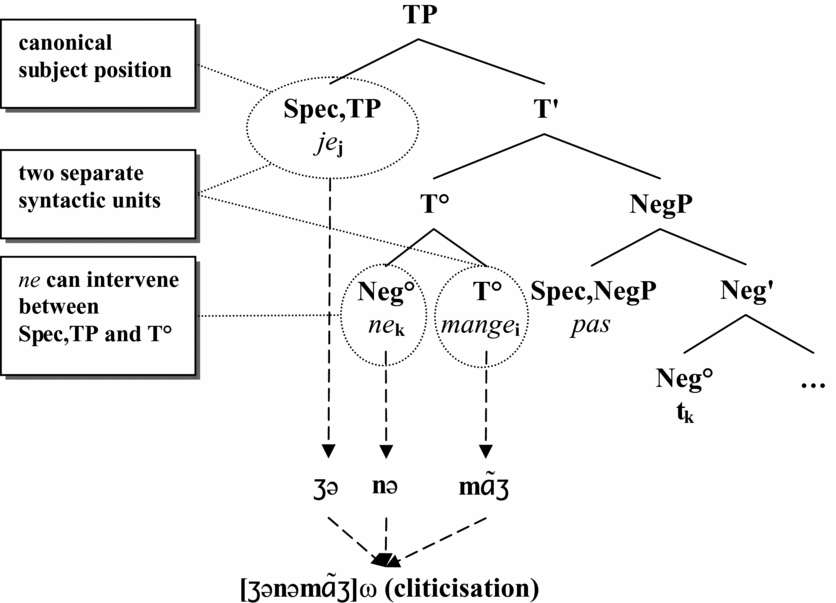
To make this last point clearer, we summarise briefly the long-lasting debate of whether French subject clitics are in fact clitics or affixes. According to the Clitic Hypothesis (cf. e.g. Kayne, Reference Kayne1975, Reference Kayne1991; Rizzi, Reference Rizzi1986; Belletti, Reference Belletti and van Riemsdijk1999; De Cat, Reference De Cat2007) the elements je, tu, il etc. are equivalent to full DPs. That is, they are true verbal arguments, they receive case and a theta-role and, crucially, they occupy the canonical subject position (the specifier of the TP, cf. Figure 3). As the clitic subject je and the finite verb mange are two separate syntactic units, other syntactic elements, e.g. the clitic ne, can intervene between je and mange.Footnote 4 It is only post-syntactically that je is cliticised onto the verb (or, as in our case, onto another intervening clitic). The subject is thus only a phonological clitic.
Clitic Subject Hypothesis
However, as Culbertson (Reference Culbertson2010: 96) points out we cannot predict the asymmetry between DP subjects (= 83.3% of ne-retention) and clitic subjects (= 6.3% and 6.7% of ne-retention) with this analysis. If ne can intervene between the subject in Spec,TP and the finite verb in T°, why is ne-retention so much higher in the case of full DPs? In other words: Why is ne omitted more frequently in cases where we have a subject clitic?
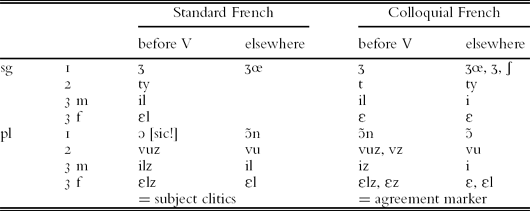
In contrast to the above analysis, Culbertson (Reference Culbertson2010) supports the hypothesis that in Colloquial French elements like je, tu, il etc. are not subject clitics, but agreement markers. One argument in favour of this assumption is phonological idiosyncrasy (cf. see Table 1). Culbertson (Reference Culbertson2010: 91) states that the elements in question are ‘extremely reduced phonologically’ when compared to the Standard French subject clitics (cf. section 3.2 for a criticism of this claim) and assumes that this phonological erosion is indicative of being an affix (Culberston, Reference Culbertson2010: 91; based on Siewierska, Reference Siewierska2004 and Hopper & Traugott, Reference Hopper and Traugott1993). In sum, in Standard French the listed elements are subject clitics, whereas in Colloquial French we have to analyse them as agreement markers, according to Culbertson (Reference Culbertson2010).
Comparison of ‘subject-clitic’ variants in Standard and Colloquial French (cf. Culbertson, Reference Culbertson2010: 91, based on Morin, Reference Morin1979 and Fonseca-Greber and Waugh, Reference Fonseca-Greber, Waugh and Núñez-Cedeño2002).
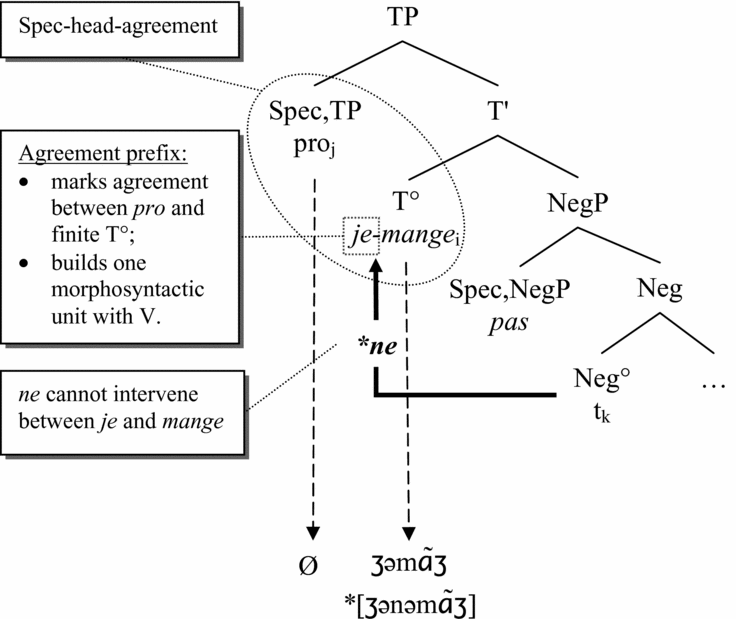
Under Culbertson's (Reference Culbertson2010) assumption, the syntactic derivation for Je (ne) mange pas would appear as shown in Figure 4. Je is not a verbal argument, it does not receive case nor a theta-role and it cannot occupy the canonical subject position (Spec,TP). Rather, it marks the phi-features of the subject (i.e. person and number) on the finite verb (i.e. it is an agreement prefix, cf. e.g. Jaeggli, Reference Jaeggli1982; Roberge, Reference Roberge1990; Auger, Reference Auger1994). Thus, another consequence (mentioned but not explored by Culbertson, Reference Culbertson2010: 124) is that Colloquial French has to be analysed as a pro-drop language or null-subject language; i.e. Spec,TP is occupied by a phonologically empty subject pronoun (= pro) specified for person and number and able to carry case and a theta-role. As the prefix je in Figure 4 and the finite verb build one single morphosyntactic unit, no syntactic element can intervene between the prefix and the verb. That is, because it is a clitic (= a syntactic unit), ne cannot intervene between je and mange.
Agreement Affix Hypothesis
At this point, let us look again at the rates of ne-omission described by Culbertson (Reference Culbertson2010). With the derivation illustrated in Figure 3 we can explain 83.3% of ne-retention with a full DP subject and with the derivation illustrated in Figure 4 we can explain over 90% of ne-omission in both cases where we have a ‘subject clitic’. But, how can we explain the remaining cases, i.e. the 16.7% where ne is omitted with full DP subjects and the 6.3% or 6.7% where ne is retained with a subject clitic?
Culbertson accounts for the remaining 6% by assuming ‘a mixture of two grammars’ (Culbertson, Reference Culbertson2010: 97): Whenever ne is retained (6.3% with true subject clitics and 6.7% with DP + true subject clitics), this falls within the rules of Standard French grammar (see Figure 3). In contrast, when ne is omitted (93.7% with subject clitics analysed as agreement markers and 93.3% with DP + subject clitics analysed as agreement markers) this constitutes Colloquial French (see Figure 4).
What triggers the switch between the two grammars? Is it really, as Culbertson (Reference Culbertson2010: 97) assumes, the social or discourse context? In this case, we should be able to find empirical evidence for the grammar-switch in stylistically diversified corpora like ours (cf. section 3.4 for a verification of this hypothesis).
There is another problem with the Affix Hypothesis that concerns the derivation in Figure 4: We said above that ne cannot intervene between the verbal agreement prefix and the verb. However, why can it not intervene between the subject in Spec,TP (i.e. pro) and the finite verb? That is, why is *[nəʒəm ʒ]ω ungrammatical? Culbertson (Reference Culbertson2010: 96) essentially says that instead of allowing *[nəʒəmʒ] the speaker opted to drop ne, ‘since it is not needed’. This leads to subject agreement prefixes being in complementary distribution with the negative marker ne (for a further discussion of Culbertson's Reference Culbertson2010 two grammar hypothesis, see Rowlett to appear Reference Rowlett2013). We do not wish to question whether ne is needed in all the other cases in what follows; instead we want to focus on the idea of context sensitivity.
2. OUR CORPUS ANALYSIS
2.1 The data-base
Our corpus of about 14,800 words, T-zéro (cf. Meisner in preparation), is a database containing linguistic and extra-linguistic data. Seventy-seven speakers (pupils, students, university staff and teachers) in France and French-speaking Switzerland were recorded in formal and informal situations. Hence, the corpus falls in two sub-corpora, a formal and an informal one: while the formal data were obtained during oral exams, the informal situations contain discussions in classrooms and informal conversations in the school hallways or in the university cafeteria.
The whole corpus contains 2,500 verb constructions, i.e. an inflected verb with all its arguments, and it is transcribed twice: orthographically and in the International Phonetic Alphabet (IPA). This narrow transcription enables us to retrace the exact morphosyntactic context of the variable in question; e.g. whether a speaker produces [ʒəsɛpa] or [ʃɛpa] for je sais pas.
2.2 The classification of French subject types
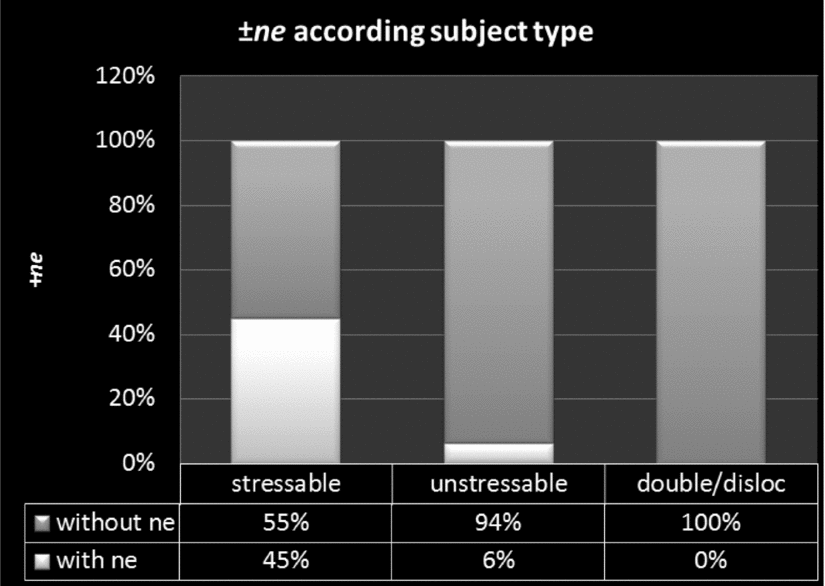
The general assumption that different subject types display different ne-rates is completely confirmed by our corpus data (cf. Figure 5, showing the overall ne-retention with respect to subject types).
±ne according to subject type
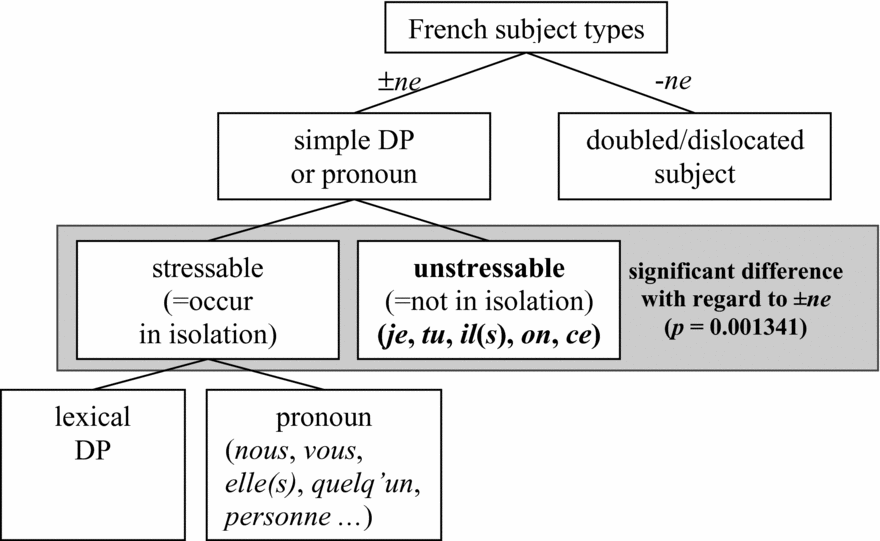
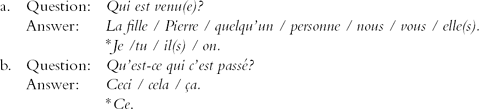
In contrast to other corpus studies, we propose a classification where the phonological properties of the subjects are considered. While stressable subjects, i.e. lexical DPs and pronouns including nous and vous, show relatively high ne-rates, unstressable clitic pronouns like je, tu and il show only 6% of ne-realisation. Contexts in which a lexical DP or a strong pronoun occurs together with a co-referential subject clitic do not show any ne-realisation at all. In our classification these cases of subject doubling or of dislocation (depending on the syntactic analysis) are split up from the other subjects (cf. Figure 6), because in our corpus they never display ne (see also Massot, Reference Massot2010, who assumes that the absence of ne is systematic with subject doubling). We also propose to subdivide the remaining simple DPs and pronouns into stressable elements that can occur in isolation (e.g. as an answer to a question) and elements which cannot occur in this context. The distinction is illustrated by the examples under (1) and supported by a significant difference with respect to ne-realisation in our corpus (p = 0.001341).
(1)

Classification of subject types
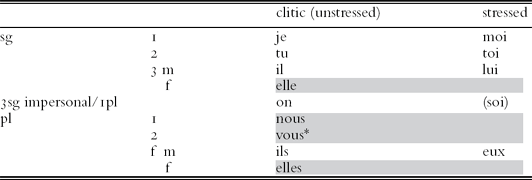
Furthermore, those pronouns which can appear in isolation cannot be classified as clitics. Most traditional classifications (cf. Table 2) assume hence that they are syncretic (or homophonous) with the non-clitic pronouns.
French personal pronouns (incomplete).
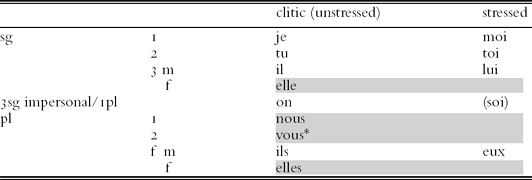
* also used as singular polite form
We are convinced that it is due to this particular morpho-phonological status that the pronouns nous and vous, and also elle(s), behave differently from other personal pronouns with respect to ne-omission in our corpus. However, we need to acknowledge that the pronouns nous and vous are also characteristic of more formal styles, and that ne-deletion, which is contextually sensitive, is hence more unlikely to appear in formal communication situations (cf. Armstrong, Reference Armstrong2001: 122–4; Coveney, Reference Coveney2002: 72–5).
The average ne-rates of every speaker in the corpus have been determined for the two subject types stressable (= occur in isolation) vs. unstressable (= do not occur in isolation). The Friedman chi-squared test shows a significant difference between the two groups (p = 0.001341). Before we come back to this point, we consider the phonological variants of personal pronouns that actually occur in the corpus.
2.3 Ne-omission with unstressable pronouns
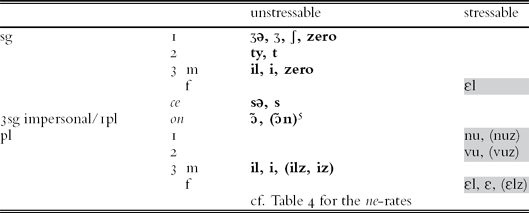
All subject clitic variants attested in our corpus are given in Table 3.
Subject ‘clitic’ variants in our corpus (including ce).
In brackets: forms that only occur in liaison contexts and hence never co-occur with ne.
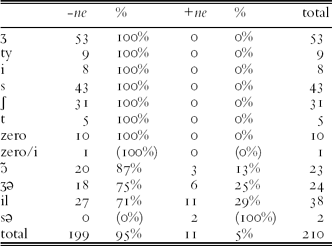
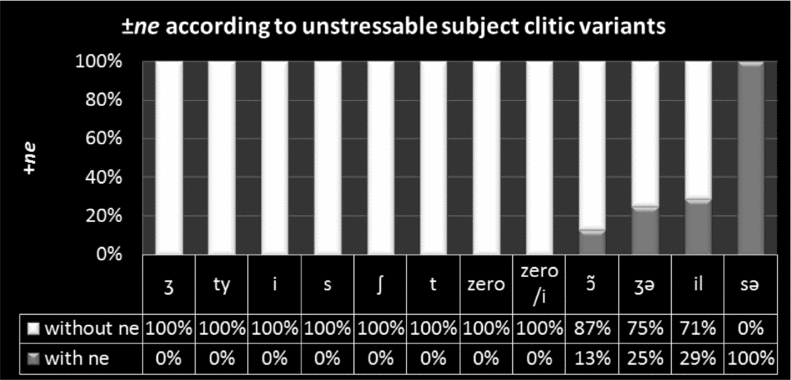
The unstressable clitics generally display a very low ne-rate of only 6%. We assume that in those rare cases, when ne is realised with an unstressable clitic the phonological realisation plays a role. In order to find out whether this is true or not, we have established the ne-rates for all unstressable forms (except for those forms that ask for a liaison context, because we can never have ne with a liaison). The results of this corpus quest are shown in Figure 7 and the underlying raw data appear in Table 4.
Underlying raw data of Figure 7Footnote 6.
±ne according to unstressable subject variants (without liaison contexts)
The different phonological realisations of the ‘clitics’ which cannot occur in isolation seem to play a decisive role in ne-omission. Perhaps unsurprisingly, the majority of these forms never co-occur with ne, namely: [ʒ], [ty], [i], [s], [ʃ], [t] and zero. Three others show quite low ne-rates, that is [ ], [ʒə] and [il]. The only element which constantly co-occurs with ne is [sə] with schwa (but we have only two negative tokens of this form). If we look at the differences between those forms that never co-occur with ne and those that do in some or in all cases, it is apparent that forms never showing ne are mainly zero or extremely reduced mono-segmental variants: [ʒ], [i], [s], [ʃ], and [t]. Only [ty] is bi-segmental and never co-occurs with ne, which could be due to scarce data.
2.4 Our results under the Two-Grammar-Hypothesis
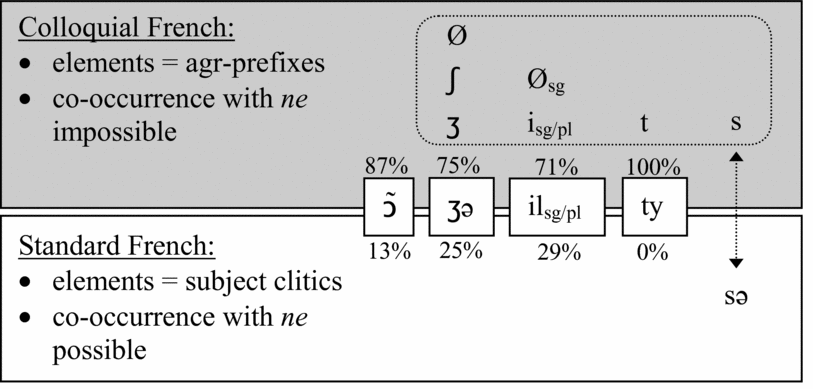
The results obtained so far do not contradict at first glance the two grammar model of French variation. We could imagine mapping our subject ‘clitic’ forms onto two grammars. Figure 8 illustrates this idea: several elements would clearly belong to the ‘grammar’ of CF, i.e. all the mono-segmental forms in the grey section. These elements would be agreement prefixes and could never co-occur with ne. The elements in the white boxes would be ‘ambiguous’ in the sense that they belong to both grammars: In CF they would be prefixes appearing without ne, whereas in SF they would be clitics compatible with ne.
Our findings under the Two Grammar HypothesisFootnote 7
However, this assumption has several shortcomings, or at least shows unexpected results: First, having evolved strongly eroded forms which we could classify as affixes, why does CF still maintain the non-eroded forms? Would we not rather expect a distribution like the one found with the demonstrative pronoun ce, where we have a clear SF clitic form and (probably) a reduced CF affix form? And what are the positive properties of SF? As Figure 8 shows, we have only one form which would clearly belong to this grammar, namely [sə].
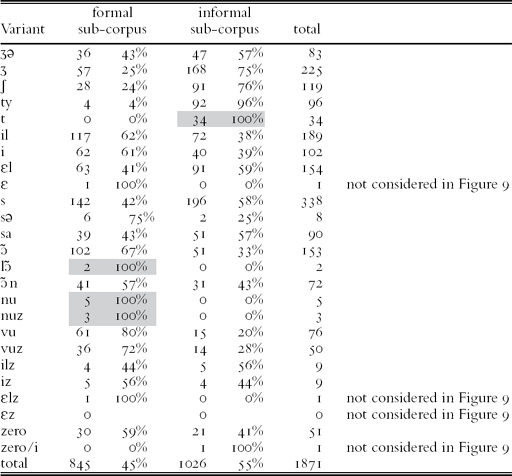
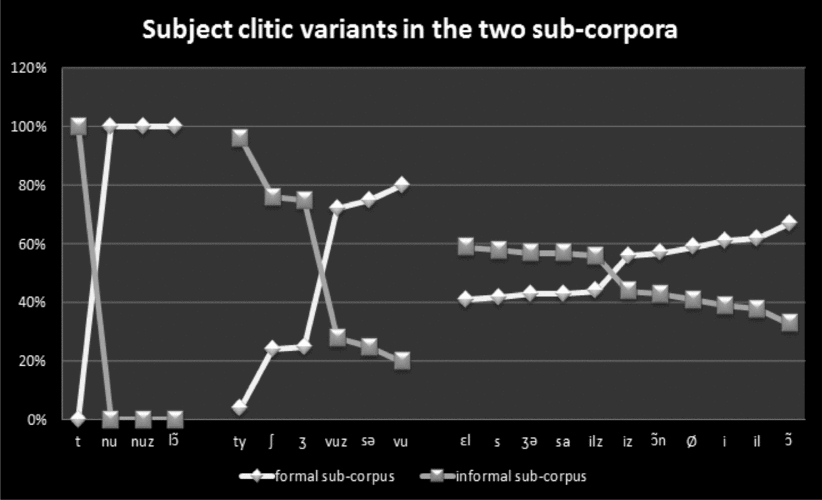
Our second objection is more complex: under the two grammar hypothesis we would expect the use of SF variants in formal situations, and of CF variants in informal situations. Let us look at the distribution of subject ‘clitic’ variants across formal and informal situations in our corpus, summarised in Table 5 and illustrated in Figure 9.
Distribution of subject ‘clitic’ variants across formal and informal situations.
Distribution of subject ‘clitic’ variants in the corpusFootnote 9
Figure 9 shows that only a few variants seem to be restricted to just one of the two sub-corpora, namely [t] for tu which is restricted to the informal corpus (= grey line) while [nu]/[nuz] and the extremely formal impersonal variant l'on only occur in the formal corpus (= white line). For all other variants we cannot state that they exclusively belong to one of the two sub-corpora, we can merely note frequency differences. In the formal corpus, tu and je tokens are reduced (but present), while nous and vous tokens are much more frequent than in the informal sub-corpus. The third person variants (especially in the singular) and [ʒə] with schwa are more or less equally present in both corpora. The same holds for on, which is seen as the informal variant of the 1st-person plural, but can also express stylistically neutral impersonal reference.
Even if we find essentially the same variants in both corpora, we also observe some stylistic variation with regard to the frequency of certain personal pronouns, such as described e.g. by Armstrong (Reference Armstrong2001). Now, we suggest that this well-known stylistic variation of personal forms is linked to ne-variation, and that ±ne is not in itself a stylistic variable but merely an epiphenomenon of this stylistic variation. More precisely, since the empirical frequency of clitic forms and of ±ne differs with regard to the communication situation, speakers might tend to associate the presence and absence of ne with these situations, which could create the ‘illusion’ of two different French grammars: Standard and Colloquial French. That is, the association between ±ne and a certain situation is purely linguistic (e.g. ne-absence in informal situations is triggered by the high frequency of clitic forms in this communication type), but it is empirically measurable, and hence perceived by the hearers. These may associate the linguistic variants with the situations in which they are frequent, for example the absence of ne and informal situations, and interpret the low ne-frequency as a characteristic of an informal style or grammar. Furthermore, some speakers might (re)produce actively ne-absence or presence aiming at the perceived styles or grammars, within the situations in which they seem adequate. This strategy, producing intrapersonal variation such as observed in our corpus, has often been explained within the framework of audience design Footnote 8developed by Bell (Reference Bell1984, Reference Bell, Eckert and Rickford2001). Hence, the audience design approach is compatible with the two grammar hypothesis (cf. Bell, Reference Bell, Eckert and Rickford2001: 146), since the two different grammars or styles of French would be used by the speakers as a sort of self-promotion in response to their audience. However, in sum, what may appear superficially as stylistic or even grammatical differences between the formal and the informal sub-corpus, are in fact only frequency differences of the same variants.
So how do our data generally fit into the picture of the two grammar hypothesis? If we are right in saying that our formal sub-corpus should be associated with SF, whereas the informal one is linked with CF, then we must recognize that there are no observable idiosyncratic features which could justify the assumption of two different grammars, since nearly all variants can appear in both corpora. Thus, we would like to explain ne-omission based on one single grammar of French.
3. SKETCH OF AN ANALYSIS: THE CONTEXT SENSITIVITY OF NE
One central point of our analysis is that the phonological form of the element preceding ne (e.g. the form of the subject) plays a crucial role for ne-omission. More precisely, ne-omission is local in the sense that the phonological shape of the left-adjacent element triggers allomorphy between ne and Ø, and it is serial, because the elements at issue are realized post-syntactically step by step from left to right (i.e. inside-out). Due to these characteristics of the phenomenon at issue, we present in what follows an account in the framework of Distributed Morphology.
Leaving some pronouns aside for the moment, our findings show that the rate of ne-realization increases together with the phonological complexity of the subject (cf. Figure 10), i.e. the left-adjacent element. Ne is absolutely excluded whenever the subject is realised by zero or by a mono-segmental (mono-moraic or mono-positional) variant of the subject. In all other cases we find variation: With unstressable, bi-segmental (bi-moraic or bi-positional) subjects there is a strong tendency towards ne-omission, whereas with stressable subjects ne is retained.
Influence of the phonological complexity of the subject on ne-realisation (without [ty], [sə] and liaison variants; n.d. = no data in our corpus)10
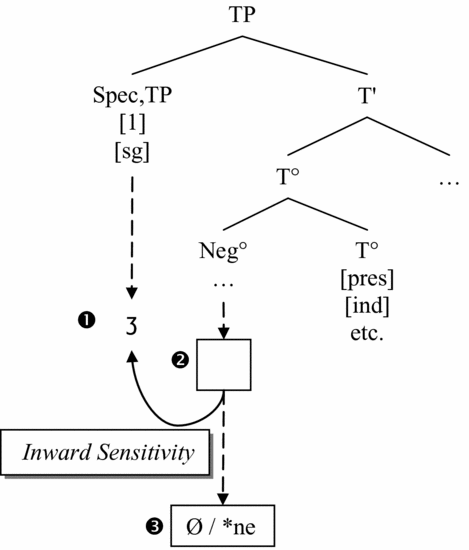
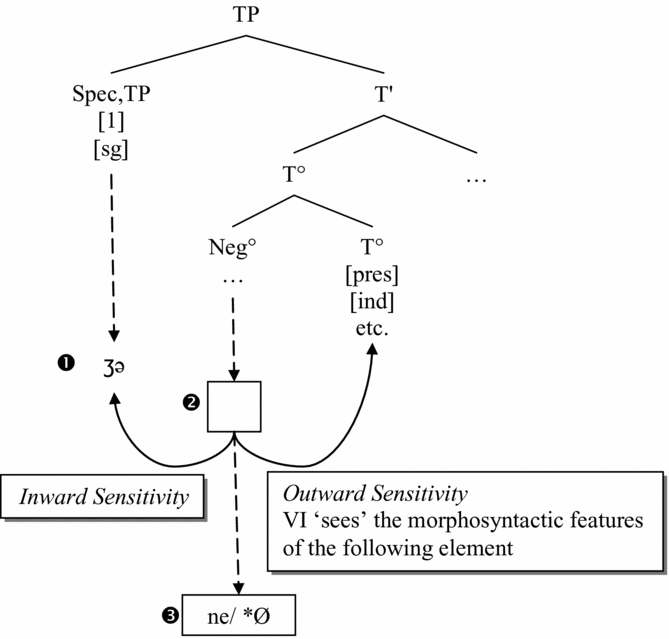
The hypothesis we want to propose here is that the particle ne is, roughly speaking, an ‘enclitic’ element in the sense that it is highly context sensitive with regard to the element on its left. The element on its right plays only a secondary role: It is irrelevant for zero and unstressable, mono-segmental subjects, but may have an influence with bi-segmental or more complex subjects. We have implemented this idea in a Distributed Morphology framework (cf. Figure 11). Here it is assumed that the syntactic structure is supplied with phonological material after syntax. Take for example Spec,TP: This syntactic terminal node bears only morphosyntactic features, but no phonological material. It is the process of Vocabulary Insertion (VI) which supplies the respective phonology. Let us assume, in order to illustrate our idea, that this slot is realised by the mono-segmental element [ʒ]. The next slot for VI is then Neg°.Footnote 11At this point we claim, in the spirit of Bobaljik (Reference Bobaljik2000: 14), that VI ‘sees’ the result of the previous application of Vocabulary Insertion (= Inward Sensitivity). Whether Neg is realised by ne or by zero depends mainly on the phonological material that has been inserted previously. That is, the complementary distribution (the ‘allomorphy’) between Ø and ne is a case of inward sensitivity. In other words, ne can only be inserted at this point if the preceding element has been realised using the appropriate phonological material. In the case illustrated in Figure 11, ne is not possible. Instead we have to insert the allomorph zero.
Context sensitivity of the Neg°-realisation
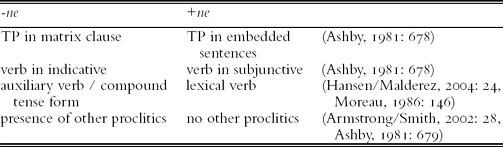
What counts as appropriate? That is, which subject-realisation triggers which allomorph? We assume that all stressable subjects (e.g. nous, vous, DPs) trigger ne-realisation of Neg° and that the zero-allomorph is the elsewhere-realisation. Yet, as we have seen above, there are some exceptions to this generalisation both with bi-segmental unstressable subjects as well as with stressable subjects. We argue that these exceptions do not (only) depend on the context to the left of the variable, but (also) on the one to its right (= Outward Sensitivity). More precisely: In these cases, it is the context to the right, i.e. the morphosyntactic features coded under T° which (additionally) forces ne-retention or ne-omission. Note that at the point when Neg° is realised phonologically we have on its left side the phonological context of the previous Vocabulary Insertion and on its right, some morphosyntactic features (cf. Figure 12). Thus, with regard to the elements on its left, ne is sensitive to the phonological context and, to its right, it alters according to the morphosyntactic features associated with (complex) T° (cf. Table 6 for some of the relevant features).
Features relevant for the Outward Sensitivity
Context sensitivity of the Neg°-realisation
It has been shown in many works that there are several morphosyntactic features encoded on the right context of ne (more precisely under T°) which influence its omission or retention. The examples in our corpus which escape the generalisation made above can all be explained taking into account the features in Table 6.
In (2) we have stressable subjects and thus would expect ne-retention, as the subject is phonologically a ‘good host’ for ne. However, the right context (e.g. a compound tense form) forces ne-omission, i.e. the Outward Sensitivity dominates in these cases. In (3) we see that the opposite is true: Due to the phonological form of the subject we would expect ne-omission, however, ne is retained. Again, this is due to the morphosyntactic feature in the right context.
(2)
(3)
It is only if the subject is realised by zero or by a mono-segmental variant that the context to the right is completely irrelevant for ne-variation. In these cases, ne is always omitted. In other words: Even if the context to the right asks for ne-retention, ne has to be omitted as the subject to its left is (under phonological perspective) an impossible host.
4. SUMMARY
In order to explain ne-variation, we have argued that stressable (e.g. full DPs, nous, vous, elle) and unstressable (e.g. je, tu, il) subjects are to be treated independently from each other; because subject forms that never co-occur with ne are mainly zero or extremely reduced mono-segmental variants: [ʒ], [i], [s], [ʃ], and [t]. Under the two grammar model – i.e. assuming, roughly speaking, that whenever we have ne-omission we are within the Colloquial French grammar, whereas when we have ne-realisation we are within the Standard French grammar –, we cannot explain our findings, since: (i) neither of the two grammars seem to show idiosyncratic features; (ii) most of the variants occur in the formal and the informal corpus and (iii) CF displays both eroded (affixal) forms and non-eroded (affixal?/clitic?) forms. Within a DM framework we can capture the allomorphy between ne and zero by specifying its inward and outward sensitivity within one French grammar.
Our analysis captures the fact that ne is highly context sensitive with respect to the phonological form of the element to its left. Our corpus analysis shows that ne is absolutely excluded whenever the subject is realised by zero or by a mono-segmental (mono-moraic or mono-positional) variant of the subject. In all other cases we find variation: With unstressable, bi-segmental (bi-moraic or bi-positional) subjects there is a strong tendency towards ne-omission, whereas with stressable subjects ne is retained. Exceptions of this tendency are explainable if we take into account the right context of ne, i.e. the morphosyntactic features coded under (complex) T°. Finally, ne-realisation is treated in our analysis as a phenomenon within one grammar and not as a consequence of ‘code-switching’ between two grammars.