Introduction
Layered solids consist of a stacked array of two-dimensional layers having high aspect ratio (Cai et al., Reference Cai, Han, Wang and Meng2020). This class of solids shows interesting properties such as ion-exchange reactivity, delamination in liquid medium, and intercalation capability (Lehn et al., Reference Lehn, Alberti and Bein1997). Among several layered solids (e.g. phyllosilicates, layered double hydroxides, hydroxy salts, layered perovskites, layered titanates, graphite, or graphite oxide), montmorillonite (Mnt) is one of the most used in the preparation of a large variety of functional and structural hybrid materials (Nascimento, Reference Nascimento2021). Due the large cation exchange capacity of Mnt (70–100 meq/100 g) (Brigatti et al., Reference Brigatti, Galan, Theng, Bergaya, Theng and Lagaly2006), the interlayer cations of this clay mineral can suffer ion-exchange reactions, allowing the accommodation of ions or molecular and macromolecular species in the interlayer space of the silicate (Alcântara et al., Reference Alcântara, Darder, Aranda and Ruiz-hitzky2016; Camara et al., Reference Camara, Liao, Xu, Zhang and Swai2019; Kotal & Bhowmick, Reference Kotal and Bhowmick2015; Ruiz-Hitzky et al., Reference Ruiz-Hitzky, Darder and Aranda2005). The ion-exchange process is a strategy usually employed to replace the inorganic cations with organic cations such as alkylammonium ions, dyes, and polymers, among others, adopting various geometrical arrangements to be used for diverse applications (Abdel-Karim et al., Reference Abdel-Karim, El-Naggar, Radwan, Mohamed, Azaam and Kenawy2021; Alcântara & Darder, Reference Alcântara and Darder2018; Bertolino et al., Reference Bertolino, Cavallaro, Lazzara, Merli, Milioto, Parisi and Sciascia2016; Calabrese et al., Reference Calabrese, Gelardi, Merli, Liveri and Sciascia2017; Salvé et al., Reference Salvé, Grégoire, Imbert, Hubert, Karpel Vel Leitner and Leloup2021). The use of Mnt, which has been reported extensively as a host matrix of pharmacologically active species, also has a large swelling capacity, good sorption ability, low toxicity for some routes of administration, and is abundant and cheap (Aguzzi et al., Reference Aguzzi, Cerezo, Viseras and Caramella2007; Bergaya & Lagaly, Reference Bergaya, Lagaly, Bergaya, Theng and Lagaly2006; Viseras et al., Reference Viseras, Cerezo, Sanchez, Salcedo and Aguzzi2010). Usually, the drug is adsorbed in the interlayer, which enhances its chemical stability and decreases the undesirable side-effects because its release can be modified to reach optimized concentrations in the organism. Within this context, tetracycline (Aguzzi et al., Reference Aguzzi, Cerezo, Sandri, Ferrari, Rossi, Bonferoni, Caramella and Viseras2014), amoxicillin (Rebitski et al., Reference Rebitski, Souza, Santana, Pergher and Alcântara2019), neomycin (Rebitski et al., Reference Rebitski, Alcântara, Darder, Cansian, Gómez-Hortigüela and Pergher2018a), metronidazole (Calabrese et al., Reference Calabrese, Cavallaro, Scialabba, Licciardi, Merli, Sciascia and Turco Liveri2013), isoniazid (Carazo et al., Reference Carazo, Borrego-Sánchez, Sánchez-Espejo, García-Villén, Cerezo, Aguzzi and Viseras2018), ibuprofen (Yan et al., Reference Yan, Zhang, Chen, Bao, Zhao, Hu, Liu and Lin2020), antidiabetic drug, metformin (Rebitski et al., Reference Rebitski, Aranda, Darder, Carraro and Ruiz-Hitzky2018b), and antipsychotic drug, olanzapine (Oliveira et al., Reference Oliveira, Alcântara and Pergher2017) have already been intercalated into Mnt.
The advantages of drug intercalation can be enhanced due to the association of Mnt-drug hybrids with biopolymers such as polysaccharides (alginate, starch, chitosan, cellulose, etc.) and proteins (zein, gelatin, collagen, among others) to form bionanocomposite materials that act as hybrid devices for drug administration (Alcântara & Darder, Reference Alcântara and Darder2018; Ruiz-Hitzky et al., Reference Ruiz-Hitzky, Darder and Aranda2005). Besides acting like a chemical and mechanical barrier to protect the intercalated bioactive species, biopolymers are naturally degradable macromolecules that can fine-tune the drug-release profile and shape the devices, e.g. as films of different thickness, beads, or threads, which characterize a multipurpose platform for drug delivery.
Biopolymers or blends of them, e.g. carboxymethylcellulose-zein (Rebitski et al., Reference Rebitski, Alcântara, Darder, Cansian, Gómez-Hortigüela and Pergher2018a, Reference Rebitski, Souza, Santana, Pergher and Alcântara2019), alginate-xanthan gum (Oliveira et al., Reference Oliveira, Alcântara and Pergher2017), or alginate-chitosan (Nayak & Sahoo, Reference Nayak and Sahoo2011) have been reported as covers of drug-based intercalation compounds, which can be processed as gel, films, nanoparticles, or foams often showing improved properties compared to the pristine biopolymers. From the point of view of biopharmaceuticals, carrageenan (CARR), polysaccharide, and gelatin (GEL) protein show interesting and important features such as non-toxicity, non-immunogenicity, and high biocompatibility and hydrophilicity, also allowing their processing as films or beads, for topical or oral drug administration, respectively (Akrami-Hasan-Kohal et al., Reference Akrami-Hasan-Kohal, Ghorbani, Mahmoodzadeh and Nikzad2020; Ashe et al., Reference Ashe, Behera, Dash, Nayak and Nayak2020). The biopolymers can, thus, be molded, in various types of processing, resulting in varied structural and functional properties. Hydrogels, based on the addition of various ratios of i-carregeenan(i-CARR) into a GEL matrix, were explored by Varghese et al. (Reference Varghese, Chellappa and Fathima2014) who demonstrated that an increase in the hydrogel porosity resulted in an improvement in the delivery of quercetin. Bionanocomposites resulting from the combination of k-carrageenan (Nouri et al., Reference Nouri, Tavakkoli Yaraki, Ghorbanpour and Wang2018) and GEL (Kevadiya et al., Reference Kevadiya, Rajkumar, Bajaj, Chettiar, Gosai, Brahmbhatt, Bhatt, Barvaliya, Dave and Kothari2014) with montmorillonite were processed as films, and showed good homogeneity, improved resistance to water, and modified drug release compared to pristine biopolymers, thereby becoming attractive materials to the biomedical sector.
Ciprofloxacin (CFX), an important antibiotic drug belonging to the 2nd generation quinolone group (hereafter called fluoroquinolones), is used widely against diverse human and veterinary bacterial infections, such as urinary tract infections and pneumonia.This drug shows diverse side effects such as gastrointestinal disruptions (nausea, diarrhea), as well as peripheral neuropathy and seizures (Thai et al., Reference Thai, Salisbury and Zito2021).
The present study aimed to develop a bionanocomposite based on a montmorillonite and i-carrageenan-gelatin biopolymer blend as a novel release system for ciprofloxacin (CFX). The bionanocomposite materials were characterized carefully to evaluate the compatibility and the establishment of interactions among the components of the system. In order to improve the performance of oral CFX release in the gastrointestinal tract, the bionanocomposites were processed as porous beads through freeze-drying, where the influence of the montmorillonite in the material and the freezing step by liquid nitrogen or conventional freezing was investigated in terms of modulation of porosity, apparent density, thermal stability, and water-uptake properties. In vitro tests of CFX delivery in conditions simulating the gastrointestinal tract were carried out to evaluate the effectiveness of this novel type of porous bionanocomposite as a controlled drug-delivery system. To the best of the authors’ knowledge, the effect of the association of montmorillonite-ciprofloxacin with i-carrageenan-gelatin blend has not been reported in the literature, making this study the first to evaluate their structure and properties aiming to pave the way toward new drug-delivery systems.
EXPERIMENTAL
Materials
GEL and i-CARR biopolymers and CFX (≥98.0%) were purchased from Sigma-Aldrich (St. Louis, Missouri, USA). Cloisite®-Na+, a homoionic sodium montmorillonite (Na)0.33(AlMg)2(Si4O10)(OH)2·nH2O is a Wyoming-type clay supplied by Southern Clay Products (Austin, Texas, USA), has a cation exchange capacity (CEC) of 93 meq/100 g. All the salts used were of analytical reagent grade: Al(Cl)3∙6H2O (>99%, Sigma-Aldrich, Taufkirchen, Germany), ZnCl2 (>99%, Synth, São Paulo, Brazil), NaOH (98%, Merck, Darmstadt, Germany), NaCl (>99%, Dinâmica, São Paulo, Brazil), NaH2PO4·H2O (>99%, Sigma-Aldrich, Taufkirchen, Germany), and CaCl2 (>99%, Dinâmica, São Paulo, Brazil). Deionized water (resistivity >18.0 Ω cm) was obtained from Milli-Q (Merck Millipore, Burlington, Massachusetts, USA).
Preparation of Montmorillonite-ciprofloxacin Hybrid
The montmorillonite-ciprofloxacin hybrid (Mnt-CFX) was prepared by cation exchange reaction. Initially, 0.25 g of CFX was dissolved in 25 mL of deionized water and this solution was sonicated for 30 min. Then, 0.5 g of Mnt was added to 25 mL of deionized water under magnetic stirring for 30 min, and the previously prepared drug suspension was added to the clay suspension. The pH value of the system was reduced to 3.5 to allow the protonation of the amino groups of the drug. The reaction mixture was stirred for 24 h at room temperature. Afterward, the hybrid material was isolated by centrifugation, washed with bidistilled water, and dried overnight at 60°C.
Preparation of i-carrageenan-gelatin Bionanocomposite Beads
The i-carrageenan-gelatin bionanocomposite beads were prepared using 1:0 and 1:0.25 (w/w) i-carrageenan:gelatin ratios with a final total biopolymer concentration of 1% (w/v). For the 1:0.25 i-carrageenan:gelatin ratio, 0.4 g of i-carrageenan was solubilized in 20 mL of deionized water, under constant stirring at 70°C. Additionally, 0.1 g of gelatin was solubilized in 15 mL of deionized water at 35°C and mixed with the previous i-carrageenan solution; the system was kept at room temperature and stirred vigorously until homogenization was complete. Thereafter, 0.1 g of CFX drug (or the necessary amount of Mnt-CFX containing 0.1 g of drug dispersed in 15 mL of water) was added to the biopolymer mixture. To help the crosslinking process, the system was added dropwise in a 5% CaCl2 solution and kept under magnetic stirring for 40 min. The resulting bionanocomposite beads were washed with bidistilled water to remove residual Ca2+ ions and non-entrapped CFX molecules or intercalation compound. The bionanocomposites beads were separated into two parts: the first fraction was frozen by conventional freezing (–20°C) for 24 h while the second was frozen by immersing in liquid N2 (–196.15°C), and both fractions were subsequently freeze-dried (Terroni, model Enterprise II, São Paulo, Brazil). The i-carrageenan-gelatin bionanocomposite beads that incorporate CFX were labeled as i-CARR-GEL/CFX, and those prepared by incorporation of Mnt-CFX intercalation compound were labeled as i-CARR-GEL/Mnt-CFX.
Characterization
Powder X-ray diffraction (XRD) data were collected using a BRUKER (Karlsruhe, Germany) D8-ADVANCE diffractometer with a CuKα source, with a scan step of 2°2θ/min between 2 and 70°2θ. Solid state 13C nuclear magnetic resonance (NMR) spectroscopy was performed at room temperature using an Agilent (Santa Clara, California, USA) DD2 spectrometer, model A600a, employing a frequency of 125.7 MHz using a CP-MAS sequence with a pulse of 2.7 μs at 62 Db, contact time 7.0 ms, and relaxation delay of 20 s at 10 kHz. Infrared vibrational spectra were collected using a Bomen spectrophotometer, model MB-102 (Montreal, Quebec, Canada), by the ATR method in transmittance mode (%T) with 256 scans at a resolution of 2 cm–1 in the range 4000–400 cm–1. Thermal analysis (TG-DSC) data were obtained using a Netzsch (Selb, Germany) model TGA/DSC 490 PC Luxx thermal analyzer. The analyses were conducted in a nitrogen atmosphere with a flow rate of 100 mL/min, from room temperature to 900°C, at a rate of 10°C/min. The amount of drug incorporated in the hybrid materials was determined by elemental chemical microanalysis (Carbon, Hydrogen, and Nitrogen) using a Perkin-Elmer (Waltham, Massachusetts, USA) model 2400 analyzer. The surface morphology of the materials was observed by scanning electron microscopy (SEM), with the samples coated with a carbon layer using an Hitachi device, model TM3030 (Tokyo, Japan), operated at 15 kV.
Estimation of CFX Loading Capacity and Encapsulation Efficiency
The CFX loading capacity (LC) and encapsulation efficiency (EE) of the bionanocomposite beads were determined by dispersing 0.02 g of beads in 100 mL of phosphate buffer at a pH of 6.8 for 24 h at 37°C to ensure the total disintegration of the material. The resulting solution was centrifuged, and the liquid phase was analyzed in a UV-Vis Shimadzu spectrophotometer, model 1800 (Kyoto, Japan) at λ = 274 nm. The percentage of drug loading was calculated using Eq. 1, and the concentration of CFX was determined by applying the Beer-Lambert law. From the drug-loading value (mass) obtained for each system, the encapsulation efficiency was calculated from Eq. 2. The theoretical loading is described as the initial amount of drug added in the system (Rebitski et al., Reference Rebitski, Souza, Santana, Pergher and Alcântara2019).


Apparent Density
The apparent density of the bionanocomposite materials was evaluated following the procedure described by Sharma et al. (Reference Sharma, Bhat, Vishnoi, Nayak and Kumar2013), adapted for spherical systems. The density in g/cm3 of dry and wet bead samples was determined by Eq. 3 using the ratio of dry mass or wet weight of the samples to their volume, respectively. The diameter of the beads was obtained with a caliper to determine the values related to the radius of the beads.

where W and R are the mass and radius of the bionanocomposite beads, respectively.
Water-uptake Properties
The water uptake of the bionanocomposite beads was evaluated by immersing 0.2 g of the beads in phosphate buffer at a pH of 6.8, in triplicate, at room temperature. In predetermined time intervals, aliquots of the beads were withdrawn, and the excess water was removed and weighed in an analytical balance (Shimadzu model ATY224, Kyoto, Japan,). The water uptake was calculated from Eq. 4:

where W 0 and W t are the initial and wet mass of beads at time t, respectively.
In Vitro Ciprofloxacin Cumulative Release Studies
The in vitro, controlled-release study of CFX was performed using solutions that simulate gastrointestinal fluids, according to the sequential pH changes that occur during the in vivo process: a solution containing 0.1 g of NaCl and 0.7 mL of HCl at a pH of 1.2 for 2 h, acting as the gastric fluid; a solution containing 0.03 g of NaOH, 0. 40 g of NaH2PO4∙H2O, and 0.62 g of NaCl at a pH of 6.8 for 2 h, simulating the first zone of intestinal fluid; and a solution at a pH of 7.4 for 4 h, prepared by adding a 1 M solution of NaOH to a pH 6.8 solution, simulating the second zone of intestinal fluid (Alcântara et al., Reference Alcântara, Aranda, Darder and Ruiz-Hitzky2010; Rebitski et al., Reference Rebitski, Souza, Santana, Pergher and Alcântara2019). The release of ciprofloxacin was evaluated by suspending the equivalent amount of 10 mg of CFX in the bionanocomposite beads or in the Mnt-CFX hybrid (previously compacted into pellets in the latter case) in 750 mL of release medium at 37°C, under agitation at 100 rpm, using a Pharma (Hainburg, Germany) Dissolution tester, model PTWS 610. For each predetermined time interval, an aliquot of 3.0 mL was withdrawn and the amount of CFX released from the drug-intercalated compound or bionanocomposite beads was quantified by UV-Vis spectrophotometry (λ = 274 nm). The measured aliquot was added back to the solution to maintain a constant volume. All the experiments were carried out in triplicate.
RESULTS AND DISCUSSION
Mnt-CFX Intercalation Compound
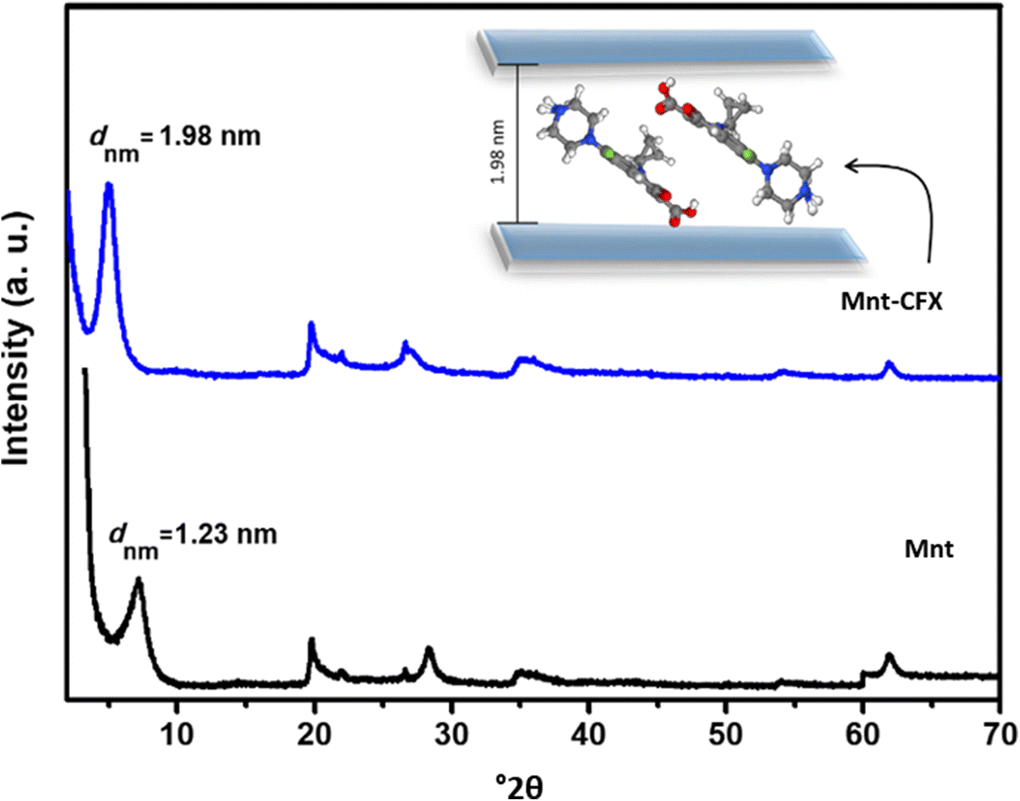
The ciprofloxacin antibiotic drug has a bipolar structure, showing positive or negative charges depending on the pH (Fig. 1). Taking advantage of this property, the possibility of immobilizing this molecule in cationic montmorillonite was explored by employing ion-exchange reactions. The XRD patterns of pristine montmorillonite and its hybrid sample are shown in Fig. 2. The 001 reflection from pristine Mnt shows a basal distance of 1.23 nm. After ion exchange in the presence of cationic CFX molecules, however, this basal distance was shifted to lower °2θ values, with a new basal spacing of 1.98 nm, which confirms the intercalation of CFX molecules between Mnt carrier layers in the Mnt-CFX sample. This basal spacing (1.98 nm) is close to that reported by Wu et al. (Reference Wu, Li, Hong, Yin and Tie2010), who reported values between 1.83 and 2.08 nm depending on the initial amount of CFX adsorbed on Mnt. According to Gieseking (Reference Gieseking1939) the single-layer thickness of Mnt is 0.96 nm; an increase in the basal spacing of 1.02 nm can, thus, be attributed to intercalation of the drug. Considering that the CFX molecule has dimensions of 1.22 nm×0.80 nm×0.41 nm (Wang et al., Reference Wang, Li and Jiang2011), a slightly tilted arrangement of the di-molecular CFX with respect to the aluminosilicate layers is proposed here (with opposite directions of piperazine groups due to the CFX+ electrostatic attraction with the clay surface), as represented in the insert in Fig. 2. This arrangement was also proposed in studies on adsorption and intercalation of ciprofloxacin in smectites and related layered solids in acid conditions (Li et al., Reference Li, Wang, Wang, Yuan and Fu2015; Wu et al., Reference Wu, Li, Hong, Yin and Tie2010). The amount of CFX incorporated in the hybrid material was calculated by elemental chemical analysis, showing 76 meq of CFX/100 g of Mnt. Considering that the CEC for Na montmorillonite is ~93 meq/100 g, this value indicates that the exchange reaction was not complete, and the presence of a small amount of Na+ ions is expected in the interlayer space.
Representation of the structure of a sodium montmorillonite and b positively charged ciprofloxacin (protonated up to pH 5.9)

XRD patterns of pristine Mnt and the Mnt-CFX hybrid prepared by ion-exchange reaction

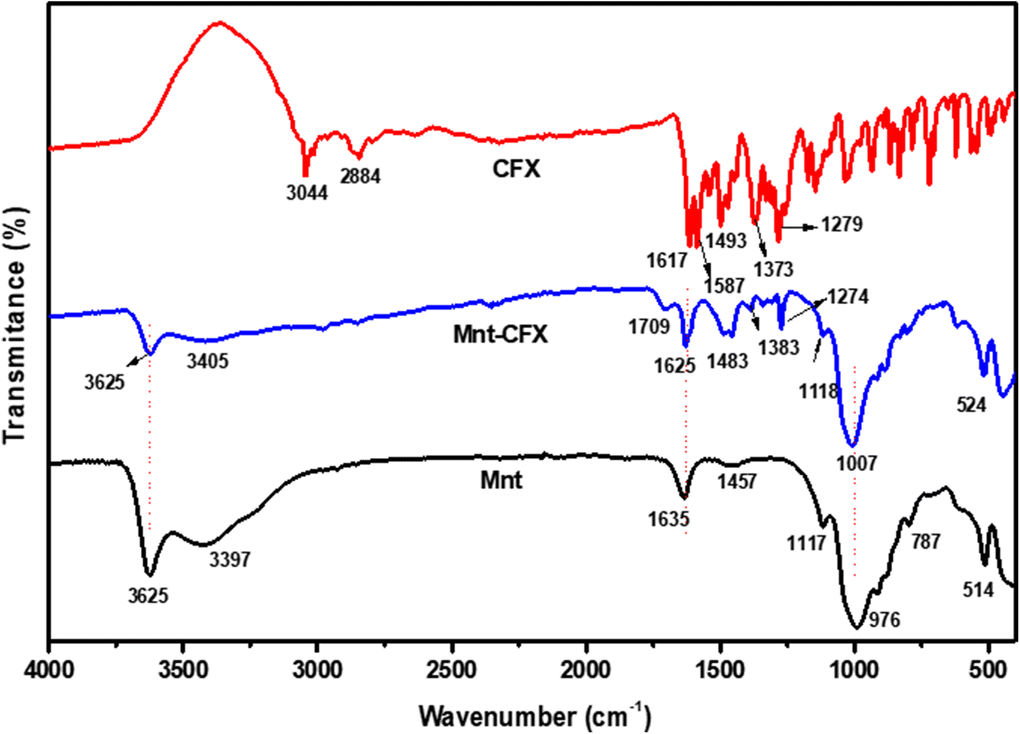
The possible interaction established between CFX ions and the Mnt solid was investigated by FTIR spectroscopy (Fig. 3). The Mnt spectrum shows bands typical of the aluminosilicate at 3625, 1635, and 1007 cm–1 assigned to ν OH of Al,Mg(OH), δ HOH of water molecules in the clay, and ν Si-O-Si, respectively (Nahin, Reference Nahin1952) ). In addition to the bands from the clay mineral, the Mnt-CFX hybrid spectrum shows a new band at 1709 cm–1 assigned to a carboxylic group (ν C=O) indicating that the drug had been protonated, and corroborated the presence of positively charged CFX intercalated into Mnt. The CFX stabilization in its positive form in the interlamellar space of Mnt was promoted precisely by the synthetic conditions of the hybrid material which was performed in an acid medium. In addition, a displacement of 10 cm–1 in the band at 1373 cm–1 in free CFX toward higher wavenumber in the hybrid material due to protonation of the amine group of the piperazine moiety was noticed, similar to reports elsewhere in studies about the interaction of CFX and Mnt (Wu et al., Reference Wu, Li, Hong, Yin and Tie2010). Although the vibrational modes of both νC-N and δN-H at 1617 and 1587 cm–1, respectively, corresponding to the amide groups present in CFX, seem to overlap the water band (δ HOH) at 1625 cm–1, making the interpretation of possible interactions in this spectral range very difficult, all the evidence described above for the hybrid material indicates the establishment of electrostatic interactions between the negatively charged surface of the silicate and the drug in its protonated form.
Infrared spectra (ATR-IR) of CFX, neat Mnt, and Mnt-CFX hybrid

The data obtained by FTIR also can be confirmed by solid state 13C NMR spectra of the hybrid material in comparison to that of free CFX (Fig. 4). All observed values are in agreement with those simulated for the CFX molecule in the Marvin Sketch software® (Fig. 4a). In the spectrum of the free drug (Fig. 4b), signals for C=O (keto group) and COOH (carboxylic group) were observed between 175 and 180 ppm. Peaks corresponding to the aromatic ring carbon atoms present in the drug molecule were observed in the regions 158, 150–145, and 120–130 ppm (Chattah et al., Reference Chattah, Linck, Monti, Levstein, Manzo, Breda and Olivera2007; Wu et al., Reference Wu, Chen and Jin2016). Two signals at 51.0 and 42.3 ppm corroborated the simulation and can be attributed to carbon atoms bonded to nitrogen (C–N). The 13C NMR spectrum of the Mnt-CFX hybrid resembles that of free CFX, which can be related to possible interactions between the intercalated drug with other CFX+ and water molecules through strong hydrogen bonds. Despite this, the signals assigned to carbon resonance in free CFX at 51.0 and 42.3 ppm are shifted slightly to 51.7 and 41.8 in the Mnt-CFX hybrid. These values correspond to the interactions of carbon atoms bonded to nitrogen present in the drug, which could indicate a possible change in C–N binding energies. This event was probably due to the CFX intercalation in the Mnt interlayer region, causing a possible interaction of CFX protonated amino groups with the negative charges of the clay layers, as indicated by the FTIR data (Fig. 3).
Solid state 13C NMR spectra of CFX and Mnt-CFX hybrid material

The thermal behavior of CFX was compared to the intercalated Mnt-CFX sample under a nitrogen atmosphere. The TGA and DSC curves shown in Fig. 5 indicate that CFX lost mass in four consecutive steps. The first and second events were exothermic (peaks between 273 and 350°C) and correspond to 58% of mass loss. According to the literature, these events can be attributed to the decomposition and release of [C4H8N2H2 + CO] from the drug molecule (García, Reference García and Parambath2018; Rivera et al., Reference Rivera, Valdés, Jiménez, Pérez, Lam, Altshuler, De Ménorval, Fossum, Hansen and Rozynek2016). The other two events occurred between 380–600°C and were associated with the removal of the remaining drug as C11H8FNO from the CFX structure (El-Gamel et al., Reference El-Gamel, Hawash and Fahmey2012), giving a total residue of 12% up to 1000°C. The TGA curve of the hybrid material shows an improvement of the thermal behavior of the CFX. The Mnt-CFX hybrid shows fewer mass-loss steps in comparison with free CFX. In the former case, only 3% of mass loss up to 200°C was evident due to the elimination of physically adsorbed water molecules. Three other decomposition steps were identified at temperatures above 400°C, however, which may be related to partial thermal decomposition of the intercalated drug and clay dehydroxylation in the 650–900°C range (Page, Reference Page1943), as observed in the thermal analysis of pristine Mnt (Fig. 5). The increase in the thermal stability of CFX in comparison to the free drug is associated with its confinement in the layered region of the Mnt, where the layered clay acts as a protective matrix, as observed in studies involving drug or biological molecule-based intercalation compounds (Cunha et al., Reference Cunha, De Souza, Da Fonseca Martins, Koh and Constantino2016; Khan et al., Reference Khan, Saba, Nawazish, Akhtar, Rashid, Mir, Nasir, Iqbal, Afzal, Pervaiz and Murtaza2017; Rebitski et al., Reference Rebitski, Alcântara, Darder, Cansian, Gómez-Hortigüela and Pergher2018a, Reference Rebitski, Souza, Santana, Pergher and Alcântara2019; Sepehr et al., Reference Sepehr, Al-Musawi, Ghahramani, Kazemian and Zarrabi2017; Wu et al., Reference Wu, Wu, Zhang, Chen, Zhou, Qian, Xu, Du and Rao2018).
TG-DSC curves of CFX, pristine Mnt, and Mnt-CFX samples recorded under a nitrogen atmosphere

The morphology of the hybrid materials, as observed by SEM (Fig. 6), revealed that the Mnt-CFX intercalation compound has a texture typical of hybrid materials. The assembly of CFX to Mnt in the Mnt-CFX hybrid (Fig. 6a, b) resulted in a compact structure in which the hybrid particles were aggregated.
SEM images (a and b) of the Mnt-CFX hybrid sample

Bionanocomposite Systems Based on Mnt-CFX Solids and a Blend of Natural Polymers
Hybrid devices processed as beads were prepared by the incorporation of the Mnt-CFX intercalation compound into a biopolymer matrix containing i-Carrageenan and Gelatin (i-CARR:GEL) for drug-release studies. For comparative purposes, the free CFX was also incorporated into the i-CARR:GEL biopolymer matrix. All bionanocomposites developed were frozen in (1) a conventional freezer (–20°C), or (2) liquid nitrogen (–196.15°C), and subsequently freeze-dried. After preparation of the beads, the encapsulation efficiency and the amount of drug incorporated into the i-CARR:GEL blend were analyzed (results given in Table 1). The bionanocomposite systems i-CARR:GEL/Mnt-CFX showed approximately a threefold increase in drug loading and encapsulation efficiency compared to the i-CARR:GEL-CFX bionanocomposites. Similar behavior was reported for carboxymethylcellulose-zein systems (Rebitski et al., Reference Rebitski, Souza, Santana, Pergher and Alcântara2019), alginate-xanthan gum (Oliveira et al., Reference Oliveira, Alcântara and Pergher2017), alginate-zein(Alcântara et al., Reference Alcântara, Aranda, Darder and Ruiz-Hitzky2010), or chitosan-pectin (Ribeiro et al., Reference Ribeiro, Alcântara, Darder, Aranda, Herrmann, Araújo-Moreira, García-Hernández and Ruiz-Hitzky2014) bionanocomposites which also encapsulated amoxicillin, neomycin, or ibuprofen drugs in montmorillonite or layered double hydroxide. This could be associated with the possibility of slower diffusion of some drug molecules from the interlayer region of the silicate, thus contributing to the good affinity between Mnt and the biopolymers used in the present study. Note, however, that no significant difference in drug loading and encapsulation efficiency was found between the bionanocomposite samples frozen through conventional or liquid N2 freezing methods, regardless of the intercalation compound incorporated. This behavior is expected as the drug-incorporation process is performed prior to the freezing step; the process should not have any influence on the amount of drug encapsulated.
Encapsulation efficiency and amount of CFX loaded either as free drug or as Mnt-CFX in the i-CARR:GEL biopolymer system.

Data are mean ± S.D., n = 3
All FTIR spectra of the pristine biopolymers and their bionanocomposite beads (Fig. 7) revealed a broad band observed at 3400–3300 cm–1, which is attributed to the νOH group from adsorbed water. In addition, for i-CARR:GEL beads, bands at 928 cm–1 and 1246 cm–1, associated with the presence of 3,6-anhydro-D-galactose and sulfated groups, respectively, were noticed in the carrageenan structure (Cheng & Jones, Reference Cheng and Jones2017; Khan et al., Reference Khan, Saba, Nawazish, Akhtar, Rashid, Mir, Nasir, Iqbal, Afzal, Pervaiz and Murtaza2017). A possible overlap of bands attributed to νCO from amide I groups of gelatin at 1622 cm–1 and H–O–H groups (adsorbed water) of i-CARR at 1633 cm–1 was noted, showing in the i-CARR:GEL blend a band at 1631 cm–1. The i-CARR:GEL/Mnt-CFX shows a similar spectrum when compared with the biopolymer blend spectrum, where clearly identifying the presence of the characteristic bands corresponding to the intercalation compound was not possible, probably because of the small amount of it in the system.
Infrared spectra (4000–400 cm–1) of pure GEL and i-CARR biopolymers, i-CARR:GEL biopolymer blend, and i-CARR:GEL/Mnt-CFX bionanocomposite system

The images of the frozen surfaces of bionanocomposite beads after different freezing methods were examined by SEM (Fig. 8). The images revealed a rough and homogeneous aspect, independent of the presence of any intercalation compound. A clear change in the morphology was evident when comparing the beads frozen by liquid N2 and those frozen using the conventional freezer. As indicated by circles in Fig. 8a, the i-CARR:GEL-CFX beads prepared from liquid N2 exhibited a more compact morphology with domains of isolated small pores on its surface. In contrast, beads obtained by conventional freezing were characterized by the presence of a more porous surface and slightly larger pores throughout the material (Fig. 8b). Similarly, the i-CARR:GEL/Mnt-CFX samples prepared by liquid N2 showed a flaky texture with the presence of only a few and small pores on the surface (Fig. 8c).When this same material was prepared through conventional freezing, however, a smooth surface with large and isolated pores was noted (Fig. 8d). These differences in the porosity of the beads can be attributed to the growth rate of the ice crystals. In the first case, the temperature of liquid N2 (–196.15°C) is low enough to allow rapid freezing of water molecules, not allowing indiscriminate ice growth. Conversely, in conventional freezing, ice grows slowly, producing larger crystals and, consequently, a larger porous structure after removal of the solid phase (ice) by freeze drying (Gutiérrez et al., Reference Gutiérrez, García-Carvajal, Jobbágy, Rubio, Yuste, Rojo, Ferrer and del Monte2007). This effect is usually observed in nanocomposites where the porous structure resulting from the elimination of ice crystals is more evident in materials prepared from conventional freezing (Fig. 8b, d) than in those prepared with liquid N2 (Fig. 8a, c) (Svagan et al., Reference Svagan, Berglund and Jensen2011). In addition, in the case of bionanocomposite materials based on Mnt-CFX, the incorporation of intercalation compounds in the biopolymer matrix may help the foaming process, acting as nucleation sites, and, at the same time, can modify the mechanical and physical properties of the final material (Darder et al., Reference Darder, Aranda, Ferrer, Gutiérrez, del Monte and Ruiz-Hitzky2011; Lee et al., Reference Lee, Zeng, Cao, Han, Shen and Xu2005).
SEM images of beads: a and b i-CARR:GEL-CFX and c and d i-CARR:GEL/Mnt-CFX frozen in liquid N2 at –196.15°C (left) and in a conventional freezer at –20°C (right)

Because the apparent density appears to be influenced by the freezing process and, consequently, in the release of CFX from the beads, this property was studied (Table 2). All the bionanocomposite beads frozen by liquid N2 had greater apparent densities than beads prepared from conventional freezing, probably due to their cellular structure composed mainly of a few small, porous beads, as observed in SEM images (Fig. 8). In contrast to the i-CARR:GEL-CFX system, which showed slight differences in apparent density values when comparing the freezing method, the i-CARR:GEL/Mnt-CFX material showed more accentuated differences in these values, indicating that the incorporation of the Mnt-CFX intercalation compound in the biopolymer matrix can directly influence the process of the cellular structure formation of the final material. Thus, the different porous structure obtained from the liquid N2 or conventional freezing did not seem to be the only influence on the apparent density of the bionanocomposite beads. As observed in Table 2, the i-CARR:GEL-CFX values were smaller (about half) than those of the i-CARR:GEL/Mnt-CFX system. These results indicated that the presence of the hybrid in the biopolymer blend contributes to an increase in the specific mass in the system and, consequently, increases the apparent density.
Apparent density values of encapsulated beads as pure drugs or as Mnt-CFX and Mnt-CFX in the i-CARR:GEL biopolymer system.

Data are mean ± S.D., n = 3
Study of water uptake by the bionanocomposite beads was conducted in deionized water at a pH of 5.5, and, in order to evaluate the stability of the beads in the presence of electrolytes in solution, a phosphate buffer at a pH of 6.8 was also used as a medium, as shown in Fig. 9. A progressive increase in the adsorption capacity as a function of time of contact independent of the polymer composition, assay medium, or freezing method used was observed. Thus, i-CARR:GEL beads prepared by liquid N2 (Fig. 9– 1a) showed adsorption values of ~1.40 g of water/g of material when immersed in deionized water, reaching up to 0.97 g/g of material in 60 min of testing (see the inset in Fig. 9– 1a). Nevertheless, the beads subjected to conventional freezing (Fig. 9– 1b) showed a 2.7-fold increase in water absorption (3.78 g/g of material) when compared to those prepared through freezing in liquid N2. This behavior was associated with the highly porous network of conventionally frozen materials compared to the beads freeze-dried in liquid N2, as indicated in the SEM images. The presence of these pores could favor the acceleration of the sorption process, as indicated by the water-uptake properties. Another characteristic observed in these systems was that the presence of gelatin seemed to contribute toward a significant enhancement in water adsorption, which is associated with its highly hydrophilic character (Sharma et al., Reference Sharma, Bhat, Vishnoi, Nayak and Kumar2013; Varghese et al., Reference Varghese, Chellappa and Fathima2014), as observed by Gómez-Mascaraque et al. (Reference Gómez-Mascaraque, Llavata-Cabrero, Martínez-Sanz, Fabra and López-Rubio2018) in studies of blends composed of carrageenan and gelatin. When the water adsorption was evaluated in a pH 6.8 phosphate buffer, the i-CARR:GEL system continued to show the greatest water-adsorption values: 1.67 and 4.36 g/g for the beads frozen in liquid N2 (Fig. 9– 2a) and conventional freezing (Fig. 9– 2b), respectively. This improvement in the water-adsorption properties in a pH of 6.8 is associated with the presence of salts in the phosphate buffer. As the biopolymer blend is mostly composed of i-carrageenan, the calcium ions, acting as a crosslink agent, are expected to be leached from the polysaccharide structure due to strong interaction with other ions present in the solution (e.g. phosphate anions), resulting in a rise in the water-adsorption values, as observed in other biopolymer-based beads (Gómez-Mascaraque et al., Reference Gómez-Mascaraque, Llavata-Cabrero, Martínez-Sanz, Fabra and López-Rubio2018; Sharma et al., Reference Sharma, Bhat, Vishnoi, Nayak and Kumar2013). In any event, the addition of ciprofloxacin in the i-CARR:GEL-CFX material reduced the water adsorption in both freezing systems (Fig. 9– 2a, b), and this effect was attributed to low solubility of the drug near its isoelectric point around neutral pH values.
Water uptake of i-carrageenan-gelatin bionanocomposite beads obtained by various freezing processes: a liquid N2 and b a conventional freezer in contact with deionized water at pH 5.5 (1) and phosphate buffer at pH 6.8 (2)

The i-CARR:GEL/Mnt-CFX bionanocomposite system showed different profiles of water uptake, which seemed to depend not only on the medium of assay, but also on the freezing method employed in the preparation of the bionanocomposite beads. In general, the amount of water adsorbed by the beads containing intercalated CFX in Mnt was significantly smaller than in analogous beads prepared from pristine i-CARR or i-CARR:GEL (Fig. 9). This behavior indicates that the presence of Mnt-CFX intercalated compound in the bionanocomposite beads offers additional stability in aqueous media, which can have an important role in controlled drug release when compared to systems based solely on biopolymer. When comparing these same bionanocomposite systems and their different freezing methods, those submitted to conventional freezing showed greater water uptake from pure water, which can be attributed to the porous surface formed by this freezing method (as indicated in the SEM images, Fig. 8). Nevertheless, the i-CARR:GEL/Mnt-CFX beads submitted to the phosphate medium showed a similar curve profile regardless of the freezing method, reaching maximum values of 0.90 and 1.05 g of water/g of material. These results may, thus, suggest that this bionanocomposite shows chemical stability in the presence of salts, indicating once more the effect of the freezing process on the physical properties of the final material.
In vitro Drug Release of Ciprofloxacin
The cumulative percentage of the CFX released as a function of time was determined by in vitro drug-release assays, where bionanocomposite beads frozen in a conventional freezer or liquid N2 were kept in contact with simulated stomach and intestinal fluids, at various pH values for 8 h, in order to simulate the different steps of the gastrointestinal tract as an in vivo process. For comparative purposes, CFX pressed as a tablet was also investigated. The CFX profiles released from the free CFX tablet and bionanocomposite beads are shown in Fig. 10. The free CFX tablet was completely dissolved at a pH of 1.2 after 30 min of assay. In contrast, the Mnt-CFX hybrid showed a modified release profile of CFX. In this case, the system allowed a gradual drug release in various media which simulate the gastrointestinal tract, where ~30% of the initial amount of CFX was released under simulated gastric juice and up to 90% of the drug was liberated at the end of the assay. The drug-release mechanism in the first zone of the gastrointestinal tract, i.e. pH 1.2, was probably due to the replacement of intercalated CFX+ cations by H+ ions present in the acidic medium, which acted as an ion-exchanger, as reported by Rebitski et al. (Reference Rebitski, Aranda, Darder, Carraro and Ruiz-Hitzky2018b) in studies about the release of metformin from metformin-montmorillonite hybrids. In spite of this, the chemical composition of this silicate becomes more resistant to the gastrointestinal fluids; a modified release of the drug was observed throughout the assay (Oliveira et al., Reference Oliveira, Alcântara and Pergher2017). Mnt-CFX was also prepared by Kevadiya et al. (Reference Kevadiya, Rajkumar, Bajaj, Chettiar, Gosai, Brahmbhatt, Bhatt, Barvaliya, Dave and Kothari2014) and promising results were reported: a long release profile of ~150 h confirmed the viability of this layered clay as a suitable matrix for topical purposes.
CFX release profiles from i-CARR:GEL-CFX and i-CARR:GEL/Mnt-CFX obtained by different freezing methods: a liquid N2 and b a conventional freezer under conditions that simulate the gastrointestinal tract passage (pH and time) at 37°C. For comparison purposes, pure CFX and Mnt-CFX hybrid were evaluated as pressed tablets

Concerning the bionanocomposite beads, the presence of the intercalation compounds in the biopolymer matrix, as well as the freezing process employed in the preparation of the beads, seems to influence the release of CFX. In this case, important to highlight is that the incorporation of Mnt-CFX in i-CARR:GEL/Mnt-CFX beads significantly altered the release profile of CFX compared to those shown by i-CARR:GEL/CFX bionanocomposite or Mnt-CFX hybrid. Thus, under a pH of 1.2 the i-CARR:GEL/Mnt-CFX dried in liquid N2 (Fig. 10a) showed a delay of ~10% in the release of CFX when compared to the Mnt-CFX hybrid and 40% in relation to the i-CARR:GEL/CFX material. Evaluating the cumulative amount released in the last gastrointestinal zone, the bionanocomposite system released almost 20 and 30% less CFX than the Mnt-CFX hybrid or the beads that incorporate directly CFX in the i-CARR:GEL matrix (i-CARR:GEL/CFX), respectively (Fig. 10a). On the other hand, in the bionanocomposite materials frozen by a conventional freezer (Fig. 10b), the profile of CFX release curves changed completely. In this case, CFX release values from i-CARR:GEL-CFX beads were >75% in stomach fluid (pH 1.2), and almost 90 and 100% in the first (pH 6.8) and second (7.4) intestinal zone were observed. This behavior was probably due to a process of erosion of the beads, similar to that observed by Varghese et al. (Reference Varghese, Chellappa and Fathima2014) in studies of quercetin release from gelatin-carrageenan matrices. The incorporation of the Mnt-CFX hybrid in the biopolymer matrix (i-CARR: GEL/Mnt-CFX) favors a slower release of the drug, although the values presented are greater than those frozen by liquid N2, showing, in this case, 95% of release of the encapsulated drug at the end of the process. In this particular case, the conventional freezing-induced cell structure seemed to promote the release of the encapsulated drug, probably due to the three-dimensional arrangement formed and greater water adsorption, as demonstrated in the water-uptake studies (Fig. 9). These results are interesting and demonstrate the utility of these bionanocomposite systems as matrices able to protect, stabilize, and modify drug release from the inorganic solid for oral administration, depending on the method of freezing employed. The exact mechanism by which this clay-based bionanocomposite system accomplishes these benefits is still poorly defined, some combined processes are clearly occurring, e.g. ion exchange, erosion of the biopolymer matrix, and diffusion, similar to reports by Rebitski et al. (Reference Rebitski, Souza, Santana, Pergher and Alcântara2019) in systems based on biopolymers combined with intercalation compounds prepared from layered double hydroxide and montmorillonite. In addition, the presence of i-carrageenan and gelatin biopolymers are thought to enhance the biocompatibility of the system, due to their non-toxic and biodegradable nature and because these biopolymers, as well as montmorillonite, are used widely as excipients of pharmaceuticals and/or in the food sector (García, Reference García and Parambath2018).
Conclusions
In the present study, the intercalation of ciprofloxacin antibiotic drug into montmorillonite was performed successfully following an ion-exchange mechanism, which was confirmed by XRD measurements. Analysis by FTIR and 13C-NMR indicated the stabilization of ciprofloxacin in the intercrystalline space of the clay, where electrostatic interactions between the drug in a cationic form and negatively charged layers of clay took place. Bionanocomposite beads were obtained by incorporation of a montmorillonite-ciprofloxacin hybrid into a biopolymer matrix composed of i-carrageenan-gelatin, using liquid nitrogen or conventional freezing to assist the drying process. Bionanocomposite beads prepared by freezing in liquid N2 showed more gradual drug release compared to the beads prepared by conventional freezing, due to the different porosity in their structures, as indicated by SEM images and water-uptake studies. The presence of the montmorillonite-ciprofloxacin intercalation compound in the biopolymer matrix favored the formation of a large porosity, where the hybrid material provided nucleation sites, as observed by SEM. Further studies of the influence of intercalation compounds on the cellular structure formed by the freeze-drying process in biopolymer materials are needed. Nonetheless, the results reported here indicate that the association of ciprofloxacin intercalation compounds with i-carrageenan and gelatin can act as hybrid porous drug-release devices, where the release of the active ingredient can be modulated depending on the freezing method employed in the preparation of the material. As a consequence, the present results make these bionanocomposite systems a promising alternative to drug-delivery applications in the biomedical area.
ACKNOWLEDGMENTS
M.S.L and W.C.S thank CNPq for masters and undergraduate scholarships, respectively. M.S.L. acknowledges the financial support obtained from the Mobility Program of Master Courses (CAPES) and the Graduate Program of the Federal University of Maranhão (UFMA) for an internship taken at the University of São Paulo (USP) and the Finance Code 001-CAPES. L.R.L acknowledges CAPES for providing the postdoctoral contract from the PROCAD-Amazônia- 88887.472618/2019-00 project.This study was funded by FAPEMA (UNIVERSAL 01118/16 and 00961/18 projects) and CNPq 425730/2018-2.
Funding
Funding sources are as stated in the Acknowledgments.
Compliance with Ethical Standards
Conflict of Interest
The authors declare that they have no conflict of interest.