Introduction
A growing body of sociolinguistic research is concerned with co-constitutive relationships between stylistic variation and social personae. This work explores how linguistic forms become enregistered (Agha Reference Agha2003), or associated with person-types, qualities, and characteristics through iterative processes of speaker production (Podesva Reference Podesva2007, Reference Podesva2011; Zhang Reference Zhang2008; Eckert Reference Eckert2011; Mendoza-Denton Reference Mendoza-Denton2011), listener perception (D'Onofrio Reference D'Onofrio2015), evaluation (Campbell-Kibler Reference Campbell-Kibler2011), and media representation (Mendoza-Denton Reference Mendoza-Denton2011; Pratt & D'Onofrio Reference Pratt and D'Onofrio2017). This literature tends to focus on discrete forms indexical of larger social categories (Ochs Reference Ochs, Duranti and Goodwin1992), but recognizes that no sociolinguistic variable stands alone. Speakers and listeners draw upon an array of linguistic, embodied, and material resources to construct personae, and a form's value in one context may not be the same when produced in combination with a different set of semiotic variables (Eckert Reference Eckert2008). The social life of a persona precedes and exceeds any variable that becomes socially meaningful in situated practices of speaking and hearing.
Here, sociolinguists approach longstanding threads of inquiry by linguistic anthropologists who ask how an individual's embodied dispositions relate to the linguistic, material, and social conditions of the world she inhabits (Bourdieu Reference Bourdieu1977). Research on language ideologies (Schieffelin, Woolard, & Kroskrity Reference Schieffelin, Woolard; and Kroskrity1998; Kroskrity Reference Kroskrity2000) points to processes of iconization (Irvine & Gal Reference Irvine, Gal and Duranti2009) that link semiotic forms with particular social images (Agha Reference Agha2005), which generate different types of social capital for speakers in the political economies that they navigate (Irvine Reference Irvine1989). In this vein, linguistic anthropologists have situated themselves in the dialectics of language and power.
Scholarship and activism on language and power often focuses on institutional contexts that render clear-cut distinctions between standard and nonstandard language. For example, in the United States this work critiques how standard American English and whiteness are normalized through educational policy (Baquedano-López & Hernandez Reference Baquedano-López, Hernandez, Levinson and Pollock2011; Flores & Rosa Reference Flores and Rosa2015), policing (Mendoza-Denton Reference Mendoza-Denton2008, Reference Mendoza-Denton2018), law (Rickford & King Reference Rickford and King2016; Slobe Reference Slobe2016a), and citizenship (Santa Ana Reference Santa Ana2002; Dick Reference Dick2011). We also recognize that standard language is an ideological construct: it is a highly institutionalized system of beliefs that produces meaning about people in specific ways, valuing some over others (Silverstein Reference Silverstein, Brenneis and Macaulay1996). How linguistic varieties come to acquire social meaning in lived practice is more complicated than a standard/nonstandard binary, and thus the value of someone's language in one social setting may not be the same in a different context. The social life of a linguistic variety precedes and exceeds its significance in any one setting.
This article considers the social life of a persona widely circulated in US media and salient in the popular cultural imaginary: the stereotypical white girl. It takes parody performances that I call Mock white girl (MWG) as a means to examine how the white girl persona and its enregistered semiotic features acquire meaning vis-à-vis the ways that they are taken up, situated, and (re)produced in a multiplex of cultural contexts. My analysis concerns how a linguistic register intimately related to standard American English—and normalized as the hegemonic representation of girlhood by popular media—is positioned and produced as meaningful by different segments of the population.
In the first context of performances, Savior MWG, the persona is used by middle-aged white women concerned with the way that girls sound, and intent on saving them from their voices. The parodic stylization of the white girl highlights her linguistic register's phonetic qualities, and problematizes them as sounding infantile and unprofessional. MWG performances in the second genre, Shit white girls say, occur in the context of the viral YouTube videos Shit white girls say to black girls (Ramsey Reference Ramsey2012) and Shit white girls say to Latinas (Igaraividez Reference Igaraividez2012). In these videos, the parodied persona is used to draw attention to racist things that white girls say to girls of color in everyday interactions. The last genre analyzed, Teenage girl problems, consists of performances from teenage boys who draw upon the white girl persona to trivialize teenage girls’ peer social groups.
The persona central to MWG, like all personae, is deeply imbricated in the matrices of power relevant to the social world she inhabits. My arguments follow Foucault's notion of power as a knowledge-producing force that emerges through a multiplicity of transformative relations between social actors, institutions, and ideas (Foucault Reference Foucault and Hurley1990:92–93). This approach adds to sociolinguistic research on how variables are imbued with social meaning by asking us to also consider how semiotic elements emerge as meaningful vis-à-vis their iconic association with personae that are always already implicated in relationships between social actors. The meaning of the mocked persona varies significantly across the contexts because different social actors have different relationships with white girls.
Figures of girlhood
The stereotypical white girl persona of today has a lot in common with the Valley Girl of the 1980s and 1990s—a Hollywood trope from Los Angeles's San Fernando Valley, making notable appearances in Frank Zappa's song ‘Valley Girl’ (Zappa & Zappa Reference Zappa and Zappa1982) as well as films like Clueless (Rudin, Lawrence, & Heckerling Reference Rudin, Lawrence and Heckerling1995) and Legally blonde (Platt, Kidney, & Luketic Reference Platt, Kidney and Luketic2001). This figure of girlhood is portrayed as young, vapid, expressive, linguistically innovative, attached to her phone, and constantly socializing with her peer social group. She is associated with cosmopolitanism, consumerism, whiteness, and middle to upper-middle class US culture. Significant attention has been given to the Valley Girl persona in the context of linguistic variation in California (Hinton, Moonwomon, Bremner, Luthin, Van Clay, Lerner, & Corcoran Reference Hinton, Moonwomon, Bremner, Luthin, Van Clay, Lerner; and Corcoran1987; D'Onofrio Reference D'Onofrio2015; Pratt & D'Onofrio Reference Pratt and D'Onofrio2017), but the persona I discuss in this article is more widespread.
The figure of girlhood associated with the style imitated in MWG performances has a scope of influence that spans well beyond the Valley. Her lexicon is more relevant to navigating social-media platforms than malls, and her use of creaky voice is as phonetically salient as uptalk. Though the white girl persona is relevant across the United States, some of the semiotic features that constitute this figure of personhood (Agha Reference Agha2005) may vary from place to place depending on people's ideological representations of her. The white girl iconic of Los Angeles might hang out on a beach in Malibu, wear Birkenstock sandals, and produce vowels associated with Californian English (Fought Reference Fought1999; Kennedy & Grama Reference Kennedy and Grama2012; D'Onofrio Reference D'Onofrio2015); whereas the Minneapolis/St. Paul version of this social figure might spend her weekends in the Mall of America, wearing Ugg boots, and speaking with vowels of the Northern Cities chain shift (Labov, Ash, & Boberg Reference Labov, Ash and Boberg2005). Los Angeles is an important locus for youth stylistic innovation that spreads around the country. However, the white girl persona does not ‘live’ anywhere in particular. She is more associated with institutions, like universities and Starbucks, and social practices, like texting and shopping, than she is with a geographical location (cf. Podesva Reference Podesva2011). She transcends place because she is cosmopolitan.
MWG performances emerge among pervasive anxieties surrounding girls’ linguistic and social practices. An example of this can be seen in the explosion of US media coverage about creaky voice quality, often referred to as ‘vocal fry’. Beginning around 2011 journalists, academics, and other concerned ‘adults’ took to the media to report an alleged increase in girls’ use of creaky voice. This discourse has fostered anxieties about potential relationships between use of creak and an inability to function as competent adult women, especially in the workplace (Anderson, Klofstad, Mayew, & Venkatachalam Reference Anderson, Klofstad, Mayew and Venkatachalam2014). The moral panic is so widespread that doctors have even suggested parents seek medical intervention to ‘fix’ their daughters’ voices, despite the fact that there is no biological reason to believe that girls who creak are at risk of any damage (Slobe Reference Slobe2016b). MWG performances draw heavily upon sensationalized linguistic resources like creaky voice because of their iconic relationship with the mocked person-type, and in doing so they index and contribute to discourses of moral panic (Cameron Reference Cameron2015).
Public discourses spectacularizing the linguistic styles of youthful cosmopolitan feminine identity-types are not unique to the United States, the English language, or recent history. Inoue (Reference Inoue2006) describes men's talk surrounding the voices of elite schoolgirls during Japan's Meiji era, and the girls as anxiety-inducing icons of a modernizing, increasingly western-oriented nation state. In Mexico and the Mexican diaspora in California, Mendoza-Denton identifies fresas as iconically modern, cosmopolitan, westernized, girls with ‘upwardly mobile aspirations’ (Reference Mendoza-Denton2008:22). Reyes (Reference Reyes2017a) sheds light on contemporary anxieties in the Philippines surrounding modernity, colonialism, race, and femininity through representations of conyo elites—upper-class girls whose language mixes Tagalog and English. In Hong Kong, Kang & Chen (Reference Kang and Chen2014) describe the stigmatized Kong girl as a site for moral panic about shifting gender relations in a changing heterosexual marketplace.
These figures of girlhood share common experiences of linguistic surveillance and public commentary that reflects widely held anxieties of their respective modernizing societies (Inoue Reference Inoue2006). They are cosmopolitan, well-educated, pursuing professional careers, upwardly mobile, and economically independent—at least relative to their mothers and grandmothers. Their language and social practices are problematized because they are highly visible social figures and symbols of changing gender dynamics. One way that these personae are circulated in public discourses is through mockery.
Mock language
Hill's seminal work on Mock Spanish (Reference Hill1998, Reference Hill2008) has inspired linguists to consider how nonstandard varieties are stigmatized in everyday hegemonic discourses. Mock Spanish is defined as a practice wherein usually white, monolingual English speakers draw upon Spanish to imbue an utterance with a particular social meaning via the exploitation and circulation of negative stereotypes about Latinos. Hill provides the example ‘let's get together and crack a few cervezas’, wherein the code-switch to Spanish modifies the pragmatic meaning of an utterance that might otherwise be ‘let's go have a few beers’ to something more like ‘on this occasion we will be relaxed about alcohol, the way we believe that Mexicans are relaxed about alcohol’ (Reference Hill2008:42). Negative stereotypes about Latinos are co-constructed by interlocutors through a shared understanding of an indexical relationship between the sign cerveza and its object, a drunken Mexican stereotype. Researchers have extended this framework to critically examine how mock practices (re)produce negative stereotypes about African Americans (Bucholtz Reference Bucholtz1999; Ronkin & Karn Reference Ronkin and Karn1999; Chun Reference Chun2001; Reyes Reference Reyes2005), Native Americans (Meek Reference Meek2006; Davis Reference Davis2017), and Latinos (Barrett Reference Barrett2006). This body of literature critiques the stigmatization of nonstandard linguistic varieties, and considers how white supremacist ideologies are perpetuated through the normalization of mock in everyday discourse.
Another body of research involving mock and mock-like practices decentralizes whiteness and the hegemonic power of the standard (e.g. Zentella Reference Zentella and Sommer2003; Chun Reference Chun2004; Mason Carris Reference Mason Carris2011; Rosa Reference Rosa, Alim, Rickford and Ball2016), complicating the moralizing gaze with which linguists have approached mock as uniformly reproducing white supremacist ideologies. For example, Rosa (Reference Rosa, Alim, Rickford and Ball2016) describes Inverted Spanglish as linguistic practices among Latina/os wherein speakers hyper-Anglicize the phonological production of widely understood Spanish terms. The significances of Mock Spanish and Inverted Spanglish are critically different when we consider context. The former involves the production of whiteness and discursive distancing of monolingual white people from Latino Spanish speakers. The latter ‘produce[s] U.S. Latina/o ethnolingustic identities that signal intimate familiarity with both English and Spanish’ (Rosa Reference Rosa, Alim, Rickford and Ball2016:74). This work encourages researchers to consider the context in which a ‘mock’ utterance occurs. As Rosa argues, not all mock-seeming practices are straightforward contributions to maintaining hegemonic whiteness and monolingual English dominance (Reference Rosa, Alim, Rickford and Ball2016:77).
I situate my analysis of MWG in both of these theoretical frameworks. The performances are similar to Mock Spanish in that they exploit widely circulated negative stereotypes associated with the white girl persona. Her enregistered linguistic variety is stigmatized as youthful, vapid, irrational, and flamboyantly feminine relative to an ideological standard variety, more associated with the practices of middle-aged, middle class, white men. In MWG performances, individuals exploit stigmatized features of the register for comedic capital. This stigma extends beyond adolescents—it is also relevant to adult women. For example, in my analysis of Savior MWG I argue that the performances draw from negative stereotypes of youth and femininity to delegitimize the voices of adult women in corporate workplaces. This stigma contributes to a systematic infantilizaiton of the voices, socialities, and bodies of adult women.
At the same time, MWG exists in a white supremacist society that normalizes and privileges the voices of white girls over girls of color. While the mocked style is stigmatized for sounding youthful, feminine, and vacuous, it is still a mainstream linguistic variety. The bodies, voices, and experiences of middle class white girls dominate popular cultural representations of girlhood, largely erasing the experiences of all other girls (Projansky Reference Projansky2014). The normalization of white girlhood as representative of all girlhoods has severe consequences. For example, in US schools girls of color are perceived more often than white girls as failing to adhere to ‘normal’ behaviors, and thus more frequently subjected to punishment. Rates of exclusionary discipline among girls of color are higher: relative to white girls, black girls are five and a half times more likely to be suspended, and Native American girls three times more likely (Onyeka-Crawford, Patrick, & Chaudhry Reference Onyeka-Crawford, Patrick and Chaudhry2017). Black and Latina girls are more often perceived as being ‘hyper-sexual’ and ‘violent’ by school officials (Harris-Perry Reference Harris-Perry2011; Onyeka-Crawford, Patrick, & Chaudhry Reference Onyeka-Crawford, Patrick and Chaudhry2017). This empirical data points to a systematic adultification (Ferguson Reference Ferguson2001) of the voices, socialities, and bodies of children of color.
It is critical to approach MWG performances using a framework that considers the diverse contexts in which it occurs. Sometimes MWG is similar to Hill's Mock Spanish in that it appropriates and stigmatizes semiotic resources associated with the mocked style, subjecting them to the problematizing gaze of dominant language ideologies and a hegemonic social order. This is the case in Savior and Teenage girl problems genres, which capitalize on stigmatization by positioning the white girl persona as infantile and vacuous, though for different reasons. The same performances perpetuate the erasure of girls of color from representations of girlhood by attributing the style simply to ‘girls’, despite being grossly limited in its representation of girls’ language. As we see below, other MWG performances, like those examined in Shit white girls say videos, evoke the persona as a means of parodying white girls’ racism. In these examples, mock is used to call out (M. Goodwin Reference Goodwin1990; Marquise Jones Reference Marquise Jones2017) white hegemony and the normalization of whiteness in representations of girlhood.
Stylization, stance, and social meaning in mock white girl
In the stylization of a persona, a social actor draws upon relevant semiotic variables (linguistic, embodied, material, and social signs) that are enregistered in the broader sociocultural landscape as associated with that person-type (Rampton Reference Rampton1999). Enregisterment is a ‘process through which a linguistic repertoire becomes differentiable within a language as a socially recognized register of forms’ (Agha Reference Agha2003:231)—thus, registers are emergent phenomena rather than static. The style mocked in MWG performances has been enregistered in its association with middle-class white girlhood through hyper-representation of white teenage girls in TV, films, magazines, and music. White girls are not the only users of this style in real life, nor is it representative of all white girls’ language. Instead, there is a conventionalized ideological relationship between the stylization of these semiotic variables and the cultural object that they index. Media spectacularization of the white girl (Projansky Reference Projansky2014) has rendered her a salient cultural object in the popular US imaginary.
The successful evocation of the white girl persona is the result of the co-occurrence of meaningful semiotic resources in relation to one another. Speakers assemble ‘bundles’ of linguistic, embodied, and material variables that are indexically linked to the mock persona (Eckert Reference Eckert, Eckert and Rickford2001). Figure 1 demonstrates this process.
The semiotics of mock white girl.

The stick figure of personhood on the right (#1) represents the white girl persona associated with the enregistered style common to MWG performances. She is not a real person, but an ideological person-type associated with the multimodal semiotic resources that surround her body. The mocking subjects (#2s) draw from a number of these variables in their parodic stylizations of the white girl persona. The stick figure on the left (#3) represent you the reader and me the author who overhear the mocking subjects’ renditions of the persona. We have diverse experiences with white femininity, which are also relevant to our individual interpretations of MWG. The ways that we perceive and relate to each performance vis-à-vis our own relationships with the persona is significant to how personae and variables acquire social meaning through ongoing, iterative processes of situated production and evaluation.
The features in each MWG performance are derived from variables ideologically associated with the stereotypical white girl, as indicated in Figure 1 with ′ (prime). Semiotic resources indexically linked with this persona include (but are not limited to): phonetic and prosodic features such as uptalk, vowels characteristic of the California chain shift like fronted /uw/ and /ow/ (Fought Reference Fought1999; Podesva, D'Onofrio, Van Hofwegen, & Kim Reference Podesva, D'Onofrio, Van Hofwegen and Kim2015) and backed /æ/ (D'Onofrio Reference D'Onofrio2015), creaky voice quality (Yuasa Reference Yuasa2010), and dynamic pitch contours; morphosyntactic features like diminutives (-ies) and tag questions; abbreviations and acronyms common in text-messaging language (Jones & Schiefflin Reference Jones and Schieffelin2009); iconic terms such as like, o-m-g and oh my god; blondeness (Pratt & D'Onofrio Reference Pratt and D'Onofrio2017); embodied gestures like selfie taking and eye rolling; and objects associated with material consumerism, especially Starbucks and Apple products. The persona is not likely to be produced via one of these variables alone, nor is it necessary for all of them to be present simultaneously. MWG performances are a bricolage of a variety of semiotic resources that combine to evoke this ideological entity (Eckert Reference Eckert2008).
My analysis of MWG performances utilizes methods developed by linguistic and visual anthropologists (e.g. M. Goodwin Reference Goodwin2006) to examine how co-occurring semiotic variables become meaningful in relation to one another. This approach considers the mutually elaborating relationships between speech, discourse, gesture, physical environment, and material objects (C. Goodwin Reference Goodwin2000). For example, in a MWG performance a speaker's use of creaky voice can occur in concert with a blonde wig, tag questions, and an iPhone. Because of the semiotic layering (Mendoza-Denton & Jannedy Reference Mendoza-Denton and Jannedy2011) of these indexical resources via multiple channels, creaky voice is linked with stereotypes of dumb blondes, tag questions as indexing uncertainty (Lakoff Reference Lakoff1975; Ochs Reference Ochs, Duranti and Goodwin1992), and widely-circulated representations of girls as having extreme relationships with phones (Kearney Reference Kearney2005; Jones & Schiefflin Reference Jones and Schieffelin2009). Thus, the physical production of creaky voice comes to be heard in relation to ideas of vapidity, unassertiveness, and excess.
In MWG performances, social actors assume ideological stances (Ochs Reference Ochs, Gumperz and Levinson1996; Du Bois Reference Du Bois and Englebretson2007) relative to the white-girl persona through the ventriloquation of her style. Ventriloquation involves the positioning of self by speaking in and through the voice of another (Bakhtin Reference Bakhtin, Holquist and Emerson1981). The stylized voice in MWG is a resource for the speaker to position his or her own identity in relation to the parodied person-type. Parody, a form of ventriloquation, allows a speaker to establish significant social distance between their own voice and the voice of the parodied group (Wortham Reference Wortham2001:68)—it is obvious that the speaker is performing a voice that is not their own (Rampton Reference Rampton1999). The style and its associated person-type become an object of stance (Du Bois Reference Du Bois and Englebretson2007) relative to which the performer positions her/himself. Through parodic stylization, the speaker takes an ideological stance by strategically indexing a field of connotations related to the white girl persona relative to the self (Rampton Reference Rampton2006:304).
The micro-social stylizations of the white girl persona in local MWG performances draw from and contribute to macro-social identity categories relating to youth, femininity, whiteness, and the middle class (M. Goodwin & Alim Reference Goodwin and Alim2010). The following sections address divergent ideological stances between genres of MWG, revealing differences in social actors’ relationships with the persona.
Savior mock white girl
Savior MWG performances emerge alongside books, blogs, and lectures wherein financially successful women disclose to younger and less-accomplished girls their secrets to navigating professional spheres dominated by men. Facebook COO Sheryl Sandberg's Reference Sandberg2013 book Lean in is canonical of the genre. I identify these performances as ‘Savior’ because they emphasize gender equality as something that can be achieved by teaching women and girls skills for ‘leaning in’ to roles and institutions traditionally created by and for white men—thus, saving them from a social demise upon entering a male-dominated workplace. Mock performances link the white girl persona and its associated linguistic style to excessiveness, inauthenticity, and immaturity, while metalinguistic commentary raises moral panic about its implication for women's careers. Savior MWG emerges from broader middle-class anxieties (Kremer-Sadlik & Gutiérrez Reference Kremer-Sadlik, Gutiérrez, Ochs and Kremer-Sadlik2013) about the ability of girls associated with this linguistic register and class trajectory to maintain middle-class socioeconomic status.
In 2013 voiceover actress Lake Bell was featured on the show Late night with Conan O'Brien to promote her comedy film In a world… (Roberts, Steiger, Vaisman, & Bell Reference Roberts, Steiger, Vaisman and Bell2013). During this segment (O'Brien Reference O'Brien2013), Conan asks Lake to describe the difficulties that women face in breaking into the male-dominated voiceover industry, and about her personal disdain for what he refers to as “the way women speak today”. Lake terms this phenomenon “sexy baby vocal virus” and shifts into MWG to demonstrate the linguistic style and evoke the white girl persona. In the following transcriptions MWG is represented in italics, creaky voice is annotated using tildes and bolded font (Mendoza-Denton Reference Mendoza-Denton2011), and uptalk using the symbol ↑. All measurements were performed in Praat (Boersma & Weenink Reference Boersma and Weenink2017).Footnote 1
(1)
Lake: I don't wanna get on my soapbox here but I'm gonna get on my ~soapbox~
um (.) there is a pandemic that is rampant in this count~ry~
and it's the
sexy baby ~vocal virus~ ↑
Lake positions herself as speaking from a place of authority, a soapbox, in her analysis of ‘sexy baby vocal virus’ and its associated linguistic features. She projects authority through clear, simple, present-tense syntax: there is a pandemic, and it's the sexy baby vocal virus. This is contrasted with the exaggerated sounds in MWG. Creaky voice quality is rendered especially excessive through a 0.8 second elongation in the production of the words “vocal virus”. As points of comparison, Lake uses creak in her normal speaking voice in the words “soapbox” and “country” for 0.28 and 0.18 seconds, respectively. Similarly, Lake's pitch falls at the end of nonmocked utterances (Figure 2) but rises into uptalk at the end of the MWG performance (Figure 3). She also makes use of pitch range by shifting from a lower average pitch—more linked to masculine authority—to a higher, more dynamic range in MWG. The Mainstream American English ToBI transcriptions (Beckman & Hirschberg Reference Beckman and Hirschberg1994) in Figure 2 and Figure 3 demonstrate this contrast.
Lake's pitch before mock white girl.

Lake's pitch during mock white girl.

Lake evokes authoritative knowledge by creating a discursive dichotomy between individuals who sound like ‘sexy babies’ and those who sound like competent adults. This is extended to a metaphorical medical domain in example (2) where she diagnosis the voice quality as evidence of an invasive species attacking an otherwise pure body: girls who have “fallen prey” to the vocal virus are “victimized”.
(2)
Lake: it's girls who talk like that and adopt that
it but it's not their fault
Conan: you mean like grown wo- grown women that talk that
Lake: grown women
and it's they're victimized
they have fallen prey to something
By identifying this register as indexical of victimized sexy babies, Lake assumes interpretive power over the mocked persona. She renders women who sound like this unagentive because their voices control them. While the women may be “grown”, they are infantilized and deemed unfit for adult social roles.
A theme in Savior MWG performances is that certain women possess the social knowledge and linguistic tools necessary to save girls from their own voices. By style shifting in and out of the stereotypical white girl persona, Lake positions herself as an individual who possesses interpretative and physical control over a voice that has infected and victimized others.
(3)
Lake: and it's two things right so it's pitch right it so it's
talking really high ↑
and then it's also the affectation which is
~the fry~ ↑
~and uptalking~ ↑
MWG is a means to reflexively position the style as an embodied object susceptible to the moralizing gaze of others (Ochs Reference Ochs2015). The phonetic exaggerations of creaky voice and uptalk throughout the performances semiotically render the style excessive and thus inauthentic (Bucholtz & Hall Reference Bucholtz and Hall2004; Reyes Reference Reyes2017b). Sounding like a respectable adult, as opposed to sounding like a ‘sexy baby’, requires linguistic changes in-line with a more standard linguistic variety hegemonic to male-dominated professional spheres.
The white girl persona is evoked through semiotic bundles of flamboyant prosody, and thus linked to ideologies of excessiveness and inauthenticity. Metalinguistic commentary about the style raises moral panic. Furthermore, girls who speak this way are presented as mindlessly oriented toward popular media, which is construed as the source of their sonic flaws.
(4)
Conan: it's a big thing in reality television
Lake: well yeah that's
see I think that's the culprit
I think that it sort of started there
I mean I don't wanna name names you know but
~it~ sort of started somewhere and then blossomed
and now is just festering
Lake is not alone in conceptualizing girls’ speech habits as having the viral properties of an infectious disease (Slobe Reference Slobe2016b), or in identifying a patient zero prominent in pop culture. Metaphors of teenage girls’ linguistic and social habits spreading through platforms of new technology are deeply entrenched in discourses about girlhood in the US (e.g. Goldstein & Hall Reference Goldstein and Hall2015). Unconscious mimicry is posited as the key to understanding girls’ innovative practices.
In Savior MWG performances, the white girl persona is the object of public shaming practices (Lo & Fung Reference Lo, Fung, Duranti, Ochs and Schieffelin2011) that attempt to induce social awareness and responsiveness on behalf of girls who speak the mocked linguistic style. Negative commentary orients the speakers of this register toward their voices as annoying and immature, and girls are held accountable for how their voice is perceived. An authoritative listening subject discursively reproduces a moral social order wherein it is the phonetic quality rather than the semantic content of girls’ voices that is heard—they are heard for how they say, not what they say (Inoue Reference Inoue2003:174).
In making use of the white girl persona, Savior MWG performances also produce erasure (Irvine & Gal Reference Irvine, Gal and Duranti2009), or the obscuring of complexity, in three critical ways. First, by positioning the mocked register and implicitly its speakers—girls and women—as dismissible, girl-group oriented speech and relationships are rendered inherently powerless relative to dominant ideologies of individualism, meritocracy, and masculinity in capitalist culture. Second, institutional structures and barriers that produce inequalities in privileged professional spheres are ignored. By foregrounding the mocked style as evidence of individual shortcomings, Savior performances render irrelevant those girls who use other linguistic varieties—and who are even more absent from corporate executive boards than are white women. Finally, while the saviors address young women in professional spheres generally, the social and stylistic features mocked in these performances reveal their contributions to hegemonic discourses wherein people say ‘girls’ as if this persona is representative of all girlhoods. These types of practices that contribute to the erasure of girls of color are ridiculed in the next genre of MWG.
Mock white girl in Shit white girls say
Shit white girls say is a series of YouTube videos created by girls of color who parody the white girl persona. The genre began in 2012 with comedian Franchesca Ramsey's (Reference Ramsey2012) Shit white girls say to black girls. In the video Franchesca ventriloquates a series of vapid, covertly racist (Hill Reference Hill2008) things that white girls frequently say to black girls. Franchesca, who is African American, embodies the white girl persona through use of a variety of linguistic and visual semiotic resources, like a platinum blonde wig and frequent uptalk. Throughout the video the white girl speaks toward the camera, putting the viewer in the position of the black girl addressee who experiences this commentary. Shit white girls say to black girls went viral and was reproduced on YouTube many times by girls of color, including in Christina Igaraividez's (Reference Igaraividez2012) popular version Shit white girls say to Latinas. In these videos MWG is used to highlight both the white girl persona as emblematic of naïve racism and the erasure that girls of color are subjected to via white hegemonic ideologies.
The white girl in Franchesca's video is obsessed with the black girl's hair, drawing from a trope of white people touching black people without permission. She reaches out to grab it, she questions its naturalness, and she comments on its texture. These physical and discursive hair gestures parody the white girl's exotification of black bodies, and of the notion that her own platinum blondness is normal. Repetition of hair commentary co-occurs with a range of nonmodal voice qualities. These practices are rendered excessive through mutual elaboration of the visual, discursive, and prosodic semiotic resources.
(5)
White Girl: wait it's not real
it is
it is okay
okay sorry
so nhhappy
[nʰæpi]
The white girl's use of “nappy” is an appropriation of African American language (cf. Bucholtz Reference Bucholtz1999; Reyes Reference Reyes2005) and indexical of widespread racist and sexist discourses about black girls’ hair as disorderly (Banks Reference Banks2000). At the onset of nappy Franchesca shifts from modal voice quality to breathy voice, which highlights the term as especially salient to the listener (C. Goodwin Reference Goodwin1994). This serves a double-function of signaling it as excessive and drawing the listener's attention to the problematic nature of what the white girl is saying.
In a different clip, the white girl describes the black girl's hair as having a similar texture to a Brillo Pad, which is a steel wool pad used for scraping pots and pans.
(6)
White Girl: kinda feels like a Brillo ~Pad~
Again, the term describing the white girl's perception of the black girl's hair texture co-occurs with a nonmodal voice quality, creaky voice. The simile evokes a semiotic ideology (Keane Reference Keane2003:419)—or, an assumption about relationships between signs and meanings—between a sensuous notion of ‘coarseness’ and the embodied qualitative characteristics of (i) a Brillo Pad, (ii) the black girl's hair, and (iii) the sound of creaky voice. The parody of the white girl persona and linguistic style in this example creates a humorous semiotic juxtaposition out of the idea that black hair is ‘coarse’ and ‘unnatural’ relative to platinum blondeness as ‘normal’.
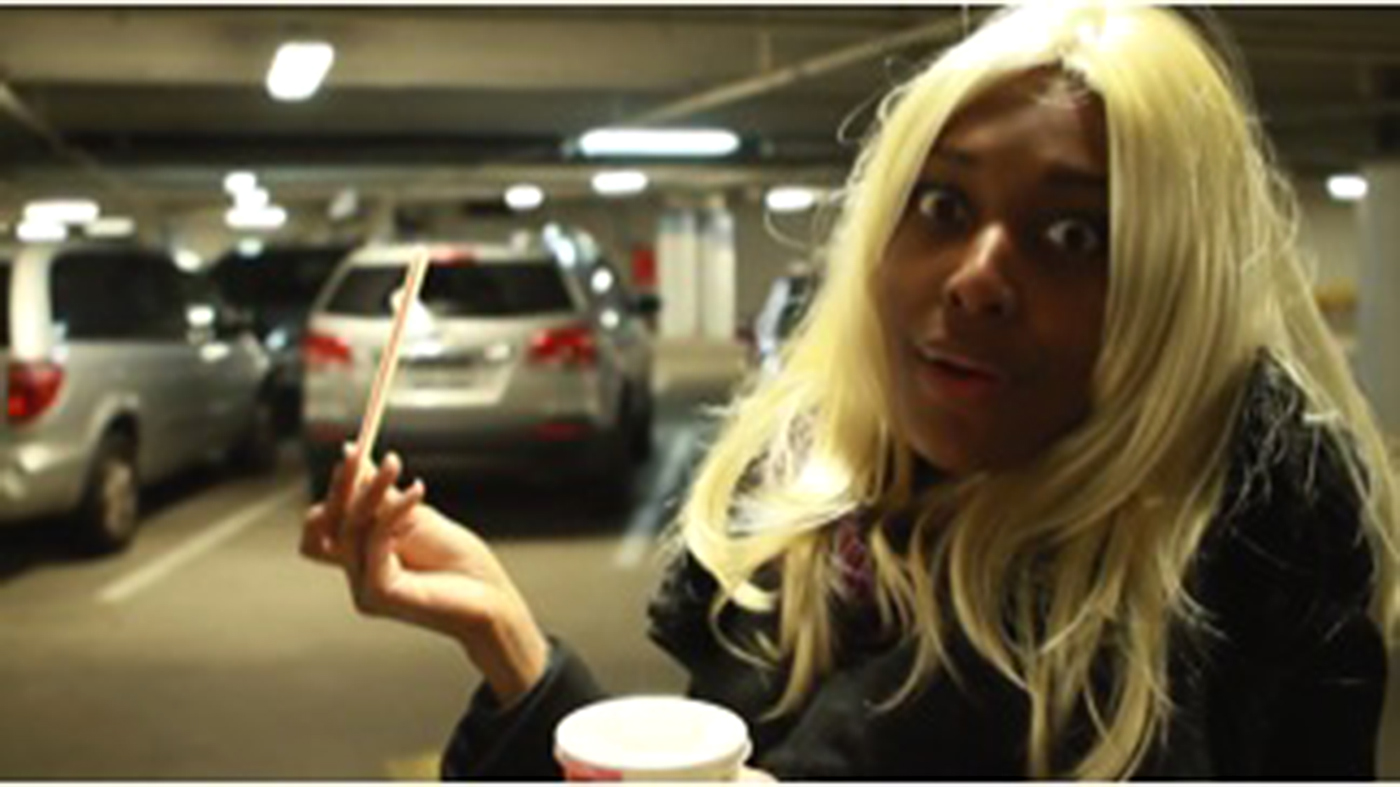
Creaky voice is also salient in the stylization of the white girl persona in Shit white girls say to Latinas. In this video, the white girl, played by Christina Igaraividez, also wearing a platinum blonde wig, repeatedly fetishizes comestibles ideologically linked to Latin America—including tacos, chimichangas, and tequila. She also explicitly exotifies the addressee's heritage, shown in (7).
(7)
White Girl: oh you're from Ecuador
how exot~ic~
Creaky voice occurs at the end of a L*+H L-L% (rising followed by falling) contour in the production of the word exotic (Figure 4). Dynamic use of pitch range and creaky voice quality prosodically mark and, ironically, exotify the white girl's use of the term exotic. The Ecuadorian Latina addressee is positioned as ‘exotic’ in the context of the white girl's ideologies of hegemonic whiteness and US nationalism.
“How exotic”.

In these examples, prosodic features such as nonmodal voice qualities, dynamic intonational contours, and dramatic use of pitch range draw the listener's attention to association between the white girl persona and practices that exotify black and brown women relative to white hegemonic notions of femininity.
In Shit white girls say the use of tag questions indexes the linguistic style associated with the white girl persona, while also parodying her attempts at forming social alliances with girls of color. As grammatical resources, tag questions occur at the end of statements and can turn declaratives into interrogatives (e.g. “right” in “I know, right?”). As a conversational convention, they attempt to elicit social alignment by coordinating the addressee's agreement toward the validity of the utterance (M. Goodwin Reference Goodwin1990). In the examples below, they construct the white girl as hungry for constant social alliance with girls of color, but clueless about how racist and offensive she is. For example, Franchesca satirizes tag questions that occur in conjunction with reductive statements about black people.
(8)
White Girl: sohh cute for a black guy ↑
right ↑
The implicit underpinnings of this claim are that the guy is an exception to an unstated rule that the white girl does not usually find black guys to be “cute”. The tag question “right?” elicits an affirmative response from the black girl that would not only confirm that the individual in question is cute, but also the racist ideology proposed by the speaker: that a “cute” black man would be an exception to an unstated rule. The same occurs in the following example where the white girl elicits alignment about the notion that she likes a group of people because “they're not like stereotypical like black people”.
(9)
White Girl: I think what I like the most about them is they're not like
stereotypical like black peo~ple~
[steɪɚioʊtɪpɪkl]
you know what I mean ↑
The tag question “you know what I mean?” elicits alliance not only toward the proposal that the individuals in question are likeable, but to the white girl's proposition that they are likeable because they are exceptional in transcending her racist notion of stereotypical blackness. The expectation of alliance implied in this tag question is further emphasized through shifts in Franchesca's gaze.
In Figure 5 Franchesca looks away from the addressee toward the ceiling. In Figure 6 her gaze shifts toward the camera, and thus toward the viewer who is in the position of the black girl. These shifts in gaze are embodied resources that parody the white girl's inane reproduction of the marked status of blackness relative to her unmarked whiteness.
“Stereotypical like black people”.

“You know what I mean?”.

Franchesca and Christina both use vowel elongations as a resource for drawing attention to a relationship between the white girl persona and the appropriation of the experiences of girls of color, also in the context of clueless attempts at social alignment. In Shit white girls say to black girls the white girl shows off her tan and claims that she and the black girl are “twinsies”—with a hyper-elongated /i/ sound.
(10)
White Girl: oh my god I'm practically Black
twinsi:::es
hha
The diminutive sound -ies at the end of “twinsies” is drawn out for 0.63 seconds through the high-pitched H-L% (high, flat) boundary tone (Figure 7).
“Twinsies”.

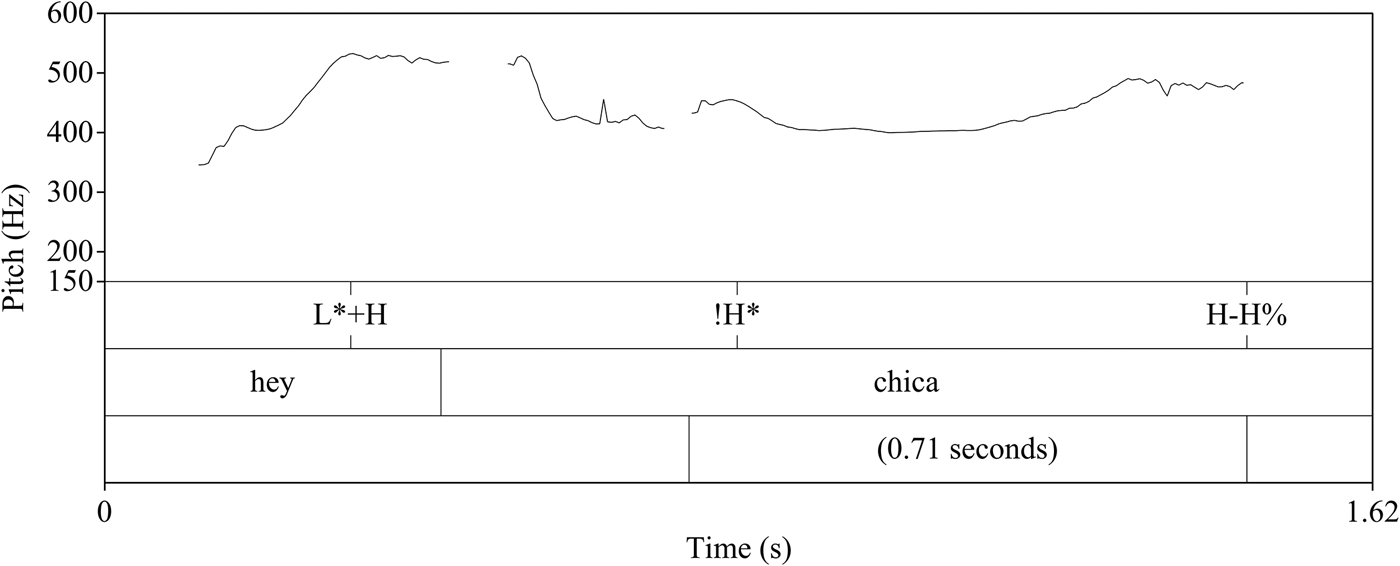
The same occurs in the following example from Shit White Girls Say to Latinas when the white girl uses Mock Spanish to greet her friend. The final vowel in chica is held for 0.71 seconds through a rising H-H% boundary tone (uptalk) (Figure 8).
“Hey chica”.

In these examples and throughout the Shit white girls say genre, the white girl persona's orientation toward girls of color is a site of mockery. She positions the black and Latina girls as her friends, but is naïve about the racist implications of the shit that she says. By assuming the same white girl persona through parody performances, Franchesca and Christina humorously draw attention to the ways that black and Latina girls are subjected to white supremacist ideologies through everyday interactions with white girls. Ventriloquation of the persona is a means of positioning her as a cultural object that represents the normalization of racist encounters that girls of color experience in white public space (cf. Hill Reference Hill1998). Shit white girls say thus flips the exotifying white gaze to draw attention to white hegemonic racism. By calling out the everyday practices that mark the embodied, linguistic, and social experiences of girls of color as nonnormative, use of the white girl persona also satirizes cultural practices that standardize white girls’ experiences as representative of all girlhoods.
Mock white girl in teenage girl problems
Brandon Calvillo is an internet celebrity who gained notoriety through the social media platform Vine. This video-based application, which was discontinued in 2016, allowed users to share six-second clips. Brandon's Vine account was one of the website's most popular, with over 5.5 million followers. His videos were based around recurring characters and thematic stories, including a series called Teenage girl problems. In these videos Brandon shifts into MWG to create the character Ashley, an expressive, vapid, and emotional teenage girl. Each of the Teenage girl problems videos tells a short story of Ashley's attempts at navigating (social media-based) relationships with her friends, crushes, and her mom. Brandon's stylization of Ashley's character draws from the stereotypical white girl persona: she is excessively dependent on her peer social group, excessively consumerist, and excessively emotional. Some of the videos portray Ashley and her friends as hyper-concerned with expensive commodities like iPhones, while others draw from contradictory stereotypes associated with teen girls as being catty, competitive, dependent on girlfriends, and boy-crazy. In all cases, the persona is stylized in a way that represents teenage girls’ problems as superficial and inherently humorous.
In one example, Brandon plays himself talking to Ashley about high school (Calvillo Reference Calvillo2013a). The video cuts to differently angled shots of Brandon, who style shifts into MWG when voicing Ashley.
(11)
Ashley: oh my god
high school is so hard
Brandon: you mean not having to work pay bills
or have any major responsibilities
Ashley: hhh ~yeah~
[jɑ]
As Ashley expresses her discontent for high school she blinks excessively, bounces her head, and rolls her eyes toward the ceiling (Figure 9).
Ashley's expression during “oh my god”.

In contrast, Brandon speaks slowly, articulates carefully, and maintains a consistent low pitch while trivializing Ashley's complaint in his questions about her lack of responsibilities as a student. Brandon's facial expression remains serious throughout the clip, and his gaze is unwaveringly directed at Ashley (Figure 10).
Brandon's expression.

The white girl persona is stylized through Brandon's embodied gestural bounciness during the MWG performance, compared to the lack of movement in his nonmock performance. This variation in embodied gesture is mirrored through differences in pitch range between the two character-types. In the nonmock performance, Brandon's minimum pitch is 97 Hz and the maximum is 217 Hz. In MWG the minimum is 116 Hz and the maximum reaches 452 Hz. The layered semiotic parallelisms (Mendoza-Denton & Jannedy Reference Mendoza-Denton and Jannedy2011) of Brandon's pitch and gestural movements highlight Ashley as capricious and inattentive. Brandon is a consistent and percipient voice of reason to the teenage girl's voice of ignorance.
Brandon's MWG performances position the white girl persona as exceptionally attentive to her position in her homosocial peer group, conformist to the norms of the group, and dependent on it for feedback and validation. In a video titled Two teenage girls watch Vines together (Calvillo Reference Calvillo2013b), Brandon and his brother Jesse appear as Ashley and a friend. The characters both clutch material objects iconic of the persona: Jesse's character (Girl Friend) sips on a Starbucks Frappuccino while Ashley holds an iPhone. The girls have just seen something on the phone, and are excited to share it with their friend group.
(12)
Ashley: oh my god
like this is SO us
Girl Friend: oh my god I know
Ashley: oh my god we have to text Steph~anie~
[stεfəni]
Girl Friend: and Bethany
[ænd bεθəni]
Ashley: and Mela~nie~
[æn mεləni]
Girl Friend: and Tiffany
[ænd tɪfəni]
Ashley: and Brittany
[æn brɪtne:]
Ashley defines the video as “so us” in that it represents some aspect of the girls’ communal identity. In delineating the social boundaries of the friend group that indexes the “us” represented by the content on Ashley's screen—the friends who they “have to” share it with—Ashley and Girl Friend name the relevant members of their peer group: Stephanie, and Bethany, and Melanie, and Tiffany, and Brittany.
The girls’ friend group is maintained through the smartphone and they are dependent on this virtual connection for sharing their identities when they cannot be in one another's physical presence. The extreme connection is emphasized even through the most individualized features of those who constitute the group, their names, because each listed member's name ends with the same /əni/ sound. As they name each girl, Ashley and her friend demonstrate what Marjorie Goodwin describes as format tying (Reference Goodwin1990:177–85) by complementing one another's prosodic structure. Every time Ashley's intonation goes down her friend's goes up (Figure 11).
“Stephanie, and Bethany, and Melanie, and Tiffany, and Brittany”.

Salient stereotypes of the white girl persona as vapid and excessively conformist coalesce in Brandon's video A teenage girl hates cigarettes (Calvillo Reference Calvillo2015). Ashley emerges in a notably different social setting—she is attempting to flirt with a boy in real life, as opposed to meticulously crafting conversations through social media and text messages. The video begins zoomed in on a boy sporting a gelled hairstyle iconic of contemporary boy bands, or nonchalant masculine social media personalities. He wears trendy sunglasses that match his trendy hair, and a cigarette hangs from his trendy mouth: he is cool. As the camera zooms out we hear Ashley attempting to match the mysterious cool boy's level of effortless sophistication as she leans against a wall with her arms crossed. She gazes directly at the cool boy and tries to strike up a casual conversation about his cigarette.
(13)
Ashley: oh my god you're smoking cigarettes
don't you know how addicting those are
wait a second where's my phone
where's my phone
I have to check SNAPCHAT
where's my phone
WHERE'S MY PHONE
Though the dialogue begins with the same “oh my god” onset as all of Brandon's previous Teenage girl problems videos, Ashley speaks much more calmly. At first, her attention is on the cool boy, rather than on herself. Brandon still stylizes Ashley using features indexical of the white girl persona, but for a moment she is notably removed from her normal context as a member of a girl group—she's acting alone. Even her pitch, though still recognizably bouncy, is more constrained in its dynamics (Figure 12) as she addresses the silent boy.
Ashley's pitch and movement.

Alas, despite her best efforts to act cool and collected, Ashley's true nature is revealed when she realizes that she does not know where her phone is. The discourse marker wait a second signals a contextual shift as Ashley's attention physically and discursively moves away from the cool boy. She frantically uncrosses her arms, puts her hands on her pockets, and asks, “Where's my phone?”. The teenage girl is immediately placed back in the metaphorical context of her peer group upon realizing that she does not know where her phone is. She is isolated from her friends, a state that causes her to physically flee the situation. Through the rest of the video, her panic increases alongside her pitch and her location in the space of the frame.
Figure 12 maps Ashley's rising pitch onto the concurrent spatiotemporal movements as the video progresses from her cool flirting, to the realization that she has lost her phone, to a frantic loss of control. Ashley becomes so hysterical by the end of the video that she attempts to jump over a gate, a visual barrier keeping her from her virtual peer group. The ascending anxiety is paralleled in her intonation. Upon realizing that she cannot engage with the material technology that connects her to her social world, Ashley illogically jumps onto the fence rather than using the door handle. She has not only lost her cool, she has lost herself.
The teenage girl is addicted to her phone and the high of the social interactions that it provides her. The phone acts as a medium for consuming the euphoria of her social media relations and without it she goes through chaotic withdrawals—just as the cigarette acts as a medium for consuming nicotine, calming the embodied cravings of addiction. In experiencing disembodiment from her drug of choice, Ashley chaotically loses touch with herself and with reality. Attention is diverted away from the cool boy. Intonation patterns fluctuate in dramatic, seemingly out of control patterns, especially relative to the constrained patterns of the preceding conversation. Her body flies toward the top of the gate which she struggles to pull herself over. The teenage girl is no longer stable because her identity depends on constant social alignment and interaction with her peer group. The teenage girl cannot function without the teenage girl group.
In each MWG example of the Teenage girl problems genre the white girl persona is positioned as trivial, irrational, and comical. The teenage boys imbue the persona with these meanings through ideological stances that reproduce widely circulated stereotypes that stigmatize girlhood. Girls’ homosocial groups and peer relationships are especially delegitimized as sites of serious cultural production. Teenage girls problems MWG parody a register associated with a very specific type of girlhood, but the performances are framed as representative of all teenage girls, perpetuating representations of girlhood as a homogenous social category.
Conclusions
This article has examined variation in how the same persona and its associated semiotic resources are imbued with meaning vis-à-vis the ways that it is taken up and (re)produced among different groups of social actors. Individuals in each genre of MWG take ideological stances relative to the white girl persona through parody performances, and the ways that white girl is rendered socially meaningful varies between contexts. In Savior MWG, this person type is identified as childish, unprofessional, and in need of salvation to be effectively socialized into middle-class professional life. Shit white girls say parodies the persona as a means of drawing attention to the ways that girls of color are subjected to racism during quotidian interactions with white girls. The persona in Teenage girl problems is a vehicle for trivializing girls’ peer groups and homosocial relationships. White girls in the United States do not mean the same thing among all social actors who overhear them. Further research on the ways in which the white girl persona is positioned through mock, as well as metalinguistic commentary, would undoubtedly reveal social meanings different from those discussed here.
MWG performances give insight into the dynamic, changing, and evolving position of middle-class white girls in modern United States ideology and society. The savior's anxieties about the sounds of the register as a barrier to upward mobility reflect the visibility and audibility of these girls in middle-class professional spheres that were once reserved for middle-class white men. The success of the Shit white girls say videos calls out white girls’ contributions to maintaining and benefiting from white hegemonic ideologies and racism. While the privileges and visibility associated with whiteness and control of financial resources undeniably grant significant advantages to middle-class white girls, Teenage girl problems performances reveal the same anxieties that fuel savior ideology: their voices are easily delegitimized because they do not sound, look, or socialize like middle-class white men.
Appendix: Transcription conventions
- ↑
rising intonation
- ~bold~
creaky voice
- hh
breathy voice
- (.)
brief pause
- :
elongation
- CAPS
increased amplitude
- [IPA]
phonetic transcription