Since the advent of the large-N survey in the mid-twentieth century, the study of voting in the United States among political scientists has progressed along two conceptually distinct tracks. The social-psychological approach, exemplified by The American Voter, Footnote 1 forwarded a “funnel of causality” model based on social group identification. Based on some of the earliest survey data from elections in the 1940s and 1950s, this social-psychological approach originated in response to findings that the mass public lacked consistent ideological belief systems.Footnote 2 Explanations of voting as a function of party identification were developed before the enactment of federal voting rights legislation, prior to party realignment among voters in the American South, and during a time in which nine out of ten Americans were white. At the inception of the American National Election Study (ANES), and despite the explicit and strong expression of racial antipathy against Blacks among some whites, group identification was conceived as tied to partisan identity alone. Identification with political party was hypothesized to be of primary significance and decades of subsequent research confirmed the importance of this group identity to voting in the United States.
By contrast, rational choice theories of voting emphasize the relevance of utility-based action. These approaches to voting behavior are exemplified by “spatial models” of voting that place voters and their choices (candidates or policies) into the same issue space, with the former casting ballots to maximize their utility by choosing the candidate or party that is closest to their own policy preferences.Footnote 3 In this basic framework, parties and candidates are assumed to have little constraint in their ability to move ideological positions strategically. Spatial models have been applied to explain the behavior of elites and elected officials and ordinary voters in the mass public.
The enduring legacy of these two important perspectives is visible in contemporary scholarly and popular analyses of electoral politics and voter choice. Explanations for voters’ behavior find support in both social-psychological and utility-based approaches.Footnote 4 Political party identification remains among the most important correlates of candidate choice, echoing the group attachment perspective. Democrats vote for Democratic Party candidates and Republicans vote for Republican Party candidates at similar and high rates of party loyalty. Voters also continue to choose candidates based on issues and policy positions as is consistent with a utility maximization approach.
Over the last five decades the U.S. population and political parties have undergone substantial change. A variety of issues including immigration, health care, trade, LGBT rights, affirmative action, income redistribution, terrorism, reproductive freedom, and environmental protection create crosscutting cleavages that complicate models of voting based solely on party identification or one-dimensional ideology. The invention of the terms “Reagan Democrat” and “working class Republicans” has driven a cottage industry of analysts explaining “what’s the matter with Kansas.”Footnote 5 Motivating this line of research is the purported irrationality of lower middle-class white Americans—the so-called “white working class”—who support the Republican Party even when its policy positions seem inimical to the material interests of this group of voters. Indeed, the victory of Republican Party candidate and political newcomer Donald Trump in the 2016 U.S. presidential election has amplified the disquietude and puzzlement regarding the motives of white voters in the United States, a demographic group representing the candidate’s base of supporters.
Both the social-psychological approach of group identification with a political party and the rational choice model built on utility maximization contain important insights about political behavior, but these explanations alone are limited in their ability to account for the dynamism in voting behavior observed in contemporary U.S. politics. The American polity has undergone substantial change both in terms of racial diversity, expansion of the franchise, and the composition of the two major political parties since these theories were first proposed. In the mid-1960s, landmark federal legislation governing immigration and suffrage set in motion changes in the racial and ethnic composition of the U.S. voting population. African American voters moved from the party of Lincoln and consolidated behind the modern Democratic Party, and once heavily disenfranchised black voters in the South now post turnout numbers as high and often higher than white voters in presidential elections.Footnote 6 In contrast, white southerners—stalwart supporters of the Democratic Party since the Civil War—made a set of dramatic changes in party loyalty away from the Democrats to pro-segregationist Dixiecrats and then to the Republican Party during the U.S. Civil Rights Movement.Footnote 7
At the same time, new Americans from Latin America, Asia, the Caribbean, Africa, and Europe, including both naturalized citizens and the native-born children of immigrants, entered the voting population in record numbers thereby transforming the ethnic and racial composition of the polity from the black-white binary of the 1960s to a multiracial electorate where more than one-quarter of eligible voters today are categorized racially as something other than white. These dramatic changes in the racial composition of the American electorate and the growing allegiance of voters of color with the Democratic Party are creating a context for white voters distinct from the previous and longstanding circumstance of white voter dominance in the 1950s and 1960s where whites were more evenly split across the two major political parties.
It is precisely because of changes in the U.S. political environment that scholars need to update their approaches to analyzing voting behavior by considering perspectives ordinarily not used together, and by learning from allied disciplines including sociology, economics, psychology, law, gender and ethnic studies, and history. In this article, we draw from these fields and articulate how utility associated with white racial identity can affect voting and candidate choice. In so doing we illustrate a two-dimensional spatial model of racial identity among white voters that combines a social-psychological approach of group membership with a rational choice perspective that focuses on the utility received from racial identity. To understand how racial identity can shape preferences among some whites, its utility must be understood within the context of the privileges associated with being white in American society.Footnote 8
We argue that racial identity among whites can be thought of as a utility-based trait relevant to decision-making in U.S. elections. Rather than treating voters as ignorant or mistaken if they support Republican Party candidates despite material interests that might align them with the Democratic Party, for example, we argue that the expression of white identity can be conceptualized as a utility-based behavior and should therefore be modeled as such. This perspective provides wider conceptual latitude for behavioral explanations, and welcomes the identification of model specifications that treat racial identity among whites as independent variables rather than as part of the error term. Before proceeding to the argument and illustration, we state three important priors about racial categorization, the meaning and measurement of white racial identity, and the relationship between ethnic and racial identity for minorities versus the default category of whiteness.
With respect to racial categorization and the classification system in the United States, our position is consistent with leading perspectives in social science that emphasize how race is formed and socially constructed rather than having a formal basis in biological science.Footnote 9 Nevertheless, we assume that both ascriptive racial classification and self-described racial identity can have meaning and political consequences for behavior and attitudes at the individual level. Indeed, precedent for the relevance of racial identity to voting behavior can be found in research on U.S. minority politics and in particular Michael Dawson’s conceptualization of the “black utility heuristic” in the form of African American racial group linked fate.Footnote 10 This concept of racial group identity has been applied to other minority groups including Asian Americans and Latinos.Footnote 11 The application of a rational choice perspective to the phenomenon of white racial identity and its implications for voting behavior in the United States, however, is novel. Economists have developed the idea of identity with respect to utility,Footnote 12 and political scientists have modeled the significance of shared race, language, and religion with political party, for example, in comparative politics.Footnote 13
The notion that white racial identity is associated with utility for some individuals does not imply that white racial identity is normatively appealing. Indeed, when any group-based identity is utilized to inflict harm or justify violence, civilized society stands as one in condemning such behavior. The utility gained from the material value of whiteness has been identified by sociologists, historians, and legal scholars, and these studies provide guidance on both the origins and the desirability of white racial identity under these circumstances.Footnote 14 Instead the purpose of articulating the utility basis of white racial identity is to consider it as an explanation of voting behavior.
In terms of the meaning and measurement of white identity beyond powerful conceptions of whiteness as property and privilege, new work among political scientists identifies racial group solidarityFootnote 15 and group competition with minorities as a catalyst for white identity.Footnote 16 We do not take a substantive position on either the meaning or measurement of white racial identity, and instead, invite empirical research and conceptual studies of the contours, variation, dynamism, and intensity of white identity in U.S. politics. In this regard, we do not see white racial identity as a simple variant of ethnic and racial identity among U.S. minorities, but instead as situated within the context of whites as the dominant category in the racial hierarchy throughout the history of the United States.
Building off these assumptions and the important work that has come before us in the social identity approach, the utility maximization perspective, and the importance of racial identity, we next discuss the utility of racial group identification among white Americans for vote choice. We argue that political scientists should take the idea of white racial identity in U.S. politics seriously to better understand the dynamics of voting behavior in an increasingly diverse American electorate.
The Political Utility of White Racial Identity
Political scientists have long acknowledged that group identity plays a considerable role in politics and voting. Empirical scholars in political science who study racial identity within the U.S. context have not typically considered racial identity among whites to be related to their political behavior. On the other hand, utility-based models of behavior explicitly consider how different factors affect choices, but such approaches have mostly disregarded the role that identity in a variety of forms can play in a voter’s utility function. This idea builds on recent work in economics that theorizes the importance of identity for choice.Footnote 17 Rather than consider identity as unrelated to utility, identity economics takes seriously preferences based on the psychology of group membership.
Incorporating identity into a utility function rather than treating it as a taste which then is enveloped into the error term is an idea pioneered in economic research by Akerlof and Kranton, who argue that “the incorporation of identity and norms then yields a theory of decision-making where social context matters.”Footnote 18 Political scientist Carole Uhlaner’s incisive work on relational goods is consistent with this perspective.Footnote 19 The theory of identity economics takes explicit exception with the common assumption within economics that taste is independent of social context. Instead, it is precisely this context of norms that form expectations for individual behavior based on group membership. “People’s identity defines who they are—their social category. Their identities will influence their decisions, because different norms for behavior are associated with different social categories.”Footnote 20 The utility function, therefore, captures the motivation to adhere to or deviate from the norms of the identity category within a particular social context.
An individual—in the absence of others—enjoys a gain in “identity utility” when she adheres to the norms for her category. But again, we have a more expansive view. This gain in utility can represent the enjoyment people experience when they do something that makes them fit in with a group. It also can represent the gains from differentiating one from another. The utility then derives from group processes.Footnote 21
Thus, rather than assume that tastes, and by extension identity, are universal and that variation is the result of idiosyncratic individual differences, Akerlof and Kranton assert a systematic and utility-based relationship between identity and social context. Applied to racial group identity and political behavior, then, identifying with one’s racial group is therefore neither deterministic nor random, and its potential relevance presents an opportunity for explaining variance in partisan and candidate vote choice. Identity at the individual level can change both within a person and in context, and at the aggregate level is distributed in probabilistic rather than deterministic fashion.
The importance of social context and the relationship between group membership and behavior is of course not a new idea; sociologists and psychologists have built robust fields of study from the observation that individuals do not exist in isolation from one another. As Herbert Blumer famously noted, thinking relationally “also shifts scholarly treatment away from individual lines of experience and focuses interest on the collective process by which a racial group comes to define and redefine another racial group.”Footnote 22 In other words, individuals understand their identity in relation to other groups of individuals juxtaposed outside of their group.Footnote 23 Similarly, social psychological research conceives of social identity at the individual level as relational, embedded in social context, and driven by, among other things, the imperative of enhancing self-concept. Once defined, in-groups and out-groups jockey to maximize status, whether the groups are defined by eye color, assignment as prisoner or guard, or racial classification as black or white.Footnote 24 At the same time, all social identities are not the same, and Marilynn Brewer’s work on “optimal distinctiveness” pushes analysts to consider the dynamics of group identity where simultaneous needs for distinctiveness from others and assimilation with a specific group must be reconciled.Footnote 25 Similarly, political scientists have long recognized and analyzed the significance of social context and group-based imperatives to political behavior and attitudes.Footnote 26
Influential as they are, these perspectives have largely been held in abeyance in voting behavior research, and the impact of context is typically incorporated into individual-level models of voting as “control” variables. In this regard, social structural relations are frequently accounted for in models as dummy variables representing being married or female or college-educated, for example.Footnote 27 Specified as such, and absent interaction terms, each control variable is estimated to have a distinct and homogenous influence on the behavior in question. This strongly agency-based analytical strategy has proven to be popular and effective in political science research, particularly when the goal of analysis is to explain individual-level decisions on vote choice. However, there is an important perspective missing from this tradition that follows in the line of some of the most influential work in allied disciplines of economics, sociology, and psychology: the recognition that agency is unequal at the individual level. As a result, identity among individuals arrayed differently in hierarchical group relations, may have correspondingly distinctive effects in utility functions. For political scientists, these venerable social scientific traditions are a potent reminder that identity and social context are important reflections of the structure of economic markets, societal organization, and inter-group relations. In a word, power is at stake in identity in politics, and specifying the utility of white identity for individual-level political choice must take into consideration the structure of group relations, the political institutional context of group identity, and the legacy of their historical formations.Footnote 28
With respect to white racial identity and its potential relevance to political behavior, Americans who identify racially as white do so in a social context in which the category of white is defined in relation to other categories of race and ethnicity. Indeed, one could argue that in politics, group identity at the individual level can best be understood in comparison to that in which one is differentiated.Footnote 29 Being categorized as white and having an identity with this classification is dependent on a context forged by historical circumstances that have simultaneously influenced and structured political institutional practices.Footnote 30 Throughout the history of the United States, whites have been defined as white as distinct from other less desirable groups. Among the most useful examples of this phenomenon is the elevation of white ethnics—Irish, Italians, Slavs, and Jews—from “less than white” in the late-nineteenth and early-twentieth centuries to the status of white only after distancing themselves from blacks.Footnote 31
Racial formation and categorization in the United States has involved hierarchy formation, reformation, and maintenance, with whites at the top of the racial order and those other than white further down in structural position.Footnote 32 Theories of the racial triangulation of minority groups provide further insight into the development and maintenance of the racial hierarchy.Footnote 33 Similarly, empirical studies in sociology and political science have demonstrated the recognition of racial and ethnic identities among individuals and their location in the racial hierarchy.Footnote 34 The political behavior of racial and ethnic minorities is driven to varying degrees by their recognition of this positionality and group linked fate.Footnote 35 Indeed, earlier behavioral perspectives on group consciousness in political science linked identity to subordinate status and deprivation.Footnote 36
In contrast, there are relatively few contemporary studies in political science about white racial identity in the tradition of large-N survey data,Footnote 37 though the study of white racial attitudes in political science is vast and longstanding.Footnote 38 White identity has not been measured in the same way as it has for minority Americans in surveys until recently because of an underlying normative bias evaluating the expression of closeness to white race as pathological, indicative of Jim Crow-style racism. Indeed, the concept of racial identity for white Americans is freighted with the legacy of slavery and the institutionalization of white privilege.Footnote 39 While the ignominious history of white supremacy makes this position undesirable, it is certainly not the only way to think about racial identity for whites. Instead, perceptions of linked fate with other whites or a sense of oneself in terms of being classified racially as white may be distributed across the population in identifiable ways. The contours and covariates of white racial identity are empirical queries best addressed with systematic data.
In an important article on white racial identity, Wong and ChoFootnote 40 demonstrate that a sense of racial group membership is in fact a meaningful identity with variation among whites, though necessary to be activated to have relevance to political choice. New scholarship in political science focusing on opposition to black political leadership among whites has also identified the role of fear and in-group processes,Footnote 41 in addition to existing work on the heuristics of demographic similarity in vote choice.Footnote 42 Similarly, scholarship in sociology provides important insight into the contours of survey measures of white identity, highlighting its bimodal distribution and differentiating between “defensive” and “progressive” white identity,Footnote 43 with the former reacting to perceived threats and the latter signifying a recognition of the privileged position of people classified as white. Similarly, social psychologists have studied the measurement of white racial identification as well as analyzed the significance of the framing of identification among whites.Footnote 44
Recently the opportunity to ascertain the degree of white racial identity using several survey questions became available when researchers included questions in the 2012 American National Election Study (ANES). One question asks about racial group linked fate, and is modeled after Dawson’s “linked fate” questions that measure what he described as the “black utility heuristic.” Among whites in 2012, 62% said they think what happens to white people in this country will have something to do with what happens in their life. By comparison, 65% of African Americans and 51% of Latinos answered similarly. These basic results demonstrate that white racial identity as measured with this question is neither non-existent nor universal.
The racial linked fate measure asks specifically about whether outcomes for an individual relate to outcomes for the group, and on its face captures an important element of utility.Footnote 45 At the same time, this question about racial group linked fate is only one possible way to measure racial identity, and some scholars have taken issue with its construct validity.Footnote 46 We take no position on the best way to measure white racial identity, and consistent with Akerlof and Kranton, leave this decision up to further research:
This methodology then avoids semantic debates, such as ‘What do we mean by identity?’ If someone else should make another model and define identity differently, we should be equally willing to entertain her definition. The real debate is deferred to a different stage and can only be resolved empirically: does the model, with the new identity part, reach new and revealing conclusions?Footnote 47
The key argument is that researchers should recognize that racial identity among whites can have utility, and then theorize and model the impact of white identity on voting decisions in U.S. elections. There are numerous reasons why white identity could have political utility. For example, both Jardina and Hutchings and his colleagues have argued in a recent set of papers that white identity is activated through perception of group solidarity and competition.Footnote 48 Wong and Cho suggest that while white identity was not salient to politics in the time of their data (1972–2000), it could be sensitive to the political environment and activated by demagogues. These are both strong possibilities that, we think, reside in a more general understanding of group hierarchy and status anxiety.
Additional support for the notion that group identity is activated under threat can be found in the incisive work of sociologist Roger Gould, who argued persuasively that status anxiety results when hierarchical relations undergo change and challenge a well-established order. Conflict increases under conditions of social and political instability, and anxiety is a result of uncertainty about relative group status.Footnote 49 Alternatively, one can also look to economics for conceptual guidance, and particularly to the pioneering work of Thomas Schelling. In Schelling’s formulation, even a small preference for a similar racial group at the individual level can drive macro-level outcomes in patterns of residential segregation.Footnote 50 The same phenomenon of slight preference for a candidate of the same racial group may also apply to vote choice among whites. Other work on social identity with co-partisans and its relationship to political polarization provide conceptual guidance about the relevance of in-group affective mechanisms.Footnote 51
Conceptualized in the way Gould theorizes status anxiety, or alternatively in Schelling’s rendering where even small individual preferences for similarity drive larger change, both the origins and reasons for adopting white racial identity are potentially wide ranging, implicating individual-level phenomena as well as aggregate-level dynamics. Nevertheless, and while most aspects of group affinity and racial identification with whites might very well be rooted in racist, anti-Black, or negative out-group affect, white racial identity could develop and be maintained by a combination of many factors. Additional conceptual work followed by empirical testing of the contours of white racial identity will be necessary before inferences can be drawn about the impact of this social group identity for political behavior.
To the extent that the factors underlying racial group identity relate to preferences and can be modeled in individual utility functions, the role of white racial identity is worth considering in analyses of voting. Equally important, if group identification based on race is a valid explanation for minority political behavior (while being explicit about the group position of minority Americans below whites in the racial hierarchy), then researchers should consider what effect racial group identification has on political outcomes for white Americans in an electoral context of growing racial diversity. As the spatial model in the next section will illustrate, racial identity can provide an account of why white voters may prefer a candidate who differs from them on ideological grounds but is more similar in terms of racial identity.Footnote 52 Some white voters might develop stronger racial group identity in the context of a rapidly changing political context that includes larger numbers of racial and ethnic minorities and the first African American U.S. president.
An Illustration of White Racial Identity in Two-Dimensional Space
Recent research in political science has provided various empirical demonstrations of white identity and its relationship to voting, but white identity has not been well connected to a theoretical framework. In this section, we illustrate how racial group identification among white voters can be conceptualized in a two-dimensional spatial model along with ideology to clarify how both can affect voter decision-making. Instead of being treated atheoretically in empirical research, treated as part of the error term, or as a pathological idiosyncrasy, white racial identification can be analyzed in conjunction with ideology, another of the most important antecedents of candidate choice in American elections.
A spatial model can be useful in situations where it is reasonable to assume that individuals (voters) have preferences that can be arrayed in single or multi-dimensional space and the choices (candidates or policies) can also be arrayed in the same dimensional space. In spatial models, voters derive utility from their choice or from the outcome of collective decisions, and the utility received from a choice is proportional to the distance between the decision-maker’s location in the single or multiple-dimensions and the position of the candidate/policy. Therefore, as we describe more fully later in this section, a utility-maximizing voter will choose the candidate that provides the greatest utility when considering both the ideological and racial identity dimensions of the vote choice.Footnote 53
Spatial theories of voting have been widely used both to explain voting behavior in legislative institutions and popular electionsFootnote 54 and to develop measures of the preferences of decision-makers and predict their behavior.Footnote 55 At the core of a spatial model is the concept of a utility function that provides a mapping between a voter’s preferences and the utility received from the choices. Spatial models have been useful in helping to conceptualize the likely outcomes of an election,Footnote 56 the tradeoffs that voters face when there are multiple dimensions of a policy choice, and the intersection of policy and non-policy attributes (such as a politician’s competence) that may affect voting.Footnote 57
Spatial models have not been applied to group identity, but there is no inherent reason why identity cannot be modeled in this manner. If we can conceive of identity as existing along a continuum, even if measured imperfectly, and if people derive utility based on their identity and its relationship to a political choice, then we can use a spatial model to conceptualize the relationship between racial identity and a voting choice.
A basic one-dimensional utility function is:
 $${U_i}({X_i}) = - {({C_j} - {X_i})^2}$$
where X i is the voter’s ideal point in a one-dimensional policy space (for instance, Xi could represent the voter’s preferred level of government intervention in the economy), and C j is a candidate’s location in the same one-dimensional policy space. This formulation assumes a proximity model in which deviations from an individual’s ideal point are equal in their effect on utility rather than accounting for the direction of the deviation.Footnote 58 In deciding for whom to cast a ballot, a voter compares the utility derived from the different candidates and votes for the candidate (C j) that maximizes U i, which implies voting for the candidate that is closest to her own ideal point (X i) along the dimension under consideration.
The choice space can also contain more than a single dimension and voters’ utility can depend on their and candidates’ location in multiple dimensions. We focus on two dimensions—political ideology and racial identity in this illustration. In two dimensions we need another term in the utility function, and to allow the importance of the dimensions to vary across individuals we add individual weights to each dimension, which reflect the possibility that the two dimensions are not equally important to all voters. The utility function then is:
 $${U_i}({X_i},{Y_i}) = - {{\it \islant20%\alpha} _i}{({C_{j,x}} - {X_i})^2}{\rm{ - }}{{\it \islant20%\beta} _i}{({C_{j,y}}{\rm{ - }}{Y_i})^2}$$
where Xi, Yi represent a voter’s ideal points on the X and Y dimensions, C j,x is a candidate’s position on the X-axis and C j,y is a candidate’s position on the Y-axis, which together describe the candidate’s position on these two dimensions.Footnote 59 The αi term represents the weight that a voter attaches to the X-dimension and βi represents the weight the voter attaches to the Y-dimension. The presence of these weights means that each dimension can contribute differentially to a voter’s utility.Footnote 60 If α=β, then the two-dimensions are equally weighted in the voter’s utility function; and if α> β then the X-dimension is more important to the individual’s utility function than the Y-dimension and vice versa if α<β.Footnote 61
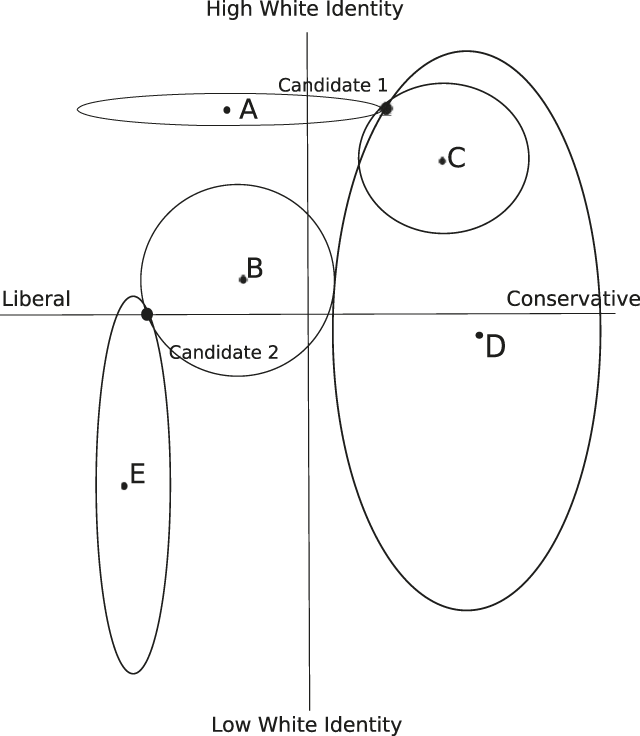
Figure 1 illustrates the interplay of ideology and white racial identity in candidate choice among a set of hypothetical voters evaluating two candidates. The left-right dimension in figure 1 captures the standard liberal-conservative ideological dimension in U.S. politics, and the vertical dimension represents white racial identity from low to high.Footnote 62 Two candidates are placed in this space. Candidate 1 is high on white racial identity and slightly more conservative than liberal ideologically. Candidate 2 is lower on racial identity and much further to the left ideologically than Candidate 1. In this two-dimensional space are hypothetical voters, A, B, C, D, and E. Each voter has an ideal point as well as an indifference curve showing how the voter’s utility from candidate choice depends on both ideology and white racial identity. The indifference curves we have drawn capture the tradeoffs in utility based on the two dimensions for each voter — any point inside a given indifference curve is preferred to any point on that particular indifference curve, and points outside of the indifference curve are less preferred to points on or inside the curve.
Illustration of two-dimensional spatial model of ideology and white racial identity

As shown in the figure, indifference curves can take several forms. A circular indifference curve means that the two dimensions are equally weighted and contribute in the same amount to the individual’s utility function. In contrast, a horizontal ellipse for an indifference curve implies that the vertical dimension is more important, and deviations from a voter’s ideal point along that dimension (in this illustration, white racial identity) affect utility more than deviations on the horizontal dimension. The opposite is true for a vertical ellipse, and for hypothetical voters with this shape of indifference curve, ideological proximity affects utility more than white racial identity in terms of candidate choice. At the extreme, and while not shown in Figure 1, an indifference curve that is a line along a single dimension (horizontal or vertical) means that the voter only cares about one dimension. For example, a horizontal line means that the voter is only concerned with distance along the dimension of white racial identity and movement from the voter’s ideal point on that dimension affects utility but movement on the ideology dimension is not important for that voter.
Voter A is to the left of center on the ideology dimension and has high white racial identity. Each point on a voter’s indifference curve is equivalent in terms of the voter’s utility, and therefore the shape of the curve represents the relative weight voters attach to each dimension. The wide elliptical indifference curve for Voter A indicates that the racial identity dimension is heavily weighted relative to ideology in this voter’s utility function. To understand the effect of the weight attached to white identity, consider the hypothetical Candidates 1 and 2 in figure 1. If we focus solely on the distance along the dimension of ideology, Voter A is closer to Candidate 2 than to Candidate 1, and therefore in a single-dimensional model, we would expect Voter A to vote for Candidate 2. However, when we add the white racial identity dimension and consider that Voter A weights this dimension more heavily than ideology, we see a horizontal indifference curve that intersects with Candidate 1. In this case, the utility for Voter A depends more on the proximity in white racial identity to Candidate 1 than in ideology to Candidate 2. In this two-dimensional framework, the notion that Voter A is making a mistake by voting for a candidate further to his right on the ideology dimension would not be supported given the relative importance of white racial identity in his or her utility.Footnote 63 Whether it is white racial identity, a sense of “new minority status,” racial resentment, rural resentment, class, or a shared sense of loss, group identity beyond traditional measures may be as or more important in the utility functions of some white voters in the United States today.Footnote 64
Voter B is located in a similar ideological position to Voter A and is actually a bit closer to Candidate 1’s ideological position than is Voter A. However, white identity and ideology are equally important for this voter, and therefore the shape of Voter B’s indifference curve is a circle that intersects Candidate 2 before reaching Candidate 1, indicating a preference for Candidate 2. Voter C’s indifference curve is also the shape of a circle, with ideology and white identity equally important to his utility. But because this voter is further to the right on the left-right dimension, his indifference curve intersects with Candidate 1.
Finally, Voters D and E have vertical elliptical indifference curves, indicating that ideology is more important to utility for this voter than white racial identity. Voter D is the most ideologically conservative of all the voters but assigns less importance to white racial identity than all the other hypothetical voters except for Voter E, who is the most ideologically liberal and attaches the least weight to white racial identity. Because ideology is more important to these two voters than racial identity, their indifference curves intersect the candidate with the best ideological fit; Candidate 1 for Voter D, and Candidate 2 for Voter E. Candidate 1 is much higher in white racial identity than Voter D and the indifference curve that intersects this candidate is relatively large and the candidate and voter’s ideal points are quite far away from each other, but the indifference curve does not intersect with Candidate 2 despite their closer proximity in terms of white racial identity. Although Voter E is more concerned with ideology than racial identity, this voter is closer to Candidate 2 on ideology and white identity and therefore we would expect this voter to choose Candidate 2 regardless of the relative weights attached to the two dimensions.
This illustration of a two-dimensional spatial model of ideology and white racial identity in figure 1 aids in conceptualizing the interaction of longstanding explanations of vote choice such as ideology with other dimensions of utility that have most often been set aside as taste, idiosyncrasies, or even false consciousness. White racial identity is an important possible explanation for candidate choice, and one of the potential group identities relevant to voter utility functions. Indeed, and borrowing from existing scholarship on relational goods (Uhlaner), identity as optimal distinctiveness (Brewer), and intersectionality,Footnote 65 a range of group identities, memberships and consciousnesses might very well apply in this updated synthesis. Different dimensions of group identity based in class, sexuality, religion, and gender might also be at work in the utility calculations voters make when choosing among candidates for political office. The relevance of group allegiance for evangelical “born again” Christians and the distinction between white women and female voters of color in terms of vote choice in recent U.S. presidential elections provides both empirical fodder and further opportunities for conceptual work on the relationship between group membership and political choice.Footnote 66
The framework discussed here combines two venerable traditions in political science on voting—utility-based rational choice explanations and a group-based social psychological perspective—while at the same time widening the range of groups about which identity is related to utility. For white racial identity in particular, our analysis is a reminder that all racial categories have political meaning, whether they are marked as African American, Latinx, or Asian American in the contemporary lexicon, or whether racial categories change from being unmarked to a political category such as “white working class.” Turning greater analytical attention to white identity will yield stronger empirical predictions and more robust conceptual narratives about voting in the United States.