Although a vast body of literature examines the sources of political interest, there is no scholarly agreement on why citizens become more or less interested in politics. Put simply, different studies highlight either dispositional or situational factors. One body of literature argues that political interest is highly stable in adulthood (Prior Reference Prior2010), rooted in family socialization (Neundorf, Smets and García-Albacete Reference Neundorf, Smets and García-Albacete2013), psychological dispositions (David Reference David2009; Gerber et al. Reference Gerber2011a) and encoded into our genes (Dawes et al. Reference Dawes2014; Weinschenk and Dawes Reference Weinschenk and Dawes2017). A second body of literature argues that political interest is shaped by features of the environment, such as election campaigns (Butler and De La O Reference Butler and De La O2010), historical and economic events (Prior Reference Prior2002; van Deth and Elff Reference van Deth and Elff2004), and mass media (Sørensen Reference Sørensen2019).
I demonstrate that these findings can be understood within a single framework. Specifically, I rely on insights from personality psychology to show that citizens' interest in politics is shaped by the interplay between the political environment and a psychological motivation to engage with new ideas and experiences. Politics provides new experiences, such as when an election is taking place or when novel events unfold, and people with a psychological disposition to engage with new ideas, as captured by the personality trait Openness to Experience, are more likely to be interested in politics under such circumstances.
Across three studies using four datasets, I show that people high on the Openness scale are more interested in politics during election campaigns (Studies 1 and 2) and in a political context with an unexpected event unfolding (Study 3). These findings provide a novel explanation for why people high on Openness are more likely to participate in elections (Mondak et al. Reference Mondak2011). When people high on Openness respond to specific events such as election campaigns, they are also more likely to be politically active. As previous studies have demonstrated how people high on Openness are more likely to have liberal views on economic and social policy issues (Gerber et al. Reference Gerber2010), these findings point to the political ramifications of the differential effects of political events on the electorate, that is, a ‘liberal bias’. Consequently, the results suggest that personality traits, and in particular how they relate to the political environment, can account for political inequalities in democratic engagement. I conclude that further experimental work is needed in order to fully understand the psychological mechanisms explaining how personality traits respond to environmental stimuli in shaping political behaviour.
Dynamic political interest
To explain long-term stability in political interest, scholars have investigated how psychological dispositions lead to differences in political interest. Weinschenk and Dawes (Reference Weinschenk and Dawes2017), in the context of behavioural genetics, show that personality traits mediate the impact of genes on political interest. More generally, as will be the focus here, multiple studies in recent decades have looked into how personality traits account for a significant part of the interpersonal variation in political interest (Blais and St-Vincent Reference Blais and St-Vincent2011; Condra Reference Condra1992; David Reference David2009; Denny and Doyle Reference Denny and Doyle2008; Gerber et al. Reference Gerber2011a; Gerber et al. Reference Gerber2011b; Mondak Reference Mondak2010).
While there is a stable component of political interest in adulthood, there are short-term changes in political interest that cannot be attributed to measurement error. Several studies demonstrate how people's level of political interest is affected by current events, including what the media is paying attention to (Beach Hansen, and Larsen Reference Beach, Hansen and Larsen2018; Lupia and Philpot Reference Lupia and Philpot2005; Strömbäck and Shehata Reference Strömbäck and Shehata2010). Prior (Reference Prior2010) finds that there was an ‘increase in interest among West Germans in the late 1980s as the Berlin Wall fell and reunification occurred’ (p. 752), and concludes that ‘events such as a close election, a stimulating political discussion, or the fall of the Berlin Wall spur people's interest (or depress it, in the case of uninspiring events)’ (p. 758).
So far little attention has been given to explaining how political interest can be stable in the long run and responsive to the political environment at the same time. To explain both the long-term stability and short-term changes in political interest, I leverage that inter-individual differences in political interest are rooted in the Big Five personality trait framework, which was designed to explain individual differences (McCrae and John Reference McCrae and John1992).
Previous research has found that the Big Five personality traits are related to a wide range of political attitudes and behaviors, including political interest (for a review, see Gerber et al. Reference Gerber2011a). As personality traits are broad dispositions that shape responses to different stimuli, they are useful to theorize how people interact with and evaluate their environment (Denissen and Penke Reference Denissen and Penke2008; Mondak and Halperin Reference Mondak and Halperin2008; Mondak et al. Reference Mondak2010). While previous research finds that personality tends to have stable effects on political outcomes (for example Bloeser et al. Reference Bloeser2015), such evidence provides limited insights into how personality traits and situations interact to shape political behaviour.
Openness to Experience is the trait within the Big Five framework that has been most systematically and positively related to political interest in different contexts (Gerber et al. Reference Gerber2011b; Vitriol, Gahner Larsen and Ludeke Reference Vitriol, Larsen and Ludeke2019). Using several datasets from multiple countries, Vitriol, Gahner Larsen and Ludeke (Reference Vitriol, Larsen and Ludeke2019) find that Openness has significant and positive effects on political interest in all samples. Gerber et al. (Reference Gerber2011a) find that the traits Openness, Conscientiousness, Extraversion and Neuroticism matter for political interest, and Mondak (Reference Mondak2010) finds that Openness is positively correlated with political interest whereas Agreeableness is negatively correlated. Gallego and Oberski (Reference Gallego and Oberski2012) find that Openness has a positive effect on political interest, and Leone, Chirumbolo and Desimoni (Reference Leone, Chirumbolo and Desimoni2012) report the strongest correlations between personality dispositions and political interest for Openness.
The consistent positive relationship between Openness and political interest is promising for exploring why this trait is linked to political interest. People high on Openness have a preference for art and aesthetics, intellectual activities, and new ideas and experiences (Gerber et al. Reference Gerber2010; Gerber et al. Reference Gerber2011a; Mondak Reference Mondak2010); they also enjoy engaging with new information and ideas. Accordingly, the propensity to express interest in political affairs increases for citizens high on Openness when there is a greater level of activity in the political environment. This relates to the fact that people high on Openness seek information and engagement of all sorts and react positively to stimuli characterized by some degree of novelty (DeYoung, Peterson and Higgins Reference DeYoung, Peterson and Higgins2005).
Consequently, we can derive specific expectations about when exactly people in the short run will become more and less interested in politics conditional upon their stable personality dispositions. Gerber et al. (Reference Gerber2011b) argue that political content ‘is likely to be especially appealing to individuals high on Openness, a trait that is associated with an attraction to new and challenging stimuli’ (p. 37). Hence, people high on Openness will be more interested in politics during an election campaign and when other types of political events with new and challenging stimuli occur. In other words, when events of a political nature take place, people high on Openness will find politics more interesting compared to times when little or nothing is taking place in the political domain.
Method and Data
The theoretical argument presented above posits that specific methodological challenges such as personal motivations, situational factors and political interest can be related via a multitude of causal pathways, for example, reverse causation (political interest affecting other types of motivations) and self-selection (as people might select into different situations with varying levels of political activities). In order to address the methodological challenges, the aim is to leverage variation in the real-world political environment people encounter.
I study four events in three studies to investigate whether people high on Openenss are more likely to be interested in politics when political events unfold compared to before or after such events. In Studies 1 and 2, I focus on election campaigns as they provide an increased focus on political topics. Study 1 looks at panel data collected before and after the European Parliament election in the Netherlands in 2009. Study 2a, using data from the Swiss Election Study, and Study 2b, using data from the Swiss Household Panel, focus on federal elections in Swtizerland.
A challenge in Studies 1 and 2 is that respondents might be aware of the election campaign. To accommodate this, I use data from the British Household Panel Survey collected during the 9/11 terrorist attack in 2001 as an exogenous, international event in the UK. The aim is to test whether people high on Openness became more interested in politics after the terrorist attack than their low-Openness counterparts. Studies 2b and 3 rely on respondents interviewed both one week prior and one week after the event in an Unexpected Event during Survey Design (Muñoz, Falcó-Gimeno and Hernández Reference Muñoz, Falcó-Gimeno and Hernández2019). Table 1 provides an overview of the studies. Additional information on the context, data sources, question wordings and descriptive statistics is available in Appendices A, B, C and D.
Overview of studies

Note: LISS = Longitudinal Internet Studies for the Social Sciences (https://www.lissdata.nl/). SELECTS = Swiss Election Study (https://forscenter.ch/projects/selects/). SHP = Swiss Household Panel (https://forscenter.ch/projects/swiss-household-panel/). BHPS = British Household Panel Survey (https://www.iser.essex.ac.uk/bhps). Additional information on the data sources is available in Appendix A–D.
Results
Study 1: The European Parliament Election, 2009
I expect that citizens will show greater levels of interest in politics during an election campaign, and that people with high Openness scores will be more interested in politics during the campaign. Accordingly, I examine whether a change in political interest from the European Parliament election campaign to after the election is greater for people high on Openness.
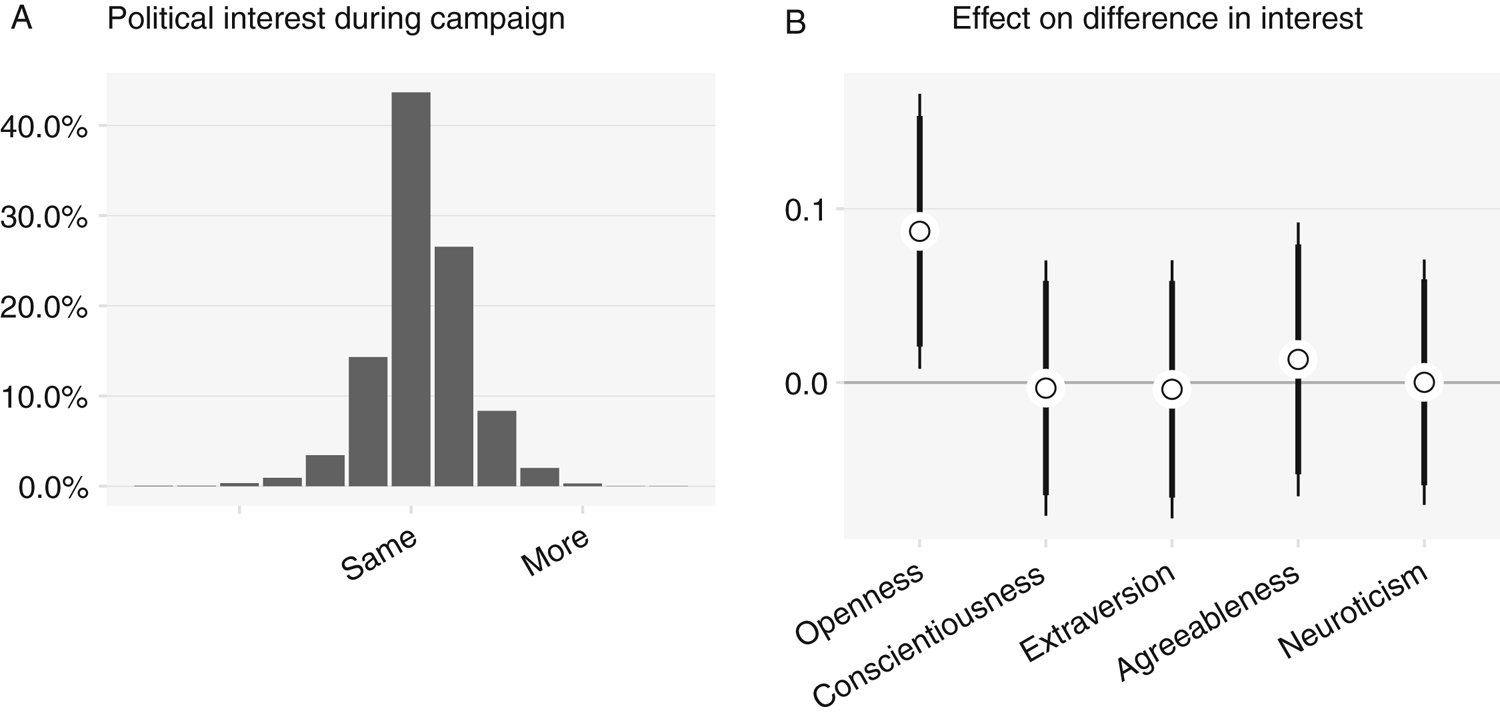
Panel A in Figure 1 shows the differences in political interest from the campaign to after the election. The figure shows that people expressed more interest in politics during the campaign than after (t = 12.75, p < 0.001). Panel B in Figure 2 shows the effects of the Big Five personality traits on change in political interest. The positive and significant effect for Openness indicates that people high on Openness expressed more interest in politics in the context of the campaign. Last, in Appendix A.5, I show that all items used to measure Openness have a positive impact on changes in political interest.
The effects of personality traits on changes in political interest, LISS (A) Political interest during campaign (B) Effect on defference in interest
Note: Panel A shows the distribution of change in political interest during the campaign compared with after it; higher values indicate more interest during the campaign and lower values indicate less interest. Panel B shows the effect of the personality traits on changes in political interest; higher values indicate more interesting during the campaign. All estimates build on Model 2 in Appendix Table A.4. This model controls for gender, age, education and the personality traits.

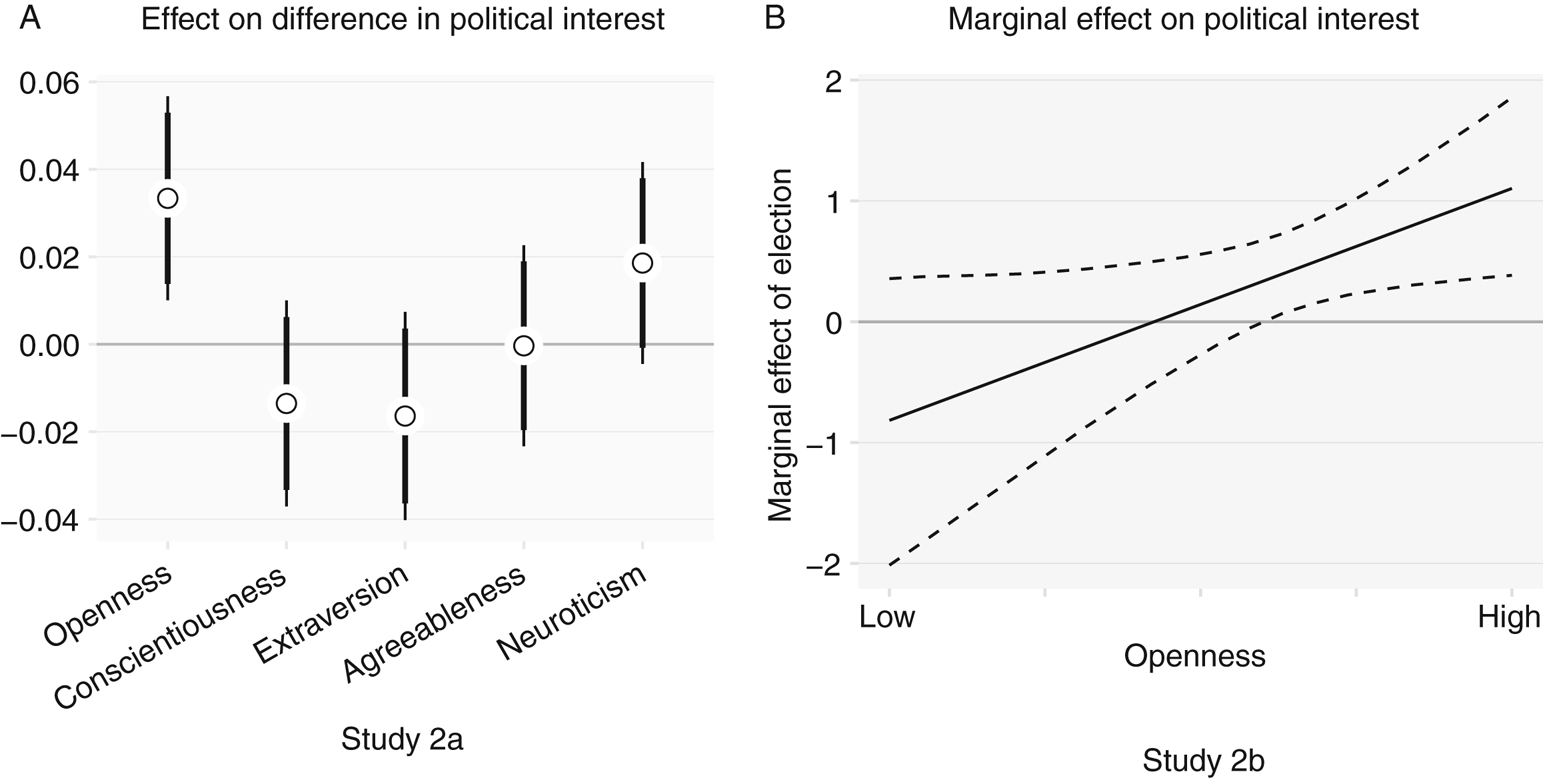
The impact of Openness on changes in political interest (A) Effect on difference in political interest (B) Marginal effect on political interest
Note: Panel A shows the effect of the personality traits on changes in political interest; higher values indicate more interest during the campaign. The estimates build on Model 2 in Appendix Table B.4. Panel B shows the marginal effects of the campaign on political interest at different levels of Openness. The dashed lines indicate the 95 per cent confidence interval. The estimates build on Model 3 in Appendix Table C.4. This model controls for gender, age, education and the interactions between the election and the personality traits.

Studies 2a and 2b: The Swiss Federal Elections
Panel A in Figure 2 shows parameters comparable to those of Panel B in Figure 1. The estimates show the impact of the personality traits on changes in political interest due to the election campaign in 2015. As in Study 1, there are similar significant differences in Study 2a where people high on Openness are more interested in politics during the election campaign. In Appendix B.5, I show that each of the items used to measure Openness contributes positively to the change in political interest.
Panel B in Figure 2 shows the differences in political interest at different levels of Openness; higher levels indicate more interest during the campaign in 2011. The marginal effects show that people high on Openness were more interested in politics during the campaign than after. For people low on Openness we see no change in the level of political interest.
However, as Study 2b relies on cross-sectional data, a key concern is whether the findings might be explained by systematic differences in how politically interested the respondents are across the two groups (cf. Muñoz, Falcó-Gimeno and Hernández Reference Muñoz, Falcó-Gimeno and Hernández2019). It might be that people interviewed after the election are less interested in politics in general, for example that politically interested people are more likely to participate in a survey during an election campaign. To accommodate this possibility, I use placebo measures of both political interest and the campaign (results reported in Appendix C.5). Specifically, I replicated the models for the sample with data collected the previous year to see whether the dynamics found here would replicate using measures without a campaign. The tests show no similar empirical patterns as above and thus little evidence that the findings can be attributed to systematic differences between the groups unrelated to the election campaign.
Next, to ensure that the covariates do not interact with the timing of the interview in explaining the main findings, I estimated a series of models with heterogeneous effects controlling for various interactions between the covariates and the election campaign (reported in Appendix C.6). Last, as in the previous studies, I estimate the key result with the different items used to measure Openness to show that they both contribute equally to the differences in political interest (available in Appendix C.7).
Study 3: The Foreign Event of 11 September 2001
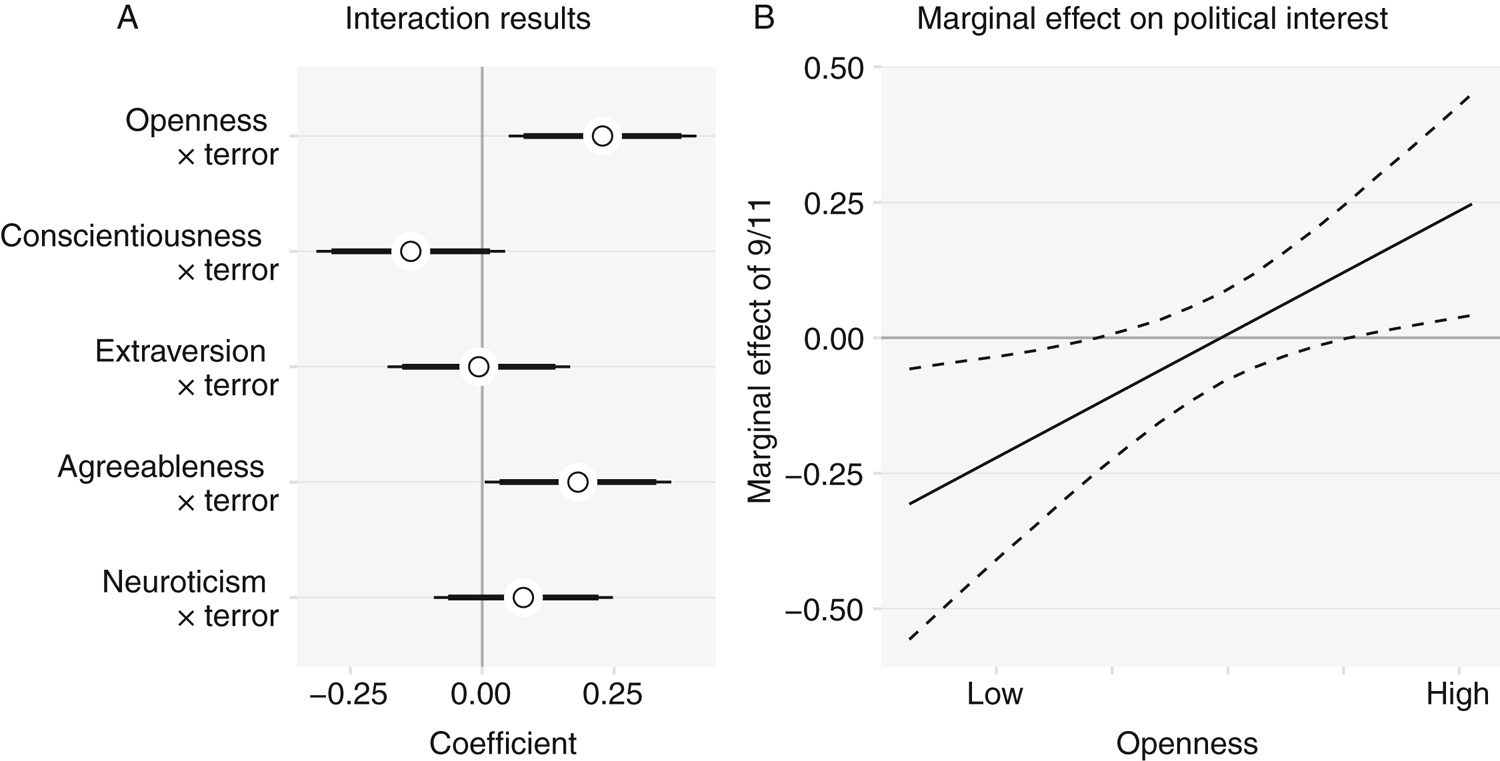
Panel A in Figure 3 shows the interactions between each of the personality traits and the event to examine whether the event led some people to be more interested in politics. Again, the expectation is that Openness will interact with the political environment (the terrorist attack) to shape people's level of political interest. The results show that there is a significant interaction between the event and Openness.
Changes in political interest at different levels of Openness, BHPS (A) Interaction results (B) Marginal effect on political interest
Note: Panel A shows the unstandardized regression coefficients for the interaction terms. The thick lines indicate 90 per cent confidence intervals and the thin lines indicate 95 per cent confidence intervals. Panel B shows the marginal effects of the terrorist attack on political interest at different levels of Openness. The dashed lines indicate the 95 per cent confidence interval. All estimates build on Model 3 in Appendix Table D.4. This model controls for gender, age, education and the interactions between the terrorist attack and the personality traits.

Panel B shows the changes in political interest at different levels of Openness. The event has a positive marginal effect for people high on Openness. In other words, people high on Openness became more interested in politics directly after the 9/11 attacks. Interestingly, people low on Openness became less interested in politics after the event. This relates to the salient nature of the event, where too much is taking place in the political realm for people low on Openness. The findings emphasize the surprising nature of terrorist attacks and show how people low on Openness find politics less interesting in such times.
I conducted two robustness tests. First, placebo tests similar to those in Study 2b ensure that the findings cannot be attributed to systematic differences between the groups unrelated to the event. Specifically, none of these tests showed any indication of patterns that can account for the findings presented above (models available in Appendix D.5). Secondly, models with interactions between the terrorist attack and the demographic characteristics show that the covariates do not account for the differences reported above (see Appendix D.6).
Last, in Appendix D.7 I show that each of the items used to capture variation in Openness account for the change in political interest in response to the terrorist attack.
Concluding Remarks
Personality differences and political interest are key to understanding turnout in contemporary democracies (Denny and Doyle Reference Denny and Doyle2008). Despite the importance of citizens being interested in political affairs, there are still scholarly challenges related to understanding public interest in politics. Using the Big Five framework to encapsulate stable psychological differences between people and connecting this to the political environment people encounter, I have resolved an important part of the puzzle.
This insight builds on the framework outlined by Mondak et al. (Reference Mondak2010), where personality traits are expected to interact with environmental factors to shape political behaviour, as well as the idea of the personality triad, which conceptualizes behaviour as a function of personality-situation interactions (Funder Reference Funder2006). The findings have implications for the literature interested in not only explaining why people are interested in politics, but also why they might pay less attention to politics. Potski and Urbatsch (Reference Potski and Urbatsch2017), for example, found that entertaining sporting events the day before US general elections make people less likely to vote, with a stronger effect among those least interested in politics.
While the focus here is on political events, further research can use the framework outlined here to study the implications of non-political events. One prediction to be explored in future work is how salient events might decrease some people's level of political interest. The findings in Study 3 show that political interest decreased for people low on Openness in the wake of 9/11 in the UK.
The real-world events studied here show the importance of linking individual differences to features of the political environment. Future research should examine the various psychological mechanisms that might be at play. Such dynamics would be ideal to test in controlled settings with fine-grained measures of personal motivations and experimental control over the novelty of the political content to explore how environmental stimuli foster (or inhibit) an individual's general interest in political affairs.
In sum, political interest is indeed stable over time as it is rooted in deep-seated personality dispositions. However, this is not incompatible with people also responding to short-term changes in the political environment on the basis of the same dispositions. Consequently, the question to be examined in future research is not whether political interest is explained by dispositional or situational factors, but understanding the complex interplay between such factors in shaping political behaviour.
Supplementary material
Data replication sets are available in Harvard Dataverse at: https://doi.org/10.7910/DVN/JZZWER and online appendices at: https://doi.org/10.1017/S0007123419000784.
Acknowledgements
I thank Zoltán Fazekas, Robert Klemmensen, Ben Seyd, Ksenia Northmore-Ball, Toni Rodon, Simon Munzert, Ed Morgan-Jones, Mogens Kamp Justesen, Jens Olav Dahlgaard, Emily Anne West, and the editor and reviewers for valuable feedback on previous versions of the article. A previous version was presented at the Hertie School of Governance, the Copenhagen Business School, the University of Kent, the Annual Conference of the Elections, Public Opinion and Parties (EPOP) specialist group of the Political Studies Association 2018 and the Annual Conference of the European Political Science Association 2018.