Elemental characterization using X-ray fluorescence (XRF) can link obsidian specimens to their sources (Shackley Reference Shackley2005), usually suggesting interaction between regions that could include trade, social networks, gifting, population movement, or direct resource exploitation among others (e.g., Findlow and Bolognese Reference Findlow, Bolognese, Ericson and Earle1982; Mills et al. Reference Mills, Clark, Peeples, Haas, Roberts, Hill, Huntley, Borck, Breiger, Clauset and Shackley2013; Shackley Reference Shackley2005). Using XRF, Arakawa and others (Reference Arakawa, Ortman, Steven Shackley and Duff2011) examine changing temporal patterns in obsidian procurement in relation to migration out of the Mesa Verde area. Their first goal was to examine the early stages of migration, especially the idea of return migration proposed by Anthony (Reference Anthony1990). In the early stages of migration, scouts or early migrants are thought to have returned to their original homeland for visits, often carrying gifts from their new homeland and conveying information to friends and relatives that could be used in deciding whether or not they should also migrate. The second goal of Arakawa and others' (Reference Arakawa, Ortman, Steven Shackley and Duff2011) study was to use obsidian artifacts to investigate the proposed migration of people from the Mesa Verde region to the northern Rio Grande, assuming that obsidian artifacts represented gifts carried from their new homeland by the return migrants. They conclude that the results of their study are “consistent with a model in which return migration was a primary mechanism behind the increased flow of Jemez obsidian into the Mesa Verde region during the thirteenth century” (Arakawa et al. Reference Arakawa, Ortman, Steven Shackley and Duff2011:790).
This proposed migration links the modern Tewa with ancestral Mesa Verde and proposes that the large Classic period Tewa villages in the northern Rio Grande were overwhelmingly formed by Mesa Verde immigrants (Arakawa et al. Reference Arakawa, Ortman, Steven Shackley and Duff2011:780; Ortman Reference Ortman2010, Reference Ortman2012). A weakness in this argument is that mechanisms other than return migration could be responsible for the observed obsidian source patterning. If other mechanisms could be responsible, then the obsidian data presented by Arakawa and others (Reference Arakawa, Ortman, Steven Shackley and Duff2011) need not support the model of mass migration from the Mesa Verde region to the northern Rio Grande.
Large-scale studies like those conducted by Arakawa and colleagues (Reference Arakawa, Ortman, Steven Shackley and Duff2011) and by Duff and colleagues (Reference Duff, Moss, Windes, Kantner and Shackley2012) for the Chaco region look at obsidian procurement from the receiving end, examining temporal changes in sources and inferring what that means in terms of possible patterns of movement, trade, and external contacts. This is, however, just part of the picture. Receiving-end trends may be influenced by conditions or events at the source end of the network or in the region between source and recipient. Although destination studies provide a valuable look at how obsidian was used, they cannot provide a full understanding of the processes that drove temporal change in obsidian procurement and movement. Those processes must be understood by examining broader geographic patterns, including the source region and areas outside the model being investigated.
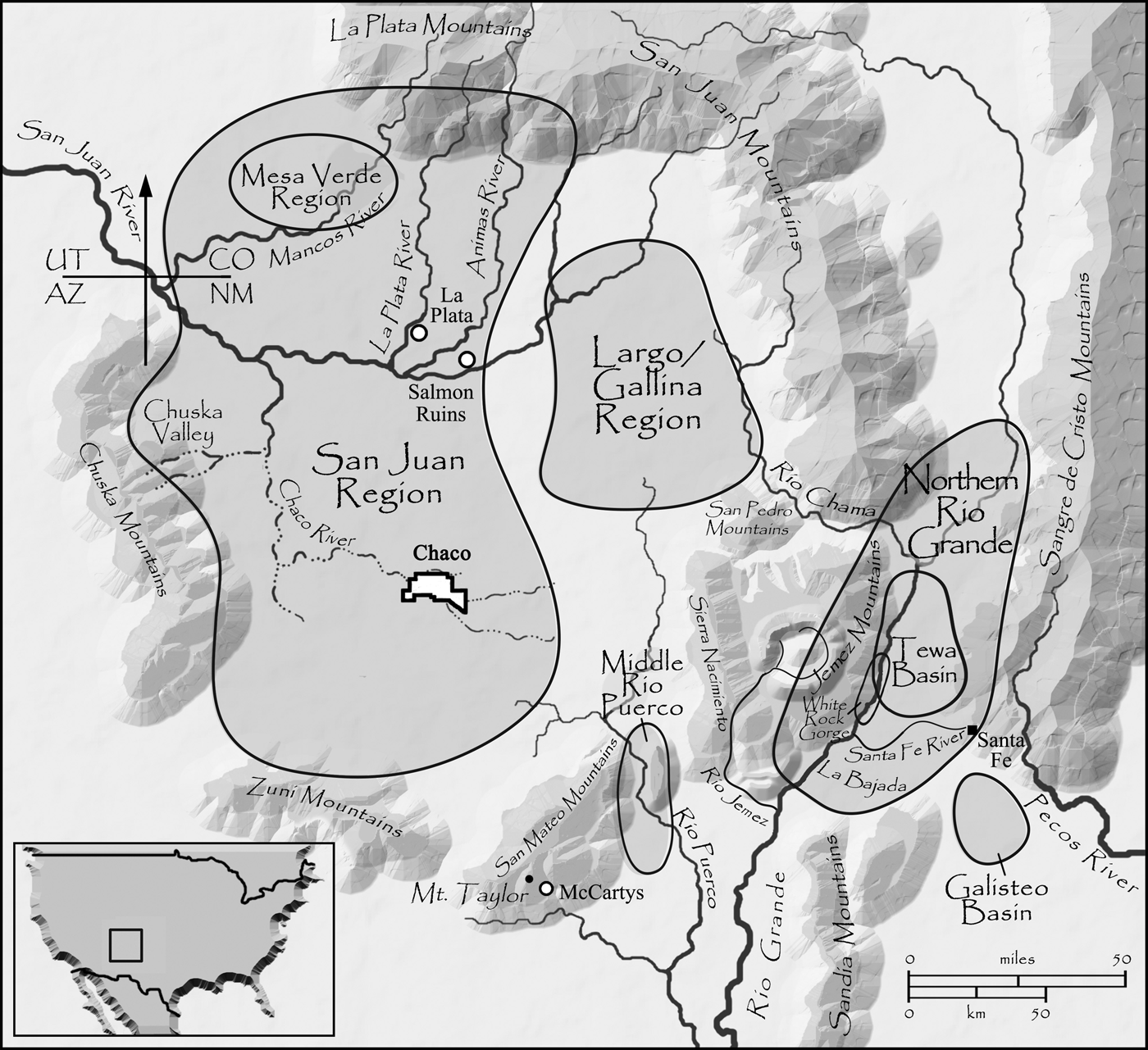
Jemez obsidian was also used by peoples of the northern Rio Grande region, and they may have been the source for much of the obsidian traded into the San Juan region of northwest New Mexico and southwest Colorado (Figure 1). Although Arakawa and others (Reference Arakawa, Ortman, Steven Shackley and Duff2011) and Duff and others (Reference Duff, Moss, Windes, Kantner and Shackley2012) examined patterning in obsidian use for the San Juan region, no comprehensive study has previously been completed for the northern Rio Grande.
The Four Corners area showing the major archaeological areas and locations in the San Juan region discussed in this article.

The present study was initiated to begin filling that gap by using information from northern Rio Grande sites as well as sites from the southern San Juan region. Using all of these studies, temporal patterns of obsidian procurement and use are compared to better understand how Jemez obsidian flowed through that system. We should also be able to test whether trade was the primary means of moving obsidian through the San Juan region, or if other mechanisms were sometimes responsible. In particular, could return migration have been responsible for obsidian movement into the Mesa Verde region after AD 1225, as suggested by Arakawa and others (Reference Arakawa, Ortman, Steven Shackley and Duff2011) and Ortman (Reference Ortman2010, Reference Ortman2012)?
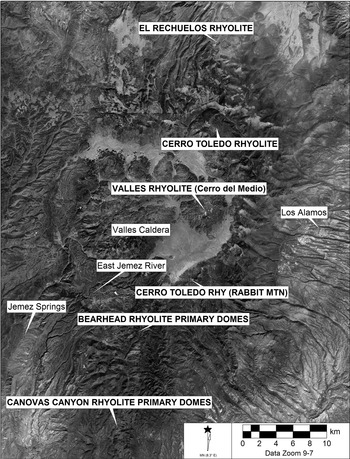
This analysis focuses on obsidian from three sources in the Jemez Mountains: Valles Rhyolite (VR), Cerro Toledo Rhyolite (CT), and El Rechuelos Rhyolite (ER; Figure 2). The locations of these obsidians and their occurrence in primary and secondary sources are discussed in detail by Shackley (Reference Shackley2005). In brief, ER and CT obsidians both outcrop on the northeast edge of the Valles Caldera, but there is a second compositionally identical outcrop of CT obsidian on the southern Pajarito Plateau at Rabbit Mountain (Figure 2). VR obsidian outcrops within the Valles Caldera, and very little of this material is moved out of the caldera by erosion (Church Reference Church2000; Shackley Reference Shackley2012). Secondary deposits of VR obsidian occur in streambeds near the primary source and exhibit minor evidence of that movement.
North-central New Mexico showing the locations of Jemez obsidian sources. Adapted from Shackley (Reference Shackley2005) and Shackley and others (Reference Shackley, Goff and Dolan2016). Sources noted in bold capitals.

Northern Rio Grande Obsidian Procurement
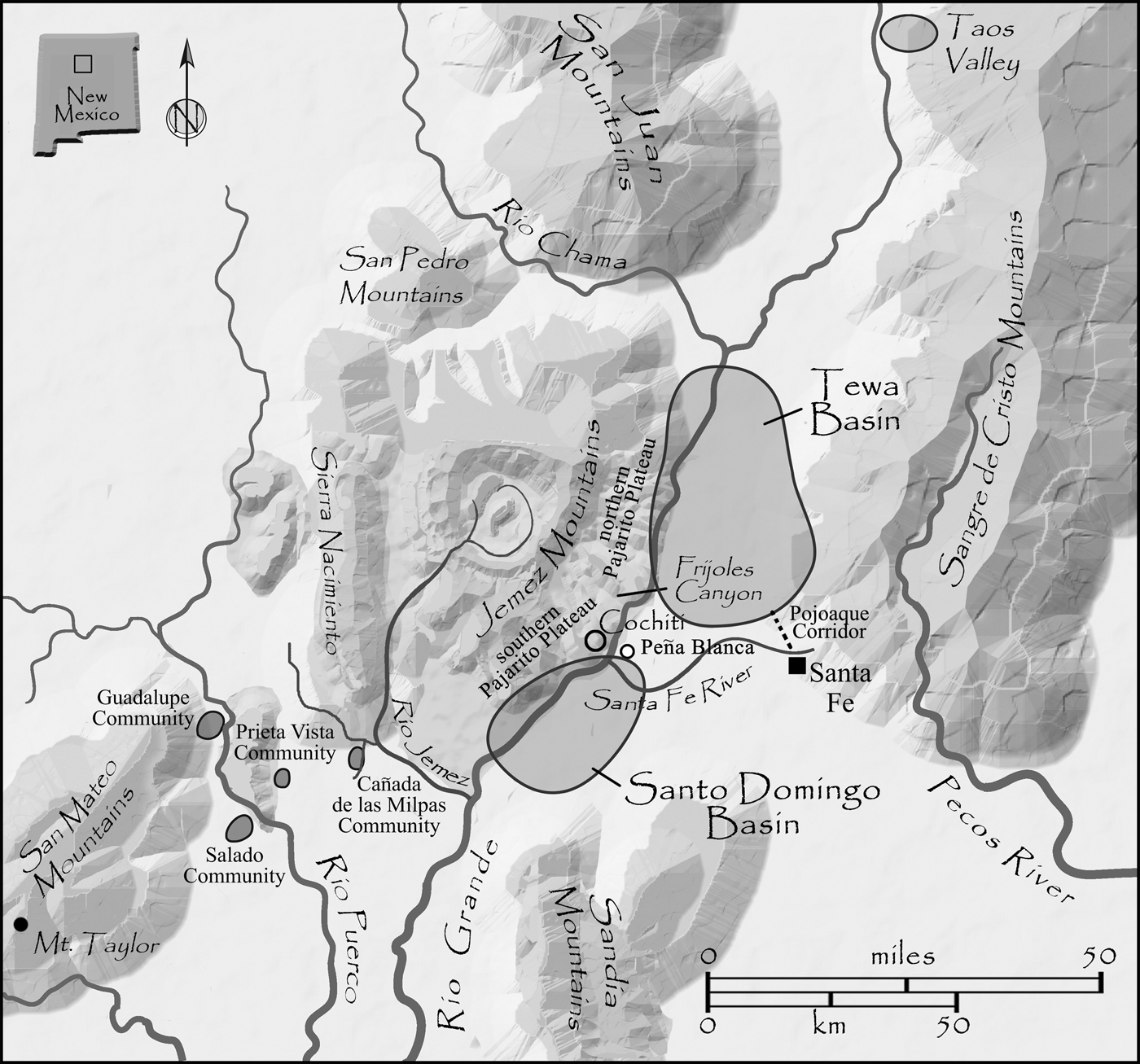
New data for this analysis are from obsidian samples from sites in the Pojoaque Corridor between Santa Fe and Pojoaque Pueblo (Figure 3) dating to the Late Developmental period (Moore Reference Moore2018; Figure 3). Additional data are from three earlier studies in the region, providing information that expands the study both geographically and temporally. A total of 301 obsidian specimens were sourced from six Late Developmental period (AD 900–1200) sites excavated in the Pojoaque Corridor to provide information on obsidian procurement (Moore Reference Moore2018; Shackley Reference Shackley2016). Ceramic analysis permitted the assignment of Late Developmental sites to three subperiods, each 100 years long. Two residential sites were selected from each subperiod for analysis, providing temporal information on changes in obsidian procurement.
North-central New Mexico showing prehistoric Pueblo communities in the middle Rio Puerco Valley and subdivisions of the middle and northern Rio Grande.

Three other studies expand the geographic perspective. The Peña Blanca Project examined seven sites from the Rio Grande Valley south of the La Bajada Escarpment near Cochiti Pueblo (Post and Chapman Reference Post and Chapman2010; Figure 1). This was a staging area for the movement of farmers into the northern Rio Grande at the AD 900 and 1200 thresholds, and so it provides complementary information. Five sites from this study provide information on the Early Developmental period and supply 62 obsidian samples. The Land Conveyance and Transfer Data Recovery Project (LAUR; Vierra and Schmidt Reference Vierra and Schmidt2008) was located on the northern Pajarito Plateau and provides 156 samples from 21 sites (Shackley Reference Shackley, Vierra and Schmidt2008). The sample of LAUR sites selected for use in this discussion includes only those that are single component and date to the periods under discussion. Data for the southern Pajarito Plateau come from the survey of Bandelier National Monument (Head Reference Head, Powers and Orcutt1999) and provide 64 samples from seven sites. The Pajarito Plateau is shown in Figure 3, and the divide into north and south sections is at Frijoles Canyon.
By augmenting obsidian source data with information on cortex type, we can look at variations in the use of primary and secondary sources, which provides a finer-grained view of where people obtained this material. Cortex represents the chemically or mechanically weathered exteriors of nodules (Andrefsky Reference Andrefsky1998:101). Cortical surfaces that exhibit only chemical weathering represent nodules procured at or near primary sources. Mechanically weathered cortex indicates movement by water and is considered evidence of procurement from secondary sources. Unfortunately, cortex type data are only available for two of these studies—the Pojoaque Corridor and the LAUR. Cortex type information from the latter is unpublished, and raw analytic data files were provided by Bradley J. Vierra (personal communication 2015). Source and cortex data are discussed by time period, using pertinent information from these four studies.
Early Developmental Period (AD 600–900)
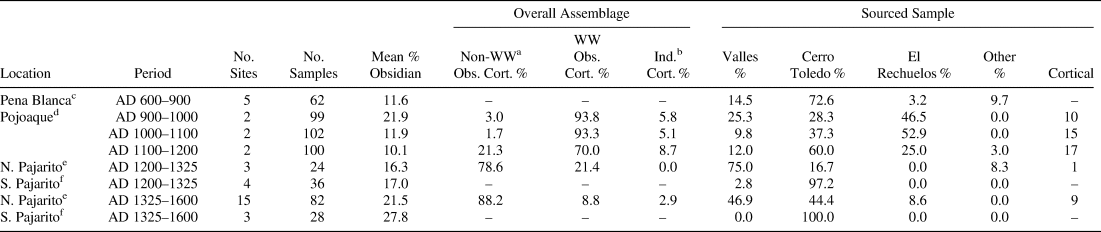
Information on obsidian use is available for Early Developmental period sites examined by the Peña Blanca Project, near Cochiti (Figure 3). This is the time period prior to the establishment of stable farming communities in the northern Rio Grande. Obsidian is not dominant in Peña Blanca assemblages, but it does represent a significant percentage (Table 1). CT obsidian makes up nearly three-quarters of these samples, with VR obsidian relegated to secondary importance. ER obsidian occurs but is uncommon. The Peña Blanca sites are in the Rio Grande Valley, where obsidian commonly occurs in gravels. Dominance of CT obsidian probably reflects use of gravels as a source because this is the most abundant obsidian type in them (Shackley Reference Shackley2005:74, Reference Shackley2012). ER obsidian is less common in Rio Grande gravels, and the small percentage in the Peña Blanca sample is consistent with this. The comparatively large percentage of VR obsidian is surprising, however, because this material rarely occurs in Rio Grande gravels, and in very small nodule sizes (Shackley Reference Shackley2012). This suggests that site occupants ventured into the Jemez Mountains to collect obsidian and perhaps other materials. Trade for these materials is unlikely because the area between the Peña Blanca sites and the Jemez obsidian sources was unoccupied by any residential population during this period.
Distribution of Obsidian, Cortex on Obsidian, and Sourced Samples by Time Period for the Northern Rio Grande Sample.

a WW = waterworn.
b Ind. = indeterminate.
c Post and Chapman Reference Post and Chapman2010.
d Moore Reference Moore2018; Shackley Reference Shackley2015.
e Vierra and Dilley Reference Vierra, Dilley, Vierra and Schmidt2008; Vierra and Schmidt Reference Vierra and Schmidt2008.
Late Developmental Period (AD 900–1200)
More data are available for Late Developmental period sites examined along an 11 km long highway right-of-way in the Pojoaque Corridor (Moore Reference Moore2018). This 300-year-long period is subdivided into three 100-year subperiods based on ceramic assemblages. Two sites from each subperiod were sampled. Sites from the early Late Developmental (ELD; AD 900–1000) provide 99 samples, those from the middle Late Developmental (MLD; AD 1000–1100) provide 102 samples, and sites from the late part of the Late Developmental (LLD; AD 1100–1200) provide 100 samples. These samples permit examination of obsidian use throughout the Late Developmental to determine how exploitation of sources varied temporally, especially the use of obsidian from secondary versus primary sources. Although 301 obsidian specimens were sourced for this period, this represents only 4% of the obsidian artifacts from these sites, and cortex was only found on 42 sourced specimens (14%). Although the sample is probably representative of trends in obsidian procurement, cortex-type data may not be.
Obsidian is abundant in ELD assemblages, averaging over 20%. Obsidian cortex is predominantly waterworn in these assemblages, indicating that most came from secondary sources. ER is the most common variety, followed by similar proportions of VR and CT. Examination of cortex type (Table 2) shows that VR obsidian was obtained at and near its primary source, CT obsidian came from both primary and secondary sources, and no information is available for ER obsidian. Although most ELD obsidian came from secondary sources, VR obsidian and some CT obsidian were also collected from primary sources.
Distribution of Cortex Types in the Sourced Samples from the Pojoaque Corridor and LAUR Projects.

a WW = waterworn.
b Ind. = indeterminate.
c Moore Reference Moore2018; Shackley Reference Shackley2015.
d Vierra and Dilley Reference Vierra, Dilley, Vierra and Schmidt2008; Vierra and Schmidt Reference Vierra and Schmidt2008.
Obsidian percentages dropped considerably in the MLD, reaching a level similar to that of the Early Developmental period in Peña Blanca (Table 1). Secondary sources continued to dominate, with ER obsidian remaining the most abundant source. CT obsidian use increased some in this subperiod, while VR obsidian use decreased considerably. Cortical information suggests that CT obsidian came from a primary source, ER obsidian came from primary and secondary sources, and VR obsidian came from its primary source and near it. The ER outcrop and one of the CT outcrops are in reasonably close proximity to the sites.
Major changes in procurement occurred in the LLD, although the percentage of obsidian in assemblages continued to drop. Percentages of obsidian with non-waterworn cortex increased sharply, as did the percentage of CT obsidian (Table 1). There was a small increase in VR obsidian and a large drop in ER obsidian. Cortical information shows that all three varieties came from primary sources, while CT and ER obsidians also came from secondary deposits.
Two trends are suggestive. The decline in assemblage percentages of obsidian between the ELD and MLD may be evidence for the depletion of nodules from easily accessed gravel deposits during the ELD, which led to a decline in the use of this resource during later periods. Although the waterworn cortex percentage continued to drop in LLD assemblages, that decline was not nearly as precipitous as the decline from the ELD to the MLD. After two centuries of exploiting secondary sources of obsidian, however, the LLD population increased its use of primary sources. This is inferred from the increase in obsidian with non-waterworn cortex in comparison with earlier periods. Although gravel deposits remained the main source, primary sources were more important during the LLD than earlier.
Increased exploitation of primary sources was accompanied by a large jump in the use of CT obsidian, a moderate increase in VR obsidian, and an extreme drop in ER obsidian during the LLD. Cortical data in Table 2 show that all three were obtained from primary sources, with CT and ER obsidians also coming from secondary deposits. Despite the much greater abundance of CT nodules in Rio Grande gravels, ER obsidian had been heavily favored during the ELD and MLD probably because it lacks the spherulites that can occur in the other two varieties. If quality alone were the main consideration in obtaining primary or secondary materials, we would expect ER obsidian to be better represented in the LLD because the focus included more primary materials. Since this is not the case, the extreme increase in CT obsidian during the LLD is attributable to exploitation of the most proximate primary sources to the sampled LLD sites.
Coalition Period (AD 1200–1325)
The Coalition period (AD 1200–1325) in the northern Rio Grande is characterized by the presence of substantial residential farming settlements on the Pajarito Plateau for the first time. They were located between the Late Developmental sites on the valley floor and the primary sources of the obsidians within and around the rim of the Jemez Caldera. Obsidian sourcing data are available from two Pajarito Plateau studies. Data for sites in the vicinity of Los Alamos (here called the “northern plateau”) are from Vierra and Schmidt (Reference Vierra and Schmidt2008), whereas Head (Reference Head, Powers and Orcutt1999) presents information for the southern Pajarito (Bandelier National Monument). Samples for both studies were sourced by Shackley (Reference Shackley, Vierra and Schmidt2008; Genevieve N. Head, personal communication, 2015). Cortical observations are only available for the northern sites.
The contrast between northern and southern Pajarito sites is striking in Table 1. Despite similar mean obsidian percentages, the sources being exploited are very different. VR obsidian dominates the northern Pajarito Plateau sample. Although CT obsidian was also used, none of the sourced samples were ER. Only one sourced specimen retained any cortical surface, and this was a piece of VR obsidian with non-waterworn cortex. Consequently, Coalition period occupants of the northern Pajarito were accessing the VR obsidian source for most of their needs, supplemented with a small percentage of CT obsidian that was probably obtained from the southern outcrop, as well as trace amounts of ER obsidian. Vierra and Dilley (Reference Vierra, Dilley, Vierra and Schmidt2008:316) note that the VR and the southern CT outcrop are about equidistant from the LAUR sites, although intervening canyons made the travel to the latter more strenuous. Cortex-type percentages for whole assemblages suggest that procurement at primary sources dominated, but a significant percentage of obsidian came from secondary sources.
CT obsidian dominates the southern Pajarito sample in Table 1, with a small amount of VR obsidian. The high percentage of CT obsidian and lack of ER obsidian suggest that the southern CT outcrop was being used. The small percentage of VR obsidian could have been obtained directly or through trade with the northern communities.
Classic Period (AD 1325–1600)
Information for the Classic period comes from the same studies discussed for the Coalition period. Again, detailed cortical information is only available for northern Pajarito sites. The contrast seen between northern and southern sites in the Coalition period is again evident, but there are also differences between these two periods. Obsidian actually makes up a larger mean percentage of Classic period assemblages than it did during the Coalition period, although the northern Pajarito percentage is somewhat smaller than that of the south (Table 1). VR obsidian remains the most common variety in the northern sample, but CT obsidian is nearly as abundant. ER obsidian is present in the analyzed sample, but this variety continues to constitute a comparatively small percentage of the total. Waterworn cortex is absent from all three sources, contrasting with the Coalition period sample and suggesting that primary source acquisition became more important during the Classic period. The small percentage of ER obsidian in combination with primary CT samples increases the likelihood that the CT obsidian was procured from the northern outcrop. The southern sample includes only CT obsidian, indicating the continuing importance of the southern CT source to those communities. ER sources need not have been accessed directly because Classic period populations expanded their geographic spread to form villages in the Chama Valley, and their proximity to the ER source could have increased the volume of ER obsidian circulating within regional social networks.
Obsidian in the San Juan Region
We are also interested in expanding the perception of temporal variation in obsidian use in the Chaco (Southern San Juan) region as a complement to the Mesa Verde (Northern San Juan) area. Southern San Juan–region obsidian is represented by studies at Chaco Canyon, the La Plata Valley, Salmon Ruin, the Middle Puerco Valley, and McCartys near Grants, New Mexico. Trends provide a context for reinterpreting Northern San Juan patterns of Mesa Verde–area obsidian and migration models as interpreted by Arakawa and others (Reference Arakawa, Ortman, Steven Shackley and Duff2011).
Middle Puerco Valley
The Middle Puerco Valley (Figure 1) contains a Chacoan community centered on Guadalupe Ruin (Baker and Durand Reference Baker and Durand2003; Figure 3). The late Pueblo II into Pueblo III periods (ca. AD 1125–1250) saw a population buildup in this area as people moved from elsewhere in the San Juan region and formed new communities. This is shown in Figure 3 as the Cañada de las Milpas, Prieta Vista, and Salado communities (Moore Reference Moore2018). Residents of this area may have had roles in obsidian movement through the San Juan regions because the Guadalupe community had access to villages in the Rio Grande Valley. Ceramic analysis suggests active pottery exchange between Guadalupe and northern Rio Grande communities during the Late Developmental period (Wilson Reference Wilson, Boyer and Moore2018), a network that may have also included obsidian and turquoise.
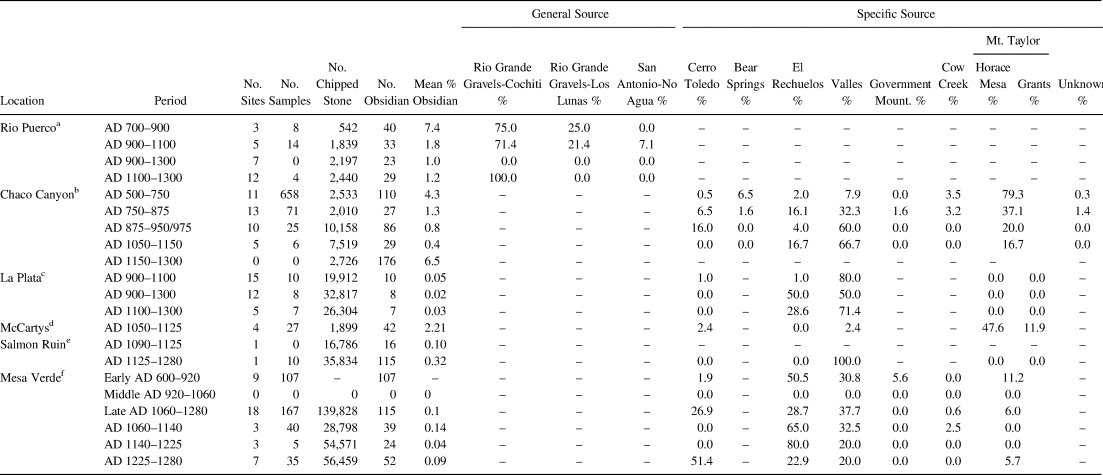
Table 3 includes obsidian source data as reported from the Middle Puerco Valley sites (Bowman Reference Bowman1987). The sites examined are small structures in the Guadalupe community, and they do not include Guadalupe Pueblo itself. Unlike the other analyses, sourcing for these samples was performed at Eastern New Mexico University (ENMU), and their results are not consistent with those of the other analyses. This is a problem—since the comparative sample came from gravel terraces along the Rio Grande near Cochiti Pueblo and Los Lunas (Bowman Reference Bowman1987), the Jemez sources are not distinguished individually in the Middle Puerco results. Therefore, we can only suggest which Jemez sources relate to each of the types defined in the Rio Puerco study. CT obsidian should be the dominant source in both Rio Grande gravels (Shackley Reference Shackley2005:74, Reference Shackley2012), with smaller amounts of ER obsidian occurring in both based on the drainage catchments of the two locations. VR has not been identified in analyses of Rio Grande secondary sources (Shackley Reference Shackley2005:74). Mount Taylor obsidians enter the Rio Grande alluvial system via the lower Rio Puerco, and they should only occur in gravels downstream from the ENMU Los Lunas sample. This suggests that both ENMU gravel sources in Table 3 should reflect CT outcrops as well as a minor amount of ER obsidian. The actual type represented by the ENMU San Antonio-No Agua obsidian in Table 3 is uncertain, but this Taos-region source is expected in Rio Grande alluvium, although it has not been reported as far south as Albuquerque (Shackley Reference Shackley2005:74–75, Reference Shackley2012).
Obsidian Data for the Various Areas Discussed.

a Bowman Reference Bowman1987.
b Duff et al. Reference Duff, Moss, Windes, Kantner and Shackley2012 for source information; Cameron Reference Cameron, Judge and Schelberg1984 for artifact counts.
c Shackley Reference Shackley2000.
d Shackley Reference Shackley2013, Reference Shackley2015.
e Shelley Reference Shelley and Reed2006.
f Arakawa et al. Reference Arakawa, Ortman, Steven Shackley and Duff2011.
Although obsidian from only eight sites was sourced, assemblage data exist for 27 sites (Table 3). Obsidian was most abundant in Pueblo I (AD 700–900) assemblages, dropping considerably in proportion during Pueblo II (AD 900–1100), and slightly further in Pueblo III (AD 1100–1300). Unlike the Pojoaque Corridor, this is not evidence for resource depletion because obsidian does not occur in the Middle Puerco Valley. Instead, this drop reflects changes in procurement patterns, with less obsidian flowing into the region. Rio Grande Gravel-Cochiti obsidian dominates throughout the Pueblo period, suggesting that CT obsidian was the main variety traded into the region. Mount Taylor obsidian was also common, however.
Obsidian occurs as debitage, utilized flakes, flake tools, and bifaces (Brett Reference Brett, Baker and Durand2003). Much of this material probably arrived as flakes or preforms, but the presence of a few obsidian cores indicates that nodules or cores were also imported (Brett Reference Brett1984:125–126, Reference Brett, Baker and Durand2003:148). The absence of any likely examples of VR obsidian is important because that variety was heavily used in the northern Rio Grande from the Developmental through the Classic period. Rather than receiving obsidian from villages in the northern Rio Grande, occupants of the Middle Puerco Valley may have been receiving this commodity from villages in the middle Rio Grande Valley.
Chaco Canyon
Duff and colleagues’ (Reference Duff, Moss, Windes, Kantner and Shackley2012) reanalysis of obsidian from Chaco Canyon (Figure 1) provides a new perspective on the acquisition of this material. During Basketmaker III (AD 500–750) and Pueblo I (AD 750–875), obsidian from sources in eastern Arizona and western New Mexico account for 3.5% and 3.3% of obsidian assemblages, respectively, but are absent from the Pueblo II (AD 875–1150) sample (Duff et al. Reference Duff, Moss, Windes, Kantner and Shackley2012:3004). Mount Taylor obsidian dominates in Basketmaker III (79.6%), with only 16.9% coming from Jemez Mountain sources. This pattern changed in Pueblo I, with Jemez Mountain sources becoming dominant (56.5%) and Mount Taylor sources becoming secondary (37.1%). The dominance of Jemez Mountain sources continued growing during Pueblo II (AD 875–1150), with 80% of early Pueblo II (AD 875–950/975) and 83.3% of late Pueblo II (AD 1050–1150) obsidian coming from that area. The use of Mount Taylor obsidian dropped at the same time, with only 20% of early Pueblo II and 16.7% of late Pueblo II obsidian coming from that area. Clearly, Jemez obsidian increased in importance through time, whereas the importance of Mount Taylor obsidian declined.
Table 3 provides obsidian and assemblage data from Chaco Canyon between Basketmaker III and Pueblo III (AD 1150–1300). The obsidian sourcing data in Table 3 are from Duff and others (Reference Duff, Moss, Windes, Kantner and Shackley2012), while assemblage content data are from Cameron (Reference Cameron, Judge and Schelberg1984), although Duff and others (Reference Duff, Moss, Windes, Kantner and Shackley2012) present no sourcing data for Pueblo III (AD 1150–1300) sites. From an initial high obsidian percentage in Basketmaker III, there was a steady decrease through late Pueblo II. Then, there was a large upsurge in early Pueblo III (AD 1120–1220), followed by a decrease in late Pueblo III (AD 1220–1300; Cameron Reference Cameron, Judge and Schelberg1984:139). Despite the decrease in late Pueblo III, however, obsidian appears to have continued being imported into Chaco Canyon in higher percentages than it was at any time between AD 700 and 1120. The decrease in Mount Taylor obsidian was continual and steady, dropping by nearly half between Basketmaker III and Pueblo I and again between Pueblo I and early Pueblo II. Although sample sizes are small for Pueblo II, it seems clear that VR obsidian was preferred, and this trend began during Pueblo I. Other Jemez types also occur, with CT obsidian occurring commonly in early Pueblo II, and ER obsidian occurring as commonly as Mount Taylor obsidian in late Pueblo II.
Other aspects of interest are the dominance of core-flake reduction, a lack of cortical specimens, and a rarity of obsidian cores (Duff et al. Reference Duff, Moss, Windes, Kantner and Shackley2012:3005). The lack of cortical specimens is attributed to reduction before obsidian was transported to sites, and the paucity of cores is attributed to material maximization and heavy reuse. Jemez obsidian tended to arrive as finished pieces, with a tool to debitage ratio of 1:1. Mount Taylor obsidian was worked locally more often, with a tool to debitage ratio of 1:5 (Duff et al. Reference Duff, Moss, Windes, Kantner and Shackley2012:3005). These differences resulted from the varying distances of transport, with Jemez Mountain obsidian tending to arrive as finished pieces, and Mount Taylor obsidian as cores and flakes (Duff et al. Reference Duff, Moss, Windes, Kantner and Shackley2012:3005). Mount Taylor obsidian was either obtained directly from sources or through indirect exchange, while Jemez obsidian probably circulated through formal exchange networks (Duff et al Reference Duff, Moss, Windes, Kantner and Shackley2012:3005). The growing dominance of Jemez obsidian shows the importance placed on acquisition of finished tools through an exchange network that probably started in the northern Rio Grande.
Salmon Ruin
Salmon Ruin (Figure 1) is a Chacoan great house in the San Juan River Valley that was occupied between AD 1090 and 1280, very late Pueblo II into Pueblo III (Reed and Adams Reference Reed, Adams and Reed2006), with evidence for two separate occupations (primary occupation: AD 1090–1125; secondary occupation: AD 1125–1280). There was an increase in obsidian use during the secondary occupation that peaked between AD 1230 and 1240 (Reed and Adams Reference Reed, Adams and Reed2006:296). Limited sourcing data indicate acquisition from the VR obsidian source (Table 3), although only 10 samples were examined (Shelley Reference Shelley and Reed2006:1031). The increase in obsidian use during the secondary occupation is clear, although the proportion of obsidian used during both periods is very low; obsidian tended to reach Salmon Ruin in reduced rather than nodular form (Shelley Reference Shelley and Reed2006).
La Plata Valley
Thirty-two Pueblo II–Pueblo III sites were examined in the La Plata Valley (Figure 1). Fifteen of these sites are Pueblo II (AD 900–1100), five are Pueblo III (AD 1100–1300), and 12 span both periods. These sites yielded few obsidian artifacts: there were 10 obsidian artifacts in the Pueblo II assemblage, seven in the Pueblo III assemblage, and eight in the Pueblo II–III (AD 900–1300) assemblage. Seventy percent of Pueblo II obsidian artifacts are formal or informal tools, as are 57% of those from Pueblo III and 38% of those from Pueblo II–III. A slight decrease in obsidian use between Pueblo II and III is visible. Overall, 56% of obsidian artifacts were formal or informal tools, and the remainder consisted of unutilized debitage and a core. This is similar to the pattern seen elsewhere, with most obsidian arriving in an already reduced form, and often as finished tools.
All obsidian from these sites came from Jemez Mountain sources (Shackley Reference Shackley2000). VR obsidian was most common (n = 17, 68%), followed by ER obsidian (n = 7, 28%), and CT obsidian (n = 1, 4%). The Pueblo II assemblage is dominated by VR obsidian, but it also includes single examples of ER and CT obsidians. VR obsidian also dominates in Pueblo III, but ER obsidian is common. The mixed Pueblo II–III assemblage contains equal amounts of VR and ER obsidians. Therefore, the Pueblo II and Pueblo III procurement patterns are very similar, the main difference being the piece of CT obsidian in the Pueblo II assemblage.
McCartys Sites
In 1961, Stewart Peckham excavated four Pueblo sites near Mount Taylor in western New Mexico (Peckham Reference Peckham1962; Figure 1). This region is at the south edge of the Chacoan system, and it exhibits links to that system in the form of trade goods and pottery types. These sites were primarily occupied during late Pueblo II (AD 1050–1125). Despite the close proximity of the Horace Mesa obsidian source, obsidian was rare in these assemblages. Of 36 pieces of obsidian found, 27 were sourced (Shackley Reference Shackley2013, Reference Shackley2015). As Table 3 shows, Horace Mesa/La Jara Mesa/Mount Taylor obsidian was most common, making up nearly half the composite assemblage. Obsidian from the more distant Grants source is the second most common variety. Surprisingly, both VR and CT obsidians also occur, although in each case they are represented by a single specimen.
Mesa Verde Region
Arakawa and others (Reference Arakawa, Ortman, Steven Shackley and Duff2011) divide the Pueblo occupation of the Mesa Verde region (Figure 1) into early (AD 600–920), middle (AD 920–1060), and late (AD 1060–1280) periods, focusing on the early and late periods because the population was small in the middle period, and no obsidian from that period is sourced (Arakawa et al. Reference Arakawa, Ortman, Steven Shackley and Duff2011:775). The late period is broken into three subperiods—AD 1060–1140, AD 1140–1225, and AD 1225–1280—to better examine temporal variations in obsidian acquisition.
Table 3 presents data generated by Arakawa and others (Reference Arakawa, Ortman, Steven Shackley and Duff2011). During the early period, just over half the obsidian came from the ER source, followed proportionally by the VR, Mount Taylor, Government Mountain, and CT sources. Therefore, although most early period obsidian came from the Jemez Mountains, some was imported from more distant sources in northwest New Mexico and northeast Arizona. A significant change is apparent in the late period. The proportion of VR obsidian increased significantly, and it became the most common variety. The use of ER obsidian dropped by nearly half, and it was now the second most common variety. The percentage of CT obsidian increased greatly, and it was imported in nearly the same quantities as ER obsidian. Use of Mount Taylor obsidian decreased by nearly half, importation of Government Mountain obsidian apparently ended, and Cow Canyon obsidian from southwest New Mexico was imported in small amounts.
Based on changing obsidian acquisition patterns in the late period and the form in which obsidian entered the region, Arakawa and others (Reference Arakawa, Ortman, Steven Shackley and Duff2011) contend there is evidence for a return of migrants from the northern Rio Grande to the Mesa Verde region, who were carrying obsidian with them. The return migration is thought to have developed around AD 1225–1260, preceding the migration that emptied the Mesa Verde region by around AD 1280 (Arakawa et al. Reference Arakawa, Ortman, Steven Shackley and Duff2011:777). Evidence for return migration is seen in two characteristics of the obsidian assemblage. First, there is a switch in one of the major sources being exploited between the early and late periods from ER, the nearest source to the Mesa Verde region, to CT, which they consider the most distant source and which is in proximity to the Pajarito Plateau. Second, there is a higher proportion of tools to flaking debris in the late period than in the early period.
These trends are visible in data shown in Table 3. ER is by far the dominant obsidian used between AD 1060–1140 and 1140–1225. VR obsidian makes up a large proportion of samples from each of these periods, and CT obsidian is absent. Between AD 1225 and 1280, CT obsidian became the most common type, the ER obsidian percentage dropped precipitously, and VR obsidian remained at the same level. But are these changes indicative of return migration or some other process?
Discussion
Now that we have a clearer picture of obsidian use in northern New Mexico, the Mesa Verde data can be put into wider perspective, and the possibility of return migration, as defined by Anthony Reference Anthony1990, can be more closely examined. The idea that return migration to Mesa Verde was the mechanism through which most obsidian arrived there in the post–AD 1225 period is based on several factors (Arakawa et al Reference Arakawa, Ortman, Steven Shackley and Duff2011:789). First, there was an increase in the amount of obsidian transported to the Mesa Verde region between AD 1225 and 1280 when compared to amounts for the period between AD 1140 and 1225 (Arakawa et al. Reference Arakawa, Ortman, Steven Shackley and Duff2011:785–786; Ortman Reference Ortman2010:463–464). Second, most obsidian artifacts represent finished tools or preforms (Arakawa et al. Reference Arakawa, Ortman, Steven Shackley and Duff2011:786; Ortman Reference Ortman2010:466). Finally, the proportion of CT obsidian rose dramatically, suggesting increased contact with the Pajarito Plateau (Arakawa et al. Reference Arakawa, Ortman, Steven Shackley and Duff2011:785; Ortman Reference Ortman2010:462). If these trends are restricted to the Mesa Verde region, then return migration could be responsible. If they are not unique to Mesa Verde, however, then another mechanism may be responsible.
In the northern Rio Grande, which is where most of the Jemez obsidian used in the northern Southwest originated, we can see temporal trends in the use of various obsidian types. In the Pojoaque Corridor there is a trend toward increased use of CT obsidian through time, mostly at the expense of ER obsidian, the main variety used before AD 1100. This trend probably indicates increasing exploitation of the Pajarito Plateau, where CT obsidian is available in primary and secondary deposits. As people from the northern Rio Grande began exploiting and possibly settling on the Pajarito Plateau beginning in the late twelfth century,Footnote 1 obsidian acquisition patterns began to change. On the northern Pajarito Plateau, obsidian percentages increased from the Coalition to the Classic period, and the amount of CT obsidian used also increased considerably (Table 1). However, VR obsidian remained the main variety during both periods, probably because that source was easier to access than the Pajarito source for CT obsidian (Vierra and Dilley Reference Vierra, Dilley, Vierra and Schmidt2008:316). This could also be a nodule size issue since CT obsidian occurs in the Bandelier Tuff on the Pajarito Plateau. The trend on the southern Pajarito is similar—there was a considerable jump in the percentage of obsidian used between the Coalition and Classic periods, as well as an increase in the percentage of CT obsidian. In this case, however, CT obsidian was the main variety used during the Coalition period, and the only type found in Classic period samples.
Consequently, the Pajarito Plateau echoes two trends noted for Mesa Verde: higher percentages of obsidian in the Classic period and heavier use of CT obsidian, especially on the southern Pajarito. There appears to be no increase in obsidian use after AD 1225 in the Middle Puerco Valley (Table 3). If, however, the Rio Grande Gravels-Cochiti category equates to CT obsidian, then Table 3 does suggest increased use of CT obsidian in the Middle Puerco after AD 1225.
In Chaco Canyon, there was a clear increase in obsidian use during Pueblo III (Table 3), but we lack source data for that period. Although no CT obsidian occurs in the late Pueblo II sample, that sample is small and probably not representative. Consequently, the Chaco Canyon data resemble those from Mesa Verde in one respect, and cannot be compared in another. Although the McCartys sites were tied into the general San Juan obsidian circulation system, that assemblage was dominated by local varieties. The small percentage of Jemez Mountain obsidian was evenly split between CT and VR obsidians. The La Plata data do not follow the same trajectory. There was no dramatic increase in obsidian use between Pueblo II and Pueblo III, and little CT obsidian occurs in any period represented. At Salmon Ruin, there is a large jump in obsidian use between the early and late occupations, and all obsidian used there appears to have been from the VR source, although the sample size is small.
Pueblo III obsidian data for the San Juan region indicate an increase in the amount of obsidian flowing into that system. This is most evident in Chaco Canyon (Table 3) but also to a lesser extent at Salmon Ruin and Mesa Verde. Not coincidentally, Pueblo III corresponds to the LLD and the Coalition period in the northern Rio Grande, when permanent populations were established on the Pajarito Plateau, providing better access to CT obsidian on the southern Pajarito and to VR obsidian on the northern Pajarito. As Table 1 shows, there was a significant increase in the proportion of obsidian in Coalition period assemblages on both the northern and southern Pajarito when compared with the earlier assemblages from the Pojoaque Corridor, which reflects improved access to sources. Obsidian use continued to increase during the Classic period on the Pajarito Plateau, returning to levels seen when the pioneering population moved into the northern Rio Grande around AD 900.
Seen in this light, the increase in obsidian percentages between AD 1225 and 1280 at Mesa Verde reflects a wider trend evident in parts of the Southern San Juan region and coincides with establishment of communities on the Pajarito Plateau. Similarly, the increase in CT obsidian in the Mesa Verde region reflects trends also occurring in the northern Rio Grande.
The final point in the return migration argument concerns the form in which obsidian arrived in the Mesa Verde region. Arakawa and others (Reference Arakawa, Ortman, Steven Shackley and Duff2011:786–787) emphasize the number of tools in the obsidian assemblage from their late period (AD 1060–1280). However, while tools make up a large percentage of the late period obsidian assemblage (34.8%), nearly two-thirds are unmodified debitage. But, is this pattern unique in the San Juan region? In the La Plata study, 70% of Pueblo II obsidian artifacts are tools, as are 57% of Pueblo III obsidian artifacts and 38% from Pueblo II–III assemblages. Tools make up 62.5% of the obsidian assemblage during the primary occupation at Salmon Ruin (AD 1088–1190) and 27% of the secondary occupation assemblage (AD 1190–1280). Although we cannot quantify the Chaco Canyon obsidian assemblage to the same degree, Cameron (Reference Cameron, Judge and Schelberg1984:150) notes that obsidian debitage is rare except for the period between AD 1120 and 1220 and that this “suggests the import of finished tools, rather than raw materials, into the canyon.” Consequently, finished obsidian tools are common in assemblages at the receiving end of the trade network, and a high percentage of obsidian tools is not unique for Mesa Verde.
Areas producing obsidian have a different pattern, but percentages of obsidian tools remain high. Only 9.5% of the McCartys obsidian are tools, although that assemblage was affected by collection methods that underrepresent both obsidian and obsidian tools. In the Pojoaque Corridor, tools make up 10.2% of the ELD obsidian, 14.1% of the MLD obsidian, and 19.7% of the LLD obsidian. In the Middle Puerco, tool percentages mostly fall between those at either end of the obsidian exchange network. Although tools make up 30% of the Pueblo I obsidian assemblage, percentages then drop, with 18.2% of Pueblo II and 20.7% of Pueblo III obsidian consisting of tools.
Much of the obsidian used in the San Juan region probably arrived there as finished tools, but obsidian may also have moved as debitage that could be made into tools. Evidence of this is more difficult to recover because production of small tools by pressure flaking creates few retouch flakes that are recoverable by screening, so in most cases, little evidence for small obsidian tool manufacture occurs. The high percentage of obsidian tools in the Mesa Verde region assemblage is not unique, and it also occurs throughout the southern San Juan region. Although obsidian was used for tool manufacture in areas near sources, tools make up increasingly large percentages of obsidian assemblages as distance increases from the source.
Summary and Conclusions
Jemez obsidian was traded widely throughout the northern Southwest, and because it can be traced to specific sources, obsidian is useful in studying patterns of resource access and movement. Whereas two of the three main varieties of Jemez obsidian—CT and ER—occur in Rio Grande gravels as far south as the Mexican border (Banks Reference Banks1990; Church Reference Church2000; Shackley Reference Shackley2012), VR obsidian does not occur in those gravels in appreciable quantities or in large nodules. By distinguishing between cortex types on obsidian artifacts, we can determine whether a nodule originated at a primary or secondary source. This type of analysis provides important information on access to obsidian. Did people go to the mountains to obtain this material, or did it come from a more commonly encountered secondary source?
During the Early Developmental period (AD 600–900), Pueblos in the Peña Blanca area mostly relied on Rio Grande gravel deposits for obsidian. This resulted in a predominance of CT obsidian—the most common type in those gravels. However, VR obsidian also occurs, and since this variety is not available in Rio Grande gravels, site occupants probably accessed the primary source in the Jemez Mountains. By the Late Developmental period (AD 900–1200), Pueblo peoples were settling the northern Rio Grande. Evidence from the Pojoaque Corridor suggests that the commonly encountered obsidian in Rio Grande gravels was nearly exhausted during the ELD, as indicated by a severe drop in obsidian percentages after that period. Primary sources were much more important by the LLD, and CT obsidian was dominant. These trends suggest that the Pajarito Plateau became an important resource procurement zone by the LLD, when people from the northern Rio Grande appear to have been exploiting and then moving into that area.
Obsidian patterns on the Pajarito Plateau suggest the presence of an ethnic divide seen by Walsh (Reference Walsh1998), with Keres in the south and Tewa in the north. The current study shows that the northern Pajarito heavily relied on VR obsidian and the southern Pajarito on CT obsidian during the Coalition period. By the Classic period, the northern Pajarito continued to rely on VR obsidian but used a similar amount of CT obsidian. Only CT obsidian occurs in Classic period sourced samples from the southern Pajarito, suggesting a nearly complete reliance on this variety.
The trends are not as clear for the San Juan region, and there may be important differences between the northern and southern San Juan. CT obsidian was dominant during Pueblo I and II, and it may have increased in dominance in Pueblo III (Table 3). Cameron's (Reference Cameron, Judge and Schelberg1984) analysis of chipped stone from Chaco indicates there was a significant increase in obsidian in Pueblo III, but no source data were presented for that period by Duff and others (Reference Duff, Moss, Windes, Kantner and Shackley2012). This makes it impossible to determine whether there was a large increase in the use of CT obsidian at Chaco similar to that in the Mesa Verde region during Pueblo III. Fortunately, there are enough data to suggest that, at least prior to Pueblo III, these regions probably belonged to the same obsidian exchange network. With the exception of Canovas Canyon Rhyolite Obsidian (Bear Springs Peak), the same six sources are represented in both regions. One major difference is the fairly common occurrence of Mount Taylor obsidian at Chaco Canyon and its comparative rarity in the Mesa Verde region.
Corresponding to a decrease in Mount Taylor obsidian beginning in Pueblo I, VR obsidian use steadily increased at Chaco Canyon, with an even greater rise in Pueblo II. These increases probably correspond to improved access resulting from the Early Developmental period occupation in the middle Rio Grande Valley (including Peña Blanca), and then the ELD occupation of the Tewa Basin (including the Pojoaque Corridor). Although VR obsidian was dominant in Chaco during Pueblo II, it was less common in the Mesa Verde region, where ER obsidian was dominant. CT obsidian was uncommon in both regions during Pueblo II, as it was in the Mesa Verde region until early Pueblo III. Only after AD 1225 was this variety abundant in either area, and we currently only have evidence for the Mesa Verde region. No CT obsidian occurred in samples from the La Plata Valley, Salmon Ruin, or McCartys. Sample error could be responsible for this lack at Salmon Ruin, but this is less likely for the other two areas. Like Chaco Canyon, the Pueblo II samples from these areas are dominated by VR obsidian, as is the case with the Pueblo III sample at Salmon Ruin.
This discussion suggests that the northern and southern San Juan regions were part of the same obsidian distribution system through at least Pueblo II. While Pueblo III data are currently lacking for Chaco Canyon, the distribution of sourced obsidian from La Plata and Salmon Ruin differ significantly from that at Mesa Verde, where CT obsidian suddenly became the most common type, although ER and VR obsidians were still commonly imported. Despite the fact that Arakawa and colleagues (Reference Arakawa, Ortman, Steven Shackley and Duff2011) and Ortman (Reference Ortman2010) consider the jump in CT obsidian indicative of return migration, the reason for this phenomenon is more likely attributable to other processes.
Rather than return migration, changes in the obsidian exchange system are likely responsible for the late spike in CT obsidian in the Mesa Verde region. In addition to the traditional players in the exchange network, colonists on the southern Pajarito increased the amount of CT obsidian moving through the system. However, CT obsidian did not replace the VR and ER obsidians that were traditionally more heavily traded. Rather, the increased supply of CT obsidian augmented the supply of those more desirable types. Removing CT obsidian from the AD 1225–1280 Mesa Verde sample in Table 3 leaves similar percentages of VR and ER obsidians (41.2% and 47.1%, respectively), and a comparatively high percentage of Mount Taylor obsidian (11.8%), as well as a more modest increase in importation. The relatively large percentage of Mount Taylor obsidian may actually be more important than the increase in CT obsidian because it implies stronger exchange ties with the southern San Juan.
Therefore, three factors were involved in changes to the structure of obsidian assemblages in the Mesa Verde region between AD 1225 and 1280. First, obsidian continued to be supplied through traditional channels. Second, a new source for obsidian—CT obsidian in particular—developed as colonists occupied the southern Pajarito, where they had direct access to one of its primary sources. And third, there was a resurgence in circulation of Mount Taylor obsidian in the Southern San Juan. Ortman (Reference Ortman2010) and Arakawa and colleagues (Reference Arakawa, Ortman, Steven Shackley and Duff2011) are correct in attributing the increase in CT obsidian—and obsidian in general—in the Mesa Verde region to colonization of the Pajarito Plateau. But they incorrectly assign that role to the northern Pajarito—the traditional home of the Tewa. The source for these changes was more likely colonization of the southern Pajarito—the traditional home of the Keres after about AD 1175.
Even though obsidian movement through northwest New Mexico and southwest Colorado was ubiquitous, the mixture of suppliers varied from area to area. Consequently, while the southern Pajarito appears to have been an important source for much of the obsidian used at Mesa Verde in the decades prior to its abandonment, this was not necessarily true for other sectors in the San Juan region. The conclusion by Ortman (Reference Ortman2010) and Arakawa and colleagues (Reference Arakawa, Ortman, Steven Shackley and Duff2011) that the increase in the amount of CT obsidian imported into the Mesa Verds region during the late Pueblo III period is attributable to reverse migration is questionable. The upsurge in obsidian use in the Mesa Verde region is mirrored in data from Chaco Canyon and Salmon Ruin, and it corresponds to colonization of both the northern and southern Pajarito Plateau. The predominance of tools in the obsidian assemblage for Mesa Verde is paralleled in the other San Juan assemblages examined. Rather than representing gifts presented by migrants during visits home, these trends in the Mesa Verde region actually mirror the regional pattern of obsidian use.
The change in obsidian sources seen in the AD 1225–1280 sample from Mesa Verde is significant, as indicated by Arakawa and others (Reference Arakawa, Ortman, Steven Shackley and Duff2011) and Ortman (Reference Ortman2010). However, we suggest that, rather than reverse migration, the reason for this shift was development of a new obsidian trade network centered on the southern Pajarito Plateau, where CT obsidian was easily accessed. The existing obsidian trade network continued to exist, and it appears to have remained the prime supplier of obsidian for the southern San Juan region. Obsidian from the existing trade network also continued to move into the Mesa Verde area via the southern San Juan region, but it was augmented by CT obsidian moving through the new trade network.
This study also lends support to the idea that the Tewa occupants of the northern Pajarito moved west into that area from the northern Rio Grande rather than from the Mesa Verde region. The Pojoaque Corridor data suggest the likely depletion of more easily accessed obsidian during the ELD, with a large drop in obsidian percentages between the ELD and the MLD. While there was a small drop in obsidian percentages for the LLD, there was also a large increase in the amount of CT obsidian with a corresponding drop in ER obsidian. This is considered evidence for exploitation of the Pajarito Plateau, where CT obsidian was available from primary and secondary sources. By AD 1100–1200, people in the northern Rio Grande were pushing outward, exploring and exploiting more distant areas such as the Pajarito Plateau, where Pueblo farmers were living by the late twelfth century. The explorers who returned from the Pajarito Plateau with obsidian were likely the initial Pueblo thrust into that area, founding villages as environmental conditions became conducive to farming more marginal areas. This scenario runs counter to the one proposed by Arakawa and others (Reference Arakawa, Ortman, Steven Shackley and Duff2011) and Ortman (Reference Ortman2010), and it should also be taken into consideration when examining patterns of population movement in the Pueblo III, or Coalition, period.
Obsidian is an important commodity for studying prehistoric patterns of trade and exchange because it is durable, unlike many other materials that were widely traded. More importantly, obsidian can also be confidently sourced, which enables it to be traced back to its point of origin. This ability is especially enhanced when some of the original cortical surface remains, and this is used to help determine whether a nodule was obtained at its primary source or from secondary deposits somewhere downstream. As this analysis shows, assemblage characteristics are also useful in deriving a clearer and more accurate picture of obsidian use, particularly when examined regionally—the latter being key to a deeper understanding of the meaning of these patterns.
Acknowledgments
The New Mexico Department of Transportation provided funding for the La Plata and Pojoaque Corridor projects, H. Wolcott Toll furnished unpublished data from the former project, and Bradley J. Vierra shared unpublished obsidian data from the LAUR Project with the authors. The authors would like to thank their colleagues at the Office of Archaeological Studies for many fruitful discussions of migration and its implications for Pueblo movement in the late prehistoric period. The figures used in this paper were drafted by Rob Turner of the Office of Archaeological Studies and M. Steven Shackley. José Luis Punzo Diaz translated the abstract into Spanish. The authors would like to thank the four anonymous reviewers for their comments, which helped strengthen this article.
Data Availability Statement
Data cited in this discussion are available as the published references, and the Geoarchaeological XRF Laboratory reports are available at https://escholarship.org/ Data from the Pojoaque Corridor and La Plata studies are available at the Office of Archaeological Studies, Museum of New Mexico, Santa Fe.