Introduction
Day-case surgery is an integral aspect of otorhinolaryngology surgery. Use of day-case surgery has the potential to increase patient satisfaction, while optimising in-hospital costs and resources.Reference Munnich and Parente1,Reference Patel, Reber and Ghosh2 Sinonasal surgery represents one of the most common types of elective surgical procedures performed in the Western world, with an estimated cost of approximately $8.6 billion annually in the USA alone.Reference Bhattacharyya3
Sinonasal procedures including septoplasty and functional endoscopic sinus surgery (FESS) have traditionally merited overnight admission post-operatively. Frequently cited reasons for overnight admission include medical co-morbidities, risk of post-operative bleeding and patients’ travel distance home.Reference Hopkins, Browne, Slack and Brown4 Numerous groups have proposed that otorhinolaryngology procedures performed as overnight cases could be performed as day cases, under the conditions of specific criteria and patient selection.Reference Hogg, Prior and Johnson5,Reference Ganesan, Prior and Rubin6
Singh et al. documented a re-admission rate as low as 2.8 per cent following septoplasty.Reference Singh, McCormack and Roberts7 Another group reported an overnight admission rate of 5 per cent and early re-admission rate of 0 per cent following day-case septoplasty.Reference Hogg, Prior and Johnson5 In the setting of FESS, a re-admission rate of 2.2 per cent has been reported by Dalziel et al.Reference Dalziel, Stein, Round, Garside and Royle8
In contrast, work by one group reported a 14.3 per cent complication rate following day-case FESS, requiring overnight hospital admission.Reference Bajaj, Sethi, Carr and Knight9 They reported a bleeding rate of 6.7 per cent, representing the most significant proportion of other admissions. Zaman et al. demonstrated that ENT procedures including both septoplasty and FESS could be performed safely as day-case surgical procedures, and they had acceptably low re-admission rates (2.2 per cent).Reference Zaman, Faraz, Adeel, Suhail and Aqil10
Regarding patients’ experience following same-day discharge, septoplasty is well received in terms of post-operative pain and overall satisfaction.Reference Agha, Heaton and Roberts11 To date, there are to our knowledge no comparison studies evaluating outcomes between a day-case and non-day-case model.
Despite data indicating that day-case sinonasal surgery is safe and well tolerated, there is a paucity of data regarding potential cost savings, and practices continue to vary with regard to discharge timing after sinonasal surgery. This study aimed to evaluate whether routine same-day discharge after sinonasal surgery is safe, well tolerated and cost-effective compared to next-day discharge after sinonasal surgery.
Materials and methods
Ethical approval was obtained from the University of Auckland Human Participants Ethics Committee (reference number: 022126).
Patients undergoing a modified endoscopic Lothrop procedure, FESS, septoplasty or turbinoplasties, performed by a single surgeon across two New Zealand public hospital sites over a 12-month period, from November 2016 to October 2017, were retrospectively audited. The policy at hospital 1 is same-day discharge after sinonasal surgery where safe, whereas the policy at hospital 2 is overnight admission, lending them to comparative study. This difference in discharge policy is in part because of the disparity in geographic catchment area between the two hospitals (catchment area of 2700 km2 for hospital 1 vs 21 000 km2 for hospital 2).
Baseline demographic and clinical details including age, gender, American Society of Anesthesiology physical status classification, surgical procedure, distance travelled from home, timing of discharge, complications and details of any re-presentation to hospital were collected.
Intra-operatively, all patients received a single dose of intravenous tranexamic acid at anaesthesia induction at the discretion of the anaesthetic team; a further post-operative dose of topical tranexamic acid was applied to the surgical field via a cotton dressing for approximately 30 minutes. Electrocautery was applied to the region of the inferior conchal artery for all turbinoplasties, and to the septal branch of the sphenopalatine artery for all sphenoidotomies.
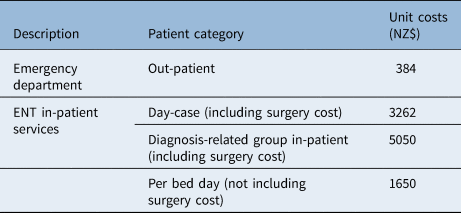
A decision tree was built to examine the cost-effectiveness of day-case surgery compared to next-day discharge after sinonasal surgery. The cost-effectiveness analysis was from the perspective of the public provider. Only direct costs to providers were included, and costs to patients were not considered. The direct costs to providers (Table 1) included in-patient costs in the otorhinolaryngology department and treatments in the emergency department associated with complications after discharge. The unit costs are displayed in Table 1, derived from the 2018 product catalogue used by the Waikato District Health Board, and are in New Zealand Dollars (NZ$).
Unit costs used in decision tree

The Pearson chi-square was used to identify any differences in complication rates, and the Mann–Whitney U test was used to examine the differences in costs between the two groups (same-day discharge vs next-day discharge). Hospital 1 stipulated that patients who lived further away (over 60 km) or were more co-morbid (American Society of Anesthesiology grade 3 or higher) were candidates for admission (being unsuitable for day-case surgery). We therefore elected to exclude this group in order to facilitate final comparisons between the two hospital sites. Statistical significance was defined as p < 0.05. All statistics were carried out using SPSS Statistics software, version 25 (IBM, Armonk, New York, USA).
Results
Twenty-two out of 181 patients (12.1 per cent) lived more than 60 km from hospital and 8 patients (4.4 per cent) had an American Society of Anesthesiology grade of 3, with the remainder being grade 1 or 2. All patients travelling more than 60 km and with an American Society of Anesthesiology grade of 3 were cared for at hospital 2.
As shown in the decision tree (Figure 1), 117 patients underwent day-case surgery and 64 were discharged on the next day. In the day-case surgery group, five patients were treated in the emergency department because of epistaxis, and one was re-admitted. In the next-day discharge group, two patients were treated in the emergency department, and four were re-admitted. The incidence of complications after sinonasal surgery was 5.13 per 100 patients in the same-day discharge group, and 9.38 per 100 patients in the next-day discharge group (p = 0.272). In addition to epistaxis, the only other hospital re-presentations were for problems with pain management (2 out of 181 patients, 1.1 per cent).
Decision tree comparing same-day discharge and next-day discharge after sinonasal surgery. ED = emergency department

The total costs in the day-case surgery group were $385 224 and the average costs per patient were $3262. The respective costs in the next-day discharge group were $330 568 and $5050. In this study, day-case sinonasal surgery was less expensive compared to next-day discharge (p < 0.001), but had similar post-surgery outcomes.
Discussion
The prevalence of allergic rhinitis, deviated nasal septum and chronic rhinosinusitis is high, and as such sinonasal operations are some of the most commonly performed elective procedures.Reference Patel, Reber and Ghosh2,Reference Hastan, Fokkens, Bachert, Newson, Bislimovska and Bockelbrink12,Reference Brożek, Bousquet, Agache, Agarwal, Bachert and Bosnic-Anticevich13 It is of particular importance therefore that these procedures are performed in the most efficient and cost-effective fashion possible.Reference Bhattacharyya, Orlandi, Grebner and Martinson14
Ambulatory surgery has been shown to have both patient-related and hospital-associated benefits.Reference Pézier, Stimpson, Kanegaonkar and Bowdler15. In an Australasian setting, one study found that day-stay surgery units had increased efficiency and patient satisfaction rates.Reference Rudkin, Bacon, Burrow, Chapman, Claxton and Donovan16 A policy of same-day sinonasal surgery has long been practised in some centres, and 600 000 patients undergo ambulatory sinonasal surgery in the USA each year.Reference Ganesan, Prior and Rubin6,Reference Bhattacharyya17 This policy has not, however, been universal across the world. Such practice variances in the timing of discharge has enabled us to compare the cost-effectiveness between these two groups.
A minority of patients in our series were considered, even in retrospect, to be unsuitable for day-case surgery owing to co-morbidities (American Society of Anesthesiology grade 3 or higher) or distance for travel home (60 km or more), although the majority were considered suitable.
In our study, the re-admission rate for the day-case surgery group, at 0.86 per cent, was lower than that reported in current literature.Reference Singh, McCormack and Roberts7,Reference Bhattacharyya18 Although not statistically significant, the raw number for the rate of re-presentation to hospital with complications was higher in the next-day discharge group, thus contributing to the overall higher costs of overnight admission. This was an unexpected result and merits further study. Conceivably, patients undergoing same-day discharge are more attuned to the fact that some degree of post-operative bleeding and discomfort can be managed safely at home without meriting hospital care.
The overall incidence of re-presentation owing to epistaxis in our study was not insignificant (5.13 per cent), despite the use of tranexamic acid and electrocautery intra-operatively. While epistaxis was the leading cause of re-presentation in our study, all cases were self-limiting and treated conservatively. Furthermore, the majority of re-presentations with epistaxis were managed in the emergency department, with only 16.7 per cent requiring formal admission. Implementation of a day-case sinonasal surgery policy does require close attention to peri-operative haemostasis and appropriate patient education.
• Sinonasal procedures can generally be performed safely as day-case procedures
• Day-case sinonasal surgery is cost-effective
• Bleeding is the most frequent cause of re-presentation after sinonasal surgery, and careful attention to haemostasis is required
• With appropriate patient selection, a policy of day-case sinonasal surgery is recommended
We have demonstrated that day-case sinonasal surgery in targeted groups is achievable, safe and cost-effective. Potential barriers to day-case surgery include post-operative bleeding, institutional culture, geographic size of the catchment area and patient co-morbidities.
Conclusion
Our results demonstrate that sinonasal surgery with same-day discharge can be performed safely and in a cost-effective manner. Careful patient selection and attention to haemostasis is imperative to achieve this.
Competing interests
None declared