1. Introduction
When political markets function well, legislators who poorly serve the constituents’ interests will be sooner or later voted out from office. Most empirical papers in the shirking literature support and argue that political markets work efficiently and voters successfully sort out politicians. Bender and Lott (Reference Bender and Lott Jr1996) conclude that congressmen's voting patterns are very stable over time and do not show any indication of engaging in opportunistic behavior, and that even small deviations result in the politician being removed from office.
Addressing questions of how shirking can be identified and measured, empirical research papers propose the model of shirking as ideological consumption goods (Kau and Rubin, Reference Kau and Rubin1979; Carson and Oppenheimer, Reference Carson and Oppenheimer1984). However, this approach has suffered both methodological and theoretical flaws; among others the underlying median voter hypothesis does not always hold (Bender and Lott, Reference Bender and Lott Jr1996). In addition, the literature has extensively focused on the US Congress – the Senate and the House of Representatives – and has overlooked state legislatures.
This paper considers Proposition 13 and the legislature's alternative to Proposition 13, Proposition 8, in the California state legislature in the late 1970s. Since there was a clear indication of different preferences for property taxes between the state legislators and the constituents, this study will evade the problem of identifying shirking politicians. I identify shirking politicians by looking at the roll call votes. Taking advantage of the unique circumstance, this paper tests the efficiency of the political market at the local level.
Analyzing the specific issue of property taxes has additional benefits. Nelson and Silberberg (Reference Nelson and Silberberg1987) demonstrated, that the cost of shirking is relatively higher on specific bills on particular weapon systems with well-defined beneficiaries, and relatively lower on general defense expenditure bills with uncertain final distribution of funds. Therefore, testing a specific property tax bill from which homeowners receive benefits will become more instructive. The test becomes efficient for yet another reason; property tax limitation was an important issue in the 1970s in California because of high inflation in the housing market. Matsusaka (Reference Matsusaka2004) argues that legislators might be in tune with their constituents on high profile issues, but act against the constituents’ interests on less important issues when voters do not have complete information and seldom have the choice of a candidate with identical policy views along every dimension.
I also analyze the bills adopted after the passage of Proposition 13 to compensate for the loss of millions of dollars in property tax collection which the local agencies suffered. Senate bill No. 154 (immediately followed by Senate bill No. 2212) is a short-run plan to finance local governments, while Assembly bill 8 is a long-run program. I ask how state legislators reacted to the constituents’ message expressed by the passage of Proposition 13 when they voted on the bills. Applying the probit regression analysis, I test if state legislators from districts which had strongly supported Proposition 13 voted differently on SB 154, SB 2212, and AB 8 than did legislators from districts which had only weekly supported Proposition 13.
This paper proceeds as follows. The shirking literature is reviewed in Section 2. Section 3 provides an overview of backgrounds related to Propositions 13, Proposition 8, SB 154, SB 2212, and AB 8. Section 4 explains the data and method to test the hypotheses and discusses the estimation results. Section 5 will conclude.
2. Literature review
‘Shirking’ means a lack of responsiveness by representatives to their constituents or the failure by the legislators to act in the interests of their constituents (Bender and Lott, Reference Bender and Lott Jr1996; Tien, Reference Tien2001). It is also defined as actions taken by legislators that do not benefit the group forming a specific constituency (Wright, Reference Wright1993). This view of political behavior matters only when a representative is thought of as an agent or a mirror of the constituents (Tien, Reference Tien2001). In this the delegate or principal-agent model of representation, elected politicians are supposed to follow the wishes of their constituents. In contrast, political shirking does not matter in the model of representation which postulates that politicians should follow their own ideology to serve constituents’ interests.Footnote 1
However, these definitions of shirking will be still ambiguous. Are legislators supposed to serve all the constituents in the district or a subset of them? A legislator's geographic constituency and reelection constituency can differ. A constituency could be defined as any group or sets of groups, including voters, contributors, and party members that affect the probability of reelection. Thus, the controversy centers around the problem of identifying the precise composition of legislators’ constituents and the constituents’ interests.
There are two main views of shirking, assuming different models of electoral competition and the corresponding legislators’ incentive to shirk. The first view of shirking is the ideology-as-a-consumption-good hypothesis in which politicians compare the costs in the form of reduced probability of reelection and the benefits from indulging in their own beliefs (Kau and Rubin, Reference Kau and Rubin1979; Carson and Oppenheimer, Reference Carson and Oppenheimer1984). Politicians have their own preferences which may differ from those of their constituents – the constituents’ interests are defined as those of the median voter. Maximizing the probability of reelection means taking the campaign position the median voter most prefers.
An alternative view of shirking is called the electoral support-maximizing model or non-ideological shirking model in which politicians look at the interests of a subset of the constituents, and forsake the interests of the other constituents, in exchange for other forms of political support, such as campaign contributions. Politicians focus on the trade-offs between factors influencing the probability of reelection.
The literature supporting the ideology-as-a-consumption-good hypothesis has considered the relationship between voters and the costs of engaging in opportunistic behavior by politicians seeking reelection. In one of the earlier research papers, Nelson and Silberberg (Reference Nelson and Silberberg1987) argue that the cost of shirking is relatively higher on specific bills and relatively lower on general bills.Footnote 2 The benefits from specific bills are well defined, and specific bills will directly affect the wealth of individuals who live in the affected district, whereas the final distribution of benefits from general bills is generally not known when legislators vote. Their findings suggest that the test in my paper is more effective because, since the property tax is a more specific tax than other kinds of taxes, such as income or sales tax, voters’ reaction will be more sensitive to legislators’ voting on the property tax.
Other researchers consider how the cost of shirking changes when they do not face the threat of reelection or when they serve their last term in office (Lott, Reference Lott1987). If politicians decide to retire, they are more likely to shirk because voters can no longer punish them at the following election. However, the literature shows that voting behavior of representatives is very stable over time and they do not deviate from their constituents’ preferences, even when they decide to retire. This suggests electoral competition efficiently sorts politicians (Bender and Lott, Reference Bender and Lott Jr1996). In other words, the lack of empirical evidence for a last-period problem supports the model of representation (Tien, Reference Tien2001). By the time legislators serve the last term, those who do not fit well with the constituents have already been voted out from office. Since a politician follows both his own ideology and their constituents’ policy preferences when he votes, he will be lowering his own utility if he attempts to deviate from the constituents’ interests during the last term. Thus, ideological shirking will be of minor importance (Bender and Lott, Reference Bender and Lott Jr1996).Footnote 3
The ideological consumption model is applied in a wide range of researches but is equally challenged by many scholars. Two major disagreements among researchers are about (1) the assumption of the median voter theory or the degree to which legislators alter their voting behavior according to the change in the perceived costs and (2) the validity of the two-step procedure or the degree to which the first-stage residuals as the ideological difference are artifacts. Based on the median voter theory, the typical empirical procedure this model utilizes to identify a legislator's shirking is the two-step residual approach. First, ideological rating scores, such as Americans for Democratic Action (ADA) scores, are regressed on average characteristics of the constituents of legislators’ political districts in the first stage. Next, the calculated residuals for each congressman rather than ADA scores themselves are used as one of the independent variables in the second-stage regression of legislator's voting for a bill. Then, a significant coefficient of the first-stage residuals in the second stage is interpreted as voting on the bill influenced by legislator-specific ideology or shirking. However, this interpretation is challenged by researchers. The underlying theoretical model, the Downs median voter hypothesis, is often inconsistent with the common phenomenon of a state having two Senators with widely different ideological voting records. In addition, critiques of the two-step methodological procedure argues that the estimated residuals that proxy for the ideology of legislators in the second stage represent the omitted variables that could measure excluded constituents’ characteristics in the first stage (Peltzman, Reference Peltzman1984). To the extent that omitted constituent characteristics explain legislators’ voting in the subsequent regression, the ideological proxy is correlated with legislators’ voting patterns.
Since this paper starts from the fact that there was an ideological difference with respect to property taxes between state legislators and voters in the 1970s in California, the problem of how to identify shirking by specifying the relevant constituent can be avoided. The question of how shirking is identified has already been solved because the state legislators have a different opinion from the constituents on property taxes in the case where the legislature attempted to head off Proposition 13 by placing a more moderate alternative, Proposition 8, on the ballot. This point will be further explained in the following section.
An alternative view of shirking is the electoral-support-maximizing model or non-ideological shirking model. It is the subset of the constituents that the legislator serves, and the deviation from the median voter's policy preference does not imply shirking any longer. Politicians simply make trade-offs between the factors influencing their probability of reelection. Kau and Rubin (Reference Kau and Rubin1993) argue that ideology and shirking should be separated, and that non-ideological shirking is quite possible. In fact, they found evidence that congressmen sometimes change their voting behavior in response to contributions. However, earlier arguments on the last-term shirking problem can also be applied to non-ideological electoral-support-maximizing model. If campaign contributions do alter how politicians vote, there should be instability in congressmen's voting patterns since congressmen change their votes during their last term when campaign contribution does not matter. If politicians have compromised their positions to receive contributions, the decision not to seek reelection should remove the threat that displeasing contributors make, and politicians are more likely to alter their voting behavior. But most empirical papers indicate that the legislators’ voting records are quite stable over time. Although campaign contributions may induce shirking, there is little evidence that political shirking exists (Bender and Lott, Reference Bender and Lott Jr1996).
Therefore, both the ideology-as-a-consumption-good and the electoral-support-maximizing models suggest that political shirking will not be a problem. When politicians do not serve the constituents’ interests, they will be defeated at the following election. Political markets efficiently sorts politicians. In this sense, the shirking literature is closely related to the political market efficiency problem.
Matsusaka (Reference Matsusaka2004) and Wright (Reference Wright1993) argue that political markets may not work well when monitoring costs are high. Voters seldom have complete information about the activities of particular politicians, but voters have to choose several politicians from the governor to school board members from the ballot on Election Day. Since candidates take positions on a large number of issues, the voter seldom has the choice of a candidate who has the same policy preferences as his/hers on every dimension. Instead, the voter will weigh various issues and choose the candidate who is closest ‘on average’ to his ideal position or on a few key issues. Thus, legislators might comply with the constituents’ preferences on high profile issues, but act against the constituents’ interests on less visible or less important issues (Matsusaka, Reference Matsusaka2004). This argument gives additional motivation to analyze Proposition 13 because property tax limitation was so important an issue for both voters and state legislators in California in the late 1970s.
3. Background
3.1 Proposition 13 and Proposition 8Footnote 4
Proposition 13 limited the property tax rate to 1% of purchase price.Footnote 5 Property tax revenues, on which local governments rely, declined to less than half.Footnote 6 Prior to Proposition 13 each local authority (counties, cities, school districts, and special districts) had the power to determine the amount of property tax revenues to collect each year. Property tax rates generally varied between 1.5% and 3.5% of market value, the average being about 2.5% (O'Sullivan et al., Reference O'Sullivan, Sexton and Sheffrin1995). Proposition 13 was a voter initiative constitutional amendment and was approved by voters by a 2–1 margin at the 1978 primary election.Footnote 7
There are several noteworthy political and economic features behind this tax revolt in California. The first point is the booming housing market after the 1973–74 economic recession. For example, housing prices rose by 2–3% as in the rest of the country in the mid 1960s, but, by early 1976, they were rising by 2–3% a month in California. Many houses were sold and resold before construction was complete, and builders were not able to meet the demand for housing. Inflation worsened as in other states during the 1970s, but the gap between home values and the general inflation rate was huge in California. Single-family home values increased by 6.1%, while overall prices rose by 3.3% in 1972. They increased by 24.6% and 5.8% respectively in 1977.
Inflation places taxpayers into higher tax brackets without increasing their disposable incomes. Rabushka and Ryan (Reference Rabushka and Ryan1982) argue that ‘purchasing power of the California citizens, real disposable income per worker, actually decreased in 1976, 1977 and 1978’ due to the ‘bracket creep’ effect.Footnote 8
California residents were paying one-third more in state and local taxes as a share of personal income than were other states’ residents.
However, the financial situation could be seen differently by homeowners than by politicians. Although some property taxes on individual homeowners doubled and tripled, homes made up on average only about a third of the property tax base, and only a third of properties were reassessed each year. So, the state treasury was little affected by property taxes. The percentage of total property tax revenues collected in California during the 1970s actually decreased – from 7.2% of personal income in 1972 to 6.5% in 1977. Since the state government raises its money mainly from income and sales taxes, the budget surplus increased from about $0.75 billion in 1975 to $4 billion in 1978.
At the same time, the share of the tax burden shifted from businesses to homeowners. The California assessments of property values of single-family houses increased by 110.9% between 1975 and 1978, the assessments of apartments went up by 34.2%, and commercial, industrial, farmland, and public utility assessments increased by 26.4%. Homeowners paid about 31.6% of the state's property taxes in 1972, while they bore about 41.0% in 1977.
Income tax rates had not been raised since 1972 at the maximum rate of 11% on taxable incomes exceeding $15,500.Footnote 9 But, due to inflation, income tax collections soared. As the inflationary economy stimulated consumer spending, even the state's sales tax receipts, though levied at a flat rate, increased substantially faster than real incomes. Between 1974 and 1977, income taxes increased more than 150% and sales taxes increased by 188%. In addition to this point, as assessed valuations went up, state aid for schools, welfare, or medical care went down. Tax burdens also shifted from state revenue sources to local ones.
Due to the proliferation of service districts at the local level, the taxpayers would be thoroughly confused about who was taxing them how much, and for what purpose. A taxpayer might find his property tax bill itemizing upward of two different charges: a city tax, a county tax, one or two school taxes, and at least a dozen special district taxes. Many local agencies have the autonomous power to levy taxes on property. During the Depression, President Roosevelt encouraged governors to permit the creation of special districts to carry out federally assisted public works. It turned out that it was a lot easier for politicians to get the voters to approve the creation of a special district than to persuade them to agree to the levy of a new tax directly, even though the ultimate fiscal effect was the same. This new form of local government often proved to be substantially less accountable to the voters than a city council or county board of supervisors.
Public pressure for substantial tax relief due to massive property tax bills was one of the biggest issues in the 1977–78 Legislature. But there were sharp divisions over how much the state treasury could afford and what form the tax relief should take. This conflict caused the legislature to end up with no tax relief measure during the 1977 legislative session. Jarvis and Gann, authors of Proposition 13, succeeded partly because the legislature stalemated.
Another issue was Serrano v. Priest. In 1971, the California Supreme court ruled in Serrano that reliance on property taxes to finance public schools is unconstitutional and violates the equal protection clause of the California constitution. The court required the inequalities in dollar expenditures per student be limited within $100 across districts in Serrano II in 1976. Fischel (Reference Fischel1989, Reference Fischel1996, Reference Fischel2004) argues that the Serrano decision and the legislature's response to Serrano II, Assembly bill No. 65, caused Proposition 13 to pass. Serrano weakened the Tiebout system and higher-than-average-spending districts lost incentives to preserve higher property tax rates. Since AB 65 required a large amount of expenditures, the legislature did not afford to propose additional tax relief to homeowners.
By the beginning of the 1978 legislative session, the Jarvis and Gann's initiative had achieved far more than the required number of signatures to qualify for the June ballot, and so the Legislature was well aware that Proposition 13 had a good chance of being passed. Governor Brown signed Senate bill No.1 on 3 March 1978. SB 1 was called the Behr bill, named after the chief author Senator Behr. SB 1 required a constitutional amendment permitting ‘split roll tax rate’; that is, different property tax rates for home and business properties. Senate Constitutional Amendment No. 8 (SCA 8) placed Proposition 8 on the June 1978 ballot to make SB 1 effective.Footnote 10 Proposition 8 was the legislature's more moderate alternative to Proposition 13, and the state legislature attempted to head off Proposition 13 by Proposition 8.Footnote 11
Proposition 13 created a $6.15 billion tax relief, while it was estimated that Proposition 8 (SB 1) would create a $1.4 billion tax relief for homeowners and renters. For homeowners, the bill provided a 30% reduction in property taxes or a $366 property tax cut on average while maintaining homeowner exemption, $7,000. For renters, who consisted of about 45% of the electorate and did not receive any benefits from Proposition 13, the bill increased the state income tax credit from $37 to $75 and allowed welfare recipients to qualify for the credit. Senior citizens with income below $13,000 were granted additional relief. The Behr bill established separate tax rates for residential and commercial construction. Since all property had to be treated equally under the state constitution, SB 1 required a constitutional amendment to allow the split roll tax system. Owners of single-family houses would effectively be assessed at a lower fraction of value than other commercial, industrial, or farmland properties. The measure limited revenues accruing to local government. A state revenue limit restricted future state revenue growth to 1.2 times the annual percentage growth in state personal income. And SB 1 automatically reduced homeowner tax rates when assessments rose (Fischel, Reference Fischel1996; Kuttner, Reference Kuttner1980; Rabushka and Ryan, Reference Rabushka and Ryan1982).Footnote 12
Virtually every interest group formed a coalition to oppose Proposition 13. Opponents came from business, labor, education, and political groups, the press and politicians themselves.Footnote 13 Opponents did an awful campaign. They warned, intimidated, threatened, or even bribed voters. Business opposed Proposition 13 partly because property tax cuts might be offset with new taxes on businesses. The potential damage to government could also hurt the investment climate. Other opponents argued that public schools might be closed when public money ran out, that police and fire services might be cut, or more simply that Proposition 13 was worse than Proposition 8. On the other hand, only a few proponents are voters themselves, probably home owners (Rabushka and Ryan, Reference Rabushka and Ryan1982).
Voters faced both propositions at the 1978 primary election and the choice was clear. The Behr bill would have taken effect only if voters voted for Proposition 8 and voted against Proposition 13. Proposition 13 was approved by 64.8–35.2%, but Proposition 8 was rejected by 47–53%.
3.2 Senate bill No. 154 and Assembly bill No. 8
After the passage of Proposition 13, the legislature and the governor surveyed possible damage on local governments due to the decline in property tax collection by more than half.Footnote 14 During a period of only about three weeks between the passage of Proposition 13 and the next fiscal year, the legislature and the governor managed to pass Senate bill No. 154 (immediately followed by Senate bill No. 2212). SB 154, popularly known as ‘Bailout I’, specified a state bailout to local governments and offered a temporary solution. The bill authorized $4.4 billion in relief to local governments to compensate for the loss in property taxes. School districts were to receive about $2.2 billion, the counties $1.48 billion, the cities $250 million, and the special districts $125 million. $900 was set aside for short-term loans to local governments.Footnote 15 This measure covered most urgent particular needs.
SB 154 provided about $2 billion of state assistance in the form of block grants and provided for state assumption of the costs of several state-mandated health and welfare programs. State aid increased in importance in the general county revenue from 23.9% in fiscal year 1977–78 to 36% in fiscal year 1978–79. The bill also specified the rule of allocating the 1% property tax revenues collected by counties to local agencies for the fiscal year 1978–79 on the basis of their average share of county-wide taxes over the previous three years. Block grants for these local agencies were intended to ensure that no local government would experience more than a 10% loss in total revenue received in fiscal year 1978–79 compared to the previous fiscal year of 1977–78.Footnote 16
Assembly bill No. 8, on the other hand, specified a long-run bailout. This bill, popularly known as ‘Bailout II’, authorized about $4.85 billion in fiscal year 1979–80 and $5.5 billion in fiscal year 1980–81. The bill eliminated the annual assistance but introduced a more permanent source of revenue. The increase in property tax revenues due to growth in assessed valuations was allocated to jurisdictions in which the property was located. AB 8 shifted a portion of property tax revenues from school districts to other local agencies but increased financial assistance from state to school districts. Under AB 8 each local agency receives a base allocation equal to the amount it received in the prior year and its share of additional revenues generated by the growth in assessed valuation within its boundary. As a 1979–80 base allocation, counties received their 1978–79 share of property taxes and 100% of their 1978–79 block grant, minus the state grant for the county health service. This measure was fashioned to prevent the state from attaching more strings to regulate local government because Proposition 13 would otherwise have caused centralization of the California public sector by limiting the real property tax rate to 1%.Footnote 17
Due to these bills, net losses were 6.1% for the general county revenues and 1.2% for the general funds of school and community college districts respectively in fiscal year 1978–79. The incomes in general funds for school and community college districts increased by 10% from fiscal year 1977–78 to fiscal year 1979–80. On the other hand, the general county revenue decreased by 2.8% from fiscal year 1977–78 to 1979–80.
Regarding AB 8 implemented during 1979 legislative session, Rabushka and Ryan (Reference Rabushka and Ryan1982) found an interesting newspaper article: ‘Some senate opponents charged that it was too generous with state revenues and amounted to ‘business-as-usual in Sacramento’ despite the tax-cutting message of Proposition 13’ (San Francisco Chronicle, 21 July 1979). This newspaper article leads to the analysis of how state legislators reacted to their districts’ preferences for property taxes when they voted on SB 154, SB 2212, and AB 8, and will be undertaken in Section 4.2. The article suggests that, although the vast majority of state legislators opposed Proposition 13, legislators seemed to have changed their minds after they observed voters’ message expressed by the passage of Proposition 13. This could indicate that the state legislators are an agent in the delegate or principal-agent model of representation, which presumes that politicians should follow the wishes of their constituents. In addition, since the legislature did not increase property tax rates afterward, shirking might not be a problem and voters might not need to punish their state legislators who did not serve constituents’ preferences.Footnote 18
Proposition 13 could also have moved political organizations to the right. Few politicians are willing to take a public stand that goes against the spirit of Proposition 13. Governor Jerry Brown initially opposed Proposition 13 but later in his campaign he announced, ‘I was wrong.’ He described himself as a ‘born again’ tax cutter in the Los Angeles Times of 6 September 1978, which was found by Rabushka and Ryan (Reference Rabushka and Ryan1982).
4. Data, method, and estimation results
4.1 Shirking legislators
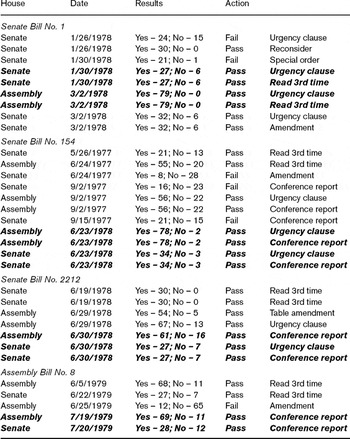
The vast majority of state legislators opposed Proposition 13. Those who opposed it will be identified by looking at roll call votes for SB 1 in the legislature.Footnote 19 If a state legislator voted ‘Yes’ on SB 1, it will indicate the legislator is the opponent. I analyze the roll call votes for SB 1 on 30 January 1978 in the Senate and 2 March 1978 in the Assembly, because these floor votes are the last votes in each house before the bill was moved to the other house and would be relatively more important. The other roll call votes are shown in Table A1 in the appendix.
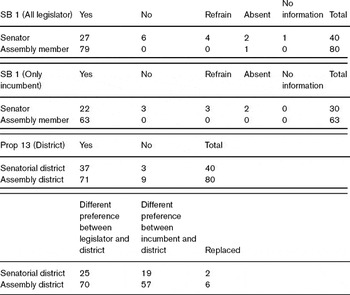
First, I look at which districts have different preferences for property taxes than the state legislators, and which incumbents are defeated in those districts by just counting the numbers. Table A2 in the appendix summarizes legislators’ voting for the selected roll call vote on SB 1 in the legislature and electoral results on Proposition 13 by the senatorial and Assembly district level at the 1978 primary election. For the senatorial districts, 27 Senators out of total 40 districts voted ‘Yes’ and, six Senators voted ‘No’. Two Senators were absent, and four Senators refrained from voting. No information is available for Senator Carpenter from the 36th district. Thirty-seven senatorial districts approved Proposition 13, and three districts denied. Thus, the State Senator and voters had different preferences for property taxes in 25 districts. By different, I mean that the district voted ‘Yes’ on Proposition 13 and the legislator voted ‘Yes’ on SB 1. Looking only at incumbents who ran for the office at the following general elections, two incumbents out of the 19 districts were defeated. One incumbent was defeated when the legislator refrained from voting and the district approved Proposition 13. One incumbent was defeated at the next primary election when the legislator and the district had different preferences. One incumbent was defeated at the 1978 primary when the legislator and the district had different preferences.
Out of 80 Assembly districts, 79 Assembly members voted ‘Yes’ on the roll call vote and one member was absent. Seventy-one Assembly districts approved Proposition 13 and nine districts denied. In 70 Assembly districts, legislators and the constituents had different opinions. Looking only at incumbents who sought reelection at the 1978 general election, six out of the 57 incumbents were removed from office. Two incumbents were defeated at the 1978 primary election when the legislators and the districts had the different preferences.
In short, eight state legislators who sought reelection against their challengers were voted out from office in the 76 districts where the district and the incumbent had the different opinions about Proposition 13.Footnote 20
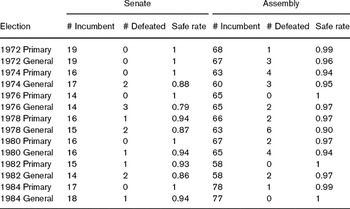
Table A3 in the appendix shows the percentages of state legislators who are reelected from 1972 to 1984 in California. As we can see, incumbents are generally safe over these years. As to the Senate, the percentages range from 79% to 100%. The percentages are relatively more stable in the Assembly between 94% and 100%. Ten percent of incumbents in the Assembly are defeated only at the 1978 general election.
Next, I apply regression analyses to explain the share of the two-party vote received by incumbents, testing how the incumbents fared in the following election if they did not represent their constituents’ preferences for property taxes. The method relies on the assumption that, if state legislators do not serve the constituents’ interests for property taxes who are responsible to reelect them, they will lose the political support that helps them hold office. I specify the political support measured by the percentage of the two-party vote received by state legislators as a function of available explanatory variables. The following is the explanation of the variables.
Dependent variable
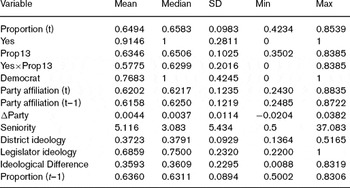
Proportion (t): The percentage of the two-party vote received by each state legislator at the general election after the passage of Proposition 13.Footnote 21 The percentage of the two-party vote is widely used to analyze the efficiency of political market in the literature. State Senators are chosen for four-year staggered terms and when they are from even-numbered districts, I look at the 1978 general election results. When they are chosen from odd-numbered districts, I look at the 1980 general election results. On the other hand, since every Assembly member is chosen for two-year terms every two years, I look at the 1978 general election. The sample includes only incumbents who sought reelection at both pre- and post-Proposition 13 elections. The number of observations is 82. I omitted observations in which the legislators did not seek reelection after the passage of Proposition 13.Footnote 22 I also excluded incumbents who were defeated at the 1978 primary election.Footnote 23 I also omitted the observations in which the incumbent had no opponent from the other party.Footnote 24 Descriptive statistics are in Table A4 in the appendix.
Independent variables
Yes: The dummy variable is equal to 1 if the legislator voted ‘Yes’ on SB 1 at the roll call votes mentioned above. In the following OLS regression 19 Senators voted ‘Yes’, three Senators voted ‘No’, two Senators were absent, and two Senators refrained from voting, and 56 Assembly members voted ‘Yes’.
Prop 13: The percentage of voters who voted in favor of Proposition 13 in the legislator's district.Footnote 25 This variable measures conservativeness of the constituents in terms of property taxes. I assume that the higher percentage indicates the district is more conservative with respect to property taxes. The districts’ preferences for property taxes are represented by a continuous variable instead of a dichotomous variable since the former can measure the district's preferences more precisely.
Democrat: The dummy variable equal to 1 if the incumbent is a Democrat.Footnote 26 Sixty-three out of 82 state legislators are Democrats.
ΔParty: The difference in party affiliation of voters in the legislator's district before and after the passage of Proposition 13, whose affiliation is the same as the incumbent.Footnote 27Seniority: The number of years the incumbent is in office.Footnote 28 I count one year as 1. The base date is 31 December 1977.
Ideological difference: This variable will measure the general ideological difference between legislators and their constituents.Footnote 29Ideological difference is the absolute difference between District ideology and Legislator ideology divided by 100. Legislator ideology and District ideology measure the general ideology of the incumbent and the constituents respectively. Legislator ideology is the voting score which ranges between 0 and 100, representing the proportion of the time that a state legislator takes the conservative position on roll call votes. The value of 100 means the legislator is completely conservative. The scores are based on the last half of the 1977–78 session of the legislature. District ideology is the percentage of voters who voted in favor of the Republican candidate for the Governor in the district at the 1978 general election.
Proportion (t−1): The percentage of the two-party vote received by the incumbent at the general election before the passage of Proposition 13. For State Senators, I look at the 1974 general election if they come from the even-numbered district. If they are chosen in the odd-numbered district, I look at the 1976 general election. For Assembly members, I look at the 1976 general election.Footnote 30 If there was no opponent from the other party, I look at the 1974 general election.Footnote 31
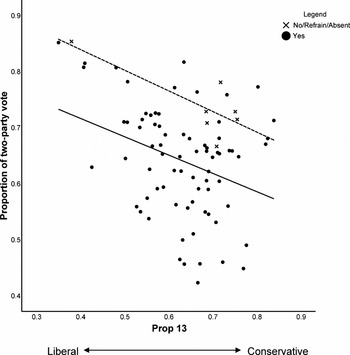
Figure 1 is a scattergram which shows a simple correlation or zero order correlation between two variables Proportion (t) and Prop 13. There seems to be a negative relationship between two variables overall. This graph also shows two separate lines fitted to two groups of observations in which state legislators voted differently on the roll call votes on SB 1. The solid line represents those who voted ‘Yes’ on SB1, while the dashed line represents those who voted ‘No’ on SB1, refrained from voting or were absent at the roll call. The solid line is located below, while the dashed line is fitted above. Thus, the sample shows that the proportion of two-party vote received by the incumbent declines if the variable Yes is equal to 1 when the variable Prop13 increases on average. I test if this difference exists shown in this sample by applying the OLS regression. The hypothesis that I test in this section is as follows.
Scattergram: Proportion of two-party vote received by the incumbent after passage of Proposition 13 vs. % Voters voted in favor of Prop 13 in the district.

Hypothesis 1: State legislators who did not represent the constituents’ preferences for property taxes lost the electoral support more than other legislators who did represent the constituents’ preferences.
I estimate population parameters by applying the Chow test of structural change. One possible argument against this estimation is that the effect of shirking with respect to Proposition 13 could disappear at the 1980 general election.Footnote 32 Two years can be long enough for voters to change the voting attitude toward a specific issue.Footnote 33 However, there are several propositions related to Proposition 13 submitted to voters after the passage of Proposition 13. In November of 1979, there was an initiative, the so-called Gann ‘Spirit of Proposition 13’ initiative sponsored by one of the same authors of Proposition 13, Paul Gann. Proposition 4 placed limits on state and local government spending. This proposition was also approved by the voters, although this measure had little impact due to the high rate of inflation. In addition, in June of 1980 there was an income-tax cutting initiative, so-called ‘Jarvis II’ or ‘Jaws II’ named after one of the same authors of Proposition 13, Howard Jarvis.Footnote 34 Proposition 10 on the same ballot was to restrict rent-control laws since tenants complained that they did not receive their fair share of Proposition 13 savings. Both propositions were rejected by the voters. In November of 1980, there were three propositions, which would modify Proposition 13 slightly.Footnote 35 These propositions, especially ‘Jaws II’, were salient enough for voters to remember Proposition 13, and I assume the effect of Proposition 13 on voters’ decision on how to vote would remain.
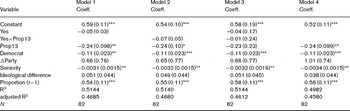
Table 1 shows the results of the OLS regression with the Chow test.Footnote 36 The results of fitting models 1 to 3 would indicate that there is no structural break between two groups of legislators who voted differently on SB1. Model 1 investigates if the break is due to the intercept terms. Model 2 investigates if the break is due to the slope coefficients. And model 3 investigates if the break is due to both the intercept terms and the slope coefficients. None of the variables Yes and Yes×Prop13 is statistically significant in the three regressions.
OLS estimates. Dependent variable: Proportion of two-party vote received by incumbents

Notes: Standard errors are in parentheses.
***Significant at the 1% level, **5% level, *10% level.
However, estimated coefficient on Prop 13 in model 4 is negative and statistically significant. This would suggest that districts punished every incumbent regardless of whether they do not represent constituents’ preferences for property taxes. Districts which supported Proposition 13 more strongly were more likely to oppose the state legislature as a whole which attempted to defeat Proposition 13 by Proposition 8.
The results are quite reasonable when collecting information is costly to voters.Footnote 37 Instead of looking into their state legislator's voting on a bill, voters perceived the context in which the majority of state legislators, every interest group, almost all the other politicians in California including the governor opposed homeowners. Since the legislature makes a decision under majority rule, it is reasonable that districts punish the whole legislature which did not represent the constituents’ preferences for property taxes.
But the effect would not be strong enough to force them out from office. When Prop 13 increased by 1 percentage point, the percentage of two-party vote received by the incumbents decreased by 0.24 percentage points on the average. This becomes significant when the constituents increase the approval rates for property tax limitation by 10% and the race is very close, with, for example, a 51–49 margin. In this case the electoral results could be reversed.
Among control variables, estimated coefficients on Democrat, Seniority, and Proportion (t−1) are statistically significant. The negative coefficient on Democrat indicates that Democratic incumbents received lower support than Republican candidates on the average. The negative coefficient on Seniority is not as expected. But the magnitude is very small; when the incumbent holds his office longer by one year, he loses his support by 0.0034 points on average or 0.34 percentage of the two-party vote he received.
4.2 Agent legislators
In the previous section, I discussed how voters react when their state legislators did not represent constituents’ preferences for property taxes, and we have seen that voters punish all state legislators regardless of whether they shirked or not. In this section, I consider how state legislators voted in the legislature after they observed their constituents’ conservativeness in terms of property taxes. As I mentioned in Section 3.2, after legislators observed the voters’ tax-cutting message expressed by the passage of Proposition 13, legislators seemed to follow the voters’ wishes when they voted on AB 8. The newspaper article in Section 3.2 clearly indicates this attitude of state legislators. I quote the newspaper article cited by Rabshka and Ryan (Reference Peltzman1982) here again: ‘Some senate opponents charged that it (AB 8) was too generous with state revenues and amounted to ‘business-as-usual in Sacrament’ despite the tax-cutting message of Proposition 13’ (San Francisco Chronicle, 21 July 1979).
I analyze the roll call votes on SB 154, SB 2212, and AB 8 to examine how state legislators reacted the constituents’ preferences for property taxes.Footnote 38 I test the following second hypothesis.
Hypothesis 2: State legislators from districts which had strongly supported Proposition 13 voted differently on SB 154, SB 2212, and AB 8 than did legislators from districts which had only weekly supported Proposition 13, applying the probit regression.
I use the same independent variables in the analyses on SB 154 and SB 2212 but slightly different variables in the analysis of AB 8. The number of observations for the analyses of SB 154 and SB 2212 is 116.Footnote 39 It is 118 for the analysis of AB 8.Footnote 40
Dependent variable. The dependent variable is a dichotomous variable which takes on the value of one if the legislator voted ‘Yes’ on the bills. For the analysis of SB 154, I looked at the roll calls both in the Senate and the Assembly on 23 June 1978. Thirty-two Senators voted ‘Yes’ on this bill, two Senators were absent at this roll call, and one Senator refrained from voting. Three Senators voted against it. Seventy-six Assembly members voted ‘Yes’ and two members voted against it.
For the analysis of SB 2212, I look at the roll call votes both in the Senate and the Assembly on 30 June 1978. Twenty-five Senators voted ‘Yes’, three Senators were absent, and three Senators refrained from voting on this bill. Seven Senators voted ‘No’. Fifty-nine Assembly members voted ‘Yes’, 16 voted ‘No’, and three refrained from voting.
In the analysis of AB 8, I look at the roll call vote on 19 July 1979 for the Assembly and 20 July 1979 for the Senate. Twenty-seven Senators voted ‘Yes’ and 12 Senators voted ‘No’. Sixty-nine Assembly members voted ‘Yes’ and ten members voted ‘No’ on this bill.
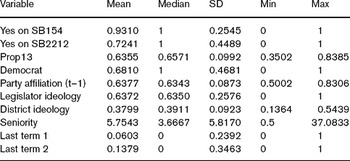
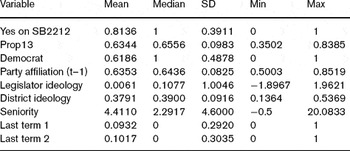
Descriptive statistics are in Tables A5 and A6 in the appendix.
Independent variables
Prop 13: The same as in Section 4.1.
Democrat: The same as in Section 4.1. There were 79 Democrats in the analysis of SB 154 and SB 2212 and 73 Democrats in the analysis of AB 8.
Proportion (t−1): The same as in Section 4.1 for the analysis of SB 154 and SB 2212. In the analysis of AB8, I look at the 1978 general election for the Senator from even-numbered districts and all the Assembly members and look at the 1976 general election for the Senator from odd-numbered districts.
Seniority: The same as in Section 4.1 for the analysis of SB 154 and SB 2212. In the analysis of AB 8, I used 31 December 1978 as the base date and count one year as 1. Legislator ideology is explained in Section 4.1. For the analysis of SB 154 and SB 2212, I used the same variables as in Section 4.1. But, in the analysis of AB 8, I look at the voting scores based on the last half of the 1979–80 session of the legislature. I standardized the voting scores to estimate the score of Senator Smith from 12th district, using the 1979 session voting scores, because the legislator's score is not available.
District ideology is the same as in Section 4.1.
Last term 1 is the dummy variable equal to 1 if the legislator was retiring.
Last term 2 is the dummy variable equal to 1 if the legislator faced the last term but ran for another office or was appointed to another office which is subject to election.
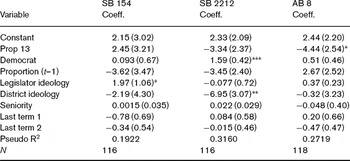
Table 2 shows the estimation results of applying the probit estimation. I analyzed SB 154, SB 2212, and AB 8. As the estimated coefficients on variable Prop 13 in the three regressions indicate, state legislators still did not match the constituents’ preferences for property taxes when they voted on the short-run rescue bills, but they did represent the constituents’ preferences when they voted on the long-run assistance bill. The estimated coefficient on Prop 13 in the third model is negative and statistically significant, which suggests that the probability of legislators voting ‘Yes’ on AB 8 decreases when Prop 13 increases by one percentage point on average. Legislators from districts which had strongly supported Proposition 13 voted more likely against AB 8 than did legislators from districts which had only weekly supported Proposition 13.
Probit estimates. Dependent variable: Legislator voting on bills (1 if Yes, 0 otherwise)

Notes: Standard errors are in parentheses.
***Significant at the 1% level, **5% level, *10% level.
This finding is consistent with the former newspaper article which states some legislators revised their opinion about property taxes after they received the tax-cutting message from their constituents. It is also consistent with other findings in the shirking literature, which argue that elected politicians represent the constituents’ preferences.
5. Conclusion
This paper considers the efficiency of the political market at the California state level in the context of the famous tax revolt. As the roll call votes on SB 1 and the electoral results for Proposition 13 indicate that the state legislators and the constituents had different preferences for property taxes, this paper tests the hypothesis that voters successfully sort out the shirking politicians. The results show that the districts punished the legislature as a whole regardless of whether or not their representative represents the constituent's preferences for property taxes.
Applying the probit model to the roll call votes on the bills to support local governments’ finance after the passage of Proposition 13, I also found that the state legislators take into consideration their districts’ preferences for property taxes when they vote on the bills. This finding suggests that after legislators observed the message conveyed by the passage of Proposition 13, they followed the constituents’ will.
This paper does not ask a question of being right or being wrong. But there are mainly three reasons why Proposition 13 could be worse than Proposition 8.Footnote 41 Because of these reasons, state legislators might oppose Proposition 13 and intend to defeat it by the legislature's more moderate alternative, Proposition 8. Proposition 13 has taken effect for nearly 30 years as the California constitution. We must keep in mind that, if the majority of voters or the majority of voters who voted were misguided, the state could go in a wrong direction.Footnote 42
About the Author
Seiji Fujii is Post-Doctoral Research Fellow at Research and Development Initiative, Chuo University and Part-time Lecturer at School of International Politics, Economics and Communication, Aoyama Gakuin University. Dr Fujii received Ph.D. in economics from University of California, Irvine in 2006.
I would like to thank Professor Amihai Glazer for much advice, guidance, and encouragement when writing this paper. I would also thank Professor Jun Ishii, Professor Hiroki Kondo, Professor Aiji Tanaka, Professor Thomas McCaleb, and former colleagues at UC-Irvine, Shuji Kimura and Yogesh Uppal, for helpful comments and suggestions. I am also grateful to the Department of Economics and the School of Social Sciences at UC-Irvine for financial support. All remaining errors are my own.
Appendix
Floor voting results: 40 Senate and 80 Assembly

Notes: Urgency clause – Section of a bill stating that the bill will take effect immediately upon enactment. It requires a two-thirds vote in each house.
Special order of business – An advance notice is given as to when the bill will be considered by the Assembly and the Senate. Notice is given by requesting unanimous consent.
Roll call votes in italic boldface are analyzed.
Voting results on SB 1 and proposition 13

How incumbents are reelected from 1972 to 1984

Descriptive statistics for OLS regression

Descriptive statistics for probit estimation (SB154 and SB2212)

Descriptive statistics for probit estimation (AB8)