

Introduction
According to the Intergovernmental Panel on Climate Change, limiting global warming to safe levels (at or below 1.5°C above preindustrial levels) requires ambitious changes in how we use fuel, land and other natural resources (Intergovernmental Panel on Climate Change, 2018, 2019). This will require large-scale changes in both behavior and policy. In the USA, for instance, some estimates hold that roughly 80% of the energy used and CO2 emitted is the result of consumer demand and supporting industries (Bin & Dowlatabadi, Reference Bin and Dowlatabadi2005). But laws that would strictly regulate the behaviors that contribute to climate change – such as the food we eat, the sizes of our homes and how many children we have – would face substantial resistance. Instead, many policies seek to guide and motivate sustainable choices among individuals and industry. Even policy solutions that focus on technology or structural changes often require behavioral components to succeed, such as the adoption of new technologies or participation in energy-efficiency programs. Ultimately, people must adhere to policies for them to succeed. Thus, to create effective policy in order to address climate change, we need to understand the motivational underpinnings and bottlenecks involved in promoting the sustainable behaviors and attitudes that may contribute to support for effective climate policies.
We suggest that these problems are best approached in terms of social influence. Critical to their solution is our basic social orientation – our motivation to belong to social communities, to join with others to work toward common goals and to conform to social norms. Indeed, we will argue that well-designed appeals to social norms – representations of what people do or value – can both highlight what changes must be made in behavior and policy and motivate people to take the necessary steps. Prior work has shown that harnessing social norms can be instrumental in addressing large-scale social dilemmas (Ostrom, Reference Ostrom2000; Bicchieri, Reference Bicchieri2002; Biel & Thogersen, Reference Biel and Thøgersen2007). First, we review why climate change is a particularly hard behavioral problem from other perspectives – namely, why fundamental drivers of behavior besides social influence are ill-suited in climate change contexts. Then, extending past work, we describe how social norms can be used in ways that overcome ubiquitous hurdles in climate contexts.
Why climate change is a difficult behavior change problem
The problem is complicated and the remedies are nonobvious
Even when people understand and endorse a goal, for people to pursue it effectively they must know which actions to take. Yet climate change is far too complicated for anyone to figure out on their own how to act. People may commonly not know which of the many personal changes they could make will be more effective. Indeed, emissions that drive climate change are produced in complex systems that play out in near-invisible ways in our daily lives. Even within familiar contexts like home energy conservation, people often do not know which actions are consequential (Attari et al., Reference Attari, DeKay, Davidson and Bruin2010). Instead, people need heuristics and, as we discuss later, these heuristics draw heavily on the social context – how others act, what they seem to value and how they seem to understand relevant behaviors.
Self-interest is ill-equipped to motivate behavior change
Even if people know how to act effectively, will they be motivated to do so? Knowledge need not breed motivation. With climate change we are asked to regulate our behavior today (e.g., to drive less) to achieve goals long in the future (to reduce global warming in future decades). Such self-regulatory problems have proven notoriously difficult to address (Weber, Reference Weber2006), even in contexts in which individuals’ self-interest is clearly at stake (e.g., increasing healthy eating to promote long-term health; Hall & Fong, 2006). Yet the harms of climate change, and the benefits of reducing emissions, are not immediate or tangible (Weber, Reference Weber2006). Perceiving a problem as immediate and concrete can impel people to act, as it can reduce procrastination (Liberman et al., Reference Liberman, Trope, McCrea and Sherman2007; McCrea et al., Reference McCrea, Liberman, Trope and Sherman2008), provide a sense of urgency in response to threats (Chandran & Menon, Reference Chandran and Menon2004) and help people focus on concrete goals (Liberman & Trope, Reference Liberman and Trope1998) – each of which facilitates progress in response to complex problems (Locke & Latham, Reference Locke and Latham1990; Locke & Latham, Reference Locke and Latham2002). By contrast, the harms of climate change are psychologically distant: they are seen as lying in the (distant) future, as geographically distant and as diffuse (Leiserowitz, Reference Leiserowitz2006; Gifford et al., Reference Gifford, Scannell, Kormos, Smolova, Biel, Boncu and Uzzell2009; Leiserowitz et al., 2013).Footnote 1 Thus, people may perceive little personal risk from climate change, reducing the motivation that derives from self-interest and stalling action.
Yet climate change is also not only or primarily a problem of personal self-regulation. It is a large-scale collective action problem where outcomes are shared but the costs in behavior change are often individual. Thus, individuals – and collectives – can free-ride on the sacrifices of others and gain collective benefits without sacrificing themselves. Moreover, people may be concerned that others will free-ride, which can lead them not to contribute for fear of being taken advantage of (Kim & Walker, Reference Kim and Walker1984; Karau & Williams, Reference Karau and Williams1993). It is easy to imagine how this can stall change. If we see others in our community not doing their part, if cities or states feel alone in taking action or if other nations appear unwilling to reduce emissions, why should we? A recent UK poll found that only 28% of respondents expressed willingness to reduce their carbon footprint (e.g., reducing car and plane travel), but 66% said they would do so if they could count on others to do the same (Barasi, Reference Barasi2019). To make personal change, people need to believe that others will also take action.
Yet climate change is not even simply a classic commons dilemma in which individuals suffer equally from a depleted resource. With climate change, there are large asymmetries in whose behavior needs to change most and who suffers most if change does not occur. People in wealthy countries are disproportionately responsible for global emissions: just 10% of people account for roughly 50% of all emissions (Gore, Reference Gore2015). And while all nations will suffer from unmitigated climate change, wealthier countries have greater capacity to adapt to those changes and thus face less risk. Furthermore, the worst near-term consequences of climate change – which create the greatest urgency for change – are projected to fall on developing countries (Gore, Reference Gore2015), who have the least ability to reduce emissions, both because their emissions are already low to begin with and because they have fewer resources to switch to more sustainable alternatives. Climate change is therefore not best approached as a problem of self-interest and self-regulation.
Concern for others is ill-equipped to motivate behavior change
What, then, about concern for others? In many contexts, people are motivated to take action to help others (e.g., Grant & Hoffmann, Reference Grant and Hofmann2011). Unfortunately, prosocial concern too is a problematic source of motivation in the context of climate change. People express less concern for victims who belong to other social groups (Xu et al., Reference Xu, Zuo, Wang and Han2009), who live at distal times and in faraway places (Latané, Reference Latané1981; Kogut et al., Reference Kogut, Ritov, Rubaltelli and Liberman2018) and even who are large in numbers (Slovic, Reference Slovic and Roeser2010). In Milgram's (Reference Milgram1965) classic research on obedience, participants were more likely to shock a person who was physically removed from them (e.g., in a different room). Similarly, in decision-making and policy preferences, people often ‘discount’ harms that are far away geographically (Smith, Reference Smith1975; Perrings & Hannon, Reference Perrings and Hannon2001) or that occur long in the future (Frederick et al., 2002; Jacobs & Matthews, Reference Jacobs and Matthews2012). Carbon emissions are an especially diffuse and removed way of harming people, and one that is thus unlikely to stir concern.
Moreover, if people see those who will be harmed by climate change as not ‘like me’ (Spence et al., 2012), they may experience less empathy for their plight (Mitchell et al., Reference Mitchell, Macrae and Banaji2006; Xu et al., Reference Xu, Zuo, Wang and Han2009; Schumann et al., Reference Schumann, Zaki and Dweck2014). Empathy and compassion can also be inhibited when people believe that caring for others will cause personal distress or exceed their capacity to cope (Davis et al., Reference Davis, Mitchell, Hall, Lothert, Snapp and Meyer1999; Goetz et al., Reference Goetz, Keltner and Simon-Thomas2010). Given the global scale of climate change, the large number of victims could easily cause great distress. Yet larger numbers of victims often lead people to respond less compassionately (Slovic, Reference Slovic and Roeser2010), including to victims of climate change (Markowitz et al., Reference Markowitz, Slovic, Vastfjall and Hodges2013), diminishing the effectiveness of concern for others in motivating an effective personal response.
Using social influence to address climate change
Social norms provide both essential opportunities to address climate change and significant challenges to their effectiveness. Here, we review these in turn.
Opportunities
In many respects, social norms are well positioned to help people understand how to act effectively to address climate change and to serve as a reliable source of motivation. In many areas of life, even where we do not fully understand complex systems, we can still act effectively if we have access to heuristics provided by experts or peers. For instance, one need not personally figure out which materials are biodegradable if experts have provided informative labels or if you see what others commonly compost. Generally, others’ actions and beliefs offer important sources of information about what is true, good and effective; in turn, these perceptions shape our decision-making and behavior (Sherif, Reference Sherif1936; Deutsch & Gerard, Reference Deutsch and Gerard1955; for a review, see Cialdini & Goldstein, Reference Capstick2004). Social norms may play an especially important role in contexts like climate change, which present substantial nuance and complexity. Indeed, both individuals (Penner & Davis, Reference Penner and Davis1969; Tesser et al., Reference Tesser, Campbell and Mickler1983; Baron et al., Reference Baron, Vandello and Brunsman1996) and organizations (Pfeffer et al., Reference Pfeffer, Salancik and Leblebici1976) rely on social norms as a source of information more when they feel uncertain or lack sufficient knowledge. If social norms signal which behaviors are effective ways of dealing with climate change, people can learn from these norms and act effectively without having to fully understand the complex systems that give rise to the problem.
Furthermore, while norms are often understood as compelling people to act in order to be seen positively in the eyes of others, they also help to define our view of what is good and thus inspire people to act so as to see themselves in a positive light (Cialdini & Goldstein, Reference Cialdini and Goldstein2004). Importantly, as a result, norms can provide a relatively intrinsic source of motivation that alters people's behavior even when they are alone, when shielded from the scrutiny of others or when other sources of motivation are absent. For these reasons, social norms not only influence how people behave, but can also shape values and beliefs, including over long periods of time (|Newcomb, Reference Newcomb1943, Reference Newcomb1967). They may thus foster lasting change in domains like individuals’ priorities and policy views around climate change.
Furthermore, social norms are well suited to help groups overcome collective action problems (Ostrom, Reference Ostrom2000). When norms of reciprocity and cooperation are reinforced through social means like gossip or ostracism, cooperation around collective action problems increases substantially (Feinberg et al., Reference Feinberg, Willer and Schultz2014). A norm to contribute can quell concerns over free riders.Footnote 2 It is unsurprising, then, that research has found social norms to be influential over a wide range of specific environmental behaviors and attitudes that otherwise could suffer from insufficient knowledge, a lack of motivation or concerns about acting alone when collective action is needed. These include conservation behaviors such as saving residential water and energy (Schultz et al., Reference Schultz, Nolan, Cialdini, Goldstein and Griskevicius2007; Allcott, Reference Allcott2011; Brent et al., Reference Brent, Cook and Olsen2015; for a review, see Abrahamse & Steg, Reference Abrahamse and Steg2013), adopting sustainable technologies such as solar panels (Bollinger & Gillingham, Reference Bollinger and Gillingham2012) and electric vehicles (Barth et al., Reference Barth, Jugert and Fritsche2016), reducing littering (Cialdini et al., Reference Cialdini, Reno and Kallgren1990; Keizer et al., Reference Keizer, Lindenberg and Steg2008) and promoting waste sorting (Fornara et al., Reference Fornara, Carrus, Passafaro and Bonnes2011).
In addition to using norms to promote climate change-mitigating behaviors, social norms can be used to promote adaptation to climate change. Policies seeking to improve adaptation behaviors such as emergency preparation, disaster insurance and even decisions about moving to more habitable regions may consider whether social norms are a barrier (Adger et al., Reference Adger, Dessai, Goulden, Hulme, Lorenzoni, Nelson and Wreford2009) and whether norms can be used to support more adaptive choices (Haer et al., Reference Haer, Botzen and Aerts2016). Indeed, research has found that perceived descriptive and prescriptive norms shape people's willingness to engage in adaptive behaviors such as purchasing flood insurance and preparing for wildfires (Lo, Reference Lo2013; Howe et al., Reference Howe, Boldero, McNeill, Vargas-Sáenz and Handmer2018; for a review, see Valkengoed & Steg, Reference van Valkengoed and Steg2019).
Appealing to social norms has also been highlighted as a means for building public support for climate policy (van der Linden et al., Reference van der Linden2015). Generally, the impact of perceived social norms on policy attitudes has been found to be robust across a wide range of population demographics (Yeager et al., Reference Yeager, Krosnick, Visser, Holbrook and Tahk2019). Furthermore, social norms have been shown to influence one's policy attitudes, even when those norms are contrary to one's initial personal beliefs (Todorov & Mandisodza, Reference Todorov and Mandisodza2004). In the context of climate change, perceived norms, such as when others we are close to take action or hold beliefs that people should take action to address climate change, predict seeing climate change as a greater threat (van der Linden, Reference van der Linden2015) and predict the extent to which people are willing to take personal and societal action to address global warming (Xie et al., Reference Xie, Brewer, Hayes, McDonald and Newell2019). Furthermore, perceived norms predict support for climate policy, such as regulating carbon emissions and requiring renewable energy use for electric utilities, particularly among political conservatives and Republicans (Gill et al., Reference Gill, Crosby and Taylor1986; Goldberg et al., Reference Goldberg, van der Linden, Leiserowitz and Maibach2019; for a review, see Alló & Loureiro, Reference Alló and Loureiro2014). Norms also shape support for climate change policy measures among policymakers themselves (Nilsson et al., Reference Nilsson, von Borgstede and Biel2004). Beyond policy support, social norms have been shown to impact whether citizens are likely to engage in political action on climate change, such as contacting government officials, voting for ‘green’ candidates and protesting (Doherty & Webler, Reference Doherty and Webler2016).
Finally, norms are likely to be an apt solution to addressing climate change because they are a robust source of influence. Norms are thought of as just as fundamental in determining our intentions as our own personal preferences and beliefs (Ajzen, Reference Ajzen, Kuhl and Beckmann1985; Bandura, Reference Bandura1986). Norms and personal preferences are also highly intertwined, as norms can shift hearts and minds. How we think of political and social issues is substantially impacted by the shared narratives that are spread by norms (Newcomb, Reference Newcomb1943). And even in cases where norms do not shift personal beliefs, they still can have a substantial impact on personal behavior (e.g., Paluck, Reference Paluck2009a). Furthermore, it is often easier to impact perceptions of social norms than directly shift people's attitudes or beliefs on a topic (Paluck, Reference Paluck2009b).
Notably, while much of the research discussed thus far has examined social norms in the USA and Europe, cross-cultural research has found that social influence may be even more influential in changing environment-related attitudes and behaviors in non-Western cultural contexts, where people define the self more in terms of its connections with others (e.g., Eom et al., Reference Eom, Kim, Sherman and Ishii2016). Taken together, social norm approaches, when thoughtfully executed, represent a reliable and accessible lever to create large-scale changes in behaviors and beliefs (Bicchieri & Mercier, Reference Bicchieri, Mercier, Xenitidou and Edmonds2014; Miller & Prentice, Reference Miller and Prentice2016; Tankard & Palluck, Reference Tankard and Paluck2016).
Challenges
Unsustainability is the norm
Yet obvious obstacles hinder social norms as a solution to climate change. A major hurdle is that many of the behaviors that fuel climate change are the norm, including: flying, driving alone, eating meat, not considering the environment in family planning, failures to conserve energy, not opting in to available renewable energy options, throwing away working products and purchasing disposable products. The fact that these behaviors are the norm is a major reason as to why they are unsustainable.
How can we use social norms to promote positive change when these norms are contrary to and, in fact, reinforce, unsustainable behavior? The literature tells us that people are likely to infer from the normative status of unsustainable behaviors that these practices are effective at helping people achieve their goals, are worth any costs to the environment and that they may be judged negatively by others if they deviate from them – or, at least, that they will not face social disapproval if they engage in them. Furthermore, since climate change is complex and it is unclear how much people should prioritize it relative to other goals, people may rely on others’ judgments in weighing its relative importance and the need to take personal action. Indeed, when others like oneself do not take action in response to an emerging threat, people can fail to recognize the threat as an emergency or, even if it is, not see it as their responsibility (Latané & Darley, Reference Latané and Darley1968). Others’ inaction on climate change tells us that we do not need to do anything. Given this breadth and degree of influence, unsustainable norms present a major hurdle to creating effective personal responses to address climate change.
In practice, the weak social norms around sustainability provide a sharp constraint on existing norm interventions. For instance, research has found that comparing residential utility customers’ home energy use against neighbors’ leads high users to reduce their energy use (Schultz et al., Reference Schultz, Nolan, Cialdini, Goldstein and Griskevicius2007). Such insights have been used in highly scalable interventions that provide social norm feedback in customers’ utility bills (Allcott, Reference Allcott2011) and water use (Brent et al., Reference Brent, Cook and Olsen2015). Such interventions have led to reductions in consumption of 1–5% (generally lower for energy and higher for water), with the greatest drops for high users. Yet these interventions are less applicable or effective among average and lower users (see Schultz et al., Reference Schultz, Nolan, Cialdini, Goldstein and Griskevicius2007). Existing social norm interventions can bring people closer to an average, but when that average is unsustainable, they are insufficient.
In many cases, there is no getting around the fact that unsustainable behaviors are the norm. Recipients are commonly surrounded by people who drive, eat meat regularly and fly whenever it is convenient. Indeed, public service announcements and appeals that convey normative messages to curb problematic behaviors can be undermined by the perception that the relevant behavior is common in domains from health (Bernthal et al., 2006; Staunton et al., Reference Staunton, Louis, Smith, Terry and McDonald2014), to safety (Cestac et al., Reference Cestac, Paran and Delhomme2014), to environmental sustainability (Reynolds-Tylus et al., 2018; Richter et al., Reference Richter, Thøgersen and Klöckner2018).
Psychological reactance
A second major challenge to using social norms to encourage sustainability is that many environmental behaviors feel very personal and often lie within domains in which people assume total freedom about how to act. Consider choices like how many children to have, what to eat or how to use energy in your home. These decisions have tremendous effects on emissions, yet people feel entitled to make these choices entirely as they see fit. In such contexts, even if the message ‘Most people do X’ is accepted as valid, the indirect implication ‘So you should too’ may be met with reactance. Thus, even norm messages without direct appeals may threaten recipients’ sense of freedom. When people feel their freedom or autonomy is threatened, they may resist and attempt to regain this sense of freedom by refusing external pressures or doubling down on their existing preferences (Brehm, 1966). Therefore, restrictive policies pertaining to diet and transportation may feel coercive and be criticized as government overreach, reducing their appeal relative to policies based on incentives (Oliver & Lee, Reference Oliver and Lee2005; de Groot & Schuitema, Reference de Groot and Schuitema2012). Normative appeals that include direct appeals, that command people to change or that directly invoke feelings of social obligation (e.g., ‘Do your part’) may be particularly likely to have ironic effects, as compared to normative appeals that simply highlight what is commonly done (e.g., see Nolan et al., Reference Nolan, Schultz, Cialdini, Goldstein and Griskevicius2008; Stok et al., 2014; Howe et al., Reference Howe, Carr and Waltonunder review).
Furthermore, psychological reactance is most likely among wealthy people in first-world countries like the USA and in cultures organized around independence and personal freedoms (Markus & Kitayama, Reference Markus and Kitayama1991). Even young European American schoolchildren show reactance in response to the suggestions of parents and friends (Iyengar & Lepper, Reference Iyengar and Lepper1999). Yet these are exactly the people and communities whose behavior most has to change in order to substantively reduce carbon emissions.
Social pressure is not enough
To motivate behavior change, appeals to social norms necessarily reference the behavior of others in a valued social group that differs from one's own. Highlighting this discrepancy is thought to motivate change precisely by fostering pressure to adhere to a norm (e.g., Ajzen, Reference Ajzen, Kuhl and Beckmann1985; Cialdini & Goldstein, Reference Cialdini and Goldstein2004). Yet if all social norm appeals do is introduce social pressure, they will be inadequate, and not just because of the reactance it may entail. Such pressure will, furthermore, evaporate in contexts where behavior is unobserved by others. A person tempted to litter may be keenly aware in public that others could see them and so fear their judgment. But if this person does not endorse this norm for themselves at some level – if the norm does not shape their intrinsic motivation or values – then they face no such constraint in private. Understanding social norm appeals only in terms of social pressure or threats is a losing strategy for climate change. Norms must also be understood in terms of individuals’ motivation, values and freely chosen decisions.
How social influence strategies can overcome common hurdles
Social norm strategies to motivate people to behave more sustainably would thus ideally: (1) function in contexts in which desired behaviors are uncommon; (2) function in contexts in which people feel entitled to choose their actions freely; and (3) work through processes that do not rely only on social pressure, but also inspire intrinsic motivation.
We describe two novel strategies for using norm information that can succeed under these conditions. Each has shown early evidence of potential to change behaviors pertinent to climate change. The first uses conformity to dynamic norms, which draws attention not to static information about where a norm is presently, but to change or the trend in the norm over time. When a norm is negative but improving, spotlighting this improvement can motivate others to follow suit. The second uses the norm to highlight an opportunity to work together toward a shared goal. The feeling of working together is a powerful source of intrinsic motivation (Carr & Walton, Reference Carr and Walton2014) – so much so that some scholars have understood the motivation to work with others as a distinguishing feature of humans (Tomasello et al., Reference Tomasello, Carpenter, Call, Behne and Moll2005). Moreover, the opportunity to work together is commonly available in normative contexts including those relevant to climate change, though it is rarely appealed to in social norm interventions.
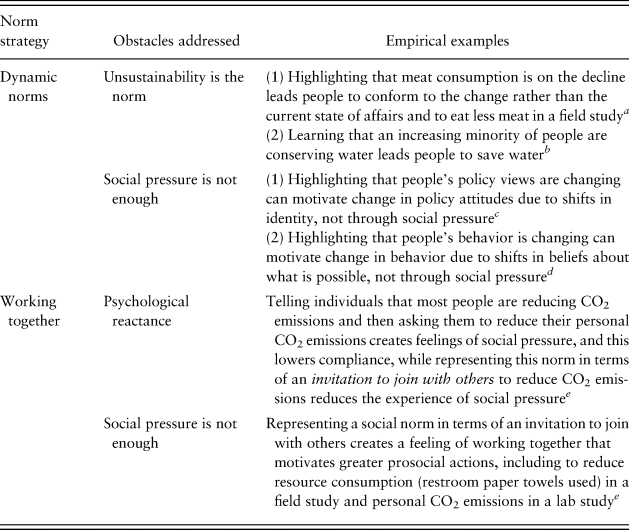
These strategies address the aforementioned hurdles to utilizing social norms to address climate change. Both strategies leverage a central fact about social norms: they have many aspects, and people's responses can be determined by which aspect is salient (Cialdini et al., Reference Cialdini, Reno and Kallgren1990). Thus, a general strategy is to identify an aspect of the norm that is positive and to highlight that, and people may then conform to it. Below, we discuss how dynamic norms are especially well suited to cases where unsustainability is the norm but improving, and how they can operate through psychological processes that do not rely on social pressure. Then, we discuss how norms emphasizing working together can overcome hurdles of psychological reactance and motivate action where social pressure is not a viable source of motivation (see Table 1).
How dynamic norms and working together overcome hurdles in climate change.

a Sparkman and Walton (Reference Sparkman and Walton2017).
b Mortensen et al. (Reference Mortensen, Neel, Cialdini, Jaeger, Jacobson and Ringel2017).
c Sparkman and Walton (Reference Sparkman and Walton2019, experiment 3).
d Sparkman and Walton (Reference Sparkman and Walton2019, experiment 1).
e Howe et al. (Reference Howe, Carr and Waltonunder review).
Dynamic norms
Thus far, when we have discussed social norms, we have discussed what we call static norms – information about the present behaviors and beliefs of others (e.g., ‘Most people eat meat’). Indeed, the social norm literature as a whole has focused almost entirely on static norms. Yet it is also possible to consider trends in norms or changes in others’ behaviors and beliefs over time – what we call dynamic norms (e.g., ‘More and more people are reducing how much meat they eat’) (Sparkman & Walton, Reference Sparkman and Walton2017). Critically, even if many unsustainable behaviors are currently normative, there are also often movements toward sustainability: thousands of people are pledging to avoid flying (Saner, Reference Saner2019); a growing number of people are reducing meat consumption (Rowland, Reference Rowland2018) and large-scale restaurant chains are expanding vegetarian offerings (Popper, Reference Popper2019); many people (and cities) are opting into residential renewable energy programs (Hunt, Reference Hunt2018) or installing solar panels (Rogers, Reference Rogers2019); desires to own a car are dropping (Gershgorn, Reference Gershgorn2016); interest in living in more dense and energy-efficient cities is rising (Frizell, Reference Frizell2014); and, in policy, more people are beginning to prioritize the environment over other goals (Saad, Reference Saad2019). In many cases pertaining to climate change, current static norms convey that most people do not live sustainably now. Yet dynamic norms convey that there is a growing interest in living sustainably and supporting sustainable policy.
People conform to static norm information. Would they also conform to dynamic norm information, if it is made salient? And would they do so despite a current unsustainable static norm? To begin to answer these questions, we examined the context of meat consumption in the USA, where most people eat meat for most meals. Given that livestock account for 14.5–18.0% of emissions, it would be ideal to change this norm (Gerber et al., Reference Gerber, Steinfeld, Henderson, Mottet, Opio, Dijkman and Tempio2013). We gave people (valid) information that meat consumption has been on the decline in the USA in recent years and that some people were beginning to reduce how much meat they ate. This increased people's interest in reducing their own meat consumption. Moreover, in a field study, it doubled the rate of people who ordered a vegetarian meal for lunch – from 17% to 34% ordering a meatless meal (Sparkman & Walton, Reference Sparkman and Walton2017). In research conducted simultaneously, another team found that people conserved more water in a laboratory setting when they learned that a growing minority of people conserved water as compared to learning simply that a minority did (Mortensen et al., Reference Mortensen, Neel, Cialdini, Jaeger, Jacobson and Ringel2017). A third team found evidence that dynamic norms could increase the use of reusable cups in a café where disposable cups were predominant (Loschelder et al., Reference Loschelder, Siepelmeyer, Fischer and Rubel2019). Broadly, dynamic norm interventions are well suited to dislodging a wide variety of problematic norms (Sparkman, Reference Sparkman2020) and can impact policy attitudes (Sparkman & Walton, Reference Sparkman and Walton2019, experiment 3), as well as voter turnout (Gerber & Rogers, Reference Gerber and Rogers2009).
Dynamic norms can also help augment norm effects when most people already act sustainably: a field study on water conservation in collective laundry rooms found that a dynamic norm intervention emphasizing that others had changed and now most conserved water produced greater conservation than a static norm intervention that conveyed simply that most people conserved water – a 29% compared to a 10% reduction (Sparkman & Walton, Reference Sparkman and Walton2017). Thus, dynamic norms can motivate people both to behave more sustainably in the face of current, salient unsustainable norms and to adhere more to existing sustainable norms. Furthermore, in these cases, people made choices freely in private contexts largely absent of overt social pressure, including in deciding what to order for lunch and in how to do their laundry at home.
Why do people conform to dynamic norms? A major driver of people's interest in eating less meat was the belief that, in the future, many people would do so. In an experimental demonstration, we found that people expressed greater interest in reducing their meat consumption only when they learned that other people were changing and that this trend was expected to continue; they showed no such interest when the change was not expected to continue (Sparkman & Walton, Reference Sparkman and Walton2017). This finding highlights an important boundary condition: if people think a trend is simply a passing fad, they are unlikely to change in defiance of current norms. But if change is seen as a harbinger of what is to come, dynamic norms can accelerate change.
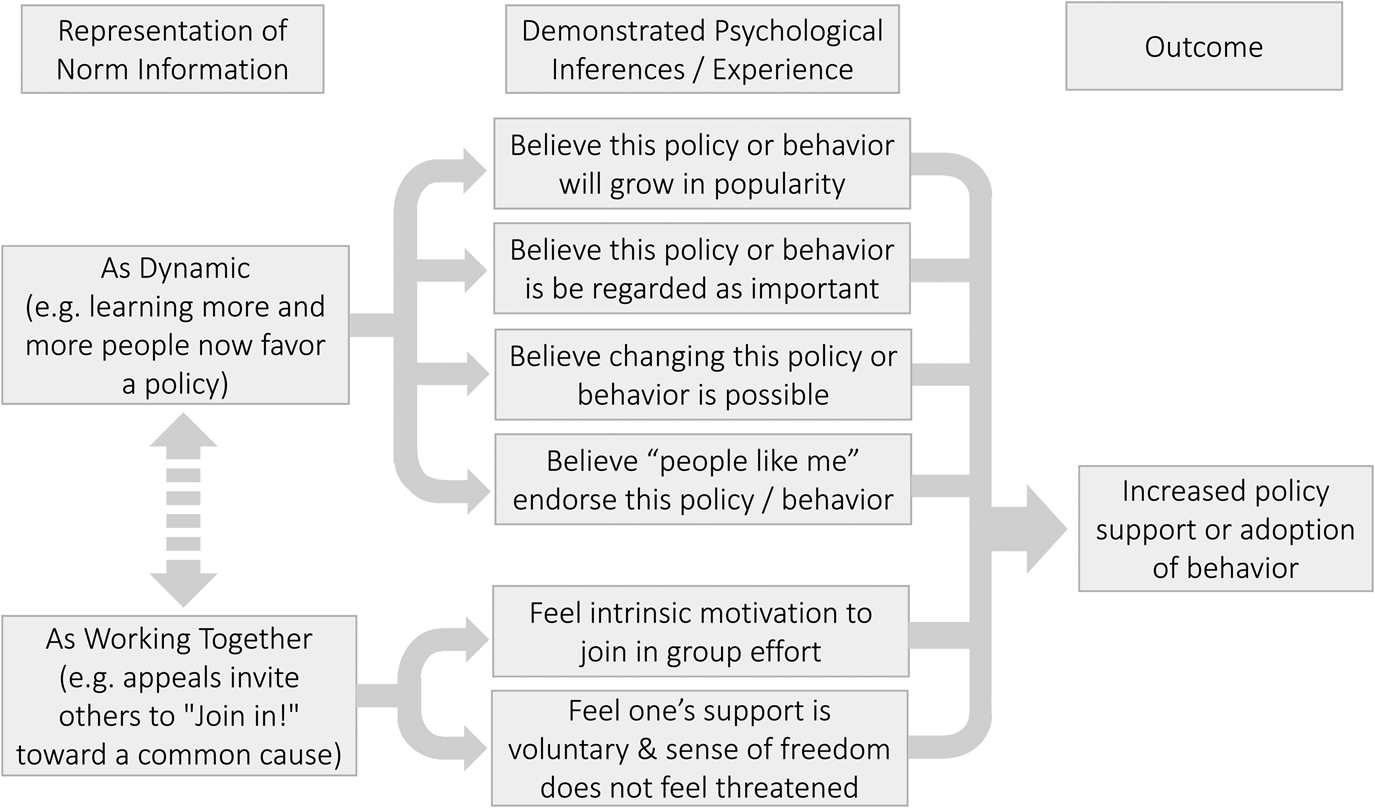
Information that others are changing carries other implications too, and these have powerful consequences for personal behavior change. Some behaviors may seem impossible to change, such as avoiding flying if one's profession traditionally involves a great deal of air travel. Others may not seem important enough to pursue, such as paying a premium for renewable energy. Others may seem inconsistent with important aspects of our self-identity – not ‘who I am’ – such as becoming a vegetarian. Many theories of behavior change treat the beliefs that a behavior is possible, important and consistent with the self as primary sources of motivation (Ajzen, Reference Ajzen, Kuhl and Beckmann1985; Oyserman, Reference Oyserman2015). Strikingly, dynamic norms can help resolve each of these barriers and, consequentially, promote positive change in diverse contexts (Sparkman & Walton, Reference Sparkman and Walton2019). Moreover, they can do so flexibly. For instance, in cases where change does not seem compatible with one's identity, seeing other people who, like oneself, did not do a behavior previously but have changed can increase the perceived compatibility of this behavior with one's identity and motivate personal change. It is as though when people learn that others are changing, they assume that whatever factor had seemed to stand in the way of change did not – and thus they infer that change that had seemed impossible is possible, that change that had seemed unimportant is important and that changed that had seemed incompatible with one's identity is compatible. A direct experimental test found that whichever barrier was made to loom largest in participants’ minds was most remedied by dynamic norms (Sparkman & Walton, Reference Sparkman and Walton2019, experiment 5). Witnessing others change clears the psychological obstacles that previously seemed to stand in the way of personal change (see Figure 1 for a summary of psychological processes that dynamic norms operate though).
A depiction of psychological processes shown in prior research to stem from dynamic norms and working-together normative appeals. While past research has examined these representations separately, these techniques may also be used together and may have synergistic value (see Figure 2). The dashed line between dynamic norms and working-together normative appeals represents how these two messages may also inspire each other (e.g., dynamic norms may imply that people are working together; a representation of working together may imply change in a norm over time). Partly for this reason, although the processes illustrated here are shown to uniquely flow from dynamic norms and working-together appeals, they may also share psychological mechanisms.

The flexible influence of dynamic norms on these mechanisms suggests their potential to motivate a wide range of behaviors relevant to climate change, including behaviors that are not currently normative and behaviors that are freely chosen, and without relying on social pressure.
Working-together normative appeals
When people are confronted with information about norms that characterize their social group – especially attitudes or behaviors that diverge from their own – they may consider the nature of their relationship with the group and how they are regarded by it. This may especially be the case when people respond to normative appeals – direct requests to an individual to change their behavior to align with the group. Then, we suggest, the perception that one has an opportunity to join with others to make a positive change can be a powerful source of motivation. It can lead people to conform, even in private, and to contribute to the solution of collective action problems.
The notion that people are motivated to join with others in collective efforts draws on our fundamentally social nature. People have a strong need to form and maintain social connections and to belong to social groups and communities (e.g., Baumeister & Leary, Reference Baumeister and Leary1995). One way this need manifests is in an ability and a motivation to share in the goals of others (Tomasello et al., Reference Tomasello, Carpenter, Call, Behne and Moll2005). From a young age, people coordinate actions and adopt each other's goals (e.g., Fitzsimons & Bargh, Reference Fitzsimons and Bargh2003; Aarts et al., Reference Aarts, Gollwitzer and Hassin2004; Sebanz et al., Reference Sebanz, Bekkering and Knoblich2006; Shteynberg & Galinsky, Reference Shteynberg and Galinsky2011; Walton et al., Reference Walton, Cohen, Cwir and Spencer2012; Butler & Walton, Reference Butler and Walton2013). Tomasello and colleagues (Reference Tomasello, Carpenter, Call, Behne and Moll2005) propose that a tendency and a motivation to work together on shared endeavors is, in fact, a central part of being human and a major driver of human cultural development.
Even simple, symbolic cues that signal to a person that they have an opportunity to work with others toward a goal can inspire intrinsic motivation. In one series of studies, the message that participants were working ‘together’ with each other (rather than separately from one another) and being presented with a ‘tip’ ostensibly from another participant (rather than the same information given by the experimenter) led participants to work longer on challenging puzzles in private, to find the experience more enjoyable, to perform better and, in certain conditions, to choose to do more similar tasks in the future (Carr & Walton, Reference Carr and Walton2014). Similar effects have been observed among young children (see Master et al., Reference Master, Butler, Walton, O'Keefe and Harackiewicz2017). In one study, preschoolers persisted longer on difficult puzzles and found them more enjoyable when they were told that they were collaborating with another child – even a stranger whom they had never met – rather than working separately or taking turns (Butler & Walton, Reference Butler and Walton2013).
The responsiveness of people to cues of opportunities to work together suggests how attuned we are to these opportunities. Consistent with this work, research finds that emphasizing the communal affordances of careers – such as opportunities to work with others on collective problems – can motivate people to pursue these paths (Diekman et al., Reference Diekman, Clark, Johnston, Brown and Steinberg2011; Diekman & Steinberg, Reference Diekman and Steinberg2013; Brown et al., Reference Brown, Thoman, Smith and Diekman2015).
Climate change is a collective problem par excellence – and this is commonly seen as a barrier to change (Capstick, Reference Capstick2013). Could this very quality point to a solution? If we represent social norms about sustainable behaviors as an opportunity to join a collective effort to address a collective problem, could this motivate personal behavior change?
Testing this question, Howe et al. (Reference Howe, Carr and Waltonunder review) examined whether normative appeals (‘Most people do X’) would motivate greater conformity if they also invited people to join others in working toward a common goal (e.g., ‘Join in!’ and ‘Let's do it together!’). Notably, in addition to emphasizing an opportunity to work together, the working-together appeals aimed to mitigate counterproductive social pressure by inviting people to join this collective effort; an invitation signals and respects the agency of the recipients (as it may be declined). Six laboratory and field experiments compared these appeals to each other and to appeals without normative information in a variety of prosocial and sustainability contexts.
In each case, the working-together normative appeal proved most effective in promoting behavior change and/or interest in behavior change; strikingly, the normative appeals alone produced no overall gain as compared to appeals without norms. One study, for instance, examined appeals to people to reduce their personal carbon emissions. When the appeal conveyed a social norm without reference to working together (“We need to reduce our carbon footprint. 65% of [school name] students are taking steps to reduce their carbon emissions … Please reduce your carbon footprint”), participants expressed no greater interest in reducing their emissions than peers exposed to an appeal with no normative information (“We need to reduce our carbon footprint … Please reduce your carbon footprint”). But when the appeal referenced an opportunity to work with others (“Let's do it together. We need to reduce our carbon footprint. 65% of [school name] students are taking steps to reduce their carbon emissions … Join in! Please reduce your carbon footprint”), participants expressed markedly greater motivation to reduce their emissions.Footnote 3
Similarly, a field experiment compared appeals to reduce paper towel use in campus restrooms. As compared to a baseline week, restrooms randomly assigned to a working-together normative appeal (“Let's do it together. 65% of people at [school name] have reduced their paper towel use. JOIN IN! Please reduce your paper towel use”) showed significant reductions in usage over 2 weeks. By contrast, restrooms assigned to an appeal that conveyed the same normative information without the working-together element (“Here's a fact: 65% of people at [school name] have reduced their paper towel use. Please reduce your paper towel use”) showed no reduction relative to the baseline week. The difference between the conditions represents 14% less paper towel usage, or 11.5 fewer feet of paper towels used per day per restroom, in restrooms randomized to the working-together appeal.
Importantly, these behaviors (e.g., intentions to reduce personal carbon emissions, restroom paper towel usage) occur in relatively private contexts in which people are generally free to choose how to behave absent overt social pressure. Consistent with laboratory research (Butler & Walton, Reference Butler and Walton2013; Carr & Walton, Reference Carr and Walton2014), the results suggest that working-together appeals increased intrinsic motivation, rather than working through social pressure or other mechanisms. Indeed, measures indicating important psychological processes were revealing. Relative to normative appeals alone, working-together normative appeals increased participants’ feelings of working together toward a common goal, and these predicted greater change in behavior and behavioral interest. By contrast, normative appeals without the working together element increased feelings of social pressure – and these predicted less compliance. People saw the use of social norms without an invitation to join a group effort as a cudgel, and they responded with reactance, doubling down on antisocial, unsustainable behaviors, thereby undermining the effectiveness of the normative appeal (see Figure 1 for a summary of these processes).
Future work on working-together norms may examine the role of other constructs relevant to collective action. For example, working-together norms may sometimes enhance a sense of perceived collective efficacy, or “shared beliefs in the power to produce effects by collective action” (Bandura, Reference Bandura2000), perhaps if they become less concerned that others will free-ride.
Research has not yet examined working-together appeals in contexts where unsustainable (static) norms are obvious but they have the potential to motivate behavior nonetheless, such as by enhancing intrinsic motivation (Carr & Walton, Reference Carr and Walton2014). They may also draw attention away from a negative static norm (‘Most people don't do X’) toward a positive representation of the relationship between the self and the group (‘We are working together to do X. Join in!’). It is also exciting to imagine how working-together normative appeals could be combined with dynamic norms to foster behavior change (e.g., ‘More people are working together to do X … Join in!’).
This research suggests that the very collective nature of climate change – the fact that it requires many people to work together to act effectively, which is commonly understood as being among the most significant barriers to action (Cole, Reference Cole2008) – can also be leveraged as a key source of individual motivation. Humans possess many psychological mechanisms that support the capacity to work together, including finding inherent reward in doing so. We evolved to work together (Tomasello, Reference Tomasello2014). The challenge of our generation is to figure out how to leverage this source of motivation to address the behavior problems we face.
Using dynamic norms and working together in climate policy
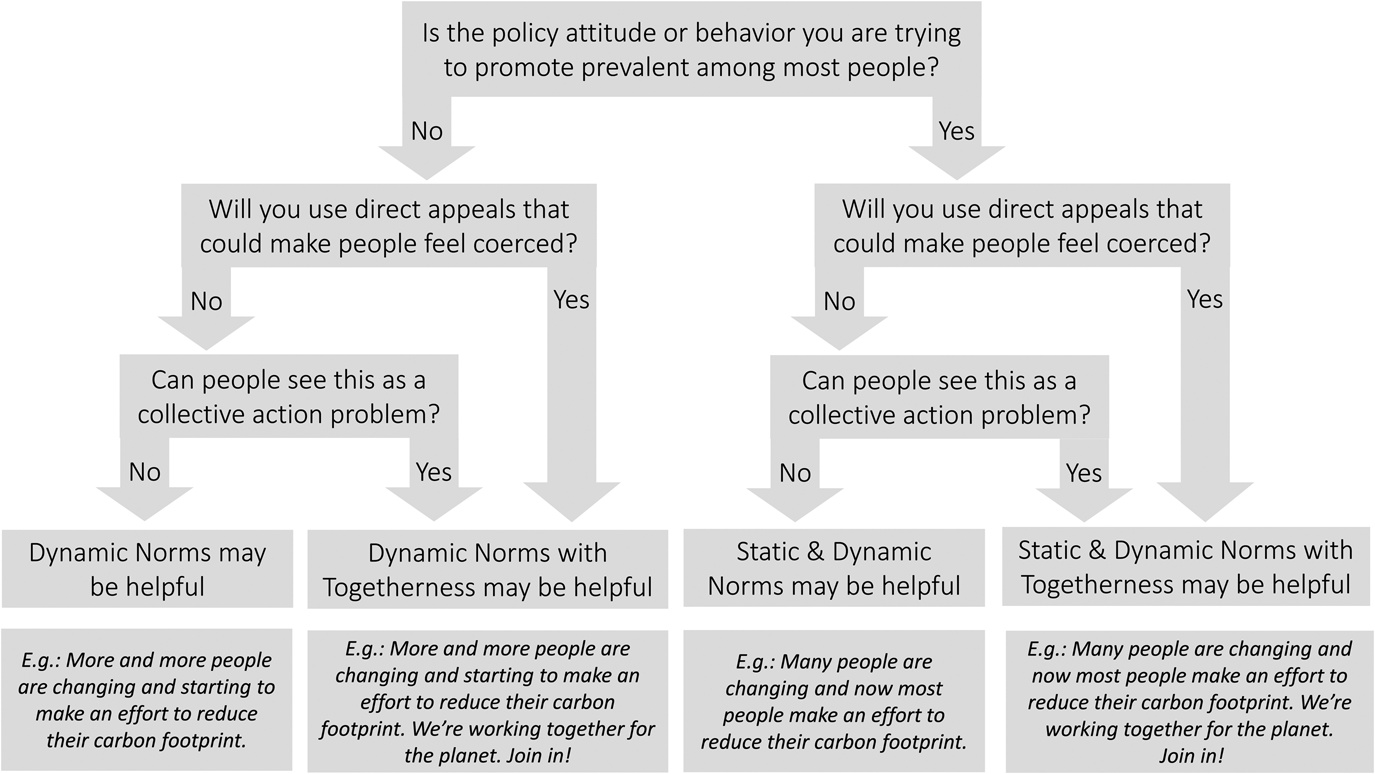
How can we incorporate well-crafted social norm strategies into effective climate change policy? The work reviewed here suggests that there are many cases in which dynamic norms and working-together normative appeals may be helpful, depending on the intervention and context (see Figure 2 for a guide on how to choose a social norm message).
A depiction of what type of norm messaging may be most effective for a particular context, including an example of each (in italics at the bottom). While past research has examined dynamic norms and working-together normative appeals separately, these techniques may also be combined, as shown in the second and fourth examples on the bottom. Note that the same context is used in all four examples for comparative purposes, not because it necessarily satisfies the criteria in the questions above.

One place to start is to see whether dynamic norms or working-together normative appeals could enhance existing interventions. For instance, would social norm feedback for home energy use that incorporates dynamic norm information – that not only compares household energy use to neighbors’ use, but also highlights community-wide improvement over time – enhance effects, especially for average or low-consumption households? Would representing reduced energy consumption as a community goal toward which neighbors are working together further foster motivation and without increasing counterproductive social pressure (Oliver & Lee, Reference Oliver and Lee2005; de Groot & Schuitema, Reference de Groot and Schuitema2012)?
It is also possible to incorporate dynamic norm and working-together strategies to speed up the adoption of new technologies. Given that solar adoption is higher when people have neighbors who use solar (Bollinger & Gillingham, Reference Bollinger and Gillingham2012), those promoting solar installations could emphasize the growth in solar in a neighborhood over time and portray this change as a community effort to make the neighborhood more sustainable. Would inviting new customers to ‘join’ this effort increase uptake?
Insights about dynamic norms and working-together appeals could also reshape how incentives for sustainable behavior are structured. For example, cities could compete for a ‘greatest improvement’ prize regarding reductions in energy usage; such a prize would emphasize that many cities were participating in this effort and portray the norm as moving in the direction of greater efficiency. Public campaigns could also focus on how behavior change connects people with others. Efforts to combat emissions (e.g., public service announcements, contests) could be deliberately pitched as collective endeavors (e.g., a county-wide campaign inviting people to join with their community in the effort to use public transit rather than driving), rather than as individual pursuits.
City and federal programs that aim to improve climate adaptation behaviors could also use the social norm strategies discussed here. For instance, in cases where people are considering moving away from areas where climate change-related flooding is becoming worse over time, perceiving that more and more neighbors are taking advantage of federal programs to sell their homes and move and that in the future almost none will be left may be key to persuading residents to move. Successful adaptation may also require community members to install or fund protective and/or resilient technologies. Representing such efforts as an opportunity to join with others in order to achieve an important collective goal – to build a shared future that is robust in the face of climate change – may overcome resistance to change in this context.
These strategies can also be applied to improve policy attitudes. Many Americans have the inaccurate perception that their fellow Americans do not care much about taking action on climate change (Geiger & Swim, Reference Geiger and Swim2016). They may also perceive partisan divides on climate change (and many other issues) as greater than they truly are and, in particular, may be overly pessimistic about how conservatives in the USA view climate change (Abeles et al., Reference Abeles, Howe, Krosnick and MacInnis2019). Highlighting how Americans in general – conservatives included – have changed over time and, increasingly, are working together to support effective climate policies may mobilize further support. An underappreciated tool for enhancing the successful enaction of climate policies involves capitalizing on the momentum found in recent polls, which find an increasing concern and frustration over the climate inaction of policymakers (Newport, Reference Newport2018; Reston, Reference Reston2019). For instance, highlighting growing support for policies like a carbon tax or a green new deal would likely increase public support for these policies and draw policymakers’ attention to them.
Successfully crafting dynamic norm or working-together norm messages will likely depend on a number of factors that may augment or limit their effectiveness. Among these is ensuring that the norm statement created is accurate, believable, delivered in a medium that is salient and noticed, received at an appropriate time and place in which people's behavior matters, judicious in its use of descriptive or injunctive norm information and uses a social referent that is meaningful to the target audience (for longer discussions of these factors see Sparkman, Reference Sparkman2020, as well as Cialdini, Reference Cialdini2003; Tankard & Paluck, Reference Tankard and Paluck2016). Generally, we advise that those seeking to change the perception of social norms should pilot materials heavily to ensure that they have navigated these factors well.
While the research on dynamic norms and working-together messages covered here all was conducted within the USA and Europe, we expect these techniques will work well in other cultural contexts. This is in part because these countries have relatively ‘loose cultures’ where social influence is, if anything, a less powerful determinant of individuals’ beliefs and behaviors (Gelfand et al., Reference Gelfand, Raver, Nishii, Leslie, Lun, Lim and Yamaguchi2011). Cross-cultural comparisons suggest these methods may work even better in ‘tight’ cultural contexts where social influence is a stronger motivational force. However, in such contexts, norm messages should be careful to convey that society is shifting, and not simply highlighting the acts of deviants who will likely be treated punitively. Likewise, many cultural contexts outside of the USA have traditions that deeply value shared goals and togetherness. Thus, we expect the strategies discussed here to do as well (if not better) elsewhere. That said, given the greater reactance in Western than in non-Western contexts (e.g., Iyengar & Lepper, Reference Iyengar and Lepper1999; Hamedani et al., Reference Hamedani, Markus and Fu2013), working-together normative messages that mitigate such reactance may be especially influential in Western contexts.
The work reviewed here shows that we do not have to accept even long-standing negative social norms as a given. As a society, through policy, communications, regulations and other means, we can shape what features of social norms are salient (Kinzig et al., Reference Kinzig, Ehrlich, Alston, Arrow, Barrett, Buchman and Saari2013), and thus how people think about their own and others’ behaviors, how others are changing and whether societal challenges pose an opportunity to work together for the common good. When done in a strategic and psychologically informed way, we can use social influence for good, even in the least conducive of circumstances.
Conflict of interest
The authors declared no potential conflicts of interests with respect to the authorship and/or publication of this article.