Interregional exchange, including the transfer of goods, ideas, and peoples, has long factored into discussions concerning the origins of Andean sociopolitical complexity (Hirth and Pillsbury Reference Hirth, Pillsbury, Hirth and Pillsbury2013). Notwithstanding the preference for models favoring community self-sufficiency (Murra Reference Murra and Murra1972) and geographic primogenesis (Shady Reference Shady Solís2010), scholars have recognized that the varied environments of the Andean landscape lent themselves to interregional exchange and that these processes affected the development of Andean cultural practices and belief systems, particularly during the late Initial period (1100–800 BC) and Early Horizon (800–1 BC) with the rise of the Chavín Interaction Sphere (950–400 BC; Burger Reference Burger1992, Reference Burger, Silverman and Isbell2008, Reference Burger2019; Matsumoto et al. Reference Matsumoto, Jason Nesbitt, Palomino and Burger2018). Much of this early exchange centered on the movement of exotic goods used for ritual paraphernalia.
In examining the impact of exchange on early Andean cultural developments, scholars have debated the degree to which these processes were influenced by the eastern Andean slopes (or ceja de selva in Peru), a narrow environmental zone of tropical montane forest situated between the highland Andes and Amazon lowlands (see Burger Reference Burger1992; Clasby Reference Clasby, Burger and Nesbitt2022; Clasby and Nesbitt Reference Clasby and Nesbitt2021; Lathrap Reference Lathrap1970, Reference Lathrap and Benson1971; Raymond Reference Raymond and Keatinge1988). Beginning in the early twentieth century, Peruvian archaeologist Julio C. Tello (Reference Tello1921, Reference Tello1940, Reference Tello and Xesspe1960) argued that the Chavín culture and Andean civilization had their roots in the ceja de selva, with many of Chavín's defining cultural features—from its art style to its use of certain cultigens, such as squash, manioc, and sweet potato—being of tropical forest origin. For Tello, these individual elements, which would develop into civilization in the highlands, first spread to the region via cultural processes occurring in the ceja de selva along trans-Andean corridors such as the Marañon River. Later archaeologists built on these ideas, arguing that the tropical forest imagery in Chavín art, combined with similarities in material culture, was a strong indication that the people of the ceja de selva were engaged in interaction with those on the Andean coast and in the highlands (Burger Reference Burger1992; Lathrap Reference Lathrap and Benson1971), perhaps via networks oriented around the exchange of ritual items and ideas. Unfortunately, a lack of investigation within the ceja combined with the perishable nature of the suspected exported items—wood, dyes, medicinal and psychotropic plant products, feathers, and pelts (Lathrap Reference Lathrap1970; Raymond Reference Raymond and Keatinge1988; Wilkinson Reference Wilkinson2018)—made it difficult to demonstrate the nature of ceja involvement within early Andean interaction networks beyond ceramic comparisons. Recent archaeological investigations within the ceja have begun to rectify this issue, although much remains unknown regarding the products that were produced and exported from this region.
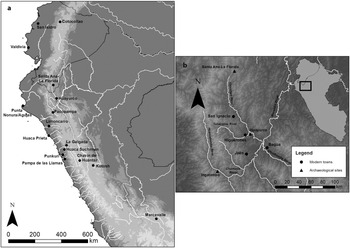
For this reason, the Huayurco site has remained important in the Andean literature. Located in the Jaén region of the northeastern Peruvian Andes along the confluence of the Chinchipe and Tabaconas Rivers (Figure 1a–b), Huayurco was discovered by Peruvian scholar Pedro Rojas (Reference Rojas Ponce1961, Reference Rojas Ponce, Santiesteban, Soriano and Ravines1985) during a three-year expedition to the Marañon Valley intended to elaborate on Tello's hypothesis that Chavín had its origins in the ceja. Rojas (Reference Rojas Ponce1961) hoped to find the source of polished stone vessels from Chavín and the Piura region. The identification of a stone vessel fragment in a private collection near Huayurco resulted in his excavation of the site.
(a) Map of Peru and Ecuador with important sites mentioned in the text; (b) Jaén region map with important towns, rivers, and sites mentioned in the text (maps by Christopher Milan, used with permission).

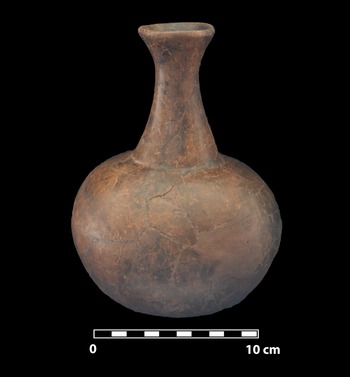
Rojas uncovered a burial featuring 12 finely carved stone vessels and 136 stone vessel fragments alongside marine shell pendants and Strombus trumpets from the Pacific coast and burnished brown ware pottery—including a nearly complete bottle (Figure 2)—similar in style to late Initial period/Early Horizon northern highland ceramics (compare with Lumbreras Reference Lumbreras2007:Figures 363–365; Terada and Onuki Reference Terada and Onuki1982:Plate 82:3–5, 83:4–6). These findings not only provided unmistakable evidence of interregional exchange at Huayurco, overturning past assumptions about the ceja as a geographical barrier to highland–lowland interaction (Steward Reference Steward1948); in addition, the stone vessels, some of which featured elaborate excised designs, were suggestive of an independent technological development within the eastern Andes (Lathrap Reference Lathrap1970:108–109), one that lent itself to study because of the vessels’ nonperishable nature. The seemingly unfinished fragments, combined with the similarity of forms and decoration to Late Preceramic and Initial period stone vessels found outside Jaén, led Rojas (Reference Rojas Ponce1961, Reference Rojas Ponce, Santiesteban, Soriano and Ravines1985) and Donald Lathrap (Reference Lathrap1970:108–109) to posit that Huayurco was a manufacturing center for ceremonial stone bowls, with some of the vessels exported to the Andean coast and highlands as a means of participating within interregional exchange networks. The documentation of additional vessels from private collections near Huayurco (Bushnell Reference Bushnell1966) and excavations in Bagua on the eastern edge of Jaén (Burger Reference Burger1992:218) lent support to this claim.
Ceramic bottle excavated by Pedro Rojas at Huayurco (photograph by author). (Color online)

Despite Huayurco and Jaén's importance for understanding ceja contributions to early Andean exchange networks, limited follow-up occurred, with little attempt to define the Jaén stone vessel style. This lack of definition made assessing the interregional distribution of these vessels difficult because Jaén was not unique in its propensity for ceremonial stone vessel production, with several early styles developing in the coast and highlands (Peterson Reference Peterson, Browman, Burger and Rivera1984; Pozorski and Pozorski Reference Pozorski and Pozorski1992; Salazar and Burger Reference Salazar and Burger1982; Tello Reference Tello and Xesspe1960; Zeidler Reference Zeidler1988). Although recent investigations within the Jaén region have provided insight into these vessels’ ritual importance to ceja de selva societies (Clasby Reference Clasby2014; Olivera Reference Olivera Núñez2014; Valdez Reference Valdez, Klein, Cevallos and Doyon2007) and investigations in the ceja of southern Ecuador have demonstrated their early use (Valdez Reference Valdez, Silverman and Isbell2008; Zarillo et al. Reference Zarillo, Gaikwad, Lanaud, Powis, Viot, Lesur and Fouet2018), much remains unknown regarding their production, style, chronological placement, and interregional distribution.
Since 2008, I have explored these questions through stylistic analyses of Jaén region stone vessels, including a reexamination of Rojas's Huayurco vessels and a study of examples in Jaén regional museums. In this article, I define the Jaén stone vessel tradition on the basis of form, design, and technology, demonstrating that it is in fact a discrete tradition, different from those of other Andean regions that produced stone vessels. I then review the archaeological literature on early Andean stone vessels to show how they help articulate this area of the ceja de selva's participation within different Andean interaction spheres between 2500 and 400 BC.
Stone Vessels and Early Social Complexity in the Andes
The Huayurco stone vessels correspond to a material category popularly referred to as ceremonial stone bowls or vessels. Although a formal definition is lacking within the archaeological literature (Zeidler Reference Zeidler1988:250–251), ceremonial stone vessels differ aesthetically and functionally from ground-stone mortars used in daily subsistence activities. Ceremonial stone vessels encompass a variety of forms, including beakers, cups, trays, convex-curved or straight-walled bowls, and effigies. They are typically well polished, with relatively thin walls in comparison to their utilitarian counterparts. Decoration is common, often occurring in the form of incision or excised relief patterns and carved zoomorphic figures. The production process likely entailed hammering, pecking, and grinding a stone core to fit a desired shape (Manen Reference Manen, Vigne, Briois and Tengberg2017; Schneider and Osborne Reference Schneider and Osborne1996), a process likely aided by softening agents (Tschopik Reference Tschopik and Steward1946) and abrasive materials such as sand (Pozorski and Pozorski Reference Pozorski and Pozorski1992).
Ceremonial stone vessels were an important material component of early Andean ritual complexes, particularly during the Central Andean Late Preceramic period, Initial period, and Early Horizon (or the corresponding Ecuadorian Formative period), when several independent styles or traditions developed in association with coastal and highland cultures throughout Ecuador and Peru. These styles have been summarized elsewhere (Peterson Reference Peterson, Browman, Burger and Rivera1984; see also Bischof Reference Bischof, Conklin and Quilter2008; Pozorski and Pozorski Reference Pozorski and Pozorski1992; Salazar and Burger Reference Salazar and Burger1982; Zeidler Reference Zeidler1988) but include the following cultures/geographical regions: Valdivia/San Isidro (cylindrical beakers and zoomorphic effigies) and Cotocollao (convex-curved or straight-walled bowls on a flat base with circumferential grooves, nicked welts, and engraved geometric decoration) in coastal and highland Ecuador, respectively; Cupisnique (beakers and convex-curved bowls with high-relief excision) along the north coast of Peru; Punkurí/Suchimán (flat-bottomed beakers with incised, interlocking design elements and geometric/figurative imagery) and Casma (beakers and cups with flanged lips and incised designs) on Peru's north-central coast; and Chavín (zoomorphic effigies) in central highland Peru. Ceremonial stone vessels that do not fit within clear styles have been documented at Marcavalle in Cuzco (Mohr-Chavez Reference Mohr-Chavez1980); Kotosh and Shillacoto in the upper Huallaga (Izumi and Sono Reference Izumi and Sono1963; Izumi and Terada Reference Izumi and Terada1972; Kano Reference Kano and Benson1972), and La Pampa (Terada Reference Terada1979:Plate 88b, 125:4–6) in the northern highlands.
Although few stone vessels have been found in context or analyzed for use, the fine craftsmanship, decoration, and variation in forms suggest that these vessels were employed as serving containers and specialized mortars during ritual activities. James Zeidler (Reference Zeidler1988) and Richard Burger (Reference Burger2011) have argued that some zoomorphic effigies were used as receptacles for preparing tropical-forest–grown hallucinogenic snuff such as vilca. Similar practices have been documented through ethnographic comparison, and Spanish accounts detailing the extirpation of idolatry during the colonial period mentioned the importance given to stone mortars holding hallucinogenic snuff, notably referred to as vilcanas, by Indigenous peoples (see Burger Reference Burger2011). Specialized stone mortars may have also functioned as palettes for the preparation of pigments involved in ritual activities such as the painting of monumental friezes (Pozorski and Pozorski Reference Pozorski and Pozorski1992).
Ceremonial stone vessels were central to Chavín cult activities: Chavín-style zoomorphic effigy vessels and cylindrical mortars have been found within the site's heartland and along the coast (Tello Reference Tello and Xesspe1960). The elaborate nature of the designs and the emphasis on felines and avian imagery support the idea that the vessels held hallucinogenic snuff (Burger Reference Burger2011; Zeidler Reference Zeidler1988). The importance of stone vessels to Chavín cult activities is also supported by non-Chavín style zoomorphic effigies found within the Ofrendas Gallery at Chavín de Huántar, a chamber used for the storage of exotic offerings (Lumbreras Reference Lumbreras2007). One fish-shaped vessel (Lumbreras Reference Lumbreras2007:Figures 199, 201a) is almost identical to examples from the Jaén region (see the later discussion).
Stone Vessels and the Jaén Region
The Jaén region (Figure 1b) is located within the Huancabamba Depression, a relatively low and narrow section of the Andes formed by the partial interruption of the Central and Eastern Cordilleras by the Chamaya-Marañón drainage system. As a result of these low elevations, the Huancabamba Depression is characterized by a westward extension of tropical montane forest that ranges from higher-altitude páramo (above 3300 m asl) and cloud forest (3300–1700 m asl) to lower-elevation dry forest (1700–300 m asl; Young and Reynel Reference Young, Reynel, Davis, Heywood, Herrera-MacBryde, Villa-Lobos and Hamilton1997).
The Jaén region corresponds to the dry forests within the depression, a hot and humid climatic zone of low-lying hills and scrub vegetation, marked by the convergence of several river valleys as they connect with the Marañón River. These valleys constitute the Jaén region and frame its geographical borders from the Huancabamba and Chamaya Rivers in the west and southwest, to the upper Marañón and lower Utcubamba in the east, and the Tabaconas and Chinchipe Valleys in the north. The convergence of these rivers created natural corridors between the coast, highlands, and tropical forest, establishing Jaén as a geographical nexus point. Indeed, evidence indicates that Jaén was home to complex societies engaged in interregional exchange as early as the Late Preceramic period (Olivera Reference Olivera Núñez2014; Valdez Reference Valdez, Silverman and Isbell2008), processes that continued through the Early Horizon (Clasby Reference Clasby, Burger, Salazar and Seki2019; Yamamoto Reference Yamamoto2008, Reference Yamamoto2013).
The geographical and environmental makeup of Jaén likely encouraged a degree of cultural uniformity within the region. Although subregional cultural differences developed between valleys (see Clasby Reference Clasby, Burger, Salazar and Seki2019, Reference Clasby, Burger and Nesbitt2022), recent investigations have shown that early Jaén occupations maintained similar lifeways and material culture. These similarities include linear settlement patterns along rivers, the use of river cobbles and yellow mortar as building materials for ceremonial architecture, and the adoption of Initial period/Early Horizon regional ceramic styles dominated by bowls and short-necked jars and decorated with incision and polychrome painting (Clasby Reference Clasby, Burger, Salazar and Seki2019, Reference Clasby, Burger and Nesbitt2022; Olivera Reference Olivera Núñez2014; Valdez Reference Valdez, Silverman and Isbell2008; Yamamoto Reference Yamamoto2008).
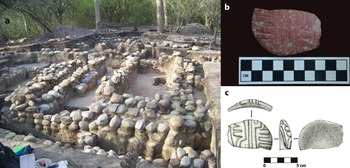
Among these investigations were the survey and excavation that I conducted at Huayurco (Clasby Reference Clasby2014, Reference Clasby, Burger, Salazar and Seki2019) to address the stone bowl question. Although 60 years of landscape alteration and Rojas's lack of detailed field notes made it impossible to identify the location of his excavations, my investigations showed that Huayurco was a large site complex comprising at least 16 sectors spread over 360 ha around the Chinchipe–Tabaconas confluence, with a continuous occupational history between 800 BC and AD 550. My investigation of Huayurco's Early Horizon components led to the discovery of a ceremonial structure (Figure 3a) organized around the ritual burning of exotic goods. Indeed, Huayurco's participation within interregional networks was central to the site's growth and development.
(a) Early Horizon ceremonial architecture at Huayurco (photograph by author); (b–c) stone vessel fragment from Huayurco (photograph by author; drawing by Edwin Silva de la Roca, used with permission). (Color online)

Despite extensive excavation, I only recovered a single stone vessel fragment from surface survey along the north side of the Chinchipe River, part of a boat-shaped bowl with zoomorphic imagery (Figure 3b–c). Atsushi Yamamoto's (Reference Yamamoto2008:Figure 10) investigations at the Ingatambo site along the Huancabamba River were more successful, encountering an amphibious-shaped effigy vessel that was associated with late Initial period architectural renovations.
Some of the most exciting information concerning stone vessels comes from Santa Ana-La Florida (SALF) in southern Ecuador. Located upstream from Huayurco in the Chinchipe Drainage, SALF is characterized by some 20 circular structures around a sunken court, as well as a spiral-shaped architectural feature found in the site's eastern half (Valdez Reference Valdez, Silverman and Isbell2008). Francisco Valdez's (personal communication 2021) investigations recovered 15 stone vessels from ritual or funerary contexts in or near the spiral feature. Some of these vessels dated to the Ecuadorian Early Formative or corresponding Late Preceramic period in Peru,Footnote 1 including one vessel placed upside down covering greenstone medallions and beads in a hearth located at the center of the spiral. Four vessels including a bird-shaped mortar were found in a shaft tomb near the spiral's vortex, which also contained ceramics (including stirrup-spout vessels), Strombus shell, and green stone beads. Residue analyses from one stone vessel revealed maize and cacao, further illustrating the site's ritual nature (Zarillo and Valdez Reference Zarillo, Valdez and Valdez2013; Zarillo et al. Reference Zarillo, Gaikwad, Lanaud, Powis, Viot, Lesur and Fouet2018). These deposits date to approximately 2250 BC. Valdez (personal communication 2021) has documented 26 additional vessels in private collections that are thought to come from SALF.
Despite the paucity of excavated finds, stone vessels were an important aspect of early Jaén regional cultures. Following Rojas's excavations, Geoffrey Bushnell (Reference Bushnell1966) and French archaeologists Henry and Paule Reichlen (Musée du Quai Branly 2021a) documented specimens from a private collection in the Higuerones community around Huayurco.Footnote 2 The Reichlens acquired and donated seven of these vessels to the Musée de l'Homme in 1965 (they were later moved to the Musée du Quai Branly). Jaén regional museums also contain numerous examples donated by local landowners. In the next section I compare the Rojas and Reichlen vessels from Huayurco to the Jaén regional collections and the SALF specimens to define the corpus of forms and decorative techniques that make up the Jaén tradition.
The Rojas Stone Vessel Collection from Huayurco
The Rojas stone vessel collection from Huayurco is held in the Museo Nacional de Arqueología, Antropología e Historia del Perú (MNAAHP) in Lima and has never been described systematically or published in its entirety. The collection consists of 12 complete vessels and 136 vessel fragments (Supplemental Table 1), some of which fit together; 73 of the 148 specimens feature a rim.
Vessels were made from arkose (25.7%), limestone (21.6%), sandstone (micaceous and cream-colored, 15.5%), tonalite (12.2%), quartzite (9.5%), basalt (8.1%), and orthoquartzite (5.4%). A cryptocrystalline bowl was also identified, along with two fragments corresponding to a type of sandstone, most likely greywacke. Geologic maps indicate that most of these raw materials are local to the Jaén region (De la Cruz Reference De La Cruz1995; Reyes and Caldas Reference Reyes Rivera and Vidal1987; Sánchez et al. Reference Sánchez, Dávila and de La Cruz1996). Some of the vessels were fashioned from river cobbles, a resource that lines Jaén region riverbeds including the Chinchipe and Tabaconas. Despite Lathrap's (Reference Lathrap1970:108) argument that some fragments were unfinished, all are shaped and feature smooth or polished finishes. As part of a burial deposit, these fragments likely corresponded to finished vessels broken before or after interment.
Vessel Size and Forms
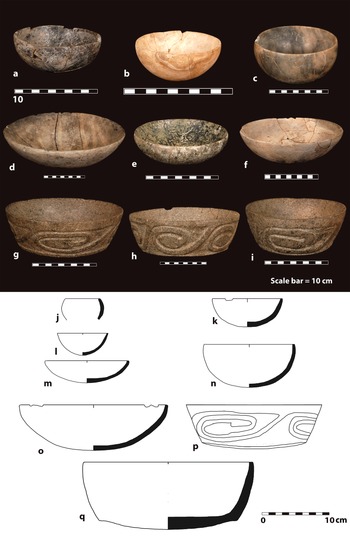
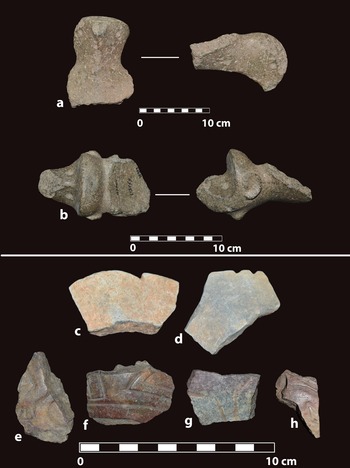
Vessels can be divided into three major forms: (1) convex-curved bowls with flat to rounded bases (Figure 4a–f, j–o), (2) straight-sided bowls with a flat base (Figure 4g–i, p–q), and (3) effigy vessels (Figure 5a–b). Convex-curved bowls are the most common form, representing 9 of the 12 complete vessels and all but two identifiable fragments. Only three straight-sided bowls and two effigy vessel fragments were identified. There is significant variation within the convex-curved bowls, with shapes mimicking gourd skeuomorphs (see DeBoer Reference DeBoer, Scott Raymond and Burger2003:295). No distinctions were made between shallow and deep bowls.
Huayurco stone vessels excavated by Pedro Rojas (photographs and drawings by author): (a–f): convex-curved bowls; (g–i): straight-walled bowls; (j–o) convex-curved bowls; (p–q) straight-walled bowls. (Color online)

Huayurco stone vessel fragments excavated by Pedro Rojas (photographs by author): (a) raptor effigy; (b) monkey effigy; (c–d) examples of castellation; (e–f) examples of incised/excised imagery. (Color online)

Vessel diameters taken from the 12 complete vessels range between 8.3 cm and 32 cm, with an average of 19.1 cm. Vessel height ranges from 3.5 cm to 10 cm, with an average of 6.4 cm. Vessel walls thicken toward the base. Rims were rounded or flat, and 14 specimens show evidence of rim castellation. This technique involves carving notches into the rim, akin to battlements on a castle (Figure 4a, d, f, k, o; Figure 5c–d). Three of the four complete vessels feature four equidistant castellations along the rim, with the fourth (badly fragmented) likely sharing this pattern. The 14 castellated specimens were made from arkose (n = 4), orthoquartzite (n = 3), limestone (n = 3), quartzite (n = 2), sandstone (n = 1), and possibly greywacke (n = 1).
The two effigy fragments are made of tonalite: one depicts the head of a raptorial bird (Figure 5a) and the other the head of a monkey (Figure 5b; see also Lathrap Reference Lathrap1970:Plate 23). Each head is attached to a concave depression positioned within the figure's dorsal side.
Decoration
The Huayurco stone vessels are well known in the Andean literature for their distinctive spiral-shaped serpentine relief patterns (Rojas Reference Rojas Ponce, Santiesteban, Soriano and Ravines1985:186; see also Burger Reference Burger1992:Figure 242; Lathrap Reference Lathrap1970:Plate 26–27). I refer to this pattern as the “coiled serpent” motif (Figure 4g–i, p). It appears on three complete stone vessels, all of which are made of tonalite and feature straight (but flaring) polished walls.
Apart from the coiled serpent motif, non-castellated and non-effigy vessel decorations appear on only 12 specimens, all fragments. The decoration is restricted to vessel exteriors and consists of incised/excised geometric and figurative imagery (Figure 5e–h), including the depiction of a hand or paw. The principal design patterns are often framed by circumferential excised/incised lines below the rim and along the basal angle. Only one decorated fragment was manufactured from tonalite, despite it being the raw material for the effigy fragments and coiled serpent vessels. The rest were made from quartzite (n = 6), orthoquartzite (n = 2), arkose (n = 2), and limestone (n = 1). Further investigation could identify whether certain types of stone were preferred for specific decorative techniques or whether other aspects such as color were more important (see Valdez Reference Valdez, Klein, Cevallos and Doyon2007).
Stone Vessels from Jaén Regional Collections
The Huayurco stone vessels parallel patterns present in Jaén regional museums and collections. I have documented 100 stone vessel specimens at the following institutions or private collections: the Museo Hermógenes Mejía Solf (MHMS; n = 76) and Universidad de Cajamarca (UCJ; n = 2) in Jaén, the Colegio Tupac Yupanqui (CTY; n = 21) in San Ignacio, and the Museo Ángel Jáuregui (MAJ; n = 1) in Bagua. This sample does not include quotidian mortar stones that I define loosely by their thick walls and rough surfaces.
The MHMS vessels, although unsystematically documented, are associated with collections records detailing the location from which they were found. These locations include towns located on the Chinchipe, Tabaconas, Huancabamba, Chamaya, and Marañón Rivers (Supplemental Table 2). There is no indication that donors acquired specimens from outside Jaén. If this information is assumed to be correct, it suggests that stone vessels were widely used throughout Jaén and probably involved multiple production centers.
Vessel Forms
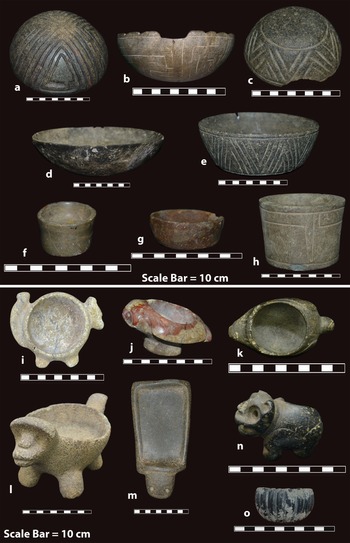
As with the Rojas collection from Huayurco, vessels largely correspond to three major forms: (1) convex-curved bowls (Figure 6a–d), (2) straight-sided bowls (Figure 6e–h), and (3) effigy vessels (Figure 6i–o). However, these categories exhibit greater variation in the Jaén regional collections, and beakers, trays, and neckless ollas appear in small numbers.
Jaén stone vessel regional collections (photographs by author): (a–d) convex-curved bowls; (e–h) straight walled vessels; (i–o) effigy vessels. (Color online)

Convex-curved bowls with round to flat bases (n = 62) remain the most common form. A subtype of this form includes oval or boat-shaped bowls (n = 5), similar in shape to the specimen I recovered from Huayurco. Convex-curved vessel diameters range from 4.8 to 28.5 cm, with an average of 11.2 cm. The variations in vessel size could indicate differences in function—larger bowls as serving vessels, smaller bowls for preparing ritual substances—as noted from ethnographic studies of ceramic assemblages (see DeBoer Reference DeBoer, Scott Raymond and Burger2003). However, a lack of chronological and spatial control and the absence of use-ware analysis make any inference of function premature.
Straight-walled bowls (n = 16) also demonstrate size variation with diameters ranging between 5 and 23 cm, with an average of 12 cm. Many of the smaller bowls exhibit thick bases and might be more adequately called tumblers (Figure 6f–g). The larger bowls, like their Rojas collection counterparts, feature flaring walls and a flat base, with some vessels exhibiting the coiled serpent motif.
Rim castellation appears on 18 specimens. Unlike the Rojas vessels, which never exhibit more than four castellations, the Jaén regional examples show more variation: some vessels feature six castellations, and others demonstrate repeated castellations along the entire rim (Figure 6b). The castellations vary in shape from rectangular to wavy, and the designs are often framed underneath by a circumferential incised line.
The effigy vessels (n = 18) typically consist of a convex-curved bowl within a zoomorphic-shaped figure. The bowl is usually located on the dorsal side (Figure 6j, l) although occasional examples are positioned on the ventral side (Figure 6k) or in profile view (Figure 6i). Figures include fish, birds, felines, monkeys, and reptiles. The MHMS also features an example of a quadruped with a circular hole in the dorsal side (Figure 6n). Although it is similar to other effigy vessels, the focus is on the animal rather than the concave depression, and the style is similar to an unprovenienced example recovered from the north coast of Peru (Larco Reference Larco Hoyle1941:Figure 154). One effigy vessel, a rectangular tray depicting a reptile (Figure 6m), deviates from the convex-curved form. Nonzoomorphic effigy vessels are rare but include two vessels featuring carved human faces and one example with squash-like high relief grooves (Figure 6o).
Other vessel forms include cylindrical beakers (n = 1), neckless ollas (n = 1), and trays (n = 3). The cylindrical beaker (Figure 6h) stands out among Jaén vessels in terms of form and decoration, featuring repeating incised fangs across the exterior. The decoration is similar to the Peruvian north-central coast stone vessel style (Bischof Reference Bischof, Conklin and Quilter2008), particularly Punkurí in the Nepeña Valley (Falcón Reference Falcón Huayta2009), and may be an import.
Decoration
The decoration on Jaén regional museum examples shares conventions, styles, and designs present in the Rojas collection. Decoration is again limited to carved effigies or exterior incised/excised designs, and the coiled serpent motif notably appears on six Jaén regional collection specimens, all of which are similar in form and design to the Rojas examples.
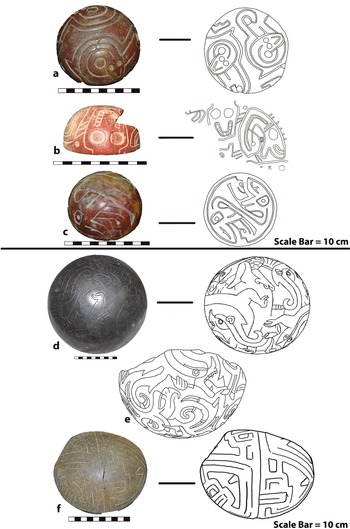
The regional collection demonstrates greater variation in design fields and imagery. For the convex-curved bowls, decoration is generally applied to the base and exterior walls (Figure 6a–b), which may constitute a single design field or be split into separate fields. On single design fields, the decoration may be divided into hemispheres or quadrants (Figure 6a–b, 7a–f). Many of the bowls show a preference for dualism, with similar zoomorphic (e.g., raptors, coiled snakes; Figure 7a, c) or geometric (concentric triangles; Figure 6a) designs on both halves. For straight-sided vessels, decoration appears on the external walls, usually framed by circumferential incision/excision along the basal joint and rim (Figure 6e). These design patterns often repeat and, in some cases, are split into separate horizontal panels. Decoration unconnected to the walls sometimes appears on the base.
Jaén stone vessel regional collection decoration; (a–c) vessel from the MHMS (photographs and drawings by author); (d) vessel from the Museo Ángel Jáuregui (photograph and drawing by author); (e) vessel from the Musée Quai Branly (2021b; redrawn from collection database photograph); (f): vessel from the MHMS (photograph and drawing by author). (Color online)

Many designs depict natural or mythological scenes. For example, one convex-curved bowl depicts two serpents in striking position facing a bird (Figure 7b). A similar example from the Museo Ángel Jáuregui presents a complex scene involving reptiles, felines, and raptors ripping apart a human (Figure 7d). The reptiles and felines repeat on opposite ends of the vessel, and the center depicts a raptor and human body parts.
Although these bowls share similar iconography, one vessel deviates from this pattern: it is a convex-curved bowl with wavy rim castellations and four incised faces along the base (Figures 6b, 7f). Despite the shape and castellation, the design shows stronger similarities with ceramic iconography from Peru's far north coast (see Izumi and Terada Reference Izumi and Terada1966:Plate 28:7, 11; and Burger Reference Burger1992:Figure 240, for comparison).
The Reichlen Stone Vessels from Huayurco
The Reichlen collection (n = 7; Musée du Quai Branly 2021a) acquired from the area around Huayurco fits firmly into the style of the Rojas vessels and the Jaén regional collections. Four of the vessels are convex curved, two are straight sided, and one is an effigy vessel of a fox. For the convex-curved vessels, two show evidence of incision, including design patterns (Figure 7e) that are similar in style and motif to the Ángel Jáuregui example (Figure 7d), and a third features rim castellation at the four equidistant points. For straight-sided forms, one example features the coiled serpent motif, whereas the other shows patterns of inverted concentric triangles, almost identical to a vessel from the MHMS (Figure 6e).
Stone Vessels from Santa Ana-La Florida, Ecuador
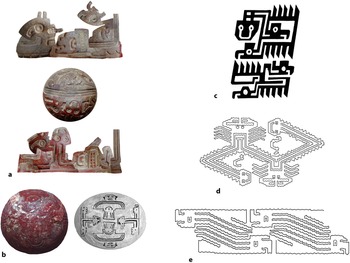
SALF shows evidence of 15 stone vessels from excavated contexts and 26 nonexcavated vessels (Francisco Valdez, personal communication 2021). Vessels were made from andesite, basalt, jasper, and sandstone and include convex-curved bowls (deep or shallow), boat-shaped bowls, and zoomorphic effigy vessels. Some of these vessels were castellated. The decorated convex-curved bowls (Figure 8a–b) share many of the conventions present in the Jaén regional collections, including bipartite and quadripartite exterior design fields emphasizing dualistic principles (Valdez Reference Valdez, Klein, Cevallos and Doyon2007, Reference Valdez, Silverman and Isbell2008). One convex-curved vessel is divided into nonsymmetrical halves with human-like figures and animals (snakes, raptorial birds; Figure 8a; Valdez Reference Valdez, Silverman and Isbell2008:Figure 43.7) and is similar in iconography to other Jaén vessels. Another vessel depicts humanoid figures with avian bodies alternating with tricephalous avian and serpent motifs, which, as will be discussed, shares similarities with coastal and highland Late Preceramic iconography (Valdez Reference Valdez, Silverman and Isbell2008:Figure 43.8).
Late Preceramic/Early Formative bicephalous imagery: (a–b) stone vessels from Santa Ana-La Florida (images courtesy of Francisco Valdez); (c) looped bag from La Galgada (redrawn from Grieder Reference Grieder, Grieder, Mendoza, Earle, Smith and Malina1988:Figure 130); (d) twined fabric from Huaca Prieta (redrawn from Bird Reference Bird1963:Figure 4); (e) reconstructed textile design from Huaca Prieta (redrawn from Bird Reference Bird1963:Figure 7b). (Color online)

The Jaén Region Stone Vessel Tradition
A review of stone vessels from the Jaén region provides evidence of a regional style that is characterized by three major forms: (1) convex-curved bowls, (2) straight-walled bowls, and (3) effigy vessels. Vessels are finely carved with smoothed to polished surfaces, and some convex-curved and straight walled bowls show evidence of rim castellation and exterior excised/incised decoration. Convex-curved bowls generally incorporate the entire exterior as a design field that is then split into bipartite or quadripartite divisions, whereas straight-walled vessels feature horizontal panels of repeating imagery. Motifs include geometric (e.g., concentric triangles, dots, spirals) and figurative imagery (e.g., snakes, birds, felines, humans, etc.) arranged in symmetrical and dualistic patterns. Many of the figurative designs depict natural or mythological scenes. Zoomorphic effigies of birds, fish, reptiles, and monkeys are common, with figures generally exhibiting a dorsal-side concave depression.
An underlying question is the temporal placement of the Jaén stone vessels. Although only the Rojas (Reference Rojas Ponce1961) and SALF (Valdez Reference Valdez, Silverman and Isbell2008) collections were systematically excavated, evidence indicates that the Jaén region was producing stone vessels for perhaps a millennium or longer, from the Late Preceramic through the late Initial period, and possibly into the Early Horizon.
Valdez's dates for SALF securely place some specimens within the Ecuadorian Early Formative (or Late Preceramic period). This conclusion is supported by the similarities in iconography—most notably in the use of bicephalous serpent and avian imagery—between the SALF vessels and textiles and gourds from La Galgada (Figure 8c; Grieder Reference Grieder, Grieder, Mendoza, Earle, Smith and Malina1988:Figures 130–132, 138–140) and Huaca Prieta (Figure 8d–e; Bird Reference Bird1963:Figures 1, 4, 7a, 7b) in the Peruvian highlands and coast, respectively,
Yamamoto (Reference Yamamoto2008) discovered a zoomorphic effigy vessel within a late Initial period context at Ingatambo, whereas the Rojas stone vessels from Huayurco were accompanied by burnished brown ware pottery, including a bottle reminiscent of late Initial period northern highland ceramics. Examples of Jaén style vessels also have been found at late Initial period coastal and highland sites (see the later discussion).
Stone vessel production possibly extended into the Early Horizon. The form and decoration characteristic of the Rojas and Reichlen collections from Huayurco are also found in Early Horizon ceramics from the same site (Clasby Reference Clasby2014, Reference Clasby, Burger, Salazar and Seki2019). In addition to the high frequency of convex-curved ceramic bowls, a number of ceramic vessels also feature castellated rims and “figure eight” designs that are similar to the coiled serpent motifs.
Unfortunately, the small sample of excavated specimens and the lack of chronological and spatial control make it difficult to construct a reliable relative sequence at the regional and subregional levels. Nevertheless, the forms, decoration techniques, design fields, and iconographic styles present in the study sample, combined with the longevity of use, indicate that the Jaén vessels pertain to a stone vessel tradition, by which I mean “a (primarily) temporal continuity represented by persistent configurations in single technologies or other systems of related forms” (Willey and Phillips Reference Willey and Phillips1958:37). This definition notably untethers single technologies from other cultural traits while also permitting regional variation (Willey and Phillips Reference Willey and Phillips1958: 35–39). Although temporal and subregional stylistic differences likely existed within the Jaén region tradition as suggested by the raw material and stylistic variation in the study sample, the differences do not appear significant enough to constitute independent styles. In addition, the presence of these vessels at SALF, Ingatambo, and Huayurco, all of which demonstrate distinct architectural layouts albeit with similar construction materials (Clasby Reference Clasby, Burger and Nesbitt2022), suggests that stone vessels were not tied to other cultural traits or types of social organization but rather represented an important ritual item within the Jaén region.
The Interregional Distribution of the Jaén Stone Vessel Tradition
Ceremonial stone vessels were not unique to the Jaén region; rather, they were a critical material component of early Andean ritual assemblages, with examples documented in several coastal and highland sites. These vessels differ dramatically in form and style from those in the Jaén collections. Stone vessels from north-central Peru are dominated by cylindrical beakers (Pozorski and Pozorski Reference Pozorski and Pozorski1992) and feature a distinct iconography emphasizing composite beings, winged creatures, and fanged mouths (Bischof Reference Bischof, Conklin and Quilter2008). As mentioned, only one vessel within the Jaén collections fits these conventions, indicating it was likely imported to the region.
Convex-curved vessels appear in the Cupisnique culture of the northern coast of Peru (Salazar and Burger Reference Salazar and Burger1982), although they are typically smaller and shallower than their Jaén counterparts. The Cupisnique iconography, oriented around spiders and trophy heads, is unique to the north coast and is done exclusively in high relief, whereas Jaén vessels sometimes feature incised patterns. Cinnabar is sometimes found within the incised grooves of the Cupisnique vessels, a trait absents from Jaén vessels. Convex-curved and straight-walled vessels appear in the Ecuadorian Cotocollao culture, but they often sit on a flat pedestal base, and their decoration is limited to circumferential grooves, nicked wilts, and engraved geometric shapes. Avian, feline, and monkey effigy vessels are found in the Ecuadorian Valdivia/San Isidro culture, and although these vessels share some similarities with Jaén (arched faces, dorsal-side depressions), the figures are stylized with rectangular, “box-like” bodies and spiral tails in the case of the monkey and feline effigies (Winn Reference Winn2009; Zeidler Reference Zeidler1988). The Valdivia/San Isidro culture also features cylindrical beakers, which are mostly absent from Jaén. Tetrapodal vessels have been found in the upper Huallaga (Izumi and Sono Reference Izumi and Sono1963:Plate 171:16; Kano Reference Kano and Benson1972), possibly representing zoomorphic effigies, but they have not been published.
The Jaén tradition is also distinct in its raw materials: the vessels were produced from a variety of igneous (tonalite, basalt, andesite), metamorphic (quartzite), and sedimentary (arkose, limestone, orthoquartzite, sandstone, jasper, cryptocrystalline silicates, and possibly greywacke) rocks. The raw material is more limited for Cupisnique (steatite) and the north-central coast of Peru (diorite, andesite, and granite). In Ecuador, the Valdivia/San Isidro and Cotocollao vessels were produced exclusively from igneous rock, with the latter made of andesite and dacite (Villalba Reference Villalba1988:307).
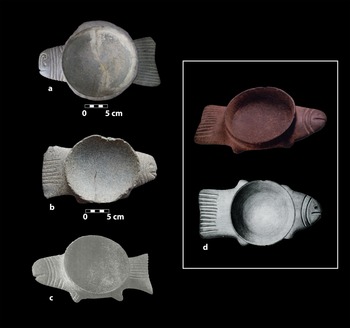
This clear delineation of stone vessel styles makes it possible to evaluate the distribution of the Jaén region style outside their center of production, and a literature review does suggest that some vessels were transported outside Jaén. Most notable is the stone fish bowl from the late Initial period Ofrendas Gallery at Chavín de Huántar (Lumbreras Reference Lumbreras2007:Figure 199, 201a). This vessel is identical to three specimens from the Jaén region (Figure 9), including one identified near Huayurco (see note Footnote 3; Amat Reference Amat Olazábal, Olazábal and Palomino1997:246; Bushnell Reference Bushnell1966:Figure 10). Scholars have argued that the Ofrendas Gallery was a depository for ritual items brought by pilgrims to Chavín (Burger Reference Burger1992, Reference Burger, Silverman and Isbell2008) and may indicate that Jaén was involved in Chavín cult activities. Tello also documented two stone vessel fragments near the Chavín temple that share similarities to Jaén vessels. One fragment (Tello Reference Tello and Xesspe1960:Figure 130b) is a straight-walled vessel with an exterior panel of inverse, concentric triangles similar to MHMS and Quai Branly specimens. The second fragment (Tello Reference Tello and Xesspe1960:Figure 132) features exterior stepped incised lines, recalling a specimen that Bushnell (Reference Bushnell1966:Figure 8) described from Huayurco.
Stone fish platters: (a) vessel recovered along the Chamaya River (MHMS; photograph by author); (b) specimen recovered near Ingatambo (MHMS; photograph by author); (c) vessel likely recovered near Huayurco (Amat Reference Amat Olazábal, Olazábal and Palomino1997:246, used with permission.); (d) vessel from the Ofrendas Gallery, Chavín de Huántar (Lumbreras Reference Lumbreras2007:Figures 199, 201a, used with permission). (Color online)

Outside Chavín, Rojas (Reference Rojas Ponce1961:Plate 61) identified a convex-curved stone bowl with rim castellation at the Initial period/Early Horizon Pacopampa site in the northern highlands; this bowl was likely imported from the Jaén region. Although it is possible that Pacopampa and Jaén produced similar stone bowls because of their geographical proximity, as argued by Emil Peterson (Reference Peterson, Browman, Burger and Rivera1984), the Pacopampa castellated bowl likely reflects the site's importance as a major ceremonial center within northern Peru. In fact, stone vessels recovered from Pacopampa belong to multiple styles. One example depicts a spider in association with severed hands (Rosas and Shady Reference Rosas La Noire and Solís2005:Figure 21c) and likely belongs to the Cupisnique culture. A small cylindrical vessel from Yarac Sara near Pacopampa (Burger Reference Burger1992:Figure 97) is also reminiscent of north-central coast stone vessel forms, albeit with a local iconographic style. Nevertheless, support for close interaction between Pacopampa and Jaén is evident in the discovery of a convex-curved bowl (Fung Reference Fung Pineda1975:Plate 8d) and zoomorphic effigy vessel fragment (Yuji Seki, personal communication 2020) at Pacopampa.
Rojas also identified four Jaén-style vessels in the Piura region of Peru's far north coast. None of these vessels were systematically excavated, but three originate from the Punta Aguja (n = 2; Ramos de Cox Reference Ramos de Cox1958; see Rojas Reference Rojas Ponce1961:1–4, Plate 117e–f) and Punta Nonura (n = 1; Kostritsky Reference Kostritsky1955; Rojas Reference Rojas Ponce1961:Plate 117a) sites. The Punta Nonura vessel was part of a multi-individual tomb with stone vessels placed over skulls (Rojas Reference Rojas Ponce1961:3–4). The Ángel Jáuregui specimen was found in similar fashion at the Las Juntas site near Bagua (Olivera Reference Olivera Núñez2014:177). The Punta Aguja and Nonura bowls are straight sided, with the former showing evidence of castellation (Rojas Reference Rojas Ponce1961:Plate 117a, c–d). The fourth vessel, not attributed to any site, features iconography that resembles an MHMS stone vessel from Jaén.
Less convincing but still intriguing are the polished stone vessel fragments that Karen Mohr-Chavez (Reference Mohr-Chavez1980:254–255, Figure17a–e) discovered at the Early Horizon Marcavalle site in Cuzco. Some fragments feature coiled serpent motifs similar to those found at Huayurco, although the Marcavalle designs are incised/low relief and the vessels are made of serpentine and biotite, rather than tonalite.
Discussion
From the Late Preceramic to the late Initial period, and possibly the Early Horizon, the Jaén region of the ceja de selva engaged in an independent craft tradition involving the production of finely carved stone vessels. These vessels served an important role within ritual activities as containers and serving vessels for ceremonial food and drink (see Zarillo et al. Reference Zarillo, Gaikwad, Lanaud, Powis, Viot, Lesur and Fouet2018), as well as possibly special mortars for the preparation of ritually important substances. The ritual significance of these stone vessels is also noted in their placement as offerings within ceremonial architecture and burials; in some cases, they were positioned over the faces of the dead (Olivera Reference Olivera Núñez2014; Rojas Reference Rojas Ponce1961:3–4).
The widespread use of these vessels throughout Jaén indicates that production likely occurred at multiple centers or areas, leaving open the possibility of several regional substyles. Jaén's precociousness in stone vessel production may be partially due to the ample raw materials that were available via local outcrops and the numerous multicolored cobbles that littered the region's riverbeds. A future study aimed at sourcing the stone vessels may resolve this question.
Although stone vessels were used in local rituals, the vessels have become emblematic of Jaén's interregional relationships. Iconography in the form of bicephalous serpents on some of the SALF stone vessels shows strong similarities to Late Preceramic gourd and textile motifs from Huaca Prieta and La Galgada, connecting Jaén to early exchange networks that have been documented between northern Peru and coastal Ecuador (Lathrap et al. Reference Lathrap, Collier and Chandra1975:21). Evidence of Jaén's involvement within these networks is further supported by the presence of warm-water marine shell at SALF. Although some of these trade networks were oriented along the coastline (Marcos Reference Marcos1978), scholars are increasingly recognizing the importance of intermontane routes that would have passed through the Jaén region (Clasby Reference Clasby2014; Hocquenghem et al. Reference Hocquenghem, Idrovo, Kaulicke and Gomis1993; Yamamoto Reference Yamamoto2013; Zeidler Reference Zeidler, Silverman and Isbell2008).
During the late Initial period, some Jaén stone vessels ended up at sites far outside the region. Although these finds are not extensive, the widespread distribution of these vessels supports recent data that indicate that Jaén and the ceja de selva participated within Initial period and Early Horizon exchange networks that developed in the Andean coast and highlands. Of particular significance are the findings of these vessels in adjacent sites/areas such as Pacopampa and Piura, which may speak to an integrated northern interaction sphere during the Initial period and Early Horizon, evident both in the close stylistic similarities between ceramics from all three areas and the ubiquity of warm-water marine shell and faunal remains at contemporary Jaén sites such as Huayurco (Clasby Reference Clasby2014, Reference Clasby, Burger, Salazar and Seki2019) and Ingatambo (Yamamoto Reference Yamamoto2008). It also may explain the north-central-style stone beaker within Jaén regional collections.
The appearance of a Jaén-style vessel within the Ofrendas Gallery at Chavín de Huántar suggests that Jaén's participation in this northern exchange network may have led to its integration within the Chavín Interaction Sphere. This integration is evident from items associated with the spread of the Chavín cult at Ingatambo (Burger Reference Burger, Silverman and Isbell2008), including Spondylus and camelid during the late Initial period and Quispisisa obsidian and Janabarriu ceramics in the Early Horizon (Yamamoto Reference Yamamoto2013). However, this integration was not uniform across sites (Clasby Reference Clasby, Burger, Salazar and Seki2019, Reference Clasby, Burger and Nesbitt2022;), nor did it interfere with local autonomy.
The Jaén region was not the only area of stone vessel production with several traditions arising in the highlands and coast during the Initial period and Early Horizon. Major centers such as Chavín and Pacopampa acquired stone vessels from multiple regions and, in the case of Chavín, produced an independent stone vessel style. Thus, the value of the Jaén stone vessels likely stemmed from their representation as exotic, tropical forest products. As shown in ethnographic studies of Andean shamanic networks, highland and coastal shamans often travel long distances to seek out their tropical lowland counterparts because they perceive that the latter have access to greater esoteric knowledge, power, and ritual paraphernalia (Helms Reference Helms1988; Langdon Reference Langdon, Francis, Kense and Duke1981). Major ceremonial centers like Chavín and Pacopampa grew in prestige based on their ability to acquire such products, and the distinctive nature of the Jaén stone vessels coupled with their tropical forest origins may have made them desirable to these centers.
The value of the Jaén stone vessels may have also extended to the substances that were contained inside. Although it is generally assumed that stone vessels were exchanged as objects unto themselves, colonial accounts indicate that small wooden or stone conopas containing espingo seeds, highly desired as chicha beer additives, were traded from Jaén and Chachapoyas where the plant was grown to the Peruvian highlands and coast (Wassen Reference Wassen, Browman and Schwarz1979). Because the Jaén collection is almost exclusively comprised of open vessels, it is not clear whether such a practice occurred during the Late Preceramic and late Initial period; however, the possibility remains that the value of the Jaén vessels was intrinsically connected to endemic tropical forest products. Recent studies have shown that vilca, a psychotropic hallucinogen, was almost certainly imported to Chavín de Huántar from the tropical forest in the form of seeds (Burger Reference Burger2011; Sayre et al. Reference Sayre, Miller and Rosenfeld2016). Located at a geographical interface, Jaén may have contributed to existing northern coastal–highland exchange networks by facilitating the trade of medicinal plants and other tropical forest products. Microbotanical analyses of exported Jaén stone vessels could shine light on this question.
Although an understanding of the Jaén stone vessel tradition remains in its infancy, these vessels were important to ritual activities in Jaén and the region's integration within long-distance exchange networks. The Jaén region undoubtedly exported other products from the Late Preceramic to the Early Horizon, but the distinctiveness of the stone vessel style and the durability of the raw material present an observable means for exploring early coastal, highland, and tropical forest relationships, one that I hope will stimulate further research in Jaén and the ceja de selva.
Acknowledgments
I thank the Museo Nacional de Arqueología Antropología e Historia del Perú in Lima, the Museo Hermógenes Mejía Solf and Universidad de Cajamarca in Jaén, the Colegio Tupac Yupanqui in San Ignacio, and the Museo Ángel Jáuregui in Bagua for permission to study the collections. Collection studies were carried out in 2008 and again at the MNAAHP and MHMS in 2019. I also thank Edwin Silva de la Roca for identifying the stone material, Christopher Milan for producing the maps, and Francisco Valdez, Hernán Amat, Luis Lumbreras, and Yuji Seki and the Pacopampa Archaeological Project for providing information and images from their investigations. Special gratitude is also extended to Jason Nesbitt and Richard Burger for their helpful comments and advice in reviewing earlier drafts of this article. The Yale University Josef Albers Traveling Fellowship and the Skidmore College Anthropology Department provided funding.
Data Availability Statement
The physical collections are held in the Museo Nacional de Arqueología Antropología e Historia del Perú in Lima, the Museo Hermógenes Mejía Solf and Universidad de Cajamarca in Jaén, the Colegio Tupac Yupanqui in San Ignacio, the Museo Ángel Jáuregui in Bagua, and the Musée Quai Branly in Paris.
Competing Interests
The author declares none.
Supplemental Material
For supplementary material accompanying this article, visit https://doi.org/10.1017/laq.2022.9.
Supplemental Table 1. Stone Vessel Data from the Rojas Collection from Huayurco.
Supplemental Table 2. Stone Vessel Data from Jaén Regional Museums and Collections.