Introduction
The New Zealand mainstream school curriculum (Ministry of Education, Reference MINISTRY OF2007) allows teachers very broad discretion, resulting in a wide diversity of curriculum content choices and pedagogical responses (Abbiss, Reference ABBISS2011; McPhail, Reference McPHAIL2012a, Reference McPHAIL2013). Individual student achievement in music at senior secondary level is summatively assessed through a national qualification, the National Certificates of Educational Achievement (NCEA). The NCEA is a modular, standards-based series of three certificates, generally corresponding to the last three years of secondary schooling. NCEA Music achievement standards assess performing, composing and arranging, aural perception, research and analysis, and music technology. The NCEA achievement standards for composing, performance, and music technology (among others) are internally assessed by the classroom teacher. Samples of each teacher's internal assessment judgements and procedures are moderated annually by a national moderator.
When curriculum content incorporates the learning of students making music together in contemporary popular styles, then teachers often need to recontextualise informal music processes and ways of knowing into formal curriculum content (Jaffurs, Reference JAFFURS2006; Green, Reference GREEN2008; Allsup, Reference ALLSUP2011; McPhail, Reference McPHAIL2012b). NCEA Music assessments for composing exemplify this situation because students may gain credit towards their high school qualification by opting to compose music in small, collaborative groups, often rock or pop bands. However, the NCEA requires teachers to award grades of Not Achieved, Achieved, Merit or Excellence to individual students, not groups. This means that the teacher must individually grade the contributions of each student, as well grading the collaboratively composed music itself.
If individuals’ achievements are to be assessed, then a teacher requires deep professional knowledge of the group's processes (James, Reference JAMES and Gardner2012). However many New Zealand music teachers are not composers, and may not have studied composing (McPhail, Reference McPHAIL2014). Furthermore, there is some evidence to suggest that teachers who do not have compositional experience and knowledge as musicians, rather than as teachers, may be less skilled in articulating compositional processes to their students than those who do (Odena & Welch, Reference ODENA and WELCH2007).
Furthermore, as Burnard (Reference BURNARD and Odena2012a) contends, ‘the unique challenge of musical creativity as it relates to music educational systems is to comprehend the multiplicity of forms, fluid roles and meanings defined in contemporary popular musics’ (p. 8). Therefore, teachers may not have the necessary style-specific knowledge to correctly interpret what group composers are doing, and what each has contributed to the collaborative creative process.
In this article I will examine the theoretical basis for assessing group and artistic processes and then present an analysis of the ways in which composition has been conceptualised in music education. Following this, I will explain how a model of group composing, shared with two teachers and their group composing students, supported a shared conceptualisation of composing between them, supporting both the pedagogy and summative assessment of group composing.
Assessment and group composing
When compared with literature about collaborative and cooperative learning, there is relatively little about the assessment of group learning, particularly of individuals engaged in collaborative creative activities (Van Aalst, Reference VAN AALST, Hmelo–Silver, Chinn, Chan and O'Donnell2013). What there is reveals a number of assessment problems.
Firstly, what musicians achieve together may be a result of the interactions between them, rather than what each person did as an individual (Fautley, Reference FAUTLEY2010). This is sometimes called distributed learning or distributed creativity where interactions, ideas and achievements are distributed across and between individuals (Salomon, Reference SALOMON and Salomon1993; Cole & Engeström, Reference COLE, ENGESTRÖM and Salomon1993; Cole, Reference COLE1996; Sawyer & DeZutter, Reference SAWYER and DEZUTTER2009; Glăveanu, Reference GLĂVEANU2011). Cognition is a complex phenomenon and within creative groups it is ‘distributed – stretched over, not divided among – mind, body, activity and culturally organised settings’ (Lave, Reference LAVE1988, p. 1). Therefore, it is very difficult, maybe even impossible to really understand what each person contributed to the creative process (Van Aalst, Reference VAN AALST, Hmelo–Silver, Chinn, Chan and O'Donnell2013). They may not even know it themselves.
Secondly, it is very difficult for an outsider, such as the classroom teacher, to gain a deep understanding of group processes without multiple, on-going interactions with the group members as they work (Johnson & Johnson, Reference JOHNSON and JOHNSON2004). In order to do so, the assessor must possess considerable professional skill and knowledge of the processes in which the group is engaged, and have developed open, collegial relationships with them (Allsup, Reference ALLSUP2003; Tobias, Reference TOBIAS2012, Reference TOBIAS2013).
Thirdly, a group composing band often functions as an intense community of practice engaged in the ‘relentless pursuit of musical passion’ (Davis, Reference DAVIS2005, p. 1). Learning in a community of practice (Wenger, Reference WENGER1998) involves expansive learning cycles where as individuals internalise the group's collective knowledge, and then externalise new learning to be subsequently shared and appropriated by others, who in turn internalise it (Engeström, Reference ENGESTRÖM2001). Such communities are very appropriate places for beginners to learn alongside their more the experienced and knowledgeable peers (Vygotsky, Reference VYGOTSKY1986). Novices may be peripheral to the creative process but are nevertheless legitimate participants (Rogoff, Reference ROGOFF1990). Novices are therefore entitled to claim shared authorship of the group's creative outputs (Fautley, Reference FAUTLEY2010). Emotional safety is an essential element to a productive creative environment (Kratus, Reference KRATUS, Bowman and Frega2012), where the teacher may play significant role in its construction and maintenance, acting as guide, facilitator and cultural manager (Dillon, Reference DILLON2007; Wiggins, Reference WIGGINS and Bresler2007; Welch, Reference WELCH, Hargreaves, Miell and MacDonald2012; Cabedo–Mas & Diaz–Gomez, Reference CABEDO–MAS and DÍAZ–GÓMEZ2013; Carlisle, Reference CARLISLE2013). This means that there is potential for serious damage to the self-esteem and confidence of less experienced, or less creative group members if the teacher then awards lower, or even fail grades to some, and higher grades to others (Thorpe, Reference THORPE2009, Reference THORPE2012).
Fourthly, the aim of most artistic creativity is to express ‘productive idiosyncrasy and individualized distinctiveness’ (Eisner, Reference EISNER and Bresler2007, p. 423). Composing is a subjective act, as is a person's response to it (Asmus, Reference ASMUS1999; Hickey, Reference HICKEY1999, Reference HICKEY, Colwell and Richardson2002; Burnard, Reference BURNARD and Bresler2007; Murphy & Espeland, Reference MURPHY, ESPELAND and Bresler2007; Wiggins, Reference WIGGINS and Bresler2007). In contrast, assessment involves generalising valid and reliable indicators of academic performance. To do so requires a high level of objectivity on the part of the assessor. The objective assessment of artistic endeavours can also be quite controversial (Boyce–Tillman, Reference BOYCE–TILLMAN2003).
Finally, research suggests that when we work collaboratively, with no external assessment, then we are likely to be more productive than when we know that we will be assessed (Johnson & Johnson, Reference JOHNSON and JOHNSON2004). This is particularly the case for novices or less confident workers whose performance may be negatively affected by external assessment (Wenger, Reference WENGER1998). Therefore, when considering group composing as a learning activity that must ultimately be summatively assessed and graded for a qualification, it is important to consider a theoretical frame that might support the generation of a learning culture where summative assessment is both valid and safe.
Theoretical frames
Social constructivist or cognitivist views of learning and achievement are well established modes of pedagogical thinking in music education and may be helpful when considering the pedagogies associated with effective learning in groups (Fautley, Reference FAUTLEY2010). Certainly, the notion of distribution across group members supports teachers to consider how individuals interact with one another in a creative group, and to act accordingly. However, when it comes to navigate, interpret and ultimately assess group learning between and among group composers, collaborative interactions are not necessarily those of ‘school students’, but that of peers working together within artistic conventions prescribed by popular music, not the culture of the school and the classroom (Green, Reference GREEN2002, Reference GREEN2008). Therefore, the predominately cognitive view of social constructivism may not particularly helpful in this context because learning may be more than ‘individual sense-making’ (James, Reference JAMES and Gardner2012, p. 191).
Socio-cultural pedagogical and assessment views are based on the assumption that learning is something that happens between people within their social environments and that ‘learning is building knowledge through doing things with others’ (James, Reference JAMES and Gardner2012, p. 192). Learning is viewed as a mediated activity, where artefacts such as physical resources, but more importantly language, play a crucial role. Language is considered central to our capacity to think and arises out of relationships between people (Rogoff, Reference ROGOFF1990; Lave & Wenger, Reference LAVE and WENGER1991). This implies that social relationships precede learning and learning cannot happen without social interaction (Vygotsky, Reference VYGOTSKY1978). Therefore, intellect cannot be separated from ‘the fullness of life, from the personal need and interests, the inclinations and impulses of the thinker’ (Vygotsky, Reference VYGOTSKY1986, p. 10). When the assessment of group composing is considered as a situated activity then group composers are no longer at the centre of the learning and assessment picture, nor is the teacher, but rather both are placed within a complex web of social interaction, mediated by culture and its artefacts.
The purpose for which assessment evidence is used defines its function (Sadler, Reference SADLER1989; Harlen, Reference HARLEN2005; Newton, Reference NEWTON2007; Black & Wiliam, Reference BLACK and WILIAM2009). Assessment validity is inextricably linked to the purpose and function of assessment, that is, whether or not it actually measures what it is intended to measure (Newton, Reference NEWTON2012). When young people get together informally in their own time and in their own spaces to jam and compose, then the criteria they use to decide if musical ideas are ‘good’ or ‘bad’ are likely to be derived from the musical and stylistic contexts of the music they play (Campbell, Reference CAMPBELL1995; Burnard, Reference BURNARD2012b). What is musically valid in one socio-musical context may not be valid in another. In the present case, the internal assessment of collaborative song writing in, say, a heavy metal band, seems a far cry from recent debates about assessment validity constructs and the reliability of ‘test scores’ (for example see, Braun Reference BRAUN2012; Newton, Reference NEWTON2012). However, while assessment validity is probably not going to be a unitary construct for the students and the teacher in this context, the national qualification requires that the students’ work be reliably graded by the teacher using the criteria of a national standard, for a national qualification.
As Young (Reference YOUNG2010) observes, ‘students do not come to school to learn what they already know’ (p. 25). When informal musical practices are integrated into school curriculum and a formal secondary school qualification such as the NCEA, then notions of informal and formal musical practices become less meaningful. Considerable professional skill and knowledge is needed if the teacher is to support the students to navigate informal and formal learning discourses, supporting students to go beyond what they can learn on their own (Folkestad, Reference FOLKESTAD2006; Green, Reference GREEN2008; Young, Reference YOUNG2010; Cain, Reference CAIN2013). Moreover, in the context of this discussion, the NCEA generally reflects the social cognitivist view that knowledge exists within the individual student, and thus grades are awarded to individuals, according to their measured achievement.
In order to give useful feedback, support the students’ creative musical processes, and ultimately arrive at valid summative grades for each member of the group, the teacher requires an understanding and knowledge of the group's processes, stylistic ways of knowing and the multiple forms of authorship associated with contemporary music cultures (Burnard, Reference BURNARD2012b; McPhail, Reference McPHAIL2014). To do this effectively, validly and safely, a shared understanding between teacher and students of relevant conceptual and stylistic knowledge related to their composing is a crucial aspect of pedagogy and assessment (Thorpe, Reference THORPE2015). Therefore, how both the teacher and the students perceive the creative processes in which they are engaged and the purposes for which they will be used, are crucial.
In essence, the issues discussed above reveal the importance of clear, frequent, knowledgeable and cordial communication between group composers and their teacher, based upon shared understandings of the nature of the creative processes in which the students are engaged, and the culture of the music they play.
The nature of creativity and how it is represented
People are creative in complex and diverse ways. There are multiple creativities, and multiple forms of musical authorship, particularly when people work together (Burnard, Reference BURNARD2012b). The way we conceive of creativity also affects our response to it (Kaufman & Baghetto, Reference KAUFMAN and BEGHETTO2009). Some believe that creativity is something that only geniuses possess, whereas others regard it as part of everyday life (Boden, Reference BODEN1990; Kaufman & Beghetto, Reference KAUFMAN and BEGHETTO2009; Fautley, Reference FAUTLEY2010). Immersion in a creative project often leads to flow where we become lost in what we are doing, leading to feelings of happiness and fulfilment (Csikszentmihalyi, Reference CSIKSZENTMIHALYI, Csikszentmihalyi and Csikszentmihalyi1988).
Creativity in educational settings is usually represented as a form of individual thinking and problem solving that is the result of cognitive processing (Odena, Reference ODENA2012) involving convergent and divergent thinking, often derived from the works of Guildford (Reference GUILFORD1950) and Torrance (Reference TORRANCE and Sternberg1988). There is a general acceptance that when we start to create, we engage in divergent thinking, looking for ideas and connections through a fairly unstructured and messy process (Barratt, Reference BARRATT and Elliot2005; Webster, Reference WEBSTER, Sullivan and Willingham2002). Once we have come up with ideas for our creation, then we usually focus on refining and shaping them into a final product through convergent thinking (Webster, Reference WEBSTER1990, Reference WEBSTER, Sullivan and Willingham2002). However, when groups of people work together in a community of practice to create something, creative thinking is also distributed across the group (Bell & Winn, Reference BELL, WINN, Jonassen and Land2000; Sawyer & DeZutter, Reference SAWYER and DEZUTTER2009; Glăveanu, Reference GLĂVEANU2011).
Growing bodies of research into composing and informal music learning provide us with some insight into how young people compose music together in styles they admire and wish to emulate (for example Allsup, Reference ALLSUP2003; Biasutti, Reference BIASUTTI2012; Campbell, Reference CAMPBELL1995; Davis, Reference DAVIS2005; Fautley, Reference FAUTLEY2005, Reference FAUTLEY2010; Jaffurs, Reference JAFFURS2004, Reference JAFFURS2006; Green, Reference GREEN2008; Tobias, Reference TOBIAS2012, Reference TOBIAS2013). Many of these show considerable alignment with empirical research into creative processes in both formal and informal musical settings. Some refer to a theory by Wallas (Reference WALLAS1926) who suggested that when we create something, we move through four stages: preparation (exploring and generating initial ideas), incubation (ideas are ‘put on the back burner’ to develop), illumination (ideas are worked on and shaped), and verification (ideas are reviewed and shaped into a final product). Some authors have represented the musical creativity of young people using diagrams (Webster, Reference WEBSTER1990, Reference WEBSTER, Sullivan and Willingham2002; Burnard & Younker, Reference BURNARD and YOUNKER2002, Reference BURNARD and YOUNKER2004; Fautley, Reference FAUTLEY2005, Reference FAUTLEY2010; Thorpe, Reference THORPE2008; Tobias, Reference TOBIAS2012).
In the next section, I explain how I developed a conceptual model of group composing (See Figure 1.) I will explain how I used the model as a pedagogical and assessment tool to support group composers' learning, and assess their contributions to the collaborative compositional process.
A conceptual model of group composing

The conceptual model
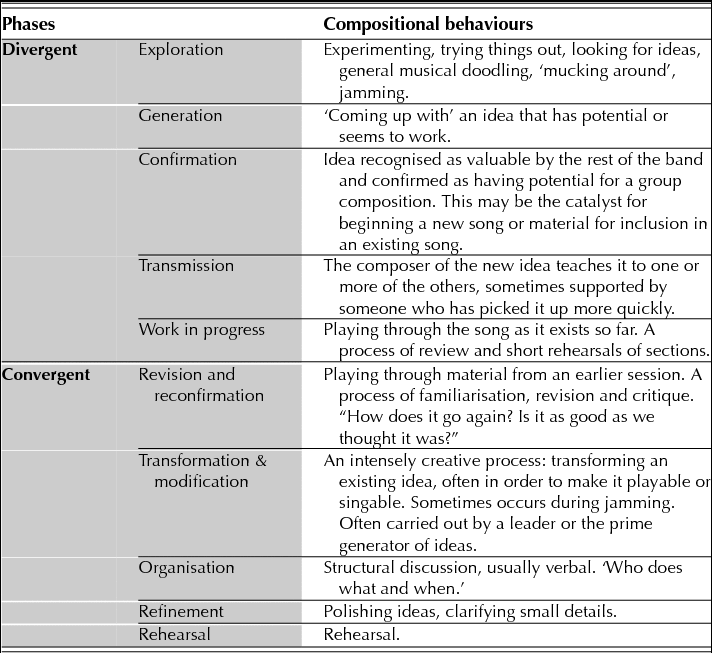
In earlier research into the collaborative composing of three rock bands (Thorpe, Reference THORPE2008), I developed a model based on those of Webster (Reference WEBSTER1990, Reference WEBSTER, Sullivan and Willingham2002) and Fautley (Reference FAUTLEY2005) to investigate how young people composed music together in three heavy metal and rock bands. Consistent with Webster and Fautley's models and other research into informal music practices (for example, Green, Reference GREEN2002; Allsup, Reference ALLSUP2003; Jaffurs, Reference JAFFURS2004; McGillen & McMillan, Reference McGILLEN and McMILLAN2005), I found that group composers moved back and forth within and between divergent and convergent stages, taking on various roles and tasks as they did so. These are represented in Table 1.
Compositional behaviours (derived from Reference THORPEThorpe, 2008, p. 69)

The study
As soon as group composing was incorporated into NCEA Music, I worked with two New Zealand secondary school music teachers and their Year 11 classesFootnote 1 over two school years, investigating how group composing might be taught and assessed. I collaborated with each teacher in a series of practical action research cycles, team-teaching the class with each teacher.
A wide range of qualitative data was gathered during the collaboration, including teacher and student interviews, recorded discussions, classroom materials and assessment documents. During data analysis, cultural historical activity theory was used to analyse and interpret the complexities and contradictions associated with group composing and its assessment.
Findings indicated that the students often struggled to articulate their compositional processes with each other, and with their teachers. Informed by Fautley's (Reference FAUTLEY2010) subsequent development of his 2005 model, I re-developed the compositional behaviours observed in my earlier research to create a student-friendly white board or PowerPoint version, and shared it with each class of 20 students. At the same time I was wary of oversimplifying the complexities of their interactions, bearing in mind Sadler's (Reference SADLER2007) assertion that the ‘meticulous specification of assessment criteria’, aimed at ‘getting students through’ assessments, can lead to no learning at all (p. 387) (See Figure 1).
When I presented the model, I explained its elements and engaged the students in discussion. I also explained that this was only one way to compose and that there were many others. Both classes of twenty students seemed very interested. Restless or noisy classroom environments became quiet and intent, remaining so throughout the session for both groups. Those students who had composed before were the ones who engaged in class discussion, often commenting that they recognised their own processes in the diagram. Many seemed fascinated to see these represented. Students who had never composed did not generally contribute much to discussion, but data analysis later revealed that these students found de-mystifying the creative process both reassuring and encouraging.
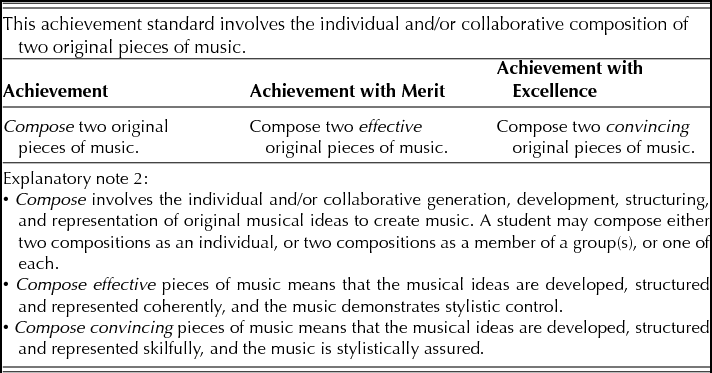
The students were given tasks that required them to compose music in specific styles. I developed a rubric using the assessment criteria and explanatory notes of the NCEA achievement standard for Level 1 composing. See Table 2 for a summary of these.
‘Assessment criteria’ and ‘Explanatory Note 2’ (New Zealand Qualifications Authority, 2010, p. 1)

Following a series of lessons focusing upon group composing in specific styles, the students went on to compose music in a style of their choice. About half the students (mainly more experienced composers) chose to solo-compose, and half to group-compose (mainly novice composers, led by more experienced students). Diagnostic and formative assessment began immediately, mainly taking the form of verbal feedback and field notes as the teacher and I moved between the groups.
Gathering data about students’ contributions to the creative process
Initially, I developed a written data-gathering tool based on the elements of the model that required students and teacher to regularly sign off compositional behaviour as it was reported or observed. This practice tended to atomise the data and did not generally present a useful picture of what was happening in the groups (Sadler, Reference SADLER2007). It also led to stilted, teacher-centred conversations that seemed to marginalise novice or less confident group members, slowing the creative process.
In both schools, informal conversations between group composers and their teachers generated the most valid and reliable assessment data. These took the form of running records and audio/video recordings collected during discussions with the students about how the group composed together, and how each student contributed to the compositional process. Generally these discussions began with a request to ‘tell us the story of how you composed the music’.
The conceptual model of group composing, presented earlier to the students, became the framework within which the students and teachers could engage in meaningful, shared discourse about the compositional processes within the group.
For example:
Fraser: We were struggling to figure something out. So he started playing that riff again and it was, ‘hang on, we could use that’ and that clicked it into the end of the messy phase.
Oliver: I refined Alex's riff.
Alex: Yep, he critiques it.
Some students also used the model to reflect on the different ways in which they worked when composing.
Alex: When we were jamming we were really quite messy but in the other room we were focused – writing it out and stuff. Yeah, we generated all our ideas probably in the practice room, not the classroom.
One teacher reported that the students used the model to discuss their progress with him.
Teacher: Some of them would say, ‘we're almost out of messy, we're almost at the point of getting focused now’. Or two of them would be getting into focused but one part would still be in messy because they are still trying to work it out. So that gave me a very clear idea of where they were at and them too, which meant that my feedback could be a lot clearer and a lot quicker and a lot more tailored to exactly what they each needed to do to achieve.
The students reported that the model gave them with a way to navigate the open-ended nature of creative processes. All said they liked the model because it gave them permission to ‘muck around’, be ‘messy’, unfocused and seemingly without direction, whilst reassuring them that they were still on the path to achievement. Some reported that it helped them to identify where they were in the compositional process so that they were able to know where to go next. The assessment literature emphasises the importance of knowing where to go next as part of formative assessment (for example, Black & Wiliam, Reference BLACK and WILIAM1998, Reference BLACK and WILIAM2009; Hattie & Timperley, Reference HATTIE and TIMPERLEY2007). There is strong evidence of this because the model provided group composers with a way of working together and a shared understanding of structure within which they all do so.
Angus: Because it kind of put less stress on you because you knew that what you were doing was actually working towards something. Because usually you sit there and you start jamming and you think, ‘I'm not coming up with anything, I've got a composition due in a month, it's for my NCEA mark, if we fail it we lose these credits and it's a big amount of credits’. With that [model] you can say, ‘Well we're in the messy phase, we're getting ideas, we are getting somewhere’ and you can build on that. Also you kind of know where to go from there, so you can follow a cycle and you know what steps you're actually in and what to do next and build on.
Angus suggests that the model reassured him that he was engaged in a process leading to composition completion. The notion of divergent and convergent processes seems to have been particularly useful once the initial ideas had been generated and the piece started to sound good.
Callum: It showed us what we were doing. And how close we were from getting it right.
Oliver: You know, how to get there, on the right path.
Although solo composers were not included in the study, some group composers went on to compose a second piece by themselves. I interviewed some students about this. Most reported that group composing with their friends gave them the confidence to then compose by themselves, and that the model also helped them to navigate their individual creative processes.
VT: Was the model helpful for your [solo] composing?
Richard: Yeah. Like, I know where I am now. I can work out where I am with my songs.
VT: How does that help you?
Richard: I know what I need to do to make it to the next step.
Some students associated the ‘focus phase’ with a path to NCEA achievement in composing.
Angus: The focus phase is kind of when you think, ‘Oh, we've got something here’. Then you can go on because that's when you know that this is something you actually want to build on and you actually want to focus on and do it more for fun than just getting an Excellence, and that's when you hit the focus phase.
Angus also implies here that once group members knew that they were on the right path to completing a piece, they could relax and enjoy group composing for its own sake.
Grading the compositions
The teachers found gathering data about each group-composing student time consuming and complex. In both classes, approximately half of the students chose to solo-compose with the others forming three or four groups composing heavy rock, reggae or indie rock music. It was challenging to manage logistically, particularly in one music department with few places for students to work in small, very noisy groups.
Visiting every student, and gathering on-going achievement data during a 50-minute class, was extremely demanding for the teachers. However both found that once their students had developed a shared understanding of the creative processes in which they were engaged, they were able communicate more clearly to one another and their teacher through commonly understood terms and concepts. Over time it also became clear that if the students had their instruments in their hands during these discussions, then inarticulate teenaged boys were able to communicate effectively through playing rather than talking about their ideas. The model became a helpful framework for the teachers to make on-going notes and give feedback about what each student had contributed to the compositional process.
Assessing the creative contributions of bass players and drummers
When it came to assessing the contributions of rhythm section players (drums and bass guitar) a number of issues came to light related to musical roles in the compositional process. Burnard (Reference BURNARD2012b) asserts that when we examine group music making in contemporary artistic contexts, there are multiple ways in which we can consider authorship. As discussed earlier, a member of a community of practice can justifiably claim joint authorship of the group's outputs.
While rhythm section players had important roles to play in shaping the music and getting the right overall feel, when it came to assessing their contributions to the creative process it was sometimes difficult for group composers and their teacher to know what that was. However, when working within a shared discourse about the processes in which they were engaged, group composers and their teacher were able to communicate productively and collegially to investigate the roles each student had taken within the music.
For example, in one group (singer, guitar, drums) the students initially explained to their teacher that the singer and guitarist had come up with all the ideas, casting doubt on the validity of the drummer's contribution (Callum). Using the model, the teacher discussed this with the group on a number of occasions, gradually revealing that Callum had established the overall feel of the piece at its inception, and had then critiqued the other boys’ ideas, particularly when refining the nearly-completed composition.
Teacher: The model was very useful because if we hadn't had it, if I had just said to them, ‘OK, what was the process of your composing? How did you start off?’ it would have begun and ended with that initial conversation and Callum would have ended up looking and feeling like he didn't do anything, like he hadn't achieved. But when I talked about the model, and we went past the jamming phase into the polishing stage, then that's when Callum realised that was when he was doing the work and the focus changed within the group. That's really helped because we would have missed that.
There is strong evidence to indicate that novice group members (usually bass players, drummers or rhythm guitarists) gained confidence, skills and knowledge from their peers. The community of practice that is a group-composing band often provided a zone of proximal development for novices to learn to compose music alongside their more capable, skilled and knowledgeable peers (Vygotsky, Reference VYGOTSKY1986). More experienced students also reported that they gained a lot of satisfaction from sharing their expertise with their less experienced friends. Nevertheless, a high degree of professional skill was needed on the part of the music teacher to identify the achievement of each student in a way that supported the novices, but also awarded credit where credit was due.
For example, one group composer, Jay, could barely play his instrument, the bass guitar. He usually played rhythm guitar but chose the bass to support his friends Jimmi (virtuoso electric guitar) and Rāwiri (accomplished rock drummer) to compose heavy rock music. When composing their first piece, Jay simply played the root of each chord in progressions dictated to him by Jimmi, and supported the feel established and maintained by Rāwiri. During the teacher's discussions with the group, it became clear that Jay's contribution to the creative process had been minimal, although the fact remains that the music might not have been composed without a bass line. While Jimmi and Rāwiri seemed likely to achieve the NCEA standard, there was some doubt about Jay.
Discussions with the boys about their compositional processes alerted them to the fact that Jay needed to take a more active role if he was to achieve the composing standard and be awarded the NCEA credits. Jay later commented ‘I need to make something up, for me.’ Following this discussion, Jimmi and Rāwiri asked Jay to write the second verse and helped him to work on developing his own part. Ultimately all members of the group achieved the composing standard with Jimmi and Rāwiri being awarded Merit grades, and Jay a low Achieved.
Solo composers are required to complete all aspects of the compositional process, including the creation of recordings and written scores or charts. However, Jimmi wrote out the charts for the group's songs by himself. Data analysis revealed that is unlikely that either Jay or Rāwiri would have been able to compose on his own, or create a written score or chart, yet both were awarded the same number of NCEA credits as their solo-composing classmates. Musically and socially this may be completely valid (Green, Reference GREEN2002, Reference GREEN2008), but these inconsistencies challenge the validity and reliability of the achievement standard itself as part of a national secondary school qualification.
Conclusion
The assessment of individuals’ achievement in collaborative groups is a complex business, as is the assessment of composing and composition. When these two complexities are brought together in the context of a secondary school qualification, then teachers require a high level of professional knowledge and skill. Composing music in a group may entail multiple forms of authorship, but in the present study this was found to be problematic for a standards-based, internally assessed, externally moderated qualification. This suggests that it may not be valid to apply the same assessment criteria to both group and solo composing. Nevertheless, there is strong evidence to suggest that group composing provides less confident, less experienced and less well-equipped students with rich opportunities for music learning both from and with their peers.
While there is a substantial and growing body of research into the nature of creativity and learning, there is very little that investigates what might happen when the nature of creativity and collaborative music processes is shared with students. McPhail (Reference McPHAIL2012b) calls for a re-examination of the nature of music curriculum, emphasising the importance of conceptual understanding in music teaching and learning. This study suggests that sharing a conceptual model of creative processes led to the development of shared conceptual understanding between teacher and students, supporting clearer communication between them and ultimately leading to more valid assessment judgements of their collaborative creative processes. It also suggests that when young musicians are reassured that a dynamic cycle of ‘mess’ and ‘focus’ is a natural part of the creative process, they may be motivated to move past exploratory social jamming to complete coherent and effective compositions.