Introduction
During the process of prey search and selection, predatory insects integrate different kinds of cues (visual, spatial, and olfactory) (Price et al., Reference Price, Denno, Eubanks, Finke and Kaplan2011). The way in which foraging wasps use cues depends on the type of prey and type of context in which foraging takes place (Raveret Richter & Jeanne, Reference Raveret Richter and Jeanne1985). Initially, wasps are guided by global and local landmarks and, once near the goal, other cues such as odour become more attractive to wasps than visual cues for inducing landing responses (Moreyra et al., Reference Moreyra, D'Adamo and Lozada2006). A forager's ability to discriminate odours and to associate indirect cues of the prey such volatile compounds emitted by the host plant where the prey develops (green-leaf volatiles-GLVs) improves its success (Brodmann et al., Reference Brodmann, Twele, Fracke, Hölzler, Zhang and Ayasse2008). This selective process helps predators reduce the costs of finding food in terms of time and energy, as it allows them to locate and even identify the quality of the resources (Matthews & Matthews, Reference Matthews and Matthews2010). The use of indirect cues during foraging behaviour has been studied in depth in parasitoid wasps, although they have different requirements from predatory wasps. Both types of search for a prey have evolved within a multitrophic context and have similar foraging strategies (Vet & Dicke, Reference Vet and Dicke1992; Turlings et al., Reference Turlings, Wäckers, Vet, Lewis and Tumlinson1993). Vet et al. (Reference Vet, Wäckers and Dicke1991) argued that parasitoid wasps during foraging behaviour face a dilemma between the reliability and detectability of cues, since the stimuli emitted by preys are of high reliability but low detectability and the stimuli released from the food of host are the opposite. Prey indirect cues (silk and/or faeces) may act as reliable indicators of host presence (Agelopoulos et al., Reference Agelopoulos, Dicke and Posthumus1995).
Vespula germanica (Fab.) (Hymenoptera:Vespidae) is a social wasp and opportunistic predator. Foraging wasps search for carrion or preys to feed their developing larvae and search for carbohydrates to satisfy their own energy requirements (Spradbery, Reference Spradbery1973). Several studies have demonstrated that during their foraging behaviour, wasps learn and integrate different kinds of cues (Free, Reference Free1970; D'Adamo & Lozada, Reference D'Adamo and Lozada2003; Moreyra et al., Reference Moreyra, D'Adamo and Lozada2006; El-Sayed et al., Reference El-Sayed, Manning, Unelius, Park, Stringer, White, Bunn, Twidle and Suckling2009; Wilson-Rankin, Reference Wilson-Rankin2015), displaying complex cognitive processes (D'Adamo & Lozada, Reference D'Adamo and Lozada2007, Reference D'Adamo and Lozada2008, Reference D'Adamo and Lozada2009, Reference D'Adamo and Lozada2011, Reference D'Adamo and Lozada2014; Lozada & D'Adamo, Reference Lozada and D'Adamo2009, Reference Lozada and D'Adamo2014; Moreyra et al., Reference Moreyra, D'Adamo and Lozada2012, Reference Moreyra, D'Adamo and Lozada2014, Reference Moreyra, D'Adamo and Lozada2016). It has been proposed that these characteristics might have contributed to the successful invasion of V. germanica in many parts of the world, including the native forests in the Andean-Patagonian region (Farji-Brener & Corley, Reference Farji-Brener and Corley1998; D'Adamo et al., Reference D'Adamo, Sackman, Rabinovich and Corley2002; Beggs et al., Reference Beggs, Brockerhoff, Corley, Kenis, Masciocchi, Muller, Rome and Villeman2011; Lozada & D'Adamo, Reference Lozada and D'Adamo2014).
The western area of Patagonia, located at the southern end of South America and including the territories of Argentina and Chile, is characterized by a temperate-cold climate and the presence of trees of the Nothofagaceae (Fagales) family. These trees represent a high quality resource for V. germanica, as they provide wood pulp, honeydew, and prey insects (Harris, Reference Harris1991). According to several authors, V. germanica wasps are capable of foraging on arthropods that inhabit the native environments, causing significant ecological impact (Moller et al., Reference Moller, Tilley, Alspach, Millar and Plunkett1988; Sackmann et al., Reference Sackmann, Farji-Brener and Corley2008; Brockerhoff et al., Reference Brockerhoff, Barratt, Beggs, Fagan, Kay, Phillips and Vink2010; Beggs et al., Reference Beggs, Brockerhoff, Corley, Kenis, Masciocchi, Muller, Rome and Villeman2011). Currently, V. germanica is one of the most abundant insects found in the Patagonian Andes, and to date, specific predators of this wasp have not been reported in this region and there is little information on the effects they may have on the native insects on which it feeds (Farji-Brener & Corley, Reference Farji-Brener and Corley1998; Raveret Richter & Tisch, Reference Raveret Richter and Tisch1999; Sackmann et al., Reference Sackmann, Farji-Brener and Corley2008).
Foraging behaviour of non-native insects can alter the host environment in ways that affect native species; for instance, if the predator is very efficient, then the prey populations can be substantially reduced (Davis, Reference Davis2009). Therefore, non-native insects may have a potential impact on the dynamics of native insect populations that inhabit the Andean- Patagonian forest, as well as on other animals competing for the same food resource (Harris, Reference Harris1991; Sackmann et al., Reference Sackmann, D'Adamo, Rabinovich and Corley2000; Masciocchi et al., Reference Masciocchi, Farji-Brener and Sackmann2010). However, there is a lack of knowledge about the native entomofauna of the region, as there are many species that are unknown or have not yet been taxonomically identified, making it difficult to analyse the real impact of these predatory insects (McQuillan, Reference McQuillan1993). Studying the foraging behaviour of invasive insects, particularly in a native environment, as the Andean Patagonian forest, provides valuable information that can be used for the development of conservation plans and even for pest management of different species of phytophagous insects associated with Nothofagaceae trees.
Perzelia arda (Lepidoptera: Oecophoridae) is an abundant native insect inhabiting the Andean- Patagonian forest (Argentina), which may represent an important food source for V. germanica. These larvae consume seeds and leaves of Lophozonia obliqua (Fagales: Nothofagaceae) (previously named Nothofagus obliqua Heenan & Smissen (Reference Heenan and Smissen2013)), and according to Carrillo & Cerda (Reference Carrillo and Cerda1987), they can become a potential pest of the Nothofagaceae family. Damage caused to leaves may lead to a reduction in reproductive and photosynthetic rates, affecting the vigour and health of these trees which represent a high-quality wood resource with socio-economic importance. Perzelia arda caterpillars use the foliage of L. obliqua to hide in and feed on. They produce silk for quick escape and for leaf tying when they build their shelter. When these caterpillars detect the presence of a threat, they leave this shelter, leaving traces of silk and faeces within, and build a new one (Pietrantuono et al., Reference Pietrantuono, Bruzzone and Fernández-Arhex2017). Therefore, we suppose that olfactory cues are essential for V. germanica during foraging of P. arda prey, as the wasps cannot observe the presence of the larva because they are hidden in the shelter made of leaves.
The purpose of this work is to study whether V. germanica use olfactory cues when foraging on P. arda caterpillars. We expect to find that during their search, V. germanica will detect different types of olfactory signals emanating from their prey.
Materials and methods
The study was conducted at different sites located in the North-western Patagonian native forests in Argentina (41°S, 71°W), where Nothofagus and Lophozonia trees are abundant. Diverse sites where wasps had been observed preying on larvae were sampled.
Each wasp was captured while collecting meat from a dish and was marked with a dot of washable paint on the abdomen for identification to avoid using the same specimen again after its use in the experiment and later release. Only female specimens were used in the experiments.
Several individuals of L. obliqua were selected in North-western Patagonian forest for the collection of samples. We collected several branches, which had healthy leaves and leaves glued by the silk with larvae and faeces inside. From these branches, we obtained P. arda larvae, leaves without traces and leaves with traces. From the total larvae collected only those that were in the last larval instar were used in the experiments in order to homogenize as much as possible experimental conditions. To select the larvae we took into account that, in their last stage, they change their colour from pale yellow to an intense green, reaching a length of 11 mm and a width of 2 mm (Donoso et al., Reference Donoso, Donoso, Gallo, Azpilicueta, Baldini, Escobar and Donoso2006). We selected the leaves that were mature, have a similar size (5–5.5 cm of length and 2.5–3 cm of width), were not chewed/or with another mechanical damage, or with the presence of fungi. Usually when a larva puts together two leaves only feeds on one of them, allowing us to use the other healthy leaf with traces for the experiment. Immediately after the selection of the stimuli, the experiment was started.
Experimental design
The experiments were carried out in natural conditions from February to April 2016, around noon.
To evaluate V. germanica foragers’ behaviour a sequence of paired comparisons was performed and a glass Y-tube olfactometer (base: 13 cm, arms: 7 cm, diameter: 2 cm, angle between minor arms: 90°) was used. This device was connected to an air pump generating an air flow of 1 cm s−1. Before entering the system, the air was filtered through activated charcoal. The stimuli containers consisted of two Plexiglas boxes (10 × 10 × 10 cm3) covered with white paper (to eliminate the possibility of visual cues) attached to the end of each arm of the olfactometer. Furthermore, the device was placed inside a large white box (50 × 50 × 25 cm3) covered by a detachable, transparent and red cover (all made in Plexiglas of 5 mm thickness).
For each assay, one female individual of V. germanica was placed in the base of the olfactometer and kept there during 1 min (i.e. adaptation period). It was then released for 3 min to choose between stimuli. Given the diameter of the Y-tube, the wasp had to make its choice while walking. A forager's choice was considered effective when the wasp performed rapid antennal movements (i.e. active search) (El-Sayed et al., Reference El-Sayed, Manning, Unelius, Park, Stringer, White, Bunn, Twidle and Suckling2009) and its full body passed a line set at 1 cm into each minor arm after the dichotomous division. The wasps that did not pass this line or not performed an active search were not considered. The Plexiglas boxes were positioned at random during the experiments and after each experiment, the olfactometer was washed to avoid wasp pheromone trails (first with ethylic alcohol, then with a 5% solution of ionic detergent and finally rinsed with distilled water). Two researchers, sat at a distance of 0.5 m from this device, recorded the length of time that the wasp spent in each arm of the olfactometer after crossing the line set 1 cm from the beginning of the minor arm.
Three treatments were performed to compare pairs of all combinations of stimuli (larvae vs. leaves with larval traces (n = 25), larvae vs. leaves without larval traces (n = 27) and leaves with larval traces vs. leaves without larval traces (n = 25)). It should be noted that we considered as larval traces the presence of silk and/or faeces of P. arda. In addition, three control treatments were performed (nothing = empty box vs. Larvae (n = 30), nothing vs. leaves without larval traces (n = 27) and nothing vs. leaves with larval traces (n = 18)). Because P. arda larvae tend to cluster in natural conditions, we offered as a stimulus five larvae simultaneously (Pietrantuono et al., Reference Pietrantuono, Bruzzone and Fernández-Arhex2017). Five entire mature leaves of similar size were used for the leaf stimulus. After six assays both stimuli were renewed to keep them fresh. In total we evaluated the response of 175 female wasps (one per assay).
Data analysis
The paired comparisons were analyzed using a two-step methodology. First, we performed a Wilcoxon matched pair test (Bonferroni corrected) to determine whether there were differences between treatments and second we developed a model using a Bayesian approach to establish a scale of preferences between stimuli. This procedure provides a more straightforward way to determine the degree of attraction between stimuli and it is widely used by ecologists in animal behaviour studies (Ellison, Reference Ellison2004; McNamara et al., Reference McNamara, Green and Olsson2006; Valone, Reference Valone2006; Pereira et al., Reference Pereira, Masciocchi, Bruzzone and Corley2013; Pietrantuono et al., Reference Pietrantuono, Fernandez-Arhex and Bruzzone2014, Reference Pietrantuono, Enriquez, Fernandez-Arhex and Bruzzone2015, Reference Pietrantuono, Bruzzone and Fernández-Arhex2017).
In order to analyse decisions made by Vespula germanica through the time that elapsed in each arm of the olfactometer, we developed two models based on the Thurstone model of comparative judgments case V (Thurstone, Reference Thurstone1927/1994; Bradley & Terry, Reference Bradley and Terry1952; Tsukida & Gupta, Reference Tsukida and Gupta2011). Through these models we were able to determine the gradient of preference for each stimulus. This scale is used in various types of experimental designs and is the most well-known tool for estimating object preferences through the observed frequency of paired comparisons (Lipovetsky, Reference Lipovetsky2007; Angulo & O'Mahony, Reference Angulo and O'Mahony2009). Not only does it provide a ranking of preferences for all the options offered, but it also provides the position of each of these options in one-dimensional space of preferences. It should be noted that when a preference scale is established, the magnitude of the quality of the options is in relation to an arbitrarily established reference value (Tsukida & Gupta, Reference Tsukida and Gupta2011). This is why we define the zero position and the unit of measure as arbitrary.
The first of the models or ‘null model’ establishes that there are not preferences between the stimuli offered. While in the second model or ‘simple model’ there is a scale of preferences (based on the Thurstone model). This linear scale expresses the degree of attraction or preference that an experimental subject shows for one of the available options. Higher values indicate an increasing preference, and lower/negative values indicate rejection. Because the Thurstone scale is an ‘interval scale’ (Stevens, Reference Stevens1946), we used one of the stimuli (larvae) as the reference value (origin ordinate) of the scale system. This stimulus was arbitrarily chosen as the reference value (corresponds to zero); therefore, it has no estimation error. In addition, the units of this scale were expressed in terms of the standard deviations of the discriminal dispersion of the reference stimulus. Thus, the preference for each stimulus within the scale was positioned relative to this value, and its values were expressed in terms of the discriminal dispersion (Pietrantuono et al., Reference Pietrantuono, Bruzzone and Fernández-Arhex2017).
For the development of the model, 110,000 iterations were performed, from which 10,000 were discarded as a burn-in. From the remainder, one in 100 was chosen to avoid autocorrelation. To test convergence, Geweke plots were used, and a visual inspection of the variable traces was carried out (Geweke, Reference Geweke, Bernardo, Berger, David and Smith1992). The analyses were performed using the PyMC library for Bayesian estimation (Patil et al., Reference Patil, Huard and Fonnesbeck2010) in the Python programming language. Finally, the model with the lowest value of the deviance information criterion (DIC) was selected (Gelman et al., Reference Gelman, Carlin, Stern and Rubin2004).
Results
Based on the data analysis performed with the Wilcoxon test we found significant differences (P < 0.05) when comparing larvae vs. leaves without larval traces (n = 27); leaves with larval traces vs. leaves without larval traces (n = 25); larvae vs. nothing (n = 30) and leaves with larval traces vs. nothing (n = 18). However, non-significant differences (P > 0.05) were found when comparing larvae vs. leaves with larval traces (n = 25), and leaves without larval traces vs. nothing (n = 27) (table 1 and fig. 1).
Average time in minutes that V. germanica wasp remained on each stimulus offered: (a) Larvae vs. Leaves with traces (n = 25, P > 0.05); (b) Larvae vs. Leaves without traces (n = 27, P < 0.05); (c) Leaves with traces vs. Leaves without traces (n = 25, P < 0.05); (d) Larvae vs. Nothing (n = 30, P < 0.05); (e) Leaves with traces vs. Nothing (n = 18, P < 0.05); (f) Leaves without traces vs. Nothing (n = 27, P > 0.05). The asterisk indicates significant differences.

Average time in minutes that V. germanica wasp remained on each stimulus and Standar Error (SE). The asterisk indicates significant differences.

From the total number of the tested individuals (n = 175), 152 wasps actively chose between two stimuli offered (i.e. each wasp passed the line set at 1 cm into each arm of the olfactometer and produced rapid antennal movements) and were included in the data analysis. The wasps that did not respond (n = 23) belonged to different treatments.
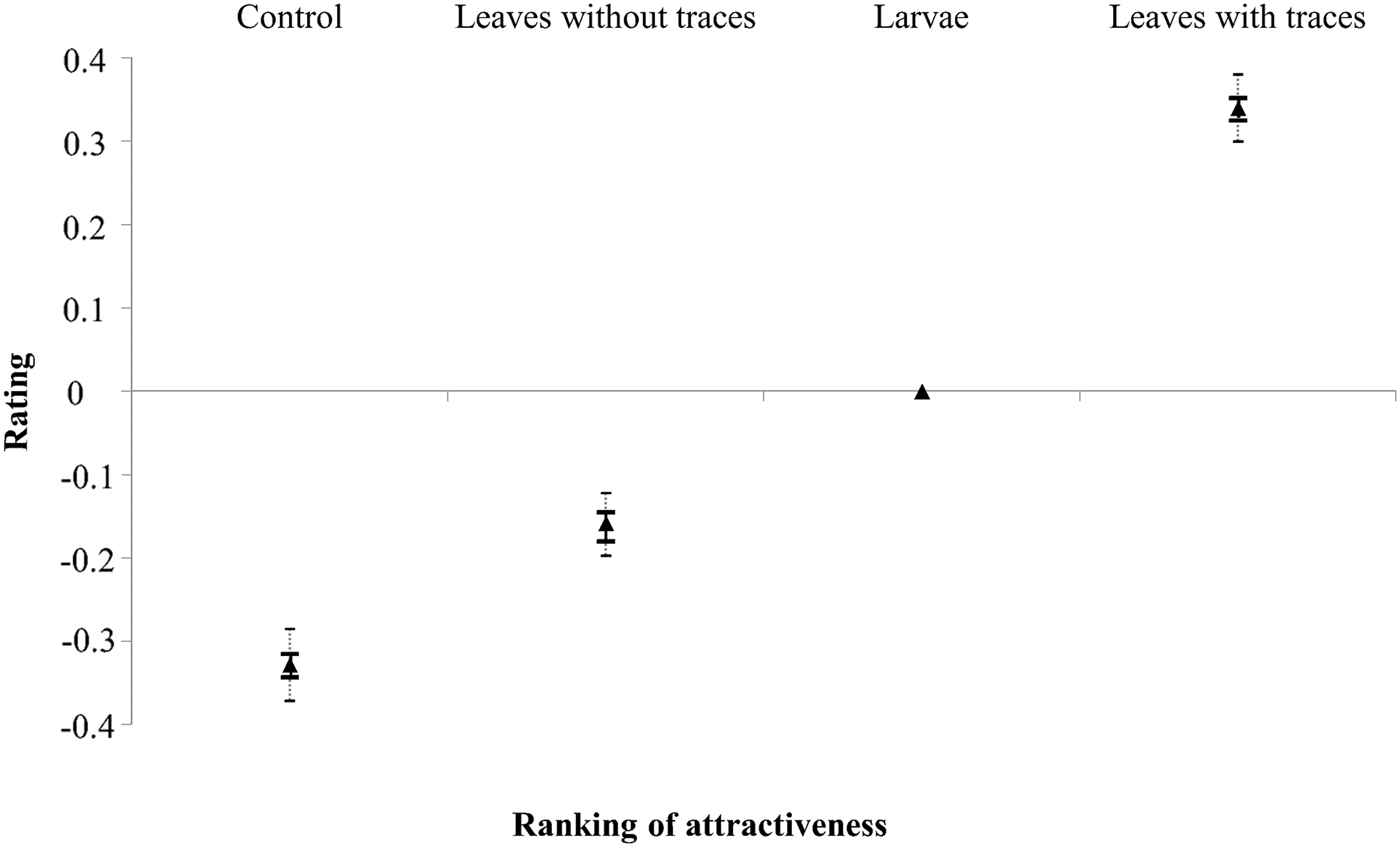
The analysis of the proposed models showed that V. germanica wasps choose P. arda as larval prey and are capable of discriminating between the offered stimuli (DIC null model = 873.97; DIC simple model = 84.5). According to the preference scale (fig. 2), leaves with traces of larvae were preferred or were the most attractive stimulus for V. germanica as shown by its first ranking; while larvae were in the second most attractive stimulus. These results could suggest that the main olfactory cue could be unrelated to larvae itself but rather to the products of its activity (silk and/or faeces). However, the control (i.e. the empty box) was the least attractive stimulus.
Ranking of attractiveness as a function of the choices made by Vespula germanica. Leaves with traces of Perzelia arda were the most attractive stimulus. The black lines indicate the error estimates for the mean value for each point on the Thurstone scale. The grey dotted lines indicate the discriminal dispersion according to case V of the Thurstone model (Thurstone, Reference Thurstone1927/1994).

Discussion
To our knowledge this is the first study that evaluates the behaviour of the exotic wasp V. germanica when foraging on P. arda, a native folivorous insect from the Andean-Patagonian forest. The present research demonstrates that V. germanica is able to differentiate between the offered stimuli and use a variety of signals to locate and choose P. arda as larval prey. Particularly, V. germanica is able to associate the traces of faeces and/or silk as a sign of the presence of the prey. This may be because, under natural conditions, larvae are never exposed outside their shelters of leaves, and therefore, the presence of these traces is a strong indicator that the larvae must be there.
Similarly, Cornelius (Reference Cornelius1993) demonstrated that the behaviour of the predatory wasp Mischocyttarus flavitarsis (Hymenoptera: Vespidae) was influenced by cues that are associated with prey but are not emitted directly by the prey (i.e. wasps preferred leaves previously damaged by caterpillars than leaves without leaf damage). Raveret Richter & Jeanne (Reference Raveret Richter and Jeanne1985) argued that the way in which foraging wasps use cues for prey location depends on both the context in which the hunt takes place and on the types of prey for which the wasp is hunting. Even though in this work the visual cues were avoided, we hypothesize that in this study system, V. germanica uses olfactory cues in a greater proportion than visuals cues (Hendrichs et al., Reference Hendrichs, Katsoyannos, Wornoayporn and Hendrichs1999; D'Adamo et al., Reference D'Adamo, Sackmann, Lozada and Corley2000). For this reason, further research is needed to discern which volatile compounds of the indirect cues as silk, faeces, or leaves are involved in this behaviour (Bergelson & Lawton, Reference Bergelson and Lawton1988; Jones et al., Reference Jones, Castellanos and Weiss2002; Chuche et al., Reference Chuche, Xuéreb and Thiéry2006). There were certain variables (such as age and previous experiences) that were not evaluated in the current work, given the nature of the experimental design used here which may have had importance in the learning and behaviour of the wasp (Papaj & Lewis, Reference Papaj and Lewis1993). Indeed, several studies have demonstrated the high plasticity with which V. germanica responds to unpredictable contextual changes while foraging and how wasps integrate old and new memories while foraging on un-depleted food sources (D'Adamo & Lozada, Reference D'Adamo and Lozada2009; Lozada & D'Adamo, Reference Lozada and D'Adamo2009; Moreyra et al., Reference Moreyra, D'Adamo and Lozada2014). In future research it would be interesting to evaluate whether age and previous experience influence wasps’ foraging behaviour on P. arda (Papaj et al., Reference Papaj, Prokopy, McDonald and Wong1987).
Works focusing on prey and predator interactions in the Andean- Patagonian forests represent a challenge since they are systems poorly studied and are difficult to develop under laboratory conditions. Therefore, in the present work we contributed to the recognition of chemically mediated interactions and to the understanding of the complexity of invasive processes and their potential impact on biodiversity and ecosystem function (Beggs & Rees, Reference Beggs and Rees1999; Vet, Reference Vet1999). On one hand, the availability of prey may influence the success of wasps and developing larvae (Raveret Richter, Reference Raveret Richter1990). On the other hand, wasps may have an important role as a positive biological control because they reduce the populations of lepidopteran that damage Nothofagaceae trees (Lawson et al., Reference Lawson, Rabb, Guthrie and Bowery1961; Gould & Jeanne, Reference Gould and Jeanne1984; Cornelius, Reference Cornelius1993).
Our work highlights the importance of studying in more depth the interaction between exotic and native species coexisting in a natural environment. These findings also provide a starting point for phytosanitary care and the conservation of systems containing native species.
Acknowledgements
The authors are very grateful to Marcela Maldonado for revising the English text. The authors like to thank the two anonymous reviewers for useful comments on previous versions of this manuscript. They also acknowledge support from the INIBIOMA-CONICET, INTA EEA-Bariloche and Universidad Nacional del Comahue.