Introduction
Approximately 73 million ha of agricultural lands in the United States are devoted to pastures and haylands (Sanderson et al. Reference Sanderson, Jolley and Dobrowolski2012). Additionally, Missouri has an inventory of 2.1 million beef cattle, and approximately 25% of farmland in the state is dedicated to pastures (USDA ERS 2017; USDA NASS 2018). The primary source of feed for these animals is forage from pasture and stored forage from haylands. Tall fescue is the predominant forage species in pastures in Missouri and throughout the eastern United States (Glenn et al. Reference Glenn, Glenn, Rieck, Ely and Bush1981). Although tall fescue is widely grown, cattle performance on tall fescue is often poor or reduced during summer months (Henning et. al. Reference Henning, Wheaton and Roberts1993; Wen Reference Wen2001). Many pastures are grown in mixtures with legumes, primarily clovers (Trifolium spp.), to increase yield and feed quality (Gerrish and Roberts Reference Gerrish and Roberts1999; Phelan et al. Reference Phelan, Moloney, McGeough, Humphreys, Bertilsson, O’Riordan and O’Kiely2015). Mixed tall fescue and legume pastures have the potential to be productive, but improper soil fertility and grazing management of these systems can limit productivity and allow weed invasions.
Forage production in pastures can be negatively affected by soil fertility and pH (Barker and Collins Reference Barker, Collins, Collins, Nelson, Barnes and Moore2018). Lower soil fertility levels can lead to increased densities of certain weed species when forage crop stands are reduced (Curran and Lingenfelter Reference Curran and Lingenfelter2009). Low pH or soil acidity is a serious detriment to forage production that can limit plant growth by reducing nutrient availability and/or nitrogen (N) fixation by rhizobia bacteria on legumes (Barnhart et al. Reference Barnhart, Mallarino and Sawyer2013). Weeds compete directly with desired species for resources such as soil nutrients, moisture, light, and space (Green et al. Reference Green, Witt and Martin2006). The presence of certain pasture weeds has been correlated with specific soil nutrient and pH levels. For example, broomsedge (Andropogon virginicus L.) was reduced in a 4-yr study after the addition of phosphorus (P) and potassium (K) at 112 kg ha−1 P2O5 and 112 kg ha−1 K2O, respectively (Peters and Lowance Reference Peters and Lowance1974). The authors noted that P and K fertilization levels allowed the forage species to effectively compete with the weed. Grekul and Bork (Reference Grekul and Bork2007) reported decreased Canada thistle density in pastures when the forage crop had been fertilized to soil test recommendations. Both studies indicate that maintaining optimum soil fertility levels in pasture systems may allow the desired forage species to outcompete and reduce the incidence of weed species, and that soil pH, P, and K levels are three of the most important components of soil fertility in grazing lands.
P is the second most limiting nutrient after N in forage systems (Barker and Collins Reference Barker, Collins, Collins, Nelson, Barnes and Moore2018). P is important for forage stand establishment and legume persistence (Barnhart et al. Reference Barnhart, Mallarino and Sawyer2013). Forage crops respond more favorably to lower levels of P than row crops (Buchholz et al. Reference Buchholz, Brown, Crocker, Garret, Hanson, Lory, Nathan, Scharf and Wheaton2004). In the soil, P is generally found in relatively high quantities with low plant availability (Schachtman et al. Reference Schachtman, Reid and Ayling1998). More than 80% of soil P becomes immobile and unavailable for plant uptake (Holford Reference Holford1997). In P-limited growing conditions, forage crops may have reduced yield (Sanderson et al. Reference Sanderson, Stair and Hussey1997). K is another important nutrient in forage systems. K is primarily found as a structural component of soils and is mostly unavailable for plant uptake and growth (Kaiser and Rosen Reference Kaiser and Rosen2018). Between 0.1% and 2% of soil K is in a plant-available form; therefore, additional applications of K may be needed to meet plant requirements (Bucholz and Brown Reference Bucholz and Brown1993).
Secondary macronutrients are needed by the forage crop as well. Magnesium (Mg) is essential to the photosynthetic process of plants and functions as the central atom in chlorophyll a and b molecules in leaf chloroplasts (Wilkinson et al. Reference Wilkinson, Welch, Mayland and Grunes1990). Mg concentrations in forages are also important to grazing animals. Low Mg concentrations in the leaves of forages may lead to a condition known as grass tetany. Grass tetany is the clinical manifestation of a metabolic disorder in livestock characterized by an abnormally low level of Mg in the blood (Metson et al. Reference Metson, Saunders, Collie and Graham1966). Calcium (Ca) is required for structural roles in the cell wall and cellular membranes of plants and is important to cell division and elongation (Kelling and Schulte Reference Kelling and Schulte2004; White and Broadley Reference White and Broadley2003). Ca is relatively abundant in most soils and rarely limits plant growth (Kelling and Schulte Reference Kelling and Schulte2004). The relative abundance of Ca may explain the limited influence Ca concentration has on weed density. Sulfur (S) is a component of many amino acids vital to plant protein synthesis (Schulte and Kelling Reference Schulte and Kelling1981). S may become unavailable to plants, as it leaches into the subsoil and adsorbs to clay particles (Dick et al. Reference Dick, Kost, Chen and Jez2008). As S levels rise, there is the tendency for soil to become more acidic (Van Breemen et al. Reference Van Breemen, Mulder and Driscoll1983).
Micronutrients are vital to plant growth and production but are needed in smaller quantities than primary nutrients such as N, P, and K and secondary nutrients such as Mg, Ca, and S (Voss Reference Voss1998). Zinc (Zn) is found in largely unavailable forms in the soil and may be toxic to crops at high concentrations (Schulte Reference Schulte2004). Manganese (Mn) is more available in lower pH soils and may become toxic in soils with a pH of 5.5 or less (Schulte and Kelling Reference Schulte and Kelling1999a). Mn is most responsible for oxygen evolution in plants (Burnell Reference Burnell, Graham, Hannam and Uren1988). Copper (Cu) is used in relatively small amounts by crops and is found in mostly plant-unavailable forms in the soil (Schulte and Kelling Reference Schulte and Kelling1999b).
Grazing animals may also influence weed and forage balance in a pasture. Grazing intensity and pressure can lead to increased incidences of certain species (Curran and Lingenfelter Reference Curran and Lingenfelter2009; Popay and Field Reference Popay and Field1996). Cattle may also avoid areas with greater weed densities; Sather et al. (Reference Sather, Kallenbach, Sexten and Bradley2013) reported that 1.5 to 4.9 times more cattle were grazing in weed-free areas that had been treated with herbicide than in weedy areas not treated with herbicide in the same pasture. Reduced forage utilization near weeds may also lead to overgrazing in other areas of a pasture. However, with proper grazing management, weed encroachment into forage systems can be avoided (DiTomaso Reference DiTomaso2000).
At present, little research has been conducted that examines the relationship between soil fertility, stocking density, forage density, and weed incidence and severity in mixed tall fescue and legume pasture systems. Therefore, the objective of this research was to determine the effects that soil fertility, soil pH, and grazing and forage system components have on the incidence and severity of weeds in mixed tall fescue and legume pastures in Missouri.
Materials and Methods
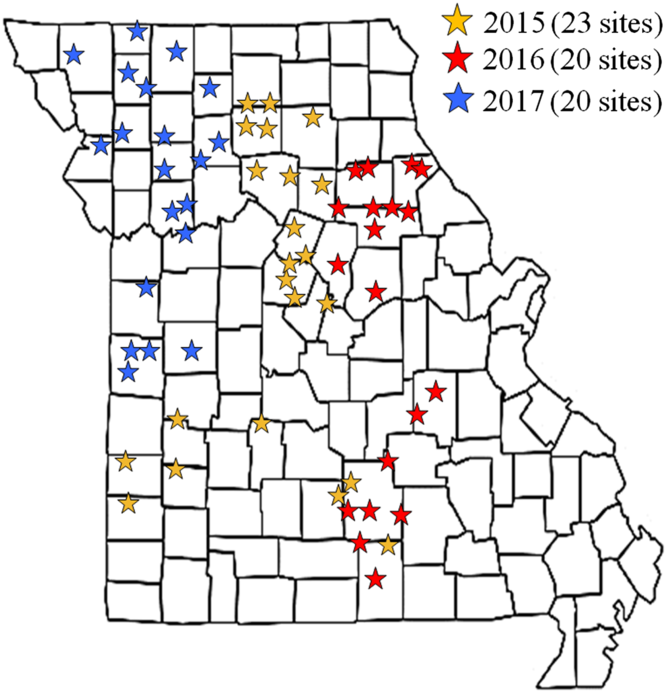
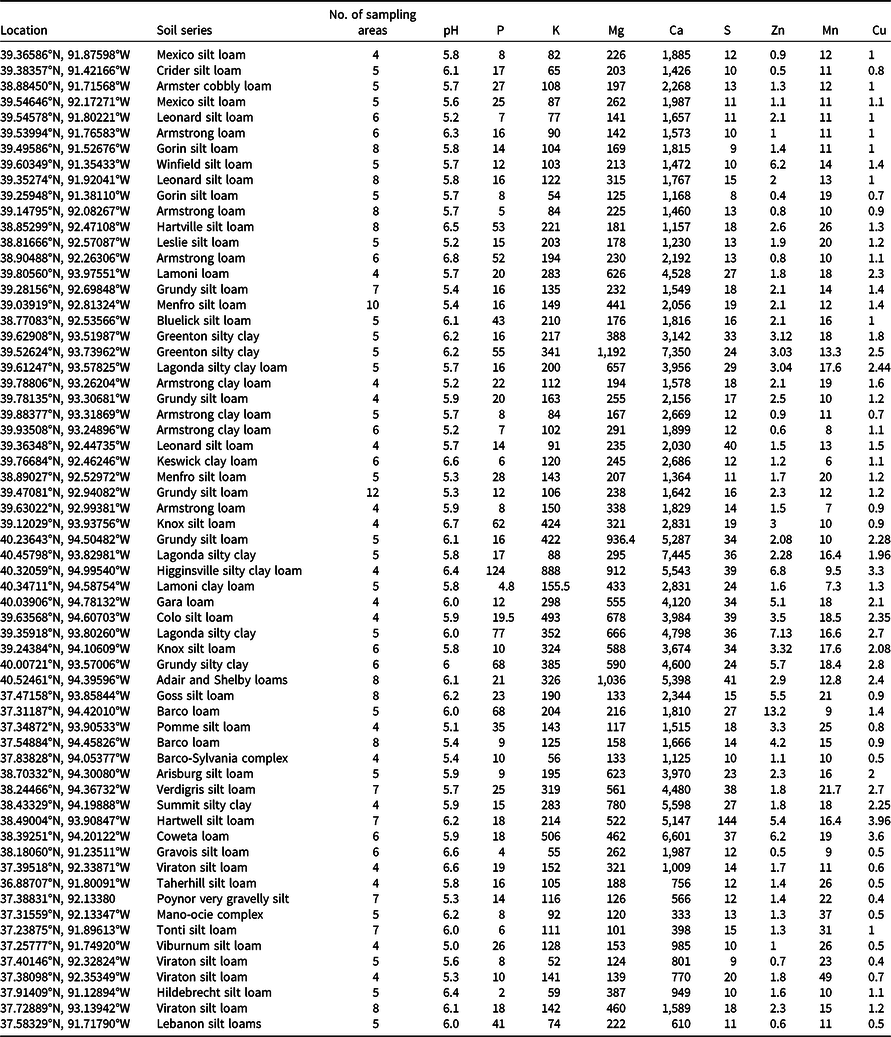
A survey was conducted during the 2015, 2016, and 2017 growing seasons at 63 pastures surveyed throughout the major cattle and forage-producing areas of Missouri (Figure 1, Tables 1 and 2). Each location consisted of a mixed perennial grass and legume pasture. The most prominent grass species was tall fescue, and the most common legume across all pastures was white clover (Trifolium repens L.); however, other legumes such as annual lespedeza (Lespedeza stipulacea Maxim.), birdsfoot trefoil (Lotus corniculatus L.), and red clover (Trifolium pratense L.) occurred sporadically in some locations. Specific information pertaining to each pasture site is presented in Table 1. No herbicide or lime applications were made in the previous or current growing season at any pasture, and cattle were actively grazing each location throughout the surveyed growing season.
Locations of pastures surveyed in Missouri from 2015 to 2017.


a Abbreviations: pH, soil pH in water; P, phosphorus; K, potassium; Mg, magnesium; Ca, calcium; S, sulfur; Zn, zinc; Mn, manganese; Cu, copper. Soil nutrients listed as parts per million (ppm).
b pH and soil nutrients listed as arithmetic means of individual locations (4 to 12 sampling areas per location).
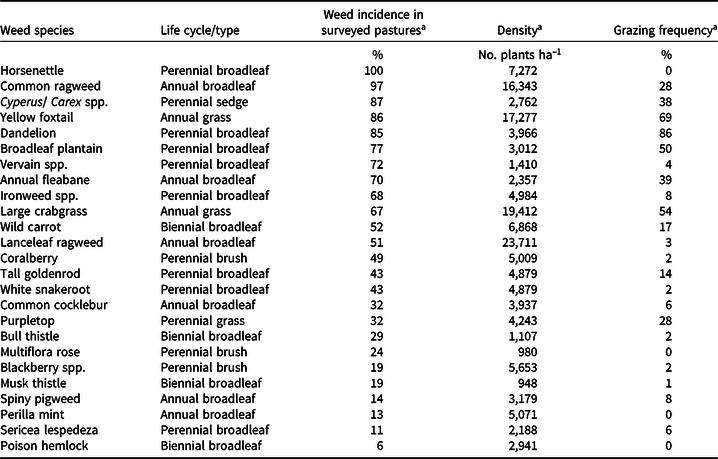
Incidence, density, and grazing frequency of common weeds in Missouri pastures from 2015 to 2017.

a All values represent the average incidence, density, and grazing frequency of the weed species across all sites surveyed.
At each site, a 20-m2 sampling area was surveyed for every 4 ha of pasture at a given survey location. Pasture size ranged from 11.7 to 48.6 ha. A minimum of four sampling areas were established at each survey location. Sampling areas were established at random throughout the pasture while trying to maintain an accurate representation of the variations found at each survey location. Upon establishment of a sampling area, a 5-cm-diam plastic survey marker (Survey marker; Lifetime Plastics Corp., Bricktown, NJ 08723) was placed in the center of each plot and driven into the ground until flush with the soil surface. Survey markers were placed below the forage to avoid grazing interference. Survey markers were georeferenced using a handheld GPS unit (Trimble GeoExplorer 2008 Series; Trimble Inc., Sunnyvale, CA 94085) so as to return to the same location for future data collection.
Following the establishment of each sampling area, data were collected at 14-d intervals for a total of 12 surveys, with the survey dates beginning in mid-April and continuing through late September. At the time of each survey, all weed species within the 20-m2 sampling area were counted, and the average height and physiological maturity of each individual weed species were recorded. Counts from each sampling area were then averaged to determine an average density for each weed species across a given pasture. Additionally, at the time of each survey each weed species was visually assessed for indications of cattle grazing or avoidance. Indications of grazing would include obvious symptoms of grazing activity on a given weed species. Evidence of grazing avoidance included clear signs of grazing forage species and/or other weeds up to and around a given weed species, but no evidence of cattle grazing on that specific weed itself. All forage grass and legume species were identified within each sampling area, and a visual assessment of the total groundcover contribution of each forage species was conducted. Visual assessment of groundcover was conducted by first determining how much of the survey area was covered in forage species, weed species, and bare ground. During the sixth survey period (late June to early July), soil samples were collected to a depth of 15 cm from each sampling area. Five soil cores were taken from each sampling area so as to make a composite soil sample. Soil sampling occurred during the sixth survey period to allow any fertilizer that may have been applied by the landowner in the spring to incorporate into the soil solution. Soil samples were analyzed (Midwest Laboratories, Omaha, NE 68144) for soil pH, P, K, Mg, Ca, S, Zn, Mn, and Cu levels. Cattle numbers and animal weight were recorded by the landowner. Changes in cattle numbers were recorded when animals were introduced or removed from a pasture. Stocking density was then determined using cattle numbers, weight, and pasture size.
Data Analysis
Interactions between weed species and the recorded parameters of soil fertility, soil pH, groundcover, and animal stocking density were analyzed using a stepwise linear regression procedure (PROC REG) in SAS (Statistical analysis software SAS 9.4; SAS Institute Inc., Cary, NC 27513) at a significance level of 0.15 in order for all variables to be included and remain in the model. Weed density was the response variable in each analysis. Effect variables included soil pH, P, K, Mg, Ca, S, Zn, Mn, and Cu concentration, cattle grazing units, total forage groundcover density, and tall fescue density. Cattle grazing units were recorded using the animal unit system, where 1 animal unit is equal to one 1,000-pound (454-kg) cow with calf by her side per acre or an herbage intake of 29.1 kg ha−1 d−1 (Redfearn and Bidwell Reference Redfearn and Bidwell2003). Weeds were grouped into one of seven life cycles: annual grass, annual broadleaves, biennial broadleaves, brush species, perennial grass, perennial broadleaves, and sedge species; 24 weeds encountered in the survey were also analyzed for individual weed and parameter interactions.
Results and Discussion
Weed, Soil Fertility, Soil pH, and Grazing and Forage Interactions
Across all 63 sites surveyed from 2015 to 2017, an increase of 1 unit in soil pH was associated with 146 fewer weeds per hectare, the largest reduction in weeds in response to any individual soil parameter (Table 3). A 1-ppm increase in soil P and Mn was correlated with an average density reduction of 62 and 36 weeds, respectively. Furthermore, an increase of 1% tall fescue and forage groundcover density, as well as a 1–animal unit increase, were also responsible for fewer weeds per hectare. Conversely, there were greater weed densities in response to 1-ppm increases in soil K, S, Zn, and Cu levels. There was no significant effect of soil Mg or Ca levels when averaged across all weed species.
Change in overall density of annual, biennial, and perennial broadleaf, biennial broadleaf, annual and perennial grass, and sedge species in response to a 1-unit increasea of a given soil nutrient, forage, or grazing parameter.

a A 1-unit increase means an increase of 1 unit soil pH; 1 ppm for P, K, Mg, Ca, S, Zn, Mn, Cu; 1% total groundcover for tall fescue and forage groundcover.
b Abbreviations: Ann., annual; Bi., biennial; Per., perennial; P, phosphorus; K, potassium; Mg, magnesium; Ca, calcium; S, sulfur; Zn, zinc; Mn, manganese; Cu, copper.
c A 1–animal unit increase refers to one 1,000-lb (454-kg) cow with calf per acre (increased herbage intake 29.14 kg ha−1 d−1).
d P < 0.001***, P < 0.05**, P < 0.10*, P < 0.15
Annual broadleaf weeds were found in greater densities than many other species in the survey (Table 2). Soil pH had the greatest effect on annual broadleaf density, with a decrease of 1,572 weeds ha−1 for each 1-unit increase in pH (Table 3). A 1-ppm increase of K and Zn was correlated with a decrease in annual broadleaf density of 12 and 219 plants ha−1, respectively. Greater forage groundcover and stocking density also resulted in annual broadleaf weed density reductions. A 1% increase in forage groundcover was associated with a decrease of 101 weeds ha−1, whereas an increase of 1 animal unit was associated with 356 fewer weeds per hectare. Conversely, there was an increase in annual broadleaf weed density for every 1-ppm increase of Mg, Ca, S, and Mn.
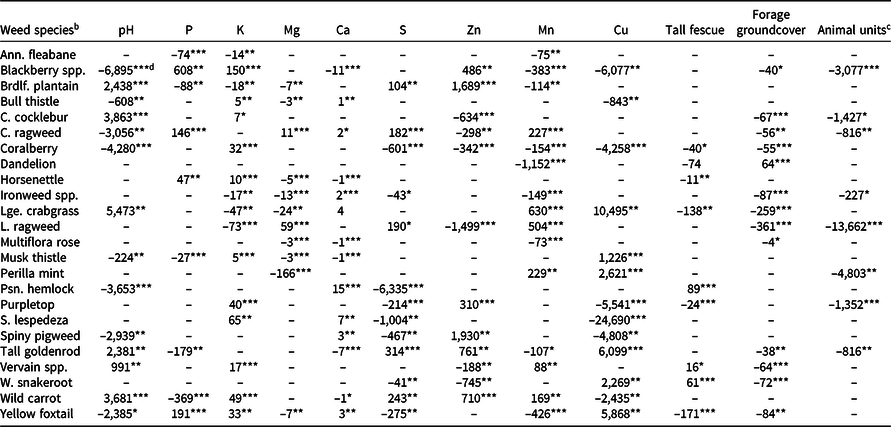
Annual broadleaf weeds encountered during the survey included annual fleabane [Erigeron annuus (L.) Pers.], common cocklebur (Xanthium strumarium L.), common ragweed, lanceleaf ragweed (Ambrosia bidentata Michx.), perilla mint [Perilla frutescens (L.) Britton], and spiny pigweed (Amaranthus spinosus L.) (Table 2). When soil pH occurred at higher levels, there was an associated decrease of common ragweed and spiny pigweed, supporting the findings of Singh and Singh (Reference Singh and Singh2009), who reported reduced common ragweed emergence as soil pH was increased above 5. However, there was an increase in common cocklebur density when pH levels were higher (Table 4). Increasing P by 1 ppm had no effect on any common annual broadleaf weed except for annual fleabane (decreased by 74 weeds ha−1) and common ragweed (increased by 146 weeds ha−1). Lanceleaf ragweed density was reduced more than any annual broadleaf weed when soil K was found at greater levels. However, higher weed densities of several common weed species such as common cocklebur, sericea lespedeza [Lespedeza cuneata (Dum. Cours.) G. Don], and yellow foxtail [Setaria pumila (Poir.) Roem. & Schult.] were associated with greater soil K levels. Increased Mg levels were associated with increased densities of common and lanceleaf ragweed and a decrease of large crabgrass [Digitaria sanguinalis (L.) Scop.] and perilla mint. Common and lanceleaf ragweed were increased by greater S concentrations. Annual fleabane density was reduced when Mn was increased by 1 ppm. However, there was an associated increase of common and lanceleaf ragweed as well as perilla mint with the same Mn increase. Greater forage groundcover was associated with lower densities of common cocklebur, common ragweed, and lanceleaf ragweed. Higher stocking density was also associated with reductions of many common annual broadleaf weeds. Density reductions ranged from 816 to 13,662 weeds ha−1 when there was a 1–animal unit increase. Cattle tended to avoid grazing certain annual broadleaf weed species such as common cocklebur, lanceleaf ragweed, and perilla mint during the survey (Table 2). The reductions in density for these weed species suggest that in underutilized pastures, increasing herbage intake may cause otherwise objectionable plants to be grazed. This is of concern with potentially poisonous species such as perilla mint, which was reduced by 4,803 weeds ha−1 when there was a 1–animal unit increase.
Change in density of common weed species encountered in Missouri pastures in response to a 1-unita increase of a given soil nutrient, forage, or grazing parameter.

a A 1-unit increase means an increase of 1 unit soil pH; 1 ppm for P, K, Mg, Ca, S, Zn, Mn, Cu; 1% total groundcover for tall fescue and forage groundcover.
b Abbreviations: Ann., annual; Brdlf., broadleaf; C., common; Lge., large; L., lanceleaf; Psn., poison hemlock; S. lespedeza, sericea lespedeza; W., white; P, phosphorus; K, potassium; Mg, magnesium; Ca, calcium; S, sulfur; Zn, zinc; Mn, manganese; Cu, copper.
c A 1–animal unit increase refers to one 1,000-lb (454-kg) cow with calf per acre (increased herbage intake 29.14 kg ha−1 d−1).
d P < 0.001***, P < 0.05**, P < 0.10*, P < 0.15.
Annual grass weed density in the surveyed pastures increased from mid-June until early September, which corresponds with the decreased growth of the tall fescue forage during summer (Pritchard et al. Reference Pritchard, Folkins and Pigden1962). This reduced-growth period often allows for the emergence of annual grass weeds. Average annual grass density was reduced when Mg and S were found at greater levels (Table 3). Additionally, greater tall fescue density and forage groundcover were associated with significant reductions of annual grass species. When tall fescue and forage groundcover were found at a 1% greater occurrence, there was an associated decrease of 129 and 141 annual grass weeds per hectare, respectively. Higher concentrations of Ca, Mn, and Cu were associated with greater densities of annual grass weeds.
The most common annual grass weeds encountered in Missouri pastures were large crabgrass and yellow foxtail, with minor occurrences of other species (Table 2). Yellow foxtail is one of the most prevalent annual grasses found in agronomic and forage crops (Santelmann et al. Reference Santelmann, Meade and Peters1963). In the survey it occurred in 86% of pastures (Table 2). When soil pH occurred at higher levels, there was an associated increase of large crabgrass and decrease of yellow foxtail (Table 4). Greater P levels were associated with increases in yellow foxtail density but made no significant difference in large crabgrass density. The increase in yellow foxtail density in soils with greater P concentrations supports the findings of Sexsmith and Russell (Reference Sexsmith and Russell1963), who found higher densities of annual grass weeds in spring wheat when supplemental P2O5 fertilizer applications were increased from 0 to 44.5 kg ha−1. However, greater Cu concentrations were associated with the largest increases in both annual grass weed species. Greater soil K levels were associated with decreased large crabgrass but increased yellow foxtail density. Greater soil Mg and Ca levels, as well as tall fescue and forage groundcover, were also associated with reductions in large crabgrass and yellow foxtail density.
Soil pH was associated with higher biennial broadleaf weed density, as were greater levels of soil K, Ca, S, and Zn (Table 3). There were associated decreases when P, Cu and forage groundcover density were found at greater levels. A 1-ppm increase in soil P was correlated with a decrease of 206 biennial broadleaf weeds per hectare, whereas 1% greater forage groundcover was associated with a reduction of 194 biennial broadleaf weeds per hectare.
The primary biennial broadleaf species encountered in the survey were wild carrot (Daucus carota L.), bull thistle [Cirsium vulgare (Savi) Ten.], and musk thistle (Carduus nutans L.), with sporadic occurrences of poison hemlock (Conium maculatum L.). Higher soil pH levels were associated with density reductions for bull and musk thistle and poison hemlock (Table 4). Musk thistle and wild carrot densities were lower when P was found at greater concentrations in the soil. Greater K levels were associated with increased weed densities for all common biennial weeds. Greater Mg concentrations were also associated with decreased thistle density. Bull and musk thistle were decreased by 3 weeds ha−1 each, when Mg was found at 1-ppm higher levels. However, there was not a consistent response of bull and musk thistle, poison hemlock, and wild carrot to Ca, S, Zn, and Mn. Greater forage groundcover and stocking density did not influence weed density for any common biennial broadleaf weed. The lack of interaction between thistles and any groundcover parameter can be explained by the bimodal growth habit of tall fescue. Tall fescue flowers, sets seed, and reduces growth in late spring (Pritchard et al. Reference Pritchard, Folkins and Pigden1962). There may be opportunities for thistle seeds to germinate in the reduced forage canopy that occurs in summer. McCarty et al. (Reference McCarty, Scifres, Smith and Horst1969) reported that two thistle species, musk thistle and plumeless thistle (Carduus acanthoides L.), had no dormancy mechanism and initiate flowering and seed production over an extended period from early June until mid-August. Grazing cattle are unlikely to graze thistles in favor of grasses (Tierney Reference Tierney2013). Additionally, cattle are unlikely to graze many poisonous plants because of their low palatability (Fishel Reference Fishel2001) and are likely to avoid weeds that have spines (Popay and Field Reference Popay and Field1996), which may explain the lack of stocking density effects on these species.
Soils with a 1-unit higher pH were associated with an average reduction of 1,410 brush weeds per hectare (Table 3). Greater Cu concentrations were associated with large reductions of brush species (3,438 weeds ha−1), whereas greater Ca, S, Zn, and Mn levels were associated with reduced densities of brush species. Tall fescue density and forage groundcover density were also associated with fewer brush weeds; however, brush species density was increased with greater concentrations of P and K.
The primary brush weeds found in Missouri pastures were blackberry species (Rubus spp. L.), coralberry (Symphoricarpos orbiculatus Moench), and multiflora rose (Rosa multiflora Thunb.) (Table 2). Higher soil pH caused the greatest reductions of any soil fertility parameter for blackberry species and coralberry but had no effect on multiflora rose density (Table 4). Multiflora rose was influenced by few soil parameters. This lack of interaction with soil nutrients supports the results of Steavenson (Reference Steavenson1946), who reported that in low soil fertility conditions, multiflora rose is vigorous and may not respond significantly to amendments. Greater P levels were associated with an increase in blackberry species density. Blackberry and coralberry density were increased by 150 and 32 weeds ha−1, respectively, when K was found at 1 ppm greater concentrations. Blackberry and multiflora rose could be reduced when Ca concentrations are increased. Although no consistent response among the brush species to S or Zn was observed, weed density for the three most common brush species was reduced when Mn concentrations were greater. Brush weed species interactions with soil Cu levels were variable; when Cu was found at 1 ppm greater levels, there was a decrease of 6,077 and 4,258 blackberry and coralberry plants ha−1, respectively, but no effect on multiflora rose density. Greater levels of tall fescue did not influence blackberry or multiflora rose but did cause a decrease in coralberry density. Greater forage groundcover was associated with decreases for all common brush species. Increasing forage groundcover was associated with a reduction of 40 blackberry plants ha−1, supporting the findings of Amor (Reference Amor1973), who reported reduced blackberry seedling survival in the presence of shading.
Average perennial broadleaf weed density in Missouri pastures was greater when soil pH and soil Cu was higher (Table 3). There was a reduction in perennial broadleaf weed density with greater soil concentrations of P, K, and Ca. Greater tall fescue and forage groundcover densities were associated with reductions in perennial broadleaf weed density. For every 1% increase in tall fescue groundcover, there was a decrease of 18 weeds ha−1. Each 1% increase in forage groundcover resulted in a reduction of 38 perennial broadleaf weeds per hectare.
Common perennial broadleaf weeds found in the survey were broadleaf plantain (Plantago major L.), dandelion [Taraxacum officinale (L.) Weber ex F.H. Wigg.], horsenettle (Solanum carolinense L.), ironweed species (Vernonia spp. Schreb.), sericea lespedeza, tall goldenrod (Solidago altissima L.), vervain species (Verbena L.), and white snakeroot [Ageratina altissima (L.) R.M. King & H. Rob. var. altissima] (Table 2). Soils with a higher pH were associated with greater densities of broadleaf plantain, tall goldenrod, and vervain species (Table 4). Greater P concentrations resulted in corresponding decreases in broadleaf plantain and tall goldenrod, but an increase of horsenettle. K occurring at 1 ppm greater concentrations was associated with a subsequent decrease of broadleaf plantain and ironweed and an increase in horsenettle, sericea lespedeza, and vervain densities. Similarly, the response of perennial broadleaf weed species to soil Ca, S, and Zn levels was variable, in that increases in the levels of these nutrients resulted in increases in the density of some species and decreases in the density of others. Greater Mg levels were associated with decreased broadleaf plantain, horsenettle, and ironweed density. Greater Cu concentrations were associated with a large reduction in sericea lespedeza density; when Cu was 1 ppm greater there was a decrease of 24,690 sericea lespedeza plants per hectare. Higher tall fescue and forage groundcover densities were associated with decreased densities of many common perennial broadleaf weeds, and ironweed and tall goldenrod were reduced when stocking density was increased. Ironweed is unlikely to be grazed in favor of other forage (Israel and Rhodes Reference Israel and Rhodes2013). The 227 and 816 weeds ha−1 reduction of ironweed and tall goldenrod in the presence of 1–animal unit greater stocking density is most likely an indication of animal acceptance of these weeds when herbage intake is increased.
Perennial grasses were not commonly found during the survey but could be numerous in locations where they did occur (Table 2). Given the perennial nature of the primarily grass forage, perennial grass weeds occupy a similar niche and are in more direct competition with the forage than other weed types. Increased soil pH was associated with the greatest reduction in perennial grass weed density per hectare. When soil pH was 1 unit greater, there was a corresponding decrease of 2,224 weeds ha−1 (Table 3). Greater Ca and Mn concentrations, greater forage groundcover, and a higher stocking rate were associated with lower perennial grass density, whereas greater soil K was associated with a higher density of perennial grass weeds. The reduction of perennial grass weeds in the presence of greater stocking densities is consistent with the results from Rocateli and Manuchehri (Reference Rocateli and Manuchehri2017), who recorded reductions in johnsongrass [Sorghum halepense (L.) Pers.] density in pastures with higher stocking rates.
The most common perennial grass species encountered was purpletop [Tridens flavus (L.) Hitchc.], which occurred in 32% of surveyed pastures (Table 2). Soil pH and P did not influence weed density for purpletop (Table 4). As with the perennial broadleaf weed species, the response of perennial grass weed species to the levels of other minor elements like Zn, Mn, and Cu was highly variable. Purpletop density was reduced with greater tall fescue density, but there was no interaction with forage groundcover. Greater stocking rate was associated with a reduction of 1,352 purpletop plants ha−1 when herbage intake was 29.14 kg ha−1 d−1 greater. The US Department of Agriculture (USDA 2002) indicates that purpletop is grazed by all classes of livestock and may perform better than cool-season forages in summer.
Sedge and sedgelike species (Carex spp. L.), (Cyperus spp. L.), (Juncus spp. L.), and (Scirpus spp. L.) were found in 87% of surveyed pastures but were not encountered at densities as high as other common weed species (Table 2). Higher soil pH and P levels had no influence on sedge density (Table 3). However, significant reductions in sedge density were associated with greater soil concentrations of K, Ca, Zn, and Mn. Greater forage groundcover percentage was associated with sedge reductions, but greater tall fescue and stocking density did not affect this weed group. Sedge and sedgelike weeds could be increased in soils with greater S concentration.
The results from this research indicate that the density of many common annual broadleaf weed species can be reduced with higher soil pH and macro- and micronutrient concentrations. Common ragweed was reduced by 3,056 weeds ha−1 when soil pH was 1 unit higher. Average weed density changes per hectare were not as pronounced as individual weed species, because some weeds were reduced by a specific fertility or forage parameter, whereas other weed species may have been increased by that same parameter. Greater stocking density was associated with a reduction in weed density for all weeds that were influenced by this parameter. Many of the most common pasture weeds can be reduced with increased competition from greater forage groundcover density. Maintaining a vigorous forage crop may be the most important aspect of pasture weed management, and increasing any of the measured soil fertility parameters to soil test recommendations would most likely increase forage groundcover. The findings of this research illustrate the most influential soil nutrients and forage parameters as they relate to weed incidence in diverse grazing systems.
Acknowledgments
This research received no specific grant from any funding agency, commercial or not-for-profit sectors.
Conflicts of Interest
No conflicts of interest have been declared.