Introduction
Pharyngocutaneous fistula is one of the dreaded complications following total laryngectomy. It can result in an extended hospital stay, the need for additional surgical intervention for correction, and even mortality.Reference Chee and Siow1–Reference Markou, Vlachtsis, Nikolaou, Petridis, Kouloulas and Daniilidis5 The incidence of pharyngocutaneous fistulae following total laryngectomy varies in the literature, with rates as high as 40 per cent reported in some series.Reference Chee and Siow1–Reference Virtaniemi, Kumpulainen, Hirvikoski, Johansson and Kosma10 Pharyngocutaneous fistulae after total laryngectomy can occur because of technical issues with anastomosis or wound-healing related issues (especially after radiotherapy).Reference Cordeiro, Shah, Santamaria, Gollub, Singh and Shah2–Reference Krouse and Metson4 Pharyngocutaneous fistulae are usually detected by radiological or clinical methods; however, no clear-cut recommendations exist in the literature.Reference Friedman, Venkatesan, Yakovlev, Lim, Tanyeri and Caldarelli3
The development of a pharyngocutaneous fistula delays the commencement of oral intake and voice rehabilitation. Additionally, a large pharyngocutaneous fistula may postpone the start of post-operative radiotherapy, which can adversely affect oncological outcomes.Reference Virtaniemi, Kumpulainen, Hirvikoski, Johansson and Kosma10 Early detection and strict management protocols are essential to prevent potentially disastrous complications, like flap necrosis, wound breakdown and carotid rupture.Reference Virtaniemi, Kumpulainen, Hirvikoski, Johansson and Kosma10
Pharyngocutaneous fistulae are usually identified with videofluoroscopy, with gastrografin as the preferred contrast materialReference Swanson, Levine, Redfern and Rubesin11–Reference Balfe, Koehler, Setzen, Weyman, Baron and Ogura13 to identify leaks. However, the quantity of gastrografin to be used and the protocol for videofluoroscopy have not been standardised. Usually about 10 ml of contrast material is used. A small quantity of contrast is preferred as larger volumes would be retained in the external soft tissues and could potentially exacerbate wound complications.
It has been routine practice in our unit to use small-volume gastrografin to detect pharyngeal leaks following total laryngectomy. This paper aims to describe our experience with this technique, and highlights the use and efficacy of small-volume (3–5 ml) gastrografin modified videofluoroscopy to identify pharyngeal leaks. It also describes a comparison of outcomes between patients who underwent routine post-operative videofluoroscopy and those who were clinically observed and diagnosed.
Materials and methods
A retrospective case–control study was conducted of 137 patients who underwent total laryngectomy between 2005 and 2017 in a tertiary care hospital and referral centre. Institutional ethical approval was obtained prior to commencement of the study. The authors assert that all procedures contributing to this work complied with the ethical standards of the relevant national and institutional guidelines on human experimentation (Indian Council of Medical Research) and with the Helsinki Declaration of 1975, as revised in 2008.
The timeline of the study was divided: during the first period (2005–2014), videofluoroscopy was not available as a screening tool at our institution and a diagnosis of pharyngocutaneous fistula was made clinically (control group); and during the second period (2015–2017), videofluoroscopy was used to detect pharyngeal leaks in all patients who underwent total laryngectomy (study group).
Both groups of patients commenced oral feeding 7–8 days post-operatively in a primary setting and 12–14 days post-operatively in a salvage setting (after radiotherapy was administered to the larynx). The control group comprised 85 patients from the pre-videofluoroscopy era, who commenced oral intake based only on clinical assessment. The study group comprised 52 patients who underwent videofluoroscopy with gastrografin prior to the commencement of oral feeding.
We preferred to use gastrografin as the contrast material to identify leaks in the study group, because it is a water-soluble material with less tissue reaction if extravasation occurs. The amount of gastrografin used was between 3–5 ml (lower than what would be used routinely) and was administered orally. During videofluoroscopy, the patient was screened in lateral and anteroposterior views, with the presence of extra-luminal dye taken as a positive sign for a pharyngeal leak.
The two groups were compared with respect to baseline characteristics, and types of surgery and reconstruction. Descriptive variables were summarised using numbers (and percentages). Univariate analysis was performed using the chi-square test. The sensitivity and specificity of videofluoroscopy to detect pharyngocutaneous fistulae were determined. A p-value of less than 0.05 was considered statistically significant. Statistical analysis was conducted using SPSS software, version 22 (IBM, Armonk, New York, USA).
Results
Patient and treatment characteristics
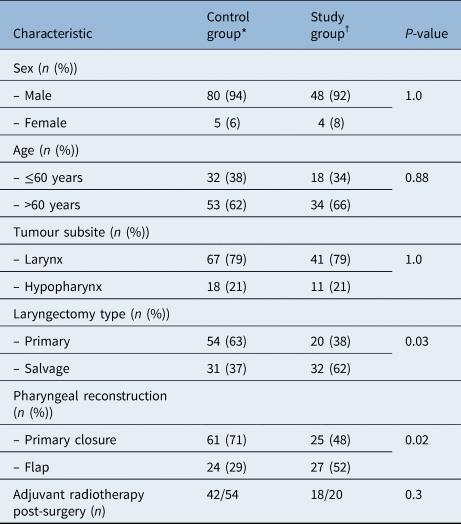
A total of 137 patients (128 males and 9 females) who underwent total laryngectomy were included in the study, as shown in Table 1. The patients’ mean age was 62 years (range, 42–84 years). The majority of patients (79 per cent) had laryngeal cancer, with the remaining having hypopharyngeal cancer. Total laryngectomy was performed in a primary setting in 47 per cent and in a salvage setting (post-radiotherapy) in the remaining 53 per cent. Sixty-three per cent of patients underwent primary closure of the pharyngeal mucosa after total laryngectomy, with the remaining 37 per cent requiring augmentation with flaps for pharyngeal closure. Forty-four per cent of patients received adjuvant radiotherapy after total laryngectomy.
Clinical and treatment characteristics of cohort

*n = 85; †n = 52
All baseline characteristics were comparable between the study and control groups, except for type of laryngectomy (more patients in the study group had total laryngectomy following radiotherapy) and reconstruction (more patients in the control group had primary closure of the pharyngeal defect). However, for the purpose of this study, these differences would not have affected our results.
Pharyngeal leaks
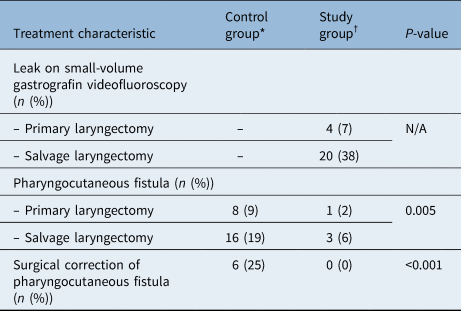
The details of pharyngeal leaks, pharyngocutaneous fistulae and management are shown in Table 2. In the control group, 24 of 85 patients (28 per cent) developed pharyngocutaneous fistulae, all of which were discovered after starting oral feeding. Six patients required surgical correction for closure. The surgical correction utilised a pectoralis major myocutaneous flap (n = 4) or a deltopectoral flap (n = 2).
Pharyngeal leak, pharyngocutaneous fistula and management

*n = 85; †n = 52
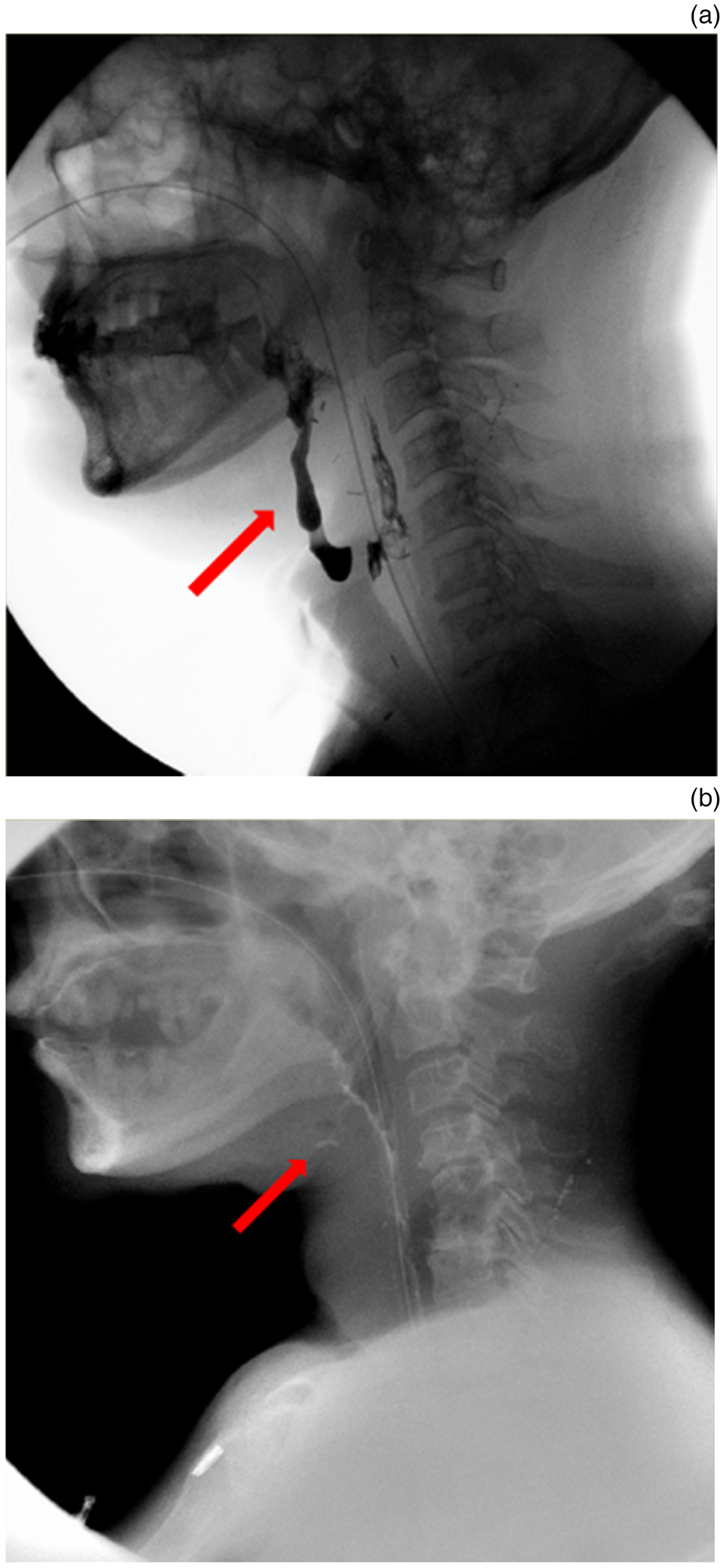
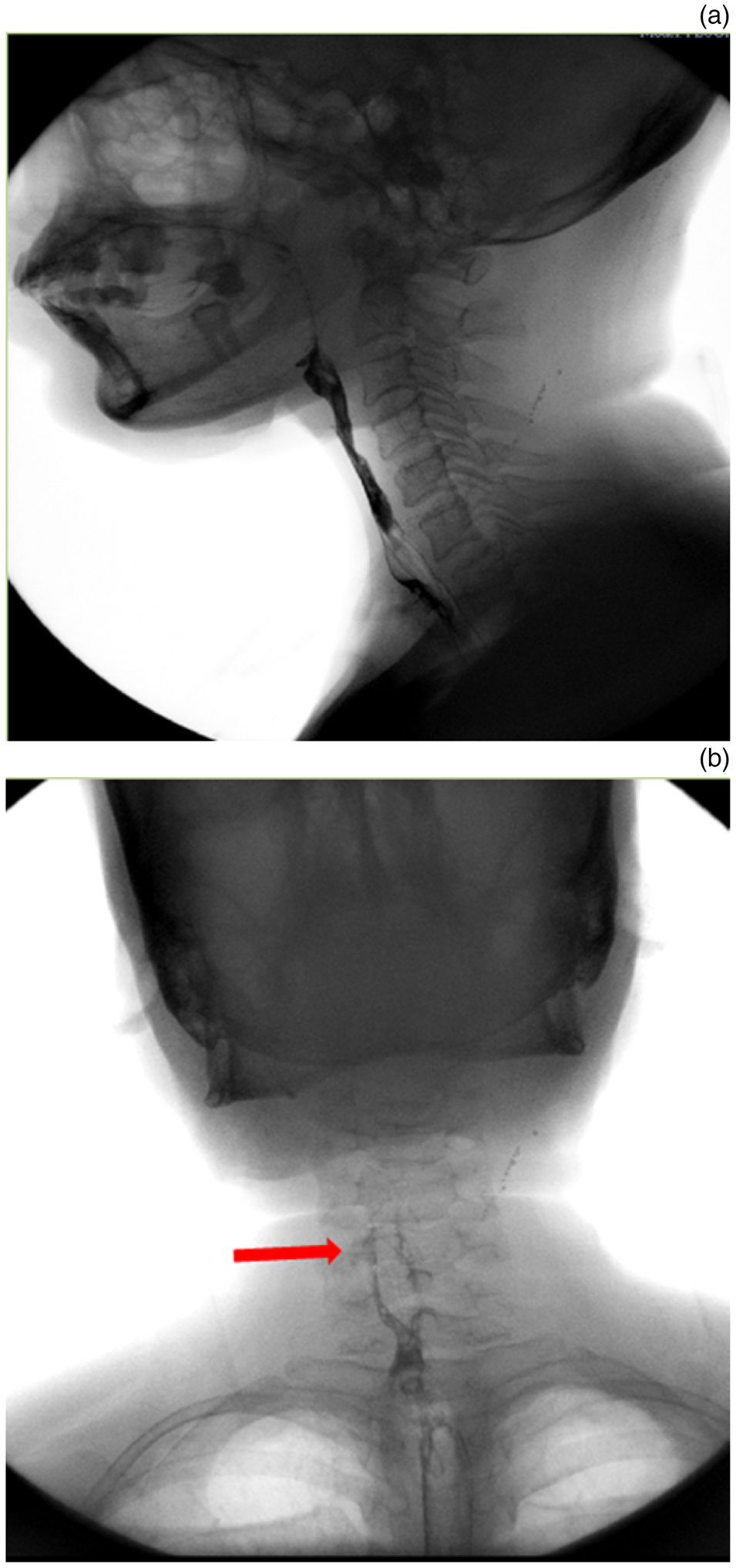
In the study group, 24 of 52 patients (46 per cent) had a radiologically detected pharyngeal leak (Figures 1 and 2), but only 4 patients (8 per cent) developed pharyngocutaneous fistulae. All of the pharyngocutaneous fistulae in the study group healed with conservative management. Two weeks of feeding through a nasogastric tube was sufficient for the leak to resolve spontaneously.
Small-volume gastrografin videofluoroscopy images showing (a) a significant leak into the soft tissue of the neck (arrow), and (b) a minimal leak (arrow).

Small-volume gastrografin videofluoroscopy images showing (a) no visible leak on lateral view, but (b) a visible leak (arrow) on anteroposterior view, highlighting the importance of both anteroposterior and lateral view acquisition for each patient.

The need for surgical intervention in the control arm could be explained by the fact that these patients’ pharyngocutaneous fistulae had been detected clinically; the fistula would already have contaminated the tissue bed, and the wound breakdown at the fistula site was larger, requiring surgical intervention. In the patients who underwent videofluoroscopy, the leaks were detected earlier, prior to contamination of the wound bed associated with oral feeding.
Of the 28 patients (54 per cent) in whom videofluoroscopy indicated no leak and so oral feeding commenced, none went on to develop a pharyngocutaneous fistula. Patients who underwent videofluoroscopy had a significantly lower chance of developing pharyngocutaneous fistulae (relative risk = 0.272, p = 0.005, 95 per cent confidence interval = 1.34–9.98), and the resultant two weeks of tube feeding after discovering early pharyngeal leaks was sufficient to circumvent surgical management for closure. Additionally, all leaks were detected with a minimal 3–5 ml of oral gastrografin administration (Table 2). None of the patients who passed the small-volume gastrografin videofluoroscopy went on to develop pharyngocutaneous fistulae. Hence, the sensitivity and specificity values of videofluoroscopy to identify pharyngocutaneous fistulae were 58 per cent and 100 per cent respectively.
Discussion
A pharyngocutaneous fistula occurs after total laryngectomy when pharyngeal healing fails.Reference Cordeiro, Shah, Santamaria, Gollub, Singh and Shah2,Reference Krouse and Metson4 It presents with wound erythema, followed by sloughing of the skin and salivary flow through a cutaneous defect. The presence of a fistula will usually become clinically apparent 7–10 days after surgery. Clinical signs and symptoms, such as low-grade fever, odour, skin oedema, saliva in the suction tube, or pain on palpation of the neck, should alert the surgeon to the development of a fistula.Reference Moses, Eisele and Jones6
Moses et al.Reference Moses, Eisele and Jones6 did not recommend imaging in patients with no clinical signs or symptoms suggestive of an impending fistula (fever, wound erythema, wound swelling or persistent elevated neck drain output). Many centres do not routinely perform videofluoroscopy, unless the patient has undergone salvage laryngectomy or had a flap reconstruction. However, it is clear from our study that a distinction needs to be made between pharyngeal leaks and pharyngocutaneous fistulae; these minor leaks need not progress to frank fistulae. This, in our opinion, is where the value of routine videofluoroscopy assessment lies.
• Small-volume gastrografin videofluoroscopy had 100 per cent specificity in identifying even small pharyngeal leaks following total laryngectomy
• A proportion of salvage total laryngectomy patients have pharyngeal leaks detected on imaging that are not clinically apparent (32 per cent)
• Early identification of leaks and withholding of oral intake resulted in spontaneous resolution, without need for surgical intervention
• Clinical evaluation was unreliable until pharyngeal leak was large and pharyngocutaneous fistula developed, 25 per cent of which required surgical correction
• Gastrografin videofluoroscopy is easy to perform and reliable, and can be incorporated into routine practice
• It can prevent a pharyngocutaneous fistula and its sequelae, especially in a salvage setting
Patients who underwent small-volume gastrografin videofluoroscopy were almost 70 per cent less likely to develop pharyngocutaneous fistulae. In patients with early leaks, two weeks of tube feeding may play a crucial role in reducing the chance of fistulae. In these patients, there is unlikely to be clinical evidence of a pharyngeal leak, and commencement of an oral diet is likely to aggravate the leak and promote the development of fistulae. This may explain the reduced need for surgical correction in our study group; for patients in whom a pharyngeal leak is detected on videofluoroscopy, immediate conservative management without resumption of an oral diet is likely to promote spontaneous resolution. Conversely, in patients for whom no pharyngeal leak is detected on gastrografin videofluoroscopy, the likelihood of developing subsequent pharyngocutaneous fistulae after an oral diet is resumed is virtually zero (specificity was 100 per cent in our study).
Videofluoroscopy has been the ‘gold standard’ for detecting pharyngeal leaks and pharyngocutaneous fistulae, but barium has traditionally been used for examination of the pharynx and oesophagus.Reference Krouse and Metson4,Reference Swanson, Levine, Redfern and Rubesin11–Reference Balfe, Koehler, Setzen, Weyman, Baron and Ogura13 It has been our institutional protocol to use gastrografin instead of barium, as the latter has low sensitivity,Reference White, Golden, Sweeny, Carroll, Magnuson and Rosenthal14 is water insoluble and causes a more intense tissue reaction when it extravasates. Barium has the advantage of better delineation of mucosal outlines, and is best suited for stricture or luminal pathology assessment.
The optimal quantity of gastrografin has not been described in the literature; however, it has been our institutional practice to use low volumes (3–5 ml). This quantity of gastrografin reliably identifies pharyngeal leaks; it also reduces costs and results in less residue in the neck in the event of a leak.
Our results show that the routine assessment of total laryngectomy patients with small-volume gastrografin videofluoroscopy has a high specificity (100 per cent) to rule out pharyngeal leaks, when performed 7–8 days post-operatively in a primary setting and 12–14 days post-operatively in a salvage setting. None of the patients with normal videofluoroscopy findings subsequently developed a pharyngocutaneous fistula. Although the sensitivity is lower, at 58 per cent, we have been successful in conservatively managing these pharyngeal leaks; none of these patients required surgical correction. Routine assessment may help identify those patients with minimal pharyngeal leaks who are likely to benefit from the continuation of tube feeding for an additional two weeks to allow resolution.
Conclusion
Small-volume gastrografin modified videofluoroscopic screening can reliably identify even small pharyngeal leaks, which have the potential to cause wound breakdown and pharyngocutaneous fistulae. It is reliable, inexpensive and easy to perform. Its use, combined with the withholding of oral feeds in patients with early leaks, may prevent the development of overt pharyngocutaneous fistulae.
Competing interests
None declared