
Introduction
Trichinellosis is a zoonosis produced by the ingestion of raw or undercooked meat from animals infected with larvae of nematodes of the genus Trichinella. Trichinella spiralis belongs to the neglected foodborne parasites recognized as responsible for considerable disease burdens globally (van der Giessen et al., Reference van der Giessen, Deksne, Gómez-Morales, Troell, Gomes, Sotiraki, Rozycki, Kucsera, Djurković-Djaković and Robertson2021), ranking among the top-five prioritized foodborne parasites of worldwide importance. The impact of foodborne parasites is known to vary considerably between countries and regions. Trichinellosis incidence in human populations is variable and depends largely on the practices related to the ingestion and preparation of the meat of the host species (Murrell, Reference Murrell2016). In Argentina, in the period 2009–2019, outbreaks of trichinellosis were recorded every year (Ministerio de Salud y Desarrollo Social de la Nación, 2019). It is considered an endemic parasitosis and constitutes a serious public health problem, given its high-morbidity rates (Gottstein et al., Reference Gottstein, Pozio and Nöckler2009). Domestic pork still accounts for many outbreaks, mostly in Eastern Europe and Argentina, where traditional small, ‘backyard’ rearing of pigs for household and local consumption often involve high-risk rearing practices, especially feeding with food waste (Ribicich et al., Reference Ribicich, Gamble, Bolpe, Sommerfelt, Cardillo, Scialfa, Gimenez, Pasqualetti, Pascual, Franco and Rosa2009; Murrell, Reference Murrell2016). Humans acquire the infection after ingesting raw or undercooked meat and meat-derived products of different animal origins containing Trichinella-infective larvae in cells of striated muscles (Gottstein et al., Reference Gottstein, Pozio and Nöckler2009). When a new host ingests infected muscle tissues, larvae are released from the nurse cell in the stomach and migrate to the small intestine, where they rapidly develop to the adult stage. Males and females copulate, and on days 6–7 post-infection, females begin releasing newborn larvae (NBL). These NBL migrate into the lymphatic vessels and enter the blood vessels to reach and penetrate striated muscle cells. In this niche, NBL develop to the infective L1 stage in 2 weeks (Pozio, Reference Pozio, Ortega and Sterling2018).
It is currently under discussion whether trichinellosis is a disease of low prevalence or it is misdiagnosed. Trichinellosis should ideally be treated at an early stage of infection when the worms are still present in the intestinal mucosa or NBL are migrating from intestinal vessels to the muscle (Gottstein et al., Reference Gottstein, Pozio and Nöckler2009). However, an early clinical diagnosis can be difficult, especially in low-level infections, due to the lack of symptoms and pathognomonic signs. Furthermore, its clinical manifestations overlap with many common diseases, such as influenza and chronic fatigue syndrome (Murrell and Pozio, Reference Murrell and Pozio2011; Shimoni and Froom, Reference Shimoni and Froom2015).
Albendazole (ABZ), recommended as a first-line anthelmintic treatment, has a broad-spectrum activity and low cost. However, its effectiveness is reduced by extremely poor aqueous solubility limiting oral absorption and decreasing its bioavailability. A possible way to overcome ABZ low solubility in water is to alter its physical properties to improve solubility and dissolution rate, using methods such as controlled precipitation with different polymers to obtain ABZ microcrystal formulations (Alanazi et al., Reference Alanazi, El-Badry, Ahmed and Alsarra2007; Leonardi et al., Reference Leonardi, Lamas and Olivieri2008; Dib et al., Reference Dib, Palma, Suárez, Farías, Cabrera, Castro, Allemandi, Moreno, Lanusse and Sánchez Bruni2011; García et al., Reference García, Barrera, Piccirilli, Vasconi, Di Masso, Leonardi, Hinrichsen and Lamas2013). Employing this technology, we developed microcrystalline ABZ formulations and characterized them by their physicochemical properties and in vitro biological activity (Priotti et al., Reference Priotti, Codina, Leonardi, Vasconi, Hinrichsen and Lamas2017). These studies showed that the microcrystalline systems based on hydroxyethyl-cellulose (S4A) and chitosan (S10A) were the best options to optimize oral absorption of the active pharmaceutical ingredient. Furthermore, the pharmacokinetics analysis, using two mouse lines that differ in susceptibility to T. spiralis, demonstrated that microcrystal formulations increased ABZ bioavailability and pharmacokinetic parameters were affected by the host sex and genotype (Codina et al., Reference Codina, Priotti, Leonardi, Vasconi, Hinrichsen and Lamas2020).
Susceptibility to parasitic diseases is associated with a polygenic genetic basis (Campino et al., Reference Campino, Kwiatkowski and Dessein2006; Hernandez-Valladares et al., Reference Hernandez-Valladares, Rihet and Iraqi2014; Mukherjee et al., Reference Mukherjee, Huda and Sinha Babu2019). The use of phenotypically defined animal models may help to elucidate the importance of the host-genetic background in resistance to parasitism and identify the genes involved in the trait (Vasconi et al., Reference Vasconi, Malfante, Bassi, Giudici, Revelli, Di Masso, Font and Hinrichsen2008). The comparative analysis of extreme response phenotypes is useful in studies of the host–parasite relationship (Machado-Silva et al., Reference Machado-Silva, Neves, Da Silva, De Oliveira and Da Silva2005; McRae et al., Reference McRae, Good, Hanrahan, Glynn, O'Connell and Keane2014, Reference McRae, Good, Hanrahan, McCabe, Cormican, Sweeney, O'Connell and Keane2016) and has an important role in evaluating the efficacy and safety of new pharmaceutical devices as therapeutic alternatives for medical and veterinary use.
This work aimed to analyse the in vivo anthelmintic efficacy of the ABZ microcrystal formulations S4A and S10A against different stages of T. spiralis in males and females from two mouse lines, which differ in susceptibility to the parasite.
Materials and methods
Animal model
Adult female and male mice (80–90 days old) of the lines CBi/L and CBi+ from the Animal Facilities of the Instituto de Genética Experimental, Facultad de Ciencias Médicas, Universidad Nacional de Rosario (CBi-IGE stock) were used. These lines, obtained by divergent selection for body conformation (Hinrichsen and Di Masso, Reference Hinrichsen and Di Masso2010), are in the 150th generation of selective breeding, and their theoretical inbreeding coefficient is 0.99. The lines differ in body shape (CBi+, obtained by agonistic selection, high body weight-long tail; CBi/L, product of an antagonistic selection, low body weight-long tail) and weight (mean ± s.e.m., g; CBi+ males: 48.3 ± 0.48; CBi + females: 44.9 ± 0.55; CBi/L males: 29.9 ± 0.23; CBi/L females; 27.2 ± 0.21), and characters related to growth. They also show differences in non-correlated characters such as the immune response to different antigens, susceptibility to spontaneous carcinogenesis, resistance/susceptibility to infection with different parasites, indicating that they are a source of significant genetic variation in all the characters analysed (Vasconi et al., Reference Vasconi, Malfante, Bassi, Giudici, Revelli, Di Masso, Font and Hinrichsen2008; Hinrichsen and Di Masso, Reference Hinrichsen and Di Masso2010). Previous experiments demonstrated that these lines differ in response to challenge with increasing doses of T. spiralis in a primary infection (Vasconi et al., Reference Vasconi, Bertorini, Codina, Indelman, Di Masso and Hinrichsen2015). There was a significant difference in the infection intensity among mouse genotypes. The larval muscle load increased as the dose increased, but the magnitude of this increase was significantly different among genotypes. CBi/L was classified as the most resistant genotype since it showed a very low larval muscle load and little variation in this trait due to dose effect, and CBi+ as the most susceptible.
All the experiments with mice were conducted during the first half of the light cycle. Mice had access to complete balanced food for rodents (Gepsa Feeds, Grupo Pilar S.A., Argentina) and water ad libitum. They were treated following the institutional regulations (Facultad de Ciencias Médicas, Universidad Nacional de Rosario, permit number 1398/2016), which comply with the guidelines issued by the Institute for Laboratory Animal Resources, National Research Council, USA (Guide for the Care and Use of Laboratory Animals, 2011).
Drug formulations
The formulations were obtained by controlled precipitation (a bottom-up method), using hydroxyethyl cellulose or chitosan as stabilizing polymers (Priotti et al., Reference Priotti, Codina, Leonardi, Vasconi, Hinrichsen and Lamas2017). Hydroxyethyl cellulose, viscosity 145 mPa s (1% in water, 20°C), and chitosan (MW 310–375 kDa, >75% deacetylated), were obtained from Sigma-Aldrich Chemie GmbH (Steinheim, Germany). Briefly, ABZ was solubilized (40 mg mL−1) in glacial acetic acid:ethanol and added into the polymeric solutions (0.1% w/v) under stirring. The ratio of ABZ solution and polymeric solution was 1 into 10 for both formulations. After 10 min, each suspension was spray dried in a Mini Spray Dry B-290 (Büchi, Germany).
Formulations or ABZ powder were prepared and administered orally as previously described in detail by Codina et al. (Reference Codina, Priotti, Leonardi, Vasconi, Hinrichsen and Lamas2020).
Parasite
Trichinella spiralis was generously provided by Dr Maria Dalla Fontana (Laboratorio de Zoonosis, Laboratorio Central de la Red Provincial de Laboratorios, Dirección de Bioquímica y Farmacia, Santa Fe, Argentina). It was maintained and passaged in CBi mice since 2006. This strain was genotyped as T. spiralis using multiplex polymerase chain reaction (PCR) (Dr Silvio Krivokapich, Departamento de Parasitología, Administración Nacional de Laboratorios e Institutos de Salud ‘Dr Carlos Malbrán’, Buenos Aires, Argentina, personal communication). L1-infective larvae used in the infection were recovered by artificial digestion from the muscles of mice from line CBi, infected 3–4 months earlier for that purpose, as described previously (Vasconi et al., Reference Vasconi, Bertorini, Codina, Indelman, Di Masso and Hinrichsen2015).
Infection
Mice were infected orally with a single dose of two T. spiralis L1 infective larvae per g of body weight. Since CBi/L and CBi+ mice show significant body weight differences, the equivalent dose was calculated as the number of infective larvae per g of the host's body weight. Each animal was weighed before infection, 24–48 h before treatment, and before sacrifice. During the infection course, general health of the mouse (overall physical condition and behaviour) was monitored three times a week.
Experimental design
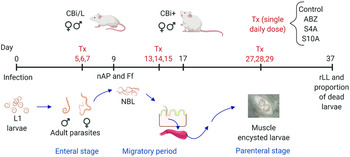
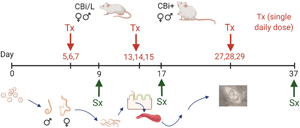
In order to evaluate the efficacy of the treatment against the different stages of T. spiralis, ABZ and the microcrystal formulations S4A and S10A were administered orally in a single dose (30 mg ABZ per kg body weight per day), as already described (Codina et al., Reference Codina, Priotti, Leonardi, Vasconi, Hinrichsen and Lamas2020), at different stages of the parasite cycle (Fig. 1). Mice (n = 4–5 per line, sex, treatment and date of sacrifice) were non-treated (controls) or treated in the enteral (group 1, days 5, 6 and 7 post-infection, p-i), migratory (group 2, days 13, 14 and 15 p-i) or parenteral (group 3, days 27, 28 and 29 p-i) phases of the infection. In the first two groups, the effects of treatment on both the intestinal and muscular parasitic load were evaluated; in group 3, only the effect on the muscular parasitic load was assessed.
Graph outlining the experimental design used. CBi+ and CBi/L mice of both sexes infected with T. spiralis infective L1 larvae were divided into three groups to receive the treatment (Tx) in the enteral (days 5, 6, 7 p-i), migratory (days 13, 14, 15 p-i), or parenteral (days 27, 28, 29 p-i) stages of T. spiralis infection. Within each group, mice were subdivided into four subgroups according to the formulation given daily as a single oral dose (30 mg ABZ/kg body weight/day): control, ABZ, S4A and S10A. Efficacy of the treatments was evaluated by determining the intestinal worm load (nAP) and T. spiralis female fecundity (Ff), and muscle relative Larval Load (rLL) and proportion of dead larvae in the tongue.

Analysis of the formulations’ therapeutic efficacy
Enteral phase
Half the animals from group 1 and their controls were euthanized by CO2 inhalation 2 days after administration of the last anthelmintic dose (day 9 p-i) to estimate intestinal parasitic load (nAP) and T. spiralis female fecundity (Ff), as described by Luebke (Reference Luebke2007). Briefly, the small intestine was removed, opened lengthwise and incubated in a Petri dish with sterile saline solution for 4 h, at 37°C, in a 5% CO2 atmosphere. Adult male and female worms were recovered from the suspension by centrifugation and washed with saline. The parasite pellet was resuspended in approximately 2 mL saline and placed in a gridded acrylic plate to count adult worms with a microscope at 40× magnification. nAP was expressed as the total number of adult parasites present in the intestine per mouse. Ff was determined by counting the number of NBL from each isolated female; eight to ten females migrating out of the intestinal wall were identified using a microscopic magnifying glass, collected with a pipette P200 and placed (one per well) in a 96 well plate containing RPMI 1640 plus 10% fetal bovine serum (FBS) and 250 μg/mL gentamicin. They were incubated for 18 h at 37°C in a 5% CO2 atmosphere, and the NBL released in each well were counted. Data were expressed as the average number of NBL per female parasite per mouse.
The remaining treated and control animals were sacrificed on day 37 p-i to assess each treatment's efficacy in reducing the muscular parasitic load, as described below.
Migratory phase
Mice in group 2 and their controls were processed following the same protocol as those in group 1, except that nAP and Ff were studied on day 17 p-i, 2 days after administering the last anthelmintic dose on this phase of the infection.
Parenteral phase
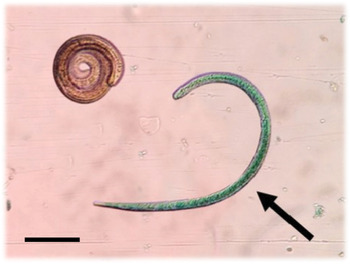
Mice from group 3 and their controls, and the remaining groups 1 and 2 mice, were euthanized at 37 days p-i, 7 days after the last administration of the drug to group 3, to determine the number of muscle encysted larvae in the tongue. This muscle is the preferred site for encystment in mice (Beiting et al., Reference Beiting, Gagliardo, Hesse, Bliss, Meskill and Appleton2007; Luebke, Reference Luebke2007; Vasconi et al., Reference Vasconi, Bertorini, Codina, Indelman, Di Masso and Hinrichsen2015) and allows recovery of encysted larvae even with low levels of infection (Leclair et al., Reference Leclair, Forbes, Suppa and Gajadhar2003; Picherot et al., Reference Picherot, Oswald, Cote, Noeckler, Le Guerhier, Boireau and Vallée2007). Briefly, the tongue was excised, weighed and subjected to pepsin–HCl artificial digestion. After overnight incubation at 37°C, the digestion was stopped by adding saline solution. Next, the larvae were rinsed with saline several times to remove debris, and the supernatant was gently removed after centrifugation at a very low speed (250–300 g) for 5 min. Finally, the pellet containing all the tongue's encysted larvae was resuspended in 2 mL saline and placed in an acrylic plate to count them under an optical microscope at 40× magnification. Each formulation's anthelmintic efficacy was determined by the number of L1 larvae per g fresh tissue (relative larval load, rLL). The effect of the formulations on the encysted L1 larvae viability was also analysed using the methylene blue supravital staining technique (Randazzo and Costamagna, Reference Randazzo and Costamagna2010; Codina et al., Reference Codina, García, Leonardi, Vasconi, Di Masso, Lamas and Hinrichsen2015). It allows identifying dead and moribund larvae by their blueish coloration due to retraction of the internal structures and chitinous layer's fragmentation that facilitate the dye's penetration. Viability was also corroborated by the lack of movement (the absence of typical movements of constant winding and unrolling) and the characteristic ‘comma’ shape of dead larvae (Fig. 2).
Micrograph of T. spiralis L1 larvae recovered after artificial digestion of the tongue. The arrow points to a dead larva showing the characteristic ‘comma shape’, stained with methylene blue. Scale bar, 50 μm.

Statistical analysis
The statistical significance of the differences among treatment groups was evaluated with a one-way analysis of variance (ANOVA), followed by Tukey's post-test for between-groups comparisons, or nonparametric Kruskal–Wallis test, using Dunn's post-test, as appropriate (Sheskin, Reference Sheskin2011). Comparison between sexes within genotype and treatment was done with Student's t-test or the nonparametric Mann–Whitney test (Sheskin, Reference Sheskin2011). Differences were considered significant if P < 0.05.
Results
Analysis of the therapeutic efficacy
Enteral phase
To evaluate the efficacy of the microcrystal systems compared to pure ABZ, S4A or S10A was administered on days 5, 6 and 7 p-i, in the first stage of the parasite cycle.
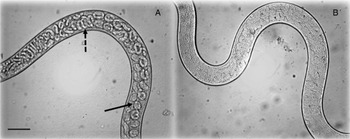
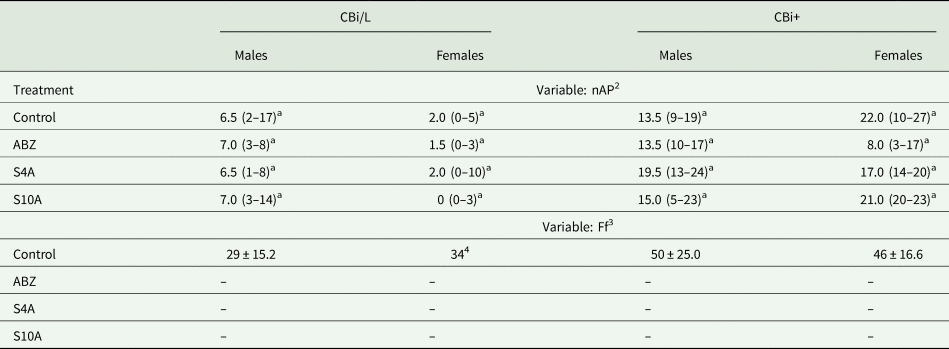
Table 1 shows the effect of the formulations on the intestinal parasitic load (nAP) and T. spiralis fecundity (Ff) in mice sacrificed 2 days after administering the last dose. Neither the formulations nor the pure drug modified the intestinal worm load since the determination of nAP on day 9 p-i in treated mice did not differ significantly from the controls in both lines and sexes. The effect of the anthelmintic preparations on T. spiralis Ff could not be evaluated because female worms recovered from the intestines of treated mice were dead or showed an altered morphology. As observed on day 9 p-i ABZ, either pure or as part of a microcrystalline system, penetrated the worms and caused alterations in T. spiralis females' internal structure (Fig. 3), thus reducing the number of NBL that would migrate to encyst in muscles. Although they did not modify the number of recovered intestinal parasites, both raw ABZ and the formulations affected the vitality of the female parasites.
Representative micrographs illustrating T. spiralis female morphology on day 9 post-infection. (A) female recovered from the intestine of a control mouse in which eggs (arrow) and larvae (broken arrow) are observed. (B) Female obtained from the intestine of a treated mouse showing no discernible internal structures. Scale bar, 50 μm.

Effect of treatment during the enteral stage of the infection1 on the host intestinal parasite burden and T. spiralis female fecundity

nAP, total number of intestinal adult parasites; Ff, T. spiralis female fecundity.
nAP differences among treatments within genotype and sex were evaluated with the nonparametric Kruskal–Wallis test followed by Dunn's test for between-groups comparison (nAP).
For each column, differences between groups not sharing the same superscript are significant at the 0.05 level.
1 Mice were treated on days 5, 6 and 7 p-i and sacrificed two days after the administration of the last dose (9 days p-i).
2 Median (range).
3 Mean ± s.e.m.
4 Only one female recovered.
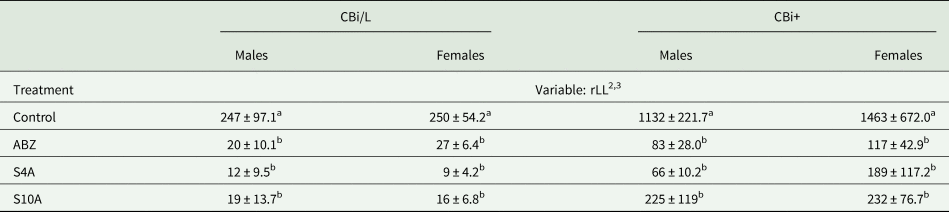
The effect of the different ABZ formulations on the number of the encysted larvae was analysed on day 37 p-i (Table 2). Muscle rLL was significantly lower in treated animals (CBi/L, ♂ P = 0.01, ♀ P = 0.0001; CBi + , ♂ P = 0.0002, ♀ P = 0.02) compared to the controls. There were no significant differences among the ABZ systems; they all reduced rLL by 90%, regardless of the host's genotype and sex. This finding is remarkable in the susceptible CBi+ host since these mice, when untreated, attain a parasitic muscle burden 5–7 times greater than that of the resistant CBi/L mice.
Effect of treatment during the enteral stage of the infection1 on the number of T. spiralis encysted L1 larvae

Differences among treatments within genotype and sex were evaluated by a one-way ANOVA, using Bonferroni's post-test for comparisons between groups.
For each column, differences between groups not sharing the same superscript are significant at the 0.01 level.
1 Mice were treated on days 5, 6 and 7 p-i and sacrificed on day 37 p-i.
2 rLL: relative Larval Load, total number of encysted larvae per g of fresh tissue.
3 Mean ± s.e.m.
The proportion of dead larvae was similar in the treated and control groups (data not shown), which is expected since the anthelmintic was administered on the enteral phase of infection. By the time NBL reach the muscle and encyst, the active pharmaceutical ingredient has already been metabolized and excreted.
The results of the treatment of this phase of the infection indicate that ABZ, S4A and S10A were equally effective at reducing the number of encysted larvae.
Migratory phase
No adult parasites were found in the intestines of mice treated with ABZ or the formulations S4A and S10A on days 13, 14 and 15 p-i and sacrificed 48 h afterwards. In the CBi-IGE model of T. spiralis infection, the migratory phase begins on days 5–6 p-i and, depending on the host line, by day 13 p-i, few or no worms are recovered from the intestine (Vasconi et al., Reference Vasconi, Bertorini, Codina, Indelman, Di Masso and Hinrichsen2015). Since there is no direct method to measure efficacy in this phase, treatment efficacy was evaluated by the number of larvae reaching the muscles to encyst.
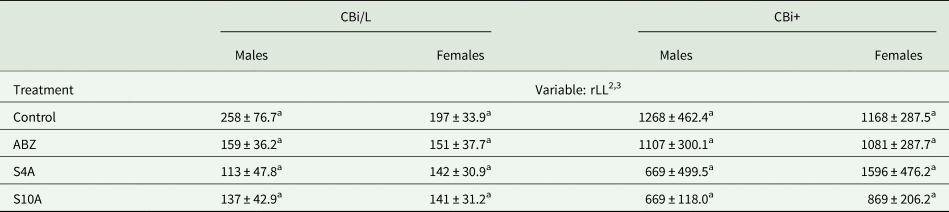
The effect of treatment during the migratory phase on the number of muscle encysted larvae was assessed on day 37 p-i (Table 3). The microcrystals showed a better, although not statistically significant, therapeutic response compared to raw ABZ. Males of both genotypes receiving S4A and S10A halved the larval muscle load compared to controls; however, this response was not observed in the females.
Effect of treatment during the migratory stage of the infection1 on the number of T. spiralis encysted L1 larvae

Differences among treatments within genotype and sex were evaluated by a one-way ANOVA, using Bonferroni's post-test for comparisons between groups.
For each column, differences between groups not sharing the same superscript are significant at the 0.05 level.
1 Mice were treated on days 13, 14 and 15 p-i and sacrificed on day 37 p-i.
2 rLL: relative Larval Load, total number of encysted larvae per g of fresh tissue.
3 Mean ± s.e.m.
Parenteral phase
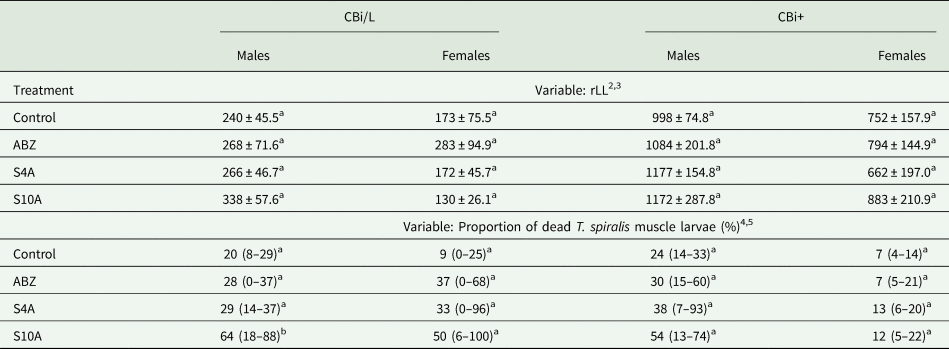
Table 4 shows the effect of administering pure ABZ or ABZ microcrystalline formulations during the chronic phase of infection (days 27, 28 and 29 p-i) on parasite muscle load and proportion of dead larvae. On day 37 p-i, muscle rLL was similar among the groups of the same genotype and sex. The number of dead larvae was, in general, higher in treated mice compared to that in controls. Treated CBi/L hosts, irrespective of sex, showed a higher proportion of dead larvae compared to their controls, this difference being significant for CBi/L males treated with S10A (P = 0.0385). CBi+ males and females did not show the same response to treatment (P < 0.05): while treated males behaved similarly to CBi/L mice and tended to increase the percentage of dead larvae, treated females did not differ from their controls. At this stage of the parasite cycle, the microcrystal system S10A showed better therapeutic efficacy compared to S4A.
Effect of treatment during the chronic stage of infection1 on parasite muscle burden

Differences among treatments within genotype and sex were evaluated with the nonparametric Kruskal–Wallis test followed by Dunn's test for between-groups comparison.
Differences among groups, within genotype and sex, were evaluated with the non-parametric Kruskal–Wallis test, using Dunn's test for comparisons between groups.
For each variable, within column, groups not sharing the same superscript differ significantly (P < 0.05).
1 Mice were treated on days 27, 28 and 29 p-i and were sacrificed on day 37 p-i.
2 rLL: relative larval load, total number of muscle encysted larvae per g of fresh tissue.
3 Mean ± s.e.m.
4 Percentage of dead muscle encysted larvae.
5 Median (range).
Discussion
When an infective agent enters into an organism, three main elements determine the clinical response: the host genotype, the parasite genotype and environmental factors (Incani et al., Reference Incani, Morales and Cesari2001; Campino et al., Reference Campino, Kwiatkowski and Dessein2006; Wilfert and Schmid-Hempel, Reference Wilfert and Schmid-Hempel2008). Resistance/susceptibility to parasitic infections is therefore determined by a complex equation that combines the three elements. Murine models have proven to be an excellent genetic tool for studying hosts’ response to parasitosis. A defined animal model, such as the mouse lines from the CBi-IGE colony in which most environmental variables can be strictly controlled, may help to elucidate the host genetic background's role in the development and establishment of a parasitic infection and on response to treatment.
ABZ is the drug of choice for treating trichinellosis in recommended doses of 400 mg/day (15 mg/kg/day) twice a day for 8–14 days. However, ABZ formulations commercially available have shown therapeutic failure in the chronic phase, and longer treatments and higher doses are required, enhancing the risk of side- effects. Modifying the properties of solid compounds through micro-crystallization of ABZ allowed us to obtain formulations with better biopharmaceutical properties and potential improved effectiveness (Priotti et al., Reference Priotti, Codina, Leonardi, Vasconi, Hinrichsen and Lamas2017; Codina et al., Reference Codina, Priotti, Leonardi, Vasconi, Hinrichsen and Lamas2020), the next step being to test their therapeutic efficacy in vivo in an animal model of T. spiralis infection. The Trichinella/mouse model has been widely used to assay benzimidazole carbamates' anthelmintic effectiveness (McCracken, Reference McCracken1978; López-García et al., Reference López-García, Torrado-Durán, Torrado-Durán, Martínez-Fernández and Bolás-Fernández1997; Chung et al., Reference Chung, Joo, Quan, Kwon and Cho2001; Casulli et al., Reference Casulli, Morales, Gallinella, Turchetto and Pozio2006; García et al., Reference García, Barrera, Piccirilli, Vasconi, Di Masso, Leonardi, Hinrichsen and Lamas2013; Codina et al., Reference Codina, García, Leonardi, Vasconi, Di Masso, Lamas and Hinrichsen2015). One of the advantages is that it allows, within a short time, testing drugs against different parasite stages and locations within the host. In the present study, our formulations' therapeutic efficacy was analysed in the three major phases of the infection: enteral, migratory and chronic or parenteral.
ABZ, S4A or S10A administered in the enteral phase of infection had no effect on the number of intestinal worms but decreased T. spiralis female worms' vitality, which showed alterations of their internal morphology leading, most likely, to a modification in fecundity with the consequent reduction of muscle encysted larvae. The same morphological alterations were observed in female worms in the in vitro assay that evaluated the formulations' anthelmintic activity (Priotti et al., Reference Priotti, Codina, Leonardi, Vasconi, Hinrichsen and Lamas2017). Moreover, the significant decrease in muscle parasite load in the chronic phase suggests that an inhibition of reproduction occurred since it is unlikely that the formulations given on days 5–7 p-i would affect migrating larvae. A similar result was reported by Campbell and Cuckler (Reference Campbell and Cuckler1964) after feeding infected mice with a diet containing 0.05% thiabendazole on days 4–11 post-infection: the treatment did not eradicate the intestinal worms but did suppress their reproduction. Also, mice under-dosed with ABZ or mebendazole on day 5 post-infection showed an effect on the parasite reproductive process, which disappeared when the drug was cleared from the system (de-la-Rosa et al., Reference de-la-Rosa, Alvarez and Gomez-Priego2007).
Notably, ABZ and the formulations given in the enteral phase were equally effective in both lines and sexes: the 90% reduction in muscle relative larval load occurred in resistant and susceptible animals despite the latter having a significantly higher intestinal and muscular parasitic load than the resistant mice.
The migratory phase of infection (Mitreva and Jasmer, Reference Mitreva, Jasmer and Hodgkin2006) begins when NBL pass to tissues, enter lymphatics, then the general circulation at the thoracic duct, and make their way through the capillaries into the muscle fibres, initiating the muscle phase of infection. Its length depends on how rapidly worms are expulsed, a character partly determined by the genotype of the host (Vallance et al., Reference Vallance, Blennerhassett and Collins1997; Steel et al., Reference Steel, Faniyi, Rahman, Swietlik, Czajkowska, Chan, Hardgrave, Steel, Sparwasser, Assas, Grencis, Travis and Worthington2019). This phase is usually considered the most refractory to treatment, probably because it always involves parasites at different development levels, unlike the intestinal and muscular phases in which the maturation of the stage occurs in a short time. In this period, newly laid larvae can coexist with others in the pre-encysting stage; consequently, their susceptibility to drugs can vary since they are in a different metabolic situation. In this context, despite variations depending on the host, such as longevity of adults in the intestinal intracellular niche, number of NBL laid per female and their survival during migration, the number of L1 larvae recovered on the chronic phase has been used by many researchers as a success index for a given treatment (Denham and Martinez, Reference Denham and Martinez1970; Bell et al., Reference Bell, Wang and Ogden1985; García-Rodriguez et al., Reference García-Rodriguez, Torrado and Bolás2001; García et al., Reference García, Bolás and Torrado2003; Eid et al., Reference Eid, Ashour, Essa, El Maghraby and Arafa2020).
Although not statistically significant, the formulations given during the migratory phase reduced by half the larval muscle load, suggesting that the microcrystals improve ABZ efficacy in the migratory stage. This tendency to present an improved therapeutic efficacy was observed only in males regardless of the host genotype. Formulations may have affected migrating newborn or pre-encysted larvae, as suggested by the decrease in the number of encysted larvae and the results of a previous in vitro experiment (Priotti et al., Reference Priotti, Codina, Leonardi, Vasconi, Hinrichsen and Lamas2017). The in vitro experiment exposing T. spiralis females to culture media containing S4A or S10A impacted to varying degrees the mobility of the NBL, which showed complete loss of movement after 2 h and up to 24 h.
Treatment on the chronic phase of trichinellosis is critical, as existing treatments may not eliminate the parasite once the larvae have become established in the muscle cells. These cases usually require repeated or more prolonged treatments that entail a higher probability of suffering side-effects. Hence, the formulations' therapeutic success in this phase would be related to their ability to enter the cyst to kill the larvae. Studies of treatment effectiveness in the chronic phase of infection have yielded mixed results when muscle larvae are fully encapsulated (López-García et al., Reference López-García, Torrado-Durán, Torrado-Durán, Martínez-Fernández and Bolás-Fernández1997; Siriyasatien et al., Reference Siriyasatien, Yingyourd and Nuchprayoon2003; de la Torre-Iglesias et al., Reference de la Torre-Iglesias, García-Rodriguez, Torrado, Torrado, Torrado-Santiago and Bolás-Fernández2014); in fact, neither ABZ nor mebendazole is equally efficacious against all larval stages (Knopp et al., Reference Knopp, Steinmann, Keiser and Utzinger2012). As stated by Shimoni and Froom (Reference Shimoni and Froom2015), adequate concentrations of the drugs or their active metabolites need to reach larvae that have invaded the muscle to be effective systemically. Adequate concentrations are usually achieved with longer periods and higher anthelminthic doses or developing formulations to enhance the aqueous drug solubility to improve bioavailability (García-Rodríguez et al., Reference García-Rodriguez, Torrado and Bolás2001; Casulli et al., Reference Casulli, Morales, Gallinella, Turchetto and Pozio2006; Codina et al., Reference Codina, García, Leonardi, Vasconi, Di Masso, Lamas and Hinrichsen2015). Treatment protocols in this study used a low dose of ABZ in short periods that, in the parenteral phase of infection, was not enough to reduce the number of encysted larvae but did affect their viability. CBi/L males and females treated with S10A showed an increase, significant in males, in the proportion of dead L1 larvae compared to ABZ. A similar effect was observed in CBi+ males, whereas females did not respond to any formulation. It is accepted that parasitic diseases differ in prevalence, course and severity between males and females; biological sex influences physiology, immune responses, drug metabolism, thus affecting the progression of the disease (Nava-Castro et al., Reference Nava-Castro, Hernández-Bello, Muñiz-Hernández, Camacho-Arroyo and Morales-Montor2012; Dkhil, Reference Dkhil2015; Hegazy et al., Reference Hegazy, Elmehankar, Azab, El-Tantawy and Abdel-Aziz2019; Lockard et al., Reference Lockard, Wilson and Rodríguez2019). This sex effect was only observed in the resistant line: CBi/L males generally had higher muscle parasite loads compared to females. On the contrary, males and females of the susceptible CBi+ line had similar parasite loads. These results highlight the importance of considering the host characteristics in response to treatment and the need to incorporate sex and genotype as variables in evaluating therapeutic efficacy in preclinical studies (Clayton and Collins, Reference Clayton and Collins2014).
Males and females differ in their response to drug treatment, differences that can be critical. In recent years, several studies have described sex-related differences in the progression of diseases and the disposition of drugs in the body (Capece et al., Reference Capece, Castells, Pérez, Arboix and Cristòfol2000; Afonso-Pereira et al., Reference Afonso-Pereira, Dou, Trenfield, Madla, Murdan, Sousa, Veiga and Basit2018; Moyer et al., Reference Moyer, Matey and Miller2019; Valodara and Sr, Reference Valodara and Sr2019). In a previous experiment analysing the pharmacokinetics of S4A and S10A (Codina et al., Reference Codina, Priotti, Leonardi, Vasconi, Hinrichsen and Lamas2020), ABZ bioavailability was significantly increased when administered as microcrystalline formulations. However, host genotype and sex influenced the pharmacokinetic parameters measured: CBi/L females attained a significantly higher C max compared to males, whereas no sex effect was observed for this variable in CBi+. Thus, the finding of the formulations' low or lack of efficacy in females treated in the migratory or parenteral phases of the infection was an unexpected outcome suggesting that the metabolism and excretion of ABZ in CBi/L and CBi+ females might be higher than that in males. The active ABZ sulphoxide (ABZSO) metabolite, responsible for the antiparasitic activity against different nematodes, is biotransformed to the inactive metabolite ABZ sulphone (ABZSO2) mainly by CYP3A4, which is expressed more in women than in men, resulting in a higher clearance rate (Wolbold et al., Reference Wolbold, Klein, Burk, Nüssler, Neuhaus, Eichelbaum, Schwab and Zanger2003). Fuscoe et al. (Reference Fuscoe, Vijay, Hanig, Han, Ren, Greenhaw, Beger, Pence and Shi2020) reported a similar sex-determined expression of gene Cyp3a2, the rat orthologue of the human gene encoding CYP3A4.
It should also be noted that ABZSO usually presents in two enantiomeric forms with known differences in their pharmacokinetic profile and activity against other helminths. Capece et al. (Reference Capece, Castells, Pérez, Arboix and Cristòfol2000) found differences in the pharmacokinetics of ABZSO enantiomers in sheep of both sexes but not in total-ABZSO or ABZSO2; they also observed a sex difference in the enantiomers Tmax; Cmax values for (−)-ABZSO were similar in both sexes, but peak concentrations differed. Thus, their data suggest another possible sex effect in ABZSO metabolism.
An effect of the ongoing infection on ABZ bioavailability could be ruled out since results reported by García Rodríguez et al. (Reference García Rodríguez, De Prada, Torrado Durán and Bolás Fernández2009) suggest that although intestinal infection by T. spiralis induces a transient acute inflammation, it is almost completely abrogated after worm expulsion from the gut. This situation prompts the recovery of absorption capacity and oral bioavailability of drugs when administered on the infection's systemic phases. S10A microcrystals, based on chitosan, showed a better therapeutic efficacy compared to ABZ or S4A when administered on the chronic phase of infection. This enhanced efficacy, significant in CBi/L males, is most probably related to the known interactions of chitosan with the immune system. Chitosan is active against a variety of diseases, possessing both antimicrobial and anticancer properties. It has shown in vitro and in vivo anticryptosporidial activity (Mammeri et al., Reference Mammeri, Chevillot, Thomas, Polack, Julien, Marden, Auclair, Vallée and Adjou2018), has effectively reduced symptoms in a mouse model of induced ulcerative colitis, improving intestinal mucosal barrier function and modifying the intestinal microflora (Wang et al., Reference Wang, Zhang, Guo and Li2019), and has enhanced vaccines’ efficacy as an adjuvant (Sun et al., Reference Sun, Yu, Zhao, Guo, Wang and Zhao2018). Furthermore, chitosan's mucoadhesive properties have been shown to enhance drug absorption (Khan et al., Reference Khan, An, Dai, Li, Khan and Ni2019). In fact, a higher bioavailability in a period of 24 h was observed in mice given S10A compared to ABZ and S4A (Codina et al., Reference Codina, Priotti, Leonardi, Vasconi, Hinrichsen and Lamas2020). The physiological activities of chitosan would depend on both molecular weight and water-solubility of the molecule (Zeng et al., Reference Zeng, Qin, Wang, Chi and Li2008) and the host's genotype.
Our results are consistent with those of a recent publication where nanostructured lipid carriers were coated with chitosan and administered to mice in the three phases of T. spiralis infection (Eid et al., Reference Eid, Ashour, Essa, El Maghraby and Arafa2020). The authors reported a 2-fold reduction of viable encysted larvae treated with chitosan-coated nanocarriers compared to ABZ suspension. In this study, chitosan-based microcrystals (S10A) increased by 1.4- to 2.3-fold the percentage of dead larvae compared to ABZ. It is important to note that while nanocarriers are prepared with a high proportion of excipient (approximately 92%), the microcrystals require much smaller amounts of the polymer (approximately 20%). This difference makes the microcrystalline formulation promising for translation to a final product.
In summary, the chitosan-based microcrystals showed a better efficacy in the chronic phase of infection when the formulations currently in use are not effective or need to be administered in higher doses or for more extended periods. Our findings suggest that host genotype- and sex-specific effects influenced the response to the formulations when administered after the intestinal phase and should be considered in pre-clinical studies. The observed dependence of the therapeutic efficacy on the different T. spiralis infection phases might respond to several factors such as the host's immune response, T. spiralis stage's susceptibility, drug bioavailability and formulations' components. The results showed that microcrystalline formulations would be suitable systems to treat T. spiralis infection in the chronic phase. More experiments using various administration protocols and analysis of the mechanisms involved should be undertaken in future studies.
Supplementary material
The supplementary material for this article can be found at https://doi.org/10.1017/S0031182021001128.
Acknowledgements
A.V.C. is grateful to CIUNR (Consejo de Investigaciones, Universidad Nacional de Rosario) for a Research Fellowship. J.P. is grateful to CONICET (Consejo Nacional de Investigaciones Científicas y Técnicas) for a Doctoral Fellowship.
Author contributions
L.I.H. and MCL conceived and designed the study. AVC, JP, MDV and DL conducted data gathering. AVC and JP performed statistical analyses. AVC, JP, MCL and LIH wrote the article.
Financial support
This work was supported by Universidad Nacional de Rosario, Project 1MED447 (LIH), CONICET, Project PIP 112-201001-00194 (MCL), and Ministerio de Ciencia, Tecnología e Innovación Productiva de Santa Fe, Project IO 2017-00220 (LIH).
Conflict of interest
The authors declare there are no conflicts of interest.
Ethical standards
The experimental protocol followed the institutional regulations and was approved by the Bioethics Committee of the Facultad de Ciencias Médicas, Universidad Nacional de Rosario (permit number 1398/2016).