INTRODUCTION
Conjunction in child language
Much of the existing acquisition literature on conjunction has focused on children's syntactic development of phrasal and sentential coordination structures. According to early transformational grammars, phrasal coordinations such as (1) were derived by the application of a deletion rule (conjunction reduction) to an underlying sentential coordination at deep structure (2) (for relevant discussion, see Chomsky, Reference Chomsky1957, Reference Chomsky1977; Ross, Reference Ross1967; Dougherty, Reference Dougherty1968, Reference Dougherty1970; Lakoff & Peters, Reference Lakoff, Peters, Reibel and Schane1969; Stockwell, Schachter & Partee, Reference Stockwell, Schachter and Partee1973; Harries, Reference Harries1973; Williams, Reference Williams1978; Grosu, Reference Grosu1979).
-
(1) Jack ate the apple and the banana.
-
(2) Jack ate the apple and Jack ate the banana.
Accordingly, developmental researchers sought to investigate the status of these forms of conjunction in child language, characterizing the nature of young children's coordinate structures (see, for example, de Villiers, Tager-Flusberg & Hakuta, Reference de Villiers, Tager-Flusberg and Hakuta1977; Lust, Reference Lust1977; Ardery, Reference Ardery1980; Bloom, Lahey, Hood, Lifter & Fiess, Reference Bloom, Lahey, Hood, Lifter and Fiess1980; Hakuta, de Villiers & Tager-Flusberg, Reference Hakuta, de Villiers and Tager-Flusberg1980; Lust & Mervis, Reference Lust and Mervis1980; Greenfield & Dent, Reference Greenfield and Dent1981; Tager-Flusberg, de Villiers & Hakuta, Reference Tager-Flusberg, de Villiers, Hakuta and Kuczaj1982). Such studies examined children's production of phrasal and sentential coordinations, as well as the deletion patterns associated with phrasal coordinations. The resulting data, gathered mostly from elicited imitation tasks and spontaneous production corpora, were somewhat mixed, and on the whole did not provide compelling arguments for the primacy of sentential coordination.
Aside from structural considerations, other existing studies have examined the meanings and pragmatic functions children may assign to the conjunction. And is reported to be the first connective that English-speaking children produce (Cromer, Reference Cromer1968; Bowerman, Reference Bowerman, Garman and Fletcher1979), both for linking syntactic phrases (Bloom et al., Reference Bloom, Lahey, Hood, Lifter and Fiess1980) and as a kind of inter-sentential discourse connective (Peterson & McCabe, Reference Peterson and McCabe1987). Though children may produce conjunction quite early (around 25 months, according to Bloom et al., Reference Bloom, Lahey, Hood, Lifter and Fiess1980), its initial meaning and function are reported to be quite general. Bloom et al., report that the earliest semantic relation expressed by conjunction is additive, allowing the child to join two events or states without necessarily conveying any dependency relation between them. The additive meaning encoded by young children's conjunction is then followed by a temporal meaning (see Reitz, Reference Reitz2013, for discussion of children's temporal inferences arising from German und); temporal meanings are subsequently followed by a causal meaning and then an adversative meaning (Bloom et al., Reference Bloom, Lahey, Hood, Lifter and Fiess1980). Peterson and McCabe (Reference Peterson and McCabe1987, Reference Peterson and McCabe1988) report that children use and to link sentences together; on its inter-sentential use, and appears as a kind of general discourse glue that allows the child to signal a thematic connection between her contiguous utterances.
Beyond the structural and pragmatic considerations described above, there has been far less attention devoted to children's logical interpretations of conjunction (although see, for example, Crain, Goro, Notley & Zhou, Reference Crain, Goro, Notley, Zhou, Stavrakaki, Lalioti and Konstantinopoulou2013, and Notley, Zhou & Crain, Reference Notley, Zhou and Crain2016, on scopal interactions between conjunction and negation in child language, and Paris, Reference Paris1973, on children's reasoning with logical connectives). In this paper, we focus on a well-known puzzle in the formal semantics literature that, as far as we know, has received no attention in the acquisition literature. More specifically, plural predicate conjunction appears to give rise to both an intersective, so-called ‘Boolean’ interpretation and a weaker ‘split’ interpretation, depending on whether the conjoined predicates are compatible or are incompatible.
The flexibility of plural predicate conjunction
Sentences containing plural definite subject noun phrases and conjoined predicates appear to give rise to two possible readings of conjunction: a so-called Boolean (Partee & Rooth, Reference Partee, Rooth, Bäuerle, Schwarze and von Stechow1983) or intersective reading as in (3), and a weaker ‘split’ interpretation as in (4).
-
(3)
-
a. The bears are big and white.
-
b. ≈ The bears are both big and white
-
-
(4)
-
a. The bears are big and small.
-
b. ≠ The bears are both big and small
-
c. ≈ Some of the bears are big and some of them are small
-
To account for the apparent ambiguity between these strong and weak meanings of conjunction, Winter (Reference Winter2001b) proposes the principle in (5), which is meant to be an extension of the Strongest Meaning Hypothesis (originally proposed by Dalrymple, Kanazawa, Mchombo & Peters, Reference Dalrymple, Kanazawa, Mchombo, Peters, Harvey and Santelmann1994; Dalrymple, Kanazawa, Kim, Mchombo & Peters, Reference Dalrymple, Kanazawa, Kim, Mchombo and Peters1998) to account for an ambiguity in the interpretation of reciprocal expressions.
-
(5) The Extended Strongest Meaning Hypothesis (ESMH): A complex plural predicate with a meaning that is derived from one or more singular predicates using singular quantification is interpreted using the logically strongest truth conditions that are generated from its basic universal meaning and that are not contradicted by known properties of the singular predicate(s).
(Winter, Reference Winter2001b, p. 342, (17))
Since the strong interpretation in (4b) would be contradictory to our knowledge that a bear cannot be both big and small at the same time, we assign the sentence (4a) the weaker interpretation in (4c). A strong reading of (3a), on the other hand, is not contradictory to our knowledge, and thus we prefer to assign the strong meaning to conjunction. A similar contrast between the strong, intersective meaning of conjunction and the weaker, split interpretation can be seen in (6).
-
(6)
-
a. The ducks are swimming and flying.
-
b. The ducks are swimming and quacking.
-
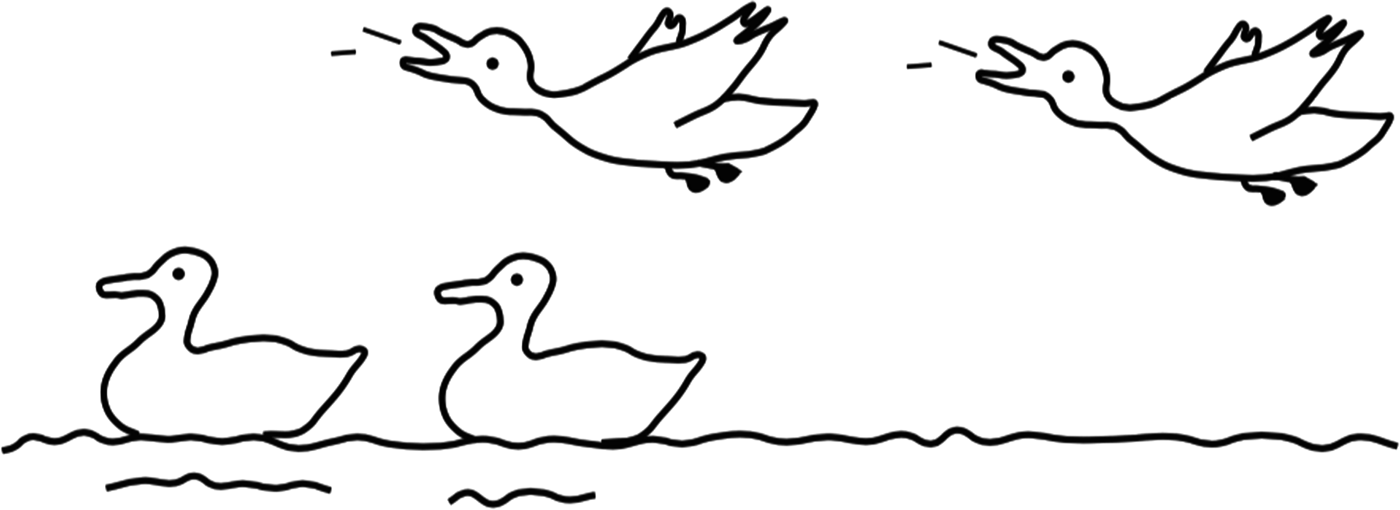
On the strong interpretation, (6a) would be contradictory to our knowledge that ducks cannot swim and fly at the same time. Thus we assign it a weaker interpretation, so we judge (6a) to be a true description of Figure 1, i.e. Some of the ducks are swimming and the other ducks are flying. A strong reading of (6b), on the other hand, is not contradictory with our knowledge, and thus we prefer to assign to it the strong meaning that the ducks are both swimming and quacking, so we judge (6b) to be a false description of Figure 1.
Figure from Winter Reference Winter2001b (page 341, Figure 2, reproduced here with permission from Oxford University Press).

In short, the ESMH principle stated in (5) ensures that the meaning of a complex predicate (that is itself composed of lexical predicates holding of atomic entities) is assigned the strongest truth conditions that do not contradict the lexical properties of the simple predicates it contains.
More recently, Poortman (Reference Poortman, Degen, Franke and Goodman2014, Reference Poortman2017) has shown experimentally that the choice between the weak and strong meanings is not as categorical as the ESMH principle might predict. She presents experimental evidence of a continuum of acceptability values for non-Boolean interpretations like (4c), which correlate with the perceived typicality of a given instance of the complex predicate. The less typical that speakers perceive the complex predicate to be, according to a Boolean interpretation, the weaker the interpretation they assign to the sentence. To explain this finding, Poortman extends the Maximal Typicality Hypothesis proposed in Kerem, Friedmann, and Winter (Reference Kerem, Friedmann, Winter, Cormany, Ito and Lutz2009) to predicate conjunction: the less typical it is for two predicates to apply simultaneously to each individual in the plural subject, the more accessible the weaker interpretation becomes.
The present study
Previous developmental studies on conjunction have tended to focus on the syntax of coordination or the pragmatic functions that underlie conjunction. As far as we know, no previous study has examined children's sensitivity to the apparent flexibility of and discussed above. In order to address the associated learnability question of how children acquire an adult-like semantics of conjunction, a first step is assessing what young children know about conjunction. Existing studies may tell us that preschool-aged children have a grasp of the syntax underlying coordination, and are capable of using and to link thematically related phrases and sentences. However, the existing data clearly do not provide the full picture of children's knowledge of the semantics of (predicate) conjunction. Not only must children acquire the cross-categorial Boolean semantics of conjunction, which yields the strong, intersective meaning, as well as the basic lexical semantics of each of the conjoined predicates, they must also accumulate sufficient experience with the world to determine how likely it is for any two predicates to hold simultaneously of the same individual.
It is also not entirely clear what predictions we should make on the basis of the existing literature. Earlier developmental studies, working within the framework of transformational grammar, sought to characterize the potential primacy of sentential (vs. phrasal) conjunctions. But such transformational accounts clearly cannot fully capture the facts; for example, the phrasal predicate conjunction in (7a) is clearly not equivalent to the sentential conjunction in (7b), and (8) is incorrectly predicted to be equivalent to the ungrammatical sentence John met and Mary met (Winter, Reference Winter2001a).
-
(7)
-
a. Some woman danced and sang.
-
b. Some woman danced and some woman sang.
-
-
(8) John and Mary met.
In the semantics literature, there has been continued discussion and evolving proposals concerning the apparent flexibility of conjunction (see, for example, Keenan & Faltz, Reference Keenan and Faltz1985; Hoeksema, Reference Hoeksema1987; Winter, Reference Winter2001b), but the literature on child language acquisition has generally not engaged with these lines of research. In the present study, we aim to take a first stab at the question of how children handle the flexibility of conjunction, by directly testing their interpretation of sentences like (3) and (4).
EXPERIMENT 1
Our first experiment tested the interpretation of phrasal predicate conjunctions. We used a 2 × 2 design with group (adults vs. children) as a between-subject factor and compatibility of the conjoined predicates (compatible vs. incompatible) as a within-subject factor. In the remainder of the paper, we will use the label compatible to refer to the condition in which the conjoined predicates were compatible, and incompatible to refer to the condition in which the conjoined predicates were incompatible.
METHOD
Participants
We tested twenty-six English-speaking children (3;02–5;02, M = 4;05), who were randomly assigned to the two conditions. Seven additional children (mean age 3;09) were tested but were excluded from analysis for failing to score at least 75% accuracy on control and filler trials (9/12 correct). We decided on this exclusion criterion before data collection began. We also tested twenty-two adult native speakers of English, who were likewise randomly assigned to the two test conditions. All adults successfully passed the control trials.
Procedure
We used a Truth Value Judgment Task (Crain & Thornton, Reference Crain and Thornton1998). Participants were presented with a series of cartoon pictures on a laptop computer. Pre-recorded video clips of a puppet watching and playing along with the game created the ruse that the puppet was participating in the game via webcam. A short introduction to each picture was provided, to encourage the child to pay attention to the full set of objects in the picture. The puppet was then asked to describe something about the set of objects. The participant's task was to decide whether the puppet's description was right or wrong. Participants were asked to fill out a scorecard for the puppet. Follow-up justifications were elicited after each response, e.g. “Why was Ellie wrong?” / “How do you know Ellie was right?” Children gave verbal justifications, while adults were asked to write out brief justifications for each of their responses.
Materials
Each participant received two training items. These were simple true and false statements designed to familiarize the participant with the task. Subsequently participants received a randomized sequence of four target items, eight control items, and four filler items. These items were presented in two orders (one the reverse of the other). The full list of test sentences is provided in the ‘Appendix’.
Target items corresponded to sentences containing a plural subject noun phrase and two conjoined adjectival predicates, which were either compatible or incompatible. To create the predicate pairs for the incompatible condition, we selected gradable adjectives that were antonyms. More concretely, two adjectives A and B were considered incompatible if being A entailed being not-B; for example, being ‘big’ entails being ‘not small’, and being ‘small’ entails being ‘not big’. For the compatible condition, we chose to pair gradable adjectives with color adjectives, in order to ensure that the intersective interpretation was possible, and even natural; the colors were chosen in such a way as to be natural for the relevant objects (for example, brown or white bears, as opposed to pink bears). Notice that the incompatible pairs would fail the entailment test mentioned above: being ‘big’ does not entail being ‘not white’, and being ‘white’ does not entail being ‘not big’.
An example image is given in Figure 2; an example trial is described in (9). If participants accessed the stronger intersective meaning, they were expected to find the incompatible target contradictory, and reject it.Footnote 1 Similarly, participants were expected to reject the compatible target, as the strong meaning made the target sentence a false description of the picture. If participants accessed weak meanings, they were expected to accept both kinds of target sentences.
-
(9) Example test trial (accompanying Figure 2)
Experimenter: What a beautiful day. Look at all the bears on the mountainside! Ellie, can you tell us something about the bears?
-
a. incompatible condition
Puppet: Hmm … the bears are big and small!
-
b. compatible condition
Puppet: Hmm … the bears are big and white!
-
Image accompanying the incompatible The bears are big and small and the compatible The bears are big and white. The two bears to the left are simultaneously big and brown, and the two bears on the right are simultaneously small and white.

In addition to the target sentences, participants received three kinds of unambiguously true and unambiguously false control sentences, containing a singular subject noun phrase. Participants heard two false control sentences containing a singular subject and incompatible conjoined predicates (only one of the predicates was true of the object in the picture), two false control sentences containing a singular subject and compatible conjoined predicates (again, only one of the predicates was true of the object), and two true control sentences containing a singular subject and compatible conjoined predicates where both predicates were true of the object in the picture. These sentences can be found in the ‘Appendix’.
Finally, to balance the overall number of yes- and no-responses across the experiment, four filler items without conjunction were included, each of which could be associated with a yes- or a no-target.
RESULTS
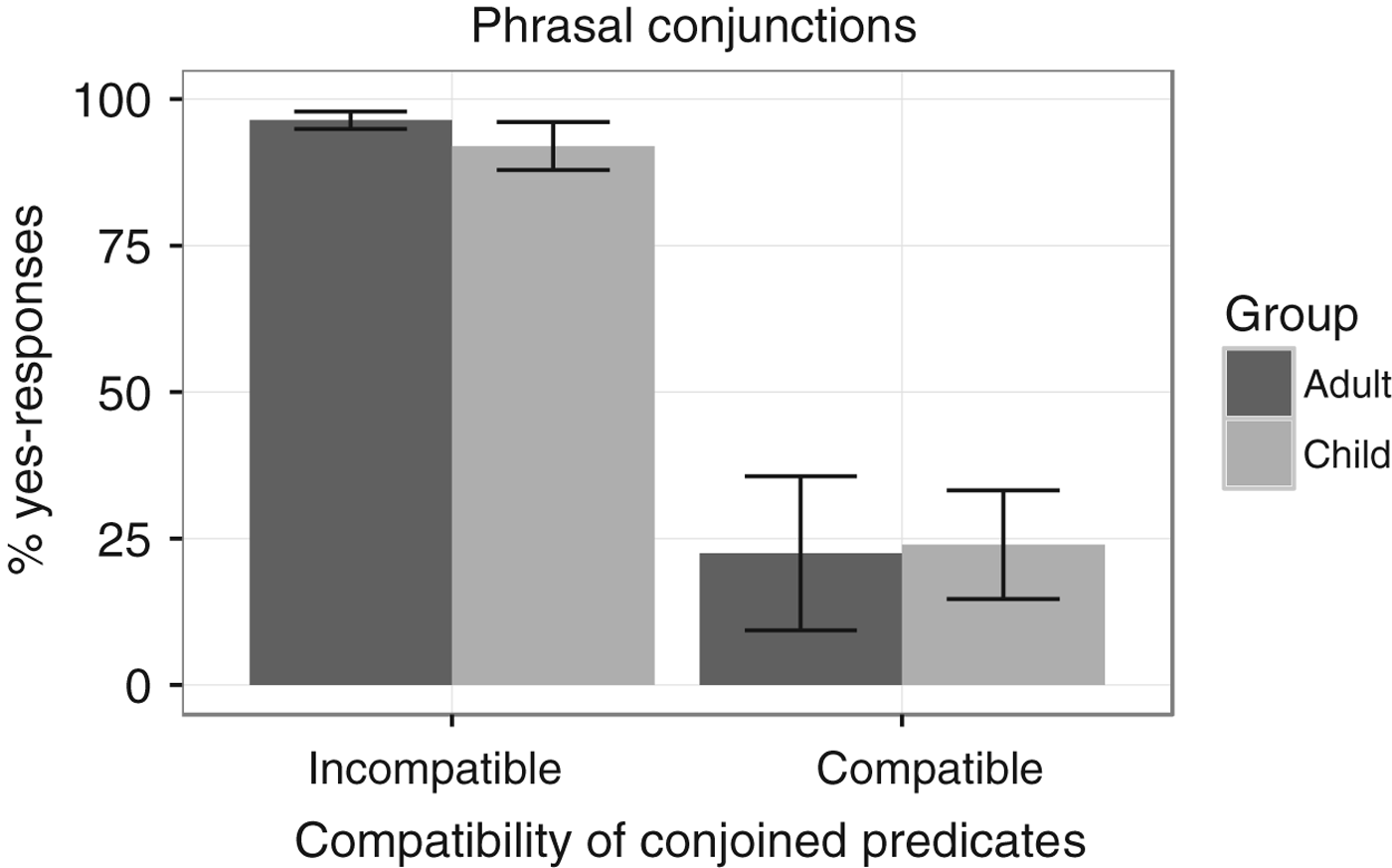
Both groups displayed above 93% accuracy across the various control and filler conditions. The performance by child and adult participants in the target conditions are presented in Figure 3, plotted as the percentage of yes-responses to the compatible and incompatible targets. A two-way ANOVA revealed a significant main effect of the compatibility of the conjoined predicates (F(1,44) = 92, p < ·001), no effect of group, and no interaction between compatibility and group. Both adult and child participants were significantly more accepting in the incompatible condition than in the compatible condition (Tukey HSD, both p < ·001).
Percentage of yes-responses from children and adults in the phrasal incompatible and compatible conditions. Yes-responses were indicative of weak readings, and no-responses were indicative of strong readings.

Participants were generally consistent in their responses, either accepting or rejecting at least three of four targets. Only four of the twenty-six children gave mixed responses (two yes-responses and two no-responses).
Children and adults gave similar justifications for their responses. These fell into three categories. Recall that yes-responses were indicative of the weaker, split interpretation. Justifications for accepting the incompatible targets indeed made reference to the two subsets of objects that verified the two predicates, e.g. “There are two short pants and two long pants” or “The green ones are tall and the yellow are short”.
No-answers were indicative of the strong, intersective reading. Justifications for rejecting the compatible targets indeed made reference to the failure of the objects to satisfy both predicates, e.g. “These giraffes are tall but not yellow” or “The bears are big or white, not both”.
Finally, those participants who accepted the compatible targets gave justifications similar to the justifications participants offered in the incompatible condition, making reference to the two subsets of objects that verified the two predicates, e.g. “Some are round and some are red” or “The grizzly bears are big, the polar bears are small”.
SUMMARY
The results of Experiment 1 reveal that four-year-olds and adults were alike in preferring strong readings of compatible predicate conjunctions, but weak readings of incompatible predicate conjunctions. Two of the eleven adults and one of the ten children in the compatible condition consistently accepted the target sentences, apparently accessing the weak reading. If we assume that Poortman's (Reference Poortman2017) typicality effect tolerates individual variation, it may not be so surprising that rejection in the compatible condition was not absolute. Importantly, children's responses did not differ significantly from those of adults in either condition.
EXPERIMENT 2
In a second experiment, we tested participants’ interpretation of the sentential versions of the incompatible predicate conjunctions from Experiment 1. We designed this additional experiment with two goals in mind.
First, given that previous developmental studies of conjunction have been somewhat equivocal about the relative primacy of phrasal vs. sentential conjunction in the child's grammar, we wanted to see whether children would also be adult-like in their interpretation of the sentential coordination equivalents of the predicate conjunctions.
Second, adding this follow-up experiment allowed us to further investigate two related predictions. Recall that both groups in Experiment 1 generally found the incompatible predicate conjunctions acceptable. One strategy that could have given rise to this pattern would involve interpreting the sentences, e.g. (10), as involving an underlying sentential conjunction (11), such that the two definite plurals could refer to two different sets of bears.
-
(10) The bears are big and small.
-
(11) The bearsi are big and the bearsj are small.
If this kind of ‘reference shift’ is behind the acceptability of the incompatible targets in Experiment 1, we should observe the same acceptibility for the sentential forms of these predicate conjunctions.
Winter (Reference Winter2001b), however, predicts that only (10) should be acceptable (and true in a context where half of the bears are big and half are small). On his account, speakers should only generate a contradictory reading of the sentential conjunction in (11), in the same context. This follows from the fact that the ESMH only applies at the predicate level. In (11), the ESMH applies in each sentential conjunct. Since the basic meaning in each conjunct doesn't result in any semantic violations or contradictions, the ESMH has no effect. The basic meaning of the sentence as a whole is therefore predicted to be incoherent. In contrast, the meaning assigned in (10) is coherent because predicate conjunction compositionally applies before predication, and before the application of the ESMH. The sentence is thus assigned the weakened meaning, making it coherent. Adding this follow-up experiment allowed us to further investigate this prediction.
METHOD
Participants
We report here on data from fourteen children (3;11–5;03, M = 4;07) and thirty-six adult native speakers of English. An additional six adults were tested but excluded from analysis, as they reported being native speakers of languages other than English. One additional child began the task but did not finish it, and was not included in the analysis.
Due to practical constraints, the fourteen child participants in Experiment 2 had all participated in Experiment 1. We sought to minimize contamination effects in the following ways. First, we ensured that a suitable time period elapsed between completion of Experiment 1 and participation in Experiment 2; on average, three weeks elapsed between the two experimental sessions. This was to ensure that children would not remember specific details of the experiment. In addition, the puppet participating in the task was changed from Ellie the Elephant to Raffie the Giraffe. The children were told that although the game would be similar, they would be playing with a different puppet, whose sentences they would also have to judge. This move was made to encourage children to treat the second session (Experiment 2) as a separate game from Experiment 1, and children were generally enthusiastic to have a chance to play the game with a new puppet. As a final precaution against contamination, we counterbalanced which condition the children of Experiment 2 had seen in Experiment 1; half had participated in the compatible condition and half in the incompatible condition. This was simply to ensure a balance of participants in Experiment 2, rather than, for example, having an entire group of children who had only seen the incompatible condition.
Procedure
We used the same Truth Value Judgment Task as in Experiment 1. Participants were presented with a series of pictures on a laptop computer, and had to judge a pre-recorded puppet's descriptions of the objects in the pictures. Again, participants were asked to fill out a scorecard for the puppet. Follow-up justifications were elicited from children and adults after each response.
Materials
The target and control sentences from Experiment 1 were modified minimally to contain sentential rather than phrasal conjunction. Only the four singular conjunction-less filler sentences remained unchanged. Each participant received two training items, followed by a pre-randomized sequence of four targets, eight controls, and four fillers. Again, the test items were presented in two orders, one the reverse of the other.
The four target sentences were the same as in Experiment 1, except that they contained sentential rather than phrasal conjunction. Each clause contained the same plural subject noun phrase, and the predicates in the two clauses were incompatible with each other. An example trial is given in (12); the accompanying image for this trial would be Figure 2.
-
(12) Example test trial (accompanying Figure 2)
Experimenter: What a beautiful day. Look at all the bears on the mountainside! Raffie, can you tell us something about the bears?
Puppet: Hmm … the bears are big and the bears are small!
In addition to the targets, participants were presented with three kinds of control sentences, which were formed by changing the phrasal conjunctions in Experiment 1 into sentential conjunctions. Participants heard two control sentences with incompatible predicates in the two clausal conjuncts (only one of the predicates was true of the object in the picture), two control sentences with compatible predicates in the two clauses (again, only one of the predicates was true of the object), and two control sentences with compatible predicates in the two clauses (where both predicates were true of the object in the picture).
Finally, to balance the number of yes- and no-responses, we included the same four conjunction-less fillers from Experiment 1, each of which could be associated with a yes-target or a no-target. All test sentences can be found in the ‘Appendix’.
RESULTS
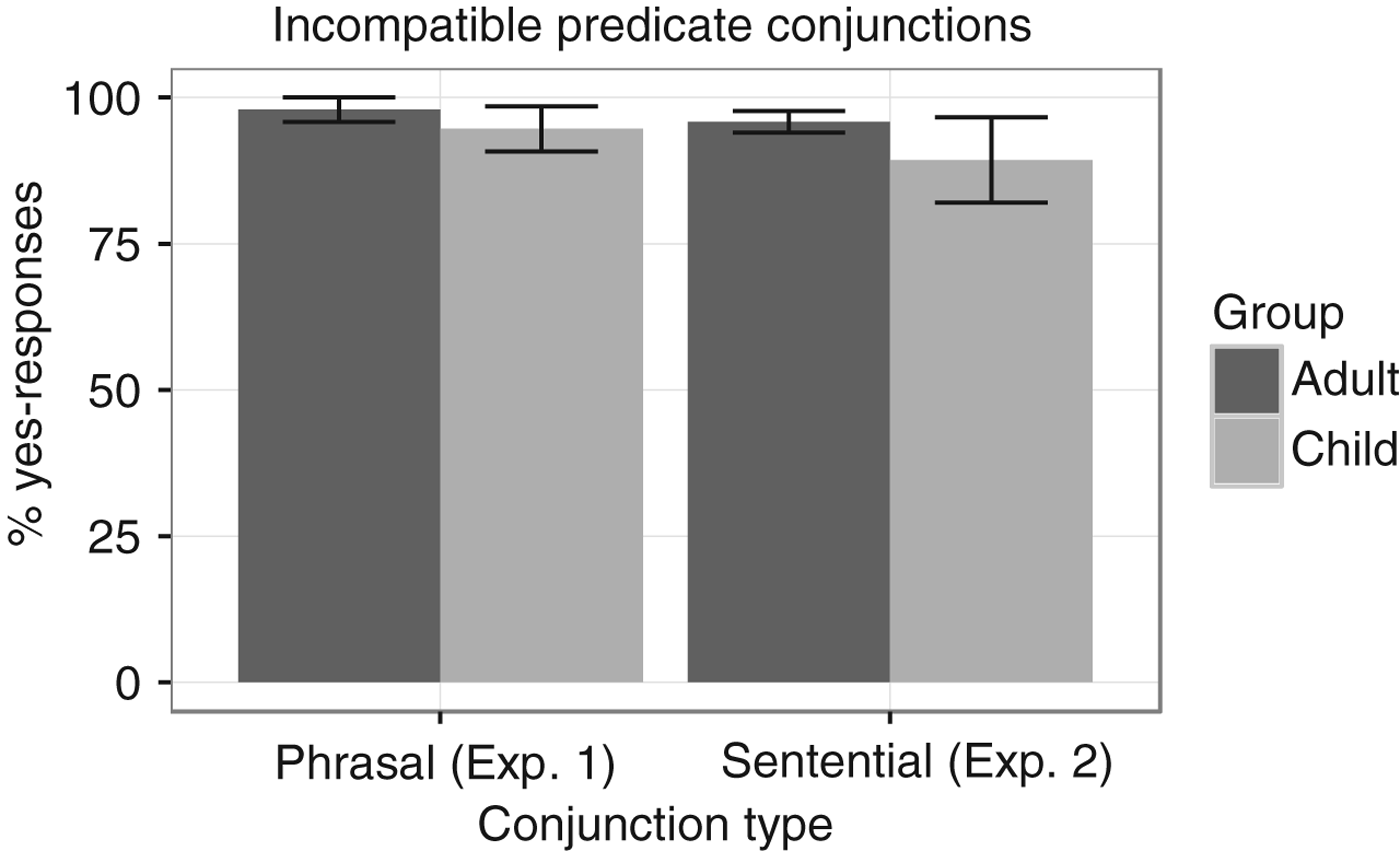
Both groups displayed above 93% accuracy across the various control and filler conditions. In Figure 4, we compare the children's and adults’ performance in the incompatible sentential target condition with that of the incompatible phrasal target condition from Experiment 1. Adults and children generally accepted the sentential conjunction targets, contra the prediction of the ESMH. A two-way ANOVA on the two incompatible conditions (phrasal and sentential) revealed no main effects of conjunction type or group, and no interaction between conjunction type and group.
Percentage of yes-responses from children and adults in the ‘sentential’ incompatible condition of Experiment 2, compared to the ‘phrasal’ incompatible condition of Experiment 1. Yes-responses were indicative of weak readings, while no-responses were indicative of strong readings.

With the exception of one adult participant, all participants were generally consistent in their responses, either accepting or rejecting at least three of four targets.
Follow-up justifications fell into two categories. One of the fourteen children in the sentential conjunction condition rejected all four targets (indicative of the strong reading), and justified these no-responses by making reference to the failure of the objects to satisfy both predicates, e.g. “She said square and round, they're really square” or “I think she said something silly … there's some big and some small”. The remaining participants accepted the sentential conjunction targets (indicative of the weak reading), justifying their yes-responses by making reference to the two subsets of objects that verified the two predicates, e.g. “Yeah, because these bears are big and those bears are small”.
One might worry that the test sentences with sentential conjunction were too long or difficult for children to process; this might have led them to resort to a strategy where they simply looked for objects in the picture that would verify the predicates in the two clausal conjuncts (thereby leading to yes-responses in the experiment). We think this is highly unlikely, however, for two reasons. First, previous studies have reported production of sentential conjunction by children as young as two to three years of age (e.g. Lust, Reference Lust1977; Bloom et al., Reference Bloom, Lahey, Hood, Lifter and Fiess1980). Second, recall that the fourteen children in Experiment 2 had also participated in Experiment 1. Half of these children had participated in the compatible condition of Experiment 1, and we went back and looked at how these seven children had responded to the compatible targets. Six of the seven had rejected all four compatible targets, even though there were objects in the picture that verified both predicates (e.g. long pants and blue pants). If these children relied on a strategy that allowed them to say yes as soon as they could find objects in the picture that verified the two predicates, they should also have accepted the compatible targets in Experiment 1, contrary to fact.
DISCUSSION
Our results can be summarized as follows. The four-year-old participants in the study were adult-like in their comprehension of phrasal and sentential predicate conjunctions. Both children and adults allowed a weaker, non-Boolean reading of incompatible predicate conjunction, and favored the stronger, intersective reading of compatible predicate conjunction. In the context of Winter's (Reference Winter2001b) theory, the results suggest that children apply the ESMH where appropriate; that is, in the case of incompatible predicates, they are adult-like in allowing for a weakened, non-intersective meaning of conjunction.
More generally, the present findings also suggest that, for common adjectives that are both frequent and familiar to four-year-olds (e.g. color and shape terms), these children have accumulated enough world knowledge about the compatibility of the associated properties, such that they can decide whether or not the linguistic conjunction of the two predicates is possible. For instance, children appear to understand that it is possible to ascribe to an entity the property of being both long and blue, but that it is not possible to ascribe to an individual the property of being both big and small. This may be considered a part of their lexical knowledge of the relevant adjectives; but it must surely interact with real-world knowledge that they accumulate as they interact with entities that satisfy the different predicates. This is especially plausible in light of Poortman's (Reference Poortman2017) findings that the acceptability of non-Boolean interpretations correlates with the perceived typicality of the complex predicate. Through real-world experience, the child must be able to modify her typicality values for different combinations of predicates.
The main developmental findings aside, the results of Experiment 2 also introduce a new puzzle. The lack of a difference between responses to the phrasal and sentential incompatible targets is compatible with the Maximal Typicality Hypothesis (Kerem et al., Reference Kerem, Friedmann, Winter, Cormany, Ito and Lutz2009; Poortman, Reference Poortman, Degen, Franke and Goodman2014, Reference Poortman2017), but does not conform to the predictions of the ESMH (Winter, Reference Winter2001b). In particular, the ESMH is not expected to apply at the sentential level, and therefore the sentential incompatible targets would be predicted to give rise to contradictory readings. Yet both child and adult participants in Experiment 2 accepted the sentential targets. One possible explanation for this puzzling finding lies in the possibility of domain restriction, or reference shift. That is, one might posit that participants assigned different referents to the definite noun phrases in the two sentential conjuncts. A possible future study might use proper name conjunctions, which would prevent quick reference shifts; one might expect it to be harder to accept (13) (in a context where John and Bill are tall, and Sue and Jane are short), compared to the targets in Experiment 2.
-
(13) John, Bill, Sue, and Jane are tall and short.
While there remain questions to be explored in future research, the present findings provide the first piece of empirical evidence that children are sensitive to both intersective and split readings of predicate conjunction, and can use their lexical and world knowledge of the relevant predicates in order to select an appropriate reading. This sophisticated knowledge goes well beyond understanding and using conjunction as a general, multi-purpose connective.
APPENDIX: TEST SENTENCES
Experiments 1 & 2
-
(14) Training items
-
a. The box is black. (target: yes)
-
b. The coat rack is very tall. (target: no)
-
-
(15) Filler items
-
a. The box is striped. (target: no) / The box is polka-dotted. (target: yes)
-
b. The vase is blue. (target: no) / The vase is pink. (target: yes)
-
c. The bowl is yellow. (target: no) / The bowl is blue. (target: yes)
-
d. The box is fuzzy. (target: no) / The box is wooden. (target: yes)
-
Experiment 1 (Phrasal conjunction)
-
(16) Incompatible targets
-
a. Context: two big brown bears, two small white bears
incompatible: The bears are big and small. (target: no)
-
b. Context: two long brown pants, two short blue pants
incompatible: The pants are long and short. (target: no)
-
c. Context: two tall green giraffes, two short yellow giraffes
incompatible: The giraffes are tall and short. (target: no)
-
d. Context: two round brown frames, two square red frames
incompatible: The window frames are round and square. (target: no)
-
-
(17) Compatible targets
-
a. Context: two big brown bears, two small white bears
compatible: The bears are big and white. (target: yes)
-
b. Context: two long brown pants, two short blue pants
compatible: The pants are long and blue. (target: yes)
-
c. Context: two tall green giraffes, two short yellow giraffes
compatible: The giraffes are tall and yellow. (target: yes)
-
d. Context: two round brown frames, two square red frames
compatible: The window frames are round and red. (target: yes)
-
-
(18) Plural – true controls
-
a. The dinosaurs are big and green. (target: yes)
-
b. The buildings are tall and purple. (target: yes)
-
-
(19) Singular – false incompatible controls
-
a. The bowl is striped and polka-dotted. (target: no)
-
b. The pencil is long and short. (target: no)
-
-
(20) Singular – true compatible controls
-
a. The apple is small and red. (target: yes)
-
b. The balloon is big and colorful. (target: yes)
-
-
(21) Singular – false compatible controls
-
a. The bear is big and white. (target: no)
-
b. The heart is small and fuzzy. (target: no)
-
Experiment 2 (Sentential conjunction)
-
(22) Incompatible targets
-
a. Context: two big brown bears, two small white bears
incompatible: The bears are big and the bears are small. (target: no)
-
b. Context: two long brown pants, two short blue pants
incompatible: The pants are long and the pants are short. (target: no)
-
c. Context: two tall green giraffes, two short yellow giraffes
incompatible: The giraffes are tall and the giraffes are short. (target: no)
-
d. Context: two round brown frames, two square red frames
incompatible: The window frames are round and the window frames are square. (target: no)
-
-
(23) Plural – true controls
-
a. The dinosaurs are big and the dinosaurs are green. (target: yes)
-
b. The buildings are tall and the buildings are purple. (target: yes)
-
-
(24) Singular – false incompatible controls
-
a. The bowl is striped and the bowl is polka-dotted. (target: no)
-
b. The pencil is long and the pencil is short. (target: no)
-
-
(25) Singular – true compatible controls
-
a. The apple is small and the apple is red. (target: yes)
-
b. The balloon is big and the balloon is colorful. (target: yes)
-
-
(26) Singular – false compatible controls
-
a. The bear is big and the bear is white. (target: no)
-
b. The heart is small and the heart is fuzzy. (target: no)
-