Introduction
Multiple different tumours can affect the lateral skull base, including vestibular schwannomas, facial nerve schwannomas, jugulo-tympanic paragangliomas and meningiomas. Their management has evolved over time, with an increased move towards conservative and observational managements in slow-growing or stable lesions.Reference McRackan and Brackmann1
Vestibular schwannomas are benign tumours of the vestibular nerve that originate from Schwann cells, usually of the inferior vestibular nerve.Reference Khrais, Romano and Sanna2 They are the most common tumour of the cerebellopontine angleReference Valvassori3 and account for up to 10 per cent of intracranial tumours. Various treatment and management strategies are available, varying from surgical resection, stereotactic radiosurgery and conservative observation (‘wait and scan’).Reference Zou and Hirvonen4–Reference Rosenberg6
Most vestibular schwannomas occur sporadically and are unilateral, but some are bilateral and are associated with neurofibromatosis type 2 (NF2).Reference Neff, Welling, Akhmametyeva and Chang7 They can present symptomatically with unilateral hearing loss, tinnitus, dizziness, facial nerve involvement or can be diagnosed incidentally on imaging.Reference Foley, Shirazi, Maweni, Walsh, McConn Walsh and Javadpour8
The natural history of vestibular schwannomas is variable, with only 20–35 per cent of cases experiencing growth after diagnosis, ranging between 0.5–2.9 mm every year,Reference Yoshimoto9 while most remain stable.Reference Stangerup, Caye-Thomasen, Tos and Thomsen10 Some vestibular schwannomas even demonstrate spontaneous involution.Reference Amoo, Rawluk, McConn Walsh and Javadpour11 In one case series, 3.8 per cent of vestibular schwannomas demonstrated tumour shrinkage, with a mean absolute shrinkage of 6.25 mm.Reference Huang, Caye-Thomasen and Stangerup5 These results have made conservative management, in the form of ‘wait and scan’, a viable alternative for patients, especially those with small tumours, advanced age, significant co-morbidities, patient preference or tumours that display slow or no growth.Reference Zou and Hirvonen4
For patients receiving repeated magnetic resonance imaging scans over the course of up to 15 years as part of their lateral skull base tumour surveillance, the travel and associated costs to a tertiary referral centre for follow-up appointments can have a significant impact on patient satisfaction but also on out-patient numbers. These patients may benefit from telephone follow-up. Virtual telephone clinics have been shown to enhance the process of care, increase patient satisfaction, free up clinic capacity and improve service delivery.Reference Oberg and Price12,Reference Casey, Powell, Braithwaite, Booth, Sizer and Corr13 While their use has been well established in multiple aspects of health care, including helping reduce re-admission rates in patients with chronic diseases,Reference Jayakody, Bryant, Carey, Hobden, Dodd and Sanson-Fisher14 monitor patients with heart failureReference Andres, Talha, Zulfiqar, Hajjam, Erve and Hajjam15 and offer increased accessibility to care for cancer patients,Reference Liptrott, Bee and Lovell16 their use in patients with stable lateral skull base tumours has not been reported yet.
The purpose of this article is to determine the impact and demonstrate the benefit of employing a clinical nurse specialist led virtual telephone clinic for follow-up of patients with stable lateral skull base tumours in the single national tertiary referral centre for lateral skull base tumours.
Materials and methods
This study aimed to evaluate the effect that the virtual telephone clinics had on the number of patients attending face-to-face clinics, determine the length of time patients waited for results of their follow-up scans and determine the travel distance saved by patients not having to attend the hospital for their results.
We performed a prospective cohort analysis of all 1515 patients in the national lateral skull base service and identified 148 patients enrolled in the virtual telephone clinics to date, which were established in 2018. Patients were enrolled following discussion at a neuro-otology and skull base multidisciplinary team (MDT) meeting using pre-determined criteria. These were as follows: two previous attendances at face-to-face clinics, stable tumour size and ability to understand a conversation over the phone. The patients were also made aware that they would not be seeing a physician, but that their results would be discussed at an MDT as was also usual for face-to-face patients, and then the consensus would be relayed via the virtual telephone clinics.
To determine the length of time that patients waited on their results of their follow-up scan, we prospectively recorded the length of time, in days, from their scan date to when patients received their results and compared this to their waiting time before enrolment in the virtual telephone clinics.
To determine the distance and time saved travelling, we recorded the patients’ county of residence and calculated the average distance (round-trip) to the tertiary referral centre.
We prospectively recorded the number of patients attending face-to-face clinics with clinicians as well as those enrolled in the virtual telephone clinics over the course of the study period to establish the impact of the virtual telephone clinics on face-to-face clinic numbers.
Results are reported as mean ± standard deviation. Unpaired t-tests were used, unless otherwise listed, using Graphpad Prism statistical software (version 6; GraphPad Software, San Diego, USA). Results reached statistical significance when p < 0.05.
Results
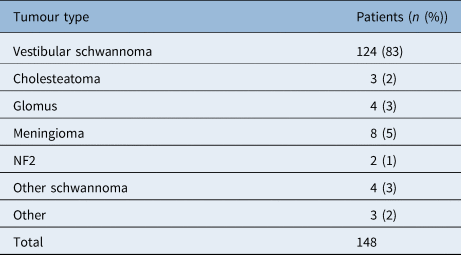
Of the 1515 patients in the national lateral skull base service, 148 were enrolled in the virtual telephone clinics. The vast majority (n = 124, 83 per cent) of these were vestibular schwannoma cases, with the remainder being either meningiomas, paragangliomas, other schwannomas or cholesteatomas (Table 1).
Type of tumours

Scan results
Most patients (76 per cent) received the results of their scans sooner in the virtual telephone clinics when compared with the face-to-face clinics. The mean time from scan day to receiving results was 30.5 ± 32 days in the virtual telephone clinic group and 44.4 ± 31 days in the face-to-face group. This difference was statistically significant (p = 0.0016). This time includes delays in uploading scans from hospitals not performed at our tertiary hospital and delays as a result of scans being performed earlier than expected.
Travel distance
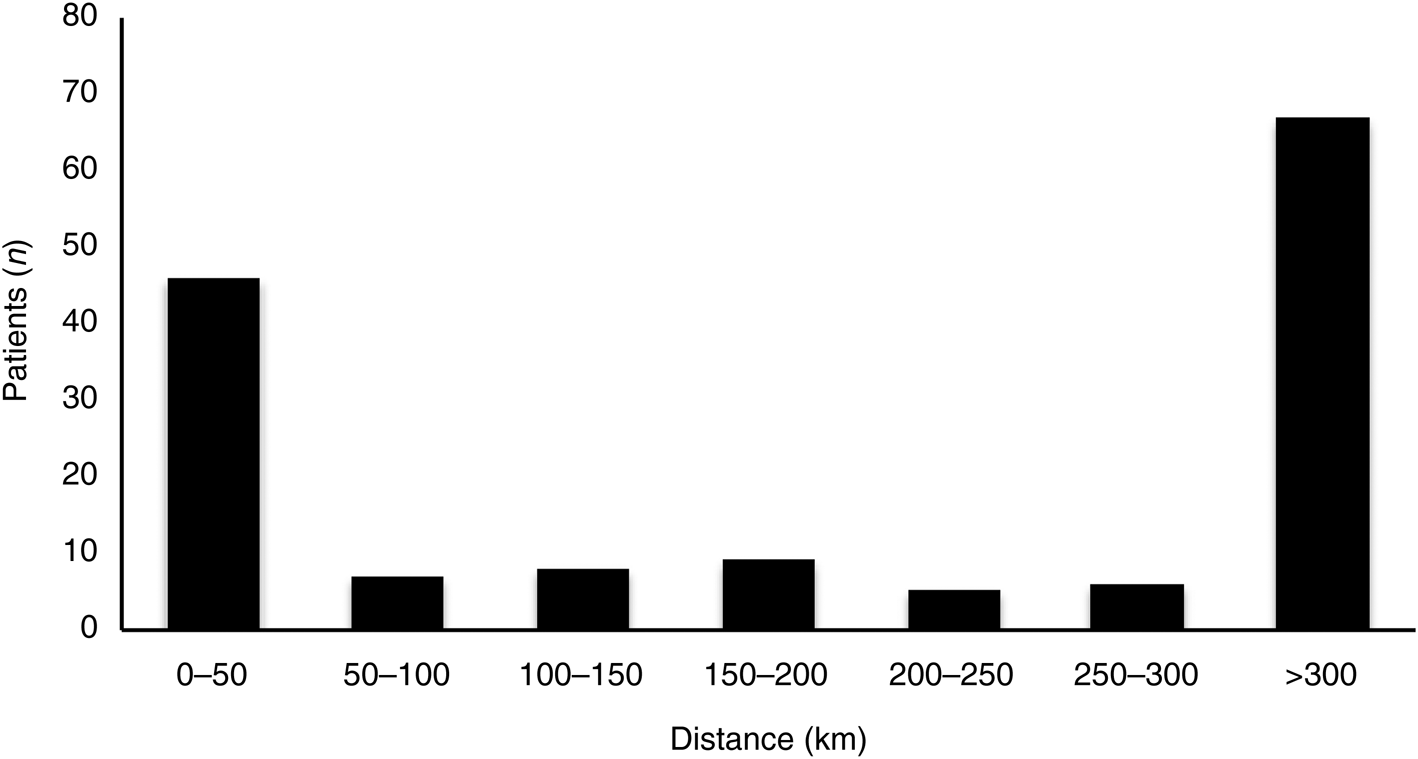
The average round-trip distance travelled by patients to the hospital for the results of their scans was 256 ± 131 km. Distances ranged from 10 to 518 km. Thirty per cent of patients travelled a round-trip distance of less than 50 km, whereas 40 per cent of patients travelled distances greater than 300 km (Figure 1).
The average round-trip distance travelled by patients to the hospital for their scan results.

Clinic numbers
Over the course of the last year, 148 patients were enrolled in the virtual telephone clinics. This made up 23 per cent of all patients reviewed at the neuro-otology and skull base MDT. The average number of patients reviewed in the virtual telephone clinics was 12 ± 5 patients per month, compared to 40 ± 15 patients in the face-to-face clinics. This means that introduction of the virtual telephone clinics reduced the number of patients needing to be seen in face-to-face clinics by up to 30 per cent. Since the introduction of the virtual telephone clinics, numbers have been progressively increasing as more patients are enrolled.
Discussion
The aim of this study was to demonstrate the impact and benefit of a virtual telephone clinic in following-up patients with stable lateral skull base tumours in order to help reduce clinic numbers, increase access to new patients, and reduce the impact of travel time and distance for the patients.
The natural course of benign lateral skull base tumours is variable, ranging from growth, to no change to rare spontaneous involution. For those that are slow growing, small, or in patients with poor performance status or patient preference, a ‘wait and scan’ approach can be utilised.Reference Zou and Hirvonen4 This approach potentially avoids the need for surgery and its associated risk and complications. Furthermore, in a study by Jufas et al. in 2015 comparing patients treated with microsurgical excision against those managed with ‘wait and scan’, quality of life scores were better in those treated conservatively when compared with those treated with surgery.Reference Jufas, Flanagan, Biggs, Chang and Fagan17 The main troublesome symptom in the surgical group was disequilibrium. Kim et al. found no significant difference in quality of life scores in patients managed conservatively when compared with those treated surgically.Reference Kim, Jin Roh, Oh, Chang and Moon18 Thus, a conservative approach with serial scanning is a viable alternative for patients with vestibular schwannoma.
With these patients requiring serial scans over the course of up to 15 years with care often coordinated through single, centralised tertiary referral centres, the travel, time and money implications for these patients can be great. With this in mind, we sought to implement a clinical nurse specialist led virtual telephone clinic. This was an attempt to not only reduce the distance that patients have to travel but also reduce the time until patients receive their results and help reduce numbers in face-to-face clinics and free up space for new patients.
Virtual telephone clinics have been successfully implemented in the setting of heart failure,Reference Andres, Talha, Zulfiqar, Hajjam, Erve and Hajjam15 have reduced re-admission rates in patients with chronic diseasesReference Jayakody, Bryant, Carey, Hobden, Dodd and Sanson-Fisher14 and increased access to cancer care support.Reference Liptrott, Bee and Lovell16 Furthermore, nurse-led telephone clinics have also been shown to enhance the process of care, increase patient satisfaction and reduce out-patient waiting times.Reference Oberg and Price12,Reference Casey, Powell, Braithwaite, Booth, Sizer and Corr13 However, these strategies have not been utilised in the follow up of benign lateral skull base tumours to date.
In our patient cohort of 148 patients enrolled in our virtual telephone clinics, the average round-trip distance to travel to the single tertiary referral centre in Ireland was 256 km. Thirty per cent of patients travelled from within the same county, travelling less than 50 km, whereas 40 per cent of patients travelled distances in excess of 300 km (Figure 1). For these patients, receiving their results via the virtual telephone clinics not only has significant time-saving benefits but also avoids patients having to take a day off from work to travel to the hospital. Anecdotal evidence shows a significant improvement in patient satisfaction and is the subject of on-going research.
Most patients enrolled in the virtual telephone clinics (76 per cent) received their scan results earlier than the patients in the face-to-face clinics. The average time in days between when the scan was performed and when patients received their results was 44 days prior to the virtual telephone clinics, compared with 32 days after enrolment. Some patients (3) did not receive their results in excess of 150 days; however, this was mainly because of patients not informing our clinical nurse specialist when their scan had been completed or they were temporarily unavailable by telephone or similar. These delays are likely early glitches of implementation of the virtual telephone clinics and have been subsequently addressed. Hence, no patients in the latter 4 months received their scan results any later than 28 days. Some of the delays associated with informing patients of their scan results were also related to delays in getting scans uploaded from outside hospitals and delays in periods where no MDTs took place (e.g. Christmas).
Finally, the virtual telephone clinics comprised 23 per cent of patients reviewed in the neuro-otology and skull base MDT. This nurse-led intervention thus reduced the number of patients requiring face-to-face consultation with a physician by an average of 10 patients per month. These additional consultation slots can instead be utilised for new patients or patients requiring surgical intervention. Patients in the virtual telephone clinics all had the option to be booked in for a face-to-face consultation if any issue arose. With increasing out-patient waiting times and pressures on the healthcare system, such interventions can have a significant impact on making a more efficient and productive delivery of healthcare services.
• For stable lateral skull base tumours, a ‘wait and scan’ approach can be used for follow up
• To reduce the distance that patients have to travel to receive results of their surveillance scans, a virtual telephone clinic can be used
• Using a virtual telephone clinic, patients reduced their distance travelled to receive their results and also received their scan results sooner
In lateral skull base tumours that are stable over time, a ‘wait and scan’ approach can be utilised. For patients receiving serial scans for surveillance of their stable lateral skull base tumour, a virtual telephone clinic was introduced at our national tertiary centre for management of neuro-otology and lateral skull base tumours, with the aim of reducing distance travelled and time spent by patients receiving their results. This clinical nurse specialist led clinic has led to a significant reduction of time until patients received the results of their scan, helped reduce travel distance and clinic numbers in traditional face-to-face clinics. Such interventions have significant potential to help reduce clinic waiting times and make for a more productive and efficient delivery of healthcare services.
Competing interests
None declared