Implications
Low rates of perinatal lamb survival reduce the productivity of sheep enterprises and are a welfare concern. This study showed that feeding caffeine to lambing ewes reduced lamb mortality to marking age from 30% to 9% for lambs born during the 1st week of supplementation, but not during the 2nd week when poor weather conditions occurred. Caffeine supplementation using the technique described could be used by commercial producers in appropriate environmental and market conditions to improve production, profit and lamb welfare, if further research confirms its effectiveness and if caffeine becomes regulated for use.
Introduction
Lamb mortality is a major source of reproductive inefficiency in Australian flocks (Kleemann and Walker, Reference Kleemann and Walker2005) with average rates of mortality of 10% for lambs born as singles and 30% for those born as twins (Hinch and Brien, Reference Hinch and Brien2014). With a current breeding ewe flock of 39.4 million (ABS, 2016), the potential annual loss in income is $1b (10 million lambs worth $100 each). Most perinatal lamb deaths occur within 3 days of birth (Dennis, Reference Dennis1974; Hinch et al., Reference Hinch, Davis, Crosbie, Kelly and Trotter1986), and the main causes are the starvation/mismothering/exposure (SME) complex, and dystocia (Haughey, Reference Haughey1981). Dystocia is likely to contribute to deaths from SME because lambs which survive the birth process but have suffered a more difficult birth have a reduced ability to thermoregulate (Darwish and Ashmawy, Reference Darwish and Ashmawy2011), and behaviour may be impaired such that they take longer to stand and suckle (Dwyer, Reference Dwyer2003), this delay increasing the risk of exposure in adverse weather (Alexander et al., Reference Alexander, Lynch, Mottershead and Donnelly1980; Haughey, Reference Haughey1980).
Hypoxia, which is associated with the duration of parturition, has been reported to occur in 32.9% of lambs born, and occurs at a higher frequency in twin rather than single-born lambs (Dutra and Banchero, Reference Dutra and Banchero2011). Brain injury may occur in lambs which survive a difficult birth, with increased neuronal damage occurring hours or days after birth (Inder and Volpe, Reference Inder and Volpe2000; Gunn and Bennet, Reference Gunn and Bennet2009). However, not all lambs experiencing hypoxia develop brain injury, and there is potential for preventive strategies (Inder and Volpe, Reference Inder and Volpe2000). Effective means of either preventing or treating the effects of difficult births are therefore likely to substantially improve the survival of newborn lambs.
Caffeine is used to treat apnoea in pre-term humans (Schmidt et al., Reference Schmidt, Roberts, Davis, Doyle, Barrington, Ohlsson, Solimano and Tin2006) and has been shown to reduce the mortality rates of pre-term infants when administered within 0 to 3 days of birth (Park et al., Reference Park, Lim, Chung, Chung, Kim and Kim2015). The key mechanism through which caffeine is thought to be effective is via its action as an adenosine antagonist, thereby improving cerebral oxygenation and countering hypoxia (for review see Park et al., Reference Park, Lim, Chung, Chung, Kim and Kim2015). Other adenosine antagonists have been shown to reduce the metabolic response to hypoxia in lambs (Koos et al., Reference Koos, Kawasaki, Kim and Bohorquez2005). Caffeine also appears to have anti-inflammatory effects which may improve immune function (Horrigan et al., Reference Horrigan, Kelly and Connor2006), with the effect being dose-dependent (Herlenius, Reference Herlenius2011). Caffeine appears to have a neuroprotective effect, as caffeine supplemented to lactating mice protects the brain of suckling newborns from hypoxia-related brain injury (Back et al., Reference Back, Craig, Ling Luo, Ren, Akundi, Ribeiro and Rivkees2006). Improved metabolism has also been shown in newborn hypoxic piglets after treatment with caffeine (Orozco-Gregorio et al., Reference Orozco-Gregorio, Mota-Rojas, Bonilla-Jaime, Trujillo-Ortega, Becerril-Herrera, Hernández-González and Villanueva-García2010), although growth rates may be reduced with excessive dose rates (Orozco-Gregorio et al., Reference Orozco-Gregorio, Bonilla-Jaime, Mota-Rojas, Trujillo-Ortega, Roldan-Santiago, Martínez-Rodríguez, Borderas-Tordesillas, Flores-Peinado, Mora-Medina and Ramírez-Necoechea2012). Caffeine mixed with the feed of sows on the day before an induced parturition improved piglet thermoregulatory ability, and tended to improve the viability of piglets; piglet survival, however, was not increased (Superchi et al., Reference Superchi, Mazzoni, Zanardelli, Piancastelli, Zambini, Beretti and Sabbioni2013). Post-birth injection with caffeine has also reduced the duration of apnoea in 7-day-old pre-term lambs (St-Hilaire et al., Reference St-Hilaire, Samson, Nsegbe, Duvareille, Moreau-Bussière, Micheau, Lebon and Praud2007). These studies indicate a potential for caffeine to be used to mitigate the effects of hypoxia in lambs. However, there is conflicting data for sheep, with an invasive experiment in sheep (instrumented foetuses) where caffeine administration to pregnant ewes resulted in a reduction in cerebral oxygenation of the lamb foetus (Tomimatsu et al., Reference Tomimatsu, Lee, Pereyra Peña, Ross, Lang and Longo2007).
The effect of caffeine supplementation to pregnant ewes on the survival of their lambs has not been studied, despite the potentially large benefits. In grazing ewes, single dose supplementation at a particular time relative to parturition is not practical in commercial flocks where lambing occurs over several weeks and ewes cannot be mustered during this time. This situation necessitates repeated daily dosing of the flock, with can only practically be achieved, currently, through feeding a supplement. Such a strategy may be effective provided the necessary repeated dosing of ewes does not have adverse impacts. The aim of this study was to evaluate whether feeding caffeine to ewes during the lambing period would increase lamb survival in a flock managed under normal commercial conditions.
Material and methods
Location and design
An Australian provisional patent has been filed (patent no. 2016904569) for the method and concepts described. An experiment was conducted with the approval of the Charles Sturt University Animal Ethics committee during 2016 (project A16009) on a commercial property (34°48'S; 147°26'E) 40 km north of Wagga Wagga, NSW. The experiment included two treatments with three replicates of each. The caffeine treatment was ewes fed caffeine daily from 1 day before the first lamb was born, for 14 days, with lambing occurring over a 6-week period, and the control was not supplemented with caffeine during the same period.
The design was a randomised block, using three paddocks as replicate blocks which were subdivided to provide paddocks for each treatment. Replicate 1 grazed 17 ha paddocks containing annual grasses, subclover (Trifolium subterraneum) and lucerne (Medicago sativa); replicate 2 grazed 11 ha paddocks containing oats, subclover and annual grasses; and replicate 3 grazed 7 ha paddocks containing annual grasses, with a large quantity of dead pasture.
Management
A flock of mature (2.5 to 6.5 years when mated, 81% of ewes were 2.5 or 3.5 years) Merino ewes which had been joined with Merino rams between 14 February and 26 March was used. All ewes had been mated annually from 1.5 years of age. Ewes (n=492) which had been determined to be pregnant using trans-abdominal ultrasound, or which by abdominal size were considered likely to be pregnant, were stratified on age, then randomly allocated to replicates and treatments (n=82 ewes/group) on 6 July, before the expected start of lambing on 14 July. Unfasted live weights and body condition score (scale 0 (emaciated) to 5 (obese)) (Jefferies, Reference Jefferies1961) of ewes was recorded before ewes were placed in paddocks. Numbered plates were tied around their necks for identification during lambing.
Lambing commenced the day after caffeine supplementation began, and is defined as day 1 of the lambing period. During the lambing period, the ewes were checked once daily each morning. Newborn lambs were identified to their mothers, eartagged and their sex recorded. Assistance to deliver lambs was provided to ewes if it appeared unlikely that she could deliver and her life was at risk, such as if the lambs’ head was swollen or tongue blue, or there was other obvious malpresentation, and assistance recorded. The day dead lambs were found was recorded, and these lambs removed from paddocks, weighed, and a postmortem examination conducted (McFarlane, Reference McFarlane1965) to determine the cause of death, with lambs which had not breathed fully being classified as ‘born dead’. When lambing was complete the sheep were brought to yards (1 to 3 September, 2016), the ewes were weighed (unfasted) and body condition scored, and the weight of lambs recorded. The survival of lambs to marking age was determined by presence at this time, as all lambs which died earlier may not have been found.
Feeding
An oral supplementation method for caffeine which was potentially suitable for commercial application was used. Caffeine was fed to the supplemented treatment groups for 14 days from 15 July (1 day before the first lamb was born) to 28 July, as this was expected to achieve supplementation to ~80% of ewes on the day before lambing if the ewes were all naturally cycling at the start of joining. Caffeine (96.8±5.1% SD purity; Wild Distributions) was fed at a rate of 1.6 g/ewe per day, based on a rate of 25 mg/kg live weight (mean 63 kg) on 6 July, with an estimated rate of 20 mg/kg at term. This rate was chosen as it is the rate widely used in treatment of human infants, and repeated daily dosing of pregnant ewes has not shown adverse effects on the lambs (Atik et al., Reference Atik, Cheong, Harding, Sa, De Matteo and Tolcos2014).
To facilitate caffeine intake, the ewes were introduced to barley grain from 7 July. During the period of caffeine supplementation, the caffeine was mixed into a molasses and water (3:1) solution, and this was mixed with barley grain (320 g/ewe per day) in a cement mixer. The same quantity of barley grain and molasses solution was mixed and fed to control ewes. The supplement was placed in 12.5 m troughs in each paddock to minimise wastage, and feed refusals were collected daily. Ewes without newborn lambs were encouraged to the feed troughs, if they did not come directly, to minimise the risk of individuals achieving excess intake of either caffeine (toxicity) or barley (acidosis). Replicate 3 ewes were also given a magnesium supplement for the duration of the lambing period due to the lack of legumes in the pasture, provided in lick blocks (Olssons Beefmaster grass tetany blocks; Olssons, Yennora, NSW, Australia) which were constantly available in each paddock.
Pasture and weather measurements
The quantity (dry matter (DM)) of live pasture available was estimated on 7 July 2016 before the lambing period. The visual estimation method of Haydock and Shaw (Reference Haydock and Shaw1975) was used, with 60 visual estimates taken in a diagonal transect across each paddock. The estimates were calibrated against 20 quadrats cut at ground level with electric clippers. Weather data (temperature, wind speed) was accessed from the Wagga Wagga airport meteorological station (no. 072150) (www.bom.gov.au/climate), ~40 km south of the experimental site. Rainfall data were recorded manually on the experimental site.
Analysis of caffeine purity
Caffeine was analysed by ultra performance liquid chromatography (UPLC) using a 1290 UPLC with diode array detector (Agilent, Sydney, Australia) fitted with a Kinetex C18 50×3 mm×2.6 µm column (Phenomenex, Sydney, Australia). Gradient elution was achieved with 0.1% formic acid in water (solvent A) and acetonitrile (solvent B) at a flow rate of 0.5 ml/min. The gradient started at 10% solvent B for 0.1 min, reaching 70% after 2 min, holding for 0.2 min and returning to 10%. The column was equilibrated for 2 min before the next injection. The injection volume was 10 µl and the absorbance was measured at 276 nm. The caffeine calibration range was 1 to 6 µg/ml and prepared from a pure caffeine standard. Six replicate samples were prepared by dissolving 30 to 100 mg of caffeine sample in 10 ml of 70:30 methanol–water. Each solution was individually diluted 2000-fold using serial dilution with 70:30 methanol–water to provide sample concentrations in the range of 1.5 to 5 µg/ml.
Statistical analyses
Data for ewes which gave birth to triplets were excluded as the numbers were small and differed between treatments (11 caffeine, six control). For all ewes for which a lambing record was available, 43%, 53% and 4% gave birth to singles, twins and triplets, respectively. Data for two lambs which were born with fatal congenital deformities, one lamb which was born as a twin to a mummified foetus, and three lambs dying due to fox predation were excluded. Lambs for which birth type (single or twin) or date of birth was not determined were also excluded from all analyses. Data for 474 ewes (45% giving birth to singles, 55% to twins) and 701 lambs (29% born as singles, 71% born as twins) were available for analysis.
Before analysis, data were assessed for assumptions of normal distribution and homogeneity using Genstat® 16th edition (VSN International, 2013). Data comparing proportions were analysed using generalised linear mixed modelling using a binomial distribution. The proportion of ewes giving birth to twins was analysed with treatment as the model fitted and replicate as the random term. The proportion lamb mortality was analysed with treatment×birth type×week of birth as the model fitted and replicate+day of lambing (where day 1=the day the first lamb was born) as the random effect. Age of ewe and sex of lamb were also initially included as fixed effects but were removed as not significant. The effect of replicate on lamb mortality was assessed using the same fixed effects, and day of lambing as the random effect. The logit transformation meant standard errors for backtransformed means were not available. Available live pasture, ewe weight and body condition score were analysed using linear mixed modelling, with treatment×time, where relevant, as the fixed and replicate as the random effects. Changes in ewe weight and body condition score were also analysed using linear mixed modelling, with treatment as the fixed and replicate as the random effects. Lamb weight at marking was analysed using linear mixed modelling using birth-rear class (single, twin, twin reared as single)+treatment×period of supplement (born during the first 2 weeks of lambing or later) as the fixed effect, and replicate as the random effect. A P-value of 0.05 was considered significant. Results are presented as means ± SEM.
Results
Weather conditions and availability of pasture
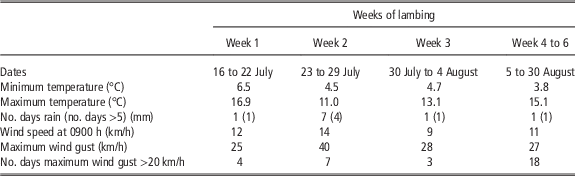
Cold, windy weather occurred during the 1st week of lambing. However, conditions declined for the entire 2nd week of lambing, with cooler temperatures, strong winds and rain falling on all days (Table 1), and a sheep graziers alert (indicating high chill conditions and risk to sheep) being issued by the Bureau of Meteorology. Subsequent weeks remained cool but wind speeds and the occurrence of rainfall declined. The quantity of live pasture available pre-lambing did not differ (P=0.334) between the caffeine (767±189 kg DM/ha) and control (742±189 kg DM/ha) plots.
Mean daily weather conditions during weekly lambing periods

Ewe weight and body condition score
The mean unfasted live weight of ewes did not differ between treatments and the interaction with time was not significant (P=0.053), although there was a numerical trend for control ewes to be 1.4 kg lighter than caffeine ewes post-lambing, but not pre-lambing. The ewes were heavier (P<0.001) before lambing (62.7±1.30 kg) compared with after the lambing period (60.7±1.30). The mean weight loss over the lambing period was less (P=0.006) in the caffeine (−1.2±1.86 kg) than in control ewes (−2.8±1.86 kg). The mean body condition score of ewes was also similar between treatments, and was 3.1±0.07 pre-lambing and 3.0±0.07 post-lambing. The loss in body condition score over the lambing period did not differ (P=0.628) between treatments (caffeine −0.1±0.12; control −0.1±0.12).
Supplement intake
All supplement was consumed in replicates 1 and 3 during the period of caffeine supplementation. In replicate 2, control ewes consumed all of the supplement, but caffeine ewes only consumed approximately half of their feed −155±18 g barley and 0.8±0.09 g caffeine per day. The majority of ewes appeared to consume supplement daily in replicates 1 and 3, whereas in replicate 2 a larger portion of ewes may not have consumed the supplement due to the large quantity of live pasture in that replicate reducing the interest of ewes in grain.
Lamb production and weight of lambs
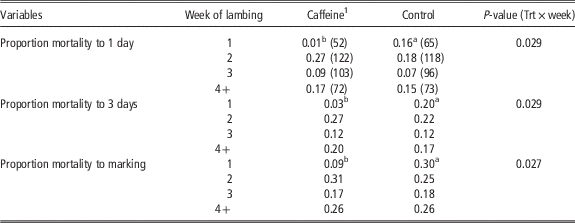
The ewes commenced lambing on 16 July, with the last lambs born on 25 August (day 41 of lambing). The percentage of ewes which lambed during weeks 1, 2, 3 and 4+ (4 to 6) was 16%, 34%, 28% and 22%, respectively. The proportion of ewes giving birth to twins was 0.57 and 0.54 (P=0.442) in the caffeine and control treatments, respectively. The proportion of lambs dying to day 1, day 3 or marking age was lower (P<0.006) for single compared with twin-born lambs, but the interaction with either treatment or week of birth was not significant. The mean proportion mortality to marking was 0.13 and 0.18 (n=98, 104) for singles, and 0.26 and 0.33 (n=251, 248) for twins in caffeine and control treatments, respectively. The mean proportion mortality to marking for lambs born in week 1 of lambing was 0.06 and 0.28 (n=16, 11) for singles, and 0.13 and 0.38 (n=36, 54) for twins in caffeine and control treatments, respectively.
Birth type was therefore included as a covariate with treatment×week of birth as the model. The proportion mortality to day 1 for singles (0.08) was lower (P<0.001) than for twins (0.16), and mortality to marking age of singles (0.16) was also lower (P<0.001) than that of twins (0.30). The proportion mortality of lambs to day 1, day 3 or marking age was 15%, 17% and 21% lower (P<0.05), respectively, in the caffeine compared with the control treatment for lambs born in week 1 of lambing, but not in later weeks, as shown in Table 2.
Proportion mortality of lambs to 1 or 3 days after birth (tagging), and to marking age for lambs born in weeks 1 to 4+ from the start of lambing

Number of lambs in brackets.
a,b Values within a row with different superscripts differ significantly at P<0.05.
1 Supplement was fed during weeks 1 and 2 of lambing.
The mortality of lambs to marking age did not differ (P=0.218) between replicates, and there was no interaction (P=0.976) between treatment and replicate nor treatment, replicate and week of birth (P=0.673) despite replicate 2 ewes consuming only half the caffeine dose. The proportion mortality to marking age for lambs born in week 1 of lambing was 0.06, 0.06 and 0.14 for caffeine treatments in replicates 1 to 3, respectively. For the control treatment, mortality was 0.23, 0.46 and 0.32 for replicates 1 to 3, respectively. The proportion of lambs born alive (breathed fully) during the period of supplementation (weeks 1 and 2 of lambing) did not differ between the caffeine (0.97) and control (0.97) treatments, and did not differ from that of lambs born in later weeks (0.99 caffeine, 0.98 control), with no interaction between treatment and period (P=0.425).
Assistance to deliver lambs was required by two caffeine and three control ewes during the first 2 weeks of lambing, the period of caffeine supplementation. After this period, a further two caffeine ewes and three control ewes required assistance for delivery. A total of eight ewes died during the lambing period, comprised of three control ewes and five caffeine ewes. Prior dystocia was considered to have contributed to the deaths of three of the caffeine treatment ewes, but none of these deaths occurred during the period of caffeine supplementation. Prolapsed intestines caused one death in the caffeine treatment, whereas the cause of the other death was unclear.
The live weight of lambs at marking age varied (P<0.001) between birth and rearing classes, and was heaviest in lambs born and reared as singles (14.9±0.63 kg), less in lambs born as twins but reared as singles (13.3±0.66 kg), and least in lambs born and reared as twins (10.7±0.62 kg). The live weight of lambs at marking age was higher (P=0.042) in the caffeine treatment (13.2±0.62 kg) compared with control lambs (12.7±0.62 kg).
Discussion
This is the first study to suggest that feeding caffeine to ewes can improve the survival of their lambs. Lamb mortality to marking was reduced from 30% to 9% by feeding caffeine to ewes for lambs born during the 1st week of lambing. Survival was not improved during the 2nd week of supplementation, however, this is considered due to the overwhelming influence of windy, wet, weather throughout that week. Rainfall combined with strong winds of the level experienced can lead to the deaths of 91% of lambs born (Obst and Day, Reference Obst and Day1968) due to lambs being unable to maintain adequate heat production for long periods (Alexander, Reference Alexander1962). Such weather usually kills lambs soon after birth, but lambs up to 2 days of age are also susceptible (Alexander et al., Reference Alexander, Lynch, Mottershead and Donnelly1980). However, further studies are needed to confirm any benefit of caffeine to lamb survival in a range of conditions.
The lack of a reduction in lamb mortality due to caffeine in week 2 of lambing is unlikely to be due to an adverse impact of caffeine accumulation in lambs. The short half-life of caffeine in both ewes and lambs (Wilson et al., Reference Wilson, Ayromlooi and Errick1983; Danielson and Golsteyn, Reference Danielson and Golsteyn1996) means that caffeine levels in lambs would have been similar in both weeks. Caffeine administered to piglets post-birth has increased mortality to 1 day of age, with increased energy expenditure a possible cause where stored energy levels are low (Nowland et al., Reference Nowland, Dearlove, Kind and van Wettere2016). In our study, caffeine inducing earlier depletion of energy stores may have contributed to the lack of reduction of lamb mortality in week 2 of lambing due to the cold weather increasing energy expenditure. However, further studies are needed to confirm this.
Lamb mortality was not reduced by caffeine in week 3 of lambing, after caffeine supplementation had ceased. This result was as expected, based on pharmacokinetics. Caffeine has a terminal elimination half-life of 8.9 h in sheep (Danielson and Golsteyn, Reference Danielson and Golsteyn1996). After drug administration is discontinued, the concentration in the body declines exponentially and by four half-lives (total 36 h for caffeine in sheep), its concentration is <10% of that achieved during dosing. The lack of any effect of caffeine on the mortality rate in week 3 is consistent with caffeine washout resulting in little or no drug remaining (beyond sub-therapeutic residue levels) in the dam and foetus to cause an effect.
Any reduction in lamb mortality in week 3 due to earlier caffeine feeding is unlikely to have been masked by poor weather as the rate of mortality for control lambs in week 3 was lower than that in weeks 1 or 2, probably associated with an improvement in weather conditions. Therefore, the lack of benefit of caffeine in week 3 suggests that caffeine supplementation was only effective when ewes were fed caffeine on the day of or some hours before parturition, and that there is limited, if any, longer-term benefit to lamb survival. However, this needs further study. Our results are consistent with studies which show that treatment with non-selective adenosine antagonists is more effective in reducing brain injury if provided soon before, rather than after, an hypoxic event (Bona et al., Reference Bona, Ådén, Gilland, Fredholm and Hagberg1997).
Importantly, the similarity of mortality in both treatments in week 3 and later also indicates that there was no adverse effect on lamb survival of a 14-day supplementation period during late pregnancy. A single dose may give a different response than repeated dosing. The similarity of marking weights of surviving lambs, and the lack of impact on ewe weight and condition also indicate the safety of at least a 14-day period of supplementation. Further studies are needed over longer periods, if it is assumed that feeding throughout the whole lambing period may occur in order to supplement all ewes on the day of lambing.
The cost-effectiveness of a longer period of supplementation will depend on the value of additional lambs, level of increase in survival, cost of feed carrier and cost of caffeine. Caffeine is inexpensive to purchase in commercial bulk quantities, and the feeding technique would be highly profitable at current high sheep values if the same level of increase in survival as obtained in week 1 was obtained over 2 or 3 weeks of supplementation. Molasses was required in order to enhance palatability, as caffeine is bitter to the taste. Elimination or reduction of this bitterness, by chemical modification or some other means, would enhance palatability and reduce overall feed costs.
The mechanism by which lamb mortality was reduced was not examined in this study. However, as the number of lambs born alive did not differ, it is clear that most of the benefit was through increasing survival in the 1st day after birth. This timing is consistent with an improvement in either response to hypoxia, or some other short-term metabolic or behavioural adaptation to the post-uterine environment. Hypoxia is more likely to occur during or as a result of prolonged parturition and may result in reduced suckling drive (Dutra and Banchero, Reference Dutra and Banchero2011). Difficult or prolonged parturition result in reduced sucking drive and increased mortality (Darwish and Ashmawy, Reference Darwish and Ashmawy2011). Hypoxic-ischaemic events due to parturition can lead to brain injury with continuing neuronal damage occurring hours or days after birth (Inder and Volpe, Reference Inder and Volpe2000; Gunn and Bennet, Reference Gunn and Bennet2009), disrupting various functions. Although death may result from an inability to obtain milk, death can also result from an inability to maintain thermoregulation (Wood and Gonzales, Reference Wood and Gonzales1996), or from failure of respiration (Porciúncula et al., Reference Porciúncula, Sallaberry, Mioranzza, Botton and Rosemberg2013). Further studies are needed to clarify which mechanisms may have impacted on lamb survival.
In the current study it is likely that caffeine reduced lamb mortality largely from caffeine absorbed before birth and any brain/birth injury, rather than from caffeine in maternal milk. Caffeine is rapidly transferred from the maternal circulation to the foetus via the placenta (Atik et al., Reference Atik, Cheong, Harding, Sa, De Matteo and Tolcos2014). Although caffeine transferred to newborns via the maternal milk is known to have some beneficial impacts on the newborn (Bodineau et al., Reference Bodineau, Saadani-Makki, Jullien and Frugière2006), and caffeine intake only post-birth may have potential to reduce continuing brain injury or alter metabolism or behaviour, the intake of caffeine in milk is low due to the low quantity of milk consumed. Caffeine readily crosses into ewes milk, so that the concentration in milk is similar to that in ewe plasma (DeGraves et al., Reference DeGraves, Ruffin, Duran, Spano, Whatley, Schumacher and Riddell1995). The low intake of caffeine by lambs via milk is a function of dilution; if daily milk consumed is 20% of lamb BW, the daily caffeine intake from milk consumed by the newborn lamb will be distributed throughout the lambs’ body resulting in much lower serum levels than in the dam. Further studies are needed to clarify pre v. post-birth effects in order to develop the most cost-effective and safe administration practices.
Studies with pigs have shown an improvement in metabolic indicators related to hypoxia, but not survival. Caffeine administered to piglets within 24 h after birth has reduced survival (Nowland et al., Reference Nowland, Dearlove, Kind and van Wettere2016), and caffeine fed to sows before induced parturition also has not improved piglet survival (Superchi et al., Reference Superchi, Mazzoni, Zanardelli, Piancastelli, Zambini, Beretti and Sabbioni2013), despite improved metabolic variables. Other studies have shown that brain injury such as may be acquired as a result of parturition can be reduced without apparent change in various metabolic variables (Bona et al., Reference Bona, Ådén, Gilland, Fredholm and Hagberg1997). Further studies are required if the mechanism leading to improved survival of lambs in the current study is to be determined, although a range of potential mechanisms for caffeine are reviewed elsewhere (Blood et al., Reference Blood, Hunter and Power2003; Horrigan et al., Reference Horrigan, Kelly and Connor2006; Porciúncula et al., Reference Porciúncula, Sallaberry, Mioranzza, Botton and Rosemberg2013).
The dose rate used in this study is consistent with that used elsewhere. Dose-response studies will need to be conducted to establish the effective dose of caffeine to be given. If a dose rate of <20 mg/kg is found to be equally effective (as replicate 2 findings effectively dosed at 10 mg/kg suggests) then cost would be reduced considerably. Supportive of a lower dose rate, studies with rats have shown that a single 10 mg/kg dose of caffeine, before a 48-h period of excess oxygen, was sufficient to prevent brain damage (Endesfelder et al., Reference Endesfelder, Zaak, Weichelt, Bührer and Schmitz2014).
Although the method of feeding caffeine used in this study is commercially feasible, more user-friendly methods are desirable which are less labour intensive and remove the risk of pure caffeine dust being inhaled by the operator. Caffeine has good heat stability (Budryn et al., Reference Budryn, Nebesny and Rachwał-Rosiak2013) therefore incorporation of caffeine into commercially manufactured feed supplement would be a simple option. Feeding methods such as lick blocks or rumen bolus, which avoid the potential mismothering of lambs at feeding time, would also make the practice more likely to be adopted by producers. Feeding caffeine is also likely to improve the survival of newborn goats, as the time and cause of death in kids is similar to that of lambs (Dwyer et al., Reference Dwyer, Conington, Corbiere, Holmøy, Muri, Nowak, Rooke, Vipond and Gautier2015). Likewise, caffeine may be beneficial in cattle, if it reduces the impact of hypoxia, as dystocia is a major cause of calf mortality (Hickson et al., Reference Hickson, Morris and Kenyon2006).
Conclusion
The mortality of lambs to marking age was reduced from 30% to 9% by oral supplementation with caffeine to ewes during a week of the lambing period, and the benefit was evident in both twin and single-born lambs. Supplementation was not effective in high chill weather conditions which caused large increases in mortality, and there was no benefit once supplementation ceased. The technique of caffeine supplementation used in this study is suitable for commercial sheep enterprises, and may have the potential to substantially improve lamb survival when used in appropriate conditions. Although caffeine supplementation is low cost, producers would need to consider the value of extra lambs, and feed costs to evaluate whether caffeine supplementation may be cost-effective. However, before use can be recommended, further studies to confirm the effectiveness and determine any adverse effects on the ewes or lambs, and to develop the most cost-effective administration strategy, should be performed. Usage must also be regulated.
Acknowledgements
The voluntary assistance of numerous students with field work is gratefully acknowledged. This study was funded by a new initiative grant from the Graham Centre for Agricultural Innovation.