Antibiotic resistance among Gram-negative bacteria is a growing global concern due to increasing rates of resistance and a relatively static armamentarium of potentially effective antibiotics.Reference Boucher, Talbot and Bradley 1 – Reference Logan, Braykov, Weinstein and Laxminarayan 3 With many first-line agents rendered ineffective, clinicians often turn to older and broader-spectrum antibiotics reserved for the treatment of infections due to these resistant organisms.Reference Hsu and Tamma 4 , Reference Qin, Galanakis, Zerr and Weissman 5 While the use of some “reserved” agents is monitored by many antimicrobial stewardship programs (ASPs), few data are available on their overall use in the United States, especially in pediatrics.Reference Kadri, Hohmann and Orav 6 , Reference Tamma, Newland and Pannaraj 7 A recent multicenter study using the Pediatric Health Information System (PHIS) database demonstrated an overall decrease in antibiotic use since 2007 and a decrease in a select subset of antibiotics commonly monitored by ASPs (carbapenems, vancomycin, and linezolid).Reference Hersh, De Lurgio and Thurm 8 However, other agents used to treat resistant Gram-negative organisms were not specifically examined.
We used the PHIS database to describe trends in use of antibiotics reserved for treatment of resistant Gram-negative organisms at freestanding children’s hospitals from 2004 to 2014. We also performed an exploratory analysis to characterize factors associated with receiving reserved agents to inform future research.
METHODS
The PHIS database encompasses administrative data from 44 of the largest children’s hospitals in America. For each hospitalization, we included demographic data, operating room billing charges, intensive care unit (ICU) admission, severity of illness as assigned by the All Patient Refined Diagnosis-Related Groups (APR-DRG) classification, mortality, and systemic antibacterial exposures (intravenous, oral, or intramuscular). We determined the presence of complex chronic conditions (CCC) using previously validated PHIS flags based on International Classification of Diseases, Ninth Revision (ICD-9) codes.Reference Feudtner, Feinstein, Zhong, Hall and Dai 9 Additionally, we included the presence of vesicoureteral reflux as defined by ICD-9 diagnosis codes 593.70–593.79, which is not captured in the CCC algorithm.
Antibiotic Exposure
Based on spectrum of activity and use for resistant Gram-negative infections, we defined reserved antibiotics as carbapenems (doripenem, ertapenem, imipenem, and meropenem), colistin, polymyxin B, tigecycline, minocycline, fosfomycin, and amikacin.
To evaluate trends in the use of reserved antibiotics, we calculated days of therapy per 1,000 patient days for each calendar year and antibiotic. Days of therapy is the aggregate sum of antibiotics a patient received, eg, 2 reserved antibiotics daily for 5 days is equal to 10 days of therapy.
Statistical Analyses
A longitudinal time trend analysis was conducted to assess patterns in the use of reserved antibiotics over time. This analysis included hospitalizations of patients aged ≤21 years discharged from the 30 PHIS hospitals contributing complete pharmacy data between January 1, 2004, and December 31, 2014. Trends in incidence rates were assessed using negative binomial regression (due to overdispersion in the data) with calendar year as the independent variable and days of therapy during each hospitalization as the dependent variable. Patient days at risk (ie, duration of hospitalization) were included as an offset term to account for varying duration of hospitalizations. Incidence rate ratios (IRRs) were used as the measure of change and were measured for all reserved antibiotics combined as well as individually. Fosfomycin was used only 3 times during the study period and was excluded from the individual antibiotic analyses. Clustered robust standard errors were used to account for the correlation between multiple hospitalizations of the same individual throughout the study period. After examining the overall trend, we conducted a post hoc analysis to quantify trends of reserved antibiotic use for the period 2004–2007 and separately for 2007–2014.
An exploratory risk-factor analysis for receipt of reserved antibiotics was performed using a nested case-control design and multivariate conditional logistic regression. Cases were defined as individuals who received reserved antibiotics during the study period. For each case, 3 patients matched by hospital and year who received only non-reserved antibiotics throughout the study period were randomly selected as controls. In the event a patient had >1 hospitalization in which reserved drugs (cases) or non-reserved drugs (controls) were received during the study, 1 hospitalization was randomly selected. Stata 12 software (version 12.0, Stata Corp, College Station, TX) was used for all analyses.
RESULTS
Rates of Reserved Antibiotic Use Over Time
Of the 3,888,152 included hospitalizations, reserved antibiotics were received in 99,802 hospitalizations (3%), only non-reserved antibiotics were received in 2,272,027 hospitalizations (58%), and no antibiotics were received in 1,516,323 hospitalizations (39%). Among hospitalizations during which a reserved antibiotic was used, a single reserved antibiotic was administered to 91% of patients, and unique patients accounted for 40% of the total. When evaluated by hospital, reserved antibiotics were used in a median of 2.8% of hospitalizations (interquartile range [IQR], 1.9%–4.34%; range, 0.66%–11.85%).
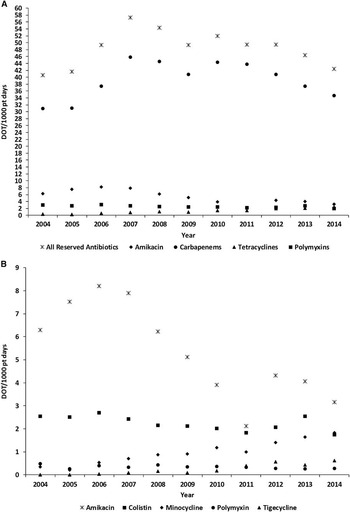
Reserved antibiotic utilization was 40.57 days of therapy per 1,000 patient days (95% confidence interval [CI], 40.26–40.88) in 2004. This use peaked at 57.27 days of therapy per 1,000 patient days (95% CI, 56.92–57.62) in 2007 and then decreased to 42.38 days of therapy per 1,000 patient days (95% CI, 42.08–42.68) in 2014 (Figure 1A). Overall, this trend represents an average increase of 2.3% annually (IRR, 1.023; 95% CI, 1.02–1.03); however, it includes an increase between 2004 and 2007 (IRR, 1.15; 95% 1.13–1.17) and a decrease thereafter (IRR, 0.99; 95% CI, 0.98–1.00). Only the use of minocycline and tigecycline increased consistently during the study (IRR, 1.18 [95% CI, 1.15–1.21] and IRR, 1.48 [95% CI, 1.36–1.60], respectively) (Figure 1B).
Days of therapy per 1,000 patient days for reserved antibiotics from 2004 and 2014 by (A) antibiotic class and (B) individually (non-carbapenems). Amikacin is included in both figures as it is the only representative of its class included in our study. DOT, days of therapy; pt, patient.

Risk Factors for Reserved Antibiotic Receipt
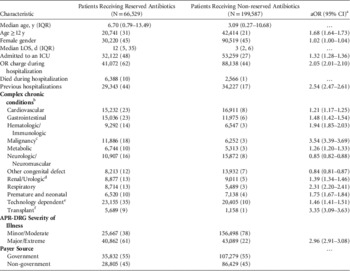
In total, 66,529 individuals receiving reserved antibiotics and 199,587 matched controls were included in this analysis. Having a major or extreme severity of illness on admission, malignancy, or history of transplantation were the strongest predictors for receiving reserved antibiotics when controlling for other factors (Table 1).
Demographics and Clinical Characteristics of Patients Receiving Reserved and Non-reserved Antibiotics from 2004 to 2014

NOTE. aOR adjusted Odds Ratio, APR-DRG, All Patient Refined Diagnosis-Related Group; CI, confidence interval; ICU, intensive care unit; IQR, interquartile range; LOS, length of stay; OR, operating room.
a Variables without adjusted odds ratios reported were not included in the multivariate model.
b Variable is not mutually exclusive.
c Variable includes neoplasms and bone marrow transplantation.
d Includes renal/urologic complex chronic condition flag in PHIS and/or ICD-9 code for vesicoureteral reflux.
e Dependence on any medical device (eg, ventriculoperitoneal shunt, tracheostomy, insulin pump, etc.)
f Includes patients who have undergone organ or bone marrow transplantation.
DISCUSSION
In our multicenter study of more than 3 million hospitalized children, rates of reserved antibiotic use increased 2.3% annually from 2004 to 2014, though this overall trend represents an increase from 2004 to 2007 and subsequent decrease between 2007 and 2014. This finding was consistent with the overall trends reported by Hersh et al and may be attributed to the impact of ASPs,Reference Hersh, De Lurgio and Thurm 8 whose implementation was recommended by the Infectious Diseases Society of America (IDSA) for all hospitals in 2007.Reference Dellit, Owens and McGowan 10
The 3 strongest factors associated with receiving reserved antibiotics in a multivariate model were having a major or extreme severity of illness, malignancy, and history of transplantation. These data suggest that these agents are used in the highest-risk patients, which is consistent with antimicrobial stewardship efforts.
This study has several important limitations. First, the PHIS database does not contain specific indications for antibiotics, so it is possible that reserved antibiotics were used to treat infections other than those caused by resistant Gram-negative bacteria. Second, because our study only included PHIS hospitals, our findings may not be generalizable to all pediatric settings. Finally, PHIS does not contain data on the features of ASPs at member hospitals. Despite these limitations, this study provides valuable insight into patterns of use of reserved antibiotics in a US pediatric setting.
In summary, between 2004 and 2014, the overall use of antibiotics reserved for the empiric or targeted treatment of resistant Gram-negative infections in freestanding US children’s hospitals included in our study increased until 2007 and subsequently decreased. Carbapenems accounted for the majority of reserved antibiotics used and were the driver of the overall decrease. Minocycline and tigecycline were used less frequently, but their use increased over time; therefore, they may be potential targets for pediatric ASPs.
Acknowledgments
Financial support: This research was supported by the University of Washington School of Medicine Medical Student Research Training Program and by the IDSA Medical Scholars Program.
Potential Conflicts of Interest: All authors report no conflicts of interest related to this article.