Introduction
For reasons that are currently unknown, conduct disorder (CD) prior to age 15 is an antecedent of schizophrenia. In 1966, Robins noted that a disproportionately high number of juvenile delinquents subsequently developed schizophrenia and recently this was confirmed in a study of all juvenile delinquents in Denmark (Gosden et al. Reference Gosden, Kramp, Gabrielsen, Andersen and Sestoft2005). Studies of children defined as high risk because of a family history positive for schizophrenia observed that a subgroup of boys displayed conduct problems in childhood and adolescence prior to the onset of schizophrenia (Asnarow, Reference Asnarow1988; Olin et al. Reference Olin, Raine, Cannon, Parnas, Schulsinger and Mednick1997). In the Epidemiological Catchment Area study that examined 20 000 persons representative of the US population, CD prior to age 15 was found to be much more common among men and women with schizophrenia than among those without a severe mental illness (Robins & Price, Reference Robins and Price1991; Robins et al. Reference Robins, Tipp, Przybeck, Robins and Reiger1991; Robins, Reference Robins and Hodgins1993). More recently, a follow-up of the Dunedin New Zealand birth cohort has reported that 40% of the cohort members who developed schizophrenic disorders by age 26 had fulfilled diagnostic criteria for CD prior to age 15 (Kim-Cohen et al. Reference Kim-Cohen, Caspi, Moffitt, Harrington, Milne and Poulton2003). In clinical samples of persons with schizophrenia, the prevalence of CD varies depending on where the sample is recruited. For example, among well-functioning individuals with schizophrenia living in the community, 23% of the men and 17% of the women were found to have presented CD prior to age 15. In a sample of men with schizophrenia who had been found not guilty by reason of insanity for a criminal offence, 27% displayed CD prior to age 15. Among a representative sample of men with schizophrenia who were convicted for a criminal offence and received a sentence of 2 years or longer, 62% met criteria for CD prior to mid-adolescence (Hodgins et al. Reference Hodgins, Mednick, Brennan, Schulsinger and Engberg1996).
Among persons without severe mental illness, CD in childhood is prognostic of poor outcomes in multiple domains in adulthood, including criminality, mental and physical health, violence in the home, and a lack of financial autonomy (Farrington et al. Reference Farrington, Gallagher, Morley, StLeger and West1988; Moffitt et al. Reference Caspi, McClay, Moffitt, Mill, Martin, Craig, Taylor and Poulton2002; Fergusson et al. Reference Fergusson, Horwood and Ridder2005; Odgers et al. Reference Odgers, Caspi, Broadbent, Dickson, Hancox, Harrington, Poulton, Sears, Thomson and Moffitt2007). When CD onsets prior to age 10 and is accompanied by low IQ, attention deficit hyperactivity disorder (ADHD), under-controlled temperament, maltreatment, low socio-economic status, and a mother with low IQ, adult outcomes across these domains are poorest (Odgers et al. Reference Odgers, Caspi, Broadbent, Dickson, Hancox, Harrington, Poulton, Sears, Thomson and Moffitt2007).
Among persons who develop schizophrenia and schizo-affective disorder, recent evidence suggests that CD prior to age 15 is associated with aggressive behaviour and violent crime up to middle age. We have reported on a multi-site study conducted in Canada, Finland, Germany and Sweden, of men with schizophrenia and schizo-affective disorder living in the community after discharge from in-patient general adult and forensic services (Hodgins et al. Reference Hodgins, Tiihonen and Ross2005). Patients were aged, on average, 38.6 years. The diagnosis of CD prior to age 15 was associated with a fourfold increase in the risk of convictions for non-violent crimes and a two and a half times increase in the risk of convictions for violent crimes. Importantly, the increased risks remained significant after controlling for lifetime diagnoses of alcohol and illicit drug abuse and dependence. More surprisingly, each symptom of CD prior to age 15 was associated with an increased risk in the numbers of convictions for non-violent and violent crimes and again the risks remained significantly elevated after controlling for history of substance abuse/dependence. We further examined these patients for 2 years when they were living in the community and collected information on physically aggressive behaviour towards others and both objective and subjective measures of alcohol and illicit drug use. Among these middle-aged men with schizophrenia or schizo-affective disorder, each CD symptom present before age 15 was significantly associated with an increased risk of aggressive behaviour after controlling for past diagnoses of substance abuse/dependence and current use of alcohol and illicit drugs.
These findings indicating that childhood CD continues to impact on men with schizophrenia well into middle age have been replicated. The Clinical Antispychotic Trials of Intervention Effectiveness (CATIE) were conducted at 56 sites across the USA and included 1410 out-patients, three-quarters of whom were men with schizophrenia who had experienced at least one prior episode. Again, childhood symptoms of CD predicted aggressive behaviour whereas substance misuse did not (Swanson et al. Reference Swanson, Swartz, Van Dorn, Elbogen and Wagner2006). These findings concur with those from other studies of clinical samples of adults with schizophrenia (Mueser et al. Reference Mueser, Crocker, Frisman, Drake, Covell and Essock1997, Reference Mueser, Crocker, Frisman, Drake, Covell and Essock2006; Fulwiler & Ruthazer, Reference Fulwiler and Ruthazer1999; Tengström et al. Reference Tengström, Hodgins and Kullgren2001), and from a study of the 39 persons in the Dunedin birth cohort who had developed a schizophrenic disorder by age 21 (Arseneault et al. Reference Arseneault, Moffitt, Caspi, Taylor and Silver2000).
Most adolescents with CD misuse alcohol and/or illicit drugs (Armstrong & Costello, Reference Armstrong and Costello2002) and their misuse begins at younger ages than that of youth who do not display conduct problems (Robins & McEvoy, Reference Robins, McEvoy, Robins and Rutter1990). Substance misuse persists across the lifespan (Odgers et al. Reference Odgers, Caspi, Broadbent, Dickson, Hancox, Harrington, Poulton, Sears, Thomson and Moffitt2007). Teasing apart the influence of conduct problems and substance misuse is difficult. Studies of siblings and twins suggest that substance misuse is one aspect of a child-onset lifelong syndrome of externalizing behaviours that is determined, in part, by genes (Rhee & Waldman, Reference Rhee and Waldman2002). Many studies have reported an association between substance misuse and aggressive behaviour and criminality among persons with schizophrenia (for example, Eronen et al. Reference Eronen, Tiihonen and Hakola1996; Swartz et al. Reference Swartz, Jeffrey, Hiday, Borum, Wagner and Burns1998), but these studies did not take account of CD. As noted above, investigations that assessed both CD prior to age 15, or conduct problems in childhood, and substance misuse observe that it is the childhood conduct problems rather than substance misuse that are associated with aggressive behaviour and criminality in adulthood (Rice & Harris, Reference Rice and Harris1995; Tengström et al. Reference Tengström, Hodgins, Grann, Långström and Jullgren2004; Hodgins et al. Reference Hodgins, Tiihonen and Ross2005; Swanson et al. Reference Swanson, Swartz, Van Dorn, Elbogen and Wagner2006).
Epidemiological investigations of large birth cohorts followed through adulthood have shown that persons who develop severe mental illness are at increased risk as compared to the other cohort members to commit both non-violent and violent crimes (Hodgins, Reference Hodgins1992; Hodgins et al. Reference Hodgins, Mednick, Brennan, Schulsinger and Engberg1996). This increased risk for criminality among persons with severe mental illness is due largely to persons with schizophrenia and schizo-affective disorders.
Among persons with schizophrenia, rates of non-violent and violent crime are increased as compared to the general population where they live. The association between schizophrenic disorders and aggressive behaviour is a robust finding. It has been reported by several independent research groups working in industrialized (Swanson et al. Reference Swanson, Holzer, Ganju and Jono1990; Arseneault et al. Reference Arseneault, Moffitt, Caspi, Taylor and Silver2000; Brennan et al. Reference Brennan, Mednick and Hodgins2000) and underdeveloped countries (Volavka et al. Reference Volavka, Laska, Baker, Meisner, Czobor and Krivelevich1997) with distinct cultures, health, social service and criminal justice systems, who have examined different cohorts and samples using various experimental designs including prospective, longitudinal investigations of birth cohorts (Tiihonen et al. Reference Tiihonen, Isohanni, Räsänen, Koiranen and Moring1997; Arseneault et al. Reference Arseneault, Moffitt, Caspi, Taylor and Silver2000; Brennan et al. Reference Brennan, Mednick and Hodgins2000) and population cohorts (Wallace et al. Reference Wallace, Mullen and Burgess2004), follow-up studies comparing patients and their neighbours (Belfrage, Reference Belfrage1998), random samples of incarcerated offenders (Fazel & Danesh, Reference Fazel and Danesh2002), and complete cohorts of homicide offenders (Erb et al. Reference Erb, Hodgins, Freese, Müller-Isberner and Jöckel2001). This population of offenders with schizophrenia is heterogeneous as to age of onset, persistence, and types of antisocial and aggressive behaviour (Hodgins & Müller-Isberner, Reference Hodgins and Müller-Isberner2004). Those characterized by conduct problems in childhood commit more crimes, and particularly more violent crimes than the others (Hodgins, Reference Hodgins, Gattaz and Häfner2004).
Externalizing problems often precede the onset of bipolar disorder (Geller et al. Reference Geller, Cooper, Watts, Cosby and Fox1992; Carlson & Weintraub, Reference Carlson and Weintraub1993). There is no evidence, however, that the childhood and adolescent conduct problems are antecedents of aggressive behaviours in adults with bipolar disorder. A small group of children and adolescents present both conduct problems and depression. In many cases, both problems persist into adulthood (Fombonne et al. Reference Fombonne, Wostear, Cooper, Harrington and Rutter2001). The epidemiological investigations of large birth cohorts that compared the prevalence of criminality among severely mentally ill and non-ill persons were conducted before bipolar disorder and major depression were distinguished in diagnostic classifications. The largest of these studies included more than 358 000 persons followed into their early forties. Affective psychosis was associated with an increased risk of violent crime but this association only held among patients with co-morbid substance misuse (Brennan et al. Reference Brennan, Mednick and Hodgins2000).
Despite the available evidence that has accumulated regarding aggressive behaviour among people with severe mental illness, mental health policy (Department of Health, 1999; Royal College of Psychiatrists and British Psychological Society, 2003) in the UK fails to address the issue, as do general adult psychiatric services. There has been a dramatic increase in the numbers of forensic psychiatric beds in the UK and across Europe (Priebe et al. Reference Priebe, Badesconyi, Fioritti, Hansson, Kilian and Torres-Gonzales2005). Most of these beds are filled with men who suffer from schizophrenia or schizo-affective disorder, most of whom were previously treated in general adult services for many years, during which time they were committing many crimes (Grounds et al. Reference Grounds, Melzer, Fryers and Brugha2004; Hodgins & Müller-Isberner, Reference Hodgins and Müller-Isberner2004; Scott et al. Reference Scott, Whyte, Burnett, Hawley and Maden2004). If antisocial behaviour was identified and treated earlier in the course of psychosis, much crime might be prevented along with the subsequent transfer to costly forensic services.
Evidence also shows that persons with severe mental illness are more likely than others to be the victims of physical assaults (Teplin et al. Reference Teplin, McClelland, Abram and Weiner2005). One of the strongest predictors of physical victimization is aggressive behaviour (Silver et al. Reference Silver, Mulvey and Swanson2002; Walsh et al. Reference Walsh, Moran, Scott, McKenzie, Burns, Creed, Tyrer, Murray and Fahy2003; Hodgins et al. unpublished observations), along with neighbourhood social deprivation (Silver et al. Reference Silver, Mulvey and Swanson2002). Again, however, neither mental health policy nor practice attends to these elevated rates of victimization and the impact on compliance with treatments for the severe mental illness is unknown.
The present study
The present study examined the association between a diagnosis of CD and CD symptoms prior to age 15 on aggressive behaviour, criminality and victimization in a sample of severely mentally ill in-patients in a socially deprived urban area in the UK. The study aimed to: (1) replicate findings from studies in other countries with different health and criminal justice systems and rates of crime showing an association between CD diagnosis and symptoms prior to age 15 and aggressive behaviour and crime in adulthood among persons with severe mental illness; (2) extend previous findings by examining the association of CD prior to age 15 on aggressive behaviour and crime by women with severe mental illness; and (3) validate the usefulness of the CD module of the Structured Clinical Interview for DSM-IV (SDID) in a clinical setting to identify severely mentally ill patients who present an elevated risk of aggressive behaviour and criminality. Many studies have reported dose–response relationships between the number of CD symptoms and adult outcomes such as schizophrenia (Robins & Price, Reference Robins and Price1991), antisocial behaviour (Robins et al. Reference Robins, Tipp, Przybeck, Robins and Reiger1991) and drug use (Robins & McEvoy, Reference Robins, McEvoy, Robins and Rutter1990). Consequently, throughout we examine the associations between both the diagnosis of CD and the number of CD symptoms and our outcomes of interest.
Method
Between July 2004 and April 2005, we assessed all of the patients (n=325) on general adult psychiatric wards of an inner-city mental health trust providing services to a catchment area of 1 105 200 inhabitants. Patients with the following characteristics were invited to participate in the study: legal resident; able to communicate in English; 18–65 years old; principal diagnosis of schizophrenia, schizo-affective disorder, bipolar disorder, major depression, non-toxic psychosis. Forty-nine patients did not meet these inclusion criteria: 21 had other diagnoses, 18 were not UK residents, eight were too old or too young, and two were mute. Of the remaining 276, 21 (7.6%) were discharged before they could be invited to participate, 50 (18.1%) refused to participate, and 205 consented. All 205 completed an interview, authorized their care-worker to provide information about them, and authorized access to their medical and criminal records.
The research team arranged with each ward to assess all patients during a 2-week period. Upon arrival on the ward, a census of the patients was made. All patients meeting the eligibility criteria were invited to participate. If the patient consented, researchers first read the patient's file, conducted the interview with the patient, and then interviewed the key worker. Patients too ill to consent were contacted when symptoms had remitted. Family members were contacted, most often by telephone, and if they agreed the interview was completed. It quickly became apparent, however, that the majority of patients did not know how to contact their parents or elder siblings. Only two-thirds (68.8%) of the patients named an individual who they thought could provide information about them. For only 20.5% of the sample, a collateral informant was found and interviewed about the patient's childhood. For 24.4% of the sample a collateral was interviewed about the patient's aggressive behaviour and victimization during the 6 months prior to the interview. Information was also extracted from psychiatric and criminal records.
Sociodemographic information was collected from patients and files. Histories of psychiatric treatment were documented from medical files. The interview with the patient included two modules (CD and Antisocial Personality Disorder) of the SCID (First et al. Reference First, Spitzer, Gibbon and Williams1996) and self-reports of aggressive behaviour using the MacArthur Community Violence Instrument (Steadman et al. Reference Steadman, Mulvey, Monahan, Robbbins, Applebaum, Grisso, Roth and Silver1998), and of substance misuse using the Alcohol Use Disorders Identification Test (AUDIT; Saunders et al. Reference Saunders, Aasland, Babor, De la Fuente and Grant1993) and the Drug Use Disorders Identification Test (DUDIT; Berman et al. Reference Berman, Bergman, Palmstierna and Schlyter2005). Interviews were conducted by a consultant forensic psychiatrist, a specialist registrar in forensic psychiatry, and two research workers with M.Sc. degrees, one in psychology and one in criminology. Interviewers were trained to use each instrument. All interviews were video-taped and 19 were selected randomly for independent rating. Inter-rater reliability was high: the intra-class correlation for number of CD symptoms was 0.985 and κ for CD diagnosis equalled 0.787.
The final sample included 120 men and 85 women aged, on average, 38.5 years. More than one-quarter (28.4%) of these patients had been born outside of the UK. One-third had no educational qualifications, 36.8% had GSEs and 30.4% had completed A-levels. More than one-half (52.9%) lived in their own home and 11.8% were homeless. Most (79.8%) had previously been in-patients and 60.5% were currently held on the ward involuntarily. Most (73.7%) of the patients had a primary diagnosis of schizophrenia or schizo-affective disorder, 18.5% bipolar disorder, 4.4% major depression, and 3.4% other psychosis.
As recommended, alcohol misuse was defined as an AUDIT score of 8 for men and 6 for women, alcohol dependence as an AUDIT score of 16, drug misuse as a DUDIT score of 6 for men and 2 for women, and drug dependence as a DUDIT score of 25 for men and women (Berman et al. Reference Berman, Bergman, Palmstierna and Schlyter2005). Fifty-four per cent of the patients did not fulfil criteria for misuse of alcohol and/or illicit drugs.
Serious assaults over the lifespan were defined as killing, injuring another person so seriously that they required in-patient hospital care, using a gun, knife or other object to injure someone. One-third (33.2%) of the patients reported having engaged in at least one serious assault over the lifespan. Serious aggressive behaviour during the previous 6 months was defined as hitting, beating, forcing someone to have sexual relations against their will, threatening someone with a weapon, using a gun or knife to injure someone, or causing someone to be unconscious, inflicting internal injuries, broken bones, or death. Forty-five per cent of the patients reported engaging in at least one incident of aggressive behaviour in the past 6 months. Victimization during the previous 6 months was defined as having been a victim of any of the above and was reported by 53.2% of the patients. The prevalence of CD was similar across diagnostic groups: 35.3% of those with schizophrenia or schizo-affective disorder, 26.3% of those with bipolar disorder and three of the nine patients with major depression fulfilled criteria for CD prior to age 15.
Criminal records were obtained from the Home Office Offenders Index and from the Police National Computer base. If an offence was recorded in only one of the databases, it was counted as an offence. More than half (51.2%) of the patients had a record of at least one conviction. Violent crimes were defined as crimes included in the Offender Index categories violence against the person, sexual offences minus prostitution-related offences, and robbery. Forty-seven per cent of the patients had at least one conviction for a violent crime. All other crimes were defined as non-violent.
Results
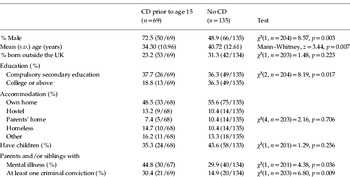
Among the severely mentally ill men, 42% fulfilled the criteria for CD prior to age 15 and the mean number of symptoms was 2.68 (s.d.=3.09). Among the women, 22.4% fulfilled criteria for the diagnosis of CD and the mean number of symptoms was 1.27 (s.d.=2.12). Comparisons of patients with and without CD diagnoses are presented in Table 1. Among these severely mentally ill patients, those with CD, as compared to those without CD, included greater proportions of men and greater proportions with substance abuse and/or dependence. Those with CD were younger and more poorly educated than those with no history of CD. The parents and siblings of patients with CD, as compared to those without, had higher rates of mental illness and of criminality. There was no difference between patients with and without CD as to the proportions born outside the UK, type of accommodation, legal status during in-patient stay, and principal diagnosis.
Characteristics of the patients

CD, Conduct disorder; s.d., standard deviation.
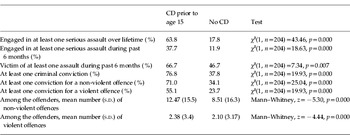
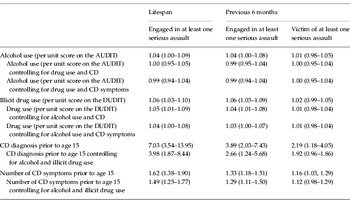
As presented in Table 2, the severely mentally ill patients characterized by CD prior to age 15 had significantly higher rates of aggressive behaviour towards others, victimization, and criminal convictions than the patients without a childhood history of CD. The associations, expressed as odds ratios (ORs), of alcohol use, illicit drug use, CD diagnosis and number of CD symptoms with assaultive behaviour and victimization are presented in Table 3. All analyses control for sex and age. CD diagnosis and CD symptoms that were present prior to age 15 were associated with aggressive behaviour and violent crime in adulthood, after controlling for alcohol and illicit drug use. Alcohol use was not associated with serious assaults over the lifespan, serious assaults in the past 6 months, or being a victim of an assault in the past 6 months after controlling for CD diagnosis and illicit drug use or CD symptoms and illicit drug use. By contrast, illicit drug use continued to be associated with aggressive behaviour after controlling for CD diagnosis and alcohol use and CD symptoms and alcohol use. CD diagnosis, after controlling for alcohol and illicit drug use, was associated with a fourfold increase in the risk of a serious assault over the lifespan and a two and a half times increase in the risk of a serious assault in the past 6 months. Each CD symptom present before the age of 15 was associated with a 1.5-fold increase in the risk of a serious assault over the lifespan and with a 1.3-fold increase in the risk of assaults in the past 6 months. The interaction terms, CD diagnosis or number of CD symptoms and sex, scores for alcohol and illicit drug use, were not associated with serious assaults over the lifespan, assaults or victimization in the past 6 months. Neither alcohol misuse, illicit drug use nor CD diagnosis or symptoms was associated with victimization.
Violent acts, victimization, and criminal offending

CD, Conduct disorder; s.d., standard deviation.
Odds ratios (and 95% confidence intervals) for risks of physical aggression towards others and of physical victimization among patients with severe mental illness conferred by a diagnosis of conduct disorder (CD), number of CD symptoms, alcohol and illicit drug use

AUDIT, Alcohol Use Disorders Identification Test; DUDIT, Drug Use Disorders Identification Test.
All analyses control for age and sex.
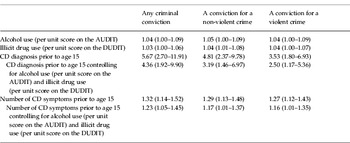
The associations, expressed as ORs, of alcohol use, illicit drug use, CD diagnosis prior to age 15 and number of CD symptoms with criminal convictions are presented in Table 4. Again, sex and age were controlled in all analyses. The associations of alcohol and illicit drug use with convictions for any crime, non-violent and violent crime disappeared after controlling for CD diagnosis and CD symptoms prior to age 15. A diagnosis of CD prior to age 15 was associated with a fivefold increase in the risk of any conviction, with a fivefold increase in the risk of conviction for a non-violent offence, and with a 2.5-fold increase in the risk of a conviction for a violent offence, after controlling for alcohol and illicit drug use. Each CD symptom present prior to age 15 was associated with an increase in the risk of any conviction, a conviction for a non-violent offence, and a conviction for a violent crime, after controlling for alcohol and illicit drug use. The interaction terms, CD diagnosis or number of CD symptoms and sex, scores for alcohol and illicit drug use, were not associated with any conviction, convictions for non-violent or violent offence.
Odds ratios (and 95% confidence intervals) for risks of criminal convictions among patients with severe mental illness conferred by a diagnosis of conduct disorder (CD) and number of CD symptoms before age 15, alcohol and illicit drug use

AUDIT, Alcohol Use Disorders Identification Test; DUDIT, Drug Use Disorders Identification Test.
All analyses control for age and sex.
Discussion
We examined a representative sample of in-patients with severe mental illness in an inner-city mental health trust. Forty-two per cent of the men and 22% of the women were characterized by a history of CD. Among the men, the rates of CD were higher than those previously reported for other clinical samples, while among the women the rate was similar to that observed in other samples (Hodgins et al. Reference Hodgins, Cote, Toupin, Cooke, Forth and Hare1998, Reference Hodgins, Tiihonen and Ross2005). The prevalence of CD among the male patients with severe mental illness was, however, similar to that reported for members of the Dunedin cohort who at age 26 presented schizophrenic disorders (Kim-Cohen et al. Reference Kim-Cohen, Caspi, Moffitt, Harrington, Milne and Poulton2003). The mental health trust studied provides services to four inner-city boroughs that rank high on a measure of social deprivation (ODPM, 2004). While we have no information on where the patients lived as children, it is known that the prevalence rates of CD increase with the level of social deprivation (Meltzer et al. Reference Meltzer, Gatwood, Goodman and Ford2003).
The results of the present study confirm and extend previous findings indicating that CD present prior to age 15 has long-term consequences for both men and women who subsequently develop severe mental illness. The subgroup of patients with CD prior to age 15 were more likely than the others to engage in assaults and to have been convicted of non-violent and violent crimes. Consistent with results from a previous study (Hodgins et al. Reference Hodgins, Tiihonen and Ross2005), each CD symptom present before age 15 was associated with an increased risk of assaults and criminal convictions through adulthood after taking account of alcohol and illicit drug use. This finding demonstrates again that even a few symptoms of CD in childhood or adolescence increased the likelihood of aggressive behaviour and violent crime in adulthood. Similarly, in the CATIE trial of patients with schizophrenia, two or more CD symptoms remained associated with aggressive behaviour in the past 6 months after controlling for substance misuse (Swanson et al. Reference Swanson, Swartz, Van Dorn, Elbogen and Wagner2006). Thus, in a UK sample of in-patients with severe mental illness, a diagnosis of CD and the number of CD symptoms prior to age 15 continued to be associated with aggressive behaviour and criminal activity into middle age. While the proportion of female patients with CD was only half that observed among the male patients, the associations of CD with lifelong patterns of aggressive behaviour and crime did not differ by sex.
Although the long-term negative outcomes of CD in general population cohorts has been well documented (Farrington et al. Reference Farrington, Gallagher, Morley, StLeger and West1988; Ferguson et al. Reference Fergusson, Horwood and Nagin2000; Moffitt et al. Reference Moffit, Caspi, Harrington and Milne2002; Odgers et al. Reference Odgers, Caspi, Broadbent, Dickson, Hancox, Harrington, Poulton, Sears, Thomson and Moffitt2007), these recent findings confirm that among both men and women who develop severe mental illness, CD is a precursor of persistent antisocial and aggressive behaviour and criminality. Aggressive behaviour and criminality have serious consequences, particularly for persons with severe mental illness. They lead to incarceration in prisons where violence is common and treatment of severe mental illness is limited (Wolf et al. Reference Wolfe, Blitz and Shi2007). Aggressive behaviour and crime by persons with severe mental illness also leads to rejection from certain types of mental health services and supported accommodation. In addition, aggressive behaviour is associated with being the victim of an assault. In the sample from the present study, having engaged in aggressive behaviour in the prior 6 months was associated with a sixfold increase [OR 6.57, 95% confidence interval (CI) 3.51–12.28] in victimization experiences in the same period (Hodgins et al. Reference Hodgins, Alderton, Cree, Aboud and Mak2007a). Patients with severe mental illness who have a history of CD display antisocial attitudes as well as antisocial behaviours. These attitudes and behaviours limit the extent to which they will follow the advice of mental health professionals who care for them.
Findings from the present study concur with those from other recent investigations showing that among patients with severe mental illness, those with prior CD, as compared to those without, are more likely to be abusing alcohol and/or illicit drugs. Results from the present study also concur with those from previous investigations, showing that substance abuse is not associated with aggressive behaviour and criminal activity among those with prior CD. By contrast, in patients with no history of conduct problems prior to onset of severe mental illness, substance misuse may be more directly related to aggressive behaviour (Mueser et al. Reference Mueser, Crocker, Frisman, Drake, Covell and Essock2006). These findings demonstrate again that among people with severe mental illness who engage in aggressive behaviour and criminality, there are several subgroups who probably have distinct aetiologies and responses to treatment (Hodgins & Müller-Isberner, Reference Hodgins and Müller-Isberner2004; Hodgins, in press). The findings from the present study also suggest that among the subgroup of severely mentally ill patients with a history of CD, reducing substance misuse will not be sufficient to eliminate the antisocial and aggressive behaviours.
More of the severely mentally ill patients with, than without, a history of CD were victims of assaults in the 6 months prior to interview, consistent with a report from the CATIE trial (Swanson et al. Reference Swanson, Van Dorn, Swartz, Smith, Elbogen and Monahan2007). However, neither the diagnosis of CD nor the number of CD symptoms was associated with victimization after controlling for substance alcohol and illicit drug use. It may be that individuals who are using alcohol and illicit drugs put themselves into situations where the risk of victimization is increased. It is known that persons with severe mental illness are at increased risk, as compared to the general population, of being victims of aggressive behaviours and crimes (Teplin et al. Reference Teplin, McClelland, Abram and Weiner2005). In addition, three studies have shown that among severely mentally ill patients, aggressive behaviour is a significant predictor of victimization (Silver et al. Reference Silver, Mulvey and Swanson2002; Walsh et al. Reference Walsh, Moran, Scott, McKenzie, Burns, Creed, Tyrer, Murray and Fahy2003; Hodgins et al. Reference Hodgins, Alderton, Cree, Aboud and Mak2007a). We hypothesize that certain environments foster, even teach, the use of aggressive behaviour to solve problems. Research is urgently needed to understand the link between victimization and aggressive behaviour among persons with severe mental illness and to identify the factors associated with reductions in both.
Strengths and limitations of the present study
The strengths of the study include examination of a complete cohort of in-patients with severe mental illness within one mental health trust, a relatively high participation rate, self-reports of aggressive behaviour and victimization using a standardized diagnostic instrument, and use of official criminal records. Aggressive behaviour was measured using the same instrument that had been used in previous studies (Hodgins et al. Reference Hodgins, Tiihonen and Ross2005; Swanson et al. Reference Swanson, Swartz, Van Dorn, Elbogen and Wagner2006). Weaknesses include the low rate of participation of collateral informants that may have resulted in underestimates of aggressive behaviour. The mental health trust studied provides services to four boroughs. In the period that patients were recruited into the study, two of these boroughs had crime rates higher than the national average and two had similar rates (Nicolas et al. Reference Nicolas, Povey, Walker and Kershaw2004/Reference Nicolas, Povey, Walker and Kershaw2005). Consequently, the proportions of patients with criminal records and who experienced victimization may be higher than in similar samples recruited from areas with lower crime rates. The associations that were observed between CD diagnosis and CD symptoms prior to age 15 and aggressive behaviour and violent crime in adulthood are probably generalizable to other samples of severely mentally ill patients. The sample was not large enough to examine the association of CD and later aggressive behaviour and criminality by type of severe mental illness.
Implications for general adult services
The study showed that among severely mentally ill patients requiring hospitalization in the inner city, a subgroup have a long history of antisocial and aggressive behaviours. These patients are easily identifiable, as we have shown, simply by conducting the interview for the CD and antisocial personality disorder modules of the SCID. Once identified, however, their characteristics suggest that they might benefit from interventions that address their multiple problems including aggressive behaviour, substance abuse, and a lack of pro-social and employment skills. Cognitive-behavioural programmes have been shown to be effective in reducing these problems among non-mentally ill persons (Hollin, Reference Hollin2004) and they are currently being adapted and evaluated for use with severely mentally ill patients. Importantly, some evidence suggests that men with schizophrenia and prior CD are less compromised neurologically than other patients with schizophrenia, making them good candidates for learning-based interventions (Naudts & Hodgins, Reference Naudts and Hodgins2006). Engagement with mental health services is a major challenge, however, with this subgroup of patients. Such programmes cannot be undertaken until psychotic symptoms are reduced and patients are compliant with medication. Community care orders coupled with adequate neuroleptic treatment have been shown to be associated with reductions in aggressive behaviour of patients living in the community (Swartz & Swanson, Reference Swartz and Swanson2004). Two studies have demonstrated reductions in aggressive behaviour in the community with the use of atypical neuroleptic medications (Swanson et al. Reference Swanson, Swartz, Elbogen and Van Dorn2004a, Reference Swanson, Swartz and Elbogenb). Another study has shown that aggressive patients with schizophrenia show greater reductions in positive and negative symptoms with clozapine than patients who do not engage in aggressive behaviour (Volavka et al. Reference Volavka, Czobor, Nolan, Sheitman, Lindenmayer, Citrome, McEvoy, Cooper and Lieberman2004). In addition, follow-up studies of community programmes that identify and manage the risk for violence achieve good outcomes (Heilbrun & Peters, Reference Heilbrun, Peters, Hodgins and Müller-Isberner2000; Hodgins et al. Reference Hodgins, Müller-Isberner, Tiihonen, Repo-Tiihonem, Eronen, Eaves, Hart, Webster, Levander, Tuninger, Ross and Kronstrand2007b). Patients with severe mental illness and childhood CD commit more crimes than other patients with severe mental illness (Hodgins, Reference Hodgins, Gattaz and Häfner2004). Furthermore, they persist in committing crimes while in and out of general adult services and are eventually transferred to in-patient forensic services (Hodgins & Müller-Isberner, Reference Hodgins and Müller-Isberner2004; Hodgins et al. Reference Hodgins, Müller-Isberner and Allaire2006). By identifying this subgroup of patients with severe mental illness at first contact with services and providing them with an intensive and structured package of interventions, it might be possible to reduce their criminal activities and thereby reduce the numbers of transfers to expensive forensic beds, and increase compliance with medication that would in turn reduce readmissions.
Childhood interventions
Although it is known that parent training programmes are effective in reducing conduct problems among children (Farmer et al. Reference Farmer, Compton, Burns and Robertson2002; Scott & Davies, Reference Scott and Davies1999), it is not known whether children with conduct problems who are developing severe mental illnesses would benefit from such interventions. Interventions in childhood designed to reduce conduct problems and to teach pro-social skills would, if effective, prevent the development of substance misuse and of persistent antisocial and aggressive behaviour. The absence of antisocial behaviour and substance misuse, and the addition of pro-social skills, would also make it easier for the individual to cope with severe mental illness.
Implications for research on aetiology
It is currently not known why CD is more prevalent among persons who develop schizophrenia than in the general population. Results from the present study confirmed previous findings showing elevated rates of criminality among the parents and siblings of the severely mentally ill patients with a history of CD (Mueser et al. Reference Mueser, Rosenberg, Drake, Miles, Wolford, Vidaver and Carrieri1999; Tengström et al. Reference Tengström, Hodgins and Kullgren2001; Hodgins et al. Reference Hodgins, Tiihonen and Ross2005). Previous studies have also shown elevated rates of substance misuse among the parents of persons with schizophrenia and a history of childhood conduct problems. These elevated rates of crime and substance misuse among the first-degree relatives of the subgroup of patients with severe mental illness and childhood CD could reflect a distinct genetic loading. Many twin and family studies have confirmed a genetic contribution to an early-onset stable pattern of antisocial behaviour (Rhee & Waldman, Reference Rhee and Waldman2002). However, suggesting that these individuals inherit a vulnerability for CD as well as for schizophrenia fails to explain why CD is more prevalent among persons with than without schizophrenia.
Criminality and substance misuse among the parents may be associated with poor parenting practices and failure to teach the offspring how to cope with stress in a healthy manner. When children with CD enter adolescence and begin experiencing prodromal symptoms such as anxiety, they may lack, even more than other adolescents developing psychosis, effective cognitive and behavioural coping skills. They may then begin taking illicit drugs, such as cannabis, in an effort to diminish prodromal symptoms. As heavy cannabis use has been associated with increased risk of schizophrenia (Zammit et al. Reference Zammit, Allebeck, Andreasson, Lundberg and Lewis2002; Arseneault et al. Reference Arseneault, Kim-Cohen, Taylor, Caspi and Moffitt2005), the presence of CD may have contributed to the development of schizophrenia.
It may also be that children carrying the susceptibility genes for severe mental illness are more likely than other children to be exposed to specific environmental factors that interact with specific genes to promote early-onset stable antisocial behaviour. For example, physical abuse in childhood is more common among individuals who subsequently develop severe mental illness than others (Bebbington et al. Reference Bebbington, Bhugra, Brugha, Singleton, Farrell, Jenkins, Lewis and Meltzer2004), and in a previous study, we found that it is most common among those with a history of CD prior to age 15. Three studies have now reported that among individuals who carry the low activity allele of the genetic polymorphism encoding monoamine oxidase A, physical abuse in childhood is associated with CD and violent offending in adulthood (Caspi et al. Reference Caspi, McClay, Moffitt, Mill, Martin, Craig, Taylor and Poulton2002; Foley et al. Reference Foley, Eaves, Wormley, Silberg, Maes and Riley2004; Widom & Brzustowicz, Reference Widom and Brzustowicz2006). It could be that parents who carry the susceptibility genes for severe mental illness are more likely than parents without such genes to engage in behaviours such as physical maltreatment (Caspi et al. Reference Caspi, McClay, Moffitt, Mill, Martin, Craig, Taylor and Poulton2002), maternal hostility (Caspi et al. Reference Caspi, Moffitt, Morgan, Rutter, Taylor, Arsenault, Tully, Jacobs, Kim-Cohen and Polo-Tomas2004) and smoking during pregnancy (Maughan et al. Reference Maughan, Taylor, Caspi and Moffitt2004) that are known to contribute to the development of antisocial behaviour. Given the very negative impact of childhood conduct problems on the lives of individuals who develop severe mental illnesses, it is essential to undertake longitudinal prospective studies to identify potential targets for prevention.
The future
In the present study, more than one-third of the severely mentally ill patients with a history of CD had children. These children are at increased risk of displaying antisocial behaviour and developing severe mental illness as a consequence of both genetic inheritance and parenting practices. Effective interventions targeting known precursors such as physical abuse, early cannabis use, aggressive behaviour, and early symptoms of the severe mental illness could lead to significant reductions in human suffering and costs to society. The available evidence strongly suggests that doing nothing will lead to the creation of another cohort of patients similar to the one examined here.
Acknowledgements
The study was supported by a grant from the R&D programme of the South London and Maudsley Mental Health Trust. The authors thank the patients, family members and staff who contributed to the project.
Declaration of Interest
None.