In a brilliant moment of theatrical self-referentiality, Cole Porter's backstage (show-within-a-show) musical Kiss Me, Kate (1948) opens with an opening song about opening songs.Footnote 1 In “Another Op'nin, Another Show,” we meet the actors in the framing show. After some expositional interplay set in the lead couple's dressing rooms, we hear the first song from the framed show (a musical version of Shakespeare's The Taming of the Shrew), another opening number about openings: “We Open in Venice.”
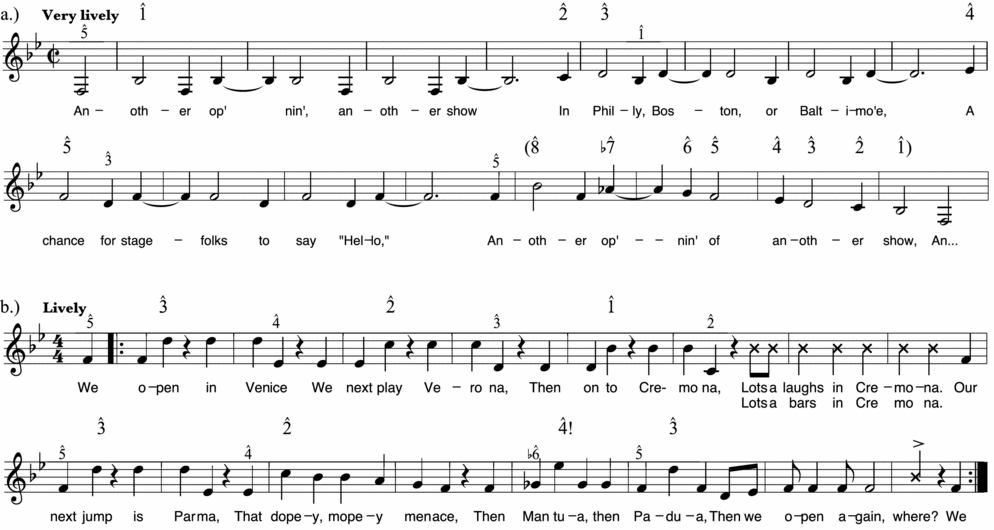
Both are catalog songs that list cities where the troupe has enjoyed—or endured—openings. The first song enumerates cities along the eastern seaboard of the United States; the second, Italian cities. But, as Example 1 illustrates, the two songs’ similarities extend beyond their contexts and subject matters: there are musical correspondences as well.
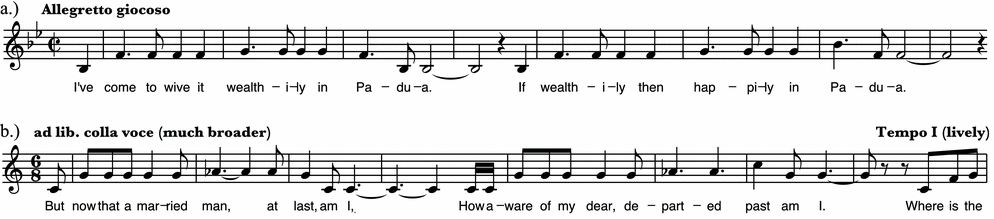
Similarities of the compound-melodic refrains from the two “opening” numbers. a) “Another Op'nin, Another Show” ascends by step (then descends at the cadence); b) “We Open in Venice” pervasively descends by step in the first phrase, then returns to
 $\hat{3}$
in the second.

Both songs feature clear compound melodies with leaps between two well-defined contrapuntal lines. Those lines progressively ascend at the beginning of “Another Op'nin” and descend in “We Open in Venice,” and in both cases the tunes reverse course, returning to the opening pitch before restarting after the next refrain. Whether or not audience members detect the clever and subtle melodic mirroring, surely everyone in the theater recognizes that these two songs are paired, and that they help set their respective scenes: not only the matter of place and time (mid-century Baltimore and sixteenth-century Venice), but also the fact that the framing and framed shows will be reflecting one another.
That the lead characters resemble the Shakespearian characters they're portraying aids the integration of the framing (outer) and framed (inner) shows. Fred Graham is self-assured and confident that he will get the girl, but perhaps not to the same degree as Petruchio, the character he portrays; Lilli Vanessi is world weary and outwardly resistant to Fred's charms, but not to the same degree as Kate (Katherine) is to Petruchio's; and Lois Lane is looking for a good time and trying to juggle two very different amorous relationships, whereas Bianca has three eager suitors. For clarity, Figure 1 shows the lead characters and whom they portray in The Taming of the Shrew.
The principals in Kiss Me, Kate and the characters they portray in the framed play (The Taming of the Shrew).

The show-within-a-show is a long-standing musical theater (and, perhaps even more pervasively, cinematic) trope. Unlike earlier backstage musicals (including Cole Porter's own Anything Goes and Fifty Million Frenchmen, Rodgers and Hart's Babes in Arms and On Your Toes, and a tremendous number of film musicals including 42nd Street and Variety Girl), the plot of Kiss Me, Kate is advanced, not suspended, by the framed action. Indeed, the musical numbers and elements of the embedded Taming of the Shrew fragments function as extensions of the framing show.
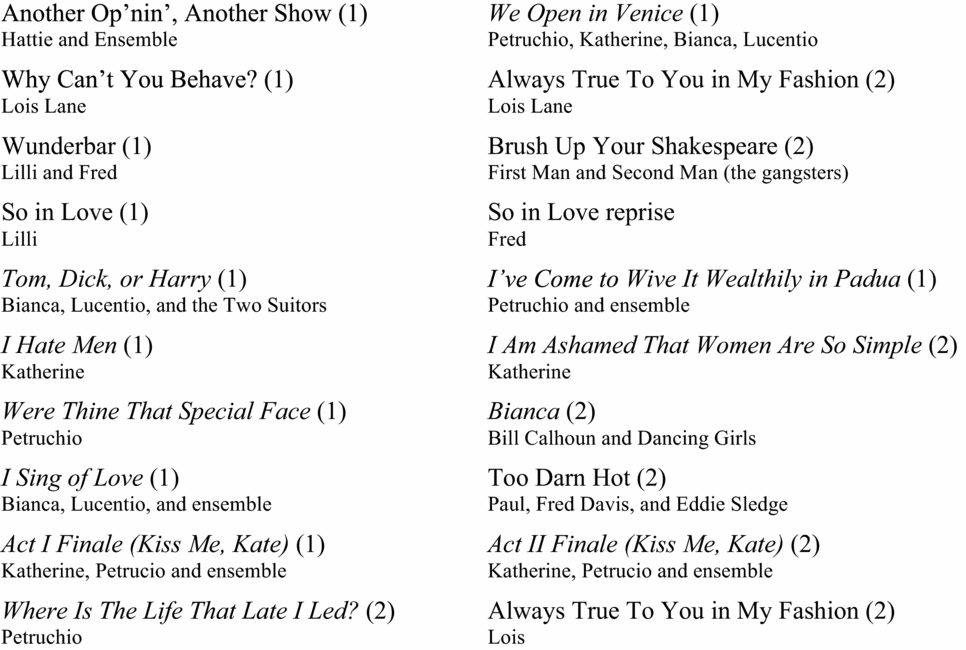
As a springboard to my own analysis, I scrutinize Raymond Knapp's (2006) interpretation of the show's musical and dramatic oppositions, in particular his claim that each song in Kiss Me, Kate has a “double”—a doppelgänger song that is heard at another point in the musical.Footnote 2 Figure 2 reproduces Knapp's song pairings; on his chart, song titles in italics occur within the framed show (The Taming of the Shrew) and numbers in parentheses specify whether each song occurs in the first or second act; additionally, I have listed the characters who sing each song.Footnote 3 Knapp employs a variety of pairing criteria: some of his doubles match a song in the framing show with one in the framed show, some are based upon similarity, some upon contrast, some are based upon persona, and some upon lyrics or situation.
Knapp's pairing of songs (“doubles”) in Kiss Me, Kate (Knapp 2006, 276.) Songs in the left column pair with aligned songs in the right column. Italicized titles are from the framed show (The Taming of the Shrew); numbers in parentheses denote whether the song is heard in act 1 or act 2.

Pairing “Another Op'nin’, Another Show” with “We Open in Venice” seems obvious to me, and for reasons already stated at this article's outset.Footnote 4 A number of Knapp's doubles are similarly compelling: they just work in a variety of ways, including dramatically and musically. Some pairs on Knapp's list were not immediately obvious to me, but I was convinced by his arguments. In other cases, I found that I couldn't be convinced—usually because musical features led me to hear other combinations more robustly.
Aside from individual agreements or disagreements with Knapp's pairings, his approach led me to look afresh at Kiss Me, Kate and to ponder both how I would group the songs and, more importantly, what groupings such as these might suggest about the show as a whole. Knapp's central motivation for song coupling appears to be demonstrating interesting comparisons and perhaps ultimately revealing something about Porter's compositional intent. I agree that relating songs is informative, though I find myself interested for different reasons. In this article, I will consider “doubles” both as informing how the characters and their Shakespearian doppelgängers (who, to preview my conclusions, might not be doppelgängers at all) communicate musically and how analyses of song similarity can foster a grand sense of form that spans the entire musical.
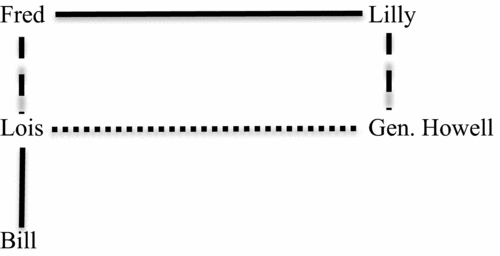
At first blush, it might seem obvious that songs should be paired both from the framing to the framed show and/or according to character. For example, paired songs might be performed by the same characters or by romantic partners. Both “Another Op'nin’” and “We Open in Venice” are ensemble numbers, the first in the framing, the second in the framed show. However, as I intimated, there isn't really a clear narrative distinction between Kiss Me, Kate (the framing show) and its internally performed portions of The Taming of the Shrew. The sense of romantic partnering is also a bit problematic in Kiss Me, Kate since Lilli and Fred (the show's central couple) are in an acrimonious relationship at the show's onset and both are involved with different partners: Lilli is engaged to be married to Harrison Howell, a military man, and Fred is having a fling with Lois Lane, a burlesque performer and aspiring actress. Fred has cast Lois as Bianca in the musical version of The Taming of the Shrew that Fred is both acting in and directing. Further complicating matters is the fact that Lois is more genuinely involved with Bill Calhoun, a gambler and another secondary character in the framed play (Shrew). So, who is paired with whom? What might be a love triangle in many shows is, here, a rather more complex geometric shape. Figure 3 offers a reading of the romantic partners, with solid lines representing relationships that eventually succeed and dotted lines representing the partners claimed at the show's outset.
Romantic relationships in Kiss Me, Kate. Solid lines denote relationships that solidify throughout the show; dashed lines denote initial relationships that come undone; dotted line denotes a one-time relationship that existed prior to the show's timeline.

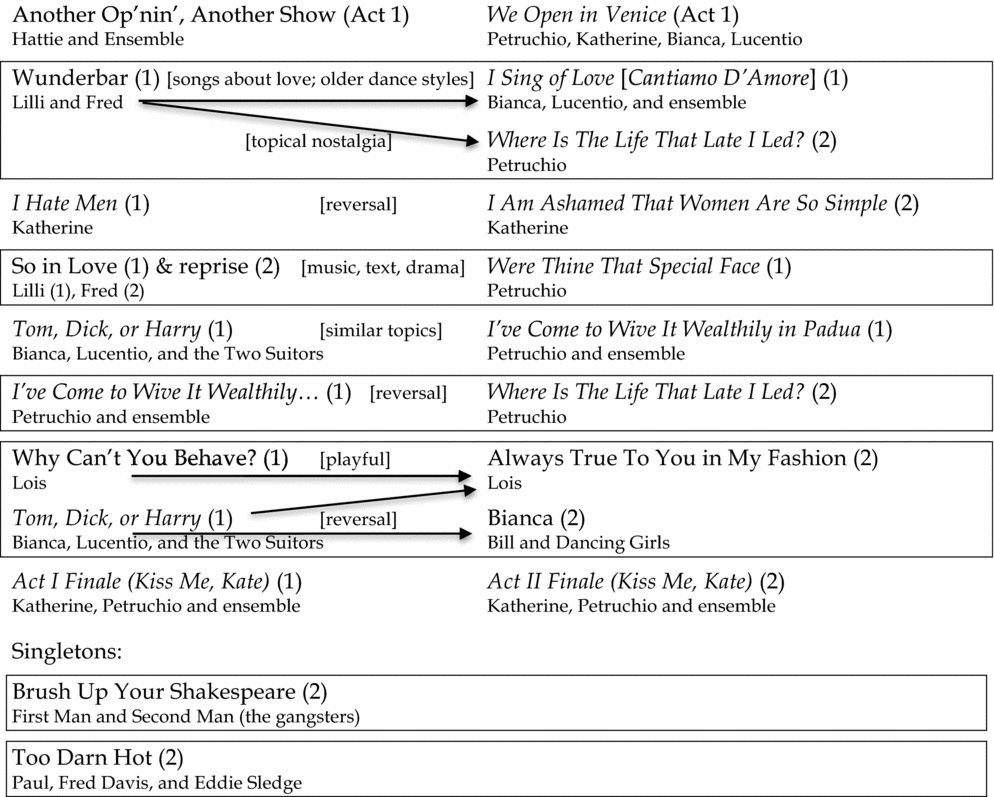
In this essay, I will examine Knapp's pairings in some detail and will suggest an alternate set of song groupings, informed by different criteria. In particular, I will show that a careful reading of musical structure can reveal some similarities not heard in the lyrics alone. The second part of this article will focus on the special relationships between “Were Thine That Special Face” and “So in Love,” a song pairing that Knapp does not draw. (Curious readers can peek ahead to Figure 4 to see my own groupings.)
My groupings of the songs in Kiss Me, Kate. Italicized titles are from the framed show (The Taming of the Shrew); numbers in parentheses denote whether each song is heard in act 1 or act 2. Boxed groupings differ from those drawn by Knapp (2006). Note that some songs appear in more than one place.

Unlike the two opening numbers about openings, Knapp's second pairing—“Why Can't You Behave?” with “Always True to You in My Fashion”—matches songs that are both sung by Lois to her boyfriend Bill in the framing musical and both deal with romantic misdeeds: the first song deals with Bill's gambling problem; the second justifies (if unsuccessfully) Lois's promiscuity. In this case, neither song in the “double” pairing occurs in the framed musical (Shrew), while both Knapp's fifth and sixth pairings occur entirely within Shrew. Knapp's fifth pairing relates “Tom, Dick, or Harry” and “I Come to Wive it Wealthily in Padua,” two songs about wanting to get married, without particularly caring to whom. His sixth pairing relates two comic songs by Kate: “I Hate Men,” in which she histrionically announces her loathing for masculinity in its entirety, and “I Am Ashamed That Women Are So Simple,” in which she has apparently reformed and is now apologizing (arguably without sincerity) for her own gender.
Though none of these three doubles matches a song from Kiss Me, Kate with a song from Shrew, each pair seems well motivated by correspondences in the songs’ dramatic situations. Indeed, aside from the two “opening” numbers, the only other pairings in Knapp's list that relate framing and framed show songs are “I Sing of Love” with “Too Darn Hot” and “Where is the Life That Late I Led” with “Always True to You in My Fashion.” I confess that that I don't see much motivation for the first of these pairings, other than performing forces. “Too Darn Hot” seems to me to be a singular number in this show: It is a showstopper that opens the second act and it has little, if anything, to do with the plot of either the framing or framed shows. It's just a rousing number that involves all the non-principal members of the cast, and it creates a bit more dramatic tension as the story is suspended even beyond the intermission. Were I to pair it with any other number(s), I would match it with the two opening numbers, but only because it, too, is an opening number (though not self-consciously so), and a gratuitous one at that.
Likewise, “Brush Up Your Shakespeare,” the two gamblers’ only song, does not especially resemble any other number in the show, though, like “Too Darn Hot” it offers a brilliant distraction while the lead characters are offstage and, with its ingenious blend of high and low humor, it is one of the show's funniest and most memorable songs. Knapp has paired “Brush Up” with “Wunderbar,” citing the fact that they're both waltzes as their central commonality.Footnote 5 But “Brush Up” is a decidedly low-class waltz that is essentially parodic whereas “Wunderbar” is a convincing imitation of a Viennese waltz that quite deliberately invokes the nostalgia of an idealized time when Fred and Lilli were a loving couple. To me, a more convincing connection is between the nostalgic songs “Wunderbar” and “Where Is the Life That Late I Led.” The first (from Kate) is nostalgic for married life; the second (from Shrew) is nostalgic for bachelorhood.
Two more of Knapp's pairings merit discussion here, and these involve songs that I will discuss in much greater analytical detail in the next section of this article. Knapp pairs “So in Love” in the first act with that song's reprise in the second act. On the one hand, it's an obvious relation. At first, Lilli sings “So in Love” alone in her dressing room and the song reflects the optimism that she and Fred will resume their relationship (they had once been married). In the second act, Fred reprises the song when he believes he has lost Lilli forever. Knapp's discussion of the musical changes between these versions is incisive, but given that the central motivation for reading “doubles” is that one song would be set in relief against another, relating a song and its reprise seems incommensurate with all of his other pairings.
One might instead envision these two renditions of “So in Love” as two interpretations of the same song rather than two different songs. Indeed, I wonder if Knapp's desire to pair every single song with another led to some less-successful matches. Perhaps the most curious pairing in Knapp's reading is “Were Thine That Special Face” with “Bianca.” Knapp was extremely savvy to notice that the title of the former song was adapted from a line that Bianca speaks in Shakespeare's original play. (“I never yet beheld that special face” The Taming of the Shrew, act 1, scene 2.)Footnote 6 This connection is subtle, to be sure, and would doubtless be lost on many theatergoers. (I confess that I would count myself among those who might have missed the connection without having read Knapp's book.) Indeed, I wonder whether this was an intentional play on characters by Porter or whether he was simply farming Shakespeare's play for lines and phrases that he could use as lyrics, regardless of who spoke them in the original and where they occurred in the play.
“Bianca” (act 2) is a love song that Bill Calhoun sings to his offstage girlfriend, Lois. That he is calling her by her character's name produces a further blurring of the framing and framed shows. To me, the comic but sincere song pairs more naturally with “I Sing of Love” (from act 1), in which Bianca and Lucentio sing together. I would even suggest that, in various ways, there is a quartet of songs that go together: “Bianca,” “I Sing of Love,” “Why Can't You Behave,” and “Always True to You in My Fashion,” which, as a group, offer lyrical interpretations of the full range of Bill's and Lois's (Lucentio's and Bianca's) relationships.
Figure 4 shows my own song groupings in Kiss Me, Kate. I have drawn boxes around relations that differ from those in Knapp (2006). In my reading, I allowed not only doubles, but also triples, a quadruple (which might also be interpreted as a pair of pairs) and two singletons that don't seem to relate well to any other songs in the show. Those peerless numbers—“Brush Up Your Shakespeare” and “Too Darn Hot”—are also the songs that have least to do with the show's plot. Figure 4 also offers thumbnail explanations of my pairing criteria.
Knapp does have one song serving double duty among his doubles (so to speak): “Always True to You in My Fashion,” Lois's impish act 2 testament of near-faithfulness is paired with both her act 1 song, chastising Bill, “Why Can't You Behave” and also with Petruchio's “Where is the Life That Late I Led,” in which he waxes nostalgic for his promiscuous lifestyle.
I believe Petruchio's song pairs better with either “Wunderbar,” the nostalgic waltz from act 1 or (still better) with “I Come to Wive It Wealthily in Padua,” also from act 1. After all, “I Come to Wive It. . .” and “Where is the Life. . .” are both sung in character as Petruchio and there is an obvious dramatic reversal from the former to the latter. He initially wanted a wife but, once wed, longed for his unattached days.
In addition to the situational reversal, there are strong musical connections between “I Come to Wive It. . .” and “Where is the Life. . .” Both are jaunty songs that (loosely) evoke Elizabethan frivolity: the former, with its pervasive dotted rhythms and emphasis on perfect intervals, more than the latter. The most obvious musical connection from the first to the second song occurs just before the beginning of the refrain in “Where is the Life. . .” where Porter makes clear reference to “I Come to Wive It. . .” Both passages are shown in Example 2, where you can readily see that the latter is a barely veiled (slower, minor-mode) reference to the former, now set to the faux-tragic lyric, “But now that a married man at last, am I. How aware of my dear departed past am I.”
a) The title line of “I Come to Wive it Wealthy in Padua” (act 1) compared with b) a slow minor version heard the end of the bridge, leading into the first refrain in “Where is the Life that Late I Led” (act 2).

Pairing “So in Love” and “Were Thine That Special Face”
Knapp didn't pair “So in Love” and “Were Thine That Special Face.” While the connections between these songs are certainly less obvious than some of the matches I described earlier, it is the “double” that I find most remarkable, both because of these two lyrical songs’ structural similarities and the ways in which Porter apparently interrelated them. Before turning to the music, consider these songs’ dramatic framing: each involves a misdelivered floral bouquet and a particular epithet.
As the show's first scene ends, Fred is having the exhausted cast practice their bows. Lilli is especially uncooperative and when Fred finally forces her to participate, he voices his dissatisfaction that she is not smiling. He asks her to do it again—though she is angry and eager to flee the theater—and, through her forced smile, she half yells “you bastard!” Back in their dressing rooms (at the start of the second scene), Fred shouts at Lilli, angry at being called a “bastard” in front of the cast.Footnote 7
Their acrimonious relationship takes a turn when they start reminiscing about better days and nostalgically sing the continental waltz “Wunderbar,” allegedly from some past show they were in together (which, incidentally, explains that song's stylistic incongruity). Their relationship further improves when a bouquet of flowers that Fred intended to send Lois Lane to wish her luck on opening night is mistakenly delivered to Lilli. Lilli, initially not seeing the attached card, takes this as a sign that Fred still loves her and, alone in her dressing room, she sings the show's most haunting and sincere song, “So in Love.” When, in the third scene, Fred realizes what has happened, he needs to get the bouquet's accompanying card away from Lilli before she takes the stage.Footnote 8
FRED: You're not going to read that now! . . . Look, I'll tell you what I wrote: “To Lilli, the only woman I've ever loved, the only artist I've ever worshipped!” Now give me the card and you can read it after the show!
LILLI: Oh, Fred, did you really mean that? (Rises, throws arms around FRED)
FRED: (Plenty nervous, tries to get card) With all my heart!
LILLI: Then—that's where it's going. (She slips card into her bosom) Right next to mine. I'm not nervous—I'm not going to whoops and I'll never call you a bastard—Fred dear, never!
FRED: (In grim resignation) You will, my sweet, you will!
Later in the first act, during the performance of The Taming of the Shrew, Petruchio (Fred) sings “Were Thine That Special Face” to Kate (Lilli). While Petruchio is singing, Lilli disappears offstage and, implicitly or explicitly (depending upon how this scene is staged) reads the note that accompanied the bouquet. When she emerges after the song, she is clearly angry and she hurls the bouquet at him.
After mocking his song, saying “Were thine that special face! Hah!” Katherine's (Lilli's) next line, spoken while holding the card, is “Speak, Petruchio. . . . Though thy message is not meant for me. (She tears up card, throws it in Petruchio's face) You bas—.” Before she can complete the word, this time in front of the full theater audience, Petruchio grabs her, chastises her in a stage whisper, and returns—post-haste—to Shakespeare.
So, both Lilli's use of the word “bastard” and the bouquet from Fred frame these two songs. These two dramatic and textual correspondences might be adequate to suggest pairing “So in Love” with “Were Thine That Special Face,” but there also are substantial musical similarities—indeed, enough to consider the latter an only slightly oblique reference to the former.
Songs in minor are relatively uncommon in musical theater (especially in early- and mid-century musical theater), yet Kiss Me, Kate has four songs that at least flirt with minor keys, although each of them ends in either the parallel or relative major. The verse of “Too Darn Hot” is solidly in a bluesy E minor, but it makes its way to E major by the refrain. Kate's most shrewish song, “I Hate Men,” begins in D minor (“I hate men, I can't abide ’em even now and then”), but it only takes her four bars to shift to the parallel major, although given the lyrics, that shift sounds ironic (“Than ever marry one of them, I'd rest a virgin rather, for husbands are a boring lot and only give you bother. . .”).
The two songs that are most substantially in minor keys are “So in Love” and “Were Thine That Special Face.”Footnote 9 These are also the two most sincere romantic songs in a musical that features predominantly comic numbers that showcase Porter's signature use of word play. “So in Love” is not wholly in minor. It exemplifies Heinrich Schenker's model of an “auxiliary cadence”: a work (or even just a phrase) that begins in one key and ends in another. Following Schenker's precepts, the beginning of this song might holistically be read as a prolongation of the submediant (vi), which eventually (by m. 29 of the refrain) moves to the true dominant and tonic of A major. However, as Allen Forte (1995) points out, the chorus is comprised of two sixteen-bar “units” (I would call them phrases because I only hear the cadence-defining phrase boundaries at the sixteen-bar level, whereas Forte clearly attended more strongly to the eight-bar level), the first of which ends with a half cadence in F-sharp.Footnote 10
One might well draw comparisons between “So in Love” and Irving Berlin's “Blue Skies.” Ask most people who have a casual knowledge of “Blue Skies” (or perhaps recall being inundated by commercials for the allergy drug, Claritin) whether Berlin's song is in major or minor and they will probably say, “minor” (I have tried this in classes and it always works). But Berlin clarifies the tonal direction of “Blue Skies” toward the relative major within the refrain's first phrase (“Nothing but Blue Skies, do I see”). It takes at least twenty-seven bars (and more likely twenty-nine bars) for us to discover that A major, not F-sharp minor, is the true tonic of “So in Love,” although Porter does hint at the relative major in mm. 9–11 (“The stars fill the sky”) where the music comes to a fleeting rest (but not a cadence) on A major.
“Were Thine That Special Face” spends even more time in the minor mode. Indeed, this song is distinctly in B-flat minor, only cadencing in B-flat major at the very end (mm. 96–103).Footnote
11
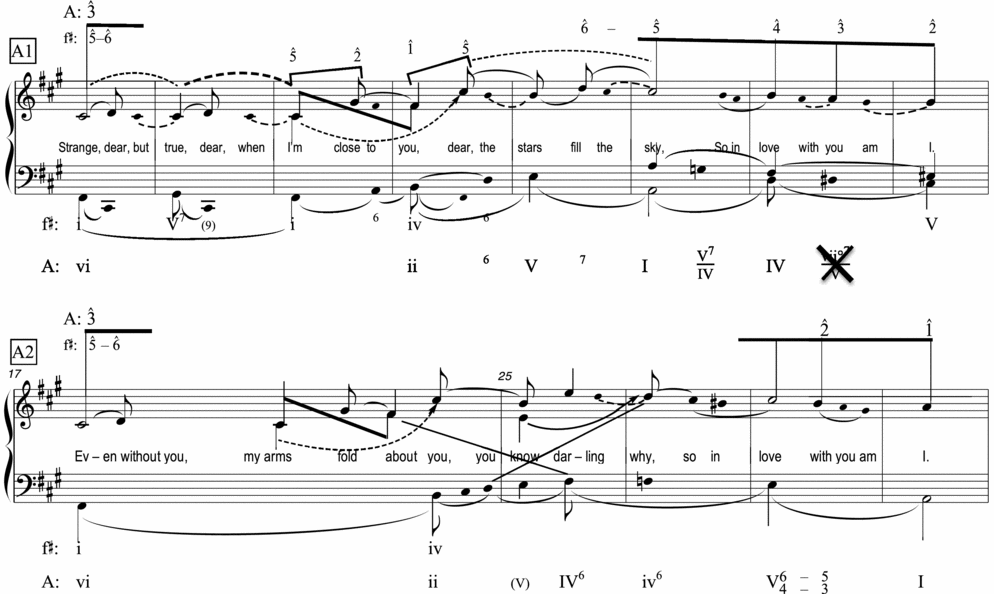
For the sake of drawing structural comparisons between these two songs (especially involving scale-degree patterns), I will primarily be considering “So in Love” to be in F-sharp minor at the beginning, though Example 3, my analytical sketch of the first two A sections (mm. 1–32) of “So in Love,” simultaneously shows F-sharp minor as both a local key and as a tonicized submediant harmony in the overall key of A major. Forte analyzed the entire song in the key of the final cadence, and didn't acknowledge the duality of C-sharp sounding like scale-degree 5 (
 $\hat{5}$
) in F-sharp minor, but later re-contextualized as
 $\hat{3}$
in the overall key.Footnote
12
While I also afford structural priority to the key of the song's final cadence, I find the sense that we start on
 $\hat{5}$
(in the relative minor) to be inescapable.Footnote
13
(Can you imagine hearing the opening “Strange dear, but true, dear” as anything but
 $\hat{5}$
–
 $\hat{6}$
–
 $\hat{5}$
–
 $\hat{6}$
in minor?) Because “So in Love” generally has a harmonic rhythm of two measures (that is: harmonies tend to last for two measures), each measure in Example 3 encompasses two actual measures of score. This compresses each sixteen-bar phrase into what appears to be an eight-bar phrase.
Analytical sketch of the first two A sections (mm. 1–32) of “So in Love.” Most measures represent two measures from the score (since the harmonic rhythm is slow). The first eight bars of each phrase are identical, so the opening of the second phrase (mm. 17–24) has been shown at a middle-ground level.

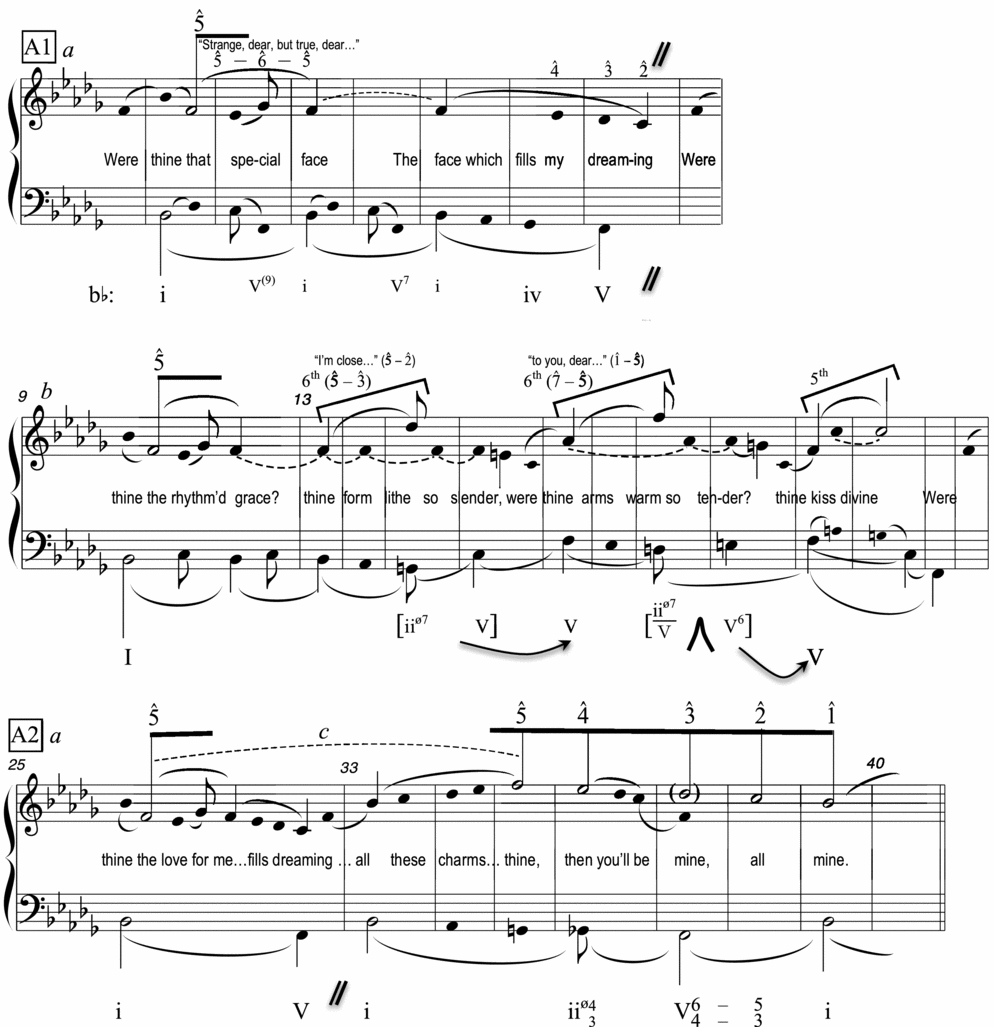
Example 4 shows my voice-leading sketch of the first two A sections (mm. 1–42) of “Were Thine That Special Face.” Comparing the harmony and counterpoint of “So in Love” and “Were Thine That Special Face” highlights many of these songs’ structural similarities. Both songs begin with an emphasis on
 $\hat{5}$
(or, in the case of “So in Love” what is only apparently
 $\hat{5}$
) in a low register. This initial melodic tone is elaborated in both cases with a half-step neighbor motion to
 $\hat{6}$
and in both cases that neighbor motion is harmonized by a dominant ninth chord. In this era, V9 is a relatively unusual harmonization of
 $\hat{6}$
in the melody, especially at the beginning of a song, so the fact that both songs elaborate
 $\hat{5}$
in the same way and in both cases with the songs’ opening lines, is already a marked similarity.
Voice-leading and motivic sketch of the A and A’ sections (mm. 1–42) of “Were Thine That Special Face.” The four phrases group into an expanded double period (abac). Certain comparisons to “So in Love” are noted above the systems.

The next line of “So in Love”— “when I'm close to you dear”—also strongly parallels “Were Thine That Special Face.” Knapp mentions Porter's use of ascending fifths in “So in Love” but there are also ascending leaps in “Were Thine” at the boldfaced words in the lyric: “Were thine the form so lithe and slender, were thine the arms so warm, so tender.” The leaps here are sixths, rather than fifths, but the similarity is more obvious when one attends to scale degrees rather than merely intervals: In both cases, the first leap is from
 $\hat{5}$
(in the initial/lower register) and the second leap is to
 $\hat{5}$
(in the final/upper register).Footnote
14
In the case of “So in Love” the attainment of the upper
 $\hat{5}$
is then elaborated by a double-neighbor motion
 $\hat{5}$
–
 $\hat{4}$
–
 $\hat{6}$
–
 $\hat{5}$
(“The stars fill the sky”) that resembles the first line of “Were Thine,” where
 $\hat{5}$
is also elaborated with the
 $\hat{4}$
–
 $\hat{6}$
motion on the word “special.”Footnote
15
The songs diverge from there: “So in Love” follows a standard AABA form with an expanded final refrain and “Were Thine That Special Face” follows a modified AABA form, in which the opening phrase is an expanded twenty-five-bar structure. However, the motivic similarities coupled with the dramatic context of each song (marked by the word “bastard” and the presence of the bouquet) and the fact that these are the two most sincere songs in the show suggest a strong compositional pairing.
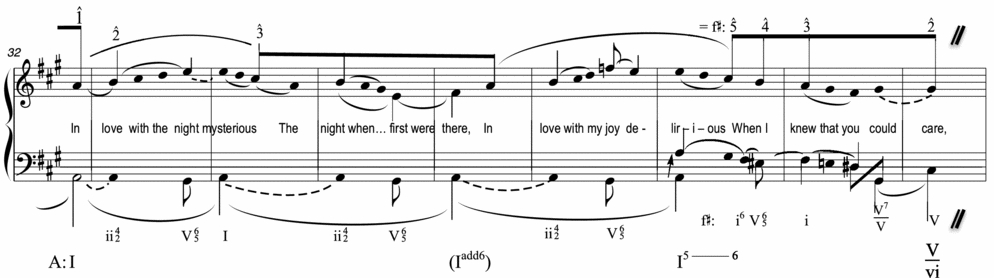
The two songs’ bridges (B sections) also merit comparison. Examples 5 and 6 respectively show my analytical sketches of the bridges from “So in Love” and “Were Thine That Special Face.” Both elicit a sense of musical stasis, but that impression is realized differently: “So in Love” features almost no harmonic motion (simply standing on tonic) until the half-cadential dominant arrival—a harmonic goal common to most bridges—in preparation for the return of the primary refrain. Note that the dominant reached is of the overall relative minor key (F-sharp minor)—the key of the refrain's first nine bars—not the key of the final cadence (A major).
Analytical sketch of the bridge (B section: mm. 33–48) of “So in Love.” Each measure above represents two measures in the score (Compare to Forte, p. 144, ex. 150).

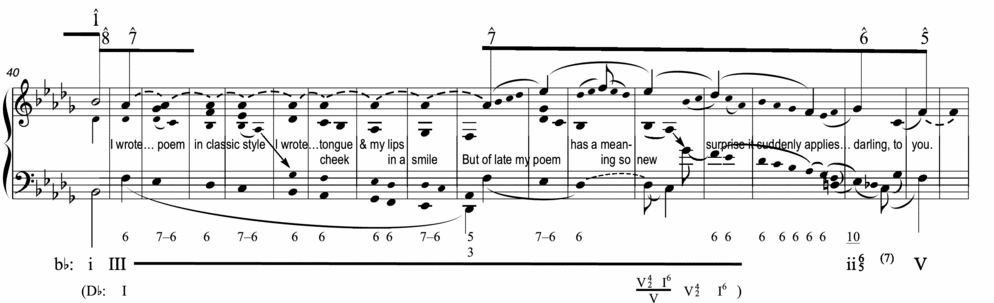
Analytical sketch of the bridge (B section: mm. 41–57) of “Were Thine That Special Face.”

By contrast, the bridge of “Were Thine That Special Face” features a constantly moving accompaniment, where stepwise cascading parallel
 ${\raise-.8pt\hbox{\fontsize{8}{8}\selectfont 6}}\atop{\raise.8pt\hbox{\fontsize{8}{8}\selectfont 3}}$
chords are framed by D-flat-major triads. The emphasis on D-flat suggests a motion to the relative major (like “So in Love”) but this intimated modulatory goal never arrives. Unlike the descending bass, the melody is static, simply reciting A-flat until the cadential approach. Perhaps coincidentally, A-flat is also the bass tone that is maintained in the reprise of “So in Love” (as shown in Example 6).
After descending a tenth from F3 to D-flat2 in the first half of the bridge (mm. 43–49), the bass (and, indeed, the complete accompaniment) in “Were Thine” begins again, but this time the descent from F3 stalls on D-flat3, which is surprisingly harmonized by a dominant
 ${\raise-.8pt\hbox{\fontsize{8}{8}\selectfont 4}}\atop{\raise.8pt\hbox{\fontsize{8}{8}\selectfont 2}}$
chord (of A-flat). This
 ${\raise-.8pt\hbox{\fontsize{8}{8}\selectfont 4}}\atop{\raise.8pt\hbox{\fontsize{8}{8}\selectfont 2}}$
chord is unexpected and only marginally resolved (in what feels like an afterthought) while Petruchio holds his note, but it doesn't seem especially unusual in a passage marked “Quasi recitative and tenderly.” As in many Baroque recitatives, the
 ${\raise-.8pt\hbox{\fontsize{8}{8}\selectfont 4}}\atop{\raise.8pt\hbox{\fontsize{8}{8}\selectfont 2}}$
chord occurs at a textually significant moment as Petruchio sings “but of late my poem has a meaning so new.” At this point, another—“new,” and much faster—cascade of parallel
 ${\raise-.8pt\hbox{\fontsize{8}{8}\selectfont 6}}\atop{\raise.8pt\hbox{\fontsize{8}{8}\selectfont 3}}$
chords commences and leads to the expected cadence on the dominant. In the long view (as seen in Example 6), the reciting tone on A-flat (overall the subtonic) is simply part of a melodic descending tetrachord from the tonic that ends the second A section to the dominant that ends the bridge, leading us directly back to the reprise.
Similarly, in “So in Love” the static predictability of the bridge is interrupted by a marked moment: at “in love with my joy delirious,” the melodic apex is on flat
 $\hat{6}$
(or natural
 $\hat{6}$
in the original key of A major), harmonized—again—by a dominant ninth chord that recalls the song's opening use of minor, while introducing a more complex harmony that suggests a tinge of regret and ennui.
To my mind, these musical and textual similarities suggest that one of these songs was likely patterned on the other. Since Geoffrey Block observes that “So in Love” was a late addition, it is entirely possible that this more famous number, one of the most beautiful songs in Porter's output, was based upon the more Shakespearean and less typical song in the show's interior.Footnote 16
That the strong resemblances between these two songs do not necessarily seem obvious when watching or listening to the show might be attributable to three very different aspects of “Were Thine That Special Face,” one involving harmony, one staging, the other style. Earlier, I mentioned the similarity in melodic leaps in “Were Thine” and “So in Love.” Though both songs leap to
 $\hat{3}$
and then to
 $\hat{5}$
, those scale degrees are harmonized quite differently: by diatonic tonic and dominant harmonies in “So in Love,” but by half-diminished seventh chords with chromatic notes in the bass in “Where Thine.”
Dramatically, during the bridge of “Were Thine,” the audience's attention is diverted away from Petruchio (who is singing) and toward Kate, who leaves her balcony (resuming her identity as Lilli) and disappears offstage to read the card from Fred (to clarify: she departs from the stage-within-a-stage; in most productions and in the 1953 film version she is still quite visible to the audience as she reads the card from Fred). Lilli's anger at learning that the flowers were not meant for her is channeled into her performance of Kate, who quickly becomes even angrier and certainly far more colloquial than Shakespeare would have imagined. The harmonic instability of the song's bridge underscores Lilli's angst, even as Petruchio's melodically static line (unsuccessfully) tries to send a calm and reassuring message.
Surprisingly, the final A section stylistically changes from romantic ballad to beguine, portraying the situational dramatic shift (enacted during the bridge) from romance to comedy. The beguine version of the refrain is not structurally different from the second A section (although, like the final A section in “So in Love,” it is also expanded) except that it ends on a major tonic chord—something of a Picardy third—that immediately segues to a dance number set to the same tune. Although the melody and lyrics are the same in each A section, the move from ballad to recitative to (beginning the) beguine, produces a dramatically fluctuating underscore that certainly affects how we hear the lyrics during the final refrain. In that sense, “Were Thine” is a far more complex and narrativistically germane song than its mate, “So in Love,” which stays on topic, both lyrically and musically.
Large-Scale Form and Narrative
That Fred and Lilli flip back and forth so readily between their backstage and Shakespearian characters reveals a particularly wonderful aspect of Kiss Me, Kate. It would be easy to read this, like so many other backstage musicals or dramas as a bifurcated narrative—two (in this case related) stories that are interwoven, and the secondary story (Shrew) provides allegorical commentary on the primary story. But I do not believe that truly captures the storyline of Kiss Me, Kate. Lilli's and Fred's characters are so strong willed and single minded that neither is able to pull off Shakespeare without more clearly revealing their own state of mind. That “Were Thine That Special Face” actually forwards the show's overall plot, even while occurring within the framed show, says a lot. I propose that there is no Petruchio and Kate; there is only Fred and Lilli. That is to say that there is only one central narrative in this show (involving a primary and secondary couple, as is common in musical theater comedies of this era) and the characters’ perspectives don't change when they don their Elizabethan costumes. In other words, despite its outward appearance Kiss Me, Kate is neither an example of two different narratives (a bifurcated narrative) nor what Rick Altman called a dual-focused narrative, wherein the same story or stories are told via multiple perspectives.Footnote 17 In Kiss Me, Kate the plot unfolds through parallel avenues that more resemble multiple lanes on the same road than entirely different routes that lead to the same location.
The lack of genuine narrative bifurcation might make Porter's use of songs that relate to one another appear to be an even more curious compositional device. On the one hand, a single narrative trajectory would explain why closely related songs don't exclusively appear between the framing and framed shows; after all, the framed show is largely irrelevant to the plot. On the other hand, the idea of repeating song types can be used in more ways than simply bolstering a particular narrative prototype. Veiled repetition can (like unveiled repetition) also suggest a kind of rotational large-scale musical and dramatic form.
In a show where parallels between the framed and framing shows abound, it hardly seems surprising that Cole Porter would have telegraphed the dramatic similarities through a clever use of musical and lyrical resemblance. Audience members are clearly asked to view Fred and Lilli through the lenses of Petruchio and Katherine. Just as individual scenes combine to create a dramatic narrative, we should think of the placement of individual songs as constructing a sort of long-range musical form. Form, to a music analyst, is tantamount to plot or narrative to a literary critic. This is not the usual sense of musical form that we learn in music analysis classes (for one thing it doesn't necessarily rely upon tonal continuity), but it is a kind of form that helps both audiences and analysts appreciate the coherence of a multi-act musical—especially one as tightly woven as Kiss Me, Kate.
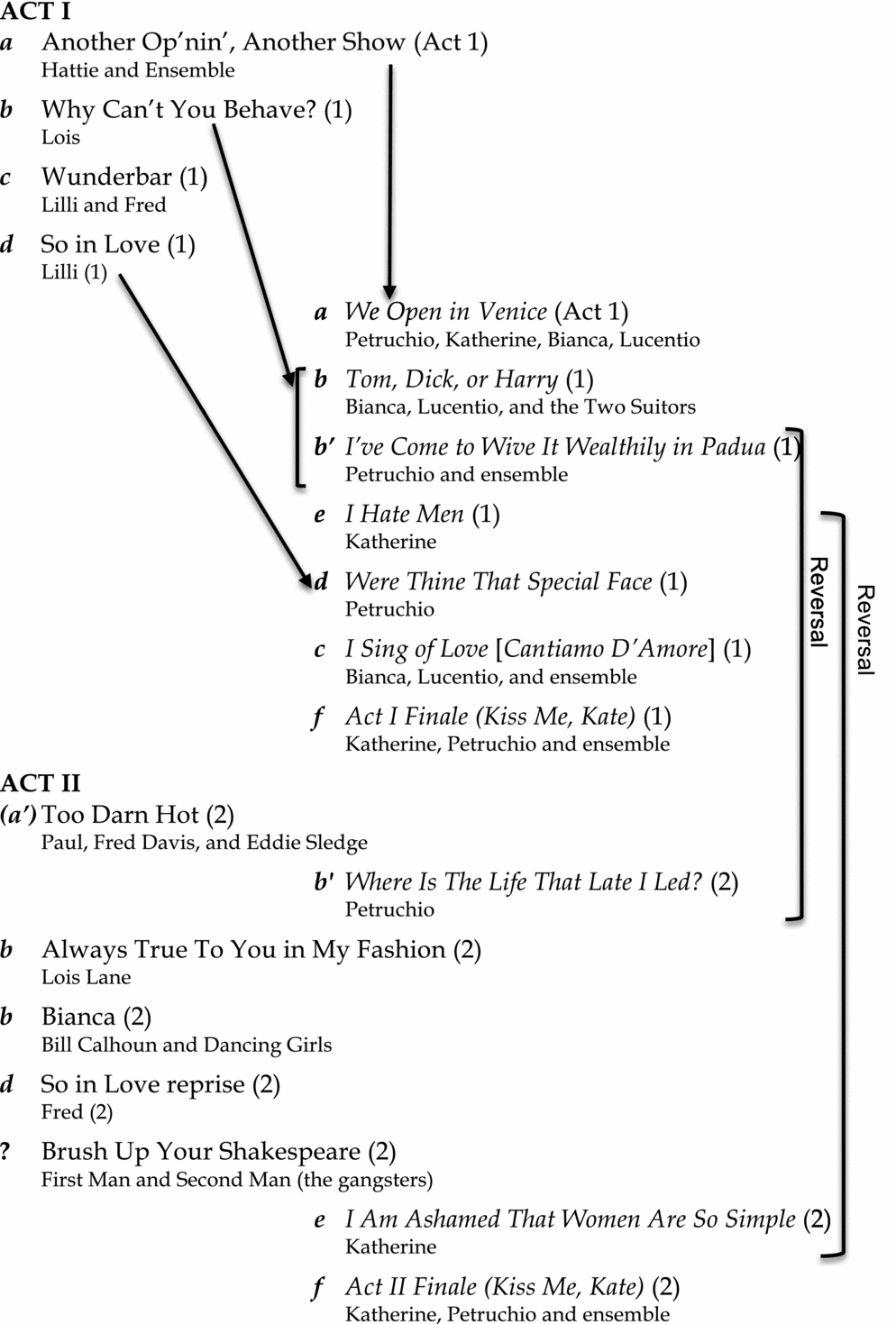
Consider how much alike the first four songs in act 1 are to the first four songs in act 2. “Another Op'nin’” and “Too Darn Hot” are both ensemble numbers that do little more than set the stage. “Why Can't You Behave” (act 1) and both “Where is the Life That Late I Led” and “Always True to You in My Fashion” are songs about misbehavior by the show's most purportedly promiscuous pair: Lois Lane and Fred/Petruchio. “Wunderbar” and “Bianca” are both songs of desire; and, in both acts, those songs are each followed by “So in Love.”
Figure 5 offers a rendition of the form that categorizes (sometimes a bit crudely) every song and concisely describes how it might relate to others. In addition to showing that there are similar songs (which should seem clear enough), this chart aims to illustrate how Porter may have created a sense of formal unity by deploying these songs in roughly equivalent positions. Songs that are listed along the left margin are heard in the framing show; songs in the right-hand column are heard in the framed show. Italicized letters (a, b, c. . .) suggest the rough song types; letters followed by an asterisk denote relations that seemed to me to be a bit too loose to assert with confidence, but were still suggestive enough to list.
A large-scale reading of rotational form, with three rotations defined by song types. Arrows and brackets show some particularly salient and/or interesting relations.

Although there are some sharp differences between my reading of the song pairings (and triplings and quadruplings) and Knapp's, I hope that my interpretation is read less as a refutation of Knapp and more as a demonstration a) that music-structural similarities involving motive, harmony, and counterpoint can be as compelling in relating different songs as can lyrics, narrative, and persona and b) that song similarity (however it is established) can nourish a sense of large-scale form. Kiss Me, Kate is so rich a show that multiple interpretations easily coexist, informing critical perspectives on a work that is replete with intertextual and intratextual allusions. References from one song to another play out both within and between the framed and framing shows and they might even help us navigate the more than 350 years that separate Shakespeare's original and Porter's (and Samuel and Bella Spewack's) brilliant and very free adaptation.