Introduction
Culture critic Néstor García Canclini, in his introduction to the 2005 edition of his classic work Hybrid Cultures, somewhat defensively replies to the objections to concepts of hybridisation – itself a reaction to uncritical and exaggerated celebrations of cross-cultural mixing – saying that it is ‘necessary to understand [hybridisation] in the context of the ambivalences of the globalised mass diffusion and industrialisation of symbolic processes, and of the power conflicts these provoke’ (García Canclini Reference García Canclini, Rosaldo, Chiappari and López2005, p. xxix). Rather than celebrating hybrid music, we are urged to reveal contradictions and that which resists being hybridised. Indeed, as García Canclini concludes, there ‘is not only one form of modernity but rather several unequal and sometimes contradictory ones’ (García Canclini Reference García Canclini, Rosaldo, Chiappari and López2005, p. xxix). Mexican sociologist Gilberto Giménez (Reference Giménez2007, p. 268) reiterates that it is precisely this polarising and unequal characteristic that is so central to globalisation. Given that we acknowledge the urgency for understanding cultural interactions and musical appropriations or exchanges in the context of the ambivalences of the globalised mass diffusion and the power asymmetries involved, how can we then critically and fruitfully engage in a scholarly dialogue – a dialogue that would ideally include all academic disciplines that focus on music?
Sarah Cohen once called upon popular music scholars to embark on an ethnographic approach to
increase our knowledge of the details of popular music processes and practices. [For] only with such knowledge can we be justified in making more general statements about popular music (e.g. regarding globalisation and its effects, the nature of popular music as mass culture, processes of consumption and production, etc.). More importantly, perhaps, such an approach would remind us that general statements tend to mask the complex interrelatedness of contexts, events, activities and relationships involved with popular music. (Cohen Reference Cohen1993, p. 135)
Much time has passed since, yet few popular music studies rely on the kind of knowledge gained by doing in-depth ethnography. While Cohen pointed to the ‘potential for an alternative or complementary ethnographic perspective’ (Cohen Reference Cohen1993, p. 126), I would like to emphasise the necessity for critical cultural analyses that are rooted in an ethnography of direct encounter and active participation. My case study, thus begins with a textual analysis of a rap piece, a common method of popular music studies. While a comprehensive examination of the rap lyrics reveals some core issues – such as the deplorable situation of Mexico's indigenous people, their exploitation and manipulation by institutionalised powers and neoliberal forces, and the significance of traditions for indigenous self-identification – it also shows the limitations of textual decoding and the need to further contextualise this particular global popular music phenomenon.
Yoreme rap music
On a sizzling hot spring day, I heard a rapping voice coming from an unplastered brick house in a dusty hamlet in northwestern Mexico, demanding respect for the region's indigenous people:
The Yoremem (plural of Yoreme; also known as the Mayo people),Footnote 1 like the neighbouring Yaqui Indians of Sonora, live in settlement clusters or rancherías scattered over a large, semi-arid territory of northern Sinaloa, a Mexican state that lies between the Gulf of California and the Sierra Madre Occidental Range. Their ancestors had settled several millennia before the first Europeans set foot on the continent on the alluvial plains formed by the deposition of sediment from the periodic flooding of the rivers running down from the Sierra Madre. The nearby monte (foothills, mountains), covered by deciduous forests and thorn scrub, was ideal for hunting and foraging. The rapper continued:
The monte not only provided the nativesFootnote 2 with food; it was considered a sacred and spiritual place. The arriving Jesuit missionaries tried to persuade the scattered indigenous peoples to congregate in villages or pueblos and construct a mission church, which should become their new place for worship. Under the influence of the missionaries and early Spanish settlers in the 17th century, Amerindian and Hispanic traditions gradually converged and, eventually led to a distinctive ethnogenesis or ‘colonial semiosis’ (Mignolo Reference Mignolo2000, p. 14), firmly grounded in the material life and cultural values of the communities. After the demise of the Jesuit missions in the mid-18th century and the ever-increasing encroachment of Spanish settlers on native lands, indigenous communities began to ‘create new modes of cultural expression both through internal pressures and external linkages with the wider society’ of which they had become a part (Radding Reference Radding1997, p. 8). Although the Yoremem continued to hold on to a dynamic symbolic ceremonial system based on ancient beliefs and music practices which clearly set them apart from the surrounding mestizo (mixed race) population, today there is no visible difference between the indigenous people labouring on the fields and the poor mestizo jornaleros (day labourers, wage workers). The rapping voice, now in a more accusing tone, had switched from the third to the first person:
Beginning in 1982, the Mexican economy underwent radical structural changes as agriculture became increasingly export-oriented and privatised. As of today, two-thirds of the Mexican rural population live in poverty or extreme poverty. The largest group among the Mexican working class are the day labourers or jornaleros, of which one-third are indigenous (Morett Sánchez and Cosío Ruiz Reference Morett Sánchez and Cosío Ruiz2004, p. 115; data based on the 2000 census). And although their exact number is contested (estimates of the total number of jornaleros range between 2.7 and 6.5 million), there are more agricultural labourers without land than before the Mexican revolution a century ago (1910–1920) and its subsequent agrarian land reforms, intended to redistribute the land that had fallen into the hands of the oligarchy among the peasantry. Although today many Mexican peasants own some land, their holdings are usually too small for subsistence. Thus, agricultural labourers must supplement their incomes by working for the remaining landlords (or by migrating to the United States). Despite the Ley Federal de Trabajo (Federal Labour Law), many jornaleros work more than eight hours per day – and overtime and holidays are not paid. Labour conditions are excruciating: there is no access to medical care; many illnesses and injuries are directly related to work, such as wounds caused by tools, transport accidents, exposure to agrochemicals, and a general lack of safety measures and hygiene. Workers may also suffer from dehydration, animal bites (snakes, spiders), intoxication, and gastrointestinal and respiration illnesses. Jornaleros are not sufficiently educated about hazardous materials and about the handling of toxins (Figure 1). Containers of pesticide are not disposed of in a proper manner; they end up in water canals and drainage and are used as vessels for drinking water. According to Morett Sánchez and Cosío Ruiz (Reference Morett Sánchez and Cosío Ruiz2004, p. 74), some pesticides and fertilisers banned in the United States and Europe are still used on Mexican fields. Although the Federal Labour Law provides protection for all agricultural workers, landlords who do not comply with these laws are seldom punished for negligence. Since jornaleros are employed for temporary seasonal work (they mostly work just half of a year), they would have to work for 50 years to become eligible for Social Security (through the Instituto Mexicano de Seguro Social) and pension. In 2000, the average daily salary of a jornalero was 64 pesos, which meant that three jornalero salaries were necessary just to cover the basic needs of a family.Footnote 3 Consequently a whole family had to work to survive – which explains the presence of women and children in the fields. More and more children forego childhood and adolescence, helping their parents on the agricultural fields instead of attending school. Close to a third of all jornaleros are illiterate; the number of illiterate indigenous labourers tops 44 per cent. Popular music thus is an ideal medium to reach this population (Figure 2).
Workers on a field sprayed with pesticides. Photograph by Helena Simonett, Reference Simonett, Corona and Madrid2008.

Housing camp for migrant jornaleros north of Sinaloa's capital city Culiacán. Photograph by Helena Simonett, Reference Simonett2009.

The young people who had gathered to listen to the rap piece were fascinated by the message they were hearing: rather than whining about the all too familiar present-day conditions of their parents and themselves, the rapper demanded respect for a marginalised community that has notoriously lacked protection. Set to a vigorous beat with melodious samplings of a familiar popular norteño song, ‘Flor de capomo’ (‘Water lily flower’), the rapper's lyrics underscored Yoreme pride (orgullo) in its traditions and customs:
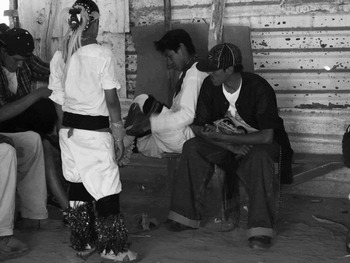
Having been politically dominated for centuries – from direct physical coercion to the more subtle but pervasive forms of ideological manipulation – Mexico's indigenous groups have often been forced to accept the repressive structures and, thus, involuntarily collaborated with the state in maintaining its hegemonic system. Indigenous people continue to inhabit the margins of Mexican society as they have been systematically excluded from the national public sphere. Although there are indigenous claims to ethnic space, as anthropologist Claudio Lomnitz has pointed out, indigenous people are largely absent from the ‘dominant forums of political discussion and public debate and have little access to the media of publicity’ (Lomnitz Reference Lomnitz2001, p. 264). As such, indigenous people are like other ethnic or marginalised groups, and their struggle for cultural identity does not differ from others'. Or does it? What was the musicians' motivation for creating the rap song that captivated the young Yoremem's ears? Who were these musicians who called themselves the ‘Yoremensamble’ (Yoreme ensemble)? And most importantly, how should we study and write about this kind of music that apparently exemplifies current trends of local indigenisations of Western popular music styles, more commonly known as ‘hybrid musics’? (See Figure 3.)
Two of the teenagers whom I met listening to the rap music a few days earlier get ready for dancing pascola, a ceremonial dance type practised by indigenous communities in northwestern Mexico. Ejido 5 de Mayo. Photograph by Helena Simonett, Reference Simonett, Corona and Madrid2008.

Hybrid musics: global popular music in academic discourse
Over the past decade, a growing body of literature has emerged which addresses music and globalisation. In a world where global capitalism, multinational corporations and the internationalisation of production and its impact on national and local spaces has come to affect everyone, musical fusions and hybrids are celebrated as forms of local resistance to such globalising forces (Mitchell Reference Mitchell2001; Perrone and Dunn Reference Dunn, Perrone and Dunn2001; Aparicio and Jáquez 2003; Berger and Carroll Reference Berger and Carroll2003; Corona and Madrid Reference Corona and Madrid2008). Although I have elsewhere argued that the current globalisation process, in contradiction to its homogenising effects, may generate unprecedented new forms of musical creativity (Simonett Reference Simonett, Corona and Madrid2008), I will focus in this essay on the flip side of such creativeness. The Yoremensamble serves as an ideal case study to illustrate the problematic nature of such hybrid musics, which may combine culturally, socially and aesthetically exclusive musical expressions (and ways of being). Yoremensamble's fusionFootnote 4 of such disparate styles as rap/jazz and indigenous ceremonial music is difficult to classify and challenges our concept of genre, which still links musical sounds to social groups (see Holt Reference Holt2007). Although the term ‘glocal popular music’Footnote 5 comes perhaps closest to describing this sonic hybrid, the Yoremensamble project points to the need for more detailed critical cultural analyses of such phenomena. Based on my learning experience while exploring the mysterious Yoremensamble, this paper ultimately claims that it is only possible to understand global musical phenomena by understanding the power conflicts provoked by the uneven distribution of and access to products of the global market: to achieve this, our theories and analyses must be informed by local experience.
It is often assumed by scholars writing on world music phenomena that all people eventually want to and will participate in modernity; that it is a ‘natural’ progression for even the most marginal, pre-modern communities. Ethnomusicologist Timothy Rice, for example, states that modernity ‘has also infiltrated, confronted, changed, and invigorated local forms of music making not yet fully engaged with the global marketplace’ (Rice Reference Rice2003, p. 154; emphasis mine). While such a statement rests on a (let's assume unintended) underlying evolutionist perception, I would argue that there are music cultures that consciously resist being subsumed by a globalising capitalist system despite the pressures to conform and despite appropriations of their cultural expressions by others who propel these new hybrid styles into the global music market circuit. As Lomnitz noted, ‘centres and peripheries have historically constituted each other … [I]deas regarding cultural and economic modernity and modernisation rely on constructions of ‘tradition’ and therefore on producing peripheries' (Lomnitz Reference Lomnitz2001, p. 165). Thus, we must consider peripheralisation and centralisation as ‘practices that can help us understand the ways in which localised idioms of distinction and political language are created’ (Lomnitz Reference Lomnitz2001, p. 165). García Canclini (Reference García Canclini1990, p. 200) claims that one reason for the growth of local culture is the need of the market to include traditional symbolic structures and goods in the mass circuits of communication in order to embrace even the population least integrated into modernity. The argument here is that potential marginal audiences will more likely listen to – and purchase – something familiar than something foreign. Christopher Dunn agrees that music which ‘stylistically and discursively affirms local or national belonging may indeed promote solidarity’ (Dunn Reference Dunn, Perrone and Dunn2001, p. 73). Yet he argues that ‘these musical practices are not by definition more empowering or efficacious than those informed by exogenous or transnational cultures’ (Dunn Reference Dunn, Perrone and Dunn2001, p. 73). Contemporary soundscapes – both global and local – are indeed very complex and call for critical and in-depth analyses from different vantage points.
Western academia provides us with a privileged position from which to study transnational and global musical phenomena. As much as ‘globalisation falls outside the established academic disciplines’ (Jameson Reference Jameson, Jameson and Miyoshi1998, p. xi), the study of the ‘global music phenomenon’ has no determined disciplinary home or privileged context. At the same time, the once rigid perspectives of the different intellectual traditions that take an interest in music have weakened: popular music scholars, communication and ethnic studies specialists, ethnomusicologists, sociologists, anthropologists and even musicologists interested in popular music may claim the global music phenomenon as an object of interest. In the following paragraphs, I will highlight a few noteworthy moments in disciplinary thought – moments of rapprochement and promising dialogue – and then return to the Yoremensamble project in what I think is a more justifiable way of analysis than the straightforward one related above.
Who does what? The blurring of discipline boundaries
The dynamics of globalisation not only affect cultural production but academic perspectives as well. Coincidentally, some of the salient recent issues discussed and debated on electronic lists such as IASPM-AL and SEM-LFootnote 6 are regarding discipline contents and the increasing blurring of discipline boundaries. Twenty-five years ago, musicologist Gary Tomlinson made a resolute call for musicology to engage with the cultural contexts of music. Because of its continued relevance – not just for musicologists, but also for us all who study musical expressions – I quote his paragraph in full:
We can continue to treat history as a ramshackle science, labouring over radically thinned descriptions that cannot invest the particular creative acts we study with the unique significance that is their (and our) due. We can continue to analyse musical process in ways that give little access to musical meaning, or reduce all past musical processes to purveyors of the meanings dear to our own culture, uninformed by a serious attempt to conceive of those of others. And we can continue to search for meaning and evaluative criteria relevant to the individual works we cherish (perhaps, again, supplying them from our own more or less irrelevant ideologies), all the while raging at the shop-worn assumptions of the only mode of understanding that, in a new guise, could provide them: history. Or we might instead realise that our endeavours, from whatever subjects and emphases they take their start, eventually are united in the effort to converse with other cultures and other times by achieving a deeper understanding of the creative acts of their most eloquent representatives, their artists. We cannot comprehend art works (or anything else) outside of a cultural context. (Tomlinson Reference Tomlinson1984, pp. 361–2)
Although anything but new for ethnomusicologists who have long acknowledged the primary importance of the cultural context of creative acts, Tomlinson's point that our ultimate goal is learning to converse with others meaningfully may sometimes too get lost in our academic endeavours. While our attempts at comprehending the cultural and social realities of the musical communities and groups we study and write about are imperative, learning to converse with other academic disciplines may ultimately yield significant benefits as well. David Brackett, tackling a long-standing debate between musicological and sociological approaches to the study of music, pointed out that sociologists studying popular music tended to question musicologists' contribution to a wider understanding of popular music. Yet, he says, ‘It may be fruitful to turn this question around, to ask what our understanding of popular music can contribute to musicology’ (Brackett Reference Brackett1995, p. 33). The strength of a sociological approach, in Brackett's opinion, is its focus on music's temporality and sociality, characteristics that undermine established musicological concepts of musical structure and music as autonomous and fixed ‘art works’.
Since the later 1990s, a predominantly younger generation of musicologists has deemed popular music a legitimate topic of interest. In the United States, a fair number of musicologists claim this new area their own and teach Popular Music courses at colleges and conservatory-like departments in universities; many of these courses are designed for students who do not major in music.Footnote 7 The shift towards including students' musical tastes and realities in the curriculum has strengthened musicologists' position within liberal arts education. In the UK, Popular Musicology has become a vital area of scholarship for which new critical and theoretical models are being developed, drawing from other disciplines. Indeed, 21st-century New/Popular Musicology, with its emphases on gender, class, politics, reception and popular music, is intellectually receptive to both sociology's concepts of music and ethnomusicology's music-and-culture approaches to music.Footnote 8
With regard to popular music's relationship to ethnomusicology, we may recall that it was not until the 1970s that popular music was actually admitted into the domain of ethnomusicological study. Ethnomusicologists with training in sociology in particular took a strong interest in the socio-cultural aspects of music and music making. The name of the first scholarly journal dedicated to popular music, Popular Music and Society (first issue published in 1972), reflected the concern at the time to study popular music as a social phenomenon.
In a recent keynote address given at Columbia University in New York, ethnomusicologist Adelaide Reyes called upon us to ‘envision a future for ethnomusicology that is historically anchored – one that retains a sense of rootedness even as it moves forward’ (Reyes Reference Reyes2009, p. 3). She proposed regarding ‘music as expressive culture’, which differs from ‘music in cultural context’ or similar formulations in its methodological implications, that is, the necessity to do fieldwork in order to acquire an insider's knowledge of the culture. Although ethnomusicologists seem notoriously concerned with defining and re-defining their discipline and with searching for a legitimate place within academia (SEM-L discussion 2008), there is some consensus of who they are and what they do (see Nettl Reference Nettl2005; Stobart Reference Stobart2008; Reyes Reference Reyes2009).Footnote 9 While today's ethnomusicologists have also turned their interest to the music industry, music and cultural policy, and applied ethnomusicology, ever more popular music scholars see the necessity of a contextualised approach to global music phenomena; the journal of Popular Music and other journals devoted to cultural studies now provide forums for published research in world popular music. Yet, as Martin Stokes has pointed out, ‘the dynamics of discussion across rigid disciplinary and subdisciplinary boundaries are complex’ (Stokes Reference Stokes2004, p. 48). Scholars from different academic fields may indeed study the very same musical expressions, yet it is apparent that they still do so, to a considerable extent, from very different vantage points.Footnote 10
The flow of music in our global world presses us to address a set of critical questions regarding the continuation of colonial histories, political economy, and ethics. I believe that our academic role should not be to enthusiastically cherish hybrid music styles (a tendency in the growing literature on such phenomena), but to reflexively and critically query their social, political and ethical implications (Simonett Reference Simonett2010, p. 81). On the following pages, I will thus return to and dive deeper into the Yoremensamble project, arguing for the necessity of doing onsite fieldwork for understanding such global phenomena.
The Yoremensamble project
The ramshackle two-room brick house with a dirt floor from where the rap voice emanated was the unlikeliest place in the world I would have expected to hear rap music, even if it was in Spanish. Indeed, in the many months of doing fieldwork in northern Sinaloa since 2001 I had never heard anything other than the popular accordion-driven música norteña, the equally popular regional brass-band style of banda sinaloense, one neighbour's favourite Chalino Sánchez's narco-corridos boasting the deeds of drug dealers, and another neighbour's popular Evangelical songs in norteño style – and, of course, the strictly ceremonial music of the Yoreme communities: pascola and venado, the reason for my extended stays in northwestern Mexico (Simonett Reference Simonett2009). I entered the open room and said some greeting words, but the teenagers did not take any notice of me; they were gathered in front of a television set listening attentively. The television was an older model with inbuilt DVD player on which they could also listen to CDs. When asked about the music and the group they were listening to, none of the young people could tell me anything about them: they did not recognise the genre of rap; nor had they heard about Yoremensamble before. But they agreed that they liked the song – or more precisely, the message of the song. They did not like any of the remaining tracks, which I later learned were instrumental pop-jazz arrangements of a number of popular pieces from the region. At the time, I copied a phone number from the CD cover, determined to find out who this mysterious ‘Yoreme ensemble’ was.
It took me quite some time to discover that Yoremensamble had only existed as a group for carrying out this one CD project in 2006. The idea to create this group came from guitarist Juan Manuel ‘Catché’ Soto and percussionist Fernando ‘Cacho’ Parra who, together with other local mestizo musicians from Los Mochis who preferably play in the jazz and rock pop genres, produced the CD.Footnote 11 The project was fully funded by Mexico's National Council for Culture and the Arts (CONACULTA).Footnote 12 For the rap track Yoremensamble had invited a local mestizo rapper, Javier Pérez Espinoza ‘El Elote’ (‘The corncob’), who was responsible for both creating and rapping the lyrics. They created the sound track by making a synthesised musical sample from the popular norteña polka, ‘Flor de capomo’ (‘Water lily flower’), a song pertaining to the popular domain but registered in the names of the Yaqui musicians José and Alejo Molina Palma, whose original recording was a bilingual version in Spanish and Yaqui, the latter a language closely related to Yoreme.Footnote 13 The rap lyrics make no references to the original song lyrics – a blithe love song – rather, as already mentioned above, they espouse the causes of the ethnic minority in the region, thus giving voice to the struggles of the marginalised indigenous population. In many ways, it fits the rhetoric of opposition and resistance to institutional forms of repression characteristic for rap outside the United States (see Mitchell Reference Mitchell2001). Local currents of ‘hip-hop indigenisations’ have taken place in other parts of the world. Yet, as Tony Mitchell has observed, the globalisation of rap is ‘a linguistically, socially, and politically dynamic process which results in complex modes of indigenisation and syncretism’ (Mitchell Reference Mitchell, Berger and Carroll2003, p. 14).
The following is a fine-grained analysis of these processes with a closer look at a musical product that embraces both the postmodern and the pre-modern worlds. It is, however, not my intention to compare cosmopolitan, urban music making to indigenous or ‘traditional’ music making in order to objectify the relationship between rap/jazz and traditional music. Rather, following Jesús Martín Barbero's observation that the popular is ‘a dense space of interactions, interchanges and re-appropriations, the movement of mestizaje (cultural hybridity)’ (Martín Barbero Reference Martín Barbero, Herlinghaus and Walter1994, p. 92), I would like to point out the tensions between these two culturally, socially and aesthetically exclusive cultural and musical ways. As we will see, the ‘movement of mestizaje’ is as ambiguous and conflicting as the indigenisation of global culture that draws its authenticity from peasant and ethnic culture. Thus, by relying on ethnography and audience reception rather than just on an analysis of the product (the recorded music), I furthermore question an uncritical celebration of local indigenisations of global musical idioms without further understanding of how/why this music was produced and how it is being received in its local context.
Although mestizos grow up in close proximity to indigenous communities – the city of Los Mochis is surrounded by ejidos or communal village holdings – they hardly know anything about Yoreme culture, except for the merrymaking of the judíos (Jews or non-believers), a spin-off of the missionary passion drama performed during Lent season and culminating in semana santa (Holy Week) (see Spicer and Crumrine Reference Spicer and Crumrine1997). A growing number of mestizos join the collective ceremonies in carnivalesque costumes (and acting accordingly) without recognising the deeper significance of the indigenous ceremonial system. Like other small children, Juan Manuel Soto (who founded the Yoremensamble) was afraid of the noise-making and the acting of the devilish masked judíos. For Soto, it was something ‘mysterious’ that he did not understand. In fact, the contact between mestizos and Yoremem in general is minimal, and it is based on mutual suspicion: while for the mestizos the ‘indo’ (Indian) is at best the ‘exotic other’, the Yoremem employ their own term for the ‘non-indigenous other’, Yori (or ‘the one who does not respect’ [the tradition]).
While Soto was attending the Universidad de Occidente in Los Mochis, a music professor tried to interest him in indigenous expressive culture. However, Soto concluded that since there was ‘no harmony, only melody and drum, there is no musical merit – from a (Western) point of view’.Footnote 14 Soto, like other educated musicians, was influenced by an urban mestizo orientation towards Western-sounding musics. At the same time, Mexican middle-class musicians have long incorporated elements of lower-class musical life. As a result of growing nationalist sentiments in the late 19th century, a large number of pianist-composers cultivated salon-music genres such as waltzes, polkas, mazurkas, and schottisches replete with vernacular elements. Peasant and indigenous culture became an object of fascination for post-revolutionary Mexico's composers trained in the European classical tradition who reconstructed ancient Aztec music and integrated mestizo folk idioms into their compositions. The various Mexican popular (folkloric) traditions – from mariachi and marimba to jarocho and banda – are based on melodies, rhythms, performance practices, and sound aesthetics of indigenous music culture.
Soto's original idea was, as he said, ‘to actualize indigenous music’, to spice it up with tropical rhythms and to make it widely available in their own Western versions.Footnote 15 The committee of CONACULTA's National Program for Municipal Cultural Development, to whom Yoremensamble submitted its proposal, was open to the musicians' idea from the very beginning, although there was a debate about the appropriateness of the project during its pre-approval for the grant competition: some members of the jury expressed concerns about ethical issues and a possible misuse of indigenous cultural expression.Footnote 16 Soto argued that he was not setting out ‘to rescue’ indigenous music, but ‘to musicalise’ it in contemporary genres such as soft jazz, jazz-rock and hip hop. His belief in the freedom of artistic expression was stronger than any ethical doubts. Soto was able to make contact with Yoreme musicians through the Universidad Indígena Autónoma de México (Autonomous Indigenous University of Mexico) in nearby former mission town Mochicahui. At the Mochicahui ceremonial centre he met with a group and recorded some music in order to familiarise himself with their repertory. From Soto's description of the musical group (one violin and two guitars), he was most likely introduced to matachín music (played for religious dances during folk-Catholic festivities) as well as a popular music style performed for secular entertainment, rather than Yoreme sacred ceremonial music: pascola and venado.Footnote 17 Soto and co-arranger Francisco Olivas chose the bilingual popular songs ‘Chepita Mochicahui’ (‘Chepita from Mochicahui’) and ‘Flor de capomo’, as well as an instrumental piece called ‘La iguana’. The remaining two pieces, the first a new age/tropical/jazz mix (‘Los hijos de la tierra’ – ‘The sons of the land’) to which a female voice speaks a text in Yoreme language, and the second a potpourri of Afro-Cuban and Afro-Brazilian genres that ends with an original Yoreme deer song (‘La vuelta al mundo en 80 tambores’ – ‘Around the world in 80 drums’), were inspired by an experience of theirs in this new, ‘exotic’ world. This second track is of particular interest as it brings together discrete musical worlds, notably through the (generic) drum (tambora in Spanish) and a Cuban son-style chorus calling out: ‘el tambor Yoreme africano nació’ (‘the African Yoreme drum has been born’). To record the ceremonial venado (deer) song, Soto invited a group of Yoreme deer singers into a Los Mochis studio. And it was there that it happened, in that ‘third space’ envisioned by postmodern theorist Homi Bhabha (Reference Bhabha1994, pp. 235, 323) as a space that focuses on the strategic and agential potentialities released in the act of translation: a moment of enlightenment for Soto and his fellow musicians in which they recognised the spiritual concept and the mystical aspect of indigenous music. This moment was triggered by the behaviour of the venado singers; when the time came for them to join the other musicians in eating the take-out food, instead they began to set up the studio space. This was their ritualistic preparation for the coming performance. For Soto all this went beyond his comprehension ‘as a human being, as a Christian: this was something different – like energy’. It was not the kind of approach he had expected because, for him, Yoremensamble was an artistic project (and conceived as such) and no ritual was necessary. The revelation in the studio that music could be a more profound spiritual experience shook him up; it made him think about the elitist attitudes of Western musicians, about what music could really mean and to re-evaluate and appreciate, in his words, ‘música sensilla’ (‘simple music’) such as ranchera (country) songs like ‘Flor de capomo’.
Having described Soto's personal experience and revelationFootnote 18 in this literally ‘dense space of interactions and interchanges’ (Martín Barbero Reference Martín Barbero, Herlinghaus and Walter1994, p. 92), it is time to compare this to the Yoreme deer singers' experience of this ‘moment of ‘mestizaje’. What did this recording session mean to them?
A space of interaction and for interpretation
Although the Yoreme musicians invited to the recording studio for the Yoremensamble project performed their own music, they did not consciously participate in this ‘dense space of interactions and interchanges’, nor did they identify in any way with the project. According to Leandro Mejía Sacaría, the lead venado singer, they came, performed, were paid a modest amount of money, and left.Footnote 19 Neither did their mestizo hosts share their reasons for the recording session, nor did they communicate beyond the basic necessity. The lack of interest in interacting and interchange certainly went both ways. In a radio interview arranger Francisco Olivas said that ‘it was very difficult [to work with the Yoreme musicians] because of their hermetic culture and jealousy’ (Radio Promored, June 2006). As an ethnomusicologist who has worked with Yoreme musicians, I must clarify this comment: if approached respectfully, Yoremem will share what is sharable, but it takes time to gain their trust – time the mestizo musicians did not want or could not invest. I would also argue that the recorded venado singers were not interested in learning about the project largely because music making means something completely different to them (see Simonett Reference Simonett2009). Indeed, performing music outside the ceremonial context is itself an ambivalent activity because it serves a culturally alien purpose.
When I played the resulting CD for a group of young Yoreme musicians and dancers, they were puzzled about the very idea of combining Western and indigenous music together: some strongly argued that fusing the two was an impossible endeavour.Footnote 20 As if to prove their point, one of the young men grabbed his violin and tried to imitate the short theme of Yoremensamble's ‘Chepita Mochicahui’ arrangement. Although it is a simple melody of narrow range, he was unable to overcome his inherited musical predisposition and play the theme in a style unfamiliar to him. The young people immediately identified the recorded violinist as a non-indigenous musician.
On the other hand, the Yoremensamble musician/arranger Olivas considered the violin part as ‘the most authentic, and the least processed and transformed’ element of the music (interview on Radio Promored, 2006), despite the fact that for the recording the violin was played by a fellow mestiza musician. According to Soto, she was chosen because the Yoreme violin players they had approached ‘were unable to perform the part in [rhythmically correct] time’ and they seemed not to understand what the arrangers wanted them to play.
One more indigenous person was involved in the project, although unknowingly: Julia Gastélum, a bilingual teacher at the Autonomous Indigenous University in Mochicahui, was approached by a group of what she believed were students of the Universidad Occidente from Los Mochis wanting to learn about Yoreme culture.Footnote 21 Gastélum not only facilitated access to the ceremonial centre in Mochicahui but also narrated bilingual stories which Soto recorded. She translated the term ‘Yoreme’ as ‘hombre digno’ (‘dignified man’) – which became the title of the CD. A couple of years later, Gastélum told me that to her surprise she heard her own voice emanating from a house in town: the Yoremensamble musicians had used her narrations in Mayo-Yoreme language for the track ‘Los hijos de la tierra’ without asking for her consent. Gastélum was deeply disturbed about the appropriation of her voice – even more so because she disliked the kind of music with which her voice was combined. The Mayo-Yoreme language is considered symbolic for ‘the colonised people’ who speak it. It is regarded as one of their major identity markers, even though younger generations tend to refrain from speaking it.
In the introduction to a volume about the politics and aesthetics of language choice and dialect in popular music, Harris Berger remarked: ‘While musical styles from unfamiliar cultures may be more or less accessible or legible to outsider audiences, the presence of a referential function in language makes songs in unfamiliar tongues inaccessible in a distinctive way. It is obvious, of course, that a listener cannot comprehend the meaning of lyrics that are set in a language that he or she doesn't understand’ (Berger and Carroll Reference Berger and Carroll2003, pp. xvi–xvii). However, although Julia Gastélum's narration is incomprehensible for non-Yoremem (her translation into Spanish language was neither put on the final track nor printed in the liner notes), Yoremensamble's use of it gives credibility to their project – even if this is just a superficial credibility knowing that the musicians are mestizos – and it places it firmly within a particular locality.
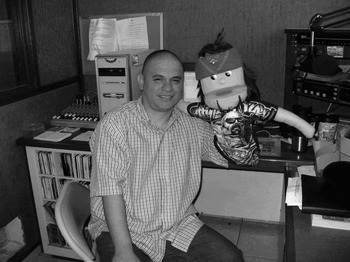
The rap piece in Spanish language is, of course, accessible to a larger contemporary audience. Javier Pérez, the rapper, uses his art as a vehicle for conscious socio-political oppositional statements, although he does not see it as ‘protest music’.Footnote 22 Nevertheless, it was Pérez's message that appealed to the youth of the Yoreme hamlet, even though Pérez never thought about how an (indigenous) audience would perceive his piece – a piece that, I would argue, to some extent reflects his own sensibility as a marginally positioned rapper (Figure 4). When Pérez and Soto heard about the reactions of the Yoremem I had witnessed, they were rather surprised.
Javier Pérez with his cholo (homeboy) ‘alter-ego’ mascot in the Los Mochis radio studio where he works as commentator and programmer. Photograph by Helena Simonett, Reference Simonett2009.

At the same time, Yoreme reactions to the rap piece differed widely. Some of the young musicians and dancers I addressed felt that they, as a people, were grossly misrepresented in the lyrics. They were keenly aware of the common views held by mestizos about indigenous people, such as walking in the monte with a machete in their hand, maybe for killing some iguanas as food supply, and they pointed out a number of such clichés in the rap lyrics. Julia Gastélum commented on the inappropriateness of rap music to express the traditional Yoreme lifestyle saying that Yoremem ‘don't scream and make such noise’. Her remark more generally underscores the conceived unsuitability of popular Western music to convey the struggles of indigenous people. Musician Bernardo Esquer, with whom I have worked intensely over the years, harshly criticised the overall concept of the Yoremensamble project, as well as the kind of music that, unlike indigenous music, ‘is incapable of contributing to an experience of transcendence’. In his view, popular music's superficiality and inherent ephemerality cannot threaten the profundity and durability of indigenous ceremonial music. So he simply shrugged off the ‘annoyance’.
From a historical point of view, it may be proper to do just this: in response to the increased ‘mestizoisation’ of their way of life, indigenous people kept holding on to ceremonial practices that clearly distinguish them from the surrounding mestizo population. As Roger Savage has pointed out, ‘Cultural works, modes of conduct, ethical evaluations, and senses of belonging are … integral to a historical community's continuing understanding of itself’ (Savage Reference Savage2009, forthcoming). Music in particular plays a crucial role in the struggle for recognition and self-representation because it intensifies a group's sense of belonging and of well-being. Yet today, one asks anxious questions regarding how indigenous people will continue to negotiate their cultural identity in the face of an ever accelerating globalisation; how they will defend their fragile soundscape against the acoustic encroachment of ever more potent high-watt sound systems; how they will deal with the transformation of their own localities which global modernity brings to them whether they want it or not.
Concluding thoughts
As I delved into exploring the Yoremensamble project, I realised that with every conversation I had, my interpretation of it shifted. Looking beyond the particularity of my example, I think we have to recognise the necessity for deep cultural analyses that must be rooted in the practices of fieldwork and ethnography. How else can we begin to converse with other cultures? How can we understand global phenomena if we are uninformed about what is going on at the local level? With regard to Martin Stokes' (Reference Stokes and Stobart2008, p. 212) reflections on local musical practice's place in the new (ethno)musicologies, my quest to ‘understand the local’ does not necessarily mean that I am ultimately searching for universals. Rather, I see this particular ethnographic work as a critical contribution to a growing literature on global popular music; it calls for anchoring popular music theory and research more thoroughly in the study of local experience.
Music is still central to what culture sounds like, but as music increasingly links the global and the local and vice versa, questions emerge regarding what this new music expresses and what it represents. Mass culture does bridge the gap between ‘marginal cultures’ and global consumer culture, but models of centre and periphery are now viewed as ineffective to describe Latin American cultures. More recent globalisation theory (as advanced by Appadurai Reference Appadurai1996, for instance) has spurred explorations of musical hybridity and cross-fertilisation. Seen in a positive light, the hybridity and multivocality generated by global consumer culture have the potential to intervene and subvert the hegemonic process through the reinterpretation and re-deployment of the received discourse (Bhabha Reference Bhabha1994, p. 162). If we consider the Yoremensamble ideally as an innovative site of collaboration and contestation, its subversive effect, however, is one-sided – while it dislocated diverse hegemonic forces, it did so at the expense of autonomous indigenous expressive culture. Instead of being a place where cultures meet, an ‘in-between space’ of fertile cultural dialogues, the project intensified binary relations – between mestizos and indigenous people, between the modern and the pre-modern, the colonisers and the colonised, the urban and the rural, the cosmopolitan and the ethnic, the outspoken and the muted, and the popular (secular) and the sacred. Pre-existing relations of tension and antagonism however continued to thrive in Bhabha's (1994, p. 172) ‘agonistic space’. And although we may note a cautious attempt towards multivocality, Yoremensamble's engagement with contemporary indigenous peoples remains at an uncritical level, or maybe worse, it speaks for a people who presumably are incapable of speaking for themselves, thus further marginalising a social group which historically has been excluded from participating in public debates and political discussions, and which has not been granted access to the media of publicity (Lomnitz Reference Lomnitz2001, p. 264).
In Michael Tenzer's words, the music in our world can be seen as a ‘staggering collective achievement’ (SEM-L, 17 December 2008). Yet, as Steven Feld has alerted us, this sonic plurality ‘is an uneven global soundscape, a contentious sound world, where we can see and hear equally omnipresent signs of struggle over augmented and diminished acoustic diversity’ (Feld Reference Feld, Kruth and Stobart2000, p. 175). The flow of music in our global world poses critical questions regarding the continuation of colonial histories, political economy, and ethics. These are questions we all – independent of our home discipline – must engage in more seriously and more deeply.
Acknowledgements
Thanks are due to the discussants of the 2009 Tepoztlán Institute for Transnational History of the Americas (Tepoztlán, Morelos) for their valuable feedback on an earlier version of this paper. The author has also analysed the Yoremensamble project within the framework of border musics in a forthcoming essay in Transnational Encounters: Music and Performance at the U.S.–Mexico Border, edited by Alejandro Madrid. His personal comments as well as the workshop he organised in the fall of 2009 to bring together the contributors to that volume helped the author to further contextualise this particular global popular music phenomenon.