Background
People in Africa bear a disproportionate burden of preventable and excess deaths before arrival at a health facility – the prehospital setting – even when compared to low-and-middle income countries on other continents.Reference Mould-Millman, Dixon, Sefa, Yancey, Hollong, Hagahmed, Ginde and Wallis 1 , 2 While the etiology is complex and multi-factorial, under-developed prehospital emergency care systems contribute significantly to this excess morbidity and mortality.Reference Lopez, Mathers, Ezzati, Jamison and Murray 3
To help address the burden of acute disease and injury in Africa, the World Health Assembly (World Health Organization [WHO]; Geneva, Switzerland) has called for the development of integrated, formal, emergency care systems on the continent.Reference Mock, Jurkovich, Amon-Kotei, Arreola-Risa and Maier 4 Emergency Medical Service (EMS) systems, defined as “Formalized prehospital care, provided by emergency care professionals who respond to medical emergencies within a well-defined jurisdiction,” 5 play a critical role in emergency care systems by providing timely, safe, on-scene evaluation, stabilization, and transport of patients to an appropriate facility.Reference Mould-Millman, Naidoo, de Vries, Stein and Wallis 6 - Reference Mock, Joshipura and Goosen 9 Further, EMS systems are a sustainable, cost-effective, front-line, public health intervention in resource-constrained environments,Reference Mould-Millman, Naidoo, de Vries, Stein and Wallis 6 , Reference Razzak and Kellermann 7 and leading international health agencies have recently begun to advocate for their development.Reference Mock, Jurkovich, Amon-Kotei, Arreola-Risa and Maier 4 , 5 , Reference Sasser, Varghese, Joshipura and Kellermann 10
Despite their importance to improved health outcomes, the crucial capabilities and capacities of EMS systems in Africa remain inadequately documented - the WHO has identified EMS as an area of neglected research.Reference Mock, Jurkovich, Amon-Kotei, Arreola-Risa and Maier 4 , Reference Nielsen, Mock, Joshipura, Rubiano, Zakariah and Rivara 11 Only one recent assessment of African EMS systems has been performed: Nielsen et al assessed EMS systems in three African (Ghana, Kenya, and South Africa) and 10 non-African countries.Reference Sasser, Varghese, Joshipura and Kellermann 10 This report provided initial evidence about the relative paucity of EMS systems in Africa; furthermore, where EMS systems exist, they were noted to be inadequate to meet the demand of the populations’ acute care needs.Reference Sasser, Varghese, Joshipura and Kellermann 10 Outside this assessment, there have been few studies of this field.Reference Nielsen, Mock, Joshipura, Rubiano, Zakariah and Rivara 11 - Reference Wachira and Martin 14
Given the burden of acute disease and injury, and the large benefit to be realized from well-thought-out and adequately-resourced EMS systems, a clear need exists to develop such systems. 5 , Reference Nielsen, Mock, Joshipura, Rubiano, Zakariah and Rivara 11 A key step in this development is a comprehensive description of the present status of African EMS systems, which can provide an evidence-driven basis for future strategic development.
The overall goal of this study was to improve the understanding of the current state of EMS systems in Africa, in the context of the regional burden of acute disease, to help inform EMS system development.
The specific objectives of this study were to: (1) assess the existence and distribution of EMS systems within the African continent; (2) define the prehospital burden of disease and injury common to African EMS systems; and (3) characterize the current organization and performance of African EMS systems.
Methods
This study, designed as a questionnaire-based survey, was conducted in 2013 and 2014. The discovery of African EMS expert respondents, and distribution of the questionnaire, occurred in four discrete phases: snowball sampling (Phases 1 and 2), a review of published literature (Phase 3), and a robust online search (Phase 4).
Ethical Approval
Ethical approval for this study was provided by the Colorado Multiple Institutional Review Board (Aurora, Colorado USA) and the Human Research and Ethics Committee of the University of Cape Town (South Africa).
Design of Questionnaire
A comprehensive questionnaire was designed to ascertain the components and function of African EMS systems. The questionnaire was based on a previously-developed framework which identifies essential elements of EMS systems in resource-constrained environments.Reference Sikka and Margolis 15 , Reference Mould-Millman and Sun 16 Following consent, the questionnaire comprised two sections: Section I - respondent screening for acceptable expertise in EMS systems; and Section II - EMS system assessment.
Section I of the questionnaire ascertained whether a respondent possessed expertise or credentials sufficient to respond credibly in the questionnaire. If a respondent indicated they were inadequately experienced, the survey was concluded, and they were requested to provide contact information for other potential respondents. Section II of the questionnaire collected EMS data pertinent to nine distinct technical components: system configuration; geographic jurisdiction; system financing; EMS legislation, rules, and regulations; dispatch, communication, and public access to EMS; responding units and/or vehicles; providers and their credentials; prehospital clinical care; and the burden of disease.
Validation of Questionnaire
The entire questionnaire was reviewed for face and content validity by three global EMS experts, and a survey expert for structure, syntax, and format. It was pilot-tested among several EMS physicians, and feedback was used to optimize survey layout, clarity of questions, brevity, skip logic, and survey flow. The final questionnaire contained 78 items and was adapted into three formats: a paper version, an electronic document in Microsoft Word (Microsoft Corporation; Redmond, Washington USA), and a web-based questionnaire on SurveyMonkey.com (SurveyMonkey; Palo Alto, California USA). The questionnaire also was translated into Arabic and French by medically-trained native-speakers, and the responses were successfully back-translated into English.
Conduct of Survey and Data Collection
In Phase 1 (November 2013), paper questionnaires were distributed to delegates attending the Emergency Medicine Society of South Africa’s (Cape Town, South Africa) biannual international conference, and the African Federation for Emergency Medicine’s (AFEM; Bellville, South Africa) second Consensus Conferences, both held in Cape Town, South Africa.
In Phase 2 (November 2013 to November 2014), questionnaires were electronically distributed to contacts provided by Phase 1 respondents and to African emergency and acute care providers identified via the AFEM network.
In Phase 3 (August 2014 to October 2014), questionnaires were sent electronically to authors identified through a robust search of peer- and non-peer-reviewed literature related to African emergency care, acute care, and prehospital care. The literature review methodology has been presented separately.Reference Mould-Millman, Oteng, Osei-Ampofo, Zakariah and Kowalenko 17
In Phase 4 (October 2014 to November 2014), questionnaires were electronically distributed to leaders of African EMS systems identified through a country-by-country, web-based online search if they did not participate in earlier phases.
Data Analysis
Distributed questionnaires were tracked manually by the investigator team and returned questionnaires were reviewed closely and documented by the study Principal Investigator (PI) after each phase to assess if there were duplicate responses and that questionnaires were complete. All questionnaires retrieved in paper or Word document formats were entered manually into the SurveyMonkey database by a member of the study team. The study PI electronically contacted all respondents to solicit answers to any questionnaire responses deemed missing (ie, blank responses). Missing data were coded as such in the study database. Additionally, EMS systems for which more than one questionnaire was completed (ie, duplicates) triggered a detailed review of the questionnaire answers to search for discrepancies which were then resolved through discussions between the study PI and involved respondents. Questionnaire data were entered and stored in a database in Microsoft Excel (Microsoft Corporation; Redmond, Washington USA). An estimate of the population size served by the jurisdictional EMS system was computed using survey geographic data and the country-specific census data available online.Reference Mould-Millman, Dixon, Sefa, Patel, Yaffee and Imediegwu 18 - 32 Results were analyzed in Microsoft Excel using descriptive statistics with percentages, ranges, and means.
Results
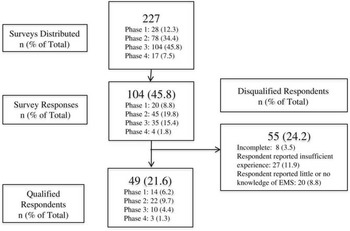
In total, 227 questionnaires were distributed. One-hundred four (45.8%) were returned, of which, 49 (21.6%) were completed by qualified respondents and 47 (20.7%) respondents were disqualified for inadequate self-reported experience or little or no knowledge about any African EMS systems (Figure 1). There were eight (3.5%) incomplete surveys.
Survey Response Results. Abbreviation: EMS, Emergency Medical Services.

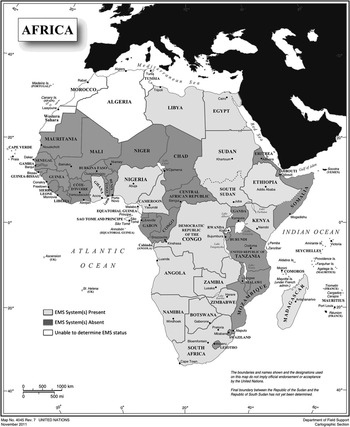
As a result of the comprehensive study processes, reliable EMS systems data were retrieved for 49 of 54 African countries. Respondents identified 25 unique EMS systems in 16 countries, representing 29.6% of 54 recognized countries in 2012 33 (Figure 2 34 ). West Africa appeared disproportionately under-served by EMS systems, with existing EMS systems confirmed in two of 16 (12.5%) countries (Ghana and Nigeria).
African EMS Systems in 2012. 33 Abbreviation: EMS, Emergency Medical Services.

In 33 (61.1%) countries, no evidence could be found of EMS systems; five (9.3%; Lesotho, Liberia, Malawi, Sierra Leone, and Tanzania) had survey responses indicating no EMS system; and 28 (51.8%) countries had no questionnaires returned. In all 33 countries, no evidence of EMS systems was confirmed through online searching, contact tracing, and personal investigation. No qualified respondents or online information was identified to conclusively determine the existence or absence of EMS systems in six (11.1%) African countries (Algeria, Mauritania, Morocco, Rwanda, Tunisia, and Western Sahara).
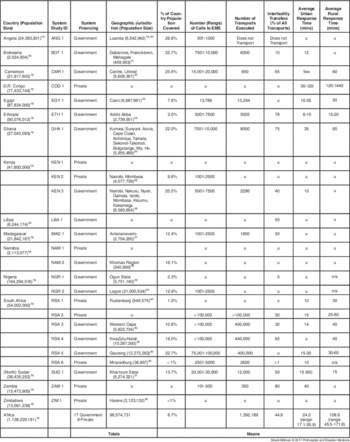
Overall, 98,574,731 (8.7%) of the total African population fell within the jurisdiction of at least one EMS system (Table 1).Reference Reinman 19 - 32 In sub-Saharan Africa specifically, the population served by EMS systems in 2012 was approximately 92 million (10.0%). Ten (18.5%) countries had predominantly government-financed EMS systems, three (6.0%) had privately-funded (ie, fee-for-service) systems, and three (6.0%) had both government and privately funded systems. Eastern and Southern African nations had the highest density of EMS systems, while West Africa had the fewest. In 2012, the mean percentage of inter-facility transports (IFTs) conducted, as a fraction of each EMS systems overall transport volume, was 44.9% (Table 1). The mean urban response time was 24 minutes (range 6-120 minutes) and median 15 minutes. The mean rural response time was 109 minutes (range 15-1,440 minutes) and median 45 minutes.
Jurisdictional, Transportation, and Response Characteristics of African EMS Systems

Abbreviations: (DR Congo), Democratic Republic of Congo; EMS, Emergency Medical Services; (n/a), not applicable; (u), unavailable.
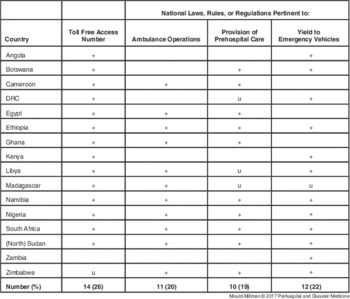
Fourteen (26%) countries represented in this survey had an established toll-free telephone number for the public to access EMS systems (Table 2). Regarding EMS laws, rules, and regulations, all countries represented in this survey had some form of legislation, rules, or regulations governing EMS or ambulance operations.
Public Access and EMS Laws, Rules, and Regulations within African EMS Systems

Note: (+) Yes, (Blank) No, (u) Unknown.
Abbreviations: DRC, Democratic Republic of Congo; EMS, Emergency Medical Services.
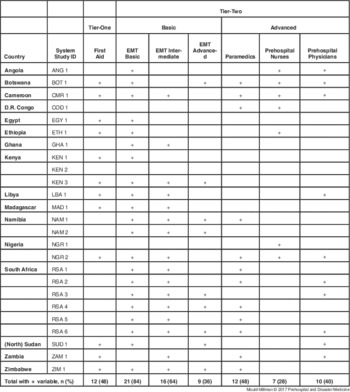
With regard to providers, 12 (48%) systems utilized tier-one (ie, layperson responders trained in first aid), and 24 (96.0%) had tier-two (ie, professional or medically-trained; Table 3). Basic emergency medical technicians (EMTs) were the most common (21 of 25; 84%) tier-two provider. One system (Democratic Republic of Congo) solely used advanced providers. Otherwise, EMS systems represented in this survey incorporated basic providers more often (21; 84%) than advanced providers (15; 60%). Seven of 25 (28%) EMS systems utilized prehospital nurses. Ten (40%) systems employed EMS physicians.
Prehospital Providers in African EMS Systems

Note: (+) Yes, (Blank) No.
Abbreviations: EMS, Emergency Medical Services; EMT, emergency medical technician.
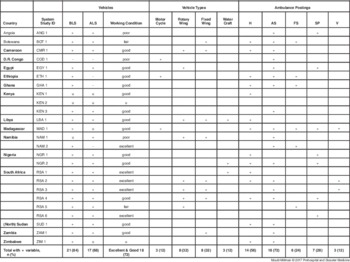
A majority of EMS systems had Basic Life Support (BLS)-capable (21; 84%) and/or Advanced Life Support (ALS)-capable (17; 68%) vehicles (Table 4). The majority of systems posted their vehicles at ambulance stations (72%) or health care facilities (56%). Three (12%) utilized motorcycle ambulances, eight (32%) had fixed wing air transport, eight (32%) had rotary wing (helicopter) ambulances, and three (12%) used water-craft (eg, boat ambulances).
Vehicles Used by EMS Systems

Note: (+) Yes, (Blank) No, (u) Unavailable.
Abbreviations: ALS, Advanced Life Support; (AS), Ambulance Station; BLS, Basic Life Support; EMS, Emergency Medical Services; (FS), Fire Station; (H), Hospital; (SP), Street Posts; (V), Variable.
Quality assurance programs existed in 11 (44%) systems, and three (12%) EMS agencies reported conducting research within their health care or EMS setting.
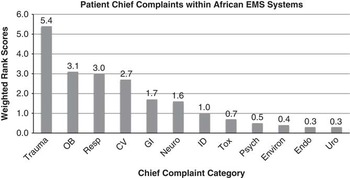
Survey respondents selected, then ranked, the top five patient chief complaint categories for which their EMS system responded, using a list provided in the questionnaire. The most common categories of chief complaints were weighted, ranked, and the final rank order is presented in Figure 3.
Histogram of Most Common Chief Complaints Encountered. Abbreviation: EMS, Emergency Medical Services.

Discussion
This study represents the first successful assessment and characterization of EMS systems across Africa - an area of neglected research - and offers an introduction to several important and unanswered clinical, operational, and public health questions.
Information was retrieved for 91% of countries, and the existence of 25 EMS systems in 16 countries was substantiated, meaning less than one-in-three African countries has an EMS system in place. Reasons for a general paucity of EMS systems in Africa include the lack of technical experts on the continent, inadequate advocacy, under-development of facility-based emergency care, and EMS system start-up costs. 5 - Reference Nielsen, Mock, Joshipura, Rubiano, Zakariah and Rivara 11 Despite these surmountable barriers, experts advocate for development of basic EMS systems as a cost-effective public health intervention, if appropriately implemented.Reference Lopez, Mathers, Ezzati, Jamison and Murray 3 , 5 - Reference Kobusingye, Hyder, Bishai, Joshipura, Hicks and Mock 8
Notwithstanding the shortcomings from a survey methodology and the lack of data from five countries, the study provides the first initial evidence that a minority (9.0%; 98 million) of Africans are geographically served by an EMS agency or system. Furthermore, nine of these 25 systems were private and utilized a fee-for-service model, which almost certainly poses a financial barrier to the populations serviced. This paucity of EMS systems has been suggested in several smaller analyses which demonstrated the ubiquitous use of commercial or private vehicles to conduct informal emergency medical transportation in many settings. 35 - Reference Mould-Millman, Rominski and Bogus 38 This necessitates a call to action by African states and public health authorities to provide locally-appropriate basic EMS systems, to help address the leading local causes of acute disease and injury.
Inadequate EMS system expertise and resources (providers and vehicles) limit the capacity of EMS systems to respond, evaluate, treat, and transport a large volume of patients. Most systems, except those in South Africa, conducted less than 10,000 transports per year. In support, Nielsen et al concluded that in those jurisdictions of Africa wherein EMS systems exist, most are inadequately resourced for the populations they serve.Reference Sasser, Varghese, Joshipura and Kellermann 10 Secondly, multi-factorial barriers limit public access to EMS services: two African studies cited financial (eg, EMS charging fees-for-services) and non-financial (eg, inadequate knowledge of access or negative attitudes about ambulance care) barriers.Reference Mould-Millman, Rominski and Oteng 36 , Reference Bosson, Redlener and Foltin 37 The provision of adequate EMS workforce and resource levels needs to be increased to match the population demand. Simultaneously, effective public access to EMS resources is a priority, for example, through a publicized toll-free emergency telephone number.
Results from this study describe the relative prehospital burden of disease in Africa, providing focus for advocacy and development of adequate EMS systems. 5 , Reference Nielsen, Mock, Joshipura, Rubiano, Zakariah and Rivara 11 , Reference Calvello, Skog, Tenner and Wallis 39 , Reference Calvello, Reynolds and Hirshon 40 Earlier published reports have indirectly derived prehospital burden of disease prevalence estimates using large-scale epidemiologic datasets. In this study, African EMS experts provided ranked burden of disease information via primary data sourced directly from their EMS systems.Reference Razzak and Kellermann 7 While it was not possible to quantify the absolute burden of each condition, due to limitations in the population data available, the 12 conditions were ranked into prehospital health priorities appropriate for the African context. Traumatic, obstetric, respiratory, cardiovascular, and gastrointestinal emergencies constituted the leading reasons for EMS responses, respectively. Emergency conditions in these areas should be prioritized in clinical, educational, operational, research, and systems improvement initiatives.
Of these priority conditions, local public health initiatives appear most closely aligned with traumatic and obstetric emergencies. 2 , 5 , Reference Nielsen, Mock, Joshipura, Rubiano, Zakariah and Rivara 11 Studies in Ghana showed that ambulances were twice as likely to be requested to transport injured patients compared to non-injured, most likely because of the non-ambulatory status of injured patients.Reference Nielsen, Mock, Joshipura, Rubiano, Zakariah and Rivara 11 , 35 While adequate EMS systems will never surpass preventative efforts in cost-efficiency, injuries will always occur despite the best prevention. Trauma-centric EMS development will be critical to minimize the burden of death and disability from injuries, especially on the road.
Obstetric complaints are the second leading contributor to the prehospital burden of disease reported here. This finding supports the recognition of maternal health as a public health priority in Africa, given the disproportionately high and preventable maternal mortality on the continent. Effective EMS systems are most appropriate to address the second (“delay in reaching care”) and third (“delay in receiving adequate medical care”) phases in the three-delays model of maternal mortality.Reference Calvello, Reynolds and Hirshon 40 , Reference Mowafi, Dworkis and Bisanzo 41 Reports from BurundiReference Papali, McCurdy and Calvello 42 and South AfricaReference Tayler-Smith, Zachariah and Manzi 43 indicate a mortality benefit and enhanced process indicators with the prioritization of ambulance systems for emergency obstetric complaints. Increased advocacy and EMS systems configuration directed to addressing maternal care is needed.Reference Nielsen, Mock, Joshipura, Rubiano, Zakariah and Rivara 11 , Reference Mowafi, Dworkis and Bisanzo 41
An important finding in this study is that IFTs constitute one-half of all EMS patient transportation. Often termed “referrals,” IFTs are a common practice in African health care systems for several reasons. In the simplest scenario, poor health literacy and poverty culminate in patients presenting at a relatively advanced stage of illness, to an inadequately equipped primary health care facility in close proximity, whose staff must promptly transfer the patient to a better resourced center. 5 , Reference Razzak and Kellermann 7 , Reference Mock, Joshipura and Goosen 9 The role of EMS resources to provide timely initial patient stabilization, transportation, and clinical care for large volumes of referred patients is critical. The predominance of IFTs also suggests that components of African EMS systems (eg, communications, procedures, knowledge, and skills) must be deliberately configured to satisfy this demand.
Survey results also revealed that basic prehospital providers were employed in the majority (85%) of systems, and most (81%) provided care within BLS-equipped ambulances. This model is most appropriate considering the evidence base of a survival benefit from BLS over ALS prehospital care, and the considerable additive investment in resources and training required to provide ALS prehospital care.Reference Yancey and Mould-Millman 44 , Reference Stiell, Wells and Spaite 45 Further, regional organizations advocate for basic, not advanced, prehospital providers in low-resource settings. 5 , Reference Mock, Joshipura and Goosen 9
A relatively wide spectrum of alternative EMS response and transport vehicles were reported, most often motorcycles, and less often water or air crafts. Given the diversity in terrain and the prevalence of unpaved roads, motorcycle ambulances likely reflect EMS systems appropriately adapting to local challenges and environments. An emerging example is the two- or three-wheeled motorbike ambulance retrofitted with a patient care compartment, which has the benefit of low purchase and operating costs, combined with robustness to operate in harsh geographic terrain.
Most countries with EMS systems already had implemented toll-free emergency numbers, which provides the first critical link for the public to access EMS resources and personnel. However, as demonstrated recently,Reference Bosson, Redlener and Foltin 37 public knowledge of this number may be lacking and focused public health education is recommended as a remedy. This is critical to protect practitioners, the EMS agency, and the population from misuse and potentially harmful procedures.
Limitations
An inherent limitation of surveys is respondent bias and recall errors. In the conduct of this survey, standardized screening for respondent expertise was incorporated as one method of minimizing erroneous responses. The relatively high prevalence of missing data limits the accuracy of some of the findings, although missing data were mostly confined to a few specific variables. While the relative rank of each chief complaint in relationship to each other was ascertained, accurate quantification of the African prehospital burden of disease was not possible for two reasons: (1) no uniform system exists throughout Africa for collecting chief complaint data;Reference Calvello, Reynolds and Hirshon 40 and (2) several EMS systems were not robustly collecting or categorizing all the survey data points. Due to a lack of EMS personnel contacts or non-participation, no reliable data were obtained for five countries, so researchers were unable to confidently discuss EMS systems in those areas. The absence of organized EMS systems in two-thirds of countries does not imply total lack of other forms of tier-one or tier-two out-of-hospital emergency care; this research was not designed to assess those programs or systems that play a valuable and supportive adjunctive role to EMS systems.
Conclusions
This study represents a first characterization of EMS systems across Africa, a historically-understudied and important field. Emergency Medical Services systems exist in one-third of countries, and only a minority (9.0%) of the population is covered. Inter-facility transports comprised one-half of all EMS transports. The leading causes of EMS transport were injury, obstetric, respiratory, cardiovascular, and gastrointestinal complaints. Most systems were predominantly BLS, government operated, and fee-for-service.
To improve outcomes for African patients with acute conditions, investments in, and development of, publicly-accessible EMS systems is recommended. Systems should be tailored to local burden of acute disease, integrated into existing health care systems, and adapted to conduct efficient IFTs. Robust and standardized data collection will help harmonize and advance EMS development in the region.