Beta-lactams comprise a family of antibiotics that share a common β-lactam ring structure; they include penicillins, cephalosporins and carbapenems. In the perioperative setting, cefazolin (a first-generation cephalosporin) is the preferred agent for antimicrobial prophylaxis in most surgical procedures.Reference Bratzler, Dellinger and Olsen1 However, due to misperceptions regarding allergy cross-reactivity, cefazolin is often avoided by prescribers in patients who report a penicillin allergy.Reference Zagursky and Pichichero2
The impact of avoiding the preferred β-lactam antibiotic for the treatment of bacterial infection has been well documented and includes an increased risk of adverse events,Reference MacFadden, LaDelfa and Leen3 infection with an antibiotic-resistant organism,Reference Macy and Contreras4 and mortality.Reference Huang, Cluzet, Hamilton and Fadugba5 To date, only 1 study has identified an association between penicillin allergy and surgical site infection (SSI).Reference Blumenthal, Ryan, Li, Lee, Kuhlen and Shenoy6 However, this cohort was limited to only 5 surgical procedure types and included only patients with reported penicillin allergy.Reference Blumenthal, Ryan, Li, Lee, Kuhlen and Shenoy6 It is also unclear whether the association exists at other institutions where the alternate antibiotic agent used may differ.
We hypothesized that patients with a reported β-lactam allergy have an increased risk of SSIs across a broad range of surgeries and that this risk is mediated by avoidance of cefazolin. The following retrospective cohort study was conducted to assess this association and the potential mediators of this effect.
Methods
A retrospective cohort study of patients undergoing a surgical procedure between January 1, 2017, and June 30, 2018, was conducted using the American College of Surgeons (ACS) National Surgical Quality Improvement Program (NSQIP) database at our acute-care hospital. Sunnybrook Health Sciences Centre (SHSC) is a 627-bed, academic, tertiary-care hospital located in Toronto, Ontario, Canada. Using a systematic 8-day sampling cycle, NSQIP extracts 135 variables relating to preoperative, intraoperative, and postoperative care. Approximately 15,000 surgical procedures are performed at SHSC annually, and nearly 2,500 of these are sampled by NSQIP.
During the study period, the following surgical specialties were sampled for NSQIP: general surgery, vascular surgery, gynecology-oncology, neurosurgery, urology, orthopedic surgery, and plastic surgery. A complete list of the specific procedures and sampling techniques is included in the Supplementary Material (online). Cases that were excluded from NSQIP sampling included brain-death organ donors, cases involving hyperthermic intraperitoneal chemotherapy, trauma cases, transplant cases, any surgical procedure related to an occurrence or complication of a prior procedure, and multiple surgical cases from the same patient within 30 days.7 Due to a markedly different pathogenesis of postoperative infections in transurethral procedures, these procedures were excluded from the study. This study received approval from our institutional research ethics board.
β-lactam allergy exposure
The exposure of interest was a self-reported β-lactam allergy, defined by any allergy to an antibiotic containing a β-lactam ring molecular structure. To obtain β-lactam allergy data, patients identified from the NSQIP database were cross-referenced with the Stewardship Program Integrating Resource Information Technology (SPIRIT) database, which aggregates microbiology, laboratory, and pharmacy information for patients admitted to the hospital.Reference Elligsen8 Since the current literature describing the association between penicillin and SSI is thought to be mediated by receipt of an alternate antibiotic (rather than a direct immune mechanism),Reference Blumenthal, Ryan, Li, Lee, Kuhlen and Shenoy6 any type of patient-perceived allergic reaction was included, regardless of whether it constituted a true drug-hypersensitivity reaction.
Study outcome
The primary outcome was 30-day SSI (superficial incisional, deep incisional, or organ-space infection), as defined by ACS NSQIP,7 which are based on the National Healthcare Safety Network (NHSN) definitions for SSI.9 This variable was collected as part of NSQIP surveillance through retrospective chart review. When postoperative follow-up notes were unavailable, the patient was contacted to inquire about SSI occurrence.
Based on the known risk factors associated with reported β-lactam allergy and SSI,Reference Blumenthal, Peter, Trubiano and Phillips10,Reference Owens and Stoessel11 the following variables were selected a priori for inclusion in the multivariable logistic regression model: age, gender, current smoker, diabetes mellitus, steroid or immunosuppressant use, American Society of Anesthesiologists (ASA) physical status classification, and wound classification. Definitions for diabetes mellitus, smoking status, and steroid or immunosuppressant use were those established by ACS NSQIP.7
Data synthesis and analysis
As part of NSQIP chart extraction, patient demographic information, comorbidities, and 30-day SSI outcome data were available for each surgical procedure. A manual review of the anesthetic record was performed for each surgical procedure to extract the type, dose, and time of preoperative antibiotic administration. This review also served to identify additional cases of reported β-lactam allergy, which were not documented electronically or detected by the cross-referencing process.
The association between a reported β-lactam allergy and SSI was evaluated using a multivariable logistic regression (generalized linear model). Because a single patient could have been sampled more than once during the study period, a generalized estimating equation was applied to estimate the model parameters. To avoid model overspecification, the ASA physical status classification covariate was reclassified as a dichotomous variable (<3, ≥3).
To understand the causal mechanisms that link a reported β-lactam allergy with SSI, mediation analysis was performed to determine whether the effect was mediated by receipt of an alternate antibiotic to cefazolin. The analysis used a natural effects model, which is an extension of marginal structural models for mean nested counterfactuals.Reference Steen, Loeys, Moerkerke and Vansteelandt12 This method allows for direct parameterization of each mediated pathway while producing estimates that correspond to the natural scale of the outcome model (an adjusted odds ratio).Reference Steen, Loeys, Moerkerke and Vansteelandt12 The same multivariable logistic regression (generalized linear model) using the same covariates was used as the outcome model for the mediation analysis. To minimize the risk of mediator-outcome confounding, surgical procedures where no preoperative antibiotic was administered was excluded from mediation analysis. All statistical analyses were performed using R version 3.4.3 statistical software (Foundation for Statistical Computing, Vienna, Austria).
Results
Over the 18-month study period, 3,708 surgical procedures were sampled by NSQIP. After excluding transurethral procedures, 3,589 procedures were performed among 3,499 patients. In total, 181 SSIs (5.0%) occurred in the study cohort. Of the 3,589 procedures, 369 (10.3%) occurred among patients who reported a β-lactam allergy.
Patient cohort
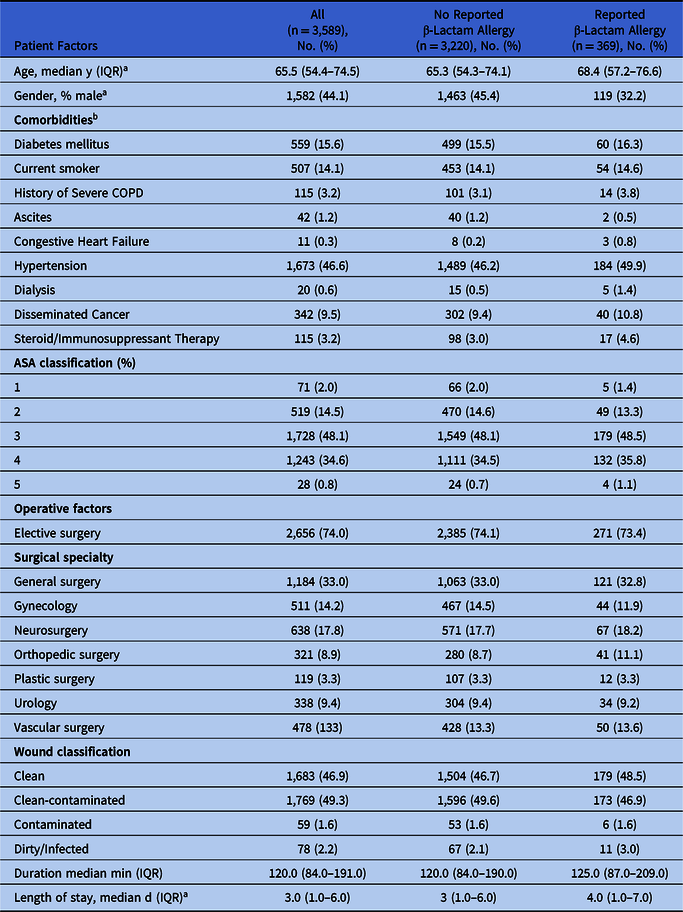
Patient demographic, comorbidities, and surgical data were available for all 3,589 procedures (Table 1). Patients with reported β-lactam allergy were older (68.4 vs 65.3 years; P = .005) and more likely to be female (67.8% vs 54.6%; P < .001) than those without allergy. Patient comorbidities, ASA physical status classification, surgical specialty, wound classification, and duration of surgery were similar between the 2 groups.
Baseline Characteristics

Note. ASA, American Society of Anesthesiologists; COPD, chronic obstructive pulmonary disease; IQR, interquartile range.
a Statistical significance (P < .05) on univariable analysis
b Definitions for comorbidities are based on American College of Surgeons National Surgical Quality Improvement Program Operations Manual.7
Preoperative antibiotic prophylaxis
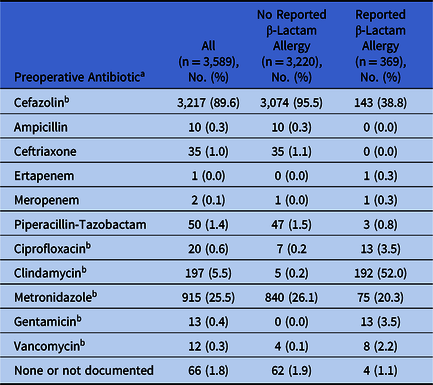
Preoperative antibiotic use stratified by reported β-lactam allergy is summarized in Table 2. The most commonly prescribed antibiotics were cefazolin (89.6%), metronidazole (25.5%), and clindamycin (5.5%). Overall, 66 cases (1.8%) were balanced across groups where no preoperative antibiotic was given or documented.
Preoperative Antibiotic Characteristics

a Cumulative antibiotic use exceeds cohort size as some patients received multiple antibiotics. For example, when metronidazole was used, it was coadministered with another antibiotic agent in 912 of 915 of cases (99.7%).
b Statistical significance (P < .05) on univariable analysis.
Patients with reported β-lactam allergy were significantly less likely to receive cefazolin (38.8% vs 95.5%; P < .001) and more likely to receive clindamycin (52.0% vs 0.2%; P < .001) or vancomycin (2.2% vs 0.1%; P < .001) than those without allergy. Of the 226 patients with reported β-lactam allergy who did not receive cefazolin, the most common alternate antibiotics administered were clindamycin (85.0%), metronidazole (33.2%), and vancomycin (3.5%).
Of the 3,523 procedures where a preoperative antibiotic was administered, the antibiotic dose and administration time were documented in 3,496 (99.2%) and 3,485 (98.9%) of cases respectively. When cefazolin was used, selection of a 2-gram dose (97.2% vs 98.0%), and administration within 60 minutes before surgical incision (95.1% vs 94.2%) were similar between patients with and without a reported β-lactam allergy. When clindamycin was used, selection of a 600-mg dose (92.7% vs 100%) and administration within 60 minutes before surgical incision (90.1% vs 80.0%) were similar between patients with and without a reported β-lactam allergy.
β-lactam allergy characteristics
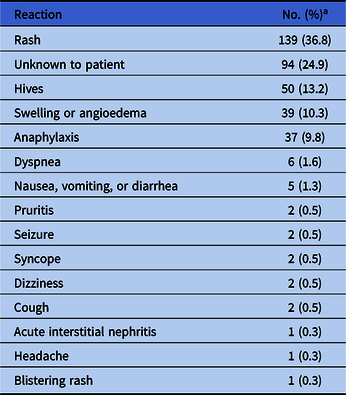
The 3 most commonly reported antibiotics were penicillin (85.4%), amoxicillin (4.0%) and cephalexin (3.7%); 7 patients (1.9%) reported an allergy to 2 different β-lactam antibiotics. The 5 most commonly reported reactions were rash (36.8%), unknown to patient (24.9%), urticaria (13.2%), swelling or angioedema (10.3%), and anaphylaxis (9.8%) (Table 3).
Allergic Reactions to β-Lactam Antibiotics

a Cumulative total exceeds reported β-lactam allergy cohort size as some patients reported >1 type of reaction.
Surgical site infection
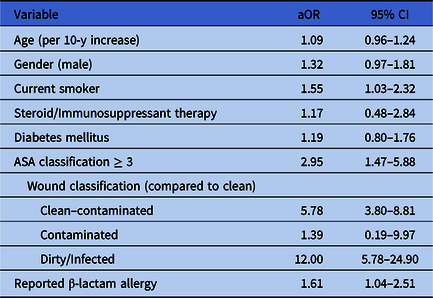
In the univariable analysis, 30-day SSI occurred in 154 of 3,220 patients (4.8%) without reported β-lactam allergy and 27 of 369 patients (7.3%) with reported allergy. In the multivariable logistic regression model, smoking status, ASA physical status classification ≥3, and a wound classified as contaminated or dirty were significantly associated with an increased risk of SSI (Table 4). After accounting for these variables and other covariates, a reported β-lactam allergy was associated with a statistically significant increase in 30-day SSI risk (adjusted odds ratio [aOR], 1.61; 95% confidence interval [CI], 1.04–2.51; P = .03).
Estimated Effects of Reported β-Lactam Allergy and Covariates on 30-Day Surgical Site Infection in the Multivariable Logistic Regression Model

Note. aOR, adjusted odds ratio; CI, confidence interval; ASA, American Society of Anesthesiologists.
Mediation analysis
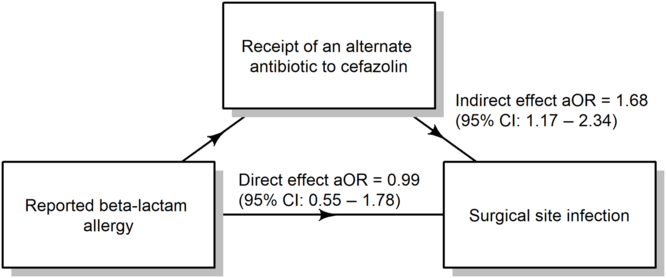
Following the exclusion of 66 procedures in which no preoperative antibiotics were administered, the effect of a reported β-lactam allergy on SSI was completely mediated by the receipt of an alternate antibiotic to cefazolin (indirect effect aOR, 1.68; 95% CI, 1.17–2.34; P = .005) (Fig. 1). When receipt of an alternate antibiotic to cefazolin was accounted for, the direct effect of a reported β-lactam allergy on the risk of SSI was not significant (direct effect aOR, 0.99; 95% CI, 0.55–1.78; P = .96).
Natural effects model estimates for receipt of an alternate antibiotic to cefazolin as the mediator. Although not shown in this figure, the following covariates were included in the natural effects model: age, gender, current smoker, diabetes mellitus, steroid/immunosuppressant use, American Society of Anesthesiologists physical status classification, and wound classification. Note. aOR, adjusted odds ratio; CI, confidence interval.

Discussion
Using a NSQIP-sampled, surgically diverse cohort spanning an 18-month period, a reported β-lactam allergy was associated with an increased risk of SSI. This effect was completely mediated by receipt of an alternate antibiotic to cefazolin. Our findings add to the mounting evidence demonstrating the harms of avoiding preferred β-lactam antibiotic due to reported allergy. In the perioperative setting, it is imperative that surgeons and anesthesiologists carefully assess patient-reported β-lactam allergies because emerging literature indicates that most patients can tolerate cefazolin.Reference Zagursky and Pichichero2
One prior study assessed the relationship between reported penicillin allergy and the risk of SSI. Blumenthal et alReference Blumenthal, Ryan, Li, Lee, Kuhlen and Shenoy6 conducted a 5-year retrospective review of 9,004 surgical procedures and reported an adjusted odds ratio of 1.51 for developing a SSI in those with a reported penicillin allergy.Reference Blumenthal, Ryan, Li, Lee, Kuhlen and Shenoy6 In their study, this association was completely mediated by receipt of a non–β-lactam antibiotic but was limited to 5 surgical procedures: coronary artery bypass, colon surgery, hip arthroplasty, hysterectomy, and knee arthroplasty.Reference Blumenthal, Ryan, Li, Lee, Kuhlen and Shenoy6
Our study strengthens the external validity of the association between reported allergy and SSI. In contrast to Blumenthal et al,Reference Blumenthal, Ryan, Li, Lee, Kuhlen and Shenoy6 our study included 7 surgical specialties encompassing >20 different surgical procedures. Our findings suggest that improving the use of β-lactam prophylaxis among these patients could have a widespread impact on SSIs across surgical specialties. In addition, our study included patients who reported any β-lactam allergy rather than penicillin allergy alone. We hypothesize that the impact of a reported penicillin allergy is not drug specific but, rather, applies to all β-lactam antibiotics, since both result in the avoidance of cefazolin. Patient and physician misconceptions surrounding penicillin allergy and cross reactivity with cephalosporins are prevalent,Reference Vorobeichik, Weber and Tarshis13 and interventions are urgently needed for clinicians to accurately assess a reported allergy and to determine whether they can safely receive cefazolin. Interventions such as β-lactam skin testingReference Li, Markus, Osmon, Estes, Gosselin and Hanssen14–Reference Moussa, Shuster and Matte19 and oral provocation challengesReference McDanel, Azar and Dowden18–Reference Savic, Gurr and Kaura20 have been used in the perioperative setting but have been limited in their scalability and sustainability due to resource requirements. It is now recognized that the cephalosporin cefazolin is non–cross-reactive with penicillin due to a structurally dissimilar side chain,Reference Zagursky and Pichichero2 which suggests that the decision to administer cefazolin preoperatively could theoretically be achieved with a clinical history alone. Further studies are needed to determine whether such a strategy is sustainable and whether an increase in cefazolin use in the patients with reported β-lactam allergy results in a decline in SSIs.
Our study provides additional insight into preoperative antibiotic use and the mediators of SSI. In the study by Blumenthal et al, 34.7% of patients who reported penicillin allergy received vancomycin as an alternate antibiotic.Reference Blumenthal, Ryan, Li, Lee, Kuhlen and Shenoy6 Preoperative administration of vancomycin is fraught with challenges, including the need for more stringent weight-based dosing, and unique to vancomycin, initiation of the antibiotic infusion ideally 60–120 minutes before surgical incision.Reference Bratzler, Dellinger and Olsen1 The challenges with antibiotic administration are reflected in the study by Blumenthal et al, in which 97.5% of patients did not receive vancomycin in the recommended time frame.Reference Blumenthal, Ryan, Li, Lee, Kuhlen and Shenoy6 Given that one-third of their patients with reported β-lactam allergy received this antibiotic, it was unclear whether inferior antibiotic efficacy or inappropriate timing of alternate antibiotics was the main contributor to the increased SSI risk. In contrast, vancomycin utilization as preoperative prophylaxis at our institution is significantly lower; only 2.2% of patients with reported β-lactam allergy received this antibiotic. By demonstrating a similar mediation effect, combined with negligible use of vancomycin, our study strongly suggests that inferior efficacy of alternate antibiotic agents is the main explanation for the increased SSI risk observed among patients with reported β-lactam allergy.
Our study has several limitations. First, the prevalence of reported β-lactam allergy (10.3%) is probably underestimated in our study because accessibility to inpatient and outpatient allergy testing services at our institution likely resulted in de-labeling of a significant proportion of patients.Reference Leis, Palmay and Ho21 Similarly, cefazolin use in patients with reported β-lactam allergy were 3× higher (38.8%) compared to the results reported by Blumenthal et al (12.2%).Reference Blumenthal, Ryan, Li, Lee, Kuhlen and Shenoy6 Therefore, the impact of a reported allergy on SSI may be more pronounced at other institutions where preoperative cefazolin utilization is lower. Second, we used the NSQIP-defined 30-day SSI outcome variable; thus, our study may not have included late-onset SSIs. Whether these would be affected by reported β-lactam allergy in the same way is unknown. Third, we cannot exclude the possibility of residual confounding variables, which could not be included due to limitations in sample size and outcome frequency. Finally, the findings of this study cannot be applied to transurethral procedures because they were excluded from this study.
A self-reported β-lactam allergy is associated with increased odds of SSI across a broad range of surgical specialties, which appears to be mediated by the use of alternate agents to intravenous cefazolin. Given recent data suggesting that cefazolin is a non–cross-reactive cephalosporin, there is great opportunity to improve SSI rates through interventions that promote the safe use of cefazolin prophylaxis among patients reporting a β-lactam allergy.
Supplementary material
To view supplementary material for this article, please visit https://doi.org/10.1017/ice.2019.374
Acknowledgments
Financial support
No financial support was provided relevant to this article.
Conflicts of interest
All authors report no conflicts of interest relevant to this article.