Introduction
For about two decades, many European countries have implemented or developed working time arrangements allowing older workers to reduce working hours in a move towards retirement. These arrangements make the end of professional careers more complex as different types of arrangements are possible, changing over time and with different implications on both the age at which the state pension is claimed and whether workers would continue to work beyond the pension age. These arrangements have two main goals. On the one hand, they contribute to smooth the transition from work to retirement by allowing a working time modulation while the access to early retirement arrangements tends to be limited in most of the European countries (Wels, Reference Wels2014a). On the other hand, they might be considered as tools aiming at extending working life as they sometimes lead to an overlap between employment and retirement. However, little is known about these arrangements at a comparative level. Even though recent research suggests that the longitudinal nature of these arrangements should be taken into consideration (see, for instance, van der Horst et al., Reference van der Horst, Lain, Vickerstaff, Clark and Baumberg Geiger2017), longitudinal datasets such as the Survey of Health Ageing and Retirement in Europe (SHARE), the English Longitudinal Study on Ageing (ELSA) or the Health and Retirement Study (HRS) in the United States do not provide clear information about voluntary working time reductions in late career. Data are usually deducted, for instance, by calculating the difference in working time between different waves, looking at transitions from full-time employment to part-time employment or looking at the expectations in terms of hours worked for the over- and under-employed workers (Bell and Rutherford, Reference Bell and Rutherford2013). As a matter of fact, these arrangements are still underestimated by empirical research (see Vickerstaff, Reference Vickerstaff2010 for the case of the United Kingdom and Wels, Reference Wels2018 for the United States), not only because their development is relatively recent (Zaidman et al., Reference Zaidman, Okba, Olier, Salzmann and Savary1999) but also because this matter raises methodological issues.
In Reference Andor2012, the Labour Force Survey (LFS), conducted by national statistical institutes across Europe and centrally processed by Eurostat, collected data about this specific matter in an ad hoc module called ‘Transition from work to retirement’, providing cross-sectional statistics that are not available using other datasets. Aiming to provide a cross-sectional overview of working time arrangements in late career across European countries and their potential impact of retirement plans, this article uses this 2012 ad hoc module. It is divided in three sections. The first section mentions the main institutional aspects of working time arrangements in Europe. The second section provides estimates of the share of older workers reducing working time in a move towards retirement in thirty European countries. Such a general overview raises several methodological issues that are briefly mentioned. Finally, in focusing on workers reducing working time before the pension age, the article assesses whether working time arrangements in late career may contribute to explain whether older workers plan to work after receiving an old-age pension or not. A short conclusion summarises the main methodological issues and the policy implications raised by the article.
The heterogeneity of working time arrangements in late career
Since the end of the 1980s, a large set of working time arrangements was implemented in European countries for smoothing the transition from work to retirement (Wels, Reference Wels2014a). The success of these arrangements was limited for quite a while (Zaidman et al., Reference Zaidman, Okba, Olier, Salzmann and Savary1999). However, following the progressive limitation of early retirement schemes in some continental countries and the progressive increase in the age at which people are entitled to leave the labour market, working time reduction schemes have gained visibility (Wels, Reference Wels2014a). By allowing older workers to reduce working time at the end of the career, these arrangements may be regarded as contributory factors towards increasing older workers’ employment participation (Léonard et al., Reference Léonard, Martinez and Wels2013), in response to targets fixed by the European Employment Strategy and, more recently, by the EU2020 Strategy (Wels, Reference Wels2016b). Furthermore, in a perspective of increasing working life, one of the main objectives of these mechanisms is to provide flexible arrangements allowing older workers to leave the labour market progressively or to continue working after receiving pension benefits. Even though a mandatory retirement age still exists in many European countries (except in the United Kingdom where the mandatory retirement age was abolished in 2011 (Lain, Reference Lain2017)), public arrangements allowing the older workers to work beyond the State pension age (Lain, Reference Lain and Scherger2015) were implemented or improved recently. For instance, the French gradual retirement scheme (‘retraite progressive’) allows older workers to reduce working time while receiving a ratio of their State pension (Cahuc et al., Reference Cahuc, Hairault and Prost2016).
Therefore, it can be assumed that the retirement age (either the mandatory retirement age and/or the state pension age) should not be considered as a clear threshold delimitating activity from inactivity. The retirement period merges with period(s) of employment and, consequently, professional paths nowadays take various forms, which are slightly less standardised than in the past (Hyde and Higgs, Reference Hyde and Higgs2004). It is therefore necessary to use an ‘operational definition’ of the retirement process, considering retirement ‘as a substantial reduction in employment accompanied by income from a retirement pension or personal savings’ (Atchley, Reference Atchley1982: 263) – but also accompanied by social benefits; rather than use a dichotomous definition that opposes working life and inactivity. Working time arrangements play a key-role in this process of relative individualisation of late career professional pathways. However, given their institutional complexity and because they raise methodological issues, these arrangements are still not well known at cross-national level. Before presenting descriptive statistics about these arrangements (section 2), there is a need to define what are working time reduction schemes in late career as the nature of these arrangements varies from one country to another and from one scheme to another (Delsen, Reference Delsen1990). For the sake of clarity, one can distinguish five main types of working time arrangements in late career based on two different aspects: the type of social benefits compensating the income loss, on the one hand; and whether the working time reduction occurs before receiving pension benefits or not, on the other hand.
Five types of main institutionalised working time arrangements can be distinguished.
Partial early retirement schemes
These refer to working time reduction before the state pension age and are covered or partly covered by social benefits. They have been implemented, for instance, in Belgium (Wels, Reference Wels2014b), the Netherlands (de Vroom, Reference de Vroom, Maltby, Vroom, Mirabile and Øverbye2004) and France (Guillemard, Reference Guillemard and Guillemard2008) and allow older workers to reduce working time in a move towards retirement in addition to social benefits such as unemployment benefits (in Belgium) or disability benefits (in the Netherlands or in Sweden)Footnote 1. In Germany and Austria, employees can also reduce working time with a subsidy to partially compensate for the income loss (Albanese et al., Reference Albanese, Thuy, Albanese and Cockx2015: 4). Most of these schemes were developed as part of early retirement programs and ‘later evolved as a method for seeking to retain older workers in the workforce’ (Fisher et al., Reference Fisher, Chaffee and Sonnega2016: 21).
Progressive retirement schemes
These are about working time reduction compensated by pension benefits that are received before the person moves to full-time retirement. ‘Progressive retirement’ was implemented in countries such as France, the United Kingdom and Sweden (Laczko, Reference Laczko1988). Regulations in terms of access to partial retirement are relatively complex. In France, for instance, the ‘retraite progressive’ allows workers aged sixty and over to reduce working time (from 20 to 60 per cent of a full-time job) and to receive a share of the pension corresponding to the share of the working time that is reduced. Progressive retirement is different from partial retirement as social benefits correspond to a share of the pension in the case of progressive retirement and to other kinds of social benefits (unemployment, sickness or disability benefits) in the case of partial retirement.
Combination of work and retirement
This is different from partial retirement schemes as the person keeps working or goes back to work after the state pension age and reduces working time in addition to pension benefits. In this case, pension benefits are not directly affected by the professional activity but the combination might affect tax contributions. One of the main differences is that, in the cases of partial early retirement and progressive retirement, the working period counts in the calculation of state pension benefits while, in most of the cases (e.g. in France since 2015), the combination of work and retirement does not count in the calculation of the state pension. While it is allowed to combine work and pension benefits in some countries such as the United Kingdom, regulations in terms of combination were more rigid in countries such as Belgium or France (Wels, Reference Wels, Bernard, Méda and Tallard2016a)Footnote 2 but have been relaxed recently.
Specific tax reductions
These can also apply when the worker does not receive any additional income but rather a reduction in the amount of tax to be paid on incomes-related earnings. This case implies a special disposition aiming at supporting the older workers. For instance, a tax credit has been developed for older workers working part-time in the United Kingdom (Burtless and Quinn, Reference Burtless and Quinn2002).
Sector-driven collective working hours reduction
Based on an age criterion, this can be observed in countries such as BelgiumFootnote 3 or the United Kingdom (Andor, Reference Andor2012). For instance, a Universities Superannuation Scheme's ‘flexible retirement’ has been implemented in 2011 in the United Kingdom for people working in Universities, higher education and associated institutions. Similarly, the NHS allows a flexible pension for people working in the health care sector since 2008 (Dubois et al., Reference Dubois, Runceanu and Anderson2016). In The Netherlands a ‘Deeltijdpensioen of PFWZ pension fund’ was implemented in the social and healthcare sector (Dubois et al., Reference Dubois, Runceanu and Anderson2016).
Some countries combine different types of arrangements while, in some other countries, the possibilities in terms of working time arrangements are limited. Similarly, some countries have developed a large set of arrangements covering successfully a large range of people, while in some other countries the access to these mechanisms is limited and concerns only a small number of people. Furthermore, these arrangements are implemented with different objectives depending on their nature. On the one hand, they can be considered as an alternative to early retirement schemes, as they allow workers to reduce working time rather than definitely leaving the labour market (retention) (Dubois et al., Reference Dubois, Runceanu and Anderson2016). On the other hand, they can be seen as tools aimed at extending the working life by smoothing the transition from work to retirement (extension) (Laczko, Reference Laczko1988).
There are national differences in terms of whether these schemes support the retention of the older workforce or the extension of the working life. Consequently, it might be relevant to estimate whether and to what extent working time reductions in late career contribute to extend the working life. Little evidence can be found in the literature, particularly at cross-national level. Using administrative data for Belgium, Albanese et al. (Reference Albanese, Thuy, Albanese and Cockx2015) show that the participation in a time-credit scheme prolongs employment during the first two years for men and four years for women. However, the authors also demonstrate that, as participants become eligible for early retirement subsequently, it accelerates the exit to early retirement. Using data for Sweden, Wadensjö (Reference Wadensjö2005) shows that the effects of the Swedish part-time pension go in different directions. On the one hand, some people make a choice of working part-time instead of full-time; on the other hand, some people work part-time instead of leaving the labour market. From a general point of view, the author shows that the part-time pension system tends to increase the number of working hours. Looking at the Austrian old-age part-time scheme, Graf et al. (Reference Graf, Hofer and Winter-Ebmer2011) show that working time reductions can be considered as a bridge to early retirement and do not contribute to maintaining people at work. Similarly, for Germany, Berg et al. (Reference Berg, Hamman, Piszczek and Ruhm2015) confirm that partial retirement reduces the probability of staying in the labour force – with differences between East and West Germany, particularly due to different labour market conditions (Huber et al., Reference Huber, Lechner and Wunsch2013).
Estimating the share of workers reducing working time in a move towards retirement
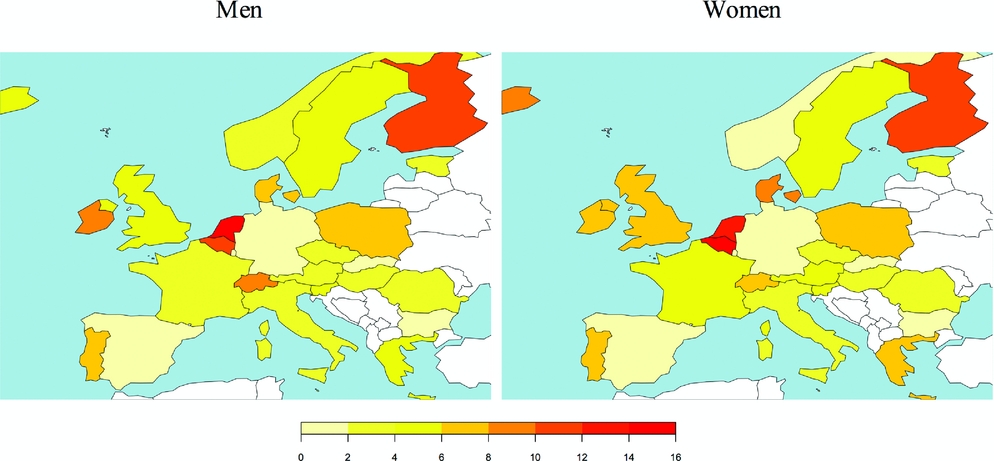
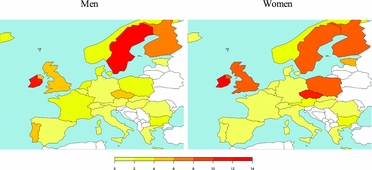
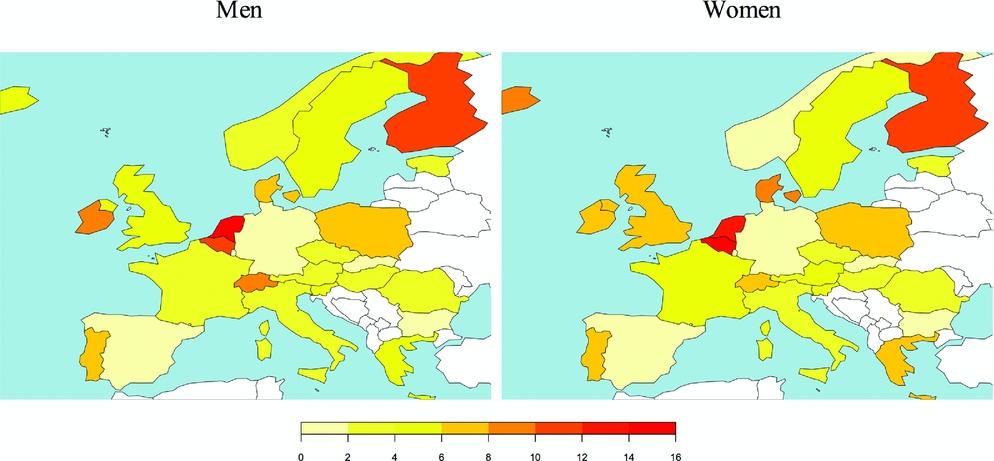
The diversity in working time arrangements in late career raises the issue of the statistical comparison. In 2013, Eurostat published an ad hoc module additionally to the yearly data provided by the LFS. Titled ‘Transition from work to retirement’, this ad hoc module embedded within the traditional survey driven by LFS furnished (for the first time since 2006) important statistical information about transitions to retirement in European countries. Despite the ad hoc module being based on only eleven additional questionsFootnote 4, the quality and the size of the sample together furnish accurate information about labour market trends in 2012. One of the variables included in the ad hoc module concerned working time reduction in the lead up to retirement. It was explicitly asked of respondents whether they ‘choose to reduce their working time in a move towards retirement’ and whether this reduction was made before receiving an old-age pension or not. Based on this variable, it is therefore possible to estimate the percentage of respondents declaring a reduction – with some degree of choice – in working time as a move towards retirement. The selected sample comprises employed and self-employed respondents aged fifty-five to sixty-nine, distinguishing between males and females. The estimates provided below calculate the share of workers (in per cent) aged fifty-five to sixty-nine declaring reduced working time in a move towards retirement before receiving pension benefits (Figure 1) and after receiving pension benefits (Figure 2), for male and female separately.
Percentage of workers aged fifty-five to sixty-nine who declared reducing working time in a move towards retirement before receiving the first old-age pension, by gender in 2012.
Percentage of workers aged fifty-five to sixty-nine who declared reducing working time in a move towards retirement after receiving the first old-age pension, by gender in 2012.
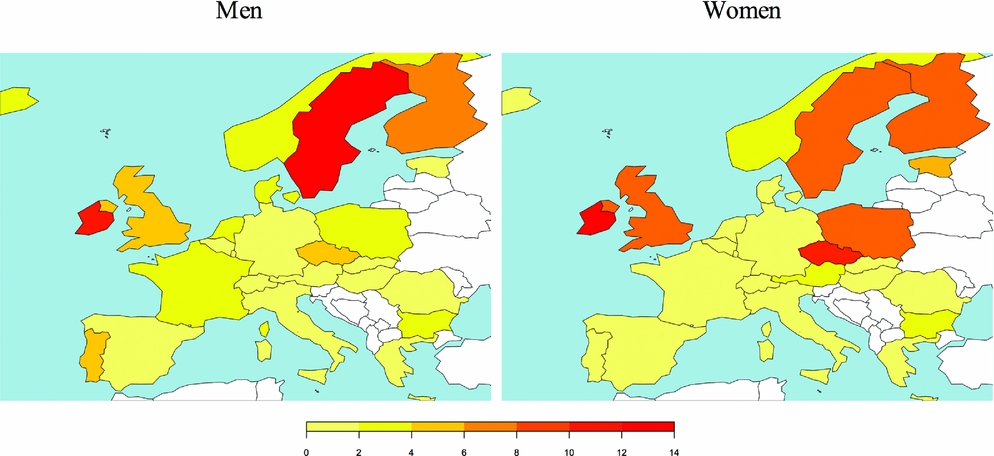
Looking at Figure 1, it can be observed that Belgium, the Netherlands, Switzerland and Finland are among the countries with the higher rates of working time reduction before pension benefits with respectively for male and female, 10.1 [7.3-13.8]Footnote 6 and 15.2 [11.2-20.2] per cent in Belgium, 15.4 [13.1-18.1] and 12.5 [10-15.5] per cent in the Netherlands, 8.9 [6.3-11.9] and 7.1 [4.7-10.1] per cent in Switzerland and 10.2 [6.7-14.4] and 10.9 [7.4-15.2] per cent in Finland. The difference between male and female is particularly important in the United KingdomFootnote 7, France, Finland and Belgium. Results are slightly different when looking at Figure 2. Sweden is the country where the share of people reducing working time in a move towards retirement after receiving first old-age pension benefits is the highest, particularly for men (respectively, 13.7 per cent for men [10.9-16.9] and 6.4 per cent for women [4.3-8.9]). It is also high in Ireland but the calculation of a 95 per cent confidence interval puts that into question (11.1 for men [2.3-29.7] and 10.7 for women [1-35.3]). Rates are also particularly high in Czech Republic, particularly for women: 4.7 per cent for men [3.1-7] and 9.4 per cent for women [6.6-13.1]. When all countries are combined, one estimates the percentage of workers reducing working hours in the lead up to retirement at 4.5 per cent for men and 5 per cent for women before an old age pension and, respectively, 3.2 and 3.1 per cent after it.
What is the originality of these estimates? They provide information about the share of the population actually reducing working time in a move towards retirement and are not based on either post-calculations or on expectations. Furthermore, the main interest of the data provided by the LFS is to make a difference between people declaring reducing working time in the lead up to retirement at the time of the interview and people working part-time. This is relevant for at least two reasons. Firstly, one can reduce working time in late career for reasons that are not about the progressive transition to retirement (economic downturn, reduced overtime, etc.). Part-time employment covers many situations that are not all about these schemes. Secondly, one can reduce working time in a move towards retirement and not be considered as a part time worker. Indeed, the usual definition of part-time employment (which is the one used in the LFS) is based on a spontaneous response given by the respondentFootnote 8.
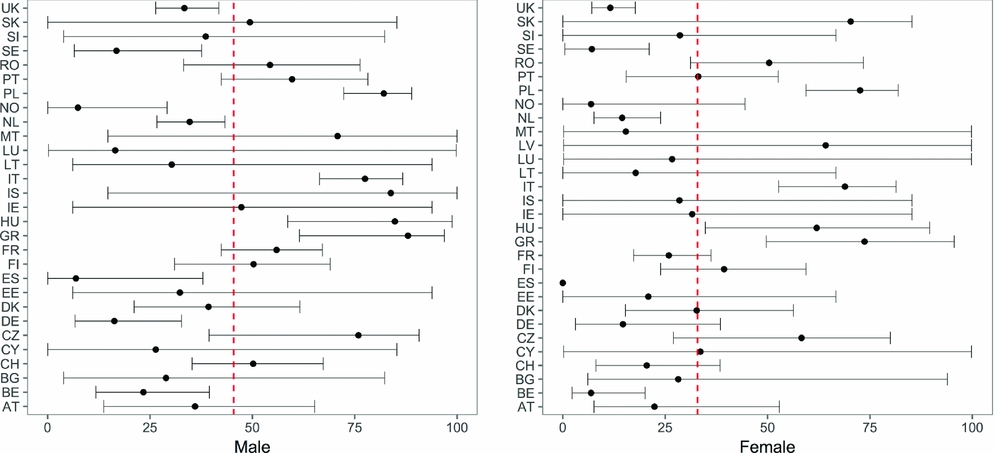
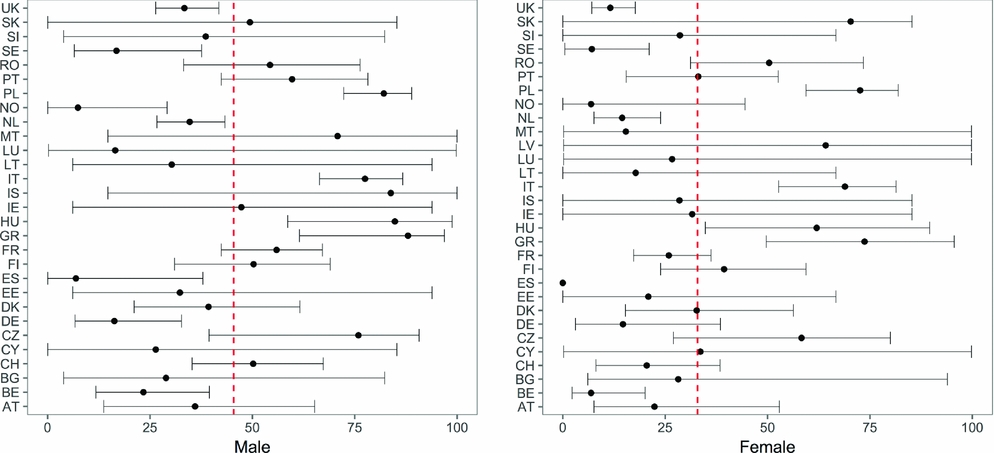
Figure 3 shows the percentage of people declaring working full-time among the population declaring reducing working time in a move towards retirement. The figure shows the estimates (in per cent) as well as the confidence intervals calculated on a 95 per cent basis. It can be observed that many individuals do not declare working part-time while they actually declare reducing their working time in a move towards retirement. Among the male population reducing working time in a move towards retirement, on average 40 per cent of the sample declares working full-time. About 30 per cent of the female selected sample declares working full-time.
Percentages still working full-time among individuals that had reduced their working hours prior to pension age
Working time reduction and retirement plans
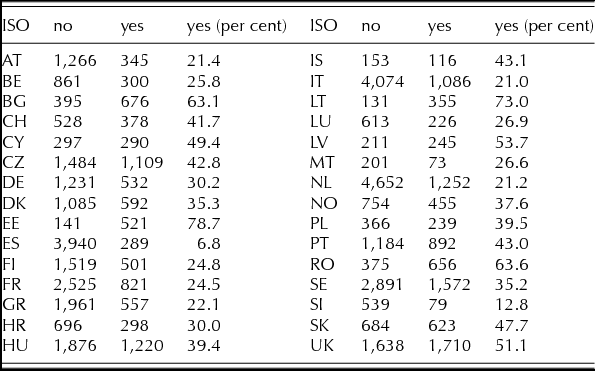
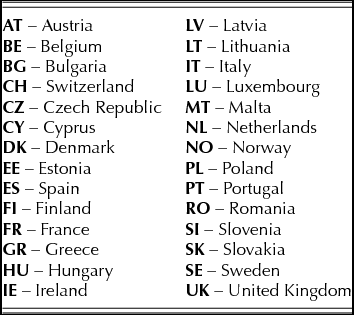
Assessing, at cross-national level, whether reducing working time in late career affects retirement plans requires a multilevel modelling that would evaluate the specific impact of working time reduction in late career by country (random effect) as well as the impact of other variables such as the gender or the type of occupation (fixed effect). Using the LFS 2012 ad hoc module for the population aged fifty-five to sixty-nine in thirty European countries (plus Switzerland) (N=56,279), this third section focuses on two main variables provided by the module: (1) whether respondents reduced working time in a move towards retirement, and (2) whether respondents plan to work after the pension age (i.e. the age at which the first old-age pension is planned to be paid) or not. The first variable is selected as a dummy explanatory variable (coded ‘yes’ or ‘no’) and has an impact varying from one country to another (descriptive statistics are presented in Table 1 and the list of the ISO country codes is in Appendix 1). The second variable is selected as the dependent variable coded ‘yes’ or ‘no’. Consequently, the model is a multilevel binary logistic regression (logit). As the dependent variable focuses on people not benefiting from a state pension, people receiving pension benefits are excluded from the model. Similarly, as the independent variable is about reducing working time, non-employed people are excluded from the model as well.
Respondents expecting to continue working/looking for a job after receiving old-age pension

Source: Labour Force Survey 2012 ad hoc module, author's calculation.
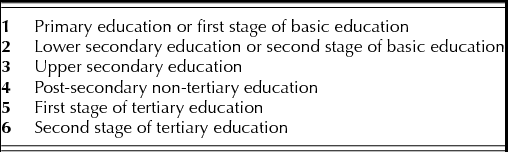
The model controls for the respondent's level of education (low, middle or high, corresponding respectively to the International Standard Classification of Education (ISCED) classification codes 0–3, 4 and 5 to 6 – see Appendix 2), whether the employment is temporary or not, the gender, the occupation (based on the International Standard Classification of Occupations (ISCO), see Appendix 3), the professional status one year prior to the interview (employed, disabled, retired, student, unemployment or other kinds of inactivity), the professional status (employed, self-employed or family worker) and, finally, the marital status (single, widowed or married). The model runs cross-sectional weights provided by the LFS with slight effects on the standard errors but no significant implications on the value of estimates.
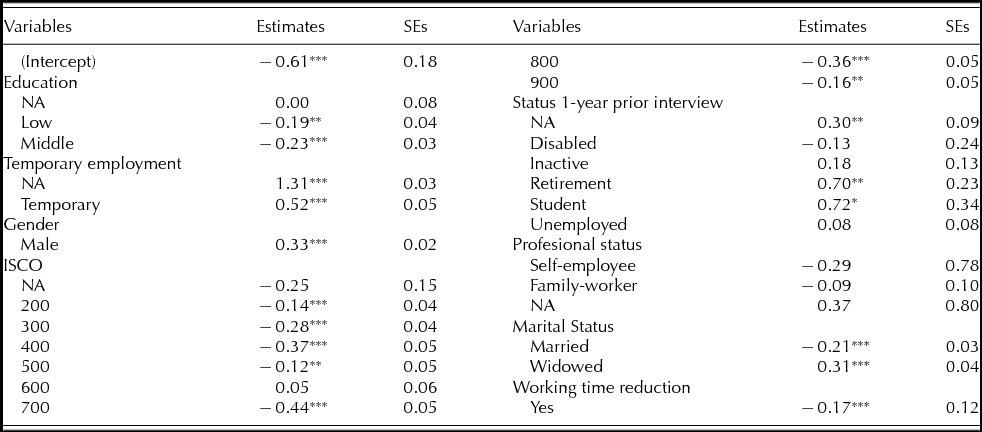
Results of the fixed effects are presented in Table 2. The table shows the estimates (these are log odds as the model is a logit), the significance and the standard errors. Looking at the level of education, the model clearly shows a strong and negative association between level of education and retirement plans. Compared to people with a high level of education, low and middle level of education are less likely to plan retiring after the retirement age. Looking at temporary employment, temporary workers are more likely than permanent workers to postpone the age at which they plan to leave the labour market. Looking at gender, male workers are more likely to plan retiring after the pension age compared to female workers. Looking at the type of occupation (ISCO), the model clearly shows that managers are more likely to plan to leave the labour market after the pension age rather than at the pension age compared to other types of occupation. The association is strongly negative and significant at 99 per cent for most of the occupation codes. Professional status one year prior to the interview is also relevant. One can observe that, compared with respondents employed one year ago, people who moved from retirement to employment (i.e., people who came back to work) are, logically, more likely to plan to work after receiving an old-age pension. A more interesting association to look at is the impact of being in full-time education (pupil, student, further training, unpaid work experience) one year prior to the interview, as it is a factor explaining whether respondents plan to work after receiving an old-age pension (which is consistent with what was observed by McNair (Reference McNair2006)). Estimates observed for the professional status are not significant, meaning that one cannot assume a significant relationship based on this sample. Finally, marital status also plays a key-role in explaining whether respondents plan to work after receiving pension benefits. Compared to single people, married respondents are less likely to work after receiving an old-age pension while widowed respondents are more likely to keep working.
Association between expecting to continue working beyond old age pension and education, employment type, gender, occupation, status one year prior to the interview, marital status and working time reduction. Logit model – Fixed effect.

Notes: Multilevel Binary logistic regression (logit) performed using the R-package ‘lme4’. Z-value as: 0 ‘***’ 0.001 ‘**’ 0.01 ‘*’ 0.05 ‘.’ 0.1 ' ' 1. Reference Education: ‘high’; reference Temporary Employment: ‘permanent’; reference Gender: ‘Female’; reference ISCO: ‘100’; reference Status 1-year prior interview: ‘Employment’; reference Professional Status: ‘Employee’; reference Marital Status: ‘Single’, reference Working time reduction: ‘No’. NA: no answer. Source: Labour Force Survey 2012 ad hoc module, author's calculation.
Looking at the dimension this article is interested in, one can observe that there is a negative and significant association (-0.17) between reducing working time in a move towards retirement and planning to work after receiving an old-age pension. Put in another way, people reducing working time are less likely to plan working beyond old-age pension entitlement compared to people who do not reduce working hours in a move towards retirement. But, as the types of schemes vary from one country to another, it is necessary to look at the random effect that was introduced in the model. Indeed, we want to explore the effect of different levels of working time reduction as they vary across countries. Instead of fitting unique models by country, we can fit a varying slope model, i.e. allowing the slope of the variables about working time reduction to vary by country.
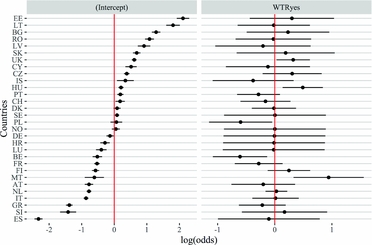
Figure 4 shows, on the left hand side, the intercept of the model per country and, more interestingly, on the right hand side, the slopes for the variable ‘reducing working time in a move towards retirement’ as they vary by country. The estimates in Figure 4 are in log odds and can be interpreted as follow: a value higher than zero means that the odds (on a logarithmic scale) of observing an association between a reduction in working time and expecting to continue working beyond the old age pension are positive (i.e. reducing working time increases the odds of working beyond the pension age) while a value lower than zero indicates lower odds to observe this association. Put in another way, results to the right of the central line indicate that reducing working time is associated with increased odds of working after pension age, and results to the left of the line indicate reduced odds of working after pension age. The figure also provides confidence intervals, calculated on a 95 per cent basis – we can assume at 95 per cent that the value of the log odds lies between the lower and higher threshold of the confidence interval.
Association between expecting to continue working beyond old age pension and working time reduction by country. Logit model – Random effect.
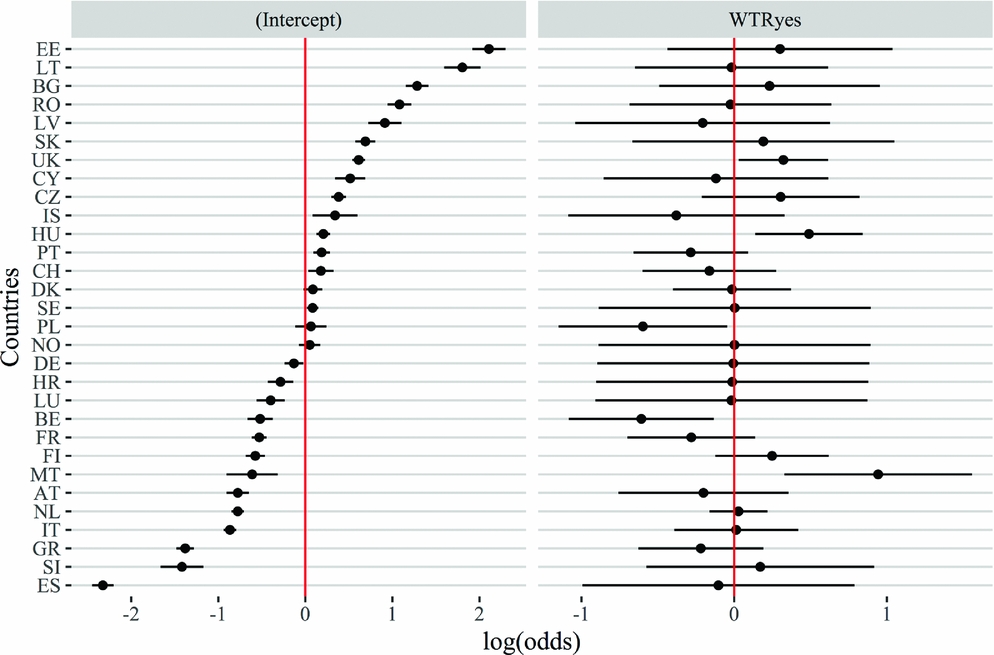
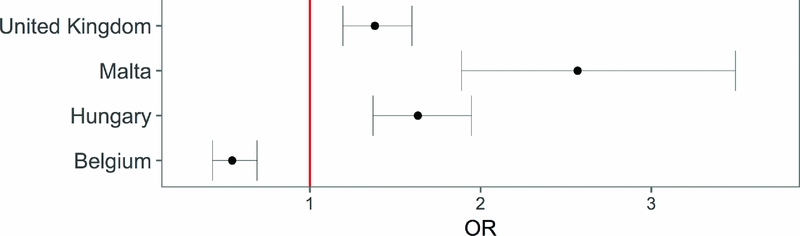
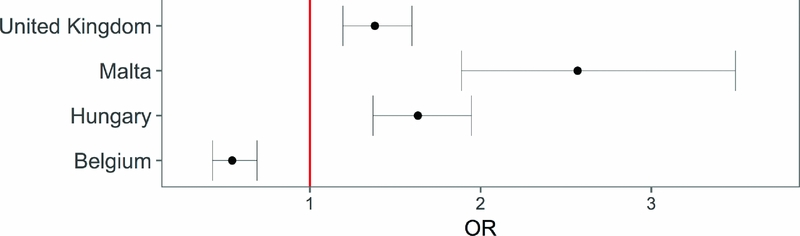
As the population declaring reducing working time in a move towards retirement is relatively small, it has been hard to provide significant results. This is reflected in the estimates presented in Figure 4. Yet, four countries show significant results: Belgium, Hungary, Malta and the United Kingdom. This does not mean that there is no relationship in other countries but rather that the model is unable to show that there is a relationshipFootnote 9. Focusing on these four significant countries, one can estimate the odds ratioFootnote 10 by calculating the exponentials of the log odds. Odds ratios for these four countries are presented in Figure 5. This shows that, in Belgium, the odds of planning to work after receiving an old age pension when reducing working time in a move towards retirement are 46 per cent lower than for respondents not reducing their working time (=1 – 0.54) with a 95 per cent confidence interval between 31 and 57 per cent. Conversely, in Hungary, Malta and the United Kingdom, the odd ratios are positive: respondents reducing working time in a move towards retirement are more likely than respondents not reducing working hours to plan to work after the first old-age pension respectively at 63, 157 and 38 per cent. From a methodological point of view, the random effect observed in the model is consistent with what is observed when performing regressions separately for each country, both in terms of values of the log odds and in terms of confidence intervals.
Association between expecting to continue working beyond old age pension and working time reduction by country. Logit model – Random effect. Odds ratios calculated for the United Kingdom, Malta, Hungary and Belgium.
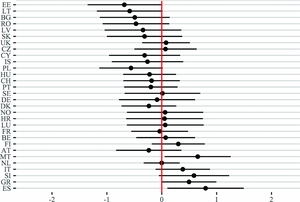
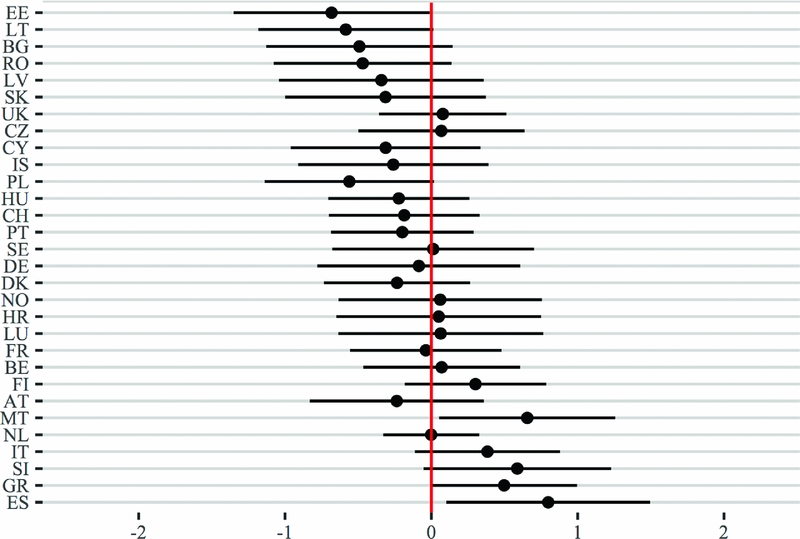
Finally, an interaction term was introduced in the random effect of the model in order to look at the specific impact of gender on the association between working time reduction and retirement expectations (Figure 6). As in the original model, the interactive model does not show lots of significant results. Although, it is possible to assume that among those reducing working time, male workers are more likely to work beyond the first old-age pension in Malta, Greece and Spain. They are less likely to expect working beyond the first old-age pension in Estonia, Lithuania and Poland compared to female workers. This particularly underlines the need to look at gender when looking at the association between career expectations and working time reductions.
Interaction between working time reduction and gender (reference: female)
What are the main findings and limitations flowing from these results and how to interpret these differences? One can assume, based on the results presented above, that the association between reducing working time in late career and considering working after the first old-age pension varies from one country to another. Different types of policies in terms of working time arrangements might have a different impact on retirement plans. This confirms, from an empirical perspective, that these arrangements are heterogeneous – they are implemented for different reasons, affect different types of individuals and, consequently, play a different role in working lives. Taking the example of Belgium and the United Kingdom, one can clearly understand what is going on. Belgium used to be a country with high early retirement rates. But, as this is less the case nowadays, working time arrangements (i.e. the ‘time-credit’) have, to a certain extent, contributed to replacing or postponing early retirement schemes. It is not a surprise that people reducing working time in a move towards retirement are more likely to be those who plan to stop working after receiving an old-age pension. Conversely, early retirement schemes were less developed in the United Kingdom with only one scheme – the Job Release Scheme (Banks et al., Reference Banks, Blundell, Bozio, Emmerson, Gruber and Wise2010). Consequently, working time arrangements in late career in the United Kingdom are implemented in order to smooth the transition from work to retirement and to extend working lives (associated with other reforms such as the abolition of the compulsory retirement age (Lain, Reference Lain2017)). Another difference is about the right to reduce working time. While, in the United Kingdom, there is a right to request flexible work and the working time reduction is negotiated within the company, in Belgium the time-credit is a proper right and employees can, under certain conditions (particularly based on the company size and the number of older workers reducing working time), reduce working time unilaterally. These differences explain both the difference in terms of who reduces working time and what the reduction is for.
There are several limitations to the results presented above, particularly due to the nature of the dataset. As mentioned previously, the 2012 LFS ad hoc module provides original information about working time reductions in late career. But LFS data used at cross-sectional level do not provide some key-information. Firstly, no information about incomes was introduced in the model. LFS provides limited information about work-related incomes (in deciles) but the rate of missing data, particularly for some countries (e.g. the United Kingdom) raises an insurmountable problem. Controlling for education level and occupations is a way to deal with this missing variable as one can control for social position. Secondly, LFS data provides the age-group (based on a five year period) and not the accurate age of the respondent. The model controlled for three categories (from fifty-five to fifty-nine, from sixty to sixty-four and from sixty-five to sixty-nine) but it would have been better to use the age as a continuous variable. Thirdly, LFS cross-sectional data are not longitudinal and there is no way (yet) to track respondents over time. Therefore, we should consider expectations of working after the first old-age pension as forecasts made by the individuals and not as a proper empirical fact. One needs to distinguish expectation from action. Fourthly, the model is based on a dichotomous variable, distinguishing people planning to remain at work after the first old-age pension from people who plan to leave. The ad hoc module provides information about people planning to leave before the first old-age pension (early retirement) but results are not significant. Finally, LFS ad hoc modules focusing on transition to retirement were developed in 2006 and 2012 but not in 2018. We can regret this lack of consistency and hope that a new module about this matter will be developed in the coming years for providing more recent and comparable data.
Conclusion
A significant share of the population aged over fifty-five is purposely reducing working time in a move towards retirement, with some high rates in countries such as the Netherlands, Belgium, Malta or, in a lesser extent, the United Kingdom. Working time reductions can be achieved through different schemes implemented at a national level. For the sake of clarity, the article distinguished five main types of schemes: partial early retirement, progressive retirement, combination of work and retirement, tax reduction and sectorial or company schemes. The aim of these schemes – such as the reasons why they were implemented – vary from one scheme to another and from one country to another. They can be implemented with the purpose of replacing early retirement schemes or with the purpose of extending working lives by offering a smooth transition to retirement. Using data from the 2012 LFS ad hoc module, the article aimed at providing descriptive statistics about the percentage of people in Europe aged fifty-five to sixty-nine reducing working time in a move towards retirement, and analysing the impact of working time reduction in late career on retirement expectations.
The article shows the need to consider working time reduction in late career as a specific topic with different implications. In particular, this might apply to life-course studies looking at transitions from work to retirement (see, for instance, Di Gessa and Grundy, Reference Di Gessa and Grundy2014; Di Gessa et al., Reference Di Gessa, Corna, Platts, Worts, McDonough, Sacker and Glaser2016; Benson et al., Reference Benson, Glaser, Corna, Platts, Gessa, Worts and Sacker2017). It also underlines both the need to distinguish working time reduction in a move towards retirement from working time reductions that are due to other factors (economic slump, involuntary reduction in overtime, etc.) and the need to make a difference between part-time employment and working time reduction. One can reduce working time and remain a full-time worker, depending on the number of hours that are reduced. A transition from full-time employment to part-time employment observed through longitudinal data does not mean that the working time was actually reduced. There are methodological challenges and as such it is an important issue that should be looked at as a proper matter for further research.
From a policy point of view, one can answer in two ways the question ‘does working time reduction in late career favour late exit?’ First, it depends on the type of scheme. Some schemes were implemented in a context of extension of the working life beyond the pension age, aimed at extending working lives. Conversely, some other schemes are path dependent and reflect, under new conditions, previous early retirement schemes. They clearly do not have the same purpose and do not target the same individuals. In most countries, both types of schemes exist and it is the management of these schemes that produces different outputs. Second, extending working life is not and cannot be the only purpose of working time arrangements. More evidence is needed about the implications of working time arrangements in late career in terms of mental and physical health and quality of life, but one can assume that, facing a reduction in access to early retirement schemes, some workers reduce working time because they have no choice. From a political perspective, this raises two issues. On the one hand, working time arrangements seem to be a temporary reform towards full-time employment in late career and against early retirement schemes. Put in another way, recent policy reforms show that the access to working time arrangements was reduced in some countries, particularly countries providing social benefits compensating the income loss (e.g. Belgium, France or Sweden), which raises doubts about the future of these schemes. On the other hand, working time arrangements associated with social benefits allow workers who cannot afford to reduce working time to reduce it anyway. Without social benefits compensating the income loss, working time modulations in late career would be a matter of inequalities between those who can afford to work fewer hours (and the impact it might have on the amount of the pension) and those who cannot.
ISO 3166 code

International Standard Classification of Education, 1997 version (ISCED-97)

International Standard Classification of Occupations (ISCO) categories