Introduction
Congenital microtia-atresia is a conspicuous ear malformation characterised by auricle and external auditory canal abnormalities and is often associated with middle-ear abnormalities. Previous studies on the global prevalence of microtia have demonstrated significant geographical and ethnic variations, with incidence rates ranging from 0.88 to 12 per 10 000 births; in China, this rate was 3.06 per 10 000 births.Reference Jovic, Gibson, Griffiths, Dobbs, Akbari and Wilson-Jones1,Reference Deng, Dai, Yi, Deng and Li2 Approximately 10 per cent of patients with congenital microtia-atresia suffer from bilateral malformation.Reference Teufert and Cruz3
In addition to its aesthetic impact, congenital microtia-atresia can also affect hearing function via meatal atresia and hearing loss.Reference Kelley and Scholes4 Therefore, congenital microtia-atresia may be associated with impaired speech and language development,Reference Jensen, Grames and Lieu5 psychosocial issues, and substantial social obstacles in daily life.Reference Johns, Im and Lewin6 Conductive hearing loss is the main clinical manifestation of impaired hearing function, with an air–bone gap (ABG) of up to approximately 60 dB HL.Reference Shonka, Livingston and Kesser7 Depending on the individual hearing disorder of each patient, hearing rehabilitation options include reconstructive surgery, bone conduction hearing device implantation or middle-ear implants. As reconstructive surgery may fail to provide satisfactory results and increase the possibility of complications including canal restenosis and infection,Reference Siegert and Magritz8 hearing device implantation has become a better choice for many patients.
Bonebridge bone conduction implants (Med-El, Innsbruck, Austria) have been clinically used in China since March 2016. This is a semi-implantable hearing system consisting of two major parts. The implantable part contains the bone conduction-floating mass transducer, which applies the vibrations directly to the bone; the external part is the audio processor which digitally processes the sound and sends the information through the coil to the internal part. Bonebridge devices have shown good safety and significantly improved hearing threshold and speech perception in children with conductive hearing loss.Reference Yang, Chen, Zhao, Liu, Gao and Huang9 Meanwhile, the transcutaneous technology reduces post-operative complications and is a suitable alternative to percutaneous devices.Reference Schmerber, Deguine, Marx, Van de Heyning, Sterkers and Mosnier10
Binaural hearing provides important benefits such as increased safety, improved directional hearing and speech perception in noisy conditions.Reference Stelling-Kończak, Hagenzieker, Commandeur, Agterberg and Wee11,Reference Avan, Giraudet and Buki12 Sound localisation, the ability to identify the direction of a sound source, requires binaural hearing. Conventionally, patients with hearing loss perform worse in directional hearing than normal hearing individuals,Reference Noble, Byrne and Lepage13 and bilateral implantation of cochlear implants or active middle-ear implants can achieve considerable improvement in sound localisation in patients with sensorineural hearing loss (SNHL).Reference Nopp, Schleich and D'Haese14,Reference Koci, Seebacher, Weichbold, Zorowka, Wolf-Magele and Sprinzl15
Hearing loss rehabilitation in both ears also has merits for patients with conductive hearing loss,Reference den Besten, Vogt, Bosman, Snik, Hol and Agterberg16 which is not only attributable to bilateral stimulation but also to binaural hearing.Reference Priwin, Stenfelt, Granstrom, Tjellstrom and Hakansson17 Most research on the bilateral use of bone conduction devices revolves around percutaneous bone conduction devices, and there is a lack of research on the effect of bilateral transcutaneous bone conduction devices on hearing function. A recent study demonstrated that contrary to bilateral percutaneous bone conduction devices, patients demonstrated difficulties in directional hearing when fitted with only one bone conduction device (i.e. with one bone conduction device turned off).Reference den Besten, Vogt, Bosman, Snik, Hol and Agterberg16 Improvements in directional hearing have been reported in childrenReference Dun, Agterberg and Cremers18 and adultsReference Bosman, Snik, Van er Pouw, Mylanus and Cremers19 fitted with bilateral bone anchored hearing aids.
Despite the merits of bilateral implants reported by previous studies, there are still some controversies regarding bilateral bone conduction device fitting in patients with bilateral conductive hearing loss. First, with the application of a single bone conduction transducer, both cochleae receive stimulation with negligible interaural attenuation.Reference Katz, Lezynski and Katz20 Second, patients fitted with bone conduction devices experience cross-hearing, and the concomitant stimulation of the contralateral cochlea might impair the ability to process interaural differences in level and timing, which limits the improvements in binaural hearing.Reference Koci, Seebacher, Weichbold, Zorowka, Wolf-Magele and Sprinzl15,Reference Stenfelt and Goode21
Given these controversies, it is important to further explore whether a second Bonebridge device can effectively have a summation effect on bilateral cues. Meanwhile, considering the cost and risks of bilateral implantation, it is critical to verify the benefits and possible limitations of bilateral implantation of Bonebridge devices prior to surgery. Accordingly, this study aimed to evaluate the threshold, speech perception and sound localisation in children with microtia and atresia fitted with bilateral Bonebridge and compare unilateral and bilateral listening conditions to determine whether bilateral Bonebridge patients are capable of localising sounds and whether the localisation ability could be improved over time.
Materials and methods
Patients with bilateral conductive hearing loss
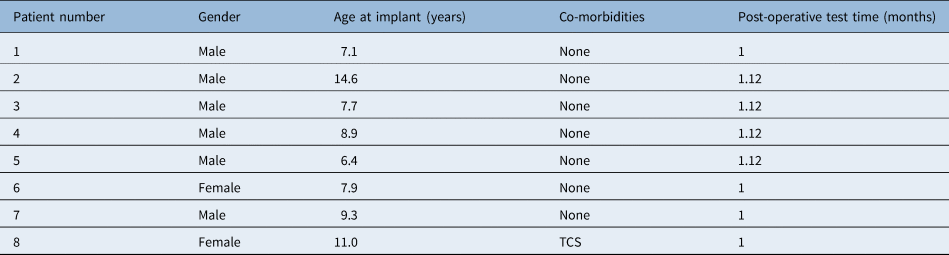
Eight patients, comprising 6 males and 2 females with a mean age of 9.11 (range, 6.4–14.6) years, with bilateral atresia and microtia were included in this single-centre, prospective study. All the patients were Mandarin-speaking and underwent bilateral Bonebridge implantation at the Tongren Hospital of the Capital Medical University between February 2019 and January 2021.
Patient characteristics are presented in Table 1. Inclusion criteria were: (1) an age of more than 5 years and bilateral congenital malformations of the middle ear with or without atresia; (2) patients in whom auricular reconstruction, if needed, had been performed or was completed before the final stage of auricular reconstruction; (3) an ABG more than 60 dB HL, bone conduction threshold equal to or less than 20 dB HL between 0.25 and 4 kHz, and a difference in bone conduction threshold between both ears of less than 15 dB HL; (4) patients with a skull thickness of equal to or more than 6 mm and a Jahrsdoerfer score of either equal to or less than 7 or more than 7 (patients with the latter score are not suitable for external auditory reconstruction or Vibrant Soundbridge implantation (Med-El)); (5) no inner ear malformation or central auditory processing disorders; (6) ability to simulate placement of the bone conduction-floating mass transducer in the mastoid process via pre-operative CT scans of the temporal bone using the three-dimensional planning Bonebridge FastView software (Med-EL); (7) a good understanding of Mandarin and ability to repeat words; (8) patients opting for bilateral implants according to their own demands and the recommendation of their doctor as well as having rational expectations of benefits and risks of bilateral Bonebridge devices. Patients not meeting the abovementioned criteria were excluded from the analysis.
Patient demographic data

TCS = Treacher Collins syndrome
Surgical intervention and test conditions
All participants signed informed consent before surgery. Patients underwent an optimal integrated surgical technique for bilateral Bonebridge implantation and auricular reconstruction, which reduced operative duration, total cost, and pain or discomfort. Patients underwent simultaneous bilateral Bonebridge implantation and the final stage of auricular reconstruction (i.e. dissecting and lifting the auricular framework, isolating the postauricular fascia and periosteum, putting the Bonebridge subperiosteally, and fixing the implantation with a titanium screw). One patient (patient 8) with Treacher Collins syndrome did not require auricular reconstruction and only underwent bilateral Bonebridge implantation. Audiological and sound source localisation tests were performed pre-operatively and post-operatively in all participants. Tests were performed in four different conditions post-operatively: left Bonebridge on, right Bonebridge on, bilateral Bonebridge on and Bonebridge off.
Hearing threshold and speech perception test
Tests on pure tone audiometry, sound field thresholds, speech reception thresholds in noise and word recognition scores in quiet were performed. Pure tone audiometry was measured with a US GSI-61 audiometer (Grason-Stadler, Eden Prairie, USA) to determine the air threshold and bone conduction threshold at 0.25, 0.5, 1, 2 and 4 kHz. In order to measure sound field thresholds, the trill was presented from the front at 0.25, 0.5, 1, 2 and 4 kHz. Speech reception thresholds in noise presented at 65 dB was determined by an adaptive test, with speech and noise both coming from the front. Results were expressed using the signal-to-noise ratio, which is expressed in dB and defined as the difference between speech presentation and noise level when the patient reached 50 per cent speech recognition. Word recognition scores in quiet conditions were measured using Mandarin Speech Test Materials. Fifty monosyllabic and fifty disyllabic words were presented at 65 dB SPL. The percentage of correctly identified words was calculated.
Sound localisation test
The methods of sound localisation test were consistent with our previous study.Reference Zhao, Yang, Liu, Gao, Chen and Zheng22 Briefly, seven loudspeakers with ranges between −90° and +90° were located in a horizontal plane in a sound-proof room. The average interval of all loudspeakers in a frontal semicircle was 30°. Participants with an eye mask were seated and asked to face the middle loudspeaker at 0° azimuth. The test sound was presented at three different sound levels (i.e. 65, 70 and 75 dB SPL). At every stimulus level, seven loudspeakers were presented twice in random sequence. Therefore, a total of 42 presentations were performed for each condition. After the sound source was played, all participants were asked to indicate the number of the loudspeaker presenting the stimulus. Sound localisation was tested 1 month after Bonebridge activation as the baseline test, and a localisation test at 12 months of follow up was conducted in 4 patients.
The mean absolute error (Equation 1) was evaluated as the accuracy of sound source localisation. Mean absolute error is the mean of all (i.e. absolute errors, expressed in degrees, between the sound source position as indicated by the patient and the actual position of the sound source). Simultaneously, results were quantified by the best linear fit of the stimulus-response relationship (Equation 2), where αRESP is the response azimuth (expressed in degrees), αSTIM is the stimulus azimuth (expressed in degrees), bias is the response bias (expressed in degrees) and gain is the response gain (which is dimensionless).
Response gain indicates accuracy, with a factor gain score of one, indicating a perfect correlation between target and response. Bias was defined as the offset in degrees. If all data points in the stimulus–response plot formed a diagonal resulting in a mean absolute error less than 10°, a gain close to 1 and a bias close to 0, the patient was considered as a good performer.Reference Vogt, Frenzel, Ausili, Hollfelder, Wollenberg and Snik23,Reference Agterberg, Snik, Van de Goor, Hol and Van Opstal24
 $${\rm Mean}\,{\rm absolute}\,{\rm error} = \displaystyle{{{\rm \;}\mathop \sum \nolimits_{i = 1}^n \vert {\alpha_{RESP}^i {\rm \;}-\alpha_{STIM}^i {\rm \;}} \vert {\rm \;}} \over n}$$
 $$\alpha {\rm RESP} = {\rm gain} \times \alpha _{{\rm STIM}} + {\rm bias}$$
Statistical analysis
Data analysis was performed using SPSS® statistical software version 22.0. Quantitative indicators were described as mean ± standard deviation (SD) or median (range). Normally distributed data were analysed using a paired-sample t-test and a repeated measures analysis of variance, and non-normally distributed data were analysed using a Wilcoxon signed rank test and a Friedman test. A p-value less than 0.05 was considered statistically significant.
Results
Eight patients, comprising 6 males and 2 females with a mean age of 9.11 years (range, 6.4–14.6 years) were enrolled in this study. All patients with bilateral transcutaneous bone conduction hearing device implantation underwent hearing threshold and speech audiometry tests. Seven patients underwent the sound localisation test, and four patients were followed up after one year. All patients with congenital aetiology had symmetric bilateral conductive hearing loss, with an air conduction difference of no more than 10 dB at 0.5, 1, 2 and 4 kHz between ears.
Pure tone audiometry
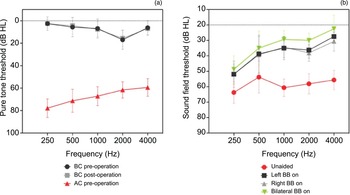
In this study, the mean pre-operative and post-operative pure tone bone conduction threshold was 9.06 ± 7.25 (range, 0–18.75) dB HL and 9.11 ± 5.45 (range, 0–19.25) dB HL, respectively, at 0.5, 1, 2 and 4 kHz, without any significant changes after bilateral implantation (p > 0.05), suggesting that bilateral Bonebridge implantation is a safe method to improve audiology of patients (Figure 1a). The mean pre-operative air conduction threshold of the eight patients in this study was 64.84 ± 6.84 (range, 57.59–76.25) dB HL. Three patients had a mean air conduction threshold of more than 65 dB (patients 2, 5 and 8), and two patients had a mean air conduction threshold of more than 70 dB (patients 2 and 8).
(a) Pre-operative mean bone and air conduction threshold and post-operative mean bone conduction threshold at each frequency (mean value ± standard deviation). (b) Post-operative frequency specified sound field thresholds of the four different listening conditions (i.e. unaided and unilateral left, unilateral right and bilateral aided conditions (mean value ± standard deviation)). BC = bone conduction; AC = air conduction; BB = Bonebridge

Free sound field thresholds
The mean sound field thresholds in the unaided condition was 57.65 ± 4.65 (range, 51.25–63.75) dB HL. The mean sound field thresholds between different aided conditions of aided left, aided right and bilaterally aided were 35.0 ± 5.09, 35.3 ± 5.54 and 28.75 ± 5.13 dB HL, respectively. Patients with a bilateral fitting performed better with lower sound field thresholds than those with a unilateral fitting (p < 0.001, both). Post-operative mean functional gain (functional gain = aided sound field thresholds minus unaided sound field thresholds) at 0.5, 1, 2, and 4 kHz in the aided left, aided right and bilaterally aided condition were 22.03 ± 2.49, 21.71 ± 3.33 and 28.90 ± 3.50 dB HL, respectively. The bilaterally aided condition had a higher functional gain than the unilaterally aided condition (p < 0.001, both).
Frequency-specified threshold improvements at different listening conditions are shown in Figure 1b. The functional gain at 250 and 500 Hz in the bilaterally aided condition was slightly higher than that in the left aided or right aided condition, but the difference was statistically insignificant (p > 0.05, both). The functional gain at 1, 2 and 4 kHz in the bilaterally aided condition was significantly higher than in the left or right aided conditions (p <0.05, both).
Speech reception scores
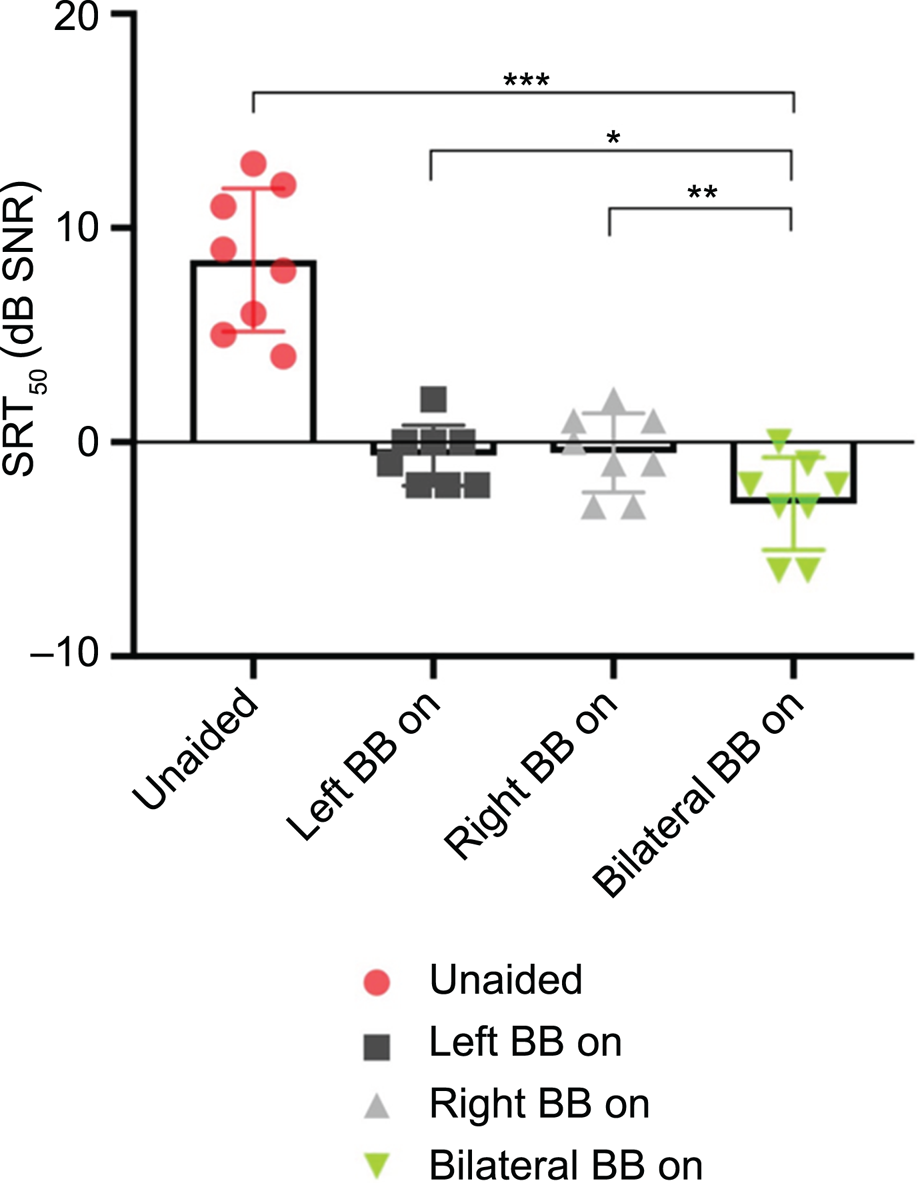
The mean speech reception threshold in noise in the unaided condition had an 8.5 ± 3.33 dB signal-to-noise ratio. The mean speech reception thresholds in noise in the aided left, aided right and bilaterally aided conditions had a signal-to-noise ratio of −0.63 ± 1.41, −0.5 ± 1.85 and −2.88 ± 2.17 dB, respectively. Speech reception threshold in noise was improved by lowering the signal-to-noise ratio by 11.38 ± 3.81 dB with bilateral Bonebridge, and this improvement gave a signal-to-noise ratio of 9.0 ± 3.20 dB and 9.12 ± 3.09 dB in the left Bonebridge and right Bonebridge aided conditions, respectively. The bilateral aided condition performed better than the other conditions (Figure 2) (p < 0.001, both).
Mean performance of speech reception thresholds of patients under noisy circumstances in four different listening conditions (i.e. unaided and unilateral left, unilateral right and bilateral aided conditions). Speech reception threshold (SRT) is measured at a fixed noise level of 65 dB SPL, with varying speech levels. The signal-to-noise ratio (SNR; dB) is calculated by speech reception threshold minus 65 dB for comparison. *p < 0.05, **p < 0.01, ***p < 0.001. BB = Bonebridge

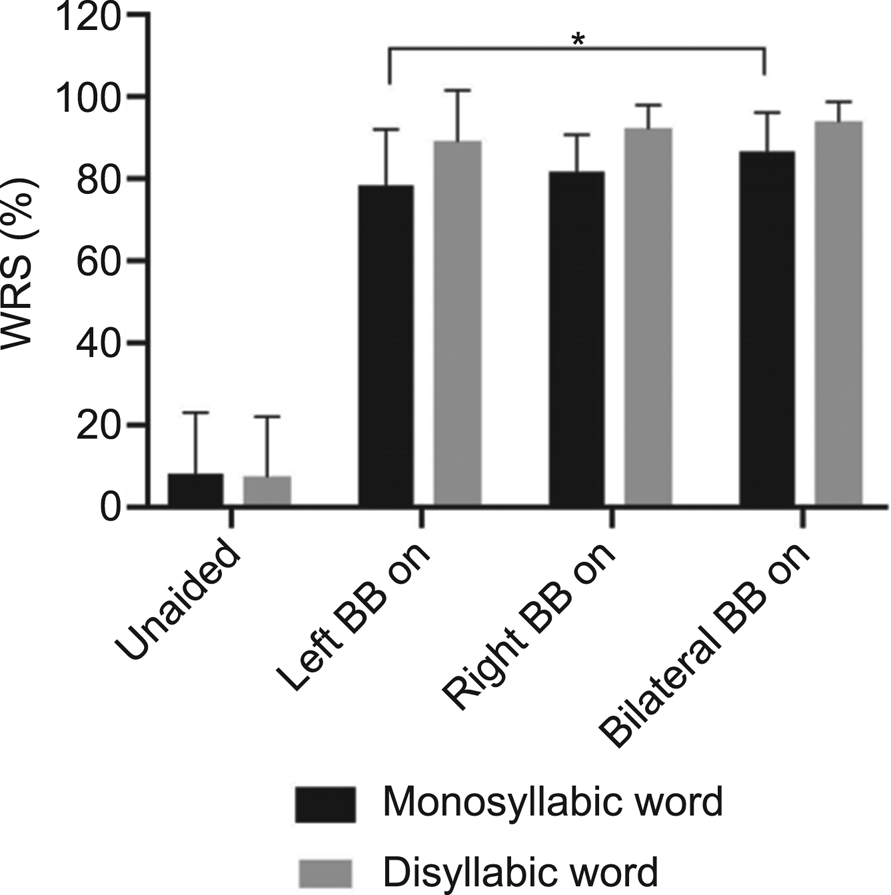
Word recognition scores under quiet conditions are shown in Figure 3. Monosyllabic word recognition scores under quiet conditions in the left Bonebridge on, right Bonebridge on and bilateral Bonebridge on conditions were 78.25 ± 13.70 per cent, 81.63 ± 8.97 per cent and 86.50 ± 9.54 per cent, respectively. The bilateral fitting condition had a significantly higher monosyllabic word recognition score than the left aided condition (p = 0.04), yet this difference was statistically insignificant between the bilateral aided and right aided condition (p > 0.05). The disyllabic word recognition scores of the bilateral aided, left aided, and right aided conditions under quiet circumstances were 94.00 ± 4.78 per cent, 89.25 ± 12.28 per cent and 92.38 ± 5.60 per cent, respectively. This difference was statistically insignificant (p > 0.05).
Mean performance of word recognition scores (WRSs). The word recognition score of monosyllabic and disyllabic words is measured under four different listening conditions (i.e. unaided and unilateral left, unilateral right and bilateral aided conditions), expressed by the correct rate. *p < 0.05. BB = Bonebridge

Sound localisation
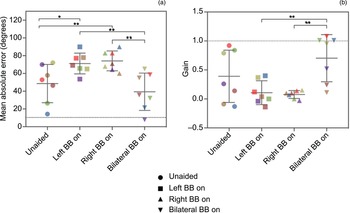
Localisation results at baseline under the unaided and three aided conditions are shown by the stimulus-response plots displayed in Figure 4. The mean unaided mean absolute error in the 7 children with conductive hearing loss was 48.57° ± 21.56° (range, 14.29°–72.14°; Figure 4a). In the unilateral aided condition, the mean absolute error was 71.20 ± 11.67° and 74.12 ± 11.18° in the left and right aided condition, respectively; these values were significantly worse than the value in the unaided condition (p<0.05, both). Bilateral fitting had better directional hearing and a lower mean absolute error than the unilateral fitting (p<0.001, both), yet there were no significant differences between the bilateral condition and the unaided condition (p > 0.05). Regarding the three stimulation levels, there was still no significant difference between the bilateral and unaided conditions (p > 0.05).
Mean absolute error and gain in four different listening conditions (i.e. unaided and unilateral left, unilateral right and bilateral aided conditions). *p < 0.05, **p < 0.01.

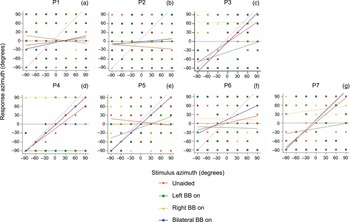
The unaided sound source localisation ability varied among patients. Two patients (patients 2 and 5) with a pre-operative air conduction higher than 65 dB HL had a relatively poor sound source localisation performance (patient 2: gain = −0.09 and mean absolute error = 72.14°; and patient 5: gain = −0.13 and mean absolute error = 70.0°). Both showed better localisation performance in the unilateral aided than the unaided conditions. Patient two had a similar sound localisation performance between unaided and bilateral aided conditions. Patient 5 had the best sound localisation performance with bilateral fitting among all conditions, with the data points lying along the diagonal with a gain of 1.01 and a small mean absolute error of 7.86°, which is close to that of children with normal hearing. The remaining 5 patients with a pre-operative air conduction equal to or less than 65 dB HL demonstrated similar localisation performance (i.e. patients in the unilateral aided condition showed a certain degree of accurate lateralisation, meaning that they felt that the sound was biased to the side of Bonebridge; Figure 5). The unaided and bilateral aided conditions had similar mean absolute error (p > 0.05), and both conditions showed better performance than the unilateral aided condition (p < 0.05).
Sound-localisation target-response plots of patients. Linear regression is represented by solid lines of different colours at different testing conditions (i.e. the unaided (red) and unilateral left (green), unilateral right (yellow) and bilateral aided conditions (blue)). A response gain (slope) indicates accuracy, with a gain of factor one indicating a perfect correlation between targets and responses. Bias is defined as offset in degrees. If all data points in the stimulus–response plot form a diagonal resulting in a gain close to one and a bias close to zero, the patient is considered as a good performer. P = patient; BB = Bonebridge

Patients three, four and seven demonstrated excellent localisation abilities with bilateral fitting, with gains close to one (Figure 5). However, patient four showed an obvious lateralisation, as the responses were all biased to the aided direction, with both left and right mean absolute error of 90° and a gain of 0 when the unilateral condition was used. This absolute lateralisation improved at the follow up of one year, with gains in the left and right Bonebridge on conditions of 0.17 and 0.24, respectively.
Four patients were followed up at one year (Figure 6). There were no significant differences in the unaided condition between tests. All four patients had improved performance of directional hearing after 1 year, with a mean delta mean absolute error of −22.14° and a delta gain of 0.3 under the bilateral Bonebridge on condition (patient 2: delta mean absolute error = −60° and delta gain = 0.87; patient 3: delta mean absolute error = −7.14° and delta gain = 0.16; patient 4: delta mean absolute error = −17.14° and delta gain = 0.01; and patient 5: delta mean absolute error = −4.29° and delta gain = 0.01). Patients two and five impressively improved, with a mean absolute error less than 5° for both. All 3 patients had better directional hearing under the bilateral fitting condition than under the unaided condition, while patient 4 had the same mean absolute error of 4.29° under both unaided and bilateral aided conditions.
Comparison of mean absolute error at baseline under unaided and bilateral aided conditions, and at the one-year follow up under unaided and bilateral aided conditions. MAE = mean absolute error; BB = Bonebridge; P = patient.

Discussion
Microtia-atresia is a conspicuous ear malformation that requires hearing restoration and auricle reconstruction. In our study, patients with bilateral congenital microtia-atresia underwent an optimal integrated surgical technique for simultaneous bilateral Bonebridge implantation and auricular reconstruction, which reduced operative time, total cost, and pain or discomfort.
In this study, functional gain with bilateral fitting improved on average by 6 or 7 dB more than the left or right aided conditions. This improvement may derive from the energy summation at the cochlear level. With two stimulation positions (i.e. bilateral bone conduction devices), a general energy increase at both cochleae is expected.Reference Priwin, Stenfelt, Granstrom, Tjellstrom and Hakansson17 For the investigated frequency range of 0.25–4 kHz, the difference in functional gain at frequencies of 0.25 and 0.5 kHz between the bilateral aided and unilateral aided conditions was statistically insignificant, while functional gain at frequencies of 1, 2 and 4 kHz in the bilateral aided condition was significantly higher than that in the left or right aided conditions. The advantages of Bonebridge at high frequencies may be related to frequency-dependent acceleration. Bonebridge stimulation achieved low acceleration through the temporal bone at low frequencies and high acceleration at high frequencies.Reference Huber, Sim, Xie, Chatzimichalis, Ullrich and Roeoesli25 Meanwhile, a second Bonebridge can compensate for the bone conduction interaural attenuation, especially at high frequencies. Consequently, threshold levels may have slightly decreased.Reference Janssen, Hong and Chadha26
A review suggested that bilateral bone-anchored hearing aids had better performance in speech under quiet and noisy conditions than unilateral bone-anchored hearing aids.Reference Janssen, Hong and Chadha26 In our study, the word recognition scores of monosyllabic and disyllabic words in the bilateral and unilateral aided conditions both significantly improved at 65 dB SPL. However, only the monosyllabic word recognition scores were higher under bilateral fitting than left aided fitting, with no significant differences in other comparisons, suggesting that unilateral Bonebridge implantation can basically enable speech recognition under quiet conditions. However, under noisy conditions, speech reception thresholds in noise improved by lowering the signal-to-noise ratio by 11.38 ± 3.81 dB with bilateral Bonebridge devices. This improvement in the bilateral Bonebridge condition was a 2.3 dB signal-to-noise ratio higher than the speech reception thresholds in noise of the left and right aided conditions. These results indicated that bilateral Bonebridge devices are beneficial for speech reception under noisy conditions, which is consistent with previous studies.Reference Priwin, Stenfelt, Granstrom, Tjellstrom and Hakansson17–Reference Bosman, Snik, Van er Pouw, Mylanus and Cremers19 Under bilateral fitting, patients were able to achieve binaural hearing effect through two stimulation positions, thus contributing to increased speech intelligibility in noise.Reference Persson, Harder, Arlinger and Magnuson27
The unaided mean absolute error of patients with bilateral microtia-atresia was 48.57 ± 21.56° (range, 14.29°–72.14°). The variability in sound localisation performance within this group of patients with the same aetiology may be because of the variety in age at study participation, bone conduction thresholds and age at bilateral hearing rehabilitation.Reference Moore and Brian28,Reference Dobreva Marina, O'Neill William and Paige Gary29 Bone-conducted sound localisation abilities of interaural time differences or interaural intensity differences are maintained in patients with bilateral congenital aural atresia.Reference Kaga, Setou and Nakamura30 In this study, patients with an air conduction less than 65 dB HL had certain sound source localisation ability, with a mean absolute error of 38.57° ± 20.43° (range, 14.29°–52.56°) in the unaided condition, demonstrating that binaural hearing can be achieved through bone conduction.
A previous study demonstrated the degraded localisation of the unilateral application of bone conduction devices in patients with congenital bilateral conductive hearing loss.Reference den Besten, Vogt, Bosman, Snik, Hol and Agterberg16 In our study, with one Bonebridge turned off, children, especially patient four, demonstrated difficulties in discriminating horizontal sound positions and tended to be biased to the implantation side when identifying the sound source. When only one bone conduction hearing device was applied, the stimulated vibrations were transmitted to bilateral cochleae, with only a small difference in level and time delay. This cross-stimulation interferes with interaural time differences and interaural level differences, thereby reducing the ability to extract binaural cues.Reference Yost31
The sound source localisation ability in patients who underwent unilateral Bonebridge implantation on one side and wore a non-invasive bone conduction hearing aid on the contralateral side did not reach the sound localisation performance under the unaided condition.Reference Fan, Ping, Yang, Niu, Chen and Xia32 In our research, bilateral sound source localisation fitting at baseline showed no significant difference compared with the unaided condition; this may be related to the fact that Bonebridge had a greater acceleration than non-invasive bone conduction hearing aids as well as the symmetrical hearing aid pattern when using bilateral Bonebridge devices.
• Bilateral Bonebridges provide better speech recognition under noise and better sound source localisation than a unilateral device
• With proper training, bilateral Bonebridge devices have potential to improve sound localisation over time
• It is important to increase patient awareness of the merits of early bilateral Bonebridge device implantation
The ability to process auditory spatial information changes over time.Reference Yathiraj and Vanaja33 Reasonable localisation scores can only be obtained with symmetric, near normal bone conduction thresholds.Reference Caspers, Janssen, Agterberg, Cremers, Hol and Bosman34 Unlike patients with bilateral mixed hearing loss or SNHL, patients with bilateral conductive hearing loss had normal cochlear function, which meant they possibly have a localisation ability close to that of normal children. A study of 15 adults with bilateral conductive hearing loss or mixed hearing loss with bilaterally fitted percutaneous bone conduction devices did not demonstrate significant differences between time visits. However, two of these conductive hearing loss patients had an improved mean absolute error, which might be related to the increased experience with bilateral bone conduction devices or increasing age.Reference Caspers, Janssen, Agterberg, Cremers, Hol and Bosman34
In our study, all four patients who attended follow up had improved localisation ability after one year. The largest improvement was observed in patient two, with a delta mean absolute error of 60° and a delta gain of 0.87. Three of the four patients had a one-year follow up mean absolute error of less than 10°, suggesting that through long-term training on symmetrical sound stimulation, localisation ability may be further improved over time. A study showed that patients who were bilaterally implanted during childhood had relatively accurate directional hearing, whereas the patient who underwent rehabilitation at the age of 24 years had poor performance.Reference Caspers, Janssen, Agterberg, Cremers, Hol and Bosman34 In our study, the average age of implantation was 9.11 (range, 6.4–14.6) years, which may be related to the excellent sound source localisation improvement at one year post-operatively. Meanwhile, under training with bilateral bone conduction devices, children with congenital microtia-atresia may gain improved directional hearing over time.
Patients with bilateral conductive hearing loss cannot access binaural cues when listening with only one bone conduction device.Reference Zeitooni, Maki-Torkko and Stenfelt35 Interaural time differences and interaural level differences conveyed by bilateral bone-conducted sound systematically modulate intracochlear responses. Patients who underwent bilateral bone conduction device implantation should have access to binaural disparities, which may allow for improved sound localisation and speech recognition.Reference Farrell, Banakis Hartl, Benichoux, Brown, Cass and Tollin36
Conclusion
The audiological outcomes of this study demonstrated the advantages of bilateral Bonebridge fitting in children with bilateral conductive hearing loss. Bilateral Bonebridge implantation can provide an energy summation with better functional gain than unilateral fitting. Moreover, this implantation can enable patients to have better speech recognition under noisy conditions and sound source localisation ability than unilateral implantation. With proper training, bilateral Bonebridge devices have the potential to improve sound localisation ability over time. Thus, it is important to increase the awareness of patients on the merits of early bilateral Bonebridge implantation.
Acknowledgements
This study was supported by grants from Project of Capital Clinical Characteristic Application Research of Beijing Municipal Science and Technology Commission (Z171100001017079) and Capital Health Research and Development Special (number: 2020-2-2057).
Competing interests
None declared